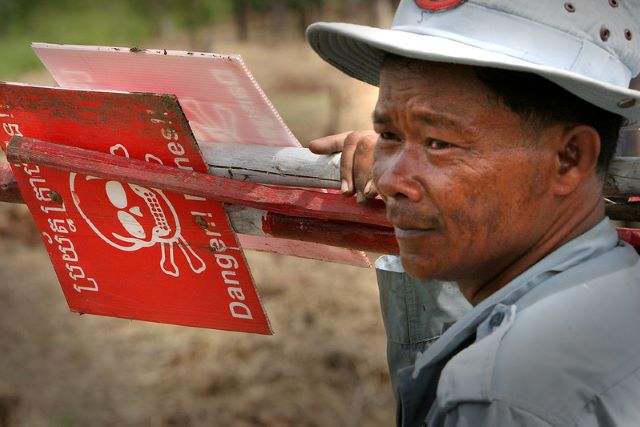
 The threat of stepping on landmines understandably leaves communities in fear of utilizing valuable farmland, traveling freely to school or rebuilding after conflict. Landmines affect impoverished communities significantly more than others as it is often the poor who are pushed into these dangerous areas. A landmine-free world is the goal of several organizations.
Landmine Policies and Campaigns
In 1997, the problems associated with landmines rose to international attention when Princess Diana walked through a minefield in Angola. Shortly after, the Ottawa Treaty was signed by 122 countries. As the most exhaustive measure for prohibiting landmines and the trade and clearance of them, the treaty has since led to clearance in 33 countries and the destruction of 51 million stockpiled landmines. Still, 58 countries remained contaminated, which is the fact that sparked the Landmine Free 2025 campaign. As of 2020, countless charities continue to work toward a world where no one has to live under the fear that a single step could kill them. Organizations and programs have formed to help make the world a landmine-free place to live.
The HALO Trust
Working across 26 territories and countries, this once small charity has grown into a top landmine-clearing organization since its founding three decades ago. HALO’s history began after the collapse of the Soviet Union in 1988 when troops were pulled out of Afghanistan leaving behind explosives that killed thousands of refugees. Guy Willoughby, Colin Mitchell and Susan Mitchell saw the devastation unfolding in Kabul and established HALO to clear landmines and allow humanitarian aid to access the region.
Through its partnerships, HALO has greatly expanded its capacity to make the world landmine-free. The organization creates jobs in the communities it works in and provides skill-building opportunities for women through projects like 100 Women in Demining in Angola, a program that trains and employs all-women clearance teams. Likewise, concerned with landmines’ ecological impact, HALO works with partners to rehabilitate habitats such as the Okavango Delta. Clearing the southwest minefields in Angola, it supports National Geographic’s Okavango Wilderness Project, which will protect the headwaters that provide water for hundreds of thousands of Africans.
In the 2019/2020 fiscal year, HALO cleared 11,200 hectares of land, a 28% increase from the previous year. An example of the organization’s dedication is the clearance of the Site of the Baptism of Christ on the River Jordan. In April 2020, after four years of work, worshippers were able to return to this holy site for the first time in 50 years. HALO does much more than clear mines, it enriches the lives of communities and allows for healing after violent conflict.
Mines Advisory Group (MAG)
MAG is the response to horrific first-hand experiences witnessed by British Army engineer, Rea McGrath, during his NGO service in Afghanistan. As a promise to a young boy who had been “absolutely shattered” by a Soviet-laid mine, McGrath founded MAG in 1989 to educate the world about landmine issues and mobilize governments to respond. It is renowned as the first landmine-clearing organization to create community liaisons as a way of understanding levels of contamination.
The devastating truth is that almost half of all victims of landmines are children. To combat this, MAG provides educational sessions for children, to teach them how to recognize mines, what to do in emergencies and alert them of the areas of contamination. Beyond that, MAG continuously supports those injured by mines, like Minga who was blinded and dismembered at the age of six. Now a paid intern, she explains that teaching risk education classes, “made me feel important in our community.”
Across 68 countries, MAG has helped 19 million people to date. The organization actively responds to crises such as the 2009 conflict in Gaza and the ISIS/ Daesh Insurgency of 2014. In 2019 alone, MAG cleared 101,031 landmines and unexploded devices, which released 9,711 hectares of land. MAG’s work shows the organization’s commitment to a landmine-free world.
Odyssey2025 Project
Not a charity, but a one-of-a-kind project with the goal to accelerate landmine clearance through the use of drones, innovative survey methods and low-cost, accessible technology. Odyssey2025 is intended to compensate for the timely process of scoping minefields by enabling teams to initially fly drones over hazardous areas.
Recently awarded a million-dollar prize for its humanitarian work in Chad, the project was applauded for its breakthroughs in infrared data that enabled teams to locate over 2,500 buried landmines, a feat never before accomplished with drones. To achieve a landmine-free world by 2025, Odyssey2025 intends to continue capacity building in order to export its projects to other countries.
– Anastasia Clausen
Photo: Flickr

How Private Sector Jobs Can End Poverty
The Role of the Private Sector in Poverty Reduction
It is crucial that the private sector takes responsibility for providing jobs, even in situations that require extensive training and infrastructure, as an investment in people living in poverty will lead to competition within the market as well as exponential growth within the company. The Global Impact Sourcing Coalition (GISC) created a toolkit to provide private sector companies with the skills and knowledge necessary to reduce poverty through employment. This toolkit outlines the benefits of workplace inclusion for people living in extreme poverty, not only from an economic standpoint but as a social responsibility as well. Outlined in the toolkit is the importance of networking and creating opportunities for people to fight poverty.
Microlending as a Poverty Reduction Tool
The Foundation for Economic Education (FEE) prioritizes microlending from the private sector as a source of poverty alleviation. Microlending is the act of loaning out very small amounts of money to self-employed individuals living in developing countries by banks and institutions. The FEE highlights a famous example of this, Grameen Bank, founded by Muhammed Yunus in Bangladesh in 1983. The Grameen Bank makes loans of $30 to $200 per person and has been able to reach millions, majority of whom are females who use the money to buy supplies in order to make and distribute their products. This is just one example of private sector work being done to connect people with limited access to resources to the job market and create opportunities.
Social Impact Matters
Traditionally, poverty has been a focus of governments rather than private companies and institutions, however, recently, partnerships between these two have been sought as the U.N. Sustainable Development Goals are focused on poverty alleviation. These partnerships between governments and private organizations are focused in areas of development, education, health, agriculture and climate change, all of which prioritize private sector jobs to fight poverty. One motivation for the private sector to participate in expanding its labor force to vulnerable communities is that of reducing reputational risks and beneficial brand awareness. PYXERA Global looks into the opportunities provided by public-private partnerships through the lens of economic development and explains that customers are now more than ever likely to consider the social impact of a specific company when it comes to purchasing products.
Social Responsibilities of the Private Sector
In order for private sector jobs to fight poverty, it is essential that organizations and corporations take social responsibility to invest in vulnerable populations that will lead to long-term positive impacts for the global economy. Strategies to employ impoverished communities in the private sector workforce have already been put in place and will continue to be essential in both alleviating poverty and expanding the global economy.
– Caroline Pierce
Photo: Flickr
Tackling Elderly Poverty in Malta
The Current Situation in Malta
Malta’s elderly poverty rate is higher than the EU average of 21%. Malta recently increased its 2008 median income to supposedly lower the poverty rate, but it did the opposite. The same result became true for Malta’s GDP. The country experienced a higher-than-average GDP growth over the past few years; however, poverty grew with it. This has been shown to significantly impact working populations but not so much the elderly population, thus making elderly people less vulnerable to poverty.
There is also a bit of a gender gap in terms of at-risk poverty for the elderly in Malta. About 20% of elderly women in Malta are at-risk of poverty whereas 15% of men are at risk of poverty. However, the gender gap in Malta is lower than the EU average by a few percentage points.
There is also severe material deprivation in Malta but the rate is not high enough to make a significant impact. Material deprivation occurs when a person cannot afford things that are desired or necessary for everyday life from utilities to annual holidays to household goods like a washer or a car. Material deprivation is measured under nine categories. If someone cannot afford three things from the nine categories, the person suffers from material deprivation. If someone cannot afford four things under the nine categories, the person suffers from severe material deprivation.
Malta’s rate of severe material deprivation has decreased over the years from more than 10% in 2014 to about 4% in 2016. This is possibly due to the rise in median income as well as a drop in unemployment. It could also be due to the rise in pensions and benefits for the elderly over the years.
What the Maltese Government is Doing to Combat Elderly Poverty
The National Strategic Policy for Poverty Reduction and Social Inclusion is one measure to tackle elderly poverty in Malta. The policy is based on six categories vital for the well-being of people and aims to combat high poverty levels. The categories include income and social benefits, employment, education, health and environment, social services and culture. The strategic actions act as a safety net on a preventative and interventionist level.
Government-funded programs and policies involving pension funding and benefits for the elderly also help to tackle elderly poverty. One program is the Full Pension Entitlement program. This program is for elderly people still working at their retirement age. Since the program’s introduction in 2014, more than 10,000 people have benefited from the program.
Another program is the Senior Citizen’s Grant. This grant gives out a €300 annual allowance for people older than 75. This grant has helped almost 30,000 people. The government also gives out bonuses to retirees who do not have pension entitlements. These bonuses help more women than men and have benefited more than 12,000 people in 2016. Finally, the government created the Draft National Strategy for Retirement Income and Financial Literacy. This draft aims to educate people on the importance of planning people’s retirement early as well as establishing campaigns to assist people in making wise financial choices for retirement.
Older generations in Malta may not be as vulnerable as the working class or young people, but elderly poverty is still an issue in Malta. With these new policies and programs aiming to help elderly people in Malta, there is hope to eradicate elderly poverty and improve the quality of life for the elderly population in Malta.
– Jackson Lebedun
Photo: Flickr
The Future of Food Systems Around the Globe
Population Growth in Africa
Global population growth does not imply an equal or even proportional increase in every region of the world. The population of sub-Saharan Africa, for example, is estimated to double by 2050, from approximately one to two billion. This number accounts for half of the global population growth expected. Such substantial growth in a population already experiencing food insecurity, if not coupled with sustainable food system developments, will exacerbate the issue and make advancement more difficult.
Facets of Food Security
Increasing demand for food is not the only threat to the future of food systems around the world. The cultivability of land is changing with the climate, requiring workers in the agriculture sector to adjust crop selection and techniques. Instability in the industry detracts from the appeal of such an occupation and further strains the food supply.
Many producers of food are among the hardest hit by the effects of food insecurity. In India, 41% of the workforce falls under agriculture, yet the country is home to the largest number of people experiencing hunger in a single nation — approximately 189 million. With the food supply responsibility falling on some of the most at-risk populations, food systems are even more vulnerable when confronted with adversity.
The COVID-19 pandemic is an example of adversity faced by food systems. Limits put in place to prevent further spread of the virus weaken the agriculture sector of the workforce and economy. This stress on food systems extends to the global economy, education, peace efforts and human rights, among others.
The Decade of Action
Just 10 years remain to meet the United Nations’ 17 Sustainable Development Goals (SDGs) by 2030. The second SDG necessitates improvements in food security, nutrition and agriculture across the globe, marking the next 10 years as the Decade of Action. The 2021 U.N. Food Systems Summit (UNFSS) has been planned to foster discussions of global challenges, priorities, opportunities and solutions in the food system sector, hopefully resulting in unified and inclusive efforts toward achieving the SDGs. In a lead up to the 2021 UNFSS, 13 organizations collaborated to host the two-day Bold Actions for Food as a Force for Good event in November 2020.
Food System Innovations
Along with the need to shift toward more sustainable consumption, gender-equity in food systems, agricultural innovations and financing for solutions, the Bold Actions for Food as a Force for Good event emphasized the importance of novel approaches to reducing extreme hunger with the Food Systems Innovation Challenge. In this challenge, teams of students from 20 universities proposed innovative ideas to transform the future of food systems. Solutions proposed by these teams include online systems connecting producers and consumers to keep all facets of the food market current on need and capacity. Apps and food labels to provide guidance on reducing food waste and making more sustainable dietary choices as well as food packaging that minimizes waste and carbon footprints formed part of these solutions.
A Sustainable Future
Projections for global population growth alongside new challenges stemming from climate change and COVID-19, make food security a top concern. By promoting the now-underway Decade of Action, the U.N. is leading unified efforts to establish sustainable and equitable food systems worldwide. Progress will depend on effective mobilization, collaboration and innovation— the backbones of development toward more stable food systems.
– Payton Unger
Photo: Flickr
SunBox Solar Kits Bring Cheap Electricity to Gaza
Electricity in Gaza
One diesel power plant produces almost all electricity for Gaza but it is not able to produce enough electricity to power the region at all times. Because of restrictions on exports and imports in Gaza, the plant only has access to a restricted amount of imported fuel. As a result, it has been forced to implement a system of rolling blackouts. According to SunBox founder, Mashhawari, hospitals in Gaza receive 10 hours of electricity a day, which the hospitals can afford to supplement with private generators. Everyone else lives on three to five hours of electricity a day unless they can pay for a generator.
If people in Gaza had reliable access to electricity, they would be able to cook, refrigerate food, run businesses effectively, access the internet and study after dark. The first two activities boost health, while the latter three increase earnings and success. Access to electricity has a strong impact on reducing poverty.
SunBox Solar Kits
SunBox solar kits could be the key to ending Gaza’s electricity crisis. SunBox has provided solar energy for 300 families since the company’s launch two years ago. Its solar kits have produced 600,000 watts of energy so far. As a small business, it employs 35 people, helping to combat Gaza’s high unemployment rates.
SunBox solar kits consist of one or two solar panels, a battery and a solar device. The panels are attached to the roof of a building and the solar device provides internet access and a plug-in for electrical devices. These kits provide 1,000 kilowatts of solar energy to consumers in a region where most days are sunny. The battery typically takes only three hours to recharge fully.
Business-wise, SunBox has profited from its “sharing is caring model.” People who cannot afford to pay for the $350 kits can buy the kit with other families, sharing the costs and the electricity. SunBox has also installed kits at desalination plants, helping to power the creation of clean water.
Female Entrepreneur: Majd Mashhawari
SunBox is the brainchild of Mashhawari, who understands the need for better electricity in Gaza because she grew up there. The territory began conducting electrical blackouts when she was 12. Mashhawari went on to attend the Islamic University of Gaza, where she majored in civil engineering. She has put her degree to good use, developing two products so far that help tackle Gaza’s unique infrastructure needs. These products are GreenCake and SunBox.
Mashhawari’s first product, GreenCake, was a building block made from ash and rubble. The Israel-Hamas war in 2014 had damaged many buildings in Gaza and rebuilding was difficult because of limits on cement imports. Mashhawari saw the need for cheap building materials that could be made from domestically available substances. Her team conducted experiments, eventually designing a cheap, durable building block made from ash and rubble, two elements that were abundant in Gaza. After her success in launching GreenCake in 2016, Mashhawari went on to create SunBox in 2018.
Mashhawari’s work has come to wider attention because of a TED Talk she gave in 2019 about her inventions. During her TED Talk, Mashhawari touted the success of her products and the need to find creative solutions to difficult problems. She also recalled that when she attended university, her school’s civil engineering program had a female-to-male ratio of one to six. Mashhawari stressed her devotion to supporting other female scientists, proudly describing how SunBox was hiring and training both female and male engineers.
Local Inventions Address Poverty
Mashhawari’s products show the inventiveness of local entrepreneurs and their ability to create solutions that are tailored to their region. She developed her products to address the specific needs of her fellow people, granting them a better way of life. Her designs are cheap and environmentally friendly and because of her dedication to hiring female engineers, her company supports female education and economic empowerment. In the fight against global poverty, it is encouraging to be reminded that there are locally developed, environmentally friendly and cost-effective solutions.
– Sarah Brinsley
Photo: Flickr
Programs Ensuring a Landmine-Free World
Landmine Policies and Campaigns
In 1997, the problems associated with landmines rose to international attention when Princess Diana walked through a minefield in Angola. Shortly after, the Ottawa Treaty was signed by 122 countries. As the most exhaustive measure for prohibiting landmines and the trade and clearance of them, the treaty has since led to clearance in 33 countries and the destruction of 51 million stockpiled landmines. Still, 58 countries remained contaminated, which is the fact that sparked the Landmine Free 2025 campaign. As of 2020, countless charities continue to work toward a world where no one has to live under the fear that a single step could kill them. Organizations and programs have formed to help make the world a landmine-free place to live.
The HALO Trust
Working across 26 territories and countries, this once small charity has grown into a top landmine-clearing organization since its founding three decades ago. HALO’s history began after the collapse of the Soviet Union in 1988 when troops were pulled out of Afghanistan leaving behind explosives that killed thousands of refugees. Guy Willoughby, Colin Mitchell and Susan Mitchell saw the devastation unfolding in Kabul and established HALO to clear landmines and allow humanitarian aid to access the region.
Through its partnerships, HALO has greatly expanded its capacity to make the world landmine-free. The organization creates jobs in the communities it works in and provides skill-building opportunities for women through projects like 100 Women in Demining in Angola, a program that trains and employs all-women clearance teams. Likewise, concerned with landmines’ ecological impact, HALO works with partners to rehabilitate habitats such as the Okavango Delta. Clearing the southwest minefields in Angola, it supports National Geographic’s Okavango Wilderness Project, which will protect the headwaters that provide water for hundreds of thousands of Africans.
In the 2019/2020 fiscal year, HALO cleared 11,200 hectares of land, a 28% increase from the previous year. An example of the organization’s dedication is the clearance of the Site of the Baptism of Christ on the River Jordan. In April 2020, after four years of work, worshippers were able to return to this holy site for the first time in 50 years. HALO does much more than clear mines, it enriches the lives of communities and allows for healing after violent conflict.
Mines Advisory Group (MAG)
MAG is the response to horrific first-hand experiences witnessed by British Army engineer, Rea McGrath, during his NGO service in Afghanistan. As a promise to a young boy who had been “absolutely shattered” by a Soviet-laid mine, McGrath founded MAG in 1989 to educate the world about landmine issues and mobilize governments to respond. It is renowned as the first landmine-clearing organization to create community liaisons as a way of understanding levels of contamination.
The devastating truth is that almost half of all victims of landmines are children. To combat this, MAG provides educational sessions for children, to teach them how to recognize mines, what to do in emergencies and alert them of the areas of contamination. Beyond that, MAG continuously supports those injured by mines, like Minga who was blinded and dismembered at the age of six. Now a paid intern, she explains that teaching risk education classes, “made me feel important in our community.”
Across 68 countries, MAG has helped 19 million people to date. The organization actively responds to crises such as the 2009 conflict in Gaza and the ISIS/ Daesh Insurgency of 2014. In 2019 alone, MAG cleared 101,031 landmines and unexploded devices, which released 9,711 hectares of land. MAG’s work shows the organization’s commitment to a landmine-free world.
Odyssey2025 Project
Not a charity, but a one-of-a-kind project with the goal to accelerate landmine clearance through the use of drones, innovative survey methods and low-cost, accessible technology. Odyssey2025 is intended to compensate for the timely process of scoping minefields by enabling teams to initially fly drones over hazardous areas.
Recently awarded a million-dollar prize for its humanitarian work in Chad, the project was applauded for its breakthroughs in infrared data that enabled teams to locate over 2,500 buried landmines, a feat never before accomplished with drones. To achieve a landmine-free world by 2025, Odyssey2025 intends to continue capacity building in order to export its projects to other countries.
– Anastasia Clausen
Photo: Flickr
Poverty Reduction: Farming Innovations in Japan
Farming Innovations in Japan
There are several innovations to take note of that have eased the labor intensity and climate impact of farming in Japan, such as heat-resistant varieties, delayed transplanting and specialized application of fertilizers, to combat both climate change and poverty in the face of a potentially grave water and food shortages.
Japan Today, an esteemed magazine based in Japan, also highlights the main goal of this growing agri-tech business as a collaboration between experts, advanced farmers and younger generations to create permanent, sustainable solutions and share knowledge about the most efficient farming techniques. “The valuable experience and techniques of veteran farmers could also be more accessible to newer farmers via the web,” explains writer Allen Croft, “such as learning resources about harvesting times with databases and photos.”
Factors Affecting Farming in Japan
Not only do these farming innovations in Japan help to alleviate poverty in vulnerable communities but they also fight climate change issues by directly limiting water and fertilizer usage and combatting overproduction. Climate change has caused tension in the agricultural world of Japan, as unpredictable water levels cause heightened food prices, specifically in terms of rice production. Several other factors are contributing to pressure on Japan’s farming industry, including a decline in labor force participation as fewer young people are becoming farmers as well as Japan’s reliance on food imports.
These new technological farming innovations in Japan are working to alleviate the problems outlined above and are bringing new uses to AI and loT technology in a way the farming communities have never seen before. Through data analysis and observation of traditional farming structures, farmers can maintain exact water measurements and maximize soil fertility in order to maintain consistent crop growth. The main goal of these digital solutions to farming in Japan is to create permanently sustainable agricultural practices for generations to come.
The Japan Social Development Fund
Specifically from the standpoint of poverty alleviation, the World Bank has implemented a project, the Japan Social Development Fund, that aids impoverished communities while focusing on education, adaptation to climate change, health and sanitation services as well as environmentally sustainable agricultural practices. While most vulnerable communities in Japan do not have access to the digital technology innovations that farmers have developed, a social shift towards awareness of water usage has allowed farmers with limited resources to implement certain practices.
The Future of Digital Agriculture
There are a variety of growing measures set in place to make the agriculture business in Japan more sustainable in the face of both climate change and poverty. Digital agriculture is growing at an immense rate and it is predicted that the global market, specifically for agricultural robots, will reach $73.9 billion by 2024, which will vastly change the structure of food production and the labor force. The scope of digital farming innovations in Japan is broad and could potentially create a basis for agriculture in other countries struggling with water and food shortages as well.
– Caroline Pierce
Photo: Flickr
Bridging the Digital Gender Gap
Safaricom
In Kenya, women are 39% less likely than men to have access to mobile internet despite women making up 51% of the Kenyan population. Safaricom, a mobile network in Kenya, therefore created a partnership with Google to offer an affordable smartphone, the Neon Kicka with Android GO, compromising 500 megabytes of free data for the first month. The mobile network believes that empowering a woman empowers an entire community and focuses on the following three barriers: affordability, relevance and digital skills. The company ensured that the price point was the lowest it could be and featured important content including access to health information and educational content to highlight the smartphone’s daily relevance for women. Safaricom recognizes that many women are not familiar with Gmail accounts and therefore developed a guide covering the basics of smartphone use.
Novissi
Togo, a country in West Africa currently run by its first female prime minister, launched a digital cash transfer program called Novissi. Its goal is to provide aid to informal workers during the COVID-19 pandemic, covering residents of three urban areas under lockdown. Many underserved women tend to be excluded from COVID-19 relief digital cash transfer programs launched by governments since they either do not have access to digital bank accounts or are uninformed. Through Novissi, women receive a monthly sum of $20, whereas men receive $17, to support the cost of food, communication services, power and water. The three additional dollars allocated to women account for the fact that women are more likely to be informal workers and take care of a family’s nutritional needs.
Wave Money
In Myanmar, Wave Money has become the number one mobile financial service, with 89% of the country benefiting from its agents. Since Wave Money deals with 85% of rural areas in the country, money enters and leaves from nearly every state and facilitates familiarity with the service. The financial service created a partnership with GSMA Connected Women to allow greater access to financial services for women. Through this partnership, women are encouraged to run Wave Money shops in Myanmar, providing them with extra income even if they live in very remote areas of the country.
Telesom Simple KYC Account
It can be challenging for women to acquire the identity documents necessary to open accounts with service providers. In Somaliland, Telesom created a simplified know-your-customer (KYC) account, allowing women that do not possess an ID to sign up for mobile money services. The service solely requires a name, date of birth, image and contact details, favoring accessibility and reducing the digital gap between women and men.
Equal Access International Partnership with Local Radio Station
In Nigeria, women and girls are denied access to technology due to the fear of moral decline that accompanies the widespread culture. Equal Access International recognizes the need to address societal norms for women and amplify women and girls’ voices. In an effort to do so, Equal Access International partnered with a local radio station in order to create a show that tackled cultural taboos and promoted women and girls using digital technologies. The episodes last 30 minutes and cover weekly themes including common misconceptions about the internet, internet safety and moral arguments regarding women and the internet.
Closing the Digital Gender Gap
Despite a digital gender gap that exists between women and men, organizations around the world are making an effort to foster a sense of inclusion and empowerment for women and girls to become familiar and encouraged to take on the digital world that is constantly emerging.
– Sarah Frances
Photo: Flickr
Modern-day Maya Artisanal Weaving
At the turn of the 11th century, war disrupted the mighty rule of the Mayas. Unfortunately, after centuries of dominance, the Maya culture fell into disrepair. Furthermore, what was left of the civilization was decimated through conflict and epidemics brought by Spanish colonizers a few centuries later. In 1960, the Guatemalan Civil War began, during which the Guatemalan government attempted to exterminate the Maya culture through savage village bombings and genocidal executions. Of the 200,000 people who died amidst the war, 95% were Maya. This article discusses the modern-day history of the Maya and highlights a group of women practicing their culture and making a living with Maya artisanal weaving.
Modern Day Marginalization of the Maya
Thankfully, the Maya people have survived their tragic near-extinction. However, the Maya continue to face marginalization. Most of the poorest families in Guatemala are Maya families; the average Maya family has eight children, making necessities costly. Generally, these indigenous families remain in isolated, rural areas and receive very little government aid for medical care and quality education. Throughout Guatemala, there is a 60% drop off between the attendance rates of primary and upper secondary school. This statistic is even more drastic for Maya students. While teachers speak Spanish, most ethnic Maya children speak one of the twenty Mayan dialects. This additional obstacle contributes to these early dropouts. Unfortunately, many Maya children also drop out before the end of primary school.
Connecting Maya Artisanal Weaving with Global Markets
The Ancient Maya created a complex weaving machine. Modern-day indigenous crafts-women and men still employ this machine, working to combat endemic poverty in the region of Panajachel, Guatemala. Today, the backstrap loom, foot pedal loom and needlepoint hand-embroidery create the bold cloth which tourists and global shoppers adore. Hiptipico is a company that connects these works of art with the global market. Founded in 2012, Hiptipico, a certified B-Corps company, aims to preserve and develop Maya communities through sharing and protecting their cultural practices. The company’s namesake “tipico” comes from the Spanish word for the traditional clothing of the Maya.
Artisans Earn Fair Wages and a Global Platform
The artisan weavers that work with Hiptipico are small business owners, as well as the Quiejel and Chontala Weaving Cooperatives. Maintaining close relationships with these individuals and small cooperatives of women weavers allows Hiptipico to maintain fair wages when pricing products for the global market.
Socially-conscious shoppers can purchase a wide variety of products from Hiptipico’s fashion line including woven greeting cards, camera straps, bags, totes, and face masks; all available in brightly colored, hand-woven patterns. Production of each Hiptipico product is incredibly time-intensive. A camera strap can take anywhere from 3 days to 3 weeks to complete. Nevertheless, purchases provide a stable income for the artisans. The high-quality merchandise of Guatemala’s indigenous artisans has brought Hiptipico attention from all over the fashion industry. For instance, Hiptipico has organized collaborations with large brands such as Free People. By earning fair, stable wages and establishing a global platform, artisans of Hiptipico are empowering themselves and celebrating their culture.
– Tricia Lim Castro
Photo: Flickr
Supporting Smallholder Coffee Farmers in Developing Countries
Farmers Below the Poverty Line
Even in the best conditions, one-third of farmers earn less than $100 per year from growing coffee and 60% of the world’s coffee is produced by farmers with less than 12.35 acres of land. Challenges arising from inefficient production methods and profiteering coffee roasting companies make it difficult to earn a living. Of the 12.5 million smallholder coffee farmers worldwide, an estimated 5.5 million exist below the international poverty line.
Coffee farmers face many obstacles, including the low international price of coffee. According to Oxfam, some farmers have little to no power to negotiate with traders and must accept the low prices offered. If farmers process their coffee by removing its outer layer, they can demonstrate their beans’ quality and negotiate a higher price. But, if their coffee is sold in its original form, they must settle for a lower price. In Peru, even with semi-processed beans, farmers are still short-changed. And while traders make extra profits for themselves, coffee roaster companies in the United States and Europe make even larger margins.
Smallholder Coffee Farmers Need Support
In the Andean region and across Central America, approximately 750,000 smallholder farmers produce coffee and cacao. Often these farmers depend on limited water resources, which are barely enough to grow subsistence crops. Low incomes result in malnutrition, minimal educational opportunities and disease. Quechua-speaking communities as well as Amazonian Indigenous communities receive little support from the government, and therefore, lack agricultural technology. This dearth of opportunity perpetuates poverty.
Maximizing Opportunities in Coffee and Cacao in the Americas (MOCCA) is working to help smallholder coffee farmers efficiently produce more coffee and cacao. Funded by the United States Department of Agriculture’s Food for Progress Program, MOCCA is carried out by a consortium led by TechnoServe, a nonprofit organization operating in 29 countries. MOCCA also partners with World Coffee Research and Lutheran World Relief.
MOCCA’s Initiatives to Aid Smallholder Coffee Farmers
MOCCA works to improve the lives of more than 120,000 coffee farmers in Guatemala, El Salvador, Honduras, Nicaragua, Ecuador and Peru. It enables farmers to make much-needed improvements while addressing the underlying problems that prevent their farms from becoming profitable.
MOCCA’s goals include:
In addition, MOCCA works to integrate young people and women into coffee and cacao market systems, so that these systems are more inclusive.
In February 2020, the National Coffee Association, the leading trade organization for the coffee industry in the United States, named TechnoServe the “Origin Charity of the Year.” This award recognizes the company’s work in supporting smallholder coffee farmers around the world.
– Sarah Betuel
Photo: Flickr
Cash for Cows: Livestock Wealth in South Africa
Apartheid and Poverty
Under the apartheid regime, the minority-white government passed policies aimed at keeping black South Africans, who made up a majority of the population, from having any meaningful participation in the economy. This left millions trapped in cycles of poverty and the residual effects of such discriminatory policies are still being contended with, in the effort to reduce poverty today.
Apartheid laws confined poor South Africans to rural regions and made the migration to urban areas difficult. The lack of opportunities and social mobility in rural areas made overcoming poverty a challenging task. The legacy of this limited mobility is still present today. South African provinces in rural areas have more households in chronic poverty compared to urban provinces. As of 2015, 25.2% of the population of urban areas lived below the upper-bound poverty line (UPBL), whereas 65.4% fell below the UBPL in rural areas. In order to reduce poverty, it is most important that rural communities receive support and investment.
Livestock Wealth
Livestock Wealth is a startup founded in 2015 by Ntuthuko Shezi which aims to provide investment for farmers in South Africa’s rural areas. Livestock Wealth allows investors from anywhere in the world to effectively purchase from South African farmers four different livestock and crop options: a free-range ox, a pregnant cow, a connected garden or a macadamia-nut tree. When the cows or the crops are sold, both the farmer and the investor receive a share of the profit.
Livestock Wealth currently has 58 partner farmers all across the country and all cows are hormone-free and grass-fed. In recent years, its business has expanded to also provide meat for investors who join the “Farmers Club.” There are currently more than 2,800 investors with Livestock Wealth and more than $4 million has been invested.
Alleviating Poverty in South Africa
Livestock Wealth is a representation of an initiative that has great potential to alleviate poverty in South Africa. South Africa’s rural populations have a long history of exclusion from the economy and have struggled to reduce poverty for decades. Livestock Wealth provides cash investments for farmers and creates a market in which they can reliably trade. By doing so, the firm exemplifies an innovation within the South African economy, one which is helping to alleviate poverty and can inspire others to do the same.
– Haroun Siddiqui
Photo: Flickr