The Republic of Indonesia, the Dutch East Indies until its independence in 1949, is a Southeast Asian archipelago (17,500 islands, 60% of which are inhabited, with over 40% of the population living in rural areas). Southeast Asia’s largest and most populous country, Indonesia, is the fourth most populous country in the world (281.19 million in 2023), with a population extremely diverse in terms of ethnic groups (300), languages (600+) and religions.
Right to Education
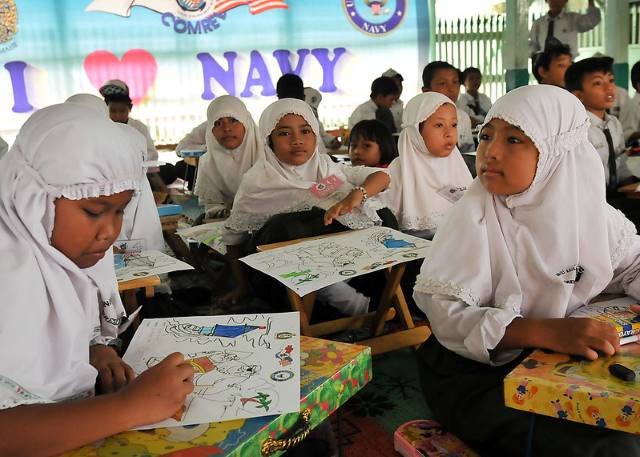
Indonesia’s emphasis on education dates to independence and by the early 21st century, the great majority of Indonesians were literate. The country’s national education system mandates compulsory education for the first six years of primary education and the first of two three-year blocks of secondary education. Tertiary education comprises dozens of public institutions and thousands of private schools. Primary schools are primarily public (93%), but private schools comprise more than half (56%) of junior secondary schools and two-thirds (67%) of senior secondary schools.
Article 3 of Indonesia’s constitution declares the right to education for citizens, as well as the government’s obligation to fund a national system of education at a minimum of 20% of the state and the regional budgets.
Current Status of Education
The World Bank in 2014 reported on the enormity of the Indonesian school system—a quarter of a million schools, 2.6 million teachers, 50 million students—the fourth largest education system in the world, behind the United States, India and China.
By the 2022-2023 academic year, there were 400,000 schools in Indonesia, the majority being primary schools. In 2022, total government spending on education as a share of GDP was 0.9%, and in 2023, it was less than 0.1% on primary education, placing Indonesia in the lowest few of all countries ranked.
Nevertheless, some recent key indicators are strong: literacy rate, 96% (2020); primary school completion rate, 101.92% (2023); secondary school enrollment, 97.17% (2023); tertiary school enrollment, 45.14% (2023). Still, the average years of formal education for individuals aged 15-64 was only 9.1 years in 2020, putting it at 88 out of 153 countries ranked.
Education Challenges . . . and Controversy
Sustainable Development Progress. The U.N.’s Sustainable Development Report classifies Indonesia’s progress on SDG 4, Quality Education, as “challenges remain.” Participation rate in pre-primary organized learning needs to increase, although trends are on track for maintaining SDG achievement for net primary enrollment rate, lower secondary completion rate and literacy rate.
Quantity versus Quality. After independence, there was a surge in school construction, followed by a shift toward educational decentralization. Decentralization has advantages, but led to uneven capacity over the country’s 500 districts, with excellence in urban areas as compared to the remote districts. One observer has suggested a multi-pronged approach to refocus funding, professionalize teaching, update and modernize assessments.
Education versus Free Meals. In February 2026, the Indonesian government moved nearly a third of the education budget to the Free Nutritious Meals program, affecting the pay of civil servants and honorary (temporary) teachers. Critics noted that those funds had been targeted for education and should be used for student scholarships and salaries of both contract and honorary teachers, already subject to late and low salary payments.
In March, a coalition of teachers and civil society groups, along with the Save Indonesian Education Coalition, filed a judicial review of the allocation (over $19 billion) to the free meals program taken from the education budget. It was estimated that this would reduce the allocation to the education sector by two-thirds, with student scholarships to receive only a little over $3 billion and teachers receiving $5.5 billion. The evidence from global programs is clear, it is argued: school feeding improves attendance and can boost nutrition, but it is not a substitute for foundational teaching, teacher training and curricular clarity.
Meeting the Challenges?
RISE, the Research on Improving Systems of Education Programme, a “global research endeavor” determined that Indonesian students were not gaining basic, foundational skills—over 60% of high school graduates with third grade or lower mathematics competence. This was due in part to half of its teachers being unable to pass a teaching competence test. The RISE country research team worked to address these issues by engaging the communities and providing incentives for instructional time and accountability, 2019-2023.
The Republic of Indonesia will celebrate 100 years of independence in 2045, and Indonesia’s Golden Vision 2045, published in 2020, set out the country’s aims for the next few decades. The Golden Vision acknowledged the country’s low learning outcomes compared to peers and called for “deliberate actions” to address this. Actions include increasing funding overall, increasing access to early childhood education, improving secondary education attendance and increasing accountability and service delivery of teachers.
One specific target of the Golden Vision is the development of digital talent so that the work force keeps pace with evolving technology and the growing demand for digital skills, which is now a focus of education and training programs. Indonesia’s commitment to the Golden Vision over the next two decades may determine its success in meeting the current educational challenges.
– Staff Reports
Photo: Flickr

Examining Women’s Rights in Egypt
Currently governed under Islamic Law as Egypt’s amended Constitution states, religion plays a major role within legislative policies. It has been a debate for several years as to whether the decline in women’s protection in Egypt is due to religious laws or the current socioeconomic environment. In order to approach the complexities of modern-day Egyptian society and women’s rights in Egypt, one must first understand the history of Islamic Law. Known for existing as more of an all-encompassing religion, Islam not only provides theological practices but also a way of living.
Islamic Law
Article 40 and 46 of Egypt’s present constitution explicitly states, “All citizens are equal before the law. They have equal public rights and duties without discrimination between them due to race, ethnic origin, language, religion or creed.” The second article of this same constitution declares “Islam is the religion of the state and Arabic is its official language. The principles of Islamic Sharia is the principal source of legislation.”
Many women in Egypt (and other predominantly Islamic regions) are facing a dilemma concerning their religious and basic freedoms. Because Egypt incorporates Islam even within legal policies, it somewhat discourages other religions. This is why the second-largest religious community is Christianity, comprising approximately only 5% of the Egyptian population.
Women’s religious and basic human rights greatly differ from men’s rights and social roles. An example of this may include the regulations in regards to a woman’s attire. The hijab as well as other head and body coverings was initially symbolic of modesty within the Islamic religion. Moreover, although the Qur’an very clearly addresses men alongside women when proclaiming rules of “guarding their modesty,” men do not have to participate in the wearing of head/face coverings.
As of recently, though, the practice of adopting body and face veils into a woman’s everyday appearance has evolved into more of a preliminary societal standard. Because scripture claims that women exposing themselves to any man unrelated to them (besides children) is a sinful act, women experience pressure to adorn these religious coverings in public just to prevent shame, which only further enforces this oppression.
Socioeconomic Factors
This brings up the debate attempting to answer whether the lack of basic human rights for women is due to the Islamic nature of Egyptian society, or society itself? Women are hesitant to go into public without these coverings because of societal and religious pressures, but the act of preserving their modesty exists now as somewhat of a precautionary measure, as well.
In several impoverished countries or regions of extreme poverty, the economy is the primary factor in societal normalities. Women’s rights in Egypt undergo frequent testing, especially in areas of extreme poverty within the country. Because of scarce job opportunities and the dilapidated financial state of certain areas, women frequently endure mistreatment. They often cannot challenge their social or religious roles or financially provide for themselves. Their husbands, neighbors and, in some cases, their relatives, use this to their advantage which results in the very common sexual harassment of women.
Because of the different roles of Egyptian men and women, the deterioration of women’s rights in Egypt and sexual harassment of women has been a prominent issue since at least the ‘80s (this was the beginning of the selective documentation of sexual harassment cases in Egypt). Although the Qur’an prophesizes the equality of men and women under God, others in Egypt sometimes see women as lesser than. In this case, the argument that socioeconomic factors are separate from religious practices and laws is valid.
Moreover, the United Nations conducted a census in 2013 revealing that an estimated 99.3% of women could encounter sexual harassment in Egypt. Meanwhile, another study concluded that about 86% of women reported that bystanders frequently ignore the aggression.
This demonstrates the frequency in which these dangerous acts happen in public. It is seemingly a social norm for women to not only have to uphold traditional religious roles but also to face arbitrary sexual aggression in public.
Solutions
As of 2014, however, Egypt is now addressing this violent aggression towards women. For the first time in Egyptian history, sexual harassers are undergoing prosecution and courts are holding them accountable. Egypt still requires more improvement, but more and more women are beginning to make others aware of this issue, even globally. The current economic state of Egypt is also developing. With an extreme poverty rate of 32% in 2018 and one of approximately 29% in 2020, Egypt is continuing to see a decline in extreme poverty.
The societal and religious pressures persist, but Egypt is generating more discourse to help bring more attention to the issue of women’s rights in Egypt. Moreover, the debate over religion is increasing along with the dismantling of unjust socioeconomic systems.
– Caroline Kratz
Photo: Flickr
Red Voz Pro and Mental Health In Mexico
The progress of psychology, medical intervention and social work is making mental health and illness awareness a necessary part of daily life. In Mexico, estimates have determined that 17% of the population has at least one mental disorder, with the expectation that one in four people could suffer from an ailment once during their lifetime. According to Plan Seguro, a health insurance provider, the financial and economic costs of mental illnesses in developing countries is equal to 4% of a country’s GDP. Red Voz Pro Salud Mental (VPSM), a nonprofit organization in Mexico, is doing its part to better serve the community and bring understanding and resources to those struggling with mental health disorders. Gabriela Cámara, psychologist and honorary president of Red Voz Pro, addresses the issues surrounding mental health in Mexico through education and the establishment of vital rehabilitation programs and facilities.
Combating Stigmas Around Mental Health
Red Voz Pro Salud Mental is a nonprofit network of organizations providing services for those suffering from mental illnesses in Mexico, as well as their families and professionals in the field. These resources range from establishing support groups and publicizing vital information on social media to providing psychoeducation of clients and promoting laws to the federal government. It also teaches the National Alliance of Mental Health’s Family to Family course and VPSM’s Land Ahoy course for patients. In an interview with The Borgen Project, Cámara contended that the most urgent challenge facing VPSM is “combating the stigma” that comes with mental illness. According to Doctor Medina Mora’s study at the National Alliance on Mental Illness, Mexico ranked second in the world in the level of stigma associated with mental health services. As a result, outreach is a crucial tool in Red Voz’s belt.
The biggest misconception regarding mental health in Mexico is the belief “that one gets better with cleansing or esoteric methods, or that it is the fault of the mother or family or the patient themselves.” This mythmaking, blame-casting idea affects a patient’s ability to get treatment, find employment and social interaction opportunities or disclose their concerns with family and friends. Red Voz Pro’s solution is one of publicity and support.
The Key is Education
Cámara insists that “through support groups, messages on social media and psychoeducation,” Mexico can overcome the stigma of mental illness. By eradicating stigma, the country can turn its focus to fostering a communal understanding of mental health and thus develop a greater ability to help those afflicted. Mental disorders among young people are almost twice as high in Mexico than in the U.S. and Canada. This likely mirrors poverty’s relationship with mental illness. Cámara points out, “lower-income increases the chance of family violence, stress, post-traumatic stress disorder, depression and suicide,” all of which one can combat with education.
Depression will be the second leading cause of disability in the world in the decade ahead and the first in developing countries, such as Mexico. The number of people experiencing mental health illnesses only continues to increase, putting the onus on learning how to recognize, accept, investigate and nurture the thoughts and feelings that one may associate with malaise. While education might appear the trite and oversimplified solution to mental health in Mexico, Cámera asserts it is the way forward.
Institutional Organizations Help Support Mental Health
VPSM focuses on “uniting similar civil organizations with government programs, crisis hotlines, and rehabilitation facilities” as a means to serve its population. The need for comprehensive health coverage is a problem that Mexico, and other nations, face. “Approximately 40% of the population has no insurance,” says Cámara, leaving integral treatments underdeveloped and underfunded. Mexico is waiting to see if the current administration is willing to tackle these issues. Number six of Red Voz’s 13 “Objectives at the National Level” is to work with the federal health system to detect and prevent issues that arise from unidentified mental health problems. By giving an increased voice to nonprofit health services such as VPSM, the federal government can receive support from a caseload and transparency point of view.
Moreover, institutional restructuring and cooperation is a process that Cámara maintains is vital to help citizens get through these hardships. “Institutions must have programs of relapse prevention, support for families, people working to decrease suicide, etc.” Without these social nets, human beings lack adequate understanding of what they are going through and thus make struggle and despair an obvious pathway. VPSM aims to be there for Mexicans looking to steer back toward the road of recovery and community.
Red Voz Pro Salud Mental is consolidating an alliance between mental health networks in Mexico by promoting psychoeducation to improve the quality of life of those struggling with mental disorders. In a world where systems feel impervious to mental health, particularly in Mexico, this nonprofit stands out by valuing human-to-human management, supporting other civil organizations and understanding mental health disorders.
– Spencer Daniels
Photo: Flickr
9 Facts About Poverty in Samoa
Samoa, a small island country in the Pacific, struggles with economic issues like rising unemployment, an imbalance between rural and urban communities and vulnerability to natural disasters. Here are nine facts about poverty in Samoa.
9 Facts About Poverty in Samoa
These nine facts about poverty in Samoa illuminate how poverty has impacted the livelihoods of its citizens. However, through the work of humanitarian organizations in the country, Samoa can address poverty and create a more economically and socially empowered population.
– Philip Tang
Photo: Flickr
The Remarkable People of Zambia
Silumesii Maboshe – Co-founder of Bongohive
In 2011, Maboshe and his partners founded Bongohive with the objective to elevate the Zambian tech sphere to the next level. The organization functions as an incubator for tech startups throughout Africa but Maboshe has kept his focus on leveraging Bongohive’s operations to advocate and develop the ideas that serve to benefit Zambia in a capacity that goes beyond just the economic. “If I have one professional goal, it is the answer to this question. How can software and innovation change Zambia for the better?” Many of the 1300+ tech products that Bongohive has helped develop function to this end, one example being an app that allows constituents to comment on proposed changes in legislation. Beyond the development of products, the organization serves also as an open platform for techies seeking general advice and hosts dozens of events annually that pertain to technology and business within Zambian society. Maboshe understands that if Zambia is to realize a brighter future it must include a thriving tech culture. The invaluable role Bongohive is playing to that end cannot be overstated.
Christopher Malambo – Sanitation Activist
It is an issue that most are too uncomfortable to actively advocate for, but the fact is that approximately 90% of child deaths are attributed to poor sanitation and the spread of disease that is a result thereof. Additionally, the World Bank reports an annual monetary loss to the African continent of $5.5 billion as a result of poor sanitation. Malambo’s efforts directly combat these staggering statistics. The focus of his activism is toward the decreasing but still prevalent number of communities in Zambia that still practice open defecation. His first objective when entering a new village is education because many of the typical residents lack even a basic understanding of the importance of good sanitation and the adverse effects of a lack thereof. After demonstrating the danger inherent in open defecation, he then organizes and assists in the digging of latrines. Malambo’s unwavering selflessness and commitment to service in the name of saving lives represents the very best of what makes the people of Zambia truly remarkable.
Dorothy Phiri – Founder of Mercy Ministries
In 1996, Phiri founded Mercy Ministries in response to a higher calling. Today the organization works to provide education through the Chifundo Community School, which was the first project started by the Phiri’s. The organization especially focuses on orphans, disabled children and other vulnerable children who are unable to have their needs met by government-funded schooling. Additionally, Phiri provides a means for children of financially struggling families to attend school. Though Zambia does provide free schooling to all its residents, many families still struggle to fund basic schooling needs such as books and uniforms. In a region where the demands of maintaining a livelihood are prioritized over education, Phiri’s commitment to the people of Zambia aims to change the status quo.
These individuals and their stories are but a microcosm of the exceptionalism that defines the people of Zambia. With the efforts of Zambia’s exceptional people, the narrative of the entire region can begin to change for the better.
– Christian Montemayor
Photo: Flickr
AI-Run Vertical Farming in Agriculture
Vertical Farming
Through the current transitions made toward maximizing agricultural use of AI, farming today has already begun employing drones and smart robots to remove weeds or spread herbicides efficiently. Greenfield Robotics had already released different functional fleets active in certain farms. Now, Plenty utilizes similar technologies with robots harvesting and organizing plants in the vertical farming stations. Fundamentals such as water, temperature and light are systematically calculated and regulated through smart systems that prioritize a greater, faster and better crop turnout.
Benefits of AI-Run Vertical Farming
Through artificial intelligence, farmers are now able to adopt a more eco-friendly methodology. Robots and machine learning promote certain technologies such as tracking soil composition, moisture content, crop humidity and optimal crop temperatures. Despite the previous vertical farming history and cost-benefit analysis, modern-day AI-run vertical farming allows certain resources to be recycled, controlled and reused. This can be seen in AI-run water filtration systems that catch evaporated water from the farms or indoor energy renewal systems.
Alleviating Agricultural Issues
These innovations alleviate many issues that arise in agriculture and distribution. The most notable feat is the space that vertical farming saves in comparison to traditional farmland regions. Plenty’s vertical farm covers two acres and yields similar, if not better, harvest and product quality to that of a 750-acre flat farm. Plenty’s website expresses its greatest feat yet: “Imagine a 1,500-acre farm. Now imagine that fitting inside your favorite grocery store, growing up to 350 times more.”
Plenty also points out the freedom AI-run vertical farming brings to agriculture today. By being independent and self-sufficient with consistent sunlight, recycled water and a controlled environment, farming is no longer restricted to natural inconsistencies. Climate change and weather patterns do not determine the outcome of the produce, due to this new ability to control the necessary components to production. In light of COVID-19 and wildfires that breakdown supply chains, this factor prevents unprecedented shutdowns of essential services in agriculture.
AI-run vertical farming allows farms to exist within metropolitan sectors instead of weather-dependent regions. By having a closer source, distribution is more efficient leading to less CO2 emissions and dependency on preservatives. This method also allows cost reduction, since transportation, product cost and labor are reduced, which allows impoverished communities access to better produce.
The Future of AI-Run Vertical Farming
All things considered, this new innovative alternative brings a cleaner and more sustainable future for agriculture, whether it be in produce quality or carbon footprint. With Plenty’s ongoing environmental adjustments and technological updates, the organization continues to expand its service, with a $400 million investment capital from Softbank, Amazon CEO, Jeff Bezos and former Google chairman, Eric Schmidt. Plenty has also partnered with Albertsons to supply 430 stores in California.
– Linda Chong
Photo: Flickr
How Tourism in Latin America Reduces Poverty
Tourism in Latin America
From the beaches of Cuba to the Andes mountains in Peru, any traveler can find a destination of their preference. The most visited countries in Latin America are Mexico, Brazil and Argentina. According to the World Bank, more than 113 million tourists traveled to Latin America in 2018, bringing $103 billion worth of revenue. Tourism in Latin America has created more than 15 million jobs, which accounts for 7.6% of all employment. Furthermore, international tourism contributes roughly $348 billion to the GDP of the countries in the region.
Ecotourism in Costa Rica
According to the World Tourism Organization (UNWTO), Central America saw a 7.3% growth in its tourism sector, the biggest subregional growth in Latin America. Moreover, the country of Costa Rica has attracted millions of international visitors thanks to its ecotourism. Costa Rica is a leader in preserving its environment while attracting millions to come and enjoy its natural beauty. Beaches, rainforests, volcanoes and wildlife attract tourists which contributes to the economic development of the nation. A study conducted by the National Academy of Sciences correlates ecotourism with improving the lives of Costa Ricans. The study found those living near protected areas and parks saw a 16% reduction in poverty. Furthermore, tourism in the country accounts for 5% of the GDP.
Poverty Reduction in the Dominican Republic
Punta Cana is the dream destination for many, with captivating views of the ocean and exciting nightlife, the beach town welcomes 60% of all Dominican Republic’s tourists. Moreover, the country has benefited more from international tourism than any other Latin American nation. The tourism industry contributes to 9.5% of the island nation’s GDP. Even though poverty is still an issue for the country, extreme poverty decreased to 1.6% of the population in 2018. Furthermore, malnourishment has also decreased and life expectancy has increased. Tourism has steadily contributed to the well-being of Dominicans.
COVID-19 and Mexico
Mexico’s tourism is very important for its economy. Mexico is dependent on its tourism sector since it accounts for 16.1% of its GDP and employs nearly nine million people. Destinations such as Cancun, Puerto Vallarta and Cabo are very popular for tourists to visit. Furthermore, Mexico’s tourism was thriving until the COVID-19 pandemic brought challenges to the country. The pandemic brought a halt to tourism and hurt the economy of Mexico. Nonetheless, Mexico still manages to keep the industry alive. Mexico began to limit hotel and restaurant capacity to curtail the virus. Mexico is also working with the CDC to ensure U.S. travelers going back to the United States are returning uninfected. Even though tourism has decreased because of the pandemic, flights to the state of Quintana Roo, where Cancun and Tulum are located, were averaging 460 air arrivals compared to an average of 500 pre-pandemic.
Tourism and the Future
Tourism in Latin America has positively impacted many lives across the region. The U.N. acknowledges that tourism is a way for a developing country to economically sustain itself. Moreover, tourism in Latin America reduces poverty. Challenges such as the COVID-19 pandemic put a setback to the growing tourism sector. Regardless, Latin America has an abundance of beauty and adventure, thus ensuring tourism will be kept alive once the pandemic is over.
– Andy Calderon Lanza
Photo: Flickr
Battling Food Waste and Food Insecurity in Israel
Israel’s Food Dilemma
Food waste is an excess of food that usually gets thrown into landfills instead of being consumed. The amount of food wasted in Israel is striking, but possibly more striking is the economic impacts it has on individual and infrastructural levels.
The Environmental Protection Ministry in Israel cited that Israeli families throw away about $1,000 worth of food per year. This equates to $352 million in waste treatment and a month and a half of average household food expenses.
Food waste is present not only on the household level but also prominently in the restaurant and agricultural sectors. Remedying food waste would likely lift a considerable economic weight from the shoulders of many Israeli individuals and communities.
Remedying food insecurity in Israel would do the same. Food insecurity is widely considered as a lack of consistent access to balanced, nutritious food sources. Many in Israel suffer from food insecurity and the number continues to climb.
The Latet organization’s yearly Alternative Poverty Report revealed that the 20.1% of Israeli households in poverty grew to 29.3% in 2020 due to COVID-19.
So naturally, food insecurity has worsened because of the pandemic. The number of food-insecure households in Israel grew from 17.8% before the pandemic to 22.6% in December 2020. Further, the number of households in extreme food insecurity increased by 34,000 during the pandemic, per the National Insurance Institute of Israel.
There is a great need to address the dilemma of food waste and food insecurity in Israel.
Leket Israel
Leket Israel is an organization that recognizes the importance of addressing the increased need for more accessible food sources and reducing food waste. Joseph Gitler started an organization in 2003 that would become Leket Israel, a food bank and the largest food rescue chain in the country.
Specifically, Leket takes nutritional food excesses and distributes them to thousands of Israelis who need them. The food provided mostly consists of agricultural surpluses and gathered cooked meals that would become food waste, with special focus on the quality and nutritional value of the food distributed to beneficiaries across Israel.
Nutritional Education
Within food insecure populations that do not have access to reliable nutritious food, there can also be a lack of knowledge about balanced nutrition. For this reason, Leket Israel implements multiple nutrition workshops to make its impact and fight to promote food security more lasting. Nutritional workshops involve lessons on how to select and prepare diverse, healthy meals on a restricted budget. They are given in Hebrew, Amharic, Arabic and Russian to increase accessibility.
There is a greater demand for the work that Leket Israel is doing because of the COVID-19 pandemic and the increase in food insecurity across Israel. The organization’s affirmative response to this demand is undeniable. Take, for example, the experience of Natalie Digora. During the pandemic, Leket Israel is helping people like Natalie Digora in Ramat Gan, Israel, who turned to the organization after being sent home from her occupation as an opera singer in March 2020. They have continued serving her.
Turning Food Trash into Food Treasure
Digora’s story is one of thousands. To date, Leket Israel has served more than 2,300,000 cooked meals to more than 200,000 individuals. As it continues this, turning one person’s trash into another’s treasure, Leket gives hope to people struggling with food insecurity in Israel.
– Claire Kirchner
Photo: Flickr
Challenges for Education in Indonesia
The Republic of Indonesia, the Dutch East Indies until its independence in 1949, is a Southeast Asian archipelago (17,500 islands, 60% of which are inhabited, with over 40% of the population living in rural areas). Southeast Asia’s largest and most populous country, Indonesia, is the fourth most populous country in the world (281.19 million in 2023), with a population extremely diverse in terms of ethnic groups (300), languages (600+) and religions.
Right to Education
Indonesia’s emphasis on education dates to independence and by the early 21st century, the great majority of Indonesians were literate. The country’s national education system mandates compulsory education for the first six years of primary education and the first of two three-year blocks of secondary education. Tertiary education comprises dozens of public institutions and thousands of private schools. Primary schools are primarily public (93%), but private schools comprise more than half (56%) of junior secondary schools and two-thirds (67%) of senior secondary schools.
Article 3 of Indonesia’s constitution declares the right to education for citizens, as well as the government’s obligation to fund a national system of education at a minimum of 20% of the state and the regional budgets.
Current Status of Education
The World Bank in 2014 reported on the enormity of the Indonesian school system—a quarter of a million schools, 2.6 million teachers, 50 million students—the fourth largest education system in the world, behind the United States, India and China.
By the 2022-2023 academic year, there were 400,000 schools in Indonesia, the majority being primary schools. In 2022, total government spending on education as a share of GDP was 0.9%, and in 2023, it was less than 0.1% on primary education, placing Indonesia in the lowest few of all countries ranked.
Nevertheless, some recent key indicators are strong: literacy rate, 96% (2020); primary school completion rate, 101.92% (2023); secondary school enrollment, 97.17% (2023); tertiary school enrollment, 45.14% (2023). Still, the average years of formal education for individuals aged 15-64 was only 9.1 years in 2020, putting it at 88 out of 153 countries ranked.
Education Challenges . . . and Controversy
Sustainable Development Progress. The U.N.’s Sustainable Development Report classifies Indonesia’s progress on SDG 4, Quality Education, as “challenges remain.” Participation rate in pre-primary organized learning needs to increase, although trends are on track for maintaining SDG achievement for net primary enrollment rate, lower secondary completion rate and literacy rate.
Quantity versus Quality. After independence, there was a surge in school construction, followed by a shift toward educational decentralization. Decentralization has advantages, but led to uneven capacity over the country’s 500 districts, with excellence in urban areas as compared to the remote districts. One observer has suggested a multi-pronged approach to refocus funding, professionalize teaching, update and modernize assessments.
Education versus Free Meals. In February 2026, the Indonesian government moved nearly a third of the education budget to the Free Nutritious Meals program, affecting the pay of civil servants and honorary (temporary) teachers. Critics noted that those funds had been targeted for education and should be used for student scholarships and salaries of both contract and honorary teachers, already subject to late and low salary payments.
In March, a coalition of teachers and civil society groups, along with the Save Indonesian Education Coalition, filed a judicial review of the allocation (over $19 billion) to the free meals program taken from the education budget. It was estimated that this would reduce the allocation to the education sector by two-thirds, with student scholarships to receive only a little over $3 billion and teachers receiving $5.5 billion. The evidence from global programs is clear, it is argued: school feeding improves attendance and can boost nutrition, but it is not a substitute for foundational teaching, teacher training and curricular clarity.
Meeting the Challenges?
RISE, the Research on Improving Systems of Education Programme, a “global research endeavor” determined that Indonesian students were not gaining basic, foundational skills—over 60% of high school graduates with third grade or lower mathematics competence. This was due in part to half of its teachers being unable to pass a teaching competence test. The RISE country research team worked to address these issues by engaging the communities and providing incentives for instructional time and accountability, 2019-2023.
The Republic of Indonesia will celebrate 100 years of independence in 2045, and Indonesia’s Golden Vision 2045, published in 2020, set out the country’s aims for the next few decades. The Golden Vision acknowledged the country’s low learning outcomes compared to peers and called for “deliberate actions” to address this. Actions include increasing funding overall, increasing access to early childhood education, improving secondary education attendance and increasing accountability and service delivery of teachers.
One specific target of the Golden Vision is the development of digital talent so that the work force keeps pace with evolving technology and the growing demand for digital skills, which is now a focus of education and training programs. Indonesia’s commitment to the Golden Vision over the next two decades may determine its success in meeting the current educational challenges.
– Staff Reports
Photo: Flickr
Continued Education for Vulnerable Children in Kenya
Education in Kenya
Over the past decade, poverty in Kenya has improved due to the country meeting many of its Millennium Development Goals. The Millennium Development Goals are goals created by the United Nations to help underdeveloped nations improve and one of these goals is to achieve universal primary education. A key issue that Kenya needs to address is education disparities. According to a UNICEF study conducted in 2014, low educational attainment of the household head and living in rural areas is the highest indicator that predicts child poverty.
Impoverished children struggle to gain an education. More than 1.2 million primary-school-age children do not attend school. Even more vulnerable children like orphans have increased susceptibility to experiencing education disparities.
Employment in Kenya
Young people in search of employment experience difficulties finding a job that lifts them out of poverty. Only 1% of Kenyan youth have a university education and many young people are entering a job market with few hirable skills. A whole 40% of the youth in Kenya either did not go to school or failed to complete primary education and the largest percentage of people unemployed in Kenya is represented by those aged between 15 and 24. Higher education in Kenya is expensive and not accessible to disadvantaged children.
UNICEF Provides Aid
Nationwide access to quality education is key in reducing poverty and investing in the futures of vulnerable children in Kenya. UNICEF alleviated education burdens during the COVID-19 crisis by providing remote learning to students and giving solar-powered radios and textbooks to vulnerable families. Through UNICEF’s solar-powered radios, 40,000 vulnerable children were reached with educational resources that are necessary for remote learning. On December 23, 2020, UNICEF provided 700,000 masks to be distributed in time for schools to reopen on January 4, 2021. Improved access to sanitation is an ongoing issue, and due to the pandemic, the need for sanitation is of crucial importance. UNICEF foresaw the issue and provided handwashing facilities to hundred of schools.
ACAKORO
ACAKORO is a community-based organization, supported by UNICEF, that uses football as a tool for development. ACAKORO works with the community of the Korogocho slum and has been tutoring vulnerable children during COVID-19 so that they can continue their learning. UNICEF is also supporting the government and the Kenya Institute of Curriculum Development (KICD) with remote learning and getting schools ready to reopen safely.
The Kenya Jua Kali Voucher Programme
The Kenya Jua Kali Voucher Programme, implemented between 1997 and 2001, was a revolutionary comprehensive policy designed to provide vulnerable youth with vouchers to pay for training courses. A similar modern-day strategy can be put in place in order to address the lack of access to essential education in Kenya. Providing equal access to education for all children in Kenya is essential to lift people out of poverty.
Organizations such as UNICEF and ACAKORO are addressing education-related disparities amid the pandemic, thereby addressing overall poverty in the nation.
– Hannah Brock
Photo: Flickr
Human Trafficking in Hong Kong
Recent Changes and Legislation
Lawmakers in Hong Kong proposed that the government pass an anti-slavery bill based on Great Britain’s “Modern Slavery Act.” However, two of those lawmakers, Dennis Kwok and Kenneth Leung, were removed from Parliament, leaving many questioning whether the bill would ever get passed. A member of The Mekong Club, a group in Hong Kong dedicated to fighting modern slavery said, “There is little chance that this important bill will move forward.” This, in conjunction with the current protests in Hong Kong likely means that lawmakers have had little time to focus on anti-human trafficking legislation.
Another recent development on human trafficking in the nation is that in mid-2020 the U.S. demoted Hong Kong from Tier 2 on the Trafficking in Persons Report to Tier 2 Watch List, suggesting that Hong Kong “does not fully meet the minimum standards for the elimination of trafficking.” The government of Hong Kong disputed the U.S. human trafficking report’s claims, arguing that the report was not based on evidence and looks at minor flaws rather than the big picture.
Hong Kong’s Approach to Resolving Human Trafficking
One problem with the nation’s current anti-human trafficking legislation is that the city only defines human trafficking as “involving cross-border sex trafficking for prostitution,” which means the legislation does not cover “labor exploitation, debt bondage, domestic servitude or similar practices.” Unfortunately, the legal system can make it difficult for those who are trafficked in Hong Kong to get the help they need or support from legal authorities.
While anti-human trafficking laws could be amended, lawmakers and academics have shown there are creative solutions to the problem. Reed Smooth Richards Butler, a law firm, worked with Liberty Asia, an anti-slavery charity, to create the Legal Gap Analysis report, which explains how other laws can be used to persecute human traffickers. For example, individuals responsible could be arrested for false imprisonment rather than human trafficking directly. Creative efforts like these are important to find solutions to salient issues, including the trafficking of people.
Protecting Human Rights
While the government can certainly improve its response to human trafficking in Hong Kong, the country has implemented many measures to help reduce human trafficking and protect human rights. Human trafficking needs addressing and analyzing the nuances in human trafficking policy can help incapacitate the industry globally.
– Madelynn Einhorn
Photo: Flickr