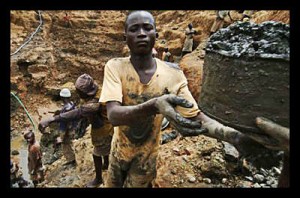
“What is a house without food?” A report from the NGO Human Rights Watch poses this question straight from the lips of a resettled farmer in Mozambique. The report examines Mozambique’s coal mining boom due to foreign investment, documenting the resettling of farmers in resource-rich areas that causes food insecurity.
In Mozambique in particular, the mining companies Vale and Rio Tinto displaced local communities from 2009-2011, a move that majorly disrupted daily life for almost 1400 households. For many of these displaced families, the investment in natural resources that should have brought increased profits to the region and country instead jeopardized regular access to food, water, and income opportunities.
The Paradox of Plenty
Statistically, countries with a high amount of natural resources experience lower economic growth and a slower development rate than countries with less natural resources. This is known in economic theory as the “resource curse,” or the paradox of plenty. Multibillion dollar companies investing in these countries’ economies promise a “trickle-down” effect that rarely — if ever — improves the quality of life and average daily income.
A number of phenomena are linked to the “resource curse.” From a historical perspective, regions with visible high amounts of natural resources are seen as more attractive targets for conquest and imperialism. With this precedent of constant push and pull of conquering countries, the host region’s development of governance and infrastructure is stunted. These regions, while relatively stable in governance now, developed with a major disadvantage in the modern economic environment.
Another chief indicator of the “resource curse” is rampant corruption on both state and local level. Extractive industries often collude with corrupt governments to allow them mining or logging rights to land claimed by indigenous people. In the Indian state of Andhra Pradesh, indigenous communities who should have been protected by constitutional law from exploitation of their land were bypassed entirely when their state leaders covertly gave foreign companies leases to mine bauxite.
While corruption on the ground level could theoretically be bypassed entirely if a foreign company advocated for the rights of the people in the surrounding region, the “resource curse” is certainly not limited to an individual country’s ability to manage its own natural resources. While Rio Tinto and Vale did implement relocation plans approved by the Mozambican government, company representatives did acknowledge the poor arability of the land to which households were relocated.
Growth Poles
Even so, the World Economic Forum sees foreign investment in the natural resource sector as a key part of making Africa’s economies more globally competitive. Growth poles — simultaneous investments coordinated in many sectors to support self-sustaining industrialization — are posed in the Africa Competitiveness Report 2013 as a way to make investing in the host country profitable.
A WEF project entitled “The Madagascar Integrated Growth Poles Project” tested the concept of growth poles, partnering both public agencies and private corporations (including Rio Tinto) to develop infrastructure, provide skills education for both the engineering and hotel industries, and improve the process of business creation. These projects improved the overall business environment in Madagascar, according to the WEF. In 2005, private investment in Madagascar was US$84 million; this number increased to US$1045 million in two years.
What sets “growth poles” apart from isolated foreign investment is dedication to expanding the market in the host country. While the largest investments may initially be extraction of natural resources, they serve as profitability assurance for other firms to invest – both international and domestic.
Responsible Foreign Investment
The key to responsible foreign investment in a country experiencing the “resource curse,” is the balancing of the investor’s profits and economic development for the host country. Partnership of MNCs (multinational corporations) and NGOs hold the most promise, because while companies – both in-house and international – ultimately invest in natural resources for the bottom line, aid and development ventures can improve the standard of living in the communities most affected by natural resource development.
Furthermore, in order for foreign investments to improve developing countries, they should not be isolated or exploitative. These ventures must be planned so as to strengthen and not undermine existing enterprises in the host country. Foreign business investments that help host countries the most are ones that promote and supplement investment in all sectors.
Responsible implementation of foreign investment in Africa’s natural resources is rare. If WEF’s Growth Poles Project is any indicator, there are ways to improve a country’s chances against the “resource curse.” MNCs Rio Tinto and Vale certainly have the resources and precedent to face Mozambique’s mining backlash with an increased dedication to developing growth poles in the region, and in their other investments, to improve development.
– Naomi Doraisamy
Source: BBC,Human Rights Watch,World Economic Forum,World Watch
Photo: AEFJN

Eco-Art: From Trash to Treasure
Eco-art, also known as contemporary environmental art, is art that is concerned with local and global environmental situations. It strives to strengthen human relationships with the natural world by expressing the development of new, creative ways for humans to co-exist with nature.
In the context of Ugandan artist Ruganzu Bruno’s newly-constructed amusement park, eco-art takes on two purposes. The 30-year-old artist and community organizer found a way to handle Kampala’s Kireka neighborhood’s acute waste management problem while engaging and empowering children through the act of play. Using a variety of recycled materials collected by the community, Bruno and his team constructed this amusement park for the children living in Kampala’s congested slums. Completed last September, the eco-park contains a myriad of exciting structures that include recycled swings and life-size board games made from plastic bottles.
However, according to Bruno, the value in the amusement park comes not only from the park itself but also from the lessons it will continue to teach the people of Kireka for generations to come. In what Bruno hopes to be an important step toward sustainability, the children and parents were taught how to make repairs to the park during its construction. Bruno, who was orphaned as a child, places particular importance upon the positive impact on children’s education that the new project promises to keep bringing.
“The attention of children in class is improved; the number of children who are dropping out [is falling] because now they have something to keep them busy there,” Bruno says, adding that the project is helping students to express themselves.
Four years ago, when Bruno was still a student at the Kyambogo University Fine Arts School, the personal goals for his work evolved from mere self-expression to wanting to make a positive impact on his community. He teamed up with a few of his fellow eco-artists to create “The Hand That Speaks,” a gigantic structure made of recycled materials in the shape of a hand. This was the first of its kind in Kampala. It was intended to serve as a reminder of how human hands can impact the environment in negative and positive ways; the same hand that throws garbage on the ground can also collect it.
The next year, in 2010, Bruno founded Eco Art Uganda, a collective of artists dedicated to the promotion of environmental awareness within their communities. They focus on transforming any waste they find – from broken electronics to scrap metal – into functional art that inspires changes in attitudes toward the environment. In April of last year, Bruno was awarded the world’s first City 2.0 Award at the TEDx summit in Doha, Qatar for the eco-park project. Currently, he is using the $10,000 prize money to fund a loan program designed to help local eco-artists in Kireka. In a continuing effort to serve his community’s needs, the young artist’s goal is to recreate “as many as 100” new eco-parks in Uganda.
Bruno’s community work is just one example of how eco-art is helping to engage communities all over the world while also keeping them clean and litter-free. The functional form of art is a promising step toward alleviating two of the world’s biggest problems; the disenchantment of the developing world’s youth and the litter that surrounds them.
– Kathryn Cassibry
Source: CNN
Photo: Ruganzu Bruno
Budget Cuts & Global Health Programs
“Sequestration”, the popular buzzword going around Washington, is the term for a series of automatic spending cuts that went into effect after Congress and the White House failed to agree on a budget for the 2013 fiscal year. While much of the conversation about sequestration has highlighted Washington gridlock and the heated and partisan nature of the negotiation process, the $85 billion dollars in sequestration cuts has caused a number of organizations to worry that the cuts could negatively impact global health programs.
Using figures from a March 1 report by the U.S. Office of Management and Budget, the group amFar, (The American Foundation for AIDS Research) estimates that the required 5% cuts to discretionary government spending would have the following negative impact on global health programs:
In addition, amFar estimates that sequestration cuts in contributions to the Global Alliance for Vaccines and Immunization will mean 789,500 fewer pentavalent vaccines for children, resulting in 8,400 more deaths from preventable diseases. The group also states that required sequestration cuts to the Global Fund to Fight AIDS, TB, and Malaria would mean:
Another group, The Global Health Technologies Coalition, notes that organizations like the National Institutes of Health (NIH), The Centers for Disease Control & Prevention (CDC), and the U.S. Agency for International Development (USAID), all of which fund research and development on projects like HIV/AIDS, and malaria and meningitis vaccinations, will have budgets slashed by significant amounts because of the required sequestration cuts. The result will be an interruption in research projects, including late-stage projects for vaccines that could help millions of people. They argue that such an interruption is not merely an inconvenience, but a potential health risk.
Both groups also argue that while sequestration cuts could negatively impact global health programs in these ways, they would have very little positive impact on the US deficit or debt reduction because spending on global health programs amounts to only .01% of the US Gross Domestic Product.
– Délice Williams
Source: National Journal,amFar,Global Health Technologies Coalition
Photo: University of Washington
Uzbekistan: Providing Relief to Those With HIV
Rano Isaeva, a healthcare worker in Uzbekistan, took time off of work to attend a training session that teaches her how to provide palliative, or relief focused care, to those living with HIV.
“Patronage nurses bring relief to patients and educate relatives to provide care and support. Often they turn into family members and counselors, trusted and relied upon.” she says.
The main goal of UNDP’s HIV project in Uzbekistan is to provide relief and comfort to families as well as patients. UNDP has trained over 2,000 nurses in several different regions of Uzbekistan. To reach as many nurses as possible the training sessions are offered in Uzbek as well as Russian. During the training, the nurses improve their knowledge about HIV infection, the effects on the body, stages of the disease, signs, symptomatic treatment and pain relief therapy. So far over 35,000 people in all regions of Uzbekistan have been reached by HIV-prevention services.
By the end of 2013 over 5,100 nurses should be trained and able to spread their knowledge in their respective communities.
“Many people in the community ask questions on HIV. Now I am able to answer any questions on prevention measures, how the virus is transmitted and not transmitted, what the consequences may be, and whether it can be treated.,” says Zarifa Jonova, a local community nurse. “Thus, I will make my input in wellbeing of my community,” she says.
The program will also begin to focus on spreading awareness to at-risk populations in the area, including young women, drug users, commercial sex workers, and homosexual men. The program has already offered 10,000 information sessions on treatment as well as prevention.
– Catherine Ulrich
Source: UNDP
Photo: Facebook
Nutrition for Growth Summit Combats Hunger
United Nations officials met with key country leaders at the Nutrition for Growth summit held in London last week to discuss pledged funds and political agreements in the fight against global hunger. Millions of infants and pregnant women are at risk for stunting and deaths from malnutrition; the Nutrition for Growth summit was a key step in securing hope and help in the fight against malnutrition. UN Secretary-General Ban Ki-moon sent a video message confirming the organization’s commitment to ending hunger and malnutrition in all forms worldwide.
One in four children will grow up stunted by chronic malnutrition. In today’s world, this number must be reversed. There is no reason for children to suffer from malnutrition. Commitments of funds and political support will help millions of children and boost the economies of some of the world’s most vulnerable countries. The UN is committed to do whatever it takes to see the goals reached and hunger ended.
The Nutrition for Growth summit brought together leaders from governments, the private, and non-profit sector. It was hosted by the governments from Brazil and the United Kingdom as well as the Children’s Investment Fund Foundation (CIFF). The event resulted in renewed commitments to continue to fight stunting and malnutrition worldwide. Funds pledged at the event exceeded $4 billion.
Stunting in children robs them of their health and their ability to grow up to be productive, contributing citizens. The summit focused on eliminating that prognosis for children. UNICEF also strengthened its desire to invest in fighting malnutrition and to continue to support programs working in over 65 countries to combat malnutrition.
Also signed at the summit was the Global Nutrition for Growth Compact which formalizes commitments to make nutrition a top political and socio-economic priority for donors and countries. It will focus on scientific knowledge, innovation to nutrition, and transparency and monitoring of results. Strong nutrition is key for individuals, nations, and economies to grow and become successful and the Nutrition for Growth summit is another step towards the elimination of global hunger and malnutrition.
– Amanda Kloeppel
Source: UN News Centre
The Resource Curse in Developing Countries
“What is a house without food?” A report from the NGO Human Rights Watch poses this question straight from the lips of a resettled farmer in Mozambique. The report examines Mozambique’s coal mining boom due to foreign investment, documenting the resettling of farmers in resource-rich areas that causes food insecurity.
In Mozambique in particular, the mining companies Vale and Rio Tinto displaced local communities from 2009-2011, a move that majorly disrupted daily life for almost 1400 households. For many of these displaced families, the investment in natural resources that should have brought increased profits to the region and country instead jeopardized regular access to food, water, and income opportunities.
The Paradox of Plenty
Statistically, countries with a high amount of natural resources experience lower economic growth and a slower development rate than countries with less natural resources. This is known in economic theory as the “resource curse,” or the paradox of plenty. Multibillion dollar companies investing in these countries’ economies promise a “trickle-down” effect that rarely — if ever — improves the quality of life and average daily income.
A number of phenomena are linked to the “resource curse.” From a historical perspective, regions with visible high amounts of natural resources are seen as more attractive targets for conquest and imperialism. With this precedent of constant push and pull of conquering countries, the host region’s development of governance and infrastructure is stunted. These regions, while relatively stable in governance now, developed with a major disadvantage in the modern economic environment.
Another chief indicator of the “resource curse” is rampant corruption on both state and local level. Extractive industries often collude with corrupt governments to allow them mining or logging rights to land claimed by indigenous people. In the Indian state of Andhra Pradesh, indigenous communities who should have been protected by constitutional law from exploitation of their land were bypassed entirely when their state leaders covertly gave foreign companies leases to mine bauxite.
While corruption on the ground level could theoretically be bypassed entirely if a foreign company advocated for the rights of the people in the surrounding region, the “resource curse” is certainly not limited to an individual country’s ability to manage its own natural resources. While Rio Tinto and Vale did implement relocation plans approved by the Mozambican government, company representatives did acknowledge the poor arability of the land to which households were relocated.
Growth Poles
Even so, the World Economic Forum sees foreign investment in the natural resource sector as a key part of making Africa’s economies more globally competitive. Growth poles — simultaneous investments coordinated in many sectors to support self-sustaining industrialization — are posed in the Africa Competitiveness Report 2013 as a way to make investing in the host country profitable.
A WEF project entitled “The Madagascar Integrated Growth Poles Project” tested the concept of growth poles, partnering both public agencies and private corporations (including Rio Tinto) to develop infrastructure, provide skills education for both the engineering and hotel industries, and improve the process of business creation. These projects improved the overall business environment in Madagascar, according to the WEF. In 2005, private investment in Madagascar was US$84 million; this number increased to US$1045 million in two years.
What sets “growth poles” apart from isolated foreign investment is dedication to expanding the market in the host country. While the largest investments may initially be extraction of natural resources, they serve as profitability assurance for other firms to invest – both international and domestic.
Responsible Foreign Investment
The key to responsible foreign investment in a country experiencing the “resource curse,” is the balancing of the investor’s profits and economic development for the host country. Partnership of MNCs (multinational corporations) and NGOs hold the most promise, because while companies – both in-house and international – ultimately invest in natural resources for the bottom line, aid and development ventures can improve the standard of living in the communities most affected by natural resource development.
Furthermore, in order for foreign investments to improve developing countries, they should not be isolated or exploitative. These ventures must be planned so as to strengthen and not undermine existing enterprises in the host country. Foreign business investments that help host countries the most are ones that promote and supplement investment in all sectors.
Responsible implementation of foreign investment in Africa’s natural resources is rare. If WEF’s Growth Poles Project is any indicator, there are ways to improve a country’s chances against the “resource curse.” MNCs Rio Tinto and Vale certainly have the resources and precedent to face Mozambique’s mining backlash with an increased dedication to developing growth poles in the region, and in their other investments, to improve development.
– Naomi Doraisamy
Source: BBC,Human Rights Watch,World Economic Forum,World Watch
Photo: AEFJN
5 Ways to Become a Digital Volunteer
Giving back can be a hassle, but with the digital revolution there are more and more opportunities to volunteer from your home. The organizations that have been thriving in this day and age are those that take advantage of technology. These are a few organizations that have great digital volunteer programs:
1. American Red Cross
The Red Cross trains individuals in using social media including Twitter, Facebook, and Instagram to communicate to victims during times of natural disaster. Volunteers help victims find information, direct them to where they can get help, and provide comfort.
2. The United Nations
The UN offers volunteer opportunities in all fields ranging from environment and health to region specific positions. These positions allows people to make a difference anywhere in the world from their computer. The time commitments range from 1-5 hours to 11-20 hours a week.
3. Code Corps
Code Corps links public and private organizations to work together during times of natural disaster. It originated in the aftermath of Hurricane Sandy and helped many in the New York area rebuild the city government through technology and digital tools. Currently this is only available to organizations in the NYC area, but other non-profits interested in linking their organization you can apply online.
4. All For Good
The All For Good database shows virtual volunteer opportunities in different areas. It offers a range of positions in non-profits and grassroots organizations.
5. Volunteer Match
Volunteer Match is another database that allows interested members to add more filters based on field of interest as well as location. The sophisticated level of filtering allows people to find the best match for their volunteering work.
And finally let’s not forget about The Borgen Project, which has volunteers who work virtually from all over the country. The Borgen Project’s goal is to have volunteers in all 435 congressional districts, and it is on its way to reaching that goal. If you are interested in becoming a virtual volunteer for The Borgen Project check out the “Act Now” page of the website.
– Catherine Ulrich
Source: Huffington Post
Source: American Red Cross
No Annual Food Aid and Development Conference
Federal budget constraints are beginning to take a toll on development and food aid efforts for the world’s poor.
After 14 years of meeting annually to discuss global development and food aid, the United States Agency for International Development (USAID) and the U.S. Department of Agriculture (USDA) confirmed this week there will be no International Food Aid and Development Conference (IFADC) in 2013 because of the current federal government budget constraints.
According to Food Business News, the agencies said, because of “U.S. government agencies facing a difficult budget environment and being urged to minimize conference events in light of these budget constraints.”
Previous IFADCs pulled together 700 or more participants from around the world, representing major food assistance program stakeholders. Meetings included representatives from U.N. agencies including the World Food Programme, officials from recipient countries, private charitable organizations, and USDA and USAID staff for the meetings in Kansas City every year.
Instead of multiple days of conference meetings as in previous years, USDA and USAID will replace the Kansas City conference with a one-day public meeting in Washington in November 2013. The meeting will be held as an add-on to the Food Aid Consultative Group meeting.
“We know that this is not a complete substitute for the IFADC and that we will have to be creative and thoughtful in how we organize this event. USDA and USAID will reach out to stakeholders during the planning of the one-day meeting,” conference organizers said.
– Liza Casabona
Source: Food Business News
Photo: Guardian
Musicians Protest Global Poverty
Several popular musicians protest global poverty by writing protest songs about the issue. Stars such as Ed Sheeran, Mumford & Sons, Macklemore & Ryan Lewis, Will.I.Am, Sting, Elvis Costello, and Green Day are among some of the artists who have joined the agit8 campaign to fight world hunger and poverty.
The agit8 campaign is an event that challenges leaders to stand up to fight poverty during the global G8 summit this year in Northern Ireland. The summit focuses on the world’s most pressing issues, and global leaders have a chance to speak up for issues they care about and feel should be addressed. The agit8 campaign is supported by the One Campaign, which was co-created by musician & activist Bono to help raise awareness about poverty and hunger problems around the world.
The One Campaign also works with filmmakers and actors to demonstrate through movies how protests have led to a major change in the world. Music is another way to lead change because it has the power to get many people involved. When fans learn about the causes their favorite artists support, they can instantly become more aware of global problems and learn how to take action. And with more people aware of the problems of the world, more people are supporting nonprofit organizations and charities to alleviate those problems.
– Katie Brockman
Source Evening Express
10 Facts: Partnership for Supply Chain Management
Here are ten facts about the Partnership for Supply Chain Management (PFSCM).
– Kira Maixner
Source PFSCM
Photo UNJLC
Four Steps to Ending Child Marriage
Ending the practice of child marriage is an important step in eradicating global poverty and improving global health. Countries that have a high rate of documented child marriages also rank high in infant and maternal mortality as well as perpetual poverty. Here are some key steps to ending the practice:
– Samantha Mauney
Source: ICRW
Photo: Sulekha