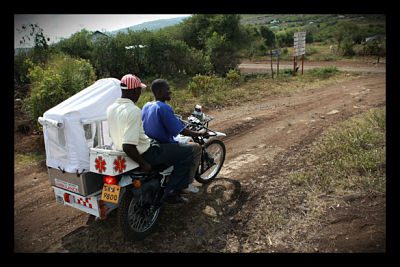
Motorcycles are often the vehicle of choice in the developing world because of their ability to zip over harsh terrain and their low maintenance costs. A motorcycle manufacturing company, eRanger, has taken this versatile vehicle and given it a new purpose as an ambulance. The eRanger company builds motorcycles with a sidecar that serves as a stretcher to transport patients from remote areas to the nearest health center or hospital.
Called the eRanger ambulance, this motorcycle offers the high-power capacity needed to cover diverse and often difficult terrain in rural and remote areas. The sidecar stretcher acts as a bed for the patient, allowing for quick and effective transport. The stretcher is designed to be simple but safe, rugged but reliable, with a cushioned pad for patient comfort and a roll cage for safety.
Loading a patient is made easy by simply pushing back the roll cage and strapping the patient into the stretcher. A rain cover can be attached to the roll cage, providing comfort and privacy in different weather conditions, and this innovative ambulance also offers room for emergency medical supplies underneath the stretcher.
The eRanger ambulance also provides additional comfort through its rugged suspension system, which absorbs shock so patients bounce less during transport. This vehicle provides the perfect alternative to the popular 4 by 4 all-terrain vehicles because of its enhanced suspension system, low cost, and simple maintenance. Motorcycle ambulances are also preferable to car ambulances, especially during the rainy season, because they are better able to navigate over developing nations’ diverse terrain.
These motorcycle ambulances are already stationed at health centers through Africa where health workers and community members can utilize them as needed. The eRanger method goes beyond just providing the vehicles, though. They provide training, maintenance instruction, and tools to keep the motorcycles in good condition.
Sustainability is key, says the eRanger company, so they provide a maintenance unit with all the necessary tools and equipment for the eRanger ambulance. This affordable, reliable, and sustainable ambulance also helps communities become more self-reliant by taking health care into their own hands.
For example, the eRanger ambulance makes it possible for a mother in labor to reach a health care clinic quickly, reducing maternal mortality rates in many African nations.
The eRanger model also allows its motorcycle to adapt to the needs of problems in the developing world, from emergency ambulance to mobile medical clinic. The company also manufactures an eRanger immunization clinic, which recreates the sidecar into a stainless steel mini clinic with refrigeration storage, weight scales, and clean water unit.
This versatile motorcycle promises dramatic impact to healthcare in developing nations. Backing that promise is an eRanger patron, Nelson Mandela, who helped eRanger South Africa launch in the Eastern Cape. Since the launch, eRanger has built a college for riders and operators in Eastern Cape, which includes basic control of the vehicle, road riding, off-road riding, and essential maintenance.
In just five hours, operators can reach a basic competency to operate and care for the motorcycle, but advanced training is always available, says eRanger. With just the right mix of affordability, sustainability, and reliability, eRanger is helping save lives in developing nations by providing safe, quick access to critical health care.
– Georganne Hassell
Sources: eRanger, UNICEF, Changemakers, The Guardian
Photo: Motorcycle

40 Hour Famine at Hennessey Catholic College
Hennessey Catholic College Students have decided to experience what world hunger and poverty is truly like in their own, unique way. The school has formed the 40-hour famine team with the goal of raising both money and awareness for those suffering from extreme poverty and international conflicts in Malawi, Ethiopia, East Timor, Nepal, Tanzania and Ugandav. The students are given the opportunity to experience the tribulations of those living in developing areas, sacrificing basic human needs such as sleep and food to fully immerse themselves in the struggle of living on less than a dollar a day.
The conflicts in Malawi are worsening. Nearly two million people in southern Malawi are starving and almost half of Malawians live on less than a dollar a day. With a population of almost 16 million people, that means nearly eight million citizens live below the poverty line. For Hennessey students, these statistics are troubling.
Starting at eight PM on the 16th of August and ending at noon on the 18th, 35 students will make multiple sacrifices for the cause. Below are some of the sacrifices individuals are contributing to the 40-hour famine campaign.
The students plan to raise $1500 dollars for the cause in hopes of helping those in need. Hennessey teacher and 40-hour famine leader Leonie Green said she is impressed with the student’s dedication to raising awareness, all the while learning very valuable lessons.
“It’s good to get people educated and not taking for granted what we have so much of,” she said.
– William Norris
Sources: The Young Witness, World Bank
Photo: World Vision
China Funds Five Research Centers in the Global South
For a variety of reasons, China has become known for its “interactiveness” with the global south. This “interactiveness” has included construction projects, student scholarships, and sending doctors.
Recently, China began to fund five research centers in Africa and the global south in order to increase collaboration between Chinese and African scientists. The topics of focus for the scientists will include the climate, water, environmentally friendly technology, biotechnology, and space technology.
Using the Chinese Academy of Sciences (CAS), $6.5 million will be distributed to the research centers over the course of the next three years. These funds will work to improve China’s soft power in the global south by conducting joint research projects between the CAS and the research centers.
Currently, there is a CAS network known as The World Academy of Sciences (TWAS) that will also benefit from this Chinese outreach to the global south. Along with the research projects, the funding will also provide for an increase in workshops, training, and PhD programs.
According to Salim Abdool Karim, director of the Centre for the AIDS Programme of Research in South Africa and a TWAS member, “The five centers will play an important role in global scientific collaboration by increasing South-South training opportunities.”
This collaboration is expected to increase climate change research. Yongqiang Liu, a research meteorologist at the USDA Forest Service’s Center for Forest Disturbance Science sees it as a good way to “prepare future leaders to lead climate change research for developing countries.”
Action through research investment should improve China’s image in the world. Currently, China stands at 50% favorable and 36% unfavorable among populaces from around the world. Comparably, the US was seen as favorable by 63%, and unfavorable by 30%. More specifically, when people were asked if they thought China considered their country’s interests, 27% thought a great deal with 63% saying either not too much or not at all.
There is still a great deal of room for China to improve its international appeal. By working with developing nations to improve research in sustainable technology and other important sciences, China can build off the work of TWAS and foster support from citizens in these countries.
Once the three years comes to an end, the education and collaboration should improve the environmental technology sector, as well as build the capacity for a future scientific community with various projects and goals. If successful, this move may be beneficial in regards to China’s popularity as well.
– Michael Carney
Sources: SciDev.Net, Pew Global
4Afrika Changes Technology Around the World
Technological capabilities in developed countries continue to evolve, changing the way our economies operate. These new tools give citizens the power they need to innovate even further. What’s more, the ability to access and use new technology properly is more and more becoming a requirement in the workforce.
Developing countries in Africa have citizens who haven’t been able to receive the positive impacts that this technology has to offer. Just seven percent of the African population has consistent access to the Internet. It is an impact that can change their individual lives and the lives of those in their communities. The 4Afrika initiative, powered by Microsoft, hopes to get these citizens up to speed with modern day technology. 4Afrika works to empower African youth and set them up for the future through three focus areas.
1. World-Class Skills
The 4Afrika Initiative works to develop a competitive, academic environment that generates young entrepreneurs. The Afrika Academy, where technological capabilities flourish, can be accessed by those with strong academic merit. Research institutions and local African universities partner to fund this innovative project. The Academy will provide advanced training that will help citizens gain employment in the workforce, benefitting the communities they live in.
2. Access to Technology
The initiative plans to make smart devices, including Windows PCs, slates, and smartphones, affordable to African communities. Injecting these capabilities into the communities is an important step in empowering the citizens. Developing stronger Internet connections and access in local African communities is also important to the initiative.
3. Innovation
Innovation is something constantly occurring across the globe, and something that Africa desperately needs. Microsoft has recently been developing new Microsoft applications that will be beneficial to developing nations. The 4Afrika Initiative plans to give the technological capabilities and market support needed to allow African communities to flourish.
Click here for more information on this innovative campaign.
– William Norris
Sources: Microsoft, Internet World Statistics
Photo: Biztech
3 High Rated Charities With Low Paid CEOs
Some of the most successful charities in the world, charities that earn large amounts of revenue annually, happen to have some of the lowest paid CEOs. These CEOs truly give everything to their company, taking miniscule amounts of money to support themselves while dedicating the rest to the cause. Below are three of the lowest paid CEOs operating some of the highest rated charities. All ratings on Charity Navigator are out of 70.
1. Deborah Rickert – Operation Support Our Troops-America
Coming in at 64.45 on the Charity Navigator scale, this organization is dedicated to ensuring that US soldiers and families receive the resourceful comfort that they deserve. While this charity raises almost 1.5 million dollars a year for the cause, its president Deborah Rickert receives only 3.77% of expenses. With a base pay of $53,500, Rickert truly gives her everything to this important cause.
2. Tom Webster – Habitat For Humanity of Spartanburg
This Christian Ministry supports the citizens of Spartanburg by building affordable housing for those in need. It comes in at 63.34 on the Charity Navigator Scale, raising 1.36 million in 2012. The executive director of this cause Tom Webster receives just 3.83% of expenses, netting a base pay of 53,000 dollars.
3. Lisa Hopper – World Care
Serving to provide emergency relief within 24 hours of a natural disaster, World Care made in difference in 2012 with over 4 million in revenue. Of the expenses, Lisa Hopper receives only 1.1 percent. This equates to a salary of $45,000. Her dedication to the cause is reflected through this information.
It is easy to assume that CEOs of organizations take home a large piece of the pie, regardless of whether the organization is for or not for profit. The CEOs above have taken significantly lower annual earnings to help their charities succeed. As a result, these charities with low paid CEOs are some of the highest rated today.
– William Norris
Sources: Charity Navigator, OSOT America
Photo: Open
Algeria Food Security
Algeria has launched an agriculture development program designed to boost domestic production. Using its increased revenue from hydrocarbon exports, the country will tackle food security through a variety of programs working with farmers in rural and low-income areas.
Like most of North Africa, Algeria imports a substantial portion of its food. As a result, it is extremely vulnerable to shifts in commodity pricing. In 2011 riots broke out across Algeria due to the high price of sugar and cooking oil and were influenced by the Arab Spring in neighboring nations as well.
In response, the Algerian government reduced the import taxes on these two goods. While the riots may have died down the country remains vulnerable to similar price spikes. As a result Algeria heavily subsidizes key food items that are estimated to amount to 1.1% of gross domestic product (GDP) in 2013.
Algeria imports almost seventy percent of its wheat consumption. Egypt also imports a significant percentage of food and is the world’s largest importer of wheat. The Egyptian government also uses a system of subsidies in an attempt to alleviate the price burden. However, these governments recognize subsidies are not a sustainable way to ensure food security.
Algeria’s agriculture development program will focus on improving farm management practices, addressing regulations, and promoting modern technological practices in the industry. Previously the country’s food security programs have focused on putting more arable land into production. While useful, this is not a sustainable way to ensure the country’s food security.
More effective programs have focused on public-private partnerships that help introduce modern farming practices among rural growers. These practices have helped increase agricultural output by 23 percent in 2011 and an additional 32 percent in 2012.
The country wishes to increase its irrigated acres, adding 0.5 million hectares to the current 1.1 million currently irrigated by 2014. Algeria will also focus on developing its infrastructure. This will be a key component to affecting agricultural development in remote areas, which in a country of Algeria’s size are significant. This component will also include development efforts to reduce post-harvest losses through storage and transportation modifications.
The effect food prices have on the country’s stability will help motivate the government to introduce new and sustainable practices. This will be done not only in an effort to increase Algeria food security but also to ensure governmental stability.
– Callie D. Coleman
Sources: Global Arab Network, IFPRI
Photo: Flickr
Why Do Slums Exist?
Put simply, the term “slum” refers to “a heavily populated urban area characterized by substandard housing and squalor.” But why do slums exist? In an effort to include quantifiable data in the definition, a group of UN experts suggested expanding it to refer to areas that combine inadequate access to safe water, sanitation and other infrastructure, structurally poor housing, overcrowding, and an unstable residential population.
Today, slums are becoming the most obvious materialization of urban poverty in developing world cities; in Nairobi, Kenya, 60% of the population lives in slums. That 60% is crowded onto only 5% of the land.
The existence of slums is caused and sustained by a number of forces, including rapid rural-to-urban migration, insecure tenure, and globalization.
Why Do Slums Exist? 4 Illuminating Facts
Rural-to-urban migration amplifies slum formation because city planning and management systems are unable to effectively manage the considerable population influx. For perspective, consider these facts:
Insecure tenure means tenants are not protected from unpredictable rent increases and eviction processes. Insecure tenure inhibits opportunities for residents to acquire credit, which limits tenants’ ability to improve upon their homes. A revolving door of tenants does little to inspire feelings of community or pride in one’s home.
Globalization also promotes slum living. Global economic booms and busts lead to uneven wealth distribution. Historically, global economic cycles have been responsible for creating many of major city slums in the developed world, and it is likely globalization will do the same to the developing world.
Addressing slums and their contributing factors are keys to sustaining progress toward the Millennium Development Goal to significantly improve the lives of at least 100 million slum dwellers by 2020. Although the percentage of people living in urban slums has decreased from 39% in 2000 to 33% in 2012, 863 million people are estimated to still be living in slums as of 2012.
– Dana Johnson
Sources: UN-HABITAT, Business Dictionary, UN
Photo: Portal OZK
3 Top Charities for Measurable Returns
When people choose to donate to one charity over another, they frequently do it guided by a strong conviction or emotion rather than pure rationale. Charity evaluators, however, are rapidly changing the way people think about giving back to society.
They argue that rather than giving to the cause that is closest to one’s heart, one should give to those charities that are the most effective, in measurable terms. One of the most trusted of these charity evaluators is GiveWell, a San Francisco-based group founded in 2007 by two hedge-fund staffers.
It recommends charities to donors according to four main criteria. First, the organization must provide strong evidence of positive impact on people’s lives. Second, it must be involved in highly cost-effective activities that provide a high, measurable return for every dollar invested. Third, the program must demonstrate that there is room for more funding and that it can productively put to good use additional donors’ dollars. Fourth, the charity must be transparent and accountable to donors.
Although GiveWell has been criticized for its results-based approach – leading it to favor health care interventions in the developing world, while ignoring others that cannot provide evidence of success due to the nature of their activities – its evaluations do carry weight in the world of philanthropy.
Its top three recommended charities are:
1. Against Malaria Foundation (AMF)
GiveWell believes that AMF effectively expands access to bed nets in sub-Saharan Africa, where over 1 million people – mostly children – die each year of malaria. Through providing insecticide-treated bed nets that cost only $5 each, AMF prevents deaths and many other non-fatal cases of malaria.
2. GiveDirectly
According to GiveWell, GiveDirectly effectively distributes cash to extremely low-income individuals in Kenya. By directly transferring money to the very poor, recipients are allowed to spend more on their basic needs – such as food – and other investments that have high returns.
3. Schistosomiasis Control Initiative (SCI)
GiveWell states that SCI effectively expands access to deworming treatments in sub-Saharan Africa. In this region, a large percentage of the population, especially children, are infected with parasite worms that cause short-term symptoms such as anemia, and long-term developmental problems. This condition is relatively easy to treat: around $5 can protect a child for 10 years.
All three charities work in Africa, which is not surprising given that money can go much further in the poorest regions of the world. Twenty-five dollars, for example, allows someone in the developing world to get an eye surgery, while in the United States, this is an insignificant amount. Although most people prefer giving back to causes that are close to home, sometimes those in greatest need are far off.
– Nayomi Chibana
Sources: GiveWell, The Guardian, The New York Times
Photo: Harpers
West Papua: A Conflict Falling on Deaf Ears
In 1962, the United Nations granted control of West Papua to the Indonesian government. Since then, more than 100,000 West Papuans have been killed or abducted by Indonesian forces with many others having been raped and tortured. The Indonesian military has also been responsible for destroying entire villages and village gardens. Though such atrocities have continued for more than 50 years, the United Nations has yet to intervene on behalf of the West Papuans.
On August 17, a group of activists, politicians and refugees set sail from Australia on what is being called the “West Papua Freedom Flotilla.” Speaking about the purpose of their voyage, activist Izzy Brown said, “West Papuans live in fear every day, in fear of the Indonesian military.” According to Brown, the participants’ aim is to raise awareness “about an issue that has for too long been ignored in the Australian and international media.”
After the fall of General Suharto in 1998, many democratic reforms were passed in Indonesia. But this did nothing to alleviate the brutal oppression of the people of West Papua. Murder and assassinations of political leaders have continued under the regime of current president, Susilo Bambang Yudhoyono. A government ban on journalists and human rights organizations make it difficult for the international community to monitor the situation in West Papua.
Under Indonesian rule, many West Papuans have been jailed or murdered for resisting the government, displaying separatist flags or speaking out in support of a free West Papua. For example, activist Philip Karma was arrested in 2004 while participating in a peaceful protest of the Indonesian government and raising a Morning Star Flag, which is a Papuan symbol. For his actions, Mr. Karma is currently serving a 15-year prison sentence.
At the end of this month, the Freedom Flotilla will land in Papua New Guinea and attempt to enter West Papua. The Indonesian government has said that it intends to intercept the flotilla and turn away the participants. Hopefully, this event will help bring awareness to a conflict that has not received much media attention in the West. But if the past is any indication, even the Freedom Flotilla may escape the attention of the international media.
In 1994, Bishop Desmond Tutu issued a statement calling on the United Nations to intervene on behalf of the West Papuans. In that statement, he said, “The people of West Papua have been denied their basic human rights, including their right to self-determination. Their cry for justice and freedom has fallen largely on deaf ears.” Almost ten years later, there are still too few listening to the cries of the West Papuans.
– Daniel Bonasso
Sources: Democracy Now!, The Guardian
Photo: West Papua Media
5 Ways to Make Your Workout Fight Poverty
We all know working out is good for us. It makes you feel good and improves your health. But what if your workout could fight poverty as well? Sound too good to be true? It’s not! Here are 5 ways that you can help end poverty with your workout:
1) Charity Miles: This free app will track how many miles you run, walk, or bike and sponsor your efforts. For every mile you run or walk, they’ll donate a quarter, while a mile biking translates to a dime for charity. When you’re done with your workout, you share your success on a social media site and they send the money to a charity of your choice!
2) Run For Charity: This website will help you find a charity to run for. Charity runners use their training and hard work to raise money for the charity of their choice. Charities are extremely supportive of their runners, providing help with registration, training, and fundraising. Some will even have race day events for their runners. This is a great opportunity for runners to put all those miles to good use.
3) Plus 3 Network: This network was created by four guys who wanted to encourage people to get out and ride their bikes more. It has since grown to include all forms of exercise, which you can log on their website. You earn money for charity by logging your activity, so you feel even better about that yoga class or walk around the block.
4) Eco-Friendly Workout Gear: You show yourself some love by working out and staying healthy. Show the earth some love, too, by purchasing eco-friendly workout gear. Be sure to buy your shoes, socks, and clothing from eco-friendly companies like Montrail (shoes), Teko (socks), or Patagonia (clothing). Using reusable water bottles will keep plastic ones out of landfills and save you money. You can also look for secondhand fitness supplies, like weights, treadmills, and exercise balls to cut down on waste.
5) Donate Your Old Workout Gear: That fitness equipment that you just don’t use anymore could help someone else lead a healthier life. You can donate old sports balls, shoes, cleats, and the like to Sports Gifts, which redistributes old workout gear to underprivileged kids. Old tennis balls can go to Rebounces, which restores them and resells them as practice balls, saving space in our landfills. Your old orthotics that helped you get back to the activities you love can be given to Rebounces’ philanthropic organization, Joni and Friends. The nonprofit will give the equipment to disabled or injured people in the developing world.
– Katie Fullerton
Sources: Charity Miles, Plus 3 Network, SparkPeople, Oprah
Photo: DX Foundation
Motorcycle Ambulance Saves Lives Through Effective Patient Transport
Motorcycles are often the vehicle of choice in the developing world because of their ability to zip over harsh terrain and their low maintenance costs. A motorcycle manufacturing company, eRanger, has taken this versatile vehicle and given it a new purpose as an ambulance. The eRanger company builds motorcycles with a sidecar that serves as a stretcher to transport patients from remote areas to the nearest health center or hospital.
Called the eRanger ambulance, this motorcycle offers the high-power capacity needed to cover diverse and often difficult terrain in rural and remote areas. The sidecar stretcher acts as a bed for the patient, allowing for quick and effective transport. The stretcher is designed to be simple but safe, rugged but reliable, with a cushioned pad for patient comfort and a roll cage for safety.
Loading a patient is made easy by simply pushing back the roll cage and strapping the patient into the stretcher. A rain cover can be attached to the roll cage, providing comfort and privacy in different weather conditions, and this innovative ambulance also offers room for emergency medical supplies underneath the stretcher.
The eRanger ambulance also provides additional comfort through its rugged suspension system, which absorbs shock so patients bounce less during transport. This vehicle provides the perfect alternative to the popular 4 by 4 all-terrain vehicles because of its enhanced suspension system, low cost, and simple maintenance. Motorcycle ambulances are also preferable to car ambulances, especially during the rainy season, because they are better able to navigate over developing nations’ diverse terrain.
These motorcycle ambulances are already stationed at health centers through Africa where health workers and community members can utilize them as needed. The eRanger method goes beyond just providing the vehicles, though. They provide training, maintenance instruction, and tools to keep the motorcycles in good condition.
Sustainability is key, says the eRanger company, so they provide a maintenance unit with all the necessary tools and equipment for the eRanger ambulance. This affordable, reliable, and sustainable ambulance also helps communities become more self-reliant by taking health care into their own hands.
For example, the eRanger ambulance makes it possible for a mother in labor to reach a health care clinic quickly, reducing maternal mortality rates in many African nations.
The eRanger model also allows its motorcycle to adapt to the needs of problems in the developing world, from emergency ambulance to mobile medical clinic. The company also manufactures an eRanger immunization clinic, which recreates the sidecar into a stainless steel mini clinic with refrigeration storage, weight scales, and clean water unit.
This versatile motorcycle promises dramatic impact to healthcare in developing nations. Backing that promise is an eRanger patron, Nelson Mandela, who helped eRanger South Africa launch in the Eastern Cape. Since the launch, eRanger has built a college for riders and operators in Eastern Cape, which includes basic control of the vehicle, road riding, off-road riding, and essential maintenance.
In just five hours, operators can reach a basic competency to operate and care for the motorcycle, but advanced training is always available, says eRanger. With just the right mix of affordability, sustainability, and reliability, eRanger is helping save lives in developing nations by providing safe, quick access to critical health care.
– Georganne Hassell
Sources: eRanger, UNICEF, Changemakers, The Guardian
Photo: Motorcycle