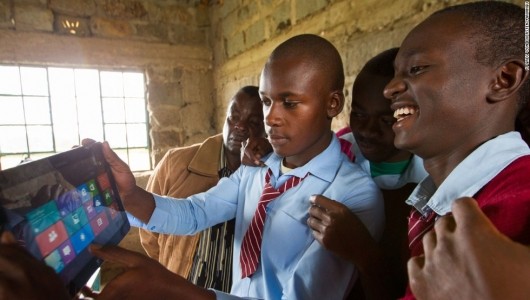
How does reducing global poverty create U.S. jobs? When people in developing nations transition from barely surviving, to middle and upper-class, they go from consumers of basic needs, like food or toothpaste, to consumers of more luxurious items like clothing, travel and technology. Reducing poverty opens giant, untapped markets for the United States. Luxury items like these are primarily operated by American companies, and an increase in demand for product stimulates more American jobs.
One in five American jobs is related to international trade in some way. In the last forty years, the impact that trade has on the U.S. economy has tripled.
The fastest-growing markets in the world are in developing countries, and 45 percent of the United States exports go to these areas. Foreign Policy Magazine states that the world’s poor is the largest untapped market on earth. “By building new markets overseas for American products, the International Affairs budget creates jobs and boosts the economy here at home,” says Governor Tom Ridge, former secretary of homeland security.
In fact, the majority of the U.S.’s top trading partners (the countries who buy our products, pouring money into our economy and providing jobs to thousands of Americans) used to benefit from U.S. foreign aid that helped them reduce poverty.
This is shown by the Marshall Plan. Implemented after World War II, the United States invested the equivalent of 110 billion dollars in both ally and enemy countries across Europe, helping them rebuild and reduce poverty.
Today, 240 billion dollars of American goods are exported to EU countries each year. The United States has made back double what their initial investment was in just one year of trade. What if this same principle is applied to developing countries?
The largest corporations in America understand the economic potential of untapped markets throughout the developing world, the subsequent boost in American jobs that accessing these markets could provide and the dire need for the United States’ foreign policy to invest in developing countries through aid.
In July 2012, over 50 major companies collaborated and sent a letter to Congress in support of the International Affairs Budget. It is in the economic interest of Google, IBM, CitiBank, Coca-Cola, Campbell Soup Company, Cargill, John Deere, Land O’ Lakes, PepsiCo, Walmart, Kraft, Johnson & Johnson and others to alleviate global poverty.
These companies wrote, “As business leaders, we know that U.S. economic growth is linked with global trade and the world’s economy like never before. As the U.S. Chamber of Commerce has noted, overseas markets represent 95 percent of the world’s consumers and 80 percent of global purchasing power. Trade already supports one in three U.S. manufacturing jobs, and these trends will become even more pronounced in the future. For all these reasons, we urge you to support a strong and effective International Affairs Budget. While just 1 percent of the federal budget, these programs are vital for achieving a more prosperous future for American businesses and the U.S. economy.”
One example of the economic potential that exists in developing nations is Indonesia’s 2011 Boeing deal. As Indonesia’s national poverty level diminished and their economy grew steadily, they became classified as a middle-income country, with help from aid investments by the U.S. and other nations. Boeing announced its largest deal in company history: 230 jets for 22 billion dollars with Indonesia’s Lion Air. Indonesia’s poverty decline has stimulated millions of new consumers of United States products, which also creates countless American jobs.
Tech companies see the consumer potential that exists in Africa; some estimate that there are over 1 billion untapped potential users of technology in Africa today. For this reason, companies are attempting to connect Africans to the internet. In Google’s Project Loon, high altitude balloons supply remote regions with beams of WiFi. Facebook has plans to fly 11,000 solar-powered drones to give Africa access to WiFi. Microsoft’s 4Afrika initiative is a 20-year plan. “ The Microsoft 4Afrika Initiative is built on the dual beliefs that technology can accelerate growth for Africa, and Africa can also accelerate technology for the world,” says their website.
Other companies are rushing to invest in Africa. Marriott estimates that Africa will be the next Asia in terms of economic development, and spent $200 million that will provide 23,000 more rooms across Africa. “Africa has significant untapped potential for travel and tourism, both as a destination and source of new global travelers. The continent’s GDP is anticipated to grow at over 5 percent annually over the next several years which we expect will raise more people into the emerging middle class,” said Arne Sorenson, CEO of Marriott.
The support that important American companies give to international aid, the rush of companies to become involved in developing regions, the United States’ history with aid investment and the importance of trade in the American economy all support the dire need for international aid investment in the world’s poor.
– Aaron Andree
Sources: The Borgen Project, Microsoft, Rural Poverty Portal
Photo: CNN

How Bindis Could Help Treat Iodine Deficiency in India
Iodine deficiency can cause health problems such as goitre, an enlargement of the thyroid gland, and other thyroid conditions that can lead to breast cancer or fibroids. Iodine is especially important for pregnant women, who generally require double the amount than is typically needed. Pregnant women with iodine deficiencies can give birth to children with developmental problems or neurological conditions such as cretinism.
Iodine does not have to be ingested for one to receive the nutritional benefits. It can also be absorbed through the skin. This was the idea behind the Life Saving Dot, a bindi designed by the Grey for Good organization and the Neelvasant Medical Foundation and Research Center.
The bindi has religious significance for Hindus, but Indian women often wear it as a fashion statement regardless of religious affiliation. Bindis can be applied with colored powder, but many now wear sticker bindis, which come in endless shapes, colors, and sizes. The Life Saving Dot looks exactly like a real bindi, yet doubles as an iodine patch.
This bindi slowly releases the necessary amount of iodine, 150-200 micrograms, over the course of the day. It fits easily into the daily routine of any woman who normally wears a bindi, making it a convenient source of iodine. These bindis have been put into circulation by medical facilities in 100 villages and have been distributed to about 30,000 Indian women. Women receive a month’s supply, which costs 10 rupees or 16 cents.
While the Life Saving Dot shows success, there are concerns that the iodine solution will evaporate and leave very little to be absorbed by the body, especially in the harsh sunlight. Therefore, they may need to carry a larger dose than the standard 200 micrograms. Many tests will need to be done before it can be certain that the bindis are effective. These include estimations for urinary iodine, radio-iodine uptakes and thyroid hormones.
Even if the bindis do not make a significant impact on iodine deficiency in India, the organization has already achieved another goal. They wanted to bring more attention to the issue of iodine deficiency, as many do not understand its importance. In order to reach more women, Grey for Good is beginning more widespread distribution efforts, and in time, the Life Saving Dot could help end iodine deficiency in India.
– Jane Harkness
Sources: About Religion, GOOD Magazine, NPR, Scroll, Times of India
Photo: Fashion Lady
Reducing Poverty Creates US Jobs
How does reducing global poverty create U.S. jobs? When people in developing nations transition from barely surviving, to middle and upper-class, they go from consumers of basic needs, like food or toothpaste, to consumers of more luxurious items like clothing, travel and technology. Reducing poverty opens giant, untapped markets for the United States. Luxury items like these are primarily operated by American companies, and an increase in demand for product stimulates more American jobs.
One in five American jobs is related to international trade in some way. In the last forty years, the impact that trade has on the U.S. economy has tripled.
The fastest-growing markets in the world are in developing countries, and 45 percent of the United States exports go to these areas. Foreign Policy Magazine states that the world’s poor is the largest untapped market on earth. “By building new markets overseas for American products, the International Affairs budget creates jobs and boosts the economy here at home,” says Governor Tom Ridge, former secretary of homeland security.
In fact, the majority of the U.S.’s top trading partners (the countries who buy our products, pouring money into our economy and providing jobs to thousands of Americans) used to benefit from U.S. foreign aid that helped them reduce poverty.
This is shown by the Marshall Plan. Implemented after World War II, the United States invested the equivalent of 110 billion dollars in both ally and enemy countries across Europe, helping them rebuild and reduce poverty.
Today, 240 billion dollars of American goods are exported to EU countries each year. The United States has made back double what their initial investment was in just one year of trade. What if this same principle is applied to developing countries?
The largest corporations in America understand the economic potential of untapped markets throughout the developing world, the subsequent boost in American jobs that accessing these markets could provide and the dire need for the United States’ foreign policy to invest in developing countries through aid.
In July 2012, over 50 major companies collaborated and sent a letter to Congress in support of the International Affairs Budget. It is in the economic interest of Google, IBM, CitiBank, Coca-Cola, Campbell Soup Company, Cargill, John Deere, Land O’ Lakes, PepsiCo, Walmart, Kraft, Johnson & Johnson and others to alleviate global poverty.
These companies wrote, “As business leaders, we know that U.S. economic growth is linked with global trade and the world’s economy like never before. As the U.S. Chamber of Commerce has noted, overseas markets represent 95 percent of the world’s consumers and 80 percent of global purchasing power. Trade already supports one in three U.S. manufacturing jobs, and these trends will become even more pronounced in the future. For all these reasons, we urge you to support a strong and effective International Affairs Budget. While just 1 percent of the federal budget, these programs are vital for achieving a more prosperous future for American businesses and the U.S. economy.”
One example of the economic potential that exists in developing nations is Indonesia’s 2011 Boeing deal. As Indonesia’s national poverty level diminished and their economy grew steadily, they became classified as a middle-income country, with help from aid investments by the U.S. and other nations. Boeing announced its largest deal in company history: 230 jets for 22 billion dollars with Indonesia’s Lion Air. Indonesia’s poverty decline has stimulated millions of new consumers of United States products, which also creates countless American jobs.
Tech companies see the consumer potential that exists in Africa; some estimate that there are over 1 billion untapped potential users of technology in Africa today. For this reason, companies are attempting to connect Africans to the internet. In Google’s Project Loon, high altitude balloons supply remote regions with beams of WiFi. Facebook has plans to fly 11,000 solar-powered drones to give Africa access to WiFi. Microsoft’s 4Afrika initiative is a 20-year plan. “ The Microsoft 4Afrika Initiative is built on the dual beliefs that technology can accelerate growth for Africa, and Africa can also accelerate technology for the world,” says their website.
Other companies are rushing to invest in Africa. Marriott estimates that Africa will be the next Asia in terms of economic development, and spent $200 million that will provide 23,000 more rooms across Africa. “Africa has significant untapped potential for travel and tourism, both as a destination and source of new global travelers. The continent’s GDP is anticipated to grow at over 5 percent annually over the next several years which we expect will raise more people into the emerging middle class,” said Arne Sorenson, CEO of Marriott.
The support that important American companies give to international aid, the rush of companies to become involved in developing regions, the United States’ history with aid investment and the importance of trade in the American economy all support the dire need for international aid investment in the world’s poor.
– Aaron Andree
Sources: The Borgen Project, Microsoft, Rural Poverty Portal
Photo: CNN
Feed the Future Helps Small Farmers in Africa
Most Tanzanian farmers do not have the training or equipment required to properly use chemical fertilizers and pesticides. They use untreated seeds planted at random distances apart in sunken beds and often rely on rainfall for precious irrigation. These inefficient techniques result in lower yields, farms that are more vulnerable to extreme weather and high levels of pollution caused by chemical runoff.
In September 2014, Obare attended a farmer’s convention in Mbeya called the Nane Nane Fair. There, he met members of the Tanzania Horticultural Association, a group run by Tanzanians and supported by USAID.
With their help, Obare learned more modern farming techniques and dramatically increased his yield. “My lifestyle has completely changed. For instance, my daughter, who was in a government school, has been transferred into a private school that has more facilities. I can confidently pay 1.5 million TZS [$740] for her annual school fees,” Obare said.
Obare’s experience in Tanzania is indicative of a greater trend throughout Africa. USAID’s Feed the Future initiative works in 12 African nations supporting groups like the Tanzania Horticultural Association. The programs differ by country, from the small farmer training and support in Tanzania to trade hub programs in Zambia, Lesotho, Swaziland, Namibia, South Africa, Botswana, Malawi and Mozambique.
“The trade hub provides targeted technical assistance to governments, the private sector and civil society organizations to advance regional trade within southern Africa while incorporating gender integration, environment compliance and strategic outreach in all activities,” a USAID report stated.
Feed the Future is ultimately trying to give developing nations a strong economic base in sustainable agriculture. Their initiatives focus on efficiency, resilience in the face of a changing climate and gender equality. Their impact has been felt by small farmers and administrators alike.
James Bever, a former mission director for USAID, is enthusiastic about the program’s potential. When asked about the Feed the Future programs in Ghana, he told reporters that agribusiness has the potential to really take off, especially in northern Ghana.
“It is a sustainable model and we are extremely excited about it,” he said. “I think Ghana is in the path to an agricultural revolution that really can turn the northern part of the country to a bread basket and reduce imports. The north is where there is a real potential for quick improvement in grain production such as rice, white and yellow maize and sorghum, which are marketable.”
The dedication of local agricultural groups is turning USAID’s support into skills and their goals into reality. More farmers are being helped every day, and despite the challenges they face, small farmers in Africa are living markedly better lives.
– Marina Middleton
Sources: Feed the Future 1, Business Ghana USAID 1, Feed the Future 2 USAID 2
Photo: Flickr
What is the 151 Account?
Altogether, International Affairs is approximately 1 percent of the total U.S. Federal budget. This means that the 151 account, dealing with all matters of international development and humanitarian assistance, is even less than 1 percent.
All of the aid that can support efforts to reduce poverty and injustice is less than 1 percent, as these efforts fall under account 151. The account also assists with efforts including supporting the generation of demand for U.S. goods to help build and maintain stable trade relationships, advancing human rights and democracy and demonstrating the goodwill of the American people.
In fact, according to Oxfam’s Foreign Aid Guide, all of the humanitarian and development aid done by the United States is only 0.7 percent of the total national budget. Imagine what could be done globally by the United States if we were expanding the budget.
By increasing the International Affairs Budget, the United States would be able to improve philanthropic efforts, create a more positive image for itself as a foreign power for war-riddled nations, advance human rights and able to promote peace in war-torn countries – the list is endless.
While some would argue that increasing the 151 account would encourage terrorism in other countries by giving them supplies without seeing an immediate reward, this has been disproven with many examples of peace. Denmark, Luxembourg, the Netherlands, Norway and Sweden all demonstrate the effects of positive spending within foreign aid. Perhaps it’s the United States’ turn to give it a try.
– Alysha Biemolt
Sources: Center for Global Development, OXFAM America
Photo: Flickr
How to Partner with a Nonprofit
Top 2 Ways to Partner With a Nonprofit
The first step in partnering with a nonprofit is seemingly obvious: know what nonprofit you want to partner with and contact them to begin the partnering process. It is important to have a connection with the nonprofit you choose; however, there are legal issues that must be verified before partnering.
Things to Consider: Legal Framework and Marketing Plan
Always remember to check the nonprofits’ tax-exempt status and ensure that they are eligible for tax-deductions, if that is something you are seeking. Requesting an IRS-issued letter, which states an organization’s eligibility for tax-deductions, can do this.
Formulating a marketing plan is vital when partnering with a nonprofit organization. By making a plan, you can guarantee that your time and money is being wisely spent. Both parties should closely access the plan so that everything is outlined clearly and properly. Important parts of the plan you should remember include a set start and end date, and how money and percentages are to work and be transferred.
Business.gov is a useful website that can help you properly set up a marketing plan for both you and the nonprofit.
Paperwork and proof are necessary when partnering with a non-profit. Because it is a partnership with a transfer of money, the records involved should always be kept so that nothing can be contemplated over later.
When money is being donated or transferred, it is important to never use cash. Doing so allows for the donation or transfer to be lost or stolen. Safer options for both you and the nonprofit, such as checks, allow for the money not to be lost and always traceable.
When donating online, in order to ensure safety, always check that there is a lock icon next to the browser’s status or another indicator that the website is safe.
Finally, promoting your partnership is essential. Though there are advertising laws that everyone should familiarize themselves with before considering serious advertising, it is always a good idea to spread the word about the nonprofit you sponsor as much as possible.
When partnering with a nonprofit, make sure to check your state or nation’s regulations regarding partnerships, because they can vary. For more information about partnering with a non-profit, contacting your state Attorney General’s office is a good way to better understand the laws in place.
– Katherine Wyant
Sources: U.S. Small Business Administration, Business USA, About Mone
Photo: Pexels
Who is my Congressman or Congresswoman?
The United States Government website database provides information necessary to get in touch with members of Congress. There are two different databases, one for the United States Senate and the other for the United States House of Representatives.
Directly contacting all of the Congressional representatives for your state proves to be the most effective method for having your voice heard.
While it is most effective to contact the representatives by phone, as their official office numbers will be listed on the database, it is also possible to email them.
Voicing your opinion on a current piece of legislature or on current events within your state influences the amount of leverage on votes, thus influencing political leaders to vote in a particular way. There is no limit to how many times you can voice your opinion on any issue.
It is important to learn about who your congressman is as well.
What positions do they hold on certain issues? How have they voted in the past? This can affect how much influence it takes to have your voice heard.
While having less of an influence, you can contact individuals of another state to voice your opinion, as you can be a catalyst to spark a new piece of legislature that could potentially influence the entire world.
A good way to have your voice heard is to get to know who your local congressmen are, as once you understand how you can make a difference, all you need to do is act.
– Alysha Biemolt
Sources: United States House of Representatives, Houston Chronicle
Photo: Flickr
What Charitable Organization Should I Donate To?
Some organizations have claimed to be nonprofit and have thus exploited a system based on charity. While a contribution may make its way to the intended individual, along the way the amount is decreased for a variety of reasons leaving the final amount received significantly less than the original contribution.
While it is important to realize the many pitfalls of philanthropic donation, it is essential to realize that not all organizations are like this. In some cases, it can mean life or death to those individuals who are on the receiving end of a donation.
For individual giving, it is important to give to a cause that is important to you. While there are many great organizations that help with global hunger like the Global Alliance for Improved Nutrition and Action Against Hunger, or global poverty like Innovations for Poverty Action, ultimately where your donation goes is up to you.
Before donating to that major philanthropic organization that says they have used the money to provide x, y and z, look deeper into their numbers and statistics and decide if your donation will really be making a difference.
A good place to get started with general philanthropic organizations can be found here.
In addition, it is important to know which organizations to generally avoid here.
– Alysha Biemolt
Sources: Marketplace, The Life You Can Save 1Tampa Bay Times, The Life You Can Save 2The Life You Can Save 3, Love to Know
Photo: Needpix.com
The Case for Eleanor Roosevelt on the New $10 Bill
This week, the US Treasury Department announced a woman will replace Alexander Hamilton on the $10 bill. While there are many deserving candidates to consider, here’s why Eleanor Roosevelt is most qualified to appear on the note.
Treasury Secretary Jack Lew announced the initiative on June 17. The new 10-piece will enter general circulation in 2020, the 100th anniversary of the women’s suffrage movement in the United States.
“We have only made changes to the faces on our currency a few times since bills were first put into circulation,” said Jacob Lew, Treasury secretary, in a press release, “I’m proud that the new $10 will be the first bill in more than a century to feature the portrait of a woman.”
The theme of the new $10 bill is Democracy in the United States. The Treasury Department is asking Americans for advice as to who might replace Alexander Hamilton. They’ve set up a website to collect ideas: thenew10.treasury.gov.
Former First Lady Eleanor Roosevelt should be considered an excellent candidate for the new $10 bill for her support of democracy and human rights, both in the United States and abroad.
Roosevelt’s contributions to American civil rights were remarkable. She frequently met with African American leaders and invited many to the White House—at a time when few blacks were welcome at the president’s residence. She controversially broke with her husband’s camp to propose greater racial equality in New Deal programs and to make lynching a federal crime. She was also a passionate advocate for the world’s poor and disenfranchised.
Following her husband’s death, Eleanor Roosevelt worked tirelessly with the nascent United Nations to protect human rights around the globe. She served as the first chairperson of the United Nations Commission on Human Rights, now known as the UN Human Rights Council.
Perhaps most importantly, she played an important role in drafting the Universal Declaration of Human Rights, a foundational document in international law.
The document famously declared, “[that] recognition of the inherent dignity and of the equal and inalienable rights of all members of the human family is the foundation of freedom, justice and peace in the world.” It protects several human rights related to global poverty, including fair pay, social security, education, healthcare and access to public services.
For her work on such an important document and for her dedication to human rights around the world, Eleanor Roosevelt should be considered the most qualified woman to replace Alexander Hamilton on the new $10 bill.
– Kevin McLaughlin
Sources: The New 10, United Nations, U.S. Department of the Treasury
Photo: Huffington Post
Where Journalism and Humanitarian Aid Collide
With six GroPros and a whole lot of determination, David Darg, a humanitarian aid worker and filmmaker, went to Nepal to report the aftermath of the earthquake. The film he produced gave people a first hand account of the devastation.
David Darg produced this film, called The Nepal Quake Project, with co-founder of RYOT Films Bryn Mooser. Darg and Mooser are part of a new wave of disaster relief: the collaboration of art and awareness with humanitarian aid. This new type of disaster relief helps those in need while also raising awareness of the problem, which in turn increases funding, support and volunteer involvement.
Darg and Mooser were previously aid relief workers. Mooser was in the Peace Corps and Darg got his start shooting films for a nonprofit, so they understand the ins and outs of disaster relief. This helped them to create relationships with the other aid workers as they filmed behind the scenes footage. “It’s our job to deliver food and water and rice, but it’s also our job to get the story out about what we’re seeing, to inspire people,” Mooser said.
RYOT films is not limited to earthquakes, they also created a behind-the-scenes film following the Red Cross during the Ebola outbreak in Liberia. This film won the 2015 Grand Jury Prize for Best Short Documentary at the Tribeca Film Festival.
The great thing about this journalism-humanitarian aid hybrid is that it combines art and personal expression with positive action in the world. Mooser acknowledges that this type of journalism appeals greatly to millennials because it is an easy and approachable way to open their eyes to a world of problems that their generation will solve in the future.
Since today’s world is reliant on real-time action such as receiving content and information in the moment on mobile devices, this filmmaking activism bridges the gap between humanitarian aid and real-time content. Now more than ever, there are new ways to deliver content.
“That’s what has been really exciting for us: We can now tell these stories that we’ve been wanting to tell in totally new ways,” Mooser says. “You don’t have to have a lot of money to tell a great story — you just have to be a great storyteller.” With this collaborative humanitarian aid and journalism, real-time, important content can reach the volunteers to-be in record time.
– Hannah Resnick
Sources: GeekWire, RYOT Films
Photo: Operation Blessing International
Highest Number of Refugees Recorded
The Office of the U.N. High Commissioner for Refugees (UNHCR) recently reported that nearly 60 million people were forcibly displaced in 2014, which is the highest number of refugees ever recorded. Of those displaced, over 38 million were displaced within the borders of their home countries. The amount of refugees worldwide is now so high that every 1 in 122 people is displaced or seeking asylum. Of those refugees, only 126,800 of them were able to return home, and over half are children. Additionally, the majority of these refugees live in protracted displacement for at least ten years, and many have children during this time.
So where are the refugees coming from? Where are they going and why?
The majority of these refugees are fleeing the civil war in Syria and most of them are going to Turkey. But with such high rates of displacement, the problem is clearly widespread. People are fleeing from sub-Saharan Africa, Myanmar and Central America. The main driver in the displacement is civil war.
Experts are calling this the worst refugee crisis since World War II. With the advancements we have made globally since World War II, we should not be seeing such record-breaking highs in displacement rates. The situation in Syria is not likely to be resolved anytime in the near future,due to the widespread destruction and Islamic hold on the nation.
As we see a more prolonged period of civil war in various countries around the world, we will continue to see high displacement rates and see these displaced people staying displaced for longer periods. The mass migrations of populations around the world have huge implications on changing culture, foreign relations and the economy.
These displaced people start to make up subpopulations in their own countries or in neighboring countries and bring with them their culture. It is no easy feat to integrate into these other countries and refugees often face harsh discrimination that results in low living conditions, inadequate access to basic services and low employment rates. These displaced people face human rights violations, even after fleeing horrific circumstances, and the governments that accept them are faced with the strain they place on their own nation. We can expect to see more internal and external tension in these countries.
Because 53 percent of all refugees worldwide come from only three countries – Syria, Afghanistan and Somalia – solutions can be targeted. But first these solutions need to be developed. There needs to be an international focus on reducing the rates at which people are fleeing. The most pressing issue is that of civil war because it destroys a nation’s infrastructure on all levels. Civil war often involves widespread human rights violations both during and after the conflict, as the huge masses of people that fled the conflict face additional problems elsewhere.
The problems that arise from civil war, including but not limited to displaced persons, are spread across large geographical areas. By addressing the three major sources of the world’s refugees, we can hopefully prevent the problem from expanding any further. Displacement is largely a political issue and to alleviate it, there must be agreements and regulations set forth by the world’s political leaders.
– Emma Dowd
Sources: CNN, Foreign Policy 1, Foreign Policy 2
Photo: Al Jazeera America