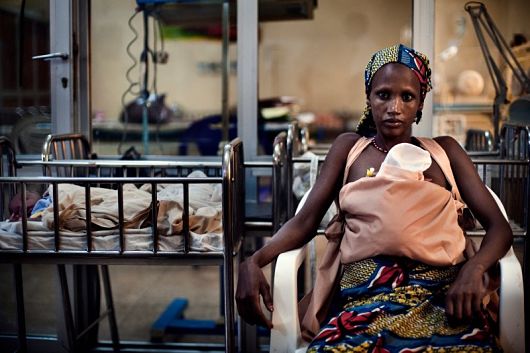
Nigeria is second only to India in terms of the number of maternal deaths it experiences, and along with five other countries—India, Pakistan, The Democratic Republic of the Congo, China and Ethiopia—Nigeria is part of a group which makes up more than 50 percent of the maternal mortalities that occur in the world.
The Maternal Mortality Rate (MMR) in Nigeria was 560 per 100,000 live births in 2013. As UNICEF states, Nigeria loses 145 women to maternal mortality each day. This high level of maternal mortality is also linked to Nigeria’s high rate of deaths for children under 5—newborns account for a quarter of the under-five deaths which occur in the country.
There are many reasons why maternal mortality in Nigeria is so high, including a lack of access to healthcare, rampant poverty, substandard health care and the prevalence of child marriage.
Urban women have more of an opportunity to receive healthcare than rural women do. As stated in a Global One report about Nigeria, women in urban areas have over twice as many deliveries taking place in public and private health facilitates than women in rural areas. This is because women in rural areas are normally not able to afford the transport to the hospitals in urban areas, and have to settle for midwives or traditional birth attendants—or no help at all—when giving birth. Many of these traditional birth attendants do not have the skills and training necessary for delivering a baby—for example, many are not able to perform C-sections—and for treating complications that can occur during birth.
Rural women do not have the money to travel to hospitals to receive better care. Nigeria has a high poverty rate, with a 2010 report stating that 64.4 percent of the population lived in extreme poverty and 83.9 percent of the population lived in moderate to extreme poverty. The fact that many people cannot afford the healthcare that they need contributes to Nigeria’s high MMR.
Even if women in Nigeria are able to have access to a hospital, they sometimes still end up suffering. This is because some hospitals in Nigeria have substandard care. For example, Global One’s report states that substandard birth techniques in government hospitals in North-Central Nigeria, including poor C-section procedures, accounted for 40 percent of all fistula injuries suffered by women in Nigeria.
A fistula, according to the World Health Organization, is a hole in the birth canal. Fistulas are directly connected to obstructed labor, a problem that contributes to high levels of maternal mortality. Even if women survive labor, many of them still have to live with the fistula. Approximately two million women live with an untreated obstetric fistula in Sub-Saharan Africa and in Asia, and women with fistulas suffer incontinence, social segregation and health issues.
Fistulas are more common in women who give birth at a young age. These women’s bodies are not ready for childbirth, leading to many health problems, including obstetric fistulas. Nigeria has an extremely high rate of child marriage—43 percent of girls get married before the age of eighteen—and many of those girls are not given the option of whether or not they want to get pregnant. Contraceptive use is slowly becoming more widespread and acceptable, but in 2008, only 10 percent of women used contraceptives.
Since contraceptive use is still stigmatized, many brides under the age of 18 are forced to give birth, and their bodies are very vulnerable to complications, therefore contributing to a high maternal mortality rate. Nigeria also has a high fertility rate—five children per woman in 2014—which also impacts the MMR.
If Nigeria wants to reduce its high levels of maternal mortality, it has to make sure that access to healthcare is more widespread. It also needs to improve the quality of healthcare available, reduce the number of child marriages and de-stigmatize contraceptive use.
– Ashrita Rau
Sources: UNICEF, WHO 1 WHO 2, WHO 3, WHO 3, Global One Girls not Brides, IRIN News CIA World Factbook
Photo: Healthy Newborn Network

Maternal Mortality Rates in China Plummet
Fifteen years ago, a summit convened. All member states of the United Nations at the time gathered and agreed on eight international development goals. The Millennium Development Goals (MDG), as they are named, were adopted to better lives in the developing world.
One of the countries highlighted was China, and it has surpassed the world’s expectations, improving health for mothers and their children – ahead of the 2015 target date.
The National Health and Family Planning Commission (NHFPC), an organization within the People’s Republic of China that works at the policy level to improve medical conditions for Chinese families, stated that, as of June 10, 2015, maternal mortality rates have dropped dramatically over the past 25 years. This exceeds the fifth Millennium Goal and has made a powerful impact on the lives of Chinese women.
The maternal death rate in China dropped significantly since 1990. In fact, it has plummeted 75.6 percent. In 1990 death rate among mothers giving birth was 88.8 per 100,000 compared to 21.7 per 100,000 in 2014.
Maternal mortality rates can be an important indication of the health of a nation and China’s success, attributed in part to its growing economy, better funded health care and allowances provided for rural women to give birth in hospitals, suggests extraordinary progress.
The gap between urban and rural pregnancies has always been vast in China with rural care significantly lower, but in past years access to medical services in less populated areas has improved as well. The hospital delivery rate in rural families was merely 36.4 percent in 1990 while in 2014, the rate had increased to 99.6 percent.
Additionally, the NHFPC said that in 2014, seven years ahead of the Millennium Development Goals deadline, infant death rates and mortality for children under 5 dropped to 8.9 per thousand and 11.7 per thousand, respectively.
In Nanning, capital of southwest China’s Guangxi Zhuang Autonomous region, several health vehicles, with the help of two organizations, were put into operation devoted to impoverished rural women in need of maternal care.
All-China Women’s Federation (ACWF) and the China Women’s Development Foundation (CWDF) donated 30 Health Express for Mothers mobile medical units in 2009 and 10 more in August 2011. During the year before the ceremonial departure on August 4, 2011, over 4,000 maternal women and 500 more critical patients were helped by the service.
Medical units such as the ones in Nanning have helped thousands of women, given training to over 17,000 medical workers and have brought health benefits to millions of rural residents.
China has made leaps and bounds in the care for its women and children. Increased healthcare funding and better medical facilities accompanied with the grass roots efforts of tenacious citizens have demonstrated China’s ability to go above and beyond the world’s expectations, improving life for its people.
– Jason Zimmerman
Sources: Women of China, Women of China, The Lancet, Women of China, China.org
Photo: MedHealthNet
Global Poverty and National Security: Soft Power and Prevention
Many people view foreign aid programs as acts of charity. However, through “soft power” and preventative measures, international assistance can play an important role in national security as well.
Poverty Reduction as Soft Power
Influential political scientist Joseph Nye coined the term “soft power” in 1990 to describe the ability of one nation to influence another without resorting to force. It’s the alternative to “hard power,” which includes military force and economic sanctions.
Cultural influence and moral authority are important aspects of soft power. When a country is seen as being morally upstanding by the world community, it achieves greater influence. For instance, if a country is strongly democratic, it can influence others by promoting democracy abroad.
In a similar way, soft power can improve national security. In a world that is increasingly democratic and interconnected, national reputation has grown in importance. Through soft power, a country can seek to influence world opinion to prevent acts of aggression or terrorism.
Foreign assistance is an important tool to improve national reputation. When a country takes the lead in humanitarian relief or international development, it improves its standing and influence. It makes cooperation more likely and conflict less so.
Poverty Reduction as a Preventative Measure
It’s no secret that violent extremism tends to flourish in desperate places. Poverty grinds down civil society and weakens government institutions. Without strong governance, many people turn to armed rebel groups for services. For instance, during the civil wars in Afghanistan, many turned to extremist schools for education and to the Taliban for protection.
The U.S. Department of Defense has long recognized this reality. Robert Gates, former defense secretary, viewed international development as a way to prevent conflicts from starting.
“The way you do that is through development. Development creates stability, it contributes to better governance,” Gates said in 2010. “If you are able to do those things, if you are able to do it in a focused and sustainable way, then it may be unnecessary to send soldiers.”
Global poverty causes conflict and perpetuates it. While the United States has the strongest military in the world, it can only react to dangers as they arise. Increased spending for foreign assistance would improve national security by reducing the likelihood of conflict and unrest.
That’s a sentiment that President Obama agrees with as well. In a recent interview with Vox.com, the president conveyed his view of foreign aid as a “tool in our national security portfolio, as opposed to charity.” The president proposed strategic investments in key countries to reduce the need to deploy the U.S. military abroad. “We would be in a better position,” he stated, “to work with other countries to stamp out violent extremism.”
– Kevin McLaughlin
Sources: Department of Defense, Foreign Affairs, Vox.com
Photo: Flickr
How a New Program is Providing Safer Schools for the World’s Poor
On April 25, 2015 a 7.8 magnitude earthquake hit Nepal. Two thousand schools collapsed, and five thousand others were damaged, forcing children to abandon their studies.
In the developing world nothing is more important than education, and when an already weak infrastructure crumbles under a natural disaster, it can be devastating for schools and a catastrophic defeat in the fight against poverty.
The Nepal earthquake was not an isolated incident. Every year natural disasters wreak havoc on underdeveloped nations, destroying the lives and property of millions. In 2013 the Philippines was the victim of a destructive typhoon that damaged 2,500 schools and disrupted the critical studies of 1.4 million children. And two years later, in March 2015, Cyclone Pam dramatically affected the Republic of Vanuatu.
The Global Program for Safer Schools (GPSS), recently created to address these issues, is managed by the Global Facility for Disaster Reduction and Recovery (GFDRR). The new initiative is not only building demolished school buildings but also reinforcing and retrofitting schools at risk in catastrophe prone areas.
GPSS maintains relationships with a wide range of international partners, including the United Nations and agencies such as UNICEF, UNESCO and UNISDR, international NGOs like Save the Children and private sector companies such as Arup. Additionally, it works with ministries of finance, public works and education, integrating risk considerations and investing in large scale education benefits for communities.
The lack of education around the world is shocking, and its effect on poverty are staggering. Nearly a billion people entered the 21st century unable to read a book or sign their name. Less than 1 percent of what the world spent every year on weapons was needed to put every child into school by the year 2000. Yet it didn’t happen. Based on enrollment data, about 72 million children of primary school age in the developing world were not in school in 2005.
Clearly education is a necessity, playing a vital role in alleviating poverty around the globe, but it is a luxury much of the world does not have, perhaps more so for girls. The state of school facilities in the developing world can be extremely fragile, and protecting them could make an immense difference.
Maternal deaths could be reduced by two thirds in the world if all mothers completed school, saving 98,000 lives. An extra year of secondary school boosts girls’ eventual wages by 15-25 percent. When women and girls earn income, they reinvest 90 percent of it in their families – buying books, medicine and bed nets and ensuring education for their children. Girls who stay in school for seven or more years typically marry four years later and have two fewer children than girls who drop out. And fewer dependents per worker allows for greater economic growth.
As much as 55 percent of the reduction in hunger from 1970 to 1995 can be attributed to improvements in women’s education and their status in society. School-based HIV/AIDS education programs are effective in preventing HIV infection, reducing the burden of this disease on families and communities.
Education can be one of the greatest tools fighting global poverty today. The Global Program for Safer Schools, through rebuilding disaster stricken institutions and retrofitting those at risk, ensures that disadvantaged children around the world have a chance.
– Jason Zimmerman
Sources: World Bank, Global Facility for Disaster Reduction and Recovery, Global Facility for Disaster Reduction and Recovery, New Internationalist, UNICEF, United Nations
Photo: Plan
5 Things You Didn’t Know About the Sex Trafficking Industry
Below are the top five things you didn’t know about the sex trafficking industry.
1. Trafficked children are treated and tried as criminals even though federal law defines anyone under the age of 18 as a victim.
U.S. Federal law states that no one under the age of 18 is able to give consent to any sexual acts. However, children under the age of 18 are tried as prostitutes and criminals every day. There is an inherent flaw in the U.S. judicial system, which seems to allow survivors to be treated as criminals. Most of these children were forced into the industry and have no means of escaping except through the law, but when law enforcement officials are after them as well, it is no wonder that so many children feel trapped.
2. Many children in the trafficking industry do not believe they are victims.
When children are first recruited into the sex industry they are brainwashed. The younger the child the more they are convinced that working in the sex industry is the only job for them. Most survivors believe that they owe their “pimps” something, that there is no life for them outside of the trafficking industry because they have seen so many horrible things. For this reason, many sex trafficking survivors do not immediately seek assistance.
One survivor explained her thought process to the Girls Educational and Mentoring Services (GEMS), stating that the reason many “victims” dislike the term victim is because they are truly survivors. These men and women have survived horrible conditions and have seen things that no one could ever imagine, yet they persevere and survive through it all.
3. Boys make up 50 percent of the children trafficked in the U.S.
While the typical image of a trafficking victim is a young girl, clueless about the situation and finding herself having to tough it out on the rough streets, this excludes half of the trafficked population. Many young boys are taken and sold as workers or sex workers. These young men are especially susceptible to suicide and drug abuse because society does not accept them. The most dangerous areas for trafficking are New York City, Florida and California.
4. There are an estimated 27 million adults and 13 million children around the world who are victims of human trafficking.
There are more slaves in the world at this moment than there have ever been at any point in history.
5. Pregnant women are some of the most trafficked individuals.
Surprisingly, many pregnant women are at higher risk to be trafficked. Women who get pregnant while in the trafficking industry will often profit off of the pregnancy. Traffickers sell newborn babies to black market industries and split the profits between the doctors, lawyers, shippers and caretakers, leaving the mother with a small sum of money in place of a child.
Many organizations are working to crack down on the sex-trafficking industry and hopefully, with better surveillance and harsher laws, a new beginning can be found.
– Sumita Tellakat
Sources: Alternet, Facts, Polaris Project
Photo: All Girls Allowed
Everjobs Emerges in Senegal
Everjobs, an online job portal created by Rocket Internet, has begun operations in Dakar, Senegal. This job portal was created to simplify the job search and hiring process by connecting job seekers with employers.
Everjobs is also currently operating in eight other developing countries, including Myanmar, Bangladesh and Cambodia.
This online job portal supports Senegal’s new initiative, “Plan Senegal Emergent.” With this initiative, Senegal seeks to establish itself as an emerging country by 2035. With a hope to better lives for generations to come, youth employment is at the top of this agenda.
Because Everjobs is online, it is hoping to attract tech savvy youths. This strategy focuses on complying with Senegal’s initiative for youth employment.
Everjobs hopes to pave the way for Senegalese to match their skills and create a career path. It focuses on the job seeker’s core skills, expertise and interests in order to explore potential career paths that suit the seeker. By taking into account these factors, this type of application process categorizes jobs that are not suitable for the job seeker.
One feature that sets Everjobs apart from other job portals is the expert Job Journal. This feature provides the job seeker with knowledge that will motivate, inspire and track their progress while using the job portal.
Everjobs addresses the need to focus on industries with a high turnover rate, such as hospitality and banks. This aspect will help Senegalese to have the opportunity to work in these industries, gain job experience and hopefully find a career they enjoy.
The co-founder and Managing Director for Africa, Eric Lauer said, “Heads of HR are concerned that a lack of basic CV writing knowledge and poor interview preparation resources have contributed to a fall in employability among its youth.”
With the resources provided by Everjobs, the youth of Senegal will gain the necessary skills in order to complete a successful resume, leave a lasting impression during an interview and gain employment. In order to fulfill Senegal’s initiative, “Plan Senegal Emergent,” it is imperative for the youth to learn the skills to gain employment. With the help of Everjobs, this can be achieved.
Senegal has set a fast pace plan to move from a developing country to an emerging country in as little as 20 years. Because of the online component of Everjobs, it is attractive to the youth seeking employment. With access to an easy to use, resourceful online job portal like Everjobs, Senegal will transition into an emerging country. With the many resources that Senegal’s youth need in order to gain employment, Everjobs will bring about the change Senegalese have been hoping for.
– Kerri Szulak
Sources: CP Africa, IT News Africa
Photo: Senegal Business Services
Ex Novo: A Charitable Brewery
A company that unites good beer, good food and good causes seems too good to be true. But the Ex Novo Brewing Company in Portland, touting itself as “a 10-barrel non-profit brewery,” is making this dream a reality.
The charitable brewery was founded by former engineer Joel Gregory, who stated in an interview with Portland Monthly Magazine that he “felt compelled to help in any way.” And with the brewery’s charitable efforts supporting causes such as Mercy Corps’ work with Syrian refugees and the International Justice Mission, Mr. Gregory is helping.
The alcohol industry is not exactly known for its charitable efforts. By taking the growing craft beer craze and using it as an opportunity to do good, Ex Novo is bringing charity to the beer industry, and bringing change to the world.
And they’re doing it deliciously. Food items served at the brewery include bacon, cottage pie and a pork meatball banh mi. Beers include Irish Stouts, IPAs and a variety of Saison brews. In addition, the brewery serves homemade brownies and a stout milkshake.
The first non-profit brewery is receiving nothing but praise for these features. Customers on Yelp praise the non-profit nature of the establishment, along with the charitable brewery’s expansive food and drink menu. Though Ex Novo does not currently bottle or can its beer, it can be found on tap throughout the Portland area.
Opened in July 2014, it would appear that the one-year-old brewery is making a big splash in Portland. And with its delicious menu and good reputation, the organization can change both lives and tastes.
Only time will tell if Ex Novo’s conception of the not-for-profit brewery will have an impact in the beer industry. Through its support of Mercy Corps’ fight to end the cycle of refugee poverty and the International Justice Missions’ fight against global systems of exploitation, Ex Novo is a wonderful example of a local business making a global difference in the fight against poverty.
– Andrew Michaels
Sources: Portland Monthly Magazine, Ex Novo Brewing Company, Yelp, Eater, International Justice Mission, Mercy Corps
Photo: Koperski
Cambodian Child Sex Trade Supported by Parents
Svy Pak is a shanty town on the outskirts of the capital of Cambodia, Phnom Penh. It is one of the most disadvantaged neighborhoods of one of Asia’s poorest cities. The population lives on less than $2 per day. As such, a child’s virginity is considered to be an extremely valuable asset because of the prices willing to be paid for it. Doctors in Cambodia perform what’s known as a “virginity check” on a child and then issue a “certificate of virginity.” This is meant to ensure buyers who want virgins that they are getting them. In some cases, a child’s virginity is sold before he or she is even born, and deposits for virginities can be easily made on toddlers. Selling one’s child for sex provides a steady source of income for families willing to make the sacrifice.
The child sex trade has blown up in Svy Pak. The town is known to pedophiles around the world as the go-to place for buying little girls. In 2008, Apage International Missions (AIM) found that 100 percent of the kids in the town between the ages of eight to 12 years of age were being trafficked for sex. The organization has rescued children as young as four years old from traffickers. UNICEF estimates that one third of the population in the sex industry is children in Cambodia, and amounts to 40,000 to 100,000 kids total.
Cambodia is a country where children have a long history of being a major export product. A young girl by the name of Kieu was sold by her mother at the age of 12. Over the course of six months, her mother sold her virginity and then forced her to work at five brothels in both Cambodia and Vietnam. Only when her mother began to make arrangements at the sixth brothel to rent her daughter out for sex did Kieu run away to find safety. CNN spoke to her mother, who said, “It was because of the debt, that’s why I had to sell her.”
The men who abuse these children fit many different profiles and backgrounds. Some are pedophile sex tourists who actively seek out sex with prepubescent children. Others are more opportunistic, situational offenders who simply take advantage of opportunities that present themselves to engage in sex with children. Then there are those for whom health-related beliefs about the protective or restorative qualities of virgins catalyze their interest in child sex.
Sex tourists tend to come from affluent countries all over the world, such as European countries, South Korea, Japan and China. But research suggests that Cambodian men remain the main exploiters of child sex trafficking in their country. Although the selling and buying of sex is illegal, not one Khmer man has ever been convicted for purchasing virgins. The police argue that they are limited in prosecuting these violations because of a lack of expertise, technical equipment and evidence collection tools. Corruption is also a barrier for law enforcement, as Cambodia is number 160 of the 175 countries on the Transparency International’s Corruption Perception Index.
The actions of the parents in Cambodia who sell their children for sex is deplorable and inexcusable. Since the beginning of time, people have been poor, but they have not always been selling their children. Something must be done.
– Erika Wright
Sources: ABC, CNN 1, CNN 2, The Guardian, Spiegel Online
Photo: Brandon Patoc Photography
Goodeed and Freerice: Two Easy Ways To Help
Helping those in need has never been easier with Goodeed and Freerice, websites that make it incredibly simple for those with computer access to make a difference in the lives of the less fortunate.
Goodeed allows users to donate to a cause for free. How is that possible, donating for free? On the website, you watch a twenty-second advertisement, and the revenue from watching the ad goes to one of three causes: trees, vaccines or meals.
The trees are in the East Khasi Hills in the Meghalaya forest in India. This area is known as the wettest place on earth and is under serious threat. Goodeed partnered with WeForest to not only conserve local biodiversity and the livelihood of the people but also to promote women’s entrepreneurship and empower the indigenous community.
The vaccines are delivered to Chad, where the goal is to completely eradicate polio. Today, 80 percent of people get vaccinated for polio, and Goodeed wants that percentage to be 100. Lastly, the meals go to Kenya schools to ensure that students get at least one nutritious meal a day. Goodeed teamed up with the World Food Programme to make this happen.
Each person can make a total of three donations a day, a grand total of 60 seconds of your time to support three worthwhile causes.
Freerice operates on a similar platform of effortless community involvement. Freerice is an English vocabulary test where, with each question answered correctly, 10 grains of rice are donated.
Freerice works with the World Food Programme to deliver rice to areas in need. They fed 27,000 refugees of Myanmar in Bangladesh for two weeks, and in Cambodia, they provided take-home rations of rice for over 13,500 pregnant and nursing women who needed it over the span of two months. In addition, they have sent rice to Uganda, Nepal and Bhutan.
Freerice is an educational tool for children in the First World, as well as an asset to the Third World. Melissa Foor, a middle school teacher in the United States, used Freerice as a vocabulary lesson for her students. Her classroom, as well as those of other inspired teachers in the school, raised 1,000,000 grains of rice. The students practiced vocabulary and learned a lesson on helping others.
There is a fine line between what people are willing to sacrifice to help others and what they are not. Goodeed and Freerice have made this sacrifice so minimal that making a difference in the lives of others takes no more than 60 seconds, and you can even have a little fun while doing it.
– Hannah Resnick
Sources: Freerice, Goodeed, The Next Web, World Food Programme
Photo: World Food Programme
Why Somalia has a High Malnutrition Rate
Over the past years, famine and food insecurity have threatened the lives of thousands of people in Somalia. These threats were, and are, some of the worst in decades. The famine in 2011 was the first famine in the Horn of Africa in over 30 years—it killed 250,000 people. Currently, about 1 million people in Somalia are food insecure and are in desperate need of assistance. There are around 236,000 children under 5 who are malnourished.
What makes Somalia so prone to these famines and to having high malnutrition rates?
For 20 years, Somalia has been in conflict. Civil war destroyed the nation. It affects how much food can be grown and destroys crops. People have to flee and cannot tend to their crops and livestock.
The conflict left the country in a state of political turmoil. So, when the drought hit in 2011, Somalia was unable to deal with the disaster. People did not receive aid from the government and foreign aid had difficulty reaching its people.
Droughts, as well as floods, continue to plague Somalia. Having crops destroyed every so many years makes it difficult to make progress in decreasing the malnutrition rate. Additionally, with a still unstable government, aid was not there. In 2014, the country once again had a threat of another famine, with up to 3 million people in need of aid.
Also contributing to the cause of high malnutrition rates is the lack of development in the younger generations. Only 42 percent of children are enrolled in school, with less than half of them being girls. Young people make up 42 percent of the population, with 67 percent of them unemployed because of a lack of education.
Without an education, these youths cannot get jobs to earn a steady income, one that would be enough to provide food for their children. The children are raised in poverty, with little food. Unlikely to escape poverty, the next generation will most likely fall in the same category. It is a difficult cycle to break, one that can contribute to the high malnutrition rates in Somalia.
Despite the hardship in Somalia, the World Food Program continues to work in Somalia to lower malnutrition rates. They provide job vocational trainings so that youths can get a job. They hand out food rations to attract parents to send their children, especially daughters to school. The WFP continues to provide nutritional and health aid in Somalia.
– Katherine Hewitt
Sources: Action Against Hunger, BBC, Huffington Post, WFP, UNICEF
Photo: Global Giving
Maternal Mortality in Nigeria
Nigeria is second only to India in terms of the number of maternal deaths it experiences, and along with five other countries—India, Pakistan, The Democratic Republic of the Congo, China and Ethiopia—Nigeria is part of a group which makes up more than 50 percent of the maternal mortalities that occur in the world.
The Maternal Mortality Rate (MMR) in Nigeria was 560 per 100,000 live births in 2013. As UNICEF states, Nigeria loses 145 women to maternal mortality each day. This high level of maternal mortality is also linked to Nigeria’s high rate of deaths for children under 5—newborns account for a quarter of the under-five deaths which occur in the country.
There are many reasons why maternal mortality in Nigeria is so high, including a lack of access to healthcare, rampant poverty, substandard health care and the prevalence of child marriage.
Urban women have more of an opportunity to receive healthcare than rural women do. As stated in a Global One report about Nigeria, women in urban areas have over twice as many deliveries taking place in public and private health facilitates than women in rural areas. This is because women in rural areas are normally not able to afford the transport to the hospitals in urban areas, and have to settle for midwives or traditional birth attendants—or no help at all—when giving birth. Many of these traditional birth attendants do not have the skills and training necessary for delivering a baby—for example, many are not able to perform C-sections—and for treating complications that can occur during birth.
Rural women do not have the money to travel to hospitals to receive better care. Nigeria has a high poverty rate, with a 2010 report stating that 64.4 percent of the population lived in extreme poverty and 83.9 percent of the population lived in moderate to extreme poverty. The fact that many people cannot afford the healthcare that they need contributes to Nigeria’s high MMR.
Even if women in Nigeria are able to have access to a hospital, they sometimes still end up suffering. This is because some hospitals in Nigeria have substandard care. For example, Global One’s report states that substandard birth techniques in government hospitals in North-Central Nigeria, including poor C-section procedures, accounted for 40 percent of all fistula injuries suffered by women in Nigeria.
A fistula, according to the World Health Organization, is a hole in the birth canal. Fistulas are directly connected to obstructed labor, a problem that contributes to high levels of maternal mortality. Even if women survive labor, many of them still have to live with the fistula. Approximately two million women live with an untreated obstetric fistula in Sub-Saharan Africa and in Asia, and women with fistulas suffer incontinence, social segregation and health issues.
Fistulas are more common in women who give birth at a young age. These women’s bodies are not ready for childbirth, leading to many health problems, including obstetric fistulas. Nigeria has an extremely high rate of child marriage—43 percent of girls get married before the age of eighteen—and many of those girls are not given the option of whether or not they want to get pregnant. Contraceptive use is slowly becoming more widespread and acceptable, but in 2008, only 10 percent of women used contraceptives.
Since contraceptive use is still stigmatized, many brides under the age of 18 are forced to give birth, and their bodies are very vulnerable to complications, therefore contributing to a high maternal mortality rate. Nigeria also has a high fertility rate—five children per woman in 2014—which also impacts the MMR.
If Nigeria wants to reduce its high levels of maternal mortality, it has to make sure that access to healthcare is more widespread. It also needs to improve the quality of healthcare available, reduce the number of child marriages and de-stigmatize contraceptive use.
– Ashrita Rau
Sources: UNICEF, WHO 1 WHO 2, WHO 3, WHO 3, Global One Girls not Brides, IRIN News CIA World Factbook
Photo: Healthy Newborn Network