Words like eco, organic, healthy, tasty, and sweet can be found in one single product: chocolate.
If the word “chocolate” is not sufficient enough, the other good part is that many of these organic chocolate products are also fair trade chocolate bars that are creating a social change and an environmental impact.
Besides being socially and environmentally good, there are some brands of chocolate who also donate to different humanitarian and environmental causes.
Here are six chocolate brands that are creating social change:
1. Madécasse
This is a social enterprise that makes chocolate products and vanilla in Madagascar. According to their website, Madécasse measures their success by the quality of the product and the social impact they make in Africa.
The enterprise started by empowering cocoa farmers in Madagascar, and by providing training and higher wages. The brand also creates an environmental impact by protecting around 70,000 cocoa trees, that are part of the habitat of over 65 species of flora and fauna, through cocoa farming.
Some of the chocolate bars that Madécasse sells are Salted Almond, Sea Salt & Nibs, Toasted Coconut, among others.
2. Alter Eco
According to the Alter Eco website, the brand is reliably delicious, socially fair, and environmentally responsible. They work directly with farmers that grow cacao, sugar, rice, and quinoa through fair trade and organic practices. Alter Eco assists these farmers by improving their food quality and their life quality.
Some of the areas that Alter Eco works on are fair trade relationships, development of programs, and the empowerment of women. The brand’s products have compostable packaging and are organically grown.
Despite of not being a brand that only sells cocoa products, Alter Eco counts with a variety of chocolates and truffles. Some of the chocolate bars and truffles available are Dark Brown Butter, Dark Quinoa, Dark Mint, Dark Velvet, Salted Caramel Truffles, Sea Salt Truffles, among others.
3. Divine Chocolate
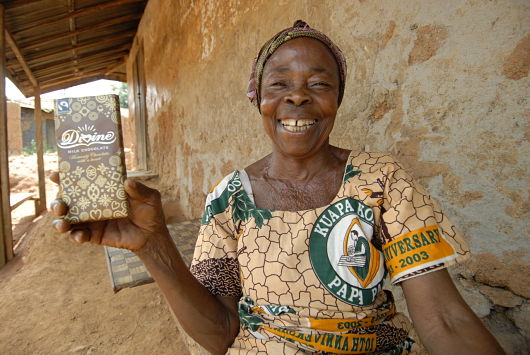
Divine Chocolate is an entity co-owned by 85,000 farmers in Ghana. From Kuapa Kokoo, these farmers produce fair trade chocolate through the premium quality cocoa that Kuapa’s has.
The brand also works for women’s empowerment by providing opportunities to women in cocoa farming. Furthermore, Divine Chocolate improves access to information for cocoa farmers through funds that support the Kuapa’s radio program.
Some of the chocolate products that Divine Chocolate offers are 38 percent Milk Chocolate with Toffee and Sea Salt, Dark Chocolate with Hazelnut Truffle, Dark Chocolate with Whole Almonds, and 70 percent Dark Chocolate with Mango & Coconut.
4. Equal Exchange
Through fair trade, Equal Exchange counts with different natural food products offered to consumers. They work with small-scale farmers and their co-ops from different countries around the world, such as India, Ecuador, Peru, El Salvador, Uganda, Chile, among others.
Some of the products that the brand offers are coffee, organic tea, organic bananas, fair foods, and chocolate & cocoa. The brand sells organic chocolate bars, chocolate mints, candy bars, cocoa, and chocolate chips.
Some of the chocolate options available for purchase are Organic Very Dark Chocolate, Organic Panama Extra Dark Chocolate, Organic Mint Chocolate with Delicate Crunch, Organic Baking Cocoa, Organic Spicy Hot Cocoa, Organic Semi-Sweet Chocolate Chips, among others.
5. SHAMAN Organic Chocolates
This brand of chocolate was created in order to support the Huichol Indian population from central Mexico. SHAMAN Organic Chocolates’ goal is to create good and ethical chocolate while they help this Indian population from Mexico.
The brand’s chocolate is a 100 percent organic, GMO free, it is fair trade chocolate, and 100 percent of the profits are donated to charity that supports three Huichol villages in Mexico.
6. Endangered Species Chocolate
Endangered Species Chocolate promotes global change by donating 10 percent of their profit to their partner organizations that support different humanitarian and environmental causes.
The causes that the brand’s partners support are the conservation of species, habitat conservation, and humanitarian efforts.
The brand pays for premium ingredients for their chocolate in order to make sure that cocoa farmers are being supported and helped, and species are being protected.
The products that Endangered Species Chocolate offers are Natural Cocoa Spread, Natural Hazelnut with Cocoa Spread, Natural Almond with Cocoa Spread, 60 percent Dark Chocolate with Lemon Poppy Seed, 60 percent Dark Chocolate with Blackberry Sage, 60 percent Dark Chocolate with Cinnamon, Cayenne & Cherries, Dark Chocolate with 88 percent Cocoa, and Dark Chocolate.
With many brands offering fair trade organic chocolate products, helping the environment, people and donating to charity can be a way to support many humanitarian and environmental causes, and contribute to the social change that these chocolate brands are creating.
– Diana Fernanda Leon
Sources: Madecasse 1, Madecasse 2, Madecasse 3, Alter Eco Foods 1, Alter Eco Foods 2, Alter Eco Foods 3, Alter Eco Foods 4, Alter Eco Foods 5, Divine Chocolate 1, Divine Chocolate 2, Endangered Species Chocolate, Shaman Organic Chocolates, Equal Exchange
Photo: Dubaruba

Eliodomestico: Solar Powered Water Purifier
Established in 2000, one of the Millennium Development Goals was to increase the availability of clean drinking water. More specifically, the United Nations aimed to reduce the number of people without access to safe drinking water in half. In 2010, this goal was met. In fact, it was the first Millennium Development Goal to be met.
Despite these advancements, over 750 million people lack access to clean drinking water even today. That’s almost two and a half times the population of the United States without safe water. That’s about 1 in 9 people in total.
This is what Italian designer Gabriele Diamanti wanted to change with the Eliodomestico, a solar powered ceramic water purifier. The Eliodomestico boils water to separate the unwanted elements from the clean drinking water.
Diamanti wanted to make something simple and inexpensive, using materials found in the area so that a local craftsman could put it together. In the end, Diamanti built the Eliodomestico to work like “an upside-down coffee percolator”.
The Elliodomestico is made of terracotta, anodized zinc and recycled plastic. It consists of two ceramic containers, one atop the other. Salt water is poured into the top container, which then gets heated by the sun and converted to steam. The increase in pressure forces the steam to travel through a tube to the lower container where it re-condenses. The clean drinking water gathers at the bottom of the lower container.
The Eliodomestico collects about 5 liters of clean drinking water per day, and it only costs $50 with no operating costs. In addition, the bottom container can be easily removed and transported on the head of the user, a common practice in developing countries.
Because the Eliodomestico doesn’t use electricity or filters, it is easier to maintain and more efficient than other solar water purifiers. Most solar powered water filters use a solar panel, which increases the cost and the style-factor, but not the efficiency. The Eliodomestico is efficient, cheap and easy to use and maintain, making it a simple solution to a wide spread problem.
– Hannah Resnick
Sources: Gabriele Diamanti, Giz Mag, Global Citizen, Inhabit, UN Millennium Project, Water.org
Photo: Gabriele Diamanti
Allversity: The e-Learning Program for Developing Nations
The connection between education and poverty is a well-established one: a lack of resources often leads to deprivation of proper education, and the lack of education further fuels this cycle of poverty. Education does not only form the foundation for a healthier, safer society, but also invariably stimulates the economy by providing more jobs. Education is therefore one of the most potent tools we have today to fight global poverty.
Despite the efforts by the international communities, many regions of the world continue to lag behind in the educational arena. In many developing countries, education is inaccessible to the masses; there is a gap in basic literacy due to socioeconomic or gender status. According to UNESCO’s Education for All Global Monitoring Report that tracks the educational goals of the world, fifty-seven million children worldwide are not receiving an education. The report extrapolates the results to conclude that the world is still far from realizing the goal of universal primary education.
The facts and figures only serve to confirm the unfortunate state of education globally. Many startup companies in the western world have been attempting over the last decade to come up with innovative, technology-based solutions to the issue of illiteracy. In late 2013, a Berlin-based group of technology entrepreneurs introduced their efforts at a solution in the form of Allversity.
Allversity is a non-profit e-learning platform, which links students in the developing world with teachers and community learning centers. According to 2013 UNESCO (United Nations Educational, Scientific and Cultural Organization) report, the world needs as many as 1.6 million additional teachers to ensure universal primary education. The lack of teachers is a major factor in the gap between global educational goals and current situation. The provision of online tutoring is a creative answer to this problem
The program offers a wide variety of subject matters, from prenatal care, to first aid and basic computer skills. The learning community also offers the education of basic entrepreneurial and technology skills. Allversity also has courses for more traditional school-taught subjects, such as math, science and history. The course list is dynamic: new courses and subjects are added as per teachers’ and students’ show of interest or requirement.
The materials of the course are in English at the moment, which makes it difficult for many to benefit from the learning interface. However, plans are already under way to offer translated materials in languages such as Swahili and Arabic to effectively reach more people.
Another problem the initiative faces is the lacking internet accessibility in many remote areas of the world. Many prospective students also might not have access to a computer or electronic device, necessary for Allversity. As internet connectivity increases worldwide, however, the program will undoubtedly become more readily usable.
Moreover, there are already efforts by the program’s developers to design smartphone applications that can be used offline once downloaded. It is estimated that around 40 per cent of the African population will own a smartphone by by 2017. The mobile version of Allversity will thereby increase the enrollment of students manifold.
The program faces a few challenges down the road regarding its objectives of global education, but this remains a laudable effort in the journey towards universal education.
– Atifah Safi
Sources: Venture Village, Allversity, UNESCO
Photo: Online Universities
UN Funding Crisis Could Lead to Massive School Year Delay
The United Nations is in the midst of its most severe funding crisis to date and the amount of people affected by it is continuing to rise.
The UN Relief and Works Agency for Palestine Refugees in the Near East (UNRWA) is one of the UN agencies most heavily affected by a lack of funding. After a recent emergency meeting conducted by its Advisory Commission, the UNRWA said that “drastic measures” would have to be taken if the current deficit of $101 million couldn’t be funded before the upcoming school year.
If the deficit is not met, the academic year could be delayed for over half a million students in the middle east across nearly 700 schools. The UN stresses, however, that there is still enough funding available to provide “immunizations for children, primary health care, relief and sanitation and some emergency programmes” through the end of 2015.
The UN has also stated that from September and on it can’t ensure the stability of those resources.
“Education lies at the very heart of the identity and dignity of Palestine refugees and of what UNRWA stands for,” says a UNRWA press release concerning the issue. “Our schools also provide a measure of stability in a very unstable region. Possible delays in opening the school year would also have grave implications for host governments.”
These budget cuts also have a serious effect on Palestinian refugees currently living in the Gaza Strip. Children who attend school in the region received $20 cash vouchers until very recently, when that service stopped entirely along with free meals provided at schools.
Coupled with additional UNRWA assistance is often what families depend on. Continuing to cut these services could have severely life-altering consequences.
“Our conditions worsen every day,” Bilal Mekdad, a Gaza Strip refugee, told the Anadolu Agency. “We fear the day we will find ourselves in the street.”
– Alexander Jones
Sources: Anadolu Agency, UN 1, UN 2
Photo: Anadolu Agency
What is Global Health and Why Should I Care?
Global health—what does that mean exactly? It isn’t the word “health” that gives us pause. It isn’t the word “global” either. But put the two words together, and people are not sure if it means health in developed countries as well as health in developing countries. Yet we know that “global” means the entire world. Anyway, why does it matter?
Commonly, we tend to think that health issues in developing countries refers to infectious diseases, while health issues in developed countries refers to chronic medical conditions. News of health issues in developing countries focuses on tropical diseases such as Ebola or diseases that have been eradicated in the developed nations such as polio and smallpox. In developed countries, news or feature stories on how to take care of our health focus on diabetes, heart attacks or strokes.
When diseases such as Ebola emerge in a developed country such as the U. S., we are jolted by the knowledge—knowledge we already have—that infectious diseases know no geographic boundaries. Ebola is not the only tropical disease to reach the U. S.
The chikungunya virus has reached a cumulative total of 2,500 cases since 2013 in the U. S. Erik Iverson, President of Business and Operations at the Infectious Disease Research Institute in Seattle, expects a “dramatic and well-reported increase in the number of chikungunya cases suffered in the U.S. over the next couple years—particularly from Florida up through the Eastern Seaboard.”
Chikungunya is a viral disease transmitted from human to human by the bites of infected female mosquitoes. Fever and debilitating joint pain are the outstanding symptoms. It has no cure but is usually not permanent or fatal. It can occasionally cause other health problems, however, such as eye, neurological, heart and gastrointestinal complications. It is a disease associated with Africa, Asia, and the Indian subcontinent. In recent decades it has spread to Europe and the Americas.
Leprosy, another tropical disease, also exists in the U. S. One hundred cases are reported every year, mostly in the south. No one knows exactly where it is coming from. Researchers and health officials have named armadillos as the source in the U. S., but some U. S. victims have had no access to armadillos.
Tuberculosis, is another disease that knows no boundaries as World TB Day reminds us with the past theme “tuberculosis anywhere is tuberculosis everywhere.” London is now considered to be the TB center of Europe, and cities in the U. S.—Los Angeles, Seattle, and Indianapolis—have each had a significant number of cases.
Swine flu and avian flu are not diseases of the past either. The swine flu is still part of the seasonal flu vaccine in the U. S. While avian flu poses a very low threat to infecting humans, it does cause a huge risk to our food supply which in turn creates economic havoc for our farmers. May 2015, saw the worst outbreak of avian flu in our nation.
Iowa, our largest producer of eggs, and Minnesota, our largest producer of turkeys, were hit the hardest. Iowa declared a state of emergency as egg prices as well as fear of buying anything related to poultry rose. Minnesota turkey farmers spent $7 million trying to prevent the spread of the disease. Approximately 41 million chickens and turkeys were destroyed in Iowa and Minnesota combined due to the avian flu. Minnesota has just been cleared by the Minnesota Board of Animal Health to restock their farms.
Recently, I hesitated to buy my favorite eggs due to the exaggerated price. I buy them because they are pasteurized, and I have a fear of salmonella having bought a dozen that was infected not long ago. Luckily, I had hard boiled the one egg I ate from the package before I knew it was recalled. They are usually significantly more expensive than even the eggs that are cage free. But when I saw the price had gone up even more, I wondered about our economy—and with good reason it turns out. But salmonella wasn’t the culprit, avian flu was.
If the avian flu affects our Thanksgiving this year, as a nation, we may take more notice. This may cause more awareness that illnesses anywhere can be illnesses everywhere. But awareness isn’t enough. According to Iverson, we are regrettably not concentrating our time, attention and research on these potential domestic health care problems. “[T]oo often, we assume that diseases like TB, chikungunya or leprosy are ‘global’ dangers, only affecting poor people in developing countries, rather than threats to the U.S.”
Ebola, avian flu and swine flu are profound examples of diseases that all too quickly affect the world. The Global Health Technologies Coalition’s 2015 Policy Report reminds us that if we are not prepared with the essential tools and systems to fight infectious diseases worldwide, they “can have devastating regional and international impact.”
The meaning of global health matters because as the GHTC analysis reiterates, “No matter how geographically distant a threat may seem, a threat to some is a threat to all.”
– Janet Quinn
Sources: KARE-TV, SiouxLandMatters.com, World Health Organization 1, World Health Organization 2, Xconomy
Photo: Stroke Smart
Climate Change Refugees and the Man from Kiribati
A man from Kiribati, a tiny Pacific island, has asked New Zealand to officially recognize him as a climate change refugee. New Zealand refused what was the world’s first appeal for climate change refugee status, and Ioane Teitiota now faces deportation. Teitiota had argued that rising sea levels had damaged his crops and contaminated the water supply, and that he feared a worsening situation in the future. Kiribati is expected to be three-fourths underwater in just 30 years. Its government has had to buy land from Fiji.
Climate change refugees might soon become a common place occurrence. Sea levels are predicted to rise by at least a couple of feet in the next few decades. Cities, or even countries, that lie below sea level are at high risk of being submerged. Bangladesh, for instance, would have already lost 17 percent of its land by 2050. An estimated 20 million people from this highly over-populated country are expected to become refugees. Rising sea levels could also sink all 1,200 of Maldives’ islands. Its government is attempting to work out an evacuation plan with nearby countries. Other coastal cities such as Manhattan, London, Shanghai, Bangkok, and Mumbai are at risk. Entire cultures and identities could be wiped away forever.
Droughts and desertification are increasingly destroying arable land, forcing many people to migrate further inland to already crowded cities. The Gobi Desert, for instance, expands 3,600 km square each year. Morocco, Tunisia and Libya are losing 1,000 km sq each annually. Poorer countries that depend on agriculture for both economic growth and basic subsistence are heavily impacted by the increasingly extreme weather patterns. Food security will become a serious issue for many countries when it was not before.
Although the need for one is clear, a universally accepted definition of climate refuge is lacking. The Global Governance House defines climate refugees as environmental migrants forced to move “due to sudden or gradual alterations in the natural environment related to at least one of three impacts of climate change: sea-level rise, extreme weather events, and drought and water scarcity.” Environmental migrants are defined as “persons or groups of persons who, for compelling reasons of sudden or progressive changes in the environment that adversely affect their lives or living conditions, are obliged to leave their habitual homes, or choose to do so, either temporarily or permanently, and who move either within their country or abroad” by the International Organization for Migration.
Last year, 36 million people were displaced by natural disasters. Of this number, an astounding 20 million were climate change refugees. António Guterres, UN High Commissioner for Refugees, predicts that the number will increase rapidly, and not just because of changes in weather in climate. The shortage of food and clean water will lead to “resource wars,” as they are called in popular culture. Increased competition for water, food and grazing lands will lead to conflict. A recent study predicts that the probability of civil war will increase in Africa by more than 50 percent by 2030 as compared to 1990.
– Radhika Singh
Sources: UNHCR, Telegraph, International organization for Migration, Global Governance House, National Geographic
Photo: ABC
Celebrating World Youth Skills Day
On July 15, 2015, the world celebrated the first annual World Youth Skills Day. Founded by the United Nations General Assembly this past winter, the goal of this day is to raise awareness of the need for training youth in the development of general life and work skills. It is also a part of the Sustainable Development Goals for the United Nations, which emphasizes the importance of education and skills training. In June 2014, following a meeting with John W. Ashe, the President of the UN General Assembly, the Sri Lankan Minister for Youth Affairs and Skills Development during the World Conference on Youth in May 2014, a draft resolution for World Skills Day was put forth for the 68th session of the General Assembly, according to a United Nations press release.
The day included a number of panels and presentations across the globe. One such event was titled “Investing in Youth and Ensuring Decent Jobs to Harness the Demographic Dividend” at the Financing for Development Conference in Addis Ababa, Ethiopia, which was attended by Ahmad Alhendawi, the U.N. Secretary General’s Envoy on Youth.
This day also reinforces the need for education in order to further economic development in the country. By educating the youth, they are more prepared for jobs, and by getting a more skilled labor force, the country may provide for greater economic opportunities individually and for the country.
According to the U.N. Secretary-General, Ban Ki-moon, “Skills development reduces poverty and better equips young people to find decent jobs. It triggers a process of empowerment and self-esteem that benefits everyone.”
– Rachelle Kredentser
Sources: UN 1, UN 2, UN 3, UN 4, UNESCOV, World Skills Day
Photo: Save the Children
How the Richest Americans are Combatting Poverty
The members of Forbes’ Top 25 richest Americans includes some of the most influential people in American society. However, these people are not just affecting the lives of Americans – many are using their wealth and influence to better the lives of the world’s poorest people. Here are two of the wealthiest that are making a difference.
Famous as the co-founder of Microsoft, Bill Gates is ranked number one on this list, with a net worth of approximately $81 billion. Focused on the idea “that all lives have equal value,” the Gates family founded the Bill and Melinda Gates Foundation in 2000. Since its launch, the foundation has donated over $30 billion to worthy causes around the world, including organizations aimed at expanding access to immunizations and groups aimed at supporting economic development. The Foundation has four main grant-making areas: global development, global health, global policy and advocacy, and the United States. GAVI Alliance, the organization with the largest grant commitment at $1.5 billion, was also created in 2000 with the goal of expanding access to vaccination in the poorest areas of the world.
An avid supporter of the Bill and Melinda Gates Foundation, as well as a trustee of the organization, Warren Buffett is the second wealthiest person in the Forbes’ list. Having earned his fortune from Berkshire Hathaway, a conglomerate company with stakes in many subsidiary companies, Buffett too makes philanthropy a top priority. Since 2006, Buffet has donated stocks from his company to different philanthropies based on his pledge made in that year to donate the majority of his fortune in annual installments. On July 6, 2015, he announced the latest donation of over $2.8 billion, with the largest amount going to the Bill and Melinda Gates Foundation and the rest donated to four family foundations: Susan Thompson Buffett Foundation, the Susan A. Buffett Foundation, the Howard G. Buffett Foundation and the NoVo Foundation.
These are just two of the richest Americans pledging billions of dollars to the fight against problems stemming from global poverty. Through advocacy, fundraising and donation, these men hope to improve life expectancy, economic mobility and more for those living in poverty in the United States and abroad. While the average American may not be able to donate such significant amounts of money, he or she can donate time and his or her voice to the larger discussion of global poverty. As Bill Gates said as the keynote speaker at the Forbes 400 Summit on Philanthropy last month, “Risk takers need backers. Good ideas need evangelists. Forgotten communities need advocates. And whether your chief resource is volunteer time or hard-earned dollars, for a relatively small investment catalytic philanthropy can make a big impact.
– Rachelle Kredentser
Sources: Forbes 1, Forbes 2 Gates Foundation 1, Gates Foundation 2, Gates Foundation 3, Huffington Post, Bank of America, NY Daily News, Philanthropy Roundtable, WarrenBuffet.com
Photo: World Crunch
8 Colombian NonProfit Organizations
From building housing for people living in vulnerable conditions to the promotion of education, Colombian organizations work on humanitarian causes in the country.
Poverty, education, health and living are the main areas that many nonprofit organizations in Colombia work on in order to contribute to the betterment of the Colombian community.
According to the Departamento Administrativo Nacional de Estadística (DANE), 784,000 people in Colombia prevailed out of poverty in 2014. In the same year, extreme poverty also experienced a decrease of 407,000 people.
These results represent a reduction in the poverty rate of Colombia, making them the lowest results in the past 13 years.
Nonprofit organizations form a part that contributes to the betterment of the Colombian society. Here are 8 Colombian nonprofit organizations that are making a difference:
Federación Nacional de Cafeteros de Colombia
Considered one of the biggest rural nonprofit organizations in the world, the Federación Nacional de Cafeteros de Colombia works for the betterment of the Colombian coffee farmers.
Representing more than 563,000 families, the Federación Nacional de Cafeteros de Colombia works to improve the life quality of Colombian coffee producers by optimizing production costs and maximizing the coffee quality.
Fundación Antonio Restrepo Barco
Responding to the issues of a country that has different social conditions and tending to social problems are some of the activities that members of the Fundación Antonio Restrepo Barco do.
The foundation believes that the families living in crisis areas are more afflicted by social issues and problems. Fundación Antonio Restrepo Barco forwards projects related to the protection of children rights, education, health and social and regional development of attention to vulnerable communities.
Fundación Juan Felipe Gómez Escobar
This foundation, also known as “La Juanfe,” works to bring a better life to the children and young people from Cartagena, Colombia. They do this by providing health care, and by bringing psychological and affective care.
The entity works with various partners that are national and international businesses, and public and private agencies.
Asociación Metrópoli Colombia
This association works for the creation of spaces where people living under vulnerable conditions could experience personal growth, the transformation of their surroundings, and equal opportunities through education and culture.
Through the program “Espacios de encuentro para la construcción de la vida y la paz,” Metrópoli Colombia proffers the availability of spaces that provide access to education, wellness, arts and culture as a means of improving the life quality of children and young people.
Corporación Día de la Niñez
This is a nonprofit organization that promotes the importance that childhood has in the development and progress of the community and families, especially in communities that live under poverty and/or violence.
They have as a mission to promote children games in the familiar and communitarian aspects.
Fundación OCMAES
This is a nonprofit foundation that works to promote people’s talent. Fundación OCMAES foments the education among young Colombians that have an academic potential, but do not have the economical facilities to afford professional programs or continue with their studies.
Through the “Programa de Apoyo Universitario,” the foundation gives scholarships to young Colombians with academic potential.
Fundación SERVIVIENDA
This organization improves the life quality of the communities living in vulnerable conditions by the construction of houses for these Colombian communities.
The foundation is compromised with integral development and brings security, identity and the sense of social belonging.
Fundación Terpel
They work to bring quality education to Colombian children. The entity implements programs that develop competitions in leadership, mathematics and language for children and young people living under vulnerable conditions.
– Diana Fernanda Leon
Sources: DANE, Federación Nacional de Cafeteros de Colombia, Fundación Antonio Restrepo Barco, Fundación Juan Felipe Gómez Escobar, Metrópoli Colombia, Corporación Día de la Niñez, Fundación Ocmaes, Fundación Servivienda, Fundación Terpel,
Photo: Fundación Juan Felipe Gómez Escobar
Kate Hudson and Michael Kors Team Up to Watch Hunger Stop
An Instagram post by @michaelkors announced that longtime pals, Kate Hudson and Michael Kors, have joined forces to end world hunger with Kors’ campaign, Watch Hunger Stop.
In the social media post, Hudson and Kors can be seen donning watches from the designer’s own collection, seemingly hinting that just as time is paused in the photo, hunger must be stopped in reality.
The award-winning actress’ first act of charity for Watch Hunger Stop will be to advertise Kors’ new styles of his Bradshaw watch. Each sale of one of these watches will provide a meal for one hundred children in need. Hudson showed her support by posting the ad on her Instagram, @katehudson, as well as speaking about her thoughts of world hunger.
“As a mother, I can’t think of anything more important than raising a healthy and educated generation of children, and World Food Program’s School Meals Program is committed to exactly that,” Hudson said. “This is a cause that I’m eager to be a part of because I believe we can all make a real and significant difference.”
The feeling of excitement was clearly quite mutual. Kors said he chose to work with Hudson because she contributes a positive and irreplaceable vibe to the charity.
“Not only does she have a unique star quality, but she also brings an incredible amount of generosity and a can-do attitude to a cause that is extremely important to me personally,” Kors said.
Kors creates timepieces specifically made to benefit his charity. He was named a United Nations Ambassador for his efforts, which presented meals to 10 million children in need. Kors’ determination is much appreciated by the UN, which said that almost one billion people worldwide go to sleep hungry–that’s 1 in 7 people on this Earth.
The UN also said that hunger not only affects the people suffering but also stifles economic growth in regions where hunger prevails.
“We also should remember that food is good business. When nations solve the problem, it fuels their economy,” said Josette Sheeran, the Executive Director of the World Food Programme in 2010.
With the help of donors and, now Hudson, Kors will continue to fight and raise awareness for hunger for the UN World Food Programme.
Hudson is no stranger to charity. The actress has also worked with Donate Life America, Fulfillment Fund, Healthy Child Healthy World, Last Chance for Animals, Red Cross and WildAid. Her partner in the Bradshaw watch campaign has also contributed greatly to multiple charities. Kors has volunteered to benefit disease, poverty, mental health, environment, conservation and of course, hunger. Kors will release the limited-edition styles of the Bradshaw watch in October of this year. With each sale, Kors will donate $25 to World Food Programme.
To learn more about the cause, visit https://destinationkors.michaelkors.com/watch-hunger-stop/ or search the hashtag, #WatchHungerStop.
– Fallon Lineberger
Sources: Daily Mail, Look to the Stars, Look to the Stars, Michael Kors 1, Michael Kors 2, United Nations
Photo: Destination Kors
6 Chocolate Brands Creating Social Change
Words like eco, organic, healthy, tasty, and sweet can be found in one single product: chocolate.
If the word “chocolate” is not sufficient enough, the other good part is that many of these organic chocolate products are also fair trade chocolate bars that are creating a social change and an environmental impact.
Besides being socially and environmentally good, there are some brands of chocolate who also donate to different humanitarian and environmental causes.
Here are six chocolate brands that are creating social change:
1. Madécasse
This is a social enterprise that makes chocolate products and vanilla in Madagascar. According to their website, Madécasse measures their success by the quality of the product and the social impact they make in Africa.
The enterprise started by empowering cocoa farmers in Madagascar, and by providing training and higher wages. The brand also creates an environmental impact by protecting around 70,000 cocoa trees, that are part of the habitat of over 65 species of flora and fauna, through cocoa farming.
Some of the chocolate bars that Madécasse sells are Salted Almond, Sea Salt & Nibs, Toasted Coconut, among others.
2. Alter Eco
According to the Alter Eco website, the brand is reliably delicious, socially fair, and environmentally responsible. They work directly with farmers that grow cacao, sugar, rice, and quinoa through fair trade and organic practices. Alter Eco assists these farmers by improving their food quality and their life quality.
Some of the areas that Alter Eco works on are fair trade relationships, development of programs, and the empowerment of women. The brand’s products have compostable packaging and are organically grown.
Despite of not being a brand that only sells cocoa products, Alter Eco counts with a variety of chocolates and truffles. Some of the chocolate bars and truffles available are Dark Brown Butter, Dark Quinoa, Dark Mint, Dark Velvet, Salted Caramel Truffles, Sea Salt Truffles, among others.
3. Divine Chocolate
Divine Chocolate is an entity co-owned by 85,000 farmers in Ghana. From Kuapa Kokoo, these farmers produce fair trade chocolate through the premium quality cocoa that Kuapa’s has.
The brand also works for women’s empowerment by providing opportunities to women in cocoa farming. Furthermore, Divine Chocolate improves access to information for cocoa farmers through funds that support the Kuapa’s radio program.
Some of the chocolate products that Divine Chocolate offers are 38 percent Milk Chocolate with Toffee and Sea Salt, Dark Chocolate with Hazelnut Truffle, Dark Chocolate with Whole Almonds, and 70 percent Dark Chocolate with Mango & Coconut.
4. Equal Exchange
Through fair trade, Equal Exchange counts with different natural food products offered to consumers. They work with small-scale farmers and their co-ops from different countries around the world, such as India, Ecuador, Peru, El Salvador, Uganda, Chile, among others.
Some of the products that the brand offers are coffee, organic tea, organic bananas, fair foods, and chocolate & cocoa. The brand sells organic chocolate bars, chocolate mints, candy bars, cocoa, and chocolate chips.
Some of the chocolate options available for purchase are Organic Very Dark Chocolate, Organic Panama Extra Dark Chocolate, Organic Mint Chocolate with Delicate Crunch, Organic Baking Cocoa, Organic Spicy Hot Cocoa, Organic Semi-Sweet Chocolate Chips, among others.
5. SHAMAN Organic Chocolates
This brand of chocolate was created in order to support the Huichol Indian population from central Mexico. SHAMAN Organic Chocolates’ goal is to create good and ethical chocolate while they help this Indian population from Mexico.
The brand’s chocolate is a 100 percent organic, GMO free, it is fair trade chocolate, and 100 percent of the profits are donated to charity that supports three Huichol villages in Mexico.
6. Endangered Species Chocolate
Endangered Species Chocolate promotes global change by donating 10 percent of their profit to their partner organizations that support different humanitarian and environmental causes.
The causes that the brand’s partners support are the conservation of species, habitat conservation, and humanitarian efforts.
The brand pays for premium ingredients for their chocolate in order to make sure that cocoa farmers are being supported and helped, and species are being protected.
The products that Endangered Species Chocolate offers are Natural Cocoa Spread, Natural Hazelnut with Cocoa Spread, Natural Almond with Cocoa Spread, 60 percent Dark Chocolate with Lemon Poppy Seed, 60 percent Dark Chocolate with Blackberry Sage, 60 percent Dark Chocolate with Cinnamon, Cayenne & Cherries, Dark Chocolate with 88 percent Cocoa, and Dark Chocolate.
With many brands offering fair trade organic chocolate products, helping the environment, people and donating to charity can be a way to support many humanitarian and environmental causes, and contribute to the social change that these chocolate brands are creating.
– Diana Fernanda Leon
Sources: Madecasse 1, Madecasse 2, Madecasse 3, Alter Eco Foods 1, Alter Eco Foods 2, Alter Eco Foods 3, Alter Eco Foods 4, Alter Eco Foods 5, Divine Chocolate 1, Divine Chocolate 2, Endangered Species Chocolate, Shaman Organic Chocolates, Equal Exchange
Photo: Dubaruba