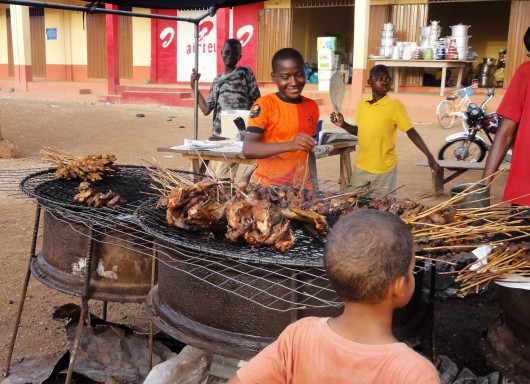
Favored by both roadside barbecue stands and upscale restaurants throughout Ghana, the nutritious and low-fat guinea fowl represents a lucrative business for smallholder farmers who want a low-maintenance livestock to raise.
The World Bank’s West Africa Agricultural Productivity Program (WAAPP) is helping guinea fowl farmers in Northern Ghana scale up operations. Its initial investment in 80 farmers has benefited more than 50,000 people.
Guinea fowl farming could create thousands of jobs and earn export revenue.
In order to build a food system to feed every African, WAAPP works with researchers, farmers and others to promote the guinea fowl industry into an engine of job creation in rural Ghana.
During the past two years, WAAPP has helped 80 guinea fowl farmers in the Northern, Upper East and Upper West regions of Ghana scale up operations.
It has also revitalized the production of a homegrown vaccine to combat Newcastle disease, a virus that is deadly to poultry.
Since 2013, more than 38 million doses of the vaccine have been released to 137,400 farmers. Moreover, the vaccine is now being exported to other West African countries, including Niger and The Gambia.
Benefited by WAAPP, participants could receive a starter kit that includes financial support, an incubator, generator, 500 eggs, dewormer, feed and vaccines.
In addition, agricultural trainers visit those farmers regularly to teach them how to care for birds so as to reduce mortality.
Moreover, the production rate of guinea fowl has been increased by more than five times due to applying incubators and techniques, such as housing birds to protect them from hawks.
With the help from WAAPP, farmers have raised their production from less than 100 birds per year to production of between 600 and 800 birds per quarter.
“Before WAAPP gave us technologies and techniques to protect our birds from predators and disease, I couldn’t make more than 100 birds a year. Now our losses are very few— this year alone we had over 800 birds so I hired people to help me,” said Gideon Anaba, a guinea fowl farmer in Boku, Ghana.
“Thanks to income from this business, I paid my children’s university bills without going in for a loan.”
Adamu Mubarik, a 34-year-old guinea fowl farmer from Garu Tempane, received a starter kit from WAAPP in 2013 and now produces up to 3,200 birds a year. He is also willing to help others on the path to success.
He incubates eggs for other farmers for as low as 20 pesewas, or US $0.05 cents, per egg and gives young people advice on how to get started as a guinea fowl farmer.
He was once a university graduate who faced the difficulty of finding a job and had no choice but to rely on his uncle in Accra for support. But because of WAAPP assistance, he’s an entrepreneur who can afford his sister’s tuition fee as well as his family.
Moreover, he can expand his business to create jobs and serve the needs of his district.
“The Bank is supporting Ghana’s guinea fowl farming because it’s ripe for expansion—it has the potential to create thousands of jobs, earn revenue by selling to the local and international market and help alleviate poverty,” said Henry Kerali, World Bank Country Director, Ghana.
– Shengyu Wang
Sources: World Bank, Mother Earth News
Photo: Yakubu Family Ghana

How Pumpkins Boost the Ugandan Economy
In Uganda, the pumpkin is a source of income that has helped boost the economy.
According to ONE, “Pumpkins can be grown all over Uganda and are often grown adjacent to cash crops. During harvest time, these pumpkins become great to sell for extra income!”
Looking at the Ugandan economy, extra income is still in great need for the large majority of the population.
While the African Economic Outlook, AEO, shows that Real GDP, gross domestic product, or the value of all goods and services produced in a single year, has increased from 4.7 to 6.3 since 2013, there is still a lot of progress to be made.
The AEO has stated that “this recovery in economic activity is mainly supported by public investment on infrastructure, recovery in private domestic consumption and investment demand, and a rebound in agriculture.”
For many in Uganda, this rebound is taking place thanks to the innovative thinking of Henry Kasozi. As chairman of the Nkokonjeru Women Saving and Credit Project, Kasozi teaches women and children how to grow pumpkins.
Since 2009, over 200 women and children have benefited from learning to cultivate pumpkins. For these individuals, it has become their main source of income.
With a fast growth cycle and multiple uses, the pumpkins have proven to be quite the cash crop.
In an interview for The Daily Monitor he stated, “the idea to grow pumpkins was born out of the realization that they take few months to grow and serve several purposes. They can serve as food, sauce, animal feeds and medicine among others.”
According to Web MD, pumpkins are legitimate sources of medicine. Both pumpkin seeds and oils have proven health benefits that have aided in alleviating various diseases.
On their site they state that “the chemicals in the pumpkin seed cause an increase in urination (diuretic effect), which helps relieve bladder discomfort. Pumpkin seed also contains a chemical that might kill intestinal worms.”
With worms and bladder/kidney infections being a large threat to the health of Ugandan citizens, pumpkins have become increasingly popular for these medicinal treatments.
Pumpkins have also shown to be a good source of calories and nutrients for the malnourished, which is one of the leading causes of preventable deaths in countries in sub-Saharan Africa, such as Uganda.
Pumpkins are more than a squash to carve into, but also a poverty-fighting and economy-boosting cash crop.
– Katherine Martin
Sources: ONE, African Economic Outlook, Farm Radio Weekly, Daily Monitor, WebMD
Photo: Wikipedia
Guinea Fowl Farming Creates Thousands of Jobs in Ghana
Favored by both roadside barbecue stands and upscale restaurants throughout Ghana, the nutritious and low-fat guinea fowl represents a lucrative business for smallholder farmers who want a low-maintenance livestock to raise.
The World Bank’s West Africa Agricultural Productivity Program (WAAPP) is helping guinea fowl farmers in Northern Ghana scale up operations. Its initial investment in 80 farmers has benefited more than 50,000 people.
Guinea fowl farming could create thousands of jobs and earn export revenue.
In order to build a food system to feed every African, WAAPP works with researchers, farmers and others to promote the guinea fowl industry into an engine of job creation in rural Ghana.
During the past two years, WAAPP has helped 80 guinea fowl farmers in the Northern, Upper East and Upper West regions of Ghana scale up operations.
It has also revitalized the production of a homegrown vaccine to combat Newcastle disease, a virus that is deadly to poultry.
Since 2013, more than 38 million doses of the vaccine have been released to 137,400 farmers. Moreover, the vaccine is now being exported to other West African countries, including Niger and The Gambia.
Benefited by WAAPP, participants could receive a starter kit that includes financial support, an incubator, generator, 500 eggs, dewormer, feed and vaccines.
In addition, agricultural trainers visit those farmers regularly to teach them how to care for birds so as to reduce mortality.
Moreover, the production rate of guinea fowl has been increased by more than five times due to applying incubators and techniques, such as housing birds to protect them from hawks.
With the help from WAAPP, farmers have raised their production from less than 100 birds per year to production of between 600 and 800 birds per quarter.
“Before WAAPP gave us technologies and techniques to protect our birds from predators and disease, I couldn’t make more than 100 birds a year. Now our losses are very few— this year alone we had over 800 birds so I hired people to help me,” said Gideon Anaba, a guinea fowl farmer in Boku, Ghana.
“Thanks to income from this business, I paid my children’s university bills without going in for a loan.”
Adamu Mubarik, a 34-year-old guinea fowl farmer from Garu Tempane, received a starter kit from WAAPP in 2013 and now produces up to 3,200 birds a year. He is also willing to help others on the path to success.
He incubates eggs for other farmers for as low as 20 pesewas, or US $0.05 cents, per egg and gives young people advice on how to get started as a guinea fowl farmer.
He was once a university graduate who faced the difficulty of finding a job and had no choice but to rely on his uncle in Accra for support. But because of WAAPP assistance, he’s an entrepreneur who can afford his sister’s tuition fee as well as his family.
Moreover, he can expand his business to create jobs and serve the needs of his district.
“The Bank is supporting Ghana’s guinea fowl farming because it’s ripe for expansion—it has the potential to create thousands of jobs, earn revenue by selling to the local and international market and help alleviate poverty,” said Henry Kerali, World Bank Country Director, Ghana.
– Shengyu Wang
Sources: World Bank, Mother Earth News
Photo: Yakubu Family Ghana
The Global Burden of Disease: Bringing Data to the People
The tool is incredibly useful to policymakers and health care providers whose mission is to keep people healthy. Health is affected by a variety of factors including one’s demographics. Where someone lives play a role in his or her vulnerability to certain health risks; some countries experience higher rates of heart disease due to cultural dietary influences while others lose children at early ages because they do not have access to necessary vaccinations.
In order to effectively address health issues in a given country, there needs to be a clear picture of what the biggest health culprits are. While data that could help paint that picture has existed for years, it has been scattered among researchers, hospitals and governments, making it inaccessible and consequently less useful.
Murray created the GBD data collection to provide information to health workers, policymakers and the general public. It is the largest effort to measure epidemiological levels and health trends globally and contains the collected and analyzed data of more than 1,000 researchers in more than 100 countries.
The GBD is open to everyone and contains a visualization of data that allows for greater contextualization of what has been collected and observed. Experts from around the world have collaborated and continue to update the database to ensure it stays as accurate as possible.
In the 2013 systematic analysis for the Global Burden of Disease, researchers found that since 1990 the global life expectancy for both sexes has increased from 65.3 years to 71.5 years. However, an individual’s life expectancy and the likely cause of death differs based on where he or she lives and the economic status of his or her home country, which understandably plays a considerable role in the individual’s health.
For instance, while there have been reductions in the number of child deaths attributed to diarrhea, lower respiratory tract infections and neonatal causes in low-income regions, these health complications are still the leading cause of death in children younger than 5 years and are more prominent in poor countries compared to wealthy countries.
The GBD delivers information to the hands of people who can provide solutions. It allows health care workers to pinpoint the problem in order to begin addressing it. If governments know their citizens are vulnerable to certain health risks they can work toward identifying the causes and implementing solutions. There has always been power in knowledge, and the GBD allows for the consolidation of knowledge, thereby increasing its untapped power.
– Brittney Dimond
Sources: WHO, The Gates Notes, IHME
Photo: Flickr
Commissioner Mimica Announced Support Package for Peru
The support package for Peru is intended to accelerate the plans of the National Development and Social Inclusion Strategy, which aims to help five regions most affected by poverty in the Peruvian Amazon.
The finalized package suggests 40 million euros ($45.5 million), with a total 66 million euros ($75.1 million) being allocated to Peru between 2014 and 2017. This money will advance the already growing economy of Peru and assist the permanent reduction of poverty that has been reflected since this growth.
However, the solidarity of development has not been established, as about 54 percent still live in poverty and 19 percent live in absolute poverty (less than a dollar a day).
Social Inclusion Strategy will address this unequal growth, favoring those who have not benefited, despite the country’s economic boom. The stratagem prioritizes people into groups based off five core topics:
Furthermore, the developmental gap in the region is ensured to decrease by a three-part approach that focuses on three-time horizons – short, medium and long term.
Temporary relief will bring short term relief to those in extreme poverty while medium term relief promises capacity building such as providing services, and the long-term approach will aid with the creation of opportunities.
In this way, Peru will see a reduction of extreme poverty that substantiates and perpetuates the developmental growth of all priority groups.
MIDIS, the organization overseeing the National Development and Social Inclusion Strategy, defines people who are already in the process of social inclusion as PEPI; PEPI households must meet three of four focal points in order to be given PEPI status:
Of these dwellings, 60 percent live between walls of adobe, 84 percent have dirt floors in their homes, 60 percent use wood to cook and 57 percent go without access to sanitation services.
The total number of people living in PEPI households (4.8 million) calculates to about 16 percent of the population. It is estimated by 2030 for the developmental gap to be significantly reduced by the support package for Peru with financial investment to be concluded for Peru in 2017.
– Emilio Rivera
Sources: European Commission, GOB, Nations Encyclopedia
Photo: Flickr
A Nobel Prize in Medicine to Change the Fate of a Continent
In 1967, Mao Zedong established a secret project dubbed “Project 523” in order to develop a cure for the widespread disease that disabled thousands of soldiers and civilians. Tu Youyou was selected to work on the cure after the group failed to create a synthetic medicine that proved effective.
Tu Youyou, then a student at the China Academy of Chinese Medical Sciences, began her search in 1969 for any herbal cure to the issue. She collected 2,000 possible remedies before cutting her list to 380 and testing her compounds on mice.
It wasn’t until 1972 that Tu Youyou successfully produced chemically pure artemisinin, which was then assessed by a group of scientists; despite their efforts, the artemisinin weakened as the chemists’ trials continued. After discovering a method in “Emergency Prescriptions to Keep Up One’s Sleeve,” an ancient text on Chinese medicine, Tu Youyou procured another solution that worked 100 percent of the time on primates and rodents.
Tu Youyou tested the medicine herself and human trials began; artemisinin treatments became the fastest-acting antimalarial medicine. Despite this, it wasn’t until 2011 that Tu Youyou’s discovery earned a Lasker prize as its first award.
Tu Youyou’s find has held promise for the eradication of malaria since its discovery, being rewarded with a Nobel Prize in Medicine on Oct. 5, 2015. New drug-resisting malaria vectors, however, have drastically altered the reception of antimalarial therapy across the world. A prominent example is that of sub-Saharan Africa.
The most recent number calculated by the WHO records that in 2013 there were an estimated 198 million cases of malaria worldwide. Malaria is the cause of about 450,000 deaths per year and 90 percent of these occur in sub-Saharan Africa, with 77 percent being children at the age of 5 and younger.
Despite the drug-resisting vectors, mortality rates have fallen 47 percent globally since 2000, with a drop of 54 percent in the WHO’s African region. The WHO also suggests halting production and marketing of artemisinin-based monotherapies until variations of the treatment are developed.
Although no specificity is provided on when other alternatives will be available, the WHO launched an emergency response in April 2013 with the hopes of containing and managing any known outbreaks, continuing today as the WHO emphasizes that “urgent actions now will deliver significant savings in the long run.” It has since received aid from the leaders of the East Asia Summit and the Global Fund to Fight AIDS, Tuberculosis and Malaria.
For now, we must enjoy “[the] gift for the world’s people from traditional Chinese medicine,” Youyou said after winning the Lasker prize in 2011.
– Emilio Rivera
Sources: CNN, Columbia, Vox, WHO
Photo: Flickr
The Indonesian Family Hope Program Ends Poverty Cycle
In 2013, 28 million Indonesians lived below the poverty line. Impoverished families throughout the nation were often too poor to afford healthcare and education for their children, leading to illness and injury that trapped them in generational poverty.
In an effort to break this generational cycle, the World Bank, in combination with the Ministry of Social Affairs, has created the Family Hope Program.
Financial and Developmental Aid
The Indonesian Family Hope Program works through a series of cash transfers. The money is given to parents who agree to participate in health and nutrition training, take their children to clinics when they’re ill and keep their children in school.
The program also provides startup money and skills training to parents. These micro-investments give families the means to become entrepreneurs and run their own family businesses, ensuring economic growth and generational development.
Health
Mothers participating in the program are encouraged to give their children the best possible start to life — beginning in the womb. The World Health Organization (WHO) recommends that women have four antenatal check-ups throughout the course of their pregnancy, thus lowering the risk of complications, infections and other life-threatening incidents through screenings. Yet, few women receive all four visits.
The Family Hope Program has increased the number of antenatal checkups by more than 7 percent. This establishes a precedent of continued family health. As mothers are healthier during and after pregnancy, children are healthier and receive better healthcare as a result. The 7 percent increase in antenatal care resulted in a mirrored raise in child immunizations by 7 percent.
The nutritional aspect of the program has also positively impacted childhood development, decreasing the number of children suffering from stunting by 5 percent. As a result of children being healthier, they are able to focus better and attend school.
Education
Along with the cash grants, more than 11,000 facilitators trained in education and nutrition hold seminars teaching mothers how to manage finances, improve the health of their families and aid their children in their studies.
The program has resulted in increased enrollment and school participation.
Many children from poor families stop attending school after completing their primary education, though not due to a lack of desire to attend. The program has removed financial barriers keeping children from continuing their education for the more than 3 million families that the program has reached.
Children now are 8 percent more likely to go on to secondary education and 10 percent more likely to enroll in junior secondary school. According to the United Nations, more education equals higher earning potential and better health, which are essential to end the generational poverty cycle.
– Claire Colby
Sources: NCBI, United Nations, World Bank, World Health Organization
Photo: PBase
Bringing Sanitation to the Impoverished Nile Delta
In rural Egypt, the freshwater of the Nile River is a life-giving resource and the main supplier of drinking water; but, due to pollution from human and animal waste, the river is also deadly.
Annually, 5 percent of Egyptian deaths are the result of water contamination and lack of sanitation, according to the World Health Organization (WHO).
Currently, there are as few as 500 rural waste treatment plants in operation throughout more than 5,500 rural villages, with only 37 percent of rural households being covered by a public sewage line.
This lack of sanitation infrastructure is a serious health risk to rural residents because of water contamination. Diarrhea, typhoid fever and E. coli are just a few of the life-threatening illnesses that result from inadequate waste treatment and storage.
In order to fight back against the mounting problem of untreated wastewater seeping or being dumped into the Nile, the World Bank has pledged $550 million to improve existing sanitation facilities in the rural Delta as well as create new sanitation systems throughout Daqahliya, Sharqiya and Beheira in Lower Egypt.
The Sustainable Rural Sanitation Services Program for Results, approved in July 2015 and set to end in October 2020, is designed to restructure the existing centralized system to create a decentralized system, giving local water and sanitation companies (WSCs) within the Nile Delta the ability to expand and cover larger areas while improving their service.
Through this decentralized approach, WSCs are able to generate more local jobs, improving not only the health of poor rural residents but also their economic standing.
Using a bottom-up business model, WSCs are held responsible through a performance-based capital grant (PBCGs) from the Central Government, ensuring empowered employment and quality service to their communities.
The Sustainable Rural Sanitation Services Program for Results is set to serve 769 villages in seven governorates that have a history of releasing untreated wastewater into tributaries of the Nile.
The program will benefit the health and socio-economic status of rural villages as well as aid in preserving the Nile, the largest source of Egyptian freshwater, constituting 98 percent of drinking water.
The program also protects against untreated human waste seeping into the groundwater, leaving impoverished Egyptians with contaminated drinking water. By the end of the five-year period, an estimated 800,000 poor Egyptians will have benefitted from the program.
– Claire Colby
Sources: American Institute of Science, World Bank 1, World Bank 2, WHO, International Water and Technology Conference
Photo: The Chronicle Herald
Kenya-South Sudan Highway Alleviates Regional Poverty
With support from the World Bank Group, the governments of Kenya and South Sudan, as well as other stakeholders, recently inaugurated a new project that will upgrade a critical trade route connecting the two countries.
The updated route will make trade easier between the two countries, improve livelihoods for people living in the northwest region and alleviate regional poverty.
Currently, the Kenya-South Sudan highway, which runs through Trans Nzoia, Turkana and West Pokot counties, is a rugged track. It’s hard for vehicles to pass the deteriorated area.
Travelers run the risk of encountering bandits along the route and also pay fares that are an average of six times the price for a comparable distance on good roads.
The East Africa Transport, Trade and Development Facilitation Project will rehabilitate a 309-kilometer trek of land to create a safe route for goods and people along the Lokichar, Nadapal/Nakodoc road in the northwest region of Kenya.
The World Bank Group launched $500 million to support other activities designed to improve the livelihoods for those living in the region and to improve regional competitiveness.
Diarietou Gaye, World Bank country director for Kenya, says, “This new project is unique in its own right, because of its size, geographical coverage, and the range of activities it will undertake, targeting the specific needs of the vulnerable communities in Trans Nzoia, Turkana and West Pokot counties.”
Including 1.5 million people, those counties are home to some of the country’s poorest and most vulnerable people.
The rehabilitation of this section will cost $676 million, among which the Kenya government will contribute $176 million. Other development partners, such as the African Development Bank, German Development Bank and the European Union have shown interest in financing the reconstruction of the remaining sections.
The World Bank Group, with other development partners such as the African Development Bank and China, will support $80 million for the other 400-kilometer section in South Sudan, from its capital Juba to the border with Kenya.
In addition to rehabilitating the trade and transport corridor, the project will facilitate the construction of a 1,000-kilometer fiber optic connection between Kenya and South Sudan, as well as a one-stop border post to facilitate cross-border transport and trade between the two countries.
When the corridor is upgraded, traveling and sending goods from Kenya’s Port of Mombasa to Juba will be much faster.
Moreover, the project will also offer water and sanitation services, build domestic and export markets for livestock, agricultural produce, fisheries and mineral products, and facilitate extraction of petroleum resources in the recently discovered oil fields in Turkana and neighboring counties.
In addition, the project will create jobs and income opportunities for members of the local communities.
– Shengyu Wang
Sources: The World Bank, Chr. Michelsen Institute
Photo: Flickr
Clinton Global Initiative Launches Health Plan
Following the aftermath of the Ebola crisis, USAID, the Clinton Global Initiative and other organizations have teamed up to create the Aspen Management Partnership for Health.
The Aspen Management Partnership for Health (AMP Health) is the first multi-sectoral partnership in the community health sector to focus on the leadership driving community health systems in developing nations.
Specifically, AMP Health hopes to strengthen the leadership and management of community health organizations. AMP Health combines the power of several different organizations in order to facilitate effective change.
This multi-sectoral partnership utilizes the power of USAID, the Aspen Institute, MDG Health Alliance, Born Free Africa, Margaret A. Cardill Foundation, GlaxoSmithKline, Partners in Health, the Harvard School of Public Health and McCann Health.
The partnership was announced at the Clinton Foundation’s 2015 Annual Meeting as one of their Commitments to Action for the Clinton Global Initiative.
“In addition to establishing mentor networks and cross-country convenings, the partners will recruit, train, and deploy in-country management professionals to work side-by-side with Ministries of Health on high-priority community health projects, ultimately strengthening health systems,” Clinton Foundation Vice Chair Chelsea Clinton said at the meeting.
The networks of trained, values-oriented health care professionals will be critical in advancing community health systems in developing nations.
Initially, the partnership will be utilized in sub-Saharan Africa, where community health interventions could save up to three million lives per year.
It will prove particularly relevant to reducing child and maternal mortality rates.
AMP Health incorporates businesses, governments, educational institutions, think tanks, multilateral organizations, and philanthropic foundations in order to affect change for community health systems.
While this may be just one of the Clinton Foundation’s 3,200 Commitments to Action, it carries much power and support from myriad organizations.
As a result of the multi-sectoral partnership, AMP Health can support sub-Saharan Africa as it works to prevent future epidemics, lower child and maternal mortality rates, and manage the treatment of chronic, non-communicable diseases.
– Priscilla McCelvey
Sources: Aspen Institute, Market Watch
Photo: Flickr
Health Poverty Action: Combating Poverty and Poor Health
Extreme poverty and poor health conditions are inextricably linked. According to the World Health Organization, about 1.2 billion people worldwide are currently living on less than $1 a day, which places them in the extreme poverty category.
This is why it is important to tackle the causes of poor health, which will in turn help to drastically improve poverty levels and vice versa.
In developing areas of the world, poverty increases people’s chances of getting sick due to poor nutrition, overcrowding and a lack of clean water. Some people are forced to put themselves into dangerous, health-hazardous situations in order to provide for and keep their families safe.
On the flip side, poor health causes an increase in poverty when a family loses a source of income due to an inability to work, perhaps causing them to sell assets such as livestock or equipment and tools essential to their work.
This will significantly decrease a family’s ability to fight poverty, especially during times of extreme political, economic or natural shocks.
In order to combat and tackle both issues at once, which will significantly reduce the prevalence of both extreme poverty and poor health conditions, Health Poverty Action, a nonprofit dedicated to fighting both poverty and poor health, suggests several things:
1. Aid should be more long term and have a stable, predictable structure. When tackling health concerns, the focus should be on improving the country’s health system and not just on one specific disease.
2. There is a need for more health workers to be trained in their own countries and to stay where they are most needed. Wealthier countries should avoid taking away sorely needed health professionals.
3. Emphasis needs to be placed on prioritizing health and reasonable global health coverage.
4. Issues such as nutrition, education, clean water and sanitation much be addressed.
5. It is important that there be affordable, easy access to a variety of medicine for the poor.
All around the world, organizations like Health Poverty Action are already enacting change.
Along the border between China and Burma, there is a high risk of malaria infection. Health Poverty Action is giving communities their access to treatments and prevention. A similar story is true of TB in Cambodia and HIV in South Omo, Ethiopia.
The poverty rate has been steadily decreasing but it is time for the world to take the next big steps as one. By implementing initiatives to address the points above, we have a true shot at ending global poverty and poor health conditions.
– Drusilla Gibbs
Sources: Health Poverty Action 1, Health Poverty Action 2, World Health Organization, Inequality Watch
Photo: Pixabay