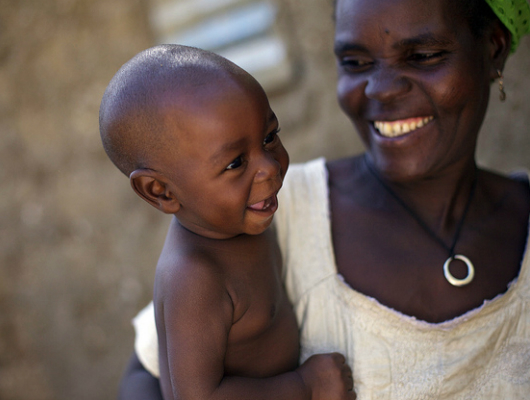
UNICEF and the World Food Programme announced recently that volunteers will go door to door over the next 12 months in an effort to screen 250,000 children for acute malnutrition in South Sudan.
The initiative will target households in the state of Warrap in Buhr el Ghazi, where an estimated 26,000 children are thought to suffer from life-threatening cases. Volunteers have been chosen from local communities and trained by the state Ministry of Health with support from UNICEF and WFP.
“Visiting every single home will help ensure that children who are malnourished or sick will be referred for treatment and will receive life-saving care,” said Vilma Tyler, Chief of Nutrition for UNICEF in South Sudan.
The announcement comes just as the recent Integrated Food Security Phase Classification warns that the situation in some areas of the country could escalate to famine levels if humanitarian assistance isn’t delivered by December. Nearly 238,000 children in South Sudan are currently experiencing Severe Acute Malnutrition (SAM).
Widespread food insecurity in the newly formed country has been the result of ongoing conflict between various rebel groups and the fledgling South Sudanese governing body.
Civil war came to a head in Juba in 2013 amidst ethnically motivated attacks, civilian massacres, and the displacement of over 750,000 children as people fled their homes to escape the violence.
Record food prices caused by the resulting economic downturn and unreliable rainy seasons have exacerbated an already dire problem; the number of children facing SAM doubled from the previous year.
With time running out, volunteers are working quickly to triage those in need. Children at risk of starvation will receive treatment at UNICEF-supported health facilities and outpatient therapeutic programs while caregivers will be offered guidance on how to keep children healthy through nutrition, hygiene and sanitation practices.
For children with SAM, initial treatment often means utilizing Ready-to-Use Therapeutic Food (RUTF) – 500kcal spreads containing essential amino acids, lipids, and minerals – as their sole nutritional intake.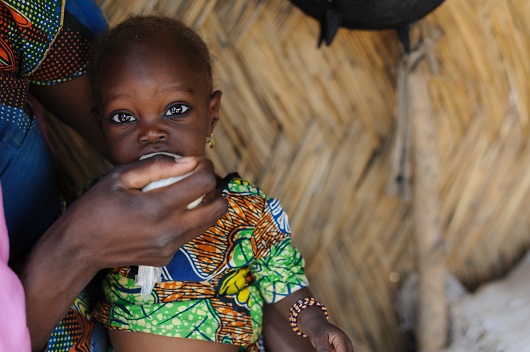
UNICEF is hoping to build on the progress it made in 2014 by prioritizing three strategic objectives: continuing humanitarian intervention in UN Protection of Civilian (PoC) and Internally Displaced Person (IDP) sites, scaling up its Rapid Response Mechanism (RRM) in hard to reach locations and supporting capacity building by engaging community-based organizations.
Until March 2014, UNICEF primarily operated within United Nations’ PoC and IDP sites, which sheltered only a fraction of the 800,000 people displaced by conflict. Ethnic and gender-based harassment and shifting security situations prevented volunteers and specialists from reaching 90 percent of at-risk individuals across the country.
Still, for 90,000 people, life-saving treatment and sustainable training came just in time. In addition to nutrition services, children benefited from guidance on sanitation and hygiene and were enrolled in school.
The development of RRM revolutionized UNICEF’s reach in the country. Mobile teams of specialists are now equipped to deploy to locations previously inaccessible because of deteriorated security.
During the 34 missions these teams conducted last year, more than 500,000 additional people were screened, and the number of children receiving life-saving treatment for SAM climbed to 93,000.
These teams are also equipped to collect more extensive data on the ground and to implement warning systems, which will alert them to return to communities when progress begins to reverse. UNICEF is hopeful that by ramping up RRM capabilities, they will continue to see more patients.
To prevent recurring cases, UNICEF will step up engagement with community-based organizations with a focus on capacity building. Last year, the organization worked with 88 local organizations to train around 1,900 partners on SAM treatment, infant and young child feeding, and nutrition surveys.
It also supported local working groups seeking to maintain progress in affected areas and engaged the government of South Sudan on water sanitation and national planning.
These efforts will be critical to ensuring that sustainable development continues even after these next 12 months, and UNICEF is hopeful that, for children in South Sudan, it will.
– Ron Minard
Sources: IpcInfo 1, IpcInfo 2, UNICEF 1, UNICEF 2
Photo: Flickr, Wikipedia

How to Get Involved with Causes that Matter
Compassion is the emotion that forms out of concern for others. For many individuals, this is easy to feel, but harder to put into action. The desire to do good, but not knowing where to start and how to help are common roadblocks.
Luckily, this block is easily overcome. Whether you are young or old, well off or just getting by, there are ways to help and get involved with causes that matter to you.
1. Educate yourself
Getting involved doesn’t necessarily mean that you have to be an expert, but it’s good to know at least the basics. Good questions to ask before getting involved may include: what is their goal, how are they working toward that goal, which route of involvement works best for your lifestyle, etc.
One worthy cause has shared, “Read, check out documentaries, listen to podcasts on your way to work – whatever you can do to learn the most that you can about your cause will only help… by giving you the knowledge you need to educate others and ignite change.”
2. Use your own unique skills
One of the beautiful things about the world we live in is how individuals are able to get together with varying skills in order to accomplish a similar goal. Getting involved with causes works the same way.
The key is to figure out what you can offer to your cause of choice. “Identify your skills—whether you’re bilingual, you have some teaching experience, or you’re skilled at communications and marketing—and volunteer them for an organization you care about. More importantly, use it as an opportunity to learn more about the issue and advocate for it.”
3. Social media
In the world that we live in, technology can be an incredibly easy way to promote a cause. Whether it’s a quick photo, a shared article, or a hashtag there are ways to share with your friends what matters most to you.
There are several ways to share information and raise awareness through social media. Get creative and try things out. You never know how much impact your post will have.
4. Get political
This one is often seen as the most daunting way to get involved with a cause, but it doesn’t have to be.
For individuals that don’t feel comfortable meeting with congress members, there are other ways. One that doesn’t take much time, yet accomplishes a lot, is sending a quick email. If you know of bills that are in congress that relate to your cause, let your leaders know that it matters to you.
At The Borgen Project, encouraging individuals to call or email congress members is a main aspect of the job, but why?
“Congressional staffers keep a tally of every issue that voters call, write and email the leader about. This information goes into a weekly report that is viewed by the Congressional leader. Your one email will get the issue or bill on the leaders radar.”
For those that are comfortable with putting themselves out there, lobbying, bird dogging and sending YouTube videos to congress are all excellent ways to share your support and get involved with your cause.
5. Volunteer/Fundraise
These two are usually the first things that come to mind when we think of personal involvement in a cause of our choice.
For many, a personal block is the feeling that small contributions don’t really help. “But you don’t have to be raking in thousands to donate to a cause—every little bit helps and you can start small.”
Whatever your cause is, check out the site and look for opportunities to volunteer or fundraise. Doing such is a great opportunity and often very rewarding.
The take home from this is that there are ways to get involved for everyone; no matter what lifestyle you live, there are ways to contribute.
– Katherine Martin
Sources: One Green Planet, The Muse, Borgen Project
Photo: Wikimedia
Project Loon Helps Internet Access Soar to New Heights
Project Loon, a product of Google X, the semi-secret research and development facility run by Google, is an innovative operation providing inexpensive or free wi-fi to people living in remote rural areas around the world via a fleet of huge helium-filled balloons floating in the stratosphere.
According to Google, these balloons can deliver widespread economic and social benefits by bringing internet access to the 60 percent of the world’s population who don’t have it. A large portion of those 4.3 billion people live in rural or extremely remote areas where telecommunications companies haven’t found it worthwhile to build cell towers or other infrastructure.
Here’s how Project Loon will work: steered by wind and equipped with solar panels with enough power to charge the battery for use at night, each balloon will be able to power itself using entirely renewable energy sources.
Constructed out of a thin plastic similar to a heavyweight trash bag, the balloons float in the stratosphere, a layer of the earth’s atmosphere stretching about 32 miles above the surface. Flying twice as high as airplanes and operating above the weather, the balloons help mobile operators extend wireless networks into more sparsely populated and remote terrain.
With a lifespan currently lasting just over 100 days, each balloon can provide connectivity to a ground area of about 50 miles in diameter using LTE wireless communications technology. LTE, short for long-term evolution, is the standard for wireless communications in high-speed data for mobile phones and data terminals.
In order to use LTE, Project Loon partners with telecommunications companies to share cellular spectrum so that people will be able to access the internet directly from their phones or other LTE-enabled devices. The signal is then passed across the balloon network and back down to the global internet on Earth.
In Indonesia, Project Loon is teaming up with the country’s three largest wireless carriers in 2016 to test its high-altitude, wind propelled balloons. Their lofty goal is to deliver internet coverage across large pockets of the nation where 83 percent of the population currently is without internet access.
If successful, Project Loon’s collaboration with Indonesian mobile operators Indosat, Telkomel and XL Axiata would result in speeds fast enough to surf websites, stream videos or make purchases. It is estimated that 100 million people in Indonesia who are not currently connected to the internet will gain access through Project Loon.
“This is a way of changing the world,” says Mike Cassidy, Project Loon’s leader in an interview with MIT Technology Review. For just hundreds of dollars per day, the operation of one Loon balloon should be able to serve a few thousand connections at any time.
For a school principal in a rural area of northeastern Brazil, where Linoca Gayoso Castelo Branco School resides and internet service is nonexistent, she experienced the benefits of the balloons firsthand.
“It was just for some minutes, but it was wonderful,” says Silvana Pereira. That day’s lesson on Portugal was enhanced by Wikipedia and online maps. “They were so involved that the 45 minutes of a regular class wouldn’t be enough to satisfy their demand for knowledge,” says Pereira.
And that is just the beginning.
– Kara Buckley
Sources: Google 1, Google 2, Google 3, Technology Review 1, Technology Review 2, USA Today
Photo: Wikimedia
Going Door-to-Door to End Malnutrition in South Sudan
UNICEF and the World Food Programme announced recently that volunteers will go door to door over the next 12 months in an effort to screen 250,000 children for acute malnutrition in South Sudan.
The initiative will target households in the state of Warrap in Buhr el Ghazi, where an estimated 26,000 children are thought to suffer from life-threatening cases. Volunteers have been chosen from local communities and trained by the state Ministry of Health with support from UNICEF and WFP.
“Visiting every single home will help ensure that children who are malnourished or sick will be referred for treatment and will receive life-saving care,” said Vilma Tyler, Chief of Nutrition for UNICEF in South Sudan.
The announcement comes just as the recent Integrated Food Security Phase Classification warns that the situation in some areas of the country could escalate to famine levels if humanitarian assistance isn’t delivered by December. Nearly 238,000 children in South Sudan are currently experiencing Severe Acute Malnutrition (SAM).
Widespread food insecurity in the newly formed country has been the result of ongoing conflict between various rebel groups and the fledgling South Sudanese governing body.
Civil war came to a head in Juba in 2013 amidst ethnically motivated attacks, civilian massacres, and the displacement of over 750,000 children as people fled their homes to escape the violence.
Record food prices caused by the resulting economic downturn and unreliable rainy seasons have exacerbated an already dire problem; the number of children facing SAM doubled from the previous year.
With time running out, volunteers are working quickly to triage those in need. Children at risk of starvation will receive treatment at UNICEF-supported health facilities and outpatient therapeutic programs while caregivers will be offered guidance on how to keep children healthy through nutrition, hygiene and sanitation practices.
For children with SAM, initial treatment often means utilizing Ready-to-Use Therapeutic Food (RUTF) – 500kcal spreads containing essential amino acids, lipids, and minerals – as their sole nutritional intake.
UNICEF is hoping to build on the progress it made in 2014 by prioritizing three strategic objectives: continuing humanitarian intervention in UN Protection of Civilian (PoC) and Internally Displaced Person (IDP) sites, scaling up its Rapid Response Mechanism (RRM) in hard to reach locations and supporting capacity building by engaging community-based organizations.
Until March 2014, UNICEF primarily operated within United Nations’ PoC and IDP sites, which sheltered only a fraction of the 800,000 people displaced by conflict. Ethnic and gender-based harassment and shifting security situations prevented volunteers and specialists from reaching 90 percent of at-risk individuals across the country.
Still, for 90,000 people, life-saving treatment and sustainable training came just in time. In addition to nutrition services, children benefited from guidance on sanitation and hygiene and were enrolled in school.
The development of RRM revolutionized UNICEF’s reach in the country. Mobile teams of specialists are now equipped to deploy to locations previously inaccessible because of deteriorated security.
During the 34 missions these teams conducted last year, more than 500,000 additional people were screened, and the number of children receiving life-saving treatment for SAM climbed to 93,000.
These teams are also equipped to collect more extensive data on the ground and to implement warning systems, which will alert them to return to communities when progress begins to reverse. UNICEF is hopeful that by ramping up RRM capabilities, they will continue to see more patients.
To prevent recurring cases, UNICEF will step up engagement with community-based organizations with a focus on capacity building. Last year, the organization worked with 88 local organizations to train around 1,900 partners on SAM treatment, infant and young child feeding, and nutrition surveys.
It also supported local working groups seeking to maintain progress in affected areas and engaged the government of South Sudan on water sanitation and national planning.
These efforts will be critical to ensuring that sustainable development continues even after these next 12 months, and UNICEF is hopeful that, for children in South Sudan, it will.
– Ron Minard
Sources: IpcInfo 1, IpcInfo 2, UNICEF 1, UNICEF 2
Photo: Flickr, Wikipedia
Cooking Up a Solution to Poverty and Malnutrition in Haiti
A chef connects solutions to poverty and malnutrition in Haiti with cooking.
Chef José Andrés has discovered a new approach to solving poverty in Haiti, and it starts in the kitchen.
In Huffington Post’s recent feature on Andrés, Lifestyle Blog Editor Zoë Lintzeris details Andrés’ love affair with Haiti, describing his innovative ideas to improve the country’s cooking conditions and, subsequently, save it from poverty.
Andrés’ solution focuses on improving cooking apparatus to decrease safety hazards in the cooking process with his “clean cook stoves.”
Cooking safety hazards in the region include the use of “dirty” firewood and coal, two fuel sources that are unsustainable and not very profitable.
These dangerous methods have gone hand in hand with deforestation and pollution in the region. Erosion of soil, extreme and frequent flooding, degradation of water resources and habitat destruction are some forces linked to socioeconomic turmoil.
“Haiti has the highest rates of deforestation of any country in the world — a mere 2 percent of Haiti’s original forests remain,” says TriplePundit.
In turn, deforestation is responsible for a large portion of Haiti’s increasing poverty rate. Haiti’s real GDP growth has slowed down in the past two years, going from 4.2 percent in 2013 to a forecasted 1.7 percent in 2015, according to the World Bank.
GOOD Magazine suggests that “efficient stoves can help in the meantime, according to Jean Kim Chaix, the founder of the Charcoal Project, which aims to become a clearinghouse on charcoal alternatives and a consultant for green entrepreneurs.”
The Charcoal Project has undertaken a project to provide an energy efficiency program for schools, to teach them to produce fuel for cooking and lighting.
The project utilizes wood and stoves that reduce smoke and save fuel, which is just what Andrés is shooting for with his clean cookstoves.
The Global Alliance for Clean Cookstoves, hosted by the UN foundation, is Andrés’ initiative to save lives and protect the environment by creating a global market for “clean and efficient household cooking solutions.”
The Alliance has set out a 10-year goal to foster the adoption of clean cookstoves and fuels in 100 million households by 2020.
Andrés also discussed Haitian cuisine in his PBS special, “Undiscovered Haiti with José Andrés.” In the video, he describes the deep ties between the food and the country’s history and culture.
Andrés’ relationship with Haiti has led him to uncover a revolutionary solution to a problem that has a long history. Perhaps economic prosperity really can start in the kitchen.
– Ashley Tressel
Sources: Huffington Post, Good.is, TriplePundit, World Bank, Charcoal Project, Clean Cook Stoves
Photo: SCINet
How Can We Achieve Global Earthquake Preparedness?
It’s commonly thought that the bigger the natural disaster, the greater the death and destruction, but that’s hardly the case. The 2010 Haiti earthquake that killed 160,000 people registered at 7.0 while the Japan earthquake that occurred a year later and registered at 9.0 killed only 15,893 people.
Why did the much larger quake have a significantly lower death toll? The answer is preparation. Japan is a rich, modernized country with advanced infrastructure and a stable economy.
It predicted and planned for the quake. Haiti was caught off guard and lacked sufficient medical supplies, shelter and clean water. The country’s poor infrastructure led to a mass collapse of buildings, trapping and injuring more people than a 7.0 earthquake would normally achieve.
How can countries around the world participate in global earthquake preparedness?
After Japan experienced its largest earthquake in 2011, known today as the Great East Japan Earthquake, it has taken great measures to make the country resilient to quakes. 90 percent of housing is earthquake resistant, and companies are encouraged to keep enough food and water onsite to sustain employees for at least three days.
Earthquakes are especially dangerous because they often trigger other natural disasters. Fires, floods, landslides and tsunamis are common earthquake side effects. Countries can minimize these risks by recognizing and avoiding faultlines, unstable terrain, highly flammable building materials and dangerously-fluctuating water levels.
“The world has already shown great progress in saving lives by improving weather forecasting, setting up early warning systems and organizing evacuations,” Ban Ki-Moon, UN Secretary-General, told the Yomiuri Shimbun.
Earthquake Preparedness for Rural Areas
The most devastating effect of earthquakes occurs when they strike under-developed rural areas. In the aftermath of disaster, victims are cut off from communication, water, medical attention and proper nutrition.
Water and Sanitation Kits, also known as WatSan-Kits, buy time for people in rural areas as they wait for emergency assistance. Depending on the type of WatSan-Kit, it may include basic hygiene, water tanks, water testing equipment, water purification units, latrine materials and a diesel pump.
One Kit can help as many as 10,000 people. The Red Cross and Red Crescent Movement train countries to use WatSan-Kits.
Communication
A key factor in global earthquake preparedness is effective and thorough communication between emergency personnel and affected areas. Because organizations are usually more prepared and knowledgeable than the countries they’re helping, resentment and lack of understanding can severely impair progress.
Organizations should include their host country in every step of the process and explain the ins and outs of the operation, suggests Earthzine.
Earthquake Preparedness at Home
Preparation can occur at even the most basic level. Families can create personal earthquake emergency plans, such as teaching children where to go in the event of a quake and maintaining a full-stocked food storage.
Clean water, especially, is a must-have. Great Shakeout Earthquake Drills, established around the world by the Southern California Earthquake Center, provide training on earthquake preparedness.
Funding for Earthquake Preparedness
Finally, proper funding is vital to global earthquake preparedness. Many countries are too poor to afford proper building materials and emergency supplies, making donations very appreciated. One donation to Red Cross or another nonprofit relief aide can make a family’s house earthquake-resilient.
– Sarah Prellwitz
Sources: Earthzine, Time, The Diplomat, CNN, Shakeout
Photo: Social Worker, Flickr
Myths about Foreign Aid
The fact is that some 795 million people in the world do not get enough food to lead healthy, productive lives, and the vast majority of the world’s hungry live in developing countries. The following are three myths about foreign aid:
1. We shouldn’t bother. Our small contributions won’t make a difference in such an enormous problem as global poverty. When it comes to world hunger, the “one person can’t make a difference” myth can be easily dispelled.
Here in the U.S., mosquitoes are aggravating little pests; however, in Africa, mosquitoes are deadly. In 2005, the Against Malaria foundation was founded; it implements practical, cost-efficient, insecticide-treated bed nets to fight this preventable disease.
Over the past 15 years, approximately 663 million cases have been prevented in Africa — roughly 68 percent of that reduction is contributed to the distribution of a billion bed nets. Each bed net costs around $5, lasts for three to four years and protects two people. So, yes, as little as five bucks can make a difference in a global problem, and this, of course, is just one example.
2. We have no idea where our money really goes. Those fundraisers are scams. Unfortunately, the existence of corruption persists all over the world, and that isn’t a myth. Along with the endless benefits the internet provides there are also the ceaseless hoaxes, which are often in the disguise of charitable organizations.
To some extent, it seems as if charities and even the word “donate” tend to act as repellents, triggering apprehension and uneasiness. Fortunately, programs, such as the Millennium Challenge Account, and laws, such as the Foreign Corrupt Practices Act, monitor and help safeguard aid. And when in doubt, research the organization before providing any type of aid. Consumer Affairs is one helpful website.
3. Taking care of others in developing countries implies that we are failing to “take care of ourselves.” On the contrary, the more independent others become, the more consumers we acquire. Actually, our nation’s safety strengthens as we lift others out of poverty.
Three major myths about foreign aid busted and many more to be exposed. The following are three ways we can effectively help eradicate global poverty and hunger:
– Dana McLemore
Sources: Against Malaria, DTIC, FAO, KFF
Photo: Flickr
Determining What Causes Droughts
In the last century, droughts have killed 11 million people and affected 2 billion more through crop failure and reduced drinking water. The U.S. has lost a total of $195 billion to related economic recovery.
The most well-known drought occurred in the 1930s. Due to overpopulation and poor soil conservation, much of the Southwest in the U.S. became nothing but plowed fields.
When the drought dried out the dirt, the wind picked it up and whipped it into a colossal dust devil that darkened the sun. The severe conditions forced 400,000 people to relocate out of harm’s way. This period became known as the Dust Bowl, or the Dirty Thirties.
Decades of study have lent scientists some insight into what causes droughts, such as disrupted weather patterns and our own human impact.
First, droughts commonly occur when disrupted weather patterns significantly alter water cycles. This year’s El Niño will disrupt storm patterns by increasing ocean temperatures, causing droughts in Australia, Indonesia and northeastern parts of South America.
Wind patterns sometimes block much-needed precipitation from certain areas for a time. Some experts speculate that global warming is the cause of many recent droughts.
The effects of a drought can impact areas that are a good distance away from the drought itself. If the mouth of a river doesn’t receive sufficient moisture from rain or melting snow, communities that reside downstream will suffer from the lack of water.
This is especially crucial in developing countries that still rely on rivers and streams for their water supply.
Secondly, humans can play a large part in drought development. Deforestation inhibits the soil’s ability to retain moisture. Trees pull water into the ground and anchor the soil, preventing soil erosion.
Dam construction, while a good method for retaining water, restricts the flow of water to downstream areas, which can severely impact vegetation, wildlife and people if not closely monitored.
As was the case with the Dust Bowl, mistreatment of crop soil can lead to desertification, in which soil becomes too compacted to absorb water and takes on an arid quality.
Though scientists are still conducting research on what causes droughts, they have developed several techniques that will reduce drought risk. Improved meteorology technology predicts approaching droughts, giving communities time to prepare.
Economically developed countries prevent and fight droughts by cutting back on water usage, replacing lawns with drought-friendly turf and installing water-saving toilets.
Farmers in any country can combat drought by rotating crops, allowing the soil to rest and reabsorb water. Emergency water kits, which are staples of almost any emergency aid organization, provide relief to drought-ridden areas as they wait for the next rainfall.
– Sarah Prellwitz
Sources: UNL, National Geographic, BBC, LOC, Water
Photo: Pixabay
Active Involvement in Global Poverty Efforts Equals Happiness
The goal to eradicate global poverty continues to be a growing challenge facing the world today. This year, an estimated 700 million people worldwide still live below the poverty line.
In a survey conducted by the charity Action For Happiness, they identified ten everyday habits that make people happier.
On a scale of 1-10, each habit was ranked based on how frequently people performed each habit.
The number 1 ranked habit, at 7.41, was giving.
“Practicing these habits really can boost our happiness. It’s great to see so many people regularly doing things to help others — and when we make others happy we tend to feel good ourselves too,” said Professor Karen Pine, a psychologist involved in the study.
Here are three simple ways people can become involved in the fight to eradicate poverty:
Through global poverty efforts, everyone can play a role in ending poverty while simultaneously feeling better about their well-being.
“Extreme poverty has been cut in half in the last 20 years, and the facts show that we can get it to virtually zero within a generation – but only if we act,” said Bono, musician and global activist.
– Alexandra Korman
Sources: Global Citizen, PSY Blog, The Borgen Project
Photo: Flickr
Virtual Reality Films Provide Powerful Insights
It is unlikely that the average American will experience poverty firsthand in Africa, South America or elsewhere. However, with the adoption of virtual reality (VR) technology, citizens across the globe can gain insight into what it is like to live in poverty, deal with life-threatening diseases or survive without basic necessities.
In a change from traditional advocacy campaigns, the United Nations collaborated with VR Director and Pioneer Chris Milk to release two virtual reality films in 2015.
The first, “Clouds Over Sidra,” follows a 12-year-old Syrian refugee through her day at a bustling camp of 84,000 in Jordan. The film captures a 360-degree view, a navigable window into the young refugee’s world.
“Waves of Grace,” the second VR film for the UN Millennium Campaign, is narrated by a Liberian Ebola survivor confronting a still fragile community. Scenes of life, illness and death with unimaginable detail document the scale and impact of the Ebola crisis in a country with more than 10,000 cases.
Gabo Arora, co-creator of “Waves of Grace” and senior advisor for the UN Millennium Campaign, thinks incorporating VR experiences into the campaign against Ebola “will promote greater understanding of the socio-economic impact of the disease and empathy for those who continue to overcome it.”
Strong responses to the films upon release indicate the powerful emotions virtual reality films inspire. In addition to spotlighting an issue, VR conveys an experience many viewers react to with increased empathy and compassion.
Organizations utilizing virtual reality films noted a higher contribution rate after individuals viewed the film and an increase in monthly contributions. The films demonstrate the potential of VR to immerse viewers and ignite empathy. In turn, this drives fundraising and advocacy.
In March of 2015, the Humanitarian Pledging Conference for Syria added a screening of “Clouds Over Sidra” in the hope of increasing support for displaced Syrians. The conference raised $3.8 billion in funds, $1.5 billion more than projected. Other organizations have also turned to VR to convey refugee experiences.
The Clinton Global Initiative also released the short VR film “Inside Impact: East Africa” following President Clinton and Chelsea Clinton’s trip to visit CGI sponsored programs in East Africa.
The featured programs, called commitment sites by the organization, include rural solar power use, malaria prevention education and supplying hearing aids to people in need.
According to The Clinton Foundation, when speaking at CGI’s annual meeting, President Clinton emphasized the effectiveness of the VR experience. “I think that the film will give people the opportunity to understand the difference CGI members can make in a whole different way,” he says.
In November 2015, the New York Times debuted NYT VR, a virtual reality application for storytelling. The inaugural story, titled “The Displaced,” follows three children displaced from their homes in Lebanon, South Sudan and Ukraine.
According to the New York Times, Editor of the New York Times Magazine Jake Silverstein echoes Arora about VR’s potential for impact and says, “This new filmmaking technology enables an uncanny feeling of connection with people whose lives are far from our own.”
Although still an expensive medium for storytelling, VR offers an intensified and comprehensive experience. Viewers see the multi-faceted world of poverty and the solutions that they can support.
– Cara Kuhlman
Sources: The Clinton Foundation, Fast Company, The New York Times, Smithsonian Magazine, UN Millennium Campaign, Vrse.works, The Wall Street Journal
Photo: Flickr
How War Impacts the Poor
The introduction of the Sustainable Development Goals (SDGs) marked a deadline: the world has 15 years to eradicate global poverty. However, in order to achieve this goal, the causes of global poverty must be carefully analyzed. One such factor is how war impacts those who are living in poverty.
Afghanistan, Iran, Sub-Saharan Africa, Syria and others continue to be plagued with war and violence, and many individuals fall into what is known as a “poverty trap.” While peaceful countries are escaping poverty and violence, corrupt government leadership often leads to war which pushes societies into poverty.
Researchers from Stanford University studied the correlation between war and poverty and found four criteria that explain how war affects the poor.
Low GDP
Statistical research on poverty and conflict suggests that countries within the 50th percentile for income have a 7-11 percent risk of experiencing civil conflict. On the other hand, countries within the 10th percentile have a risk that rises to 15-18 percent.
For example, according to the World Bank, the Middle East has experienced a 30 percent decrease in GDP per capita since 1999. According to Stanford’s research, a 1 percent increase in GDP growth could reduce the risk of internal conflict by roughly 1 percent.
Large Youth Population
Almost 60 percent of the world’s poor are under the age of 25. With high youth populations, research shows that parents have more children in developing countries to cope with the lack of environmental resources in impoverished areas.
“[Long-term] demographic and economic data indicate that high fertility raises absolute levels of poverty by slowing economic growth, reducing the poverty reduction that growth would have helped deliver, and skewing the distribution of consumption against the poor,” The UN Population Fund reports.
Poor Education Systems
Compared to the national secondary school net enrollment of 92 percent between 2000 and 2004, developing countries had a mere 30 percent secondary school enrollment. By increasing schools’ enrollment by 10 percent, the average risk of conflict can drop 3 percent.
Dependence on Natural Resources
Natural resource dependence has been linked to both rebellion and a weak government. Previous research by Stanford University showed that only high-value, easily extracted resources including agriculture and diamonds further increase the likelihood of war.
Thus, from understanding these four criteria, it is clear that global leaders will have to collaborate and find solutions for people who are trapped in poverty due to war.
– Alexandra Korman
Sources: The Brookings Institution, The Economist
Photo: Rescue.Org