Project Loon Helps Internet Access Soar to New Heights
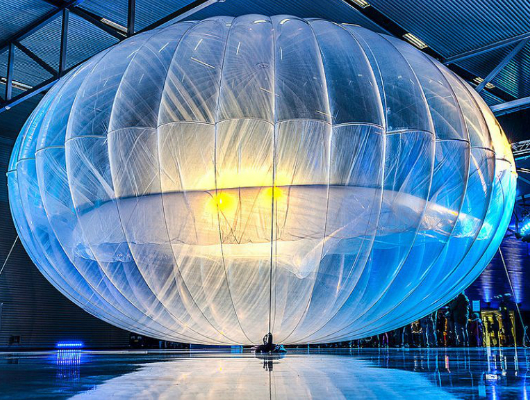
Project Loon, a product of Google X, the semi-secret research and development facility run by Google, is an innovative operation providing inexpensive or free wi-fi to people living in remote rural areas around the world via a fleet of huge helium-filled balloons floating in the stratosphere.
According to Google, these balloons can deliver widespread economic and social benefits by bringing internet access to the 60 percent of the world’s population who don’t have it. A large portion of those 4.3 billion people live in rural or extremely remote areas where telecommunications companies haven’t found it worthwhile to build cell towers or other infrastructure.
Here’s how Project Loon will work: steered by wind and equipped with solar panels with enough power to charge the battery for use at night, each balloon will be able to power itself using entirely renewable energy sources.
Constructed out of a thin plastic similar to a heavyweight trash bag, the balloons float in the stratosphere, a layer of the earth’s atmosphere stretching about 32 miles above the surface. Flying twice as high as airplanes and operating above the weather, the balloons help mobile operators extend wireless networks into more sparsely populated and remote terrain.

With a lifespan currently lasting just over 100 days, each balloon can provide connectivity to a ground area of about 50 miles in diameter using LTE wireless communications technology. LTE, short for long-term evolution, is the standard for wireless communications in high-speed data for mobile phones and data terminals.
In order to use LTE, Project Loon partners with telecommunications companies to share cellular spectrum so that people will be able to access the internet directly from their phones or other LTE-enabled devices. The signal is then passed across the balloon network and back down to the global internet on Earth.
In Indonesia, Project Loon is teaming up with the country’s three largest wireless carriers in 2016 to test its high-altitude, wind propelled balloons. Their lofty goal is to deliver internet coverage across large pockets of the nation where 83 percent of the population currently is without internet access.
If successful, Project Loon’s collaboration with Indonesian mobile operators Indosat, Telkomel and XL Axiata would result in speeds fast enough to surf websites, stream videos or make purchases. It is estimated that 100 million people in Indonesia who are not currently connected to the internet will gain access through Project Loon.
“This is a way of changing the world,” says Mike Cassidy, Project Loon’s leader in an interview with MIT Technology Review. For just hundreds of dollars per day, the operation of one Loon balloon should be able to serve a few thousand connections at any time.
For a school principal in a rural area of northeastern Brazil, where Linoca Gayoso Castelo Branco School resides and internet service is nonexistent, she experienced the benefits of the balloons firsthand.
“It was just for some minutes, but it was wonderful,” says Silvana Pereira. That day’s lesson on Portugal was enhanced by Wikipedia and online maps. “They were so involved that the 45 minutes of a regular class wouldn’t be enough to satisfy their demand for knowledge,” says Pereira.
And that is just the beginning.
– Kara Buckley
Sources: Google 1, Google 2, Google 3, Technology Review 1, Technology Review 2, USA Today
Photo: Wikimedia
