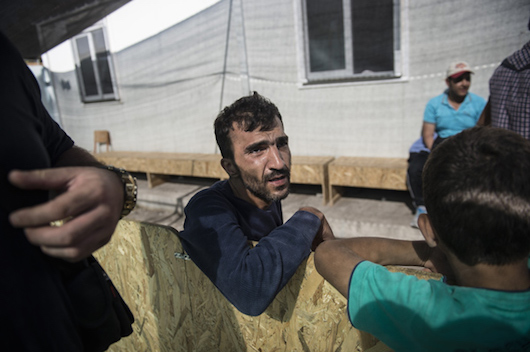
The World Food Programme announced that trucks carrying food for more than 40,000 people safely reached Madaya, Syria on Jan. 12, 2016.
Boxes of food containing rice, wheat flour, vegetable oil, salt, sugar, canned food, beans and lentils came on what Madaya’s residents hope to be the first of many aid convoys according to the World Food Programme.
“You could see a mixture of hope in people’s eyes and disbelief that this thing was actually happening,” Pawel Krzysiek of the International Committee of the Red Cross told the Thomson Reuters Foundation.
Unfortunately, residents of Madaya have been suffering from starvation as aid had not reached the area since Oct. 18, 2015, according to CNN; however it is not for a lack of trying.
Yacoub El Hillo, U.N. resident and humanitarian coordinator in Syria and Kevin Kennedy, regional humanitarian coordinator for the Syria Crisis released a statement from the U.N. Office for the Coordination of Human Affairs (OCHA) on Jan. 7, 2016 indicating that Madaya has been, “inaccessible since then despite numerous requests for access.”
The statement calls for unimpeded humanitarian access to reach those in need in hard-to-reach and besieged areas in Syria and claimed that the almost 42,000 people remaining in Madaya are at risk of further hunger and starvation.
“We do not want to see this as a one-off,” El Hillo told BBC News. “Ultimately the real solution to this predicament, to the plight of the people besieged in these towns, is for the siege to be lifted.”
World Food Programme Spokeswoman Abeer Etefa told CNN the recent convoy should sustain 40,000 for a month.
Oxfam America issued a press release on Jan. 11, 2016 expressing relief that aid was scheduled to reach those starving in Madaya, but warned that this may not be sufficient.
“Madaya is one of 15 areas across Syria under siege, with inhabitants restricted from leaving and aid workers blocked from bringing in food, medicine, fuel and other supplies,” according to Oxfam America’s press release. “People in these areas also desperately need assistance and protection, yet access to them keeps deteriorating.”
The World Food Programme reported that nutritional items from UNICEF, medical supplies from the World Health Organization (WHO) and items from the International Committee of the Red Cross (ICRC) and the Syrian Arab Red Crescent were delivered with their convoy.
The second aid convoy is reported to have reached Madaya on Jan. 14, 2016 according to BBC News.
– Summer Jackson
Sources: BBC, CNN, Oxfam America, Relief Web, WFP, News Yahoo
Photo: Catch News

Effectiveness of U.S. Disaster Response in Nepal
Over the last several months the world has focused on South Asia in response to devastating earthquakes in Nepal, Pakistan, and Afghanistan. With the threat of a natural disaster always looming in this densely populated area of the world, it is important to take note of the methods of disaster response in Nepal that have had the most success.
U.S. disaster response has seen results in curbing the consequences of world crisis when steps have been taken to recognize potential threats and build resilience.
On April 26 of last year, Nepal was devastated by a massive earthquake that claimed the lives of more than 8,000 people and left millions homeless. Given the catastrophic results, it’s hard to imagine a worse outcome.
However, given Nepal’s location in what the U.S. Geological Survey has called “one of the most seismically hazardous areas on earth,” the results could have been far more dire.
With help from the United States and the UN Development Program, prior to the earthquake, Nepal took several steps to help curb the awaiting catastrophe by developing a Disaster Risk Reduction approach.
According to the Council on Foreign Relations, those steps “ran the gamut from retrofitting buildings for seismic resistance; strengthening governance practices on matters of zoning and building codes; helping Nepal develop a more robust disaster response management capacity; creating better advance preparations for search and rescue to save more lives; and raising public awareness to the steps individuals can take to prepare themselves better.”
To that end, U.S. disaster response in Nepal was highly effective despite the devastation. By helping to foster a program of resilience, the U.S. mitigated a substantial portion of the crisis in Nepal.
USAID’s Disaster Assistance Response Team Leader, Bill Berger confirmed this when he said, “I expected a much higher death toll and much higher destruction.”
Outside of Disaster Risk Reduction, The U.S. government has also worked to bolster Nepal’s agricultural sector, which makes up nearly 40 percent of its GDP.
USAID’s Knowledge-Based Integrated Sustainable Agriculture and Nutrition (KISAN) in particular is working to increase agricultural productivity and improve nutrition.
As stated by USAID, some of the key goals of the project are:
Achieving these goals will hopefully work to provide Nepal with the food security to better handle natural disasters in the future. USAID’s KISAN project serves as another important example of how the U.S. is committed to responding to disaster through building resiliency.
– Daniel Liddicoet
Sources: CFR, USAID, USGS, USGLC
Photo: Flickr
New Tier Education System in South Africa
The City Press has reported a possible new tier education system in South Africa where students will be divided into three tiers based on their strengths and weaknesses.
According to Business Tech, students will be placed into one of three categories based on their assessed aptitude for each. The tiers are academic, technical occupational and technical vocational.
The academic tier will mirror the current matriculation program.
On the other hand, the technical occupational tier aims to produce students who can leave the education system in South Africa and enter the workplace immediately with skills such as spray painting, hairdressing and woodwork.
According to Mathanzima Mweli, Director General of DBE, “We will introduce these (technical occupational) subjects at grade four and will increase the number of schools offering the new subjects to hundreds or thousands.”
The technical vocational tier will include subjects such as engineering and technical drawing and focus on students who want to study trades. The technical vocational stream will offer 12 subjects.
The department of basic education hopes the new school system will result in 60 percent of students completing technical qualifications.
Moira de Roche, MD of Aligned4Learning, said, “There is no point in forcing a new learner who is good with their hands to do academic subjects. They end up failing and feeling useless, whereas they are good at many things. Hopefully, it will also result in less kids (and their parents) thinking the only option for them is a university.”
Education activist and founder of Partners4Possibility, Louise van Rhyn noted that the new tier system will enable young people to find fruitful careers by providing opportunities that are not solely focused on academic success.
Van Rhyn also said, “In addition to implementing this change, we also need to ensure that we still create opportunities for learners to participate in the knowledge economy, as this is a sure way out of poverty and these skills are critical for our future. We need a much higher percentage of learners with a solid foundation in maths and science.”
According to Business Tech, the new school system is being developed this year and will be tested in 58 schools in 2017.
– Jordan Connell
Sources: All Africa, Business Tech, It Web
Photo: The Guardian
Etisalat Raise ICT Literacy Through Donations
The computers were presented to the school during a commissioning of facilities ceremony where Etisalat also unveiled school renovations, according to It News Africa.
The Vice President of Government and Regulatory Affairs for Etisalat, Ibrahim Dikko, said the donation was in line with their commitment to improving education in Nigeria through partnerships with the government.
ICT education has become a basic component of learning and will provide a greater benefit if students in primary and secondary schools are exposed to it early on. The company is dedicated to creating an improved and conducive learning environment for Nigerian children, according to Dikko.
Headmistress of Nuhu Bamali Primary School, Hajia Asmau Mohammed Lawan, hopes the computers will go a long way in giving pupils the cutting edge education to prepare them for their individual career paths according to It News Africa.
In October 2015, Etisalat donated desktop computers to the ICT center of Girls’ Government College in Nigeria, which is also located in Kano State.
According to Etisalat’s Head of Government and Community Relations, Mohammed Suley-Yusuf, “Etisalat is proud to be able to contribute positively to achieving the government’s objective of improving Kano State, especially in the area of education.”
Etisalat Group is a telecommunications provider who offers services to 18 countries throughout the Middle East, Asia and Africa. It is one of the world’s leading telecom groups and ranks among the most profitable telecom groups in the world. They work with the British Council to provide a Pan-Nigerian teacher training program and they continue to focus on improving education through their Adopt-a-School program.
The company is currently working on an initiative to create an Etisalat Telecommunications Engineering Postgraduate Program within the education sector.
– Jordan Connell
Sources: Etisalat, It News Africa, Prompt News Online
Photo: Manic
O’Donnell’s KIND Fund Raises $10.5 million for Malawi
In 2010, Lawrence O’ Donnell saw firsthand the struggles of schoolchildren lacking essential school supplies in Malawi. Every day in rural villages, children would attend school without basic school equipment, like desks and chairs.
Most students would sit in the dirt or on hard cement floors, using their knees as makeshift tables to write notes. The lack of a physical platform would lead to poor handwriting and damaged papers. Because the students only have a single pair of clothing, their families would spend every other day washing their shirts and pants, often causing children to miss class.
Wanting to help improve the bleak situation, O’Donnell contacted UNICEF and a local woodworking shop, paying them to make 30 student desks — enough for a full classroom. Realizing how easily he could improve student education, O’ Donnell created the KIND Fund after his visit.
Since 2010, the organization has built and placed more than 148,755 desks in 575 primary schools in Malawi, creating legitimate work spaces for more than half a million students who would otherwise be sitting on the dirty floor. On his show, O’Donnell thanked his viewers for their ongoing support for the KIND Fund. To him, $10 million dollars “was beyond my wildest dreams when I started [the fund].”
The KIND Fund has also benefited the Malawian communities outside the classroom by manufacturing the desks locally, creating jobs for residents since its inception.
In addition to building desks for schools, the KIND Fund also provides scholarships to young women to complete their secondary school education. Because of their impoverished situation, families choose to not send their daughters to school.
With the scholarships that the KIND Fund offers, the girls receive an education that diminishes their chances of being exploited, making them less likely to fall victim to human trafficking. Girls who finish secondary school also marry at an older age, and their babies are more likely to survive.
Knowing this, the KIND Fund promotes its scholarships and makes sure both young men and women have a brighter future and better education.
“This is proof that small acts of kindness can make a big difference in our world,” O’Donnell said.
– John Gilmore
Sources: Look to the Stars, UNICEF USA
Photo: Flickr
Tackling Tuberculosis Across the Globe
Tuberculosis (TB) is responsible for 4,000 deaths daily, killing more adults around the world than any other infectious disease. Here are some key facts on TB:
Tackling Multidrug-resistant TB
Unfortunately, after decades of use, anti-tuberculosis drug resistance is becoming widespread. Disease strains that are resistant to a single anti-TB drug have been documented in every country surveyed by WHO.
Multidrug-resistant tuberculosis (MDR-TB) is a form of TB caused by bacteria that do not respond to Isoniazid and Rifampicin, the two most common anti-TB drugs.
The primary cause of MDR-TB is inappropriate treatment. Inappropriate treatment ranges from an incorrect use of anti-TB drugs to the use of poor quality medicines.
“If we don’t act promptly, if we don’t act now, then the problem of drug-resistant TB will just get worse,” reported Peter Cegielski, team leader for Drug-Resistant TB and Infection Control in the global TB branch at the CDC.
The U.S. Agency for International Development (USAID) reported this year alone more than 480,000 people will develop MDR-TB and fewer than 20 percent will receive the medications they need.
The USAID responded to this global health concern by announcing two new partnerships to add resources and cutting-edge technology to fight drug-resistant tuberculosis.
Janssen, the pharmaceutical arm of Johnson & Johnson, announced a $15 to $20 million pledge to combat MDR-TB. Cepheid, a maker of molecular systems and tests, is also teaming with USAID in an effort to increase access to rapid, accurate diagnostic tools.
“USAID remains committed to addressing the global rise of MDR-TB,” Dr. Ariel Pablos-Méndez, USAID Assistant Administrator for Global Health, said. “With the successful implementation of this plan, we have an incredible opportunity to make a significant impact on the emergence and spread of MDR-TB. We will continue to harness mutually rewarding partnerships, like the ones with Janssen and Cepheid, to lead international efforts against MDR-TB.”
– Kara Buckley
Sources: USAID, VOA News, WHO
Photo: All Africa
Internet Celebrity Charity Takes Center Stage
Reelio specializes in linking companies with Youtube stars to promote their brands, and Reelio Cares specializes in linking charities with social media influencers to promote their causes. CEO Pete Borum believes that the time has come for Reelio Cares, as many nonprofits have difficulty reaching their target audience via traditional methods like mail and television.
Already, online celebrities have become a force in charity work. In 2013, PewDiePie raised over $160,000 in just two weeks for Charity: Water, a nonprofit that specializes in providing clean drinking water to countries all over the earth. LoadingReadyRun has raised more than $450,000 for Child’s Play over several years. Child’s Play brings toys and games to sick children in hospitals worldwide.
Internet celebrity charity is advantageous to all parties involved. For nonprofits, it provides a free way to contact a young, engaged audience willing to give. For online stars, it lets them change the world in a positive way. According to one such star, woodworking sensation Steve Ramsey, “Many have huge audiences that they weren’t really expecting. They start to think ‘Do I want to just keep making videos or do I want to do something with those videos, with this audience and really use it for good?’”
Besides promoting charities, the videos also promote the online celebrity’s site. Reelio reports that videos with a positive, charitable message receive two-and-a-half times as many views as normal videos. This is because of the way these drives usually work.
For the number of views a video receives, the celebrity will donate an ever-increasing number of dollars to a cause. As such, subscribers are encouraged to share with their social network as much as possible. As more people see the video, they also donate their own money to the cause. In the end, the online celebrity only contributes a small portion directly to the charity. It’s the audience who contributes the lion’s share.
Demographically, the shift to internet celebrities makes sense for nonprofit charities. According to CNN in November 2015, teens spend roughly nine hours a day on social media. Advertising agencies such as BrightRoll report that the majority of their customers find online advertising to be at least as effective as television.
While it may be too soon for traditional celebrities to step aside, the time has come for them to share center stage with internet celebrities. Social media lets charitable organizations reach an audience that’s not only willing to give, but willing to share their message with as many people as possible. It lets them reach young people who are as familiar with Youtube sensations as they are with movie stars. As the information age advances, internet celebrity charity is destined to positively change the planet.
– Dennis Sawyers
Sources: CNN, Financial Times, Marketing Land, Reason Digital, Reelio
Photo: Google Images
Millennium Challenge Corporation Seeks Expansion
The Millennium Challenge Corporation (MCC) is seeking approval from Congress to expand its operations over the coming years via the Millennium Compacts for Regional Economic Integration (M-CORE) Act.
In a recent testimony before the Senate Foreign Relations Committee, MCC CEO Dana Hyde argued that the organization would be more effective if given the authority to make regional investments, in addition to the single-country investments it is currently authorized to make.
“By making coordinated regional investments across multiple eligible countries, MCC can help countries work together to build and grow regional markets…and help generate new business and market opportunities for U.S. and other companies,” Hyde said.
The MCC has a singular mandate: reduce poverty through economic growth. The organization does this by initiating joint public-private investment projects in countries working toward democratic governance, open markets and human development.
Since its creation in 2004 by President Bush, the Millennium Challenge Corporation has committed $10 billion in over 58 projects in 25 countries. Around 70 percent of this investment has gone into infrastructure projects like highways and ports and an increasing percentage is being invested in energy.
The organization is currently only allowed to initiate projects within single countries, which, according to Hyde and other experts, is an impractical development strategy.
According to Hyde, countries cannot develop economically if they are unable to trade with their neighbors. Regional projects like cross-border highways and railways could make a bigger impact – especially among groups of small states.
“It’s easy to think about how regional engagement might be beneficial in the context of electricity,” said Center for Global Development President Dr. Nancy Birdsall. “The logic of a shared grid across borders is clear. To work, countries involved need to commit to a strong regulatory and financial structure outside the auspices of a single government for power trading and pricing.
However, initiating projects across multiple countries also poses a number of challenges. One such challenge occurs because neighboring countries are often not at the same level of development. For example, if the MCC wanted to begin a project across two countries, one may meet the required indicators for open governance and human development while the other might not.
The organization currently bridges this gap by undertaking threshold programs designed to assist near-eligible countries to become ready for investment.
Now, it wants the additional authority to conduct threshold programs at the same time it begins investment projects – meaning countries can begin projects before they are fully eligible to do so.
It may seem counter to MCC’s mandate, but Hyde argued that it is a necessary.
In her testimony, Hyde said the Millennium Challenge Corporation has a proven record of implementing successful country projects and is well equipped to take on the challenges of regional investments without straying from its mandate.
– Ron Minard
Sources: American Progress, Senate.gov 1, Senate.gov 2, MCC
Photo: Wikipedia
Education in Namibia and Its Role in Development
The United Nations recently presented its Human Development Report in Windhoek, Namibia. The Report included the U.N.’s Human Development Index (HDI) which not only measures a nation’s economic well-being but also that of its citizens. Many find the HDI useful because it takes into account the citizenry’s quality of life.
The Report provided sobering news for the host nation when it was revealed its HDI rank was 126 out of 188. Despite its status as an upper middle-income nation, Namibia ranks fairly low on quality of life metric.
The HDI shows that a rising gross domestic product cannot cover up the citizen’s poor standard of living. The HDI points out that there is wealth inequality, poverty, poor healthcare and educational underperformance in Namibia.
Babatunde Omilola, the United Nations Development Programme’s chief of development planning in New York offered his opinion on solutions to these issues. In particular, Omilola noted that Namibia “could do better if it invests more in education.”
For example, Namibia invests billions of dollars in its education, yet only 30 percent of 12th graders in 2013 met the requirements for college admissions. With statistics showing that college graduates earn more throughout their lifetime, Namibia’s lack of collegiate students translates to unrealized potential.
By improving education in Namibia, it is likely that its citizens will benefit from increased opportunities and a higher HDI as the country tries to overcome a staggering poverty rate of 30 percent.
Omilola also noted that education “allows people to enhance their capabilities by providing them with acquired skills and knowledge.”
He then concludes this by saying Namibia’s “Education and skills need to be boosted.”
With a greater focus on education in Namibia, it is hoped that the country will produce more college graduates that have 21st century skills. These graduates will be able to fill the nation’s skills gap, and take advantage of the nation’s abundant resources.
– Andrew Wildes
Sources: Capacity4dev, World Bank, UNDP, Namibian 1, Namibian 2, Namibian Sun, WHO
Photo: UNDP
Fighting Starvation: Madaya Finally Receives Aid
The World Food Programme announced that trucks carrying food for more than 40,000 people safely reached Madaya, Syria on Jan. 12, 2016.
Boxes of food containing rice, wheat flour, vegetable oil, salt, sugar, canned food, beans and lentils came on what Madaya’s residents hope to be the first of many aid convoys according to the World Food Programme.
“You could see a mixture of hope in people’s eyes and disbelief that this thing was actually happening,” Pawel Krzysiek of the International Committee of the Red Cross told the Thomson Reuters Foundation.
Unfortunately, residents of Madaya have been suffering from starvation as aid had not reached the area since Oct. 18, 2015, according to CNN; however it is not for a lack of trying.
Yacoub El Hillo, U.N. resident and humanitarian coordinator in Syria and Kevin Kennedy, regional humanitarian coordinator for the Syria Crisis released a statement from the U.N. Office for the Coordination of Human Affairs (OCHA) on Jan. 7, 2016 indicating that Madaya has been, “inaccessible since then despite numerous requests for access.”
The statement calls for unimpeded humanitarian access to reach those in need in hard-to-reach and besieged areas in Syria and claimed that the almost 42,000 people remaining in Madaya are at risk of further hunger and starvation.
“We do not want to see this as a one-off,” El Hillo told BBC News. “Ultimately the real solution to this predicament, to the plight of the people besieged in these towns, is for the siege to be lifted.”
World Food Programme Spokeswoman Abeer Etefa told CNN the recent convoy should sustain 40,000 for a month.
Oxfam America issued a press release on Jan. 11, 2016 expressing relief that aid was scheduled to reach those starving in Madaya, but warned that this may not be sufficient.
“Madaya is one of 15 areas across Syria under siege, with inhabitants restricted from leaving and aid workers blocked from bringing in food, medicine, fuel and other supplies,” according to Oxfam America’s press release. “People in these areas also desperately need assistance and protection, yet access to them keeps deteriorating.”
The World Food Programme reported that nutritional items from UNICEF, medical supplies from the World Health Organization (WHO) and items from the International Committee of the Red Cross (ICRC) and the Syrian Arab Red Crescent were delivered with their convoy.
The second aid convoy is reported to have reached Madaya on Jan. 14, 2016 according to BBC News.
– Summer Jackson
Sources: BBC, CNN, Oxfam America, Relief Web, WFP, News Yahoo
Photo: Catch News
Mobile Weather Texts Prepare West African Farmers
Swedish technology company and social enterprise Ignitia has teamed up with Business Call to Action (BCtA) to send tropical weather forecasts via text message to 1.2 million small-scale west African farmers by the end of 2017.
The BCtA is backed by the UNDP and encourages businesses to include poverty-level populations and help to achieve sustainable development goals.
Founded in 2010 as a physics and meteorologist research team, Ignitia offers weather forecasts to prepare west African farmers for inclement weather.
The company has since developed algorithms that provide weather forecasts to 3,400 small-scale farmers in Ghana – with an 82 percent level of accuracy, compared to the 39 percent standard, according to Ignitia .
Here’s how it works: Ignitia’s weather forecasts are reported through Iska as text messages and are sent directly to small-scale farmers throughout tropical regions. Each forecast is tailored to a specific farmer’s crop location via an automated application that finds its GPS coordinates.
Farmers receive these forecasts by subscribing to an SMS service for $0.04 per day that can be paid in installments or from pre-paid credit on a mobile phone. This equals less than two percent of a farmer’s total expenditures, according to The Guardian.
https://www.youtube.com/watch?v=8sy0INKw_bg
Iska offers warnings of heavy rains and dry spells, specific start and end dates for the rainy season and provides two-day forecasts to west African farmers daily, in addition to a monthly outlook report and two six-month seasonal reports.
About 40 percent of the world’s population lives in the tropics where most livelihoods come from small-scale farming, with sub-Saharan African farmers seeing the lowest yields in the world.
Since tropical weather conditions can change drastically in a short amount of time, monitoring crops can be a tricky task for farmers. Changes in weather patterns and the unpredictability of severe weather make traditional farming methodologies less dependable.
Iska’s short-mid and long-range forecast messaging offers these farmers a vital way of adapting to climate change. The Guardian reports that at least 20 percent of yields are lost due to weather, but meteorology updates like the ones Iska provides can help increase a farmer’s income by 80 percent.
In West Africa, Iska demonstrated an 84 percent accuracy rate during the 2013 and 2014 rainy seasons, according to Ignitia.
“With Iska, smallholder farmers receive the vital information they need to mitigate risk and create resilience. In doing so, farmers are able to increase yields and improve their livelihoods, year after year,” said Liisa Petrykowska, Ignitia’s chief executive officer.
Ignitia has provided over six million weather forecasts to 80,000 small-time African farmers and plans to expand its services to 20 other countries throughout Southeast Asia, Central America and other regions of Africa.
– Kelsey Lay
Sources: Ignitia 1, Ignitia 2, Ignitia 3, The Guardian
Photo: Times Higher Education