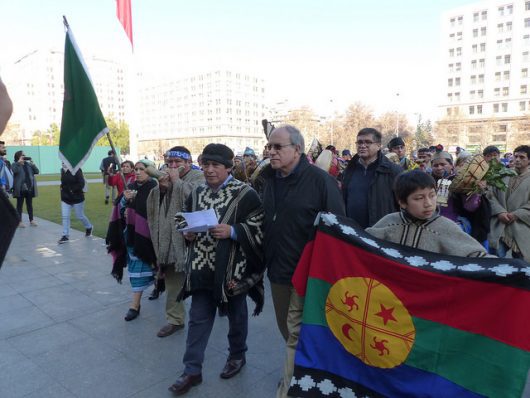
An indigenous group of south-central Chile and southwestern Argentina, the Mapuche live in the heart of oppression. Despite a long history of war on culture and tradition, the Mapuche have remained dedicated to irreplaceable ancestral lands, recently taking to protests for expression against Mapuche oppression.
Enduring unforgiving Spanish colonialism and Pinochet’s dehumanizing regime of the late 1990s, the indigenous group fell under harsh marginalization, their resistance ultimately criminalized. Moreover, with deep-seeded enmity rooted in the expropriation of ancestral lands by big forestry corporations, the Mapuche now stand tall to defend their rights with no sign of giving up.
The Mapuche Are Vocal
The array of indigenous groups that populate the state of Chile make up about 10 percent of the national population. Small, in comparison, but these groups preserve what remains of the once prominent inhabitation of tribes that traversed the length of the country.
The Mapuche, being the largest of the remaining indigenous groups, remain relevant. From historical anecdotes detailing their resistance to the reign of the Incas and the invading Spaniards to their modern day revolution for justice, the Mapuche are neither silent nor invisible, but rather stoic warriors.
Desperate to literally strike gold, riches drove the Spanish into Chile — yet the Spaniards were never able to fully defeat the Mapuche presence in this area. Enter: modern day. Vocal and politically involved, the Mapuche struggle against oppression has led to national and international visibility.
Their Land is Their Livelihood
From the rebellion against the Spanish to modern-day protesting, Mapuche oppression has remained consistent. Victimized by violence and poverty, indigenous independence has been compromised, especially through the campaign know as “Pacification of the Araucanía Region.” This program was designed to legally integrate much of the Mapuche land into Chilean territory.
Without land – a fundamental foundation for cohesion and tradition – self-sustainability becomes almost impossible. Without self-sustainability, a vital encompassment of Mapuche identity, they had no other choice but to migrate to the urban populace, an unfortunate move to foreign scenery and lifestyles. Consequently, employment obstacles prompted poverty and, subsequently, the forced construction of informal housing settlements.
Mapuche oppression only escalated during the reign of dictator Augosto Pincohet. Under the “Law of Community Division,” devised by Pinochet himself, any remains of communal Mapuche land was rendered privatized. Wholehearted resistance to such targeted and deliberate injustice led to the disappearance of many indigenous peoples by the government.
With restored democracy, efforts have been made to mend the relationship between indigenous groups and the Chilean government. The establishment of CONADI, or the National Corporation for Indigenous Development (Corporación Nacional de Desarrollo Indígena), and the reallocation of ancestral land for self-sustainability are steps in the right direction.
Mapuche Resistance: A Force To Be Reckoned With
Police occupation has heavily increased in Araucanía, a region dense with dwellers of Mapuche ancestry. The militarization of the region surfaces as a direct result of Mapuche defiance.
Recently, Mapuche resistance has taken to aggressive tactics. Determined to both reclaim ancestral lands and gain political sovereignty, the indigenous group has turned to direct action. The Coordinadora Arauco-Malleco (CAM), an anti-capitalist organization, is just but one part of the rebellion.
“The government practices and respects Catholicism but it discriminates against Mapuche spiritual beliefs,” an indigenous Mapuche stated. “The Mapuche have been impoverished spiritually, culturally and economically by Chile. I’m willing to sacrifice my life for my people.”
Mapuche Hope For Restoration Is Indestructible
Not looking for cushy legislation that holds no ground or legitimate benefit, the Mapuche simply request the return of autonomy to their populace and land. The citizens of Araucanía, the region with the worst poverty and unemployment rates in the country, have no intention of quieting down.
“When we recover lands we plant crops, breed animals and reconstruct our cultural world,” says Llaitul, a spokesperson for CAM. “We will build houses but our first priority is a spiritual center, the rewe.”
With tensions still thin, the center-left president Michelle Bachelet proposed a project to Congress: an Indigenous Peoples’ Ministry.
Furthermore, Bachelet proposed future dedication to infrastructure, including road construction, clean drinking water and programs to reallocate ancestral land back to the indigenous Mapuche.
“We’ve failed as a country,” Bachelet stated from La Moneda presidential palace in metropolitan Santiago. But, with Mapuche prowess, their dedication to full restoration is a force to be reckoned with.
– Mary Grace Miller
Photo: Flickr

On the Road to Progress: Poverty Reduction in Papua New Guinea
Poverty in Papua New Guinea is characterized by many social, economic and geographical inequalities, but there is an abundance of organizations willing to help bring the country to a flourishing state. Here are the issues, solutions and organizations involved in poverty reduction in Papua New Guinea.
Poverty Reduction in Papua New Guinea
Since the 1990s, poverty in Papua New Guinea has been on the rise. With about 6.5 million people living in the country, more than 37 percent of the population lives on less than $1.25 a day.
According to UNDP, seventy-five percent of the population is dependent on agriculture. A large portion of the population lives in rural areas, where agriculture is the main source of income. Citizens living in rural communities don’t have access to electricity and adequate healthcare facilities.
UNDP supports the government in implementing new strategies with reducing poverty in Papua New Guinea as well as promotes equality among women and men. The organization is working towards creating a financial sector in the country to make more services affordable to citizens.
Healthcare
The healthcare system in Papua New Guinea has been struggling in the past few decades to offer quality health services. The rugged terrain, landscape of the country and lack of transportation systems makes it difficult for citizens living in rural areas to get to healthcare services in the urban areas. Malnutrition is one of the main reasons for infant mortality, which reached 57 deaths per 1000 live births.
Diseases also run high throughout the country and clean water is difficult to obtain. In fact, 4.8 million citizens do not have access to clean water in Papua New Guinea, and over 200 children under the age of five die from diarrhoeal diseases. Other disease such as HIV/AIDS and malaria are also top causes of death in the country.
Caritas is an organization that helps bring education, healthcare and community empowerment to people living in poverty in Papua New Guinea. In 2011, Caritas implemented a program that made sure that people living in remote or rural areas of the country have access to healthcare facilities that test for many diseases such as HIV/AIDS and malaria. Caritas also started a Life Skills program to help young adults struggling with HIV/AIDS and ex-prisoners that need a new start in life.
Gender Inequality
Papua New Guinea is ranked on the top ten list of countries with the most gender inequality. Women have unequal access to healthcare and education and are very underrepresented in government. There is also many violent crimes against women and children in the country, and sex trafficking is common.
Oxfam Australia strives for equality amongst men and women in Papua New Guinea by raising awareness about violent crimes against women to hopefully stop violence before it occurs. OxFam is supported by the Australian government through many provided programs such as Australian NGO Cooperation Program (ANCP), which offers quality support to survivors of crime in the country.
Not only do they help with crime victims, OxFam also provides clean water and hygiene services to people living in poverty in Papua New Guinea.
Natural Disasters
The country is also affected by natural disasters that ruin food crops and infrastructure. In fact, about four million people were affected by natural disasters in Papua New Guinea from the years 1997 to 2010.
CARE is a nonprofit organization that has worked since 1989 to help eradicate poverty in Papua New Guinea. The organization responds directly to emergency situations such as natural disasters and droughts. They bring water, hygiene and sanitary services to areas that need it the most. CARE also assists with improving agricultural practices, education and disease prevention.
Missionaries and the Prospect of Prosperity
Aside from the many non-profit organizations focused on poverty reduction in Papua New Guinea, missionaries also work hard to bring their services to the country. Danny Markell of Douglasville, Georgia went on a mission trip with a traveling preacher to Papua New Guinea. Markell and the rest of the team traveled to Port Moresby and urban cities surrounding the capital to pass out food, water and other basic necessities.
“We gave out a lot of Bibles and coloring books for the kids,” Markell said. “We also helped out at two young camps.” Missionaries like Markell travel to the country every year to give citizens supplies, education and healthcare to make their lives a little bit easier.
Through their efforts and the work of the many organizations that provide assistance, there could be hope for the people living in poverty in Papua New Guinea.
– McKenzie Hamby
Photo: Flickr
One Bite at a Time: A Look at the Top Malaria Nonprofits
Malaria is the most deadly disease facing the world’s poor today. In 2016, roughly 445,000 people died due to malaria, and the illness still remains in 91 countries and threatens half of the world’s population. The fight against malaria is far from over, and many nonprofits are still working on achieving a world without malaria. Here are five of the top malaria nonprofits to be aware.
Malaria No More
Malaria No More (MNM) launched in 2006 alongside the President’s Malaria Initiative. The goal of the organization is to create “a world where no one dies from a mosquito bite.” MNM aims to end malaria by mobilizing advocates and securing funding to combat malaria. Their work focuses on three countries, including Kenya.
MNM started work in Kenya in 2014, and their work’s focus is to protect pregnant women and babies who are both at a higher risk for contracting malaria than any other populations. In Kenya, MNM partners with several other nonprofits to make malaria a top political priority. MNM also spreads awareness about malaria through meetings with politicians and events with celebrities.
As a result of MNM’s work, roughly 1,800 mothers and pregnant women received mosquito nets, two Kenyan counties increased funding for malaria elimination and millions of people received information on malaria treatment and prevention via radio.
The International Committee of the Red Cross
Another one of the many nonprofits combating malaria is the International Committee of the Red Cross (ICRC). Since its inception in 1863, the goal of ICRC is to assist victims of war and poverty. Since malaria threatens so many impoverished nations, the organization aids in combating malaria.
The ICRC also focuses on encouraging and assisting communities to band together and fight malaria. In 2008, the organization and its partners distributed 60,000 nets to Burkina Faso and helped educate its people on the importance of nets and how to hang them properly.
The President’s Malaria Initiative
The President’s Malaria Initiative (PMI) started in 2006 with the goal of reducing the malaria death rate by 50 percent. The PMI offers several services to the people of sub-Saharan Africa, including insecticide-treated nets, indoor residual spraying, intermittent preventative treatments for pregnant women, and seasonal chemoprevention treatments.
Since the formation of the PMI, more than 5 million houses received an indoor residual spraying, which protects more than 20 million people. The PMI also distributed 40 million treated nets. Overall, the malaria rate in sub-Saharan Africa dropped 54 percent in the past 17 years.
The World Health Organization
The World Health Organization (WHO) is one of the many nonprofits combating malaria. Founded in 1948, WHO oversees international health through the United Nations and aims to improve health systems and respond to health crises all over the world. Their oversight and work includex fighting to eradicate malaria.
In 2015, the E-2020 plan, which aims to eliminate malaria in 21 countries by 2020, began. WHO is one of several supporters of this initiative and works with 21 countries to reach the elimination of malaria.
Comoros is one of the countries that WHO works with. In 2014, the number of reported indigenous malaria cases reached 53,000; in 2016, that number fell to 1,066. This decrease was the result of a treatment campaign, indoor spraying and the delivery of insecticide-treated nets by WHO.
Nothing But Nets
Nothing but Nets supplies nets to areas that are vulnerable to malaria. The organization also raises awareness about malaria and mobilizes citizens to take action by contacting their representative or starting a fundraising campaign.
Nothing but Nets raised $65 million for 12 million mosquito nets to be sent to families all over the world. Most of these nets go to sub-Saharan Africa, where malaria is most common and deadly. In 2000, only two percent of the population in sub-Saharan Africa owned mosquito nets; in 2017, 53 percent of people in sub-Saharan Africa possessed a net.
As you can see, these top malaria nonprofits have made it their mission to put a stop to this disease sooner rather than later.
– Drew Garbe
Photo: Flickr
Universal Basic Income in India
Universal Basic Income (UBI) refers to an unconditional sum of money given by the government to all citizens, via cash transfer, regardless of their wealth. The goal of such a scheme is to guarantee that all citizens of the country are able to support themselves and fulfill their basic needs.
Benefits of Universal Basic Income
Arvind Subramanian, Chief Economic Advisor to the Government of India, believes that Universal Basic Income will be a reality in some states in the country within the next two years. He argues that such a scheme will be more effective and easier to administer, compared to other welfare programs administered by the government.
The Economic Survey of 2017 highlighted the benefits of Universal Basic Income in India as a means to alleviate poverty. The report mentions that such a scheme must first and foremost be unconditional and universal, and thus it will promote social justice, productivity and economic equality. The poor would be empowered to decide how to spend their money most efficiently, based on their individual needs.
Individuals would also have the ability to select their employment conditions more carefully, instead of being forced to work in exploitative conditions simply because of the desperate need to provide for themselves and their families.
The report asserts that UBI is an effective scheme, and should replace existing subsidies that are given with the lofty aim of alleviating poverty. However, it also makes a specific mention that the political climate might prove to be an obstacle to achieving this goal. Universal Basic Income in India cannot replace state capacity but it could and should complement it.
UBI would especially empower women by providing them with greater economic independence. Having their own reliable source of income would enhance their agency, make them less dependent on men and will be a step to narrow the gender inequality and the overarching sway of patriarchy.
Such a scheme would also encourage citizens to utilize financial systems and establish credit. Not only will this enhance the financial knowledge of citizens, but it will be profitable for banks in India. Allowing previously socioeconomically marginalized groups to access formal credit systems will reduce their reliance on informal loans and exploitation by moneylenders.
Critics of UBI
Critics of Universal Basic Income argue that giving unconditional cash to citizens will encourage them to spend it recklessly on alcohol, gambling and drugs and that this would actually reduce the incentive to work. However, basic income experiments conducted in a village in Kenya over a 12-year period show that most participants used $22 per month allowance on basic necessities and did not squander the money.
The UBI pilots in India were funded by UNICEF and the Self Employed Women’s Association (SEWA) and operated in rural villages of Madhya Pradesh, in 2011. These pilots showed largely positive results- the beneficiaries were using the money wisely by investing in education, household expenditure and food. A report published by SEWA found that unconditional cash transfers helped improve productivity, financial stability and health of the people.
The pilot study measured only the short-term impact of UBI, and critics argue that the long-term impact cannot be measured so easily and thus we cannot really assess if the scheme is feasible.
This innovative approach offers the prospect of empowering the poor and providing them with basic necessities. Previous studies have shown its positive impact on poverty alleviation on social, political and economic levels.
– Isha Kakar
Photo: Flickr
A Rundown on the History of Ebola in Liberia
The first outbreak of Ebola in Liberia was documented in March 2014. By June of that year, Ebola began to take lives. On August 6, the president of Liberia declared a state of emergency, closed schools, and established an Ebola task force.
In her statement on August 6, President Ellen Johnson Sirleaf stated, “The virus currently has no cure and has a fatality rate of up to 90 percent. The aggregate number of cases: confirmed, probable and suspected in Liberia has now exceeded 500 with about 271 cumulative deaths. With 32 deaths among health care workers. The death rate among citizens, especially among health workers is alarming.”
Development of Epidemic
In mid-August, the Ivory Coast banned all flights traveling to or from Liberia. Ebola had also spread to neighboring countries, including Guinea and Sierra Leone. Multiple clinics began opening in Monrovia, country’s capital, and across the country, but they did not have enough space to house all those inflicted, and many people died outside hospitals waiting for care.
The president of Liberia requested international assistance in early October of 2014, and on October 16, President Barack Obama granted the use of the National Guard and reservists in Liberia.
At that point, nearly 4,500 people had died from Ebola in Liberia, Sierra Leone and Guinea. The military personnel sent by the U.S. assisted in building clinics and providing humanitarian assistance.
Working on Ebola-free Country
World Health Organisation (WHO) began to implement its 70-70-60 plan to curb the epidemic. The goal was to get 70 percent of the cases isolated and 70 percent of the deceased buried safely within 60 days starting on October 1, 2014. WHO also worked with Liberia’s Ministry of Health to train health care workers on how to safely treat patients that were infected.
In November 2014, WHO reported that there was evidence of a decline of new cases of Ebola in Liberia. In January 2015, clinics that had been overflowing began to close due to a lack of patients.
As of January 28, 2015, there were only five reported cases of Ebola in Liberia. The prevalence of the disease began declining significantly over the next year.
On the May 9, Liberia was declared Ebola-free and three months passed without a recurrence of the disease. Medecins Sans Frontieres encouraged people to stay aware of the disease coming back after the announcement of the eradication.
A few new cases were found in the summer of 2015, but they did not lead to another significant outbreak. Liberia continued to be declared Ebola-free on and off for every 42-day period that passed without a reported case. Most recently, Liberia has been Ebola-free since June 9, 2016.
The Causes for Epidemic Spreading
The massive outbreak of Ebola in Liberia has been contributed by lack of sanitation, corruption and hiding of bodies/diseased people, among others factors.
Many Liberians did not report cases of Ebola or deaths due to it. Instead, they were self-treating and burying bodies in unsafe places. This practice led to the disease spreading at a faster pace.
Lack of sanitation was a major contributor, as many Liberians in Monrovia use the beach and the river as a lavatory. Without sanitary spaces, Ebola was able to run rampant. Additionally, it was reported that body-collection teams would accept bribes from families who did not want people to know their relative died of Ebola. Instead of collecting the body, the teams would leave it with the family so they could host their own funeral.
Thankfully, Liberia has been Ebola-free since 2016 and is now better equipped to handle an outbreak it was to return.
– Amelia Merchant
Photo: Flickr
Eliminating Human Trafficking in the Democratic Republic of the Congo
Human trafficking is both a human rights and an economic concern. The following is a discussion on the progress being made in eliminating human trafficking in the Democratic Republic of the Congo (DRC).
Human trafficking accounts for a large portion of the economic flow in the Democratic Republic of the Congo; unfortunately, little is being done to combat this occurrence by the Congolese government. This practice has thus continued to be a common human rights violation in the country and is perpetuated by a handful of linked issues such as corrupt government, poor economic climate and low infrastructure.
Prevalence of Human Trafficking and Existing Laws
Currently, no laws exist in the Democratic Republic of the Congo to prevent human trafficking.
Further, human trafficking rings are often under the control of gangs and various militant groups that the Congolese government has little power to challenge. This makes the country a breeding ground for human trade and other human rights violations.
Current Aid and Interventions
Despite the Congolese government’s inefficiency in eliminating human trafficking in the DRC, several different aid groups have begun working on behalf of the cause. Among these groups are the United Nations and USAID.
Unfortunately, Joseph Kabila, the current president of the Congolese nation, is refusing aid, insisting that it is not needed despite the millions of displaced people unable to regularly access food. Kabila has threatened outside parties that offer assistance — including Sweden and the Netherlands — and made it hard for the victims of and those vulnerable to human trafficking to receive the intervention that they need.
Earlier this year, the humanitarian assistance needed in the DRC was estimated at $1.7 billion, which is four times the amount of aid that was offered last year. Due to increased hostility from President Kabila, those raising aid for the nation will face large hurdles from the government if they continue working amidst Kabila’s threats.
Although the United Arab Emirates has been clear that they will not sponsor aid unapproved by Congolese officials, at this point no other aid source has withdrawn their pledge to support the rehabilitation of the DRC. The hope is that the aid to be received will be used to confront big-ticket issues in the nation, with human trafficking among the biggest concerns.
Moving Forward in Eliminating Human Trafficking in the Democratic Republic of the Congo
While there are many obstacles that the Democratic Republic of the Congo faces along with anyone who dares to support its victims, there is a clear opportunity for the world to be a force for good.
There is power in numbers, and the greater support citizens of the nation receive, the greater the likelihood the nation will push through to the other side of its very real and serious struggles.
A great tool for U.S. citizens is writing to representatives about issues that are important, requesting changes. Many small voices can make a powerful impact.
– Alexandra Ferrigno
Photo: Flickr
Top 10 Facts Everyone Should Know about Genocide
Genocide, or the mass murder of specific groups of people, is something that most consider to be a thing of the past, citing the Jewish holocaust and Nazi regime that ended over 60 years ago. Unfortunately, the concept of genocide is alive and well in the current state of world affairs. Moreover, it is important to note that genocide has farther reaches than those of mass death, extending into severe turmoil for those left alive.
Top 10 Facts Everyone Should Know about Genocide
Due to the causes of genocide being varied and complex, these are only the top 10 facts everyone should know about genocide and not a comprehensive list. However, no matter how much information is gathered about genocide, the most imperative thing to take away is that no small action or thought is too small to matter. Every action and all thoughts contribute to what the future holds. Everyone makes a difference.
– Alexandra Ferrigno
Photo: Flickr
Slowly but Surely: 10 Facts About Living Conditions in North Korea
The world was watching when Kim Jong Un ascended the international stage to shake hands with U.S. President Donald Trump. Yet the fanfare of a once-in-a-blue-moon summit in Singapore between the North Korean and American heads of state shuffled North Korean human rights abuses to the back of the media’s story deck. The latest member of the Kim dynasty lives and speaks in superlatives; his people do not. Here are the top 10 facts about living conditions in North Korea.
Top 10 Facts About Living Conditions in North Korea
Improving Day to Day
The top 10 facts about living conditions in North Korea show that the situation is abysmal, but standards are on the rise. Kim Jong Un has been more liberal than his predecessors in state control of the economy, allowing pockets of capitalism to flourish.
Despite this, totalitarian shackles remain as steadfast as ever before, and the possibility of political reform seems a distant specter. A long bridge of negotiation and diplomacy on the part of outside powers must be crossed if living conditions in North Korea are ever to substantially improve.
– Alex Qi
Photo: Flickr
4 Crucial Things To Know About Mapuche Oppression
An indigenous group of south-central Chile and southwestern Argentina, the Mapuche live in the heart of oppression. Despite a long history of war on culture and tradition, the Mapuche have remained dedicated to irreplaceable ancestral lands, recently taking to protests for expression against Mapuche oppression.
Enduring unforgiving Spanish colonialism and Pinochet’s dehumanizing regime of the late 1990s, the indigenous group fell under harsh marginalization, their resistance ultimately criminalized. Moreover, with deep-seeded enmity rooted in the expropriation of ancestral lands by big forestry corporations, the Mapuche now stand tall to defend their rights with no sign of giving up.
The Mapuche Are Vocal
The array of indigenous groups that populate the state of Chile make up about 10 percent of the national population. Small, in comparison, but these groups preserve what remains of the once prominent inhabitation of tribes that traversed the length of the country.
The Mapuche, being the largest of the remaining indigenous groups, remain relevant. From historical anecdotes detailing their resistance to the reign of the Incas and the invading Spaniards to their modern day revolution for justice, the Mapuche are neither silent nor invisible, but rather stoic warriors.
Desperate to literally strike gold, riches drove the Spanish into Chile — yet the Spaniards were never able to fully defeat the Mapuche presence in this area. Enter: modern day. Vocal and politically involved, the Mapuche struggle against oppression has led to national and international visibility.
Their Land is Their Livelihood
From the rebellion against the Spanish to modern-day protesting, Mapuche oppression has remained consistent. Victimized by violence and poverty, indigenous independence has been compromised, especially through the campaign know as “Pacification of the Araucanía Region.” This program was designed to legally integrate much of the Mapuche land into Chilean territory.
Without land – a fundamental foundation for cohesion and tradition – self-sustainability becomes almost impossible. Without self-sustainability, a vital encompassment of Mapuche identity, they had no other choice but to migrate to the urban populace, an unfortunate move to foreign scenery and lifestyles. Consequently, employment obstacles prompted poverty and, subsequently, the forced construction of informal housing settlements.
Mapuche oppression only escalated during the reign of dictator Augosto Pincohet. Under the “Law of Community Division,” devised by Pinochet himself, any remains of communal Mapuche land was rendered privatized. Wholehearted resistance to such targeted and deliberate injustice led to the disappearance of many indigenous peoples by the government.
With restored democracy, efforts have been made to mend the relationship between indigenous groups and the Chilean government. The establishment of CONADI, or the National Corporation for Indigenous Development (Corporación Nacional de Desarrollo Indígena), and the reallocation of ancestral land for self-sustainability are steps in the right direction.
Mapuche Resistance: A Force To Be Reckoned With
Police occupation has heavily increased in Araucanía, a region dense with dwellers of Mapuche ancestry. The militarization of the region surfaces as a direct result of Mapuche defiance.
Recently, Mapuche resistance has taken to aggressive tactics. Determined to both reclaim ancestral lands and gain political sovereignty, the indigenous group has turned to direct action. The Coordinadora Arauco-Malleco (CAM), an anti-capitalist organization, is just but one part of the rebellion.
“The government practices and respects Catholicism but it discriminates against Mapuche spiritual beliefs,” an indigenous Mapuche stated. “The Mapuche have been impoverished spiritually, culturally and economically by Chile. I’m willing to sacrifice my life for my people.”
Mapuche Hope For Restoration Is Indestructible
Not looking for cushy legislation that holds no ground or legitimate benefit, the Mapuche simply request the return of autonomy to their populace and land. The citizens of Araucanía, the region with the worst poverty and unemployment rates in the country, have no intention of quieting down.
“When we recover lands we plant crops, breed animals and reconstruct our cultural world,” says Llaitul, a spokesperson for CAM. “We will build houses but our first priority is a spiritual center, the rewe.”
With tensions still thin, the center-left president Michelle Bachelet proposed a project to Congress: an Indigenous Peoples’ Ministry.
Furthermore, Bachelet proposed future dedication to infrastructure, including road construction, clean drinking water and programs to reallocate ancestral land back to the indigenous Mapuche.
“We’ve failed as a country,” Bachelet stated from La Moneda presidential palace in metropolitan Santiago. But, with Mapuche prowess, their dedication to full restoration is a force to be reckoned with.
– Mary Grace Miller
Photo: Flickr
Top 10 Facts about Poverty in Cyprus
The small, Mediterranean island nation of Cyprus has undergone development and overall economic growth despite conflicts within the country. Although the economy has grown, the financial situation in Cyprus has fluctuated in recent years, causing more issues of poverty. In order to gain a better understanding of poverty and how it’s changing in Cyprus, below are the top 10 facts about poverty in this country.
Top 10 Facts about Poverty in Cyprus
These top 10 facts about poverty in Cyprus underscore the government’s commitment to improving the economy and offering more opportunities for its people. A strong focus on the service and skilled industry, along with industrial and agricultural growth, has allowed the country to improve its already high standard of living. Although the economy has developed significantly, poverty for some people still continues, and with possible reunification between the North and South, poverty would continue to decrease in Cyprus.
– Matthew Cline
Photo: Flick
Top 10 Quotes about Advocacy
Advocacy is when an individual or group supports and influences political, economic and social decisions. The goal of an advocate is to gain support in a certain environment to create change for the better. According to Culture & Creativity, it only takes 10 percent of a population holding a strong belief to persuade the remaining population to adopt that same belief. This means that with the right amount of support, help and a common goal to better the world, people all around the world can eventually live freely and equally.
Advocates have been contributing to the world’s success for centuries. While all of these advocates come from different backgrounds and places from all around the world, they all have one thing in common- a passion to change the world for the better. Below are the top 10 quotes about advocacy from powerful people and the short biographies of these people.
Top 10 Quotes about Advocacy
To be an advocate is to have courage, independence and passion for the things that matter. These top 10 quotes about advocacy provide a glance at the passion these people had and have for their society and the future of the people. As the good saying goes: “if you don’t stand for something, you’ll fall for anything.”
– Kristen Uedoi
Photo: Flickr