4 Crucial Things To Know About Mapuche Oppression
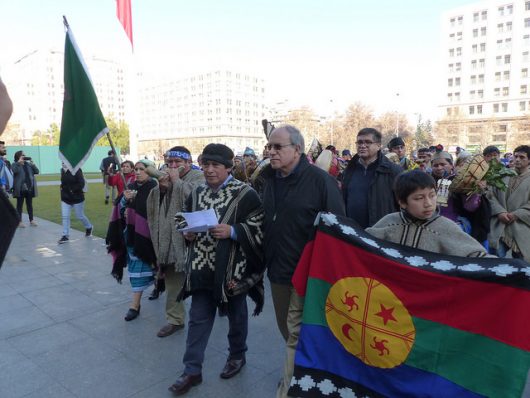
An indigenous group of south-central Chile and southwestern Argentina, the Mapuche live in the heart of oppression. Despite a long history of war on culture and tradition, the Mapuche have remained dedicated to irreplaceable ancestral lands, recently taking to protests for expression against Mapuche oppression.
Enduring unforgiving Spanish colonialism and Pinochet’s dehumanizing regime of the late 1990s, the indigenous group fell under harsh marginalization, their resistance ultimately criminalized. Moreover, with deep-seeded enmity rooted in the expropriation of ancestral lands by big forestry corporations, the Mapuche now stand tall to defend their rights with no sign of giving up.
The Mapuche Are Vocal
The array of indigenous groups that populate the state of Chile make up about 10 percent of the national population. Small, in comparison, but these groups preserve what remains of the once prominent inhabitation of tribes that traversed the length of the country.
The Mapuche, being the largest of the remaining indigenous groups, remain relevant. From historical anecdotes detailing their resistance to the reign of the Incas and the invading Spaniards to their modern day revolution for justice, the Mapuche are neither silent nor invisible, but rather stoic warriors.
Desperate to literally strike gold, riches drove the Spanish into Chile — yet the Spaniards were never able to fully defeat the Mapuche presence in this area. Enter: modern day. Vocal and politically involved, the Mapuche struggle against oppression has led to national and international visibility.
Their Land is Their Livelihood
From the rebellion against the Spanish to modern-day protesting, Mapuche oppression has remained consistent. Victimized by violence and poverty, indigenous independence has been compromised, especially through the campaign know as “Pacification of the Araucanía Region.” This program was designed to legally integrate much of the Mapuche land into Chilean territory.
Without land – a fundamental foundation for cohesion and tradition – self-sustainability becomes almost impossible. Without self-sustainability, a vital encompassment of Mapuche identity, they had no other choice but to migrate to the urban populace, an unfortunate move to foreign scenery and lifestyles. Consequently, employment obstacles prompted poverty and, subsequently, the forced construction of informal housing settlements.
Mapuche oppression only escalated during the reign of dictator Augosto Pincohet. Under the “Law of Community Division,” devised by Pinochet himself, any remains of communal Mapuche land was rendered privatized. Wholehearted resistance to such targeted and deliberate injustice led to the disappearance of many indigenous peoples by the government.
With restored democracy, efforts have been made to mend the relationship between indigenous groups and the Chilean government. The establishment of CONADI, or the National Corporation for Indigenous Development (Corporación Nacional de Desarrollo Indígena), and the reallocation of ancestral land for self-sustainability are steps in the right direction.
Mapuche Resistance: A Force To Be Reckoned With
Police occupation has heavily increased in Araucanía, a region dense with dwellers of Mapuche ancestry. The militarization of the region surfaces as a direct result of Mapuche defiance.
Recently, Mapuche resistance has taken to aggressive tactics. Determined to both reclaim ancestral lands and gain political sovereignty, the indigenous group has turned to direct action. The Coordinadora Arauco-Malleco (CAM), an anti-capitalist organization, is just but one part of the rebellion.
“The government practices and respects Catholicism but it discriminates against Mapuche spiritual beliefs,” an indigenous Mapuche stated. “The Mapuche have been impoverished spiritually, culturally and economically by Chile. I’m willing to sacrifice my life for my people.”
Mapuche Hope For Restoration Is Indestructible
Not looking for cushy legislation that holds no ground or legitimate benefit, the Mapuche simply request the return of autonomy to their populace and land. The citizens of Araucanía, the region with the worst poverty and unemployment rates in the country, have no intention of quieting down.
“When we recover lands we plant crops, breed animals and reconstruct our cultural world,” says Llaitul, a spokesperson for CAM. “We will build houses but our first priority is a spiritual center, the rewe.”
With tensions still thin, the center-left president Michelle Bachelet proposed a project to Congress: an Indigenous Peoples’ Ministry.
Furthermore, Bachelet proposed future dedication to infrastructure, including road construction, clean drinking water and programs to reallocate ancestral land back to the indigenous Mapuche.
“We’ve failed as a country,” Bachelet stated from La Moneda presidential palace in metropolitan Santiago. But, with Mapuche prowess, their dedication to full restoration is a force to be reckoned with.
– Mary Grace Miller
Photo: Flickr
