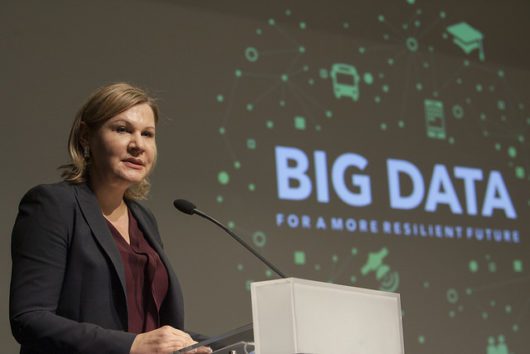
Three years into the United Nations’ latest agenda to fight global poverty and promote peace, health and justice, the chief Sustainable Development Goal of 2030 to end extreme poverty has become a contest to procure and deliver the right resources for the world’s most vulnerable people at just the right pace. There is a race against rising inequality and time, but some economic circles have come to regard one performance-enhancing resource as more valuable than oil and with the potential to boost poverty relief — big data.
Big Data to End Global Poverty
During a lecture at Singularity University Global Summit 2018, a lead economist for the World Bank, Wolfgang Fengler, shared his curiosity about using data to end global poverty by asking, “What would it take to create a data revolution for the SDGs [Sustainable Development Goals]?” Fengler oriented summit-goers to subterranean depths as he compared big data to oil, and emphasized how their values are only realized in the efficiency of its production modes: collection, refinement and delivery in a usable form.
In 1990, 1.9 billion people were considered extremely impoverished; in 2015, the final year of the United Nations Millennium Development Goals, that number was 836 million, a 66 percent decrease. Pointing to the World Poverty Clock, a real-time dashboard for poverty numbers created by Fengler, the current global poverty escape rate is 1.1 people per second. That rate should be 1.6 people per second to put an end to global poverty by 2030.
World Poverty Clock
The World Poverty Clock shows data from specific countries, and these types of snapshots provide reliable stories that can inform effective policy and strategic poverty alleviation practices. According to Singularity Hub, next steps for the World Poverty Clock include presenting data by specific regions within countries with the idea in mind that there are region-specific issues related to poverty.
Forbes Magazine contributor Bernard Marr offers some corrections to the data and oil comparison, one that suggests much richer potential for data. Oil is a finite resource that requires a massive amount of ancillary resources to deliver a final product. Contrarily, data has a low cost of production and can become more useful with every use. He also contends big data is environmentally innocuous and has a wider variety of application beyond its crude state.
New Kind of Renewable Resource
While Marr takes issue with comparing big data to an “old world resource,” he does concede to its versatility and value in shrinking hunger and battling climate change. He likens it more so to a renewable energy source such as wind or the sun. The World Poverty Clock reports that poverty is rising in 13 African nations. Two of those nations are Africa’s largest oil exporters: Angola and Nigeria, which both produced more than 1.5 million barrels of oil in 2017.
Rounding out the rest of the African OPEC nations, Guinea and Libya are labeled as “off track,” or “unable to reach the sustainable development goal target at the current rate;” Gabon and Algeria are also considered to have “no extreme poverty.” In Nigeria, oil production accounts for 10 percent of the GDP of the new world capital of extreme poverty; almost half of the nation’s 180 million people live within poverty’s grips.In Angola, 30 percent of its 25 million live in extreme poverty; oil production is expected to comprise 10 percent of its GDP.
Combatting Poverty
These macro-level findings support The Economist’s and Forbes Magazine’s positions on data’s supremacy to oil as a precious resource for profit and a poverty alleviation tool. Crude oil has less of a guarantee, if any at all, to be wielded as such a resource as it does not necessarily translate to economic stability in nations where the gross national income per capita has been decreasing since 2015.
Just as marketing research uses big data to track discrete consumer insights — such as millennial spending trends or researchers’ use of data to identify the demographic most likely to be excessive sun tanners — big data has the power for direct combat against extreme poverty.
Big Data Around the Globe
In China, the Guizhou province developed a cloud-computing platform that tracks the financial status of 6 million impoverished people in 9,000 villages. China aims to usher 10 million people out of poverty annually from 2016 to 2020. In Tongzi county, the government issued subsidies to needy villagers and a data platform monitors the distribution of these subsidies, minimizing the risk of embezzlement by unscrupulous officials.
Zhou Xing, an expert of the poverty-relief office in Guizhou province, said, “Big data really helps make poverty-relief more precise and efficient.” On the days before big data, Xing added, “poverty relief work was difficult because the information of residents was written by hand and passed to central authorities via a series of local officials, which could be hampered by corruption.”
In Rwanda, American researchers have leveraged cellphone metadata to estimate wealth and poverty distributions and the telephoning habits of the affluent and those with more modest means.
Infinite Possibilities
Putting an end to extreme poverty can potentially be achieved through fiber-optic cables rather than petroleum pipelines. The Sustainable Development Goals for 2030 are fixed; through big data, the potential for precisely architected solutions to end extreme poverty seems infinite.
– Thomas Benjamin
Photo: Flickr

Top 10 Facts About Living Conditions in Bulgaria
Bulgaria is a country in southeastern Europe, neighboring Serbia and Macedonia to the west, Romania to the north, Greece and Turkey to the south and the Black Sea to the east. The country has been a member of NATO since 2004 and the EU since 2007. After its transition from Soviet control, it has sought to deepen its ties with the West. Bulgaria has improved a lot in its post-communist period from 1990 up to today, yet it still ranks near the bottom of EU lists on life expectancy, income per capita and several other areas. These are the top 10 facts about living conditions in Bulgaria you should know.
Top 10 Facts About Living Conditions in Bulgaria
The transition from a centralized, planned economy to a free market one has been tumultuous. The country has implemented changes, but it is lagging behind in its development compared to other member states in the EU. These facts about living conditions in Bulgaria focus on what needs to improve and how poverty in Bulgaria has ethnic, gender, age and rural dimensions.
The situation may look pessimistic based on some of these 10 facts about living conditions in Bulgaria, but despite its challenges, Bulgaria has vastly improved and continues to improve. The cultural environment is rich and diverse and tourism is flourishing in many parts of the country. Furthermore, telecommunications are highly developed with Internet speeds being some of the highest in the world.
Overall, these top 10 facts about living conditions in Bulgaria highlight that, while there is room for improvement, the country has great potential to continue developing into a wealthy, prosperous member of the EU.
– Aleksandra Sirakov
Photo: Pixabay
TOP 10 FACTS ABOUT HUNGER IN MALAWI
Top 10 Facts About Hunger in Malawi
Final Comments
These facts show us the challenges faced by people in Malawi. However, in collaboration with the government, local and international organizations are working to promote sustainable farming practices and empower communities. These efforts offer hope for a future with reduced food insecurity in the country.
– Aquillina Ngowera and Maria Waleed
Photo: Flickr
Updated: November 11, 2024
e-Commerce in India Encourages Female Empowerment
The e-commerce industry in India is growing at an unprecedented rate and is estimated to be worth $150 billion by 2022. This industry is expected to generate employment throughout the country; it includes e-travel, e-tail and e-financial services. Fashion retail is around 30 percent of the online retail searches and may reach as much as $35 billion by 2020. This will be a significant source of employment for women and minorities.
Supporting Digital Commerce
The Government of India has supported this sector through initiatives such as Digital India and Startup India. Digital India is a campaign to increase access to digital technology throughout the country by improving infrastructure, spreading awareness about digital technology and digitizing government services. This campaign has been endorsed by several high profile companies such as Google, Facebook and Microsoft. Other major initiatives, such as the GST (Goods and Services Tax), have coaxed the economy away from cash transactions towards the digital economy.
The Government of India has involved various stakeholders from the private and public sector to create an updated e-commerce policy that recommends improving the regulatory mechanism and enforcing certain protectionist barriers. The draft version of this policy includes providing data protection for users, giving more control to the founders of e-commerce and encouraging domestic production.
Helping Women Become Successful Entrepreneurs
The e-commerce industry in India is expected to generate more than a million jobs by 2023; this will not only increase jobs in the corporate sector but also in industries such as logistics, warehousing, customer care, human resources and technology. This will benefit many Indians in both urban and rural areas.
Studies show that more than 70 percent of online sellers come from smaller towns, and more than 20 percent of them are women. Thus, e-commerce encourages women entrepreneurship and adds to the growth of the economy. Creating opportunities for women to be economically independent helps fight gender norms and make progress towards economic equality of the sexes.
Many women are selling products within the fashion, health and wellness as well as handicraft industries. The ability to work from home is a convenient and effective way to earn a living, and it also supplements family incomes. Studies show that empowering women has a huge impact on the health and well being of the family.
An online portal named Mahila-e-Haat is an organization that facilitates a direct interaction between vendors and buyers. It provides support to women who wish to gain financial independence; this group is expected to help 125,000 women nationwide.
Craftsmanship on the Rise
Global as well as local companies are contributing to the market by expanding the workforce. Many traditional craftsman and artisans have been able to use this platform to sell their products. Now, they can continue the age-old traditions of craftsmanship while at the same time break free from the traditional costs of the middleman.
Plus, the e-commerce industry in India is empowering small manufacturers since many e-commerce companies are employing experienced craftsman, many of whom were not formally employed before, but rather, worked with their families unofficially.
– Isha Kakar
Photo: Flickr
Top 10 Facts About Hunger in the Congo
Top 10 Facts About Hunger in the Congo
While these facts about hunger in Congo demonstrate the severity of the situation, progress has been and is still being made to improve it. Through the efforts of various organizations, such as the World Food Program, SDG 2 of zero hunger is achievable.
– Massarath Fatima
Photo: Flickr
Updated: September 24, 2024
Top 10 Facts About Hunger in Mexico
Mexico has suffered from the effects of poverty and food insecurity for decades. The problem does not lie in food unavailability but in the fact that areas living in poverty do not make enough money to purchase necessary goods. This issue is being addressed and alleviated by nonprofit organizations like The Hunger Project (THP) and even the country’s President, Enrique Peña Nieto. In the text below top 10 facts about hunger in Mexico are presented.
Top 10 Facts About Hunger in Mexico
The top 10 facts about hunger in Mexico highlight the main problem which can be summarized in the fact that the food is available but cannot be accessed due to the different reasons mentioned above.
– David Daniels
Photo: Flickr
Top 10 Facts About Poverty in Belarus
Belarus is a country in Eastern Europe bordering Russia and Ukraine. Instead of integrating with the rest of the region, the country, known popularly as “White Russia”, is the last dictatorship in Europe. In the text below, top 10 facts about poverty in Belarus are presented.
Top 10 Facts about Poverty in Belarus
Despite the reforms and efforts that have been achieved, Belarus is in desperate need of internal and external reform. It needs to create a stable social security system that will allow social mobility rather than punishing people for being poor and reaching a more equitable society for all.
– Maneesha Khalae
Photo: Flickr
Top 10 Facts About Living Conditions in Iraq
Decades of war and conflict have left their mark on Iraq. The lack of stability in the region has made the productive investment a challenge and limited private sector consumption and growth. Living conditions in Iraq are often strenuous and many people struggle with poverty, unemployment and malnutrition.
The struggle has marked the recent past for many Iraqis, however, despite setbacks, the country is trying to rebuild itself. In May 2018, the country had its first national election since the war with ISIS, instilling hope in many people that Iraq is on it’s way to political stability. The hope is that times of war are in the past and a new Iraq lays ahead. In the text below, top 10 facts about living conditions in Iraq are presented.
Top 10 Facts About Living Conditions in Iraq
When looking at Iraq, one can see a country set back and hurt by decades of conflict. Currently, though, the country is not at war and the national election this past May marked the progress of the living conditions in the country since the chaos of a year ago. However, a voting recount and partisan negotiations have made the results of the election vague and uncertain.
Reflective of the frustration of this election and the futile optimism of the Iraqi people is a quote from Hawla Habib, a professor at Mustansiriya University in Baghdad explaining that “all Iraqis care about their nation, it’s just that many are too tired to think anymore.”
– Clarke Hallum
Photo: Flickr
Eight Facts About Poverty, Crime and Orphans in Ecuador
A simple Google search for “Ecuador orphans,” expected to provide factual information, instead it presents a plethora of pages touting orphanages to donate to, opportunities to volunteer in Ecuador, children to adopt and personal fundraising pages. Even with some keyword tweaking, clearly orphans in Ecuador have abundant needs, but very few scholarly or news articles provide coverage of the issues. In an effort to fill that apparent statistical lack, orphans in Ecuador relate to the country’s poverty and crime rates in eight factual ways.
Eight Facts About Poverty, Crime and Orphans in Ecuador
Clearly, such a system that inadvertently funnels non-orphans into institutions and perpetuates poverty must be directly combated. However, organizations like Restore17 enter into the present reality to provide stable homes and equip boys to overcome poverty as men. It is a good beginning. Such efforts should help create a new financially capable and empowered generation that will be able to raise their children at home and above the poverty line.
– Charlotte Preston
Photo: Flickr
How Identification Closes The Gender Gap
Empowering women has long been acknowledged as a key ingredient in reducing poverty and improving economic development. The United Nations (U.N.) has set 17 Sustainable Development Goals (SDGs) and gender equality underlies almost all of them. More specifically, the fifth SDG is set to achieve gender equality and empower all women and girls. As the World Health Organization (WHO) recognizes, these goals are interdependent, meaning gender equality is essential not only to the economic prosperity of the communities but for other important issues like health and sustainability as well.
Even today, gender inequality persists worldwide, depriving women of basic human rights and equal opportunities. In poverty-stricken communities around the world, an estimated 90 percent sustain long-standing social practices that devalue women.
Need for Identification
Breaking these modes will require great efforts. Both legal and cultural strides need to change in order to counter deeply ingrained discrimination throughout societies. Studies by the U.N. and UNHCR found that women in conflict and poverty affected regions do not have adequate identification documents. These documents are necessary for achieving the benefits of civic and public life.
Access to identification closes the gender gap in the developing world, but a lack of awareness around the documents prevents women from obtaining them in some cases. Many believe that identification cards are only necessary for exceptional circumstances when in reality they are needed to make the most of social programs and civil rights.
Having personal identification cards in the developing world acts as an important stepping stone. In having the ability to access decisive services and claim entitlements as citizens, women are able to increase their voice and agency through civic participation, access to finances and voting. In assisting women’s social engagement, identification closes the gender gap.
Example of Myanmar
All factors of the country development are intertwined. Women’s documentation is often essential to the peace process in some countries. Resolving the issue of land rights, for example, is crucial to the current conflict in Myanmar, and gender inclusion in the peace process is fundamental to reaching a genuine peace accord. The laws in this country allow women to register and co-register for the property even if they are not head of the household.
While progressive laws have been enacted, there lies a major gap between the law and the reality that women face. Cultural conventions exclude women from participating in land governing let alone a peace accord, making it essential that their names are registered to partake in community meetings. The decisions affect both women and men, making identification an important transition step in transforming cultural norms in poverty and conflict-stricken regions.
Problems with Women Identification
In 2012, four out of every 10 infants born worldwide were not registered with civil governments or authorities. Globally, 750 million children lack identification. A 2013 UNICEF survey found that there is no major disparity between the birth registration of boys and girls.
Evidence suggests that adult women, however, face gender-specific barriers to getting identification documents. Women must provide proof of marriage, additional family signatures and conduct many other steps in the process to obtain identification that men simply do not have to deal with. Unmarried women especially face discrimination as, without a male counterpart or marriage certificate, obtaining identification documents (IDs) is often impossible. IDs are also optional for women, although essential to accessing civic opportunities and required for men.
Increasing access to identification closes the gender gap by helping international organizations better plan and target gender inequality in poverty. The incompleteness of civil registration for women has generated holes in statistics and data for organizations like the World Bank to measure the progress of women in the developing world.
Changing Cultural Barriers
Equality is fundamental to building strong societies. Having active members at every level of a community makes the plight of poverty that much easier to conquer. Gender equality is no different. Ensuring that more than half of the population can do its part must remain at the foremost of poverty reduction endeavors.
While the legal framework with these notions in mind has changed for the better, an uphill battle in the mindset of the communities is much needed. Obtaining identification is the first step in employing available programs and in realizing the agency needed to transform the cultural barriers that devalue women.
– Joseph Ventura
Photo: Flickr
Big Data and the Fight Against Global Poverty
Three years into the United Nations’ latest agenda to fight global poverty and promote peace, health and justice, the chief Sustainable Development Goal of 2030 to end extreme poverty has become a contest to procure and deliver the right resources for the world’s most vulnerable people at just the right pace. There is a race against rising inequality and time, but some economic circles have come to regard one performance-enhancing resource as more valuable than oil and with the potential to boost poverty relief — big data.
Big Data to End Global Poverty
During a lecture at Singularity University Global Summit 2018, a lead economist for the World Bank, Wolfgang Fengler, shared his curiosity about using data to end global poverty by asking, “What would it take to create a data revolution for the SDGs [Sustainable Development Goals]?” Fengler oriented summit-goers to subterranean depths as he compared big data to oil, and emphasized how their values are only realized in the efficiency of its production modes: collection, refinement and delivery in a usable form.
In 1990, 1.9 billion people were considered extremely impoverished; in 2015, the final year of the United Nations Millennium Development Goals, that number was 836 million, a 66 percent decrease. Pointing to the World Poverty Clock, a real-time dashboard for poverty numbers created by Fengler, the current global poverty escape rate is 1.1 people per second. That rate should be 1.6 people per second to put an end to global poverty by 2030.
World Poverty Clock
The World Poverty Clock shows data from specific countries, and these types of snapshots provide reliable stories that can inform effective policy and strategic poverty alleviation practices. According to Singularity Hub, next steps for the World Poverty Clock include presenting data by specific regions within countries with the idea in mind that there are region-specific issues related to poverty.
Forbes Magazine contributor Bernard Marr offers some corrections to the data and oil comparison, one that suggests much richer potential for data. Oil is a finite resource that requires a massive amount of ancillary resources to deliver a final product. Contrarily, data has a low cost of production and can become more useful with every use. He also contends big data is environmentally innocuous and has a wider variety of application beyond its crude state.
New Kind of Renewable Resource
While Marr takes issue with comparing big data to an “old world resource,” he does concede to its versatility and value in shrinking hunger and battling climate change. He likens it more so to a renewable energy source such as wind or the sun. The World Poverty Clock reports that poverty is rising in 13 African nations. Two of those nations are Africa’s largest oil exporters: Angola and Nigeria, which both produced more than 1.5 million barrels of oil in 2017.
Rounding out the rest of the African OPEC nations, Guinea and Libya are labeled as “off track,” or “unable to reach the sustainable development goal target at the current rate;” Gabon and Algeria are also considered to have “no extreme poverty.” In Nigeria, oil production accounts for 10 percent of the GDP of the new world capital of extreme poverty; almost half of the nation’s 180 million people live within poverty’s grips.In Angola, 30 percent of its 25 million live in extreme poverty; oil production is expected to comprise 10 percent of its GDP.
Combatting Poverty
These macro-level findings support The Economist’s and Forbes Magazine’s positions on data’s supremacy to oil as a precious resource for profit and a poverty alleviation tool. Crude oil has less of a guarantee, if any at all, to be wielded as such a resource as it does not necessarily translate to economic stability in nations where the gross national income per capita has been decreasing since 2015.
Just as marketing research uses big data to track discrete consumer insights — such as millennial spending trends or researchers’ use of data to identify the demographic most likely to be excessive sun tanners — big data has the power for direct combat against extreme poverty.
Big Data Around the Globe
In China, the Guizhou province developed a cloud-computing platform that tracks the financial status of 6 million impoverished people in 9,000 villages. China aims to usher 10 million people out of poverty annually from 2016 to 2020. In Tongzi county, the government issued subsidies to needy villagers and a data platform monitors the distribution of these subsidies, minimizing the risk of embezzlement by unscrupulous officials.
Zhou Xing, an expert of the poverty-relief office in Guizhou province, said, “Big data really helps make poverty-relief more precise and efficient.” On the days before big data, Xing added, “poverty relief work was difficult because the information of residents was written by hand and passed to central authorities via a series of local officials, which could be hampered by corruption.”
In Rwanda, American researchers have leveraged cellphone metadata to estimate wealth and poverty distributions and the telephoning habits of the affluent and those with more modest means.
Infinite Possibilities
Putting an end to extreme poverty can potentially be achieved through fiber-optic cables rather than petroleum pipelines. The Sustainable Development Goals for 2030 are fixed; through big data, the potential for precisely architected solutions to end extreme poverty seems infinite.
– Thomas Benjamin
Photo: Flickr