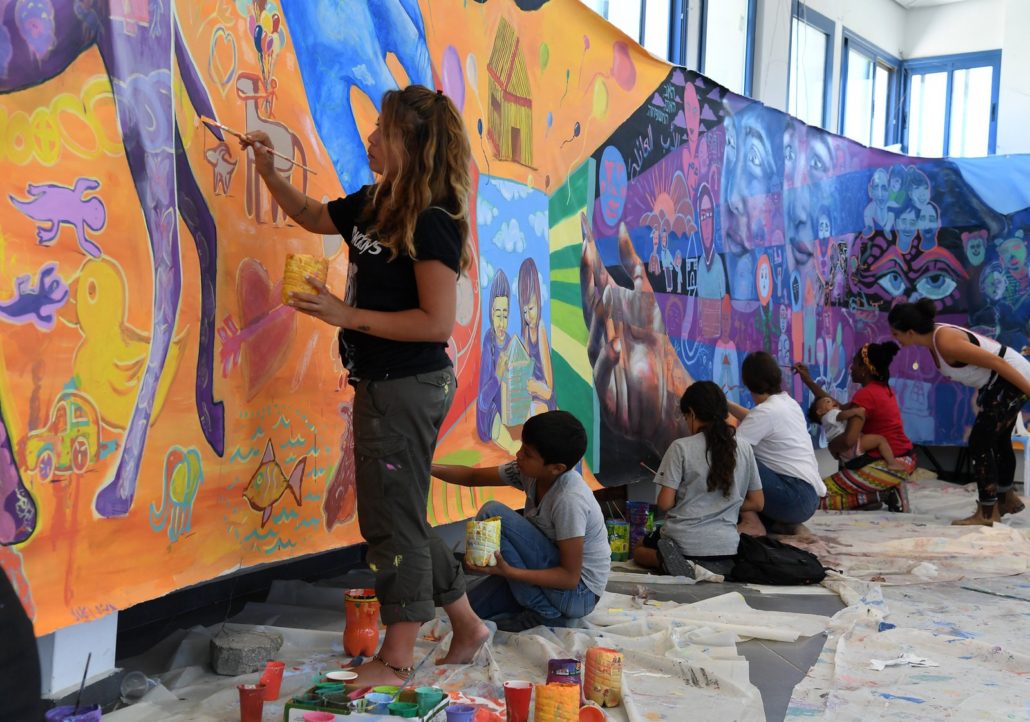
 While charities and humanitarian organizations ensure that children refugees receive food, blankets, shelter, vaccinations and malnutrition screenings, it is easy to overlook the other side of war and displacement – the psychological impact – and the healing power of art.
Refugees and Mental Illnesses
There are 25.9 million refugees around the world and over half of them are children under 18. Children refugees are more at risk of trauma and psychological disorders, such as post-traumatic stress disorder (PTSD), with rates ranging between 50 and 90 percent compared to 10 and 40 percent in adults. Even major depression rates are higher among children refugees than adults.
The distress caused by war is often chronic, with one study showing 45 percent of participants still suffering from depression and PTSD three years after the Bosnian war. Fourteen different studies also show a significantly higher trend of disturbance among displaced individuals living in refugee camps than nondisplaced individuals or those living temporarily with relatives, even when nondisplaced individuals experienced significant trauma.
According to UNICEF, 2.5 million Syrian children are living as refugees in Egypt, Iraq, Jordan, Lebanon and Turkey. In Jordan, nearly 100,000 out of the 1.4 million Syrian refugees reside in Za’atari, a refugee camp. Syrians refugees have no legal right to work in Jordan and tensions are mounting between the two populations. Humanitarian organizations are struggling to provide food, shelter and medical care, so people often overlook educational and creative activities for children.
Artolution and the Need for Art and Expression
According to Joel Bergner, co-founder of the public art organization, Artolution, “The kids, most of whom went to school in Syria, now roam the refugee camp with few rules or structured activities. They are very rough and frequently get into fights. Yet, at the same time, they are also really sweet and friendly.”
If the international community seeks to rebuild war-torn countries or reintegrate child refugees back into a functional society, then psychological treatment is just as necessary as the physical. The trauma of war will lose whole generations if people underestimate the healing power of art.
Bergner seeks to reverse the trend of trauma, aggression and marginalization by giving children something to do with their time and by recognizing the healing power of art. Advances in neuroimaging have shown that the Broca’s area of the brain, associated with speech and articulation, actually shuts down after an individual experience’s trauma. People call this change speechless terror, which makes expressing, and therefore, managing a trauma significantly harder. However, the sensory areas of the brain that process trauma also play a role in art-making. This allows creating art to become a voice for those unable to express their trauma and reconcile their emotions.
Art Therapy
The first use of the term “art therapy” was in 1942, following Adrian Hill’s service in World War I. Hill was a British soldier, author and an official war artist whose work highlighted the healing power of art-making. Since then, art therapy has taken on various forms beyond being a method for a therapist and patient to communicate. It can involve drawing, painting, dance, theatre and song.
According to the American Art Therapy Association, the art-making process helps foster self-awareness, manage behavior and develop social skills while reducing anxiety and increasing self-esteem. The most effective art therapy models, though, are those conducted in groups and that include a discussion. This helps prevent avoidance and emotional numbing often associated with PTSD.
The organization, Artolution, is a collaborative art-making project that connects children to positive role models and their peers, but it is not only that. In Za’atari camp, the Syrian artist, Jasmine Necklace, co-facilitated a community mural alongside Bergner as well as Syrian and Jordanian children. This practice allows for discussions among refugee youth so they can talk openly about their trauma.
Art therapist, Melissa S. Walker, says that she and her colleagues have seen the healing power of art therapy through its ability to overcome the speech-language barrier in veterans, allowing them to work through their traumatic experiences in a way that feels safe.
Art therapy programs such as these have found root across the world, as more organizations acknowledge the healing power of art. UNICEF helped develop a drama program in Slavonski Brod, a town in Eastern Croatia, to help children overcome the psychological effects of the Yugoslav Wars. A counseling project for Sudanese refugees utilized drawing, theatre, writing and storytelling to help children traumatized by civil war. The nonprofit organization, War Child, sponsors art-therapy projects in the Caucasus for children refugees and those damaged by war.
Just as any humanitarian organization seeks to improve the lives of children, art therapy projects help heal the psychological wounds of war. It gives refugees a channel to communicate and a chance to rebuild their communities.
– Emma Uk
Photo: Flickr

The Healing Power of Art After War
Refugees and Mental Illnesses
There are 25.9 million refugees around the world and over half of them are children under 18. Children refugees are more at risk of trauma and psychological disorders, such as post-traumatic stress disorder (PTSD), with rates ranging between 50 and 90 percent compared to 10 and 40 percent in adults. Even major depression rates are higher among children refugees than adults.
The distress caused by war is often chronic, with one study showing 45 percent of participants still suffering from depression and PTSD three years after the Bosnian war. Fourteen different studies also show a significantly higher trend of disturbance among displaced individuals living in refugee camps than nondisplaced individuals or those living temporarily with relatives, even when nondisplaced individuals experienced significant trauma.
According to UNICEF, 2.5 million Syrian children are living as refugees in Egypt, Iraq, Jordan, Lebanon and Turkey. In Jordan, nearly 100,000 out of the 1.4 million Syrian refugees reside in Za’atari, a refugee camp. Syrians refugees have no legal right to work in Jordan and tensions are mounting between the two populations. Humanitarian organizations are struggling to provide food, shelter and medical care, so people often overlook educational and creative activities for children.
Artolution and the Need for Art and Expression
According to Joel Bergner, co-founder of the public art organization, Artolution, “The kids, most of whom went to school in Syria, now roam the refugee camp with few rules or structured activities. They are very rough and frequently get into fights. Yet, at the same time, they are also really sweet and friendly.”
If the international community seeks to rebuild war-torn countries or reintegrate child refugees back into a functional society, then psychological treatment is just as necessary as the physical. The trauma of war will lose whole generations if people underestimate the healing power of art.
Bergner seeks to reverse the trend of trauma, aggression and marginalization by giving children something to do with their time and by recognizing the healing power of art. Advances in neuroimaging have shown that the Broca’s area of the brain, associated with speech and articulation, actually shuts down after an individual experience’s trauma. People call this change speechless terror, which makes expressing, and therefore, managing a trauma significantly harder. However, the sensory areas of the brain that process trauma also play a role in art-making. This allows creating art to become a voice for those unable to express their trauma and reconcile their emotions.
Art Therapy
The first use of the term “art therapy” was in 1942, following Adrian Hill’s service in World War I. Hill was a British soldier, author and an official war artist whose work highlighted the healing power of art-making. Since then, art therapy has taken on various forms beyond being a method for a therapist and patient to communicate. It can involve drawing, painting, dance, theatre and song.
According to the American Art Therapy Association, the art-making process helps foster self-awareness, manage behavior and develop social skills while reducing anxiety and increasing self-esteem. The most effective art therapy models, though, are those conducted in groups and that include a discussion. This helps prevent avoidance and emotional numbing often associated with PTSD.
The organization, Artolution, is a collaborative art-making project that connects children to positive role models and their peers, but it is not only that. In Za’atari camp, the Syrian artist, Jasmine Necklace, co-facilitated a community mural alongside Bergner as well as Syrian and Jordanian children. This practice allows for discussions among refugee youth so they can talk openly about their trauma.
Art therapist, Melissa S. Walker, says that she and her colleagues have seen the healing power of art therapy through its ability to overcome the speech-language barrier in veterans, allowing them to work through their traumatic experiences in a way that feels safe.
Art therapy programs such as these have found root across the world, as more organizations acknowledge the healing power of art. UNICEF helped develop a drama program in Slavonski Brod, a town in Eastern Croatia, to help children overcome the psychological effects of the Yugoslav Wars. A counseling project for Sudanese refugees utilized drawing, theatre, writing and storytelling to help children traumatized by civil war. The nonprofit organization, War Child, sponsors art-therapy projects in the Caucasus for children refugees and those damaged by war.
Just as any humanitarian organization seeks to improve the lives of children, art therapy projects help heal the psychological wounds of war. It gives refugees a channel to communicate and a chance to rebuild their communities.
– Emma Uk
Photo: Flickr
9 Facts About Human Trafficking in Mexico
Human trafficking in Mexico has recently risen to have the country become one of the most popular trafficking destinations in the world. This is largely due to its high level of corruption and powerful drug-cartels that support the illicit practice. This has been coupled with the nation’s growing national awareness toward the issue. The recent government attempts to combat it through policy change reflect this. Additionally, there is an emergence of organizations designed to reintegrate victims of human trafficking in Mexico into society.
What is Human Trafficking?
Human trafficking is the third most lucrative industry in the world. It is characterized as a form of exploitation through the act of obtaining someone for (often sexual) services and subjecting them to a form of involuntary servitude. Its somewhat confusing and wide-ranged definition creates a vast multitude of unique cases, allowing many criminals to slip through the cracks. Many countries all of the world struggle with passing sufficient anti-human-trafficking policy. This partially explains its prevalence and therefore profitability worldwide.
9 Facts about Human Trafficking in Mexico
Much of the criticism surrounding past Mexican administrations failure to fix the problem focuses on two pillars: poor data and broad targets. The leading government commission appointed to human trafficking (the Inter-Ministerial Commission Against Human Trafficking) reports positive results. However, its technical secretary has spoken out, saying the data is unreliable. Additionally, while high ambitions seem good in principle, goals will be stunted if they are not broken into manageable parts. This was certainly the case for past administrations, according to Monica Salazar, head of non-profit Dignificando el Trabajo. Salazar blames past administrations with a lack of clarity, which made priorities vague and indeterminate.
While human trafficking ranks third internationally for most lucrative markets, it is second in Mexico. The country has also assumed the number one rank for female sex-trafficking and makers of child pornography in the Americas. Much of that comes from the government’s corruption and inability to control the drug-cartels that wreak havoc across the country. These groups are largely responsible for the kidnapping of women and children into the sex and slave trade.
Many states are in tune with Salazar’s comments on Mexico’s grandiose plans to combat the issue of human trafficking in Mexico. Out of the 21 states, 12 have still not updated their legislation to be in accordance with the most recent national law on human trafficking. Their failure to adhere to this mandate is telling as to why the country has made little progress on the issue.
A large misconception regarding trafficking is that it does not just involve citizens of the country it takes place in. In Mexico, many victims are solicited from surrounding countries, and from Eastern Europe over the internet. On the opposite end, many culprits of the trafficking travel to Mexico because of its loosely-regulated trafficking reputation.
Despite its small size and a population of only 13,000, Tenancingo wields an international human trafficking presence. Susan Coppedge, a former Assistant U.S. Attorney, says young girls from small rural communities across the country are unfamiliar with its reputation. They are therefore are not suspicious of men from there.
Next in these facts about human trafficking in Mexico is that Mexico City recently started momentum towards anti-sex trafficking legislation. It did this by unanimously passing a bill that indirectly decriminalized sex work. The bill removed a law which stated that prostitutes and their clients could be fined if neighbors complained. Although the latter part already made the law unreliable, it still marks a start of anti-sex-trafficking legislation under President Andres Manuel Lopez Obrador.
Since human trafficking maintains many different forms, it can largely go unnoticed and disappear in the shadows. However, the optimal way to tackle this issue is to let local organizations that are well-versed in their particular areas take charge. With adequate funding from the government, these groups accomplish a lot to help the current situation in Mexico.
But they do not have enough government support. These nonprofits work behind the scenes with a policy such as the decriminalization of sex work. However, they do not receive the funding they deserve. For the government to live up to its goals of making real progress on eliminating human trafficking in Mexico, they must dedicate the finances to their objectives.
A large portion of government money allocated to ending human trafficking should be dedicated to the training of people working at groups to end it. The broad nature of human trafficking packages each case differently. Therefore, training and hiring people in and from many different backgrounds will best help alleviate the issue.
How to Help
A final word about human trafficking in Mexico is that groups such as Polaris provide direct funding to disrupt the human trafficking trade in Mexico. By advocating for them, as well as The Borgen Project, they grow in influence and stand a better chance of grabbing the government’s attention.
– Liam Manion
Photo: Flickr
5 Global Health care Organizations Everyone Should Know
5 Global Health Care Organizations Everyone Should Know
Doctors of the World is an international human rights nonprofit committed to providing long-term medical care to those who cannot afford it. With over 400 programs in more than 80 countries, this organization is located in war zones, refugee camps and even rural communities. Doctors of the World successfully provides emergency and long-term medical care to those who greatly need it. In doing so, this organization treats those afflicted by poverty, disease, armed conflict, natural disasters or chronic, structural disparities. Doctors of the World helps treat 1.6 million people each year.
Medic Mobile is a nonprofit organization that strives to improve health care for those living in hard to reach communities. To do so, Medic Mobile builds software to ensure health care workers being able to deliver equitable care to communities everywhere around the world. Moreover, the organization is the core contributor to the Community Health Toolkit. CHT is a software that helps health workers deliver medical items safely, track outbreaks of disease faster, treat illnesses door to door, keep stock of essential medicines and communicate emergencies. Medic Mobile now impacts 14 countries in Africa and Asia, having trained and equipped 24,463 health workers.
International Medic Corps is a nonprofit organization with a mission based on improving the quality of life by saving lives and relieving suffering through health care training and relief and development programs. Based in the United States and the United Kingdom, International Medic Corps offers training and health care to local populations. The organization also provides medical assistance to those at the most risk. In 2017, International Medic Corps estimated it performed 4.8 million medical consultations, benefitting 8 million people directly and 50 million people indirectly.
Mothers 2 Mothers is a unique nonprofit organization dedicated to employ, train and help to empower HIV-positive women as community health workers in Africa. The “Mentor Mothers” work in local African communities and understaffed health facilities. They provide advice, essential health education and support to other HIV-positive mothers on how to protect their babies from HIV infection. Mothers 2 Mothers also works to ensure women and families are getting proper health advice and medication, are linked to the right clinical services and are supported on their treatment journey. Since 2001, Mothers 2 Mothers has reached over 10.5 million women and children. In 2017, the organization reported it had served 1 in 6 of the world’s HIV-positive women.
Mercy Ships is an organization committed to helping those struggling without medical services in Africa. To do so, the organization uses the Africa Mercy, a floating hospital ship with volunteer medical teams and sterile operating rooms. As a result, Mercy Ships directly aids those who would otherwise receive no care. Aboard the Africa Mercy, medical treatments are free of charge, such as removing tumors, correcting clefts and straightening legs. Since being founded in 1978, Mercy Ships has reported it has performed more than 100,000 surgeries.
Access to medical care and healthcare are necessary, affecting global health, economy and living conditions. To learn more about any of these five global healthcare organizations, visit their sites. All five global healthcare organizations accept donations to continue providing much needed medical and healthcare. While a country’s infrastructure may not currently be equipped to meet the needs of its population, NGOs, such as these, can make a significant difference.
– Natalie Chen
Photo: Flickr
Top 10 Facts About UNICEF
UNICEF is an organization which assists children in over 190 countries. The organization focuses on saving the lives of children, defending children’s rights, and helping them fulfill their potential as individuals. Founded in December of 1946 in an effort by the United Nations to support children in post-war Europe and China, UNICEF has been active ever since.
Here are the top 10 facts about UNICEF and how their impact has been felt around the world.
Top 10 Facts About UNICEF
Since their launch 73 years ago, UNICEF has become one of the most well-known and renowned organizations dedicated to public health and the well-being of children. These top 10 facts about UNICEF are just a few of this organization’s incredible accomplishments. Striving to make the world a better place since December of 1946, UNICEF shows no sign of slowing down.
– Jacob Nangle
Photo: Flickr
Maternal Mortality Rate in Guatemala: The Indigenous Story
Improving Mortality through Training
In 2006, UNFPA, a U.N. agency focused on sexual and reproductive health, began to offer obstetrical emergency training to local comadronas and family planning methods. The agency also teaches the importance of a skilled attendant being present during births in order to improve the maternal mortality rate in Guatemala. Estimates suggest that a well-trained midwifery service “could avert roughly two-thirds of all maternal and newborn deaths.” Statistics show that from 2009 to 2016, UNFPA has trained more than 35,000 midwives.
The Department of Sololá in the western highlands of Guatemala is home to more than 300,000 people, most of whom are indigenous Maya. Only one in four rural births occurs in a hospital, compared with over two-thirds of urban births. In Sololá, comadronas attend more than 63 percent of births mainly outside of a hospital. Some estimates put this figure at more than 90 percent.
The Improving Maternal and Neo-Natal Health Initiative has a three-pronged approach and funding from the World Bank’s Youth Innovation Fund in 2017. The initiative has established a visually-based curriculum to help comadronas recognize dangers and risks during delivery, two-week long training workshops conducted in local healthcare posts, and endowment of “safe birthing kits” for all comadronas containing tools such as latex gloves and gauze pads. Unlike previous initiatives, these trainings have been conducted in local languages rather than solely Spanish. Rosa, a comadrona in the city of Santiago, said this simple change made her “feel more respected” and gave her an increased desire to participate because she felt empowered to save “more lives in her community.”
In collaboration with the Ministry of Public Health and the government of Guatemala, the Maternal Child Survival Program (MCSP), an international program with national and subnational branches, implemented a Midwifery Training Program in February 2018 to improve the maternal mortality rate in Guatemala. Their model uses a competency-based skills training approach. Working with the University of San Martin Porres, MCSP established a coursework protocol for certification.
Discrimination Against Indigenous Peoples
Maternal mortality rates among indigenous populations in Guatemala face particular hurdles. In addition to access to care and infrastructure challenges, indigenous populations face heavy discrimination. They are often evicted from their ancestral lands only to face abuse within the criminal justice system. One young indigenous man reported abuse at the hands of a local gang to police. He believed that “the police don’t listen to us as indigenous people–they do not care about us.” A U.N. Special Rapporteur on the rights of indigenous peoples, Victoria Tauli-Corpuz, says she is very worried about “the grave situation of indigenous peoples” in Guatemala.
Guatemala has made consistent strides in reducing the national maternal mortality rate from more than 200 in 1990 to less than 100 today. However, the maternal mortality rate among indigenous populations remains high. Indigenous populations should be heartened by these improvements, but their unique struggles must not be lost in the larger narrative of maternal mortality in Guatemala.
– Sarah Boyer
Photo: Flickr
A Shift in Girls’ Education in Afghanistan
Changing attitudes about girls’ education in Afghanistan have bolstered female enrollment rates. This shift has, in turn, increased support for public education in general and foreign aid—particularly from the U.S. Agency for International Development. USAID statistics offer some encouraging numbers to support this:
The Rustam School
One promising example of this shift forward is the Rustam School, located in the Yakawlang district. The Rustam School possesses a small student body of only a few hundred. Nevertheless, 92 percent of its graduating class moved onto Afghanistan’s public universities in 2017.
Inverting the country’s enrollment statistics, two-thirds of the Rustam School’s students are girls. To note, the Taliban outlawed girls’ education in Afghanistan and pushed many boys into Islamic studies, rather than popular STEM courses. However, students, particularly girls, apply themselves rigorously to their education. They go so far as to learn the Windows operating systems without the aid of a computer.
The Fight for Education
Unlike in the United States, where public K-12 education is universal, the fight for education in Afghanistan has a checkered past. As far back as the 1970s, mujaheddin resistance fighters (rebelling against the USSR’s attempted occupation of Afghanistan) were killing government-paid teachers and closing down their schools.
With over half of the country’s 36 million citizens under the age of 18, the investment and safeguarding of education are more critical than ever. In recognition of this fact, USAID, the Pentagon and the State Department have invested $759 million in primary and secondary education over the last 17 years. These investments have fostered the changing attitudes of both local politicians and regional power-brokers—with the constant exception of the Taliban.
Though the expansion and protection of girls’ education in Afghanistan have had much progress, there is still room for improvement. The majority of Afghan girls are not enrolled in public school. This is explained by two main factors. First, most Afghan girls still marry at a very young age (for a variety of sociocultural factors). Subsequently, this causes a lack of female teachers and all-girls’ schools. Second, Afghanistan faces logistical difficulty when it comes to extending education to rural areas. Long walks to school sometimes have significant geographical barriers along the way that physically prevent students from attending. Also, many rural families are subsistence farmers; it is difficult for students to go to school if they have animals or crops to look after. However, the Rustam School proves that though providing education to rural Afghan children may be difficult, it is not impossible.
The Future of Education
Despite the recent progress and development of education in Afghanistan since the early 2000s, significant hurdles exist for girls’ education. The country’s education system must still be further advanced. However, a local initiative can make do with minimal resources and reach out to rural areas—like the Rustam School. Most importantly, despite its shortcomings, Afghanistan’s primary and secondary education systems offer success stories of what foreign aid can accomplish, especially if maintained over long periods of time.
– Rob Sprankle
Photo: Flickr
Record-High Poverty Line in Hong Kong
Hong Kong’s reputation as one of the most financially significant regions on earth masks internal issues of poverty and inequality. The record-high poverty line in Hong Kong has hit the city hard, with one-fifth of its residents living in a state of poverty in 2018. The one-fifth mark is the highest record rate of poverty the city has experienced since the government began publishing statistics in 2009. The highest rise in poverty came in 2016 when statistics documented that 20 percent, or 1.35 million of the residents, were living in a state of poverty.
The Poverty Line in Hong Kong
Government officials in Hong Kong attribute their record-high poverty line to an overgrown population, containing many elderly residents. With 7.4 million individuals inhabiting the country, many people of the older generation call Hong Kong home.
Chief Secretary Matthew Cheung Kin-Chung stated there is not much room for the poverty rate to drop significantly to combat a rapidly aging population. Kin-Chun stated that “The structural problem of the aging population is irreversible. Tens of thousands of our residents fall into the elderly category every year. This has nullified the poverty alleviation effect.”
Hong Kong and Inequality
Even though government officials shift the blame toward the aging population, history shows that inequality amongst the people in Hong Kong set in motion the high poverty rates. Rapid growth in technology and markets in the city has negatively impacted those who work standard jobs at an older age. More advanced jobs are taking over the city, handing out higher salaries and making those who work the latter unable to pay for proper shelter, food, water and other necessities.
The government of Hong Kong has provided some assistance by lowering the cost of necessities for the older generation. An acknowledged solution would be to provide better education about new technology and markets. Further, it could be beneficial to reassign residents to positions when qualified could lead to better outcomes.
Rent and Income
Another reason why the city has hit record-high poverty is that the monthly rent per household and wages each earns has skewed in opposite directions. Monthly rent is 70 percent of the median for household income for half of the city. The average unskilled worker works a 12-hour day to afford only a 100 square foot home.
Monthly rent could rise 10 cents in 2019 making affordable housing scarce. The government has proposed higher tax cuts on middle- and lower-class residents, including the older generation. Additionally, it proposed increasing taxes on wealthy residents. In doing so, it hopes to combat inequality amongst living and working situations.
Wealth Distribution
Wealth distribution in Hong Kong is extremely uneven. The top 10 percent in Hong Kong earn 44 times more than the lower 10 percent in the city. Wealthy business owners, who influence politicians and leading governmental officials, impact the division in income. The divide hurts the ability of those living below the poverty line to get any form of governmental assistance.
Like many other regions of the world, inequality and undervaluing of women have also contributed to the record-high poverty rate. Historically, China has undervalued women, restricting them to a one-child preferred boy law, while illegal abortions took place. A 2017 report found 451,700 women fell below the poverty line, compared to 80,000 men. The government of Hong Kong is actively working on passing more laws in order to provide more protection and better education for women and girls.
Nonprofit Efforts
The poverty in Hong Kong has finally exposed governmental leaders and ignited a need for change in the city. Hong Kong is finally beginning to publicly acknowledge the issues and seek help in turning the city around. Nonprofit organizations have implemented solutions to assist in reducing poverty. The ADM Capital Foundation, which emerged in 2006, addresses environmental and social challenges across Asia to combat the new markets and technologies.
Additionally, the Chen Yet-Sen Foundation is a charitable institution in Hong Kong. It works on establishing innovative and cost-efficient means to provide better literacy programs for children and women. Finally, the Our Hong Kong Foundation, founded in 2014, conducts research on land, housing, technology and economic development. In doing so, it helps to provide relief for those living in poor or unsanitary housing.
– Aaron Templin
Photo: Pexels
Why Poor Countries Fail to Administer Vaccines
Three Reasons Why Poor Countries Fail to Administer Vaccines
In 2017, roughly 19.9 million infants globally did not receive a DTP vaccination. This vaccination helps prevent children from getting diphtheria, tetanus and pertussis if a child receives roughly five doses over the course of their life. However, poorer nations have difficulty providing clinics and the means of offering repeated vaccinations.
People living in rural areas must travel for hours to urban cities to receive treatments. In addition, transporting these goods to rural regions is tough because the hot temperatures can kill the immunity components of the vaccines. Shortages in supplies and lack of trained professionals also hinder the process. This heavily contributes to why poor nations fail to administer vaccines to large amounts of people.
On top of these issues, the costs of vaccinating a single child increased from $10 to roughly $42 since 2000. However, these heavy costs do not heavily burden extremely poor countries because the vaccine alliance, Gavi, funds them. Gavi encompasses many organizations such as the World Health Organization, UNICEF, The World Bank and others. This alliance has allowed the economic burden to lift for roughly 70 countries, and it is actively seeking ways to overcome the geographical obstacles in these regions.
According to the WHO, vaccine hesitancy is the refusal to vaccinate despite the availability of vaccines. Lack of trust in immunization is a major reason why people in poorer nations face this issue. Many people fear the side effects and potential dangers of immunization, so they choose not to vaccinate their children. Another reason for this hesitancy revolves around cultural differences. Primarily Western nations have introduced these vaccinations and citizens have difficulties accepting them into their society.
An example of this is the Democratic Republic of the Congo’s recent Ebola outbreak. For the past few months, a large percentage of Congolese citizens refused to take the life-saving vaccination. These people do not trust the medical system and the government that allowed for a different country to intervene in its lifestyle. Their exposure to the disease has meant that other communities isolate and neglect them, which means they are having a hard time letting outsiders into their homes, even if intentions are good. Some citizens even attacked treatment centers in Katwa and Butembo in February 2019 to make a statement.
Health officials in the DRC, as well as other countries, are making efforts to interact more with the communities during the vaccination process. A major step is finding ways to educate people on these medicines while respecting the cultures that they are entering. Recent campaigns such as the WHO World Immunization Week 2019 have made efforts to demonstrate the value of vaccines and immunization to start this process.
War-torn countries are some of the most difficult places to administer vaccinations. Hospitals and clinics can become damaged and make it harder for people to receive the treatment they need. The Syrian War is an example of this. Before the war began, child vaccination coverage against DTP was 89 percent. However, in 2016, the number dropped to 61 percent as children received less than the three recommended doses of the vaccine. Syria and other countries at the bottom of the WHO’s vaccination coverage list were experiencing a civil war or conflict in their country.
In addition to wars, natural disasters also hinder the vaccination process with widespread destruction. In Mozambique, a deadly hurricane swept through the country in March 2019. Not only did the storm destroy hospitals and clinics, but it also made reaching citizens living in rural areas with life-saving medication difficult. Natural disasters generally exacerbate issues that many countries already face, making it more difficult for health care officials to work until recovery ends.
In recent years, Gavi has funded initiatives to help administer vaccines in countries facing these issues. Gavi offered to purchase vaccinations and other equipment to assist vaccinating millions of children exposed to preventable diseases in Syria. Also, the organization funded an influx of oral cholera vaccinations in 2017 to Sierra Leone after flooding and landslides.
Overall, there are many reasons why poor countries fail to administer vaccines to their citizens, but there are even more efforts going on today to overcome these obstacles. With the efforts of many health care organizations, the path to total global immunization might not be far out of reach.
– Sydney Blakeney
Photo: Flickr
10 Facts About Rural Poverty in China
Though China’s rapid development has benefited its citizens who live in highly industrialized urban centers along the eastern coast, it has simultaneously left many rural and agricultural communities behind. These rural communities have little food, limited access to clean water and insufficient means to dig themselves out of poverty. However, rural poverty in China is something that the Chinese government is actively working to combat.
Hannah Adkins, a university student who recently studied abroad in China, commented on the poverty disparity between its rural and urban communities. “Though ecotourism, for example, is a growing industry in China due to the country’s natural beauty and expansive landscape, rural communities have a difficult time jumping on those opportunities. They simply do not have enough expendable money to put toward money-making industries like ecotourism, meaning that they must receive help from the government or NGOs. Otherwise, these poor rural people will be stuck in cyclical rural poverty,” Adkins told The Borgen Project.
When most people think of China, they undoubtedly think of the nation’s rise to economic prowess and its many industrial centers. However, China is an enormous country geographically, consisting of 3.7 million square miles of land area. Many, though, are unaware of its impoverished rural people who live in its expansive central and western provinces. Here are 10 facts about rural poverty in China.
10 Facts About Rural Poverty in China
Looking Ahead
While rural poverty in China is a paramount issue, there are movements to make improvements. China’s Pledged Supplementary Lending program and President Xi Jinping’s 13th Five-Year Plan will be sure to improve rural living conditions and help Chinese people in need.
– Ethan Marchetti
Photo: Flickr
10 Facts About Human Trafficking in Europe
The definition of human trafficking is the act of illegally transporting people from one country or area to another, typically for the purpose of forced labor or sexual exploitation. Human trafficking occurs all over the world. There are approximately 20 to 30 million slaves worldwide and around 800,000 people trafficked across international borders every year. Moreover, 80 percent of people trafficked yearly are female. Here are 10 facts about human trafficking in Europe.
10 Facts About Human Trafficking in Europe
Human trafficking is an issue people often brush aside over due to low report rates and a lack of focus. However, as these 10 facts about human trafficking in Europe state, the rates of trapped and abused victims are only increasing in Europe. Ultimately, it is important to acknowledge the organizations working to end human trafficking in Europe, as organizations like OSCE and La Strada work tirelessly to achieve.
– Claire Bryan
Photo: Flickr