• Link to X
  • Link to Facebook
  • Link to Instagram
  • Link to TikTok
  • Link to Youtube
  • About
    • About Us
      • President
      • Board of Directors
      • Board of Advisors
      • Financials
      • Our Methodology
      • Success Tracker
      • Contact
  • Act Now
    • 30 Ways to Help
      • Email Congress
      • Call Congress
      • Volunteer
      • Courses & Certificates
      • Be a Donor
    • Internships
      • In-Office Internships
      • Remote Internships
    • Legislation
      • Politics 101
  • The Blog
  • The Podcast
  • Magazine
  • Donate
  • Click to open the search input field Click to open the search input field Search
  • Menu Menu

Tag Archive for: Education

Posts

Education

South Korea Sets Education Standards High

south-korea
With thousands of students vying for acceptance into top colleges, adolescent suicide rates in South Korea increasingly mirror rising scholastic pressure. These uncompromising education standards, as many suggest, continue to compromise happiness nationwide.

The bodies of two 16-year-old girls were found on a cement sidewalk in early March. A note reading, “We hate school,” was found following their jump from the multistory Daejeon hospital building.

Less recently, at the Korea Advanced Institute of Science and Technology (KAIST), students grappled with the loss of four peers and one professor to suicide. As the region’s most prestigious institution, test anxiety and copious amounts of schoolwork are part of the daily routine.

“Day after day we are cornered into an unrelenting competition that smothers and suffocates us. We couldn’t even spare 30 minutes for our troubled classmates because of all our homework,” the KAIST student council said. “We no longer have the ability to laugh freely.”

These grim narratives dominate headlines in South Korea – a country where the number of teen suicides has increased by 57 percent since 2001.

While secondary schools hold candlelight vigils and Seoul subway stations install barriers to prevent commuters from jumping, some are questioning the actual education system itself and its effects on adolescent suicide rates in South Korea.

For a typical high school student, class begins at eight in the morning and finishes at four in the afternoon. From there, however, military-style cram sessions at private institutions can last until 11 at night.

This pressure hits its peak in November, when students from around South Korea gather to take a single college entrance exam – the “suneung.” While mothers pray at churches or temples and the South Korean Air Force lands all planes, adolescents hunker over booklets and answer sheets for the nine hour test.

The “suneung” determines which university, if any, the student will attend. Most strive for the so-called SKY schools – Seoul National, Korea or Yonsei universities.

“To get admitted there decides what you can do in life and who you can marry. It determines your future,” Young Hwan Kim, a 17-year-old at Shinil High School said.

This race to success contrasts sharply with pre-World War II conditions. Though now an economic powerhouse, South Korea was once one of the poorest countries in the world, with only $64 per capita income.

Severely undereducated, only five percent of the population had attended secondary school or pursued advanced degrees.

Investment in infrastructure and human capital, in addition to foreign aid from both Japan and the U.S., pushed the country to its contemporary state. An unyielding focus was also placed on education, perhaps to make up for South Korea’s lack of tangible resources.

“We don’t have enough natural resources; the only resources we have [are] human resources,” said Kim Mee Suk, a researcher at the Korea Institute for Health and Social Affairs.

Now, in response to this mindset, roughly 75 percent of students attend a university – something many call the “Korean education miracle.”

This blessing, however, has also been a curse.

While overall suicide rates in developed countries are falling, adolescent suicide rates in South Korea continue to climb. A February survey released by the Korea Health Promotion Foundation even found that just over half of the country’s teens had suicidal thoughts this year.

Inchae Ryu, a 17-year-old student also at Shinil High School, spends 12 hours per day studying. Hunkered down in the library, clad in a navy uniform and green tie, he looks over notes for an extra English class he attends twice a week.

“I have no time to think about my future or my dreams,” Ryu said.

While attempting to stimulate the economy today, South Korean officials have blatantly disregarded what may happen in the future. In addition to overall drops in mental health, many parents are choosing not to have children because private tutors and lessons cost too much.

If this pattern continues, both in terms of diminished family size and augmented suicide rates, the country may face a deficit in that highly valued human capital. Numbers aside, South Korea may be facing an entire generation of unhappy citizens as well.

“It’s kind of alarming actually. If young students [are] not happy, we cannot guarantee their happiness when they grow up, so our future will be really dark,” Kim said.

– Lauren Stepp

Sources: Aljazeera, NPR, The New York Times, The Wall Street Journal
Photo: Flickr

May 1, 2015
https://borgenproject.org/wp-content/uploads/borgen-project-logo.svg 0 0 Borgen Project https://borgenproject.org/wp-content/uploads/borgen-project-logo.svg Borgen Project2015-05-01 12:00:062020-07-03 08:16:36South Korea Sets Education Standards High
Education, Global Poverty

Education Schools in Brunei

Education_in_Brunei
Education is an important part of a nation’s development and is a crucial key to unlocking an economy’s success. Quality education provides a bright future for a country and its citizens; a future above poverty lines, hunger and food insecurities. The education system in Brunei focuses on just that—ensuring quality education for all in hopes of achieving a better tomorrow for its citizens and the country as a whole.

What makes the education system different and possibly successful? It provides free education to children in not only primary levels, but secondary levels as well. As a result, more and more children are being educated. According to the World Bank Group, an estimated 94 percent of children are enrolled in school. There also seems to be a correlation between education and economy; Brunei also happens to be a high income country with one of the most developed economies in Asia.

Brunei is located in the southern region of Malaysia and has created a government that highly values education and places the responsibility of education upon its shoulders. The education system aims to develop its citizens’ knowledge, and by doing so, develop the country as a whole as well.

Schools in Brunei

Education in Brunei has previously been established to emulate Islamic forms of eduction. These Islamic schools, also known as Madrassas, serve as an important part of education in Brunei; however, in more recent years, the education system has slightly shifted to recognize western education as well. Although in recent years the education in Brunei has begun to encompass western learning, the education system remains closely rooted to the religious values of the region.

There are schools all over the country that provide free primary and secondary education to children. As more schools were being built, the country saw a substantial increase in not only the quantity of children attending, but the quality of education as well. Schools in Brunei provide comprehensive lessons in subjects involving history, language and geography, as well as the study of technology, mainly computers.

Brunei Ministry of Education

Brunei established a ministry of education that led the education sector with a key goal in mind: a proper development of the school system and of education. A five year plan was then implemented in 1954 in order to ensure this principal aim was reached. Additionally, the Brunei ministry of education formed and implemented several educational reforms such as the National Education Policy of 1962 and the National Education System (1985) that ensured quality education free of charge at every grade level. To do so successfully, the ministry governed the schools, funded the education programs and determined the curriculum. As a result, Brunei saw a substantial rise in literacy rates.

Following the establishment of Brunei’s ministry of education, the literacy rate improved from 69 percent to 92 percent. The implementation of the Brunei ministry of education has proven to be successful. As of 2012, 92 percent of children were enrolled in primary education, with an even higher 94 percent enrolled in secondary education.

Ultimately, education in Brunei has been established with a major purpose: to create quality education, free for all citizens, to be used by citizens as a means of achieving and living to their fullest potential. The education system in Brunei seeks to prepare citizens for the future and help them possess the skills and knowledge necessary to be able to excel in society and the changing demands society has on one’s livelihood.

There’s a known correlation between education and a nation’s success; more often than not, highly educated countries have a more stable economy and way of life than countries with limited education. Free education for all seems to also be a key component to Brunei’s successful and continual development.

– Nada Sewidan

Sources: APEC, Maps of World, World Bank
Photo: Flickr

April 30, 2015
https://borgenproject.org/wp-content/uploads/borgen-project-logo.svg 0 0 Borgen Project https://borgenproject.org/wp-content/uploads/borgen-project-logo.svg Borgen Project2015-04-30 04:00:452020-07-03 08:18:12Education Schools in Brunei
Development, Education, Global Poverty

Poverty in Sao Tome and Principe

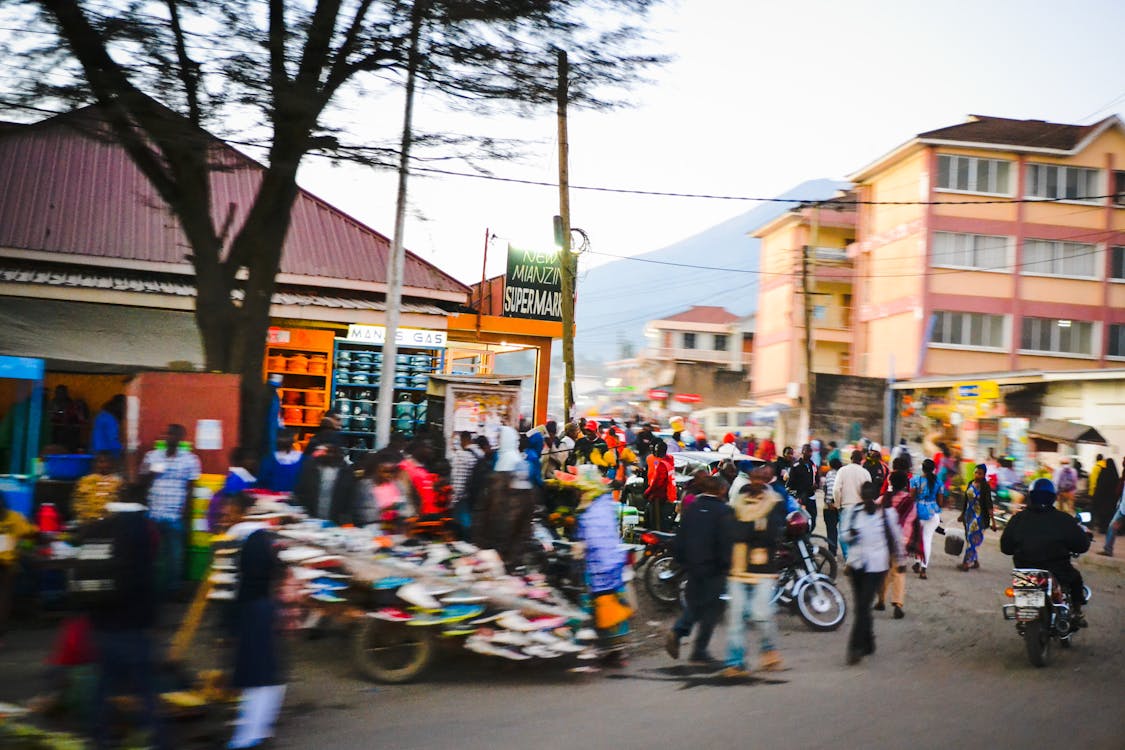
Free Photo of People Walking Outdoors Stock PhotoTwo small islands off the coast of West Africa, Sao Tome and Principe, are known for their lush vegetation, Portuguese influences and warm island weather year-round. Guadalupe, a small town on the northern coast of Sao Tome and Principe, has become one of Africa’s premier vacation spots.

As one of Africa’s smallest countries, Sao Tome and Principe has experienced periods of dramatic growth and economic and political decline. However, about 45% of the country’s 223,561 residents face poverty, with those in rural areas with dense populations particularly affected.

Causes of Poverty in Sao Tome and Principe

The leading causes of poverty in Sao Tome and Principe are low income, lack of productive assets and means of production, lack of infrastructure and lack of social capital. Most of the country’s citizens depend on subsistence agriculture and farming; many work on cacao plantations, harvesting Sao Tome and Principe’s number one export. Approximately 80% of the country’s cacao production is sent abroad.

Since gaining independence from Portugal in 1975, the country has depended mainly on cacao production to generate national profit. However, due to poor agricultural practices and mismanagement, the quality of cacao coming from Sao Tome and Principe has decreased substantially, as has the quality of life for those who depend on its harvesting to survive.

Sao Tome and Principe also relies heavily on imports, possibly due to its lack of a skilled workforce and high national debt. This reliance on imports makes the country susceptible to fluctuations in global market prices. Similarly, it has a gross domestic product (GDP) of only $542.7 million and a vast amount goes to imported goods. Moreover, according to the African Development Bank (ADB), Sao Tome and Principe imports 50% of its goods and 100% of its oil. Hence, there is little room for emergency funding or poverty reduction spending.

According to the World Factbook, 55.5% (2017 estimate) of Sao Tome and Principe’s population lives below the poverty line. Furthermore, around 11.7% of its children aged less than 5 are suffering from stunting and 4.5% are suffering from being overweight.

Looking Ahead

Despite its lack of economic resources and small population, there are bright prospects for Sao Tome and Principe. In the last decade, the nation has made significant progress. In the education sector, nearly 100% of its children, including boys and girls, complete primary education. Overall, more than 90% of Sao Tome and Principe’s population is literate, leading to better job opportunities, higher productivity and economic growth. Though the country’s residents face poverty, illness and economic hardship, Sao Tome and Principe’s governing body places the utmost importance on education and finding better ways to sustain its integrity.

In the health care sector, Sao Tome and Principe has achieved a significant milestone against HIV/AIDS prevalence, reducing it to less than 1.5% from around 3% to 4% in 2005. The country is also on course to reduce stunting and wasting among its children. Like every other country, Sao Tome and Principe is facing its own challenges. However, it is working to improve the lives of its citizens.

– Candice Hughes

Photo: Pexels
Updated: May 27, 2024

April 27, 2015
https://borgenproject.org/wp-content/uploads/borgen-project-logo.svg 0 0 Borgen Project https://borgenproject.org/wp-content/uploads/borgen-project-logo.svg Borgen Project2015-04-27 12:00:392024-06-24 07:43:49Poverty in Sao Tome and Principe
Global Poverty, Women and Female Empowerment

Empowered Women Can End Poverty

Empowered Women
For years, women have been faced with the challenges of discrimination and inequality all across the world. Taking up 50 percent of the population, their representation in many fields has been far less than equal. While women continue to be oppressed, they hold great power in the potential to influence the end of global poverty. From brutal attacks to income inequality, there is a broad range in which women’s rights can be improved, not only for financial reasons but humanitarian as well.

Millenium Development Goals have made gender equality and women empowerment the third top priority in ending world poverty. They also include improving maternal health in their MDG as number five. One of their focuses in improving gender equality is through education. “In many countries, gender inequality persists and women continue to face discrimination in access to education, work and economic assets, and participation in government,” according to the U.N.

Through their efforts, the MDGs have successfully achieved equality between boys and girls in primary education. However, the fight continues to end discrimination across the globe.

The World Bank Organization has made gender equality the top priority in their plan to end world poverty. They stress that if girls are educated and healthy, then they have a chance to become influential leaders in their countries. Yet, in many countries women continue to make less than their male counterparts. Since many women are a directly involved with much of the worlds agriculture, The World Bank mentions the impact women can have with improving hunger.

“It is estimated … that if women worldwide had equal access to productive resources, 100-150 million fewer people would go hungry every day,” says The World Bank.

Although women deserve to be educated and paid more, the most important right they need is security. Across the world women face the danger of being kidnapped and sold into human trafficking, or experience brutal sexual assault. They are forced into marriages and discriminated against and therefore are un-cared for. According to the World Health Organization, “35 percent of women worldwide have experienced either intimate partner violence or non-partner sexual violence in their lifetime.”

Everyday women are limited to housework and reproduction. If they had the chance to be seen as equal they would be empowered to chase the dreams they have always been held back from. Therefore, making half of the population into entrepreneurs, scientists, and educated women who can help make a difference in the world. By oppressing women the world is oppressing itself from its full potential.

– Kimberly Quitzon

Sources: UN Millennium Development Goals, The World Bank, World Health Organization
Photo: Flickr

April 18, 2015
https://borgenproject.org/wp-content/uploads/borgen-project-logo.svg 0 0 Borgen Project https://borgenproject.org/wp-content/uploads/borgen-project-logo.svg Borgen Project2015-04-18 04:00:302020-07-03 08:23:16Empowered Women Can End Poverty
Global Poverty

Five Easy Steps to Develop a Country Sustainably

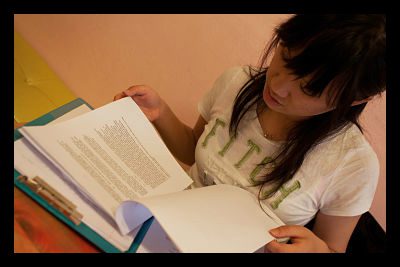
Five Easy Steps to Develop a CountryAccording to the Human Development Index, most of the world’s developed countries are located in Europe and North America while large swaths of Africa and Asia remain underdeveloped (South America falls somewhere in the middle). In addition to population size problems, these developing nations have to deal with political pressure revolving around the use of environmentally sustainable measures of growth—pressures that did not exist when currently developed nations were in their growth spurts. Discussed below are five easy steps to help develop a country and guide the growth of future international trading partners.
 

Five Easy Steps to Develop a Country


1. Share resources

Obviously, the fewer resources an average family uses, the lower the nation’s ecological footprint. Developing countries may not be able to afford electric or semi-electric cars, but their people can conserve both money and oxygen by carpooling, riding bikes and reusing grocery bags.

At the level of foreign advocacy, there are already influential notables arguing for the synergy between alleviating poverty and quelling climate change. Lord Nicholas Stern, chairman of the Grantham Research Institute on Climate Change and the Environment, warned against resorting to high-carbon-intensive resources to help impoverished countries. “The world is underinvesting in infrastructure, especially in developing countries where there are the largest unmet needs,” he wrote recently. For this reason, he encouraged governments not to separate climate and environmental funds from foreign aid, arguing that the two had to go hand-in-hand in order to produce long-term benefits.


2. Promote education

All levels of education are important stepping-stones to development, from the fundamentals of kindergarten, to the advanced quantum physics courses at the university. Each class ought to be taught with the overarching goals of quality of life and economic improvement in mind. Education stops terrorist groups from gaining strength and trains doctors and scientists to research and cure diseases. It is one of the primary movers that help impoverished nations to help themselves. Studies have shown that the greater number of mean years children attend school, the healthier that nation’s economy becomes.


3. Empower women

Education is most valuable to a developing country’s most vulnerable groups. The most common demographic among all of these populations—farmers, small-scale producers, victims of epidemics and terrorist groups—are women. Children of both genders are vulnerable as well, but the impoverished boys who do not die prematurely or join the terrorists are more likely to have enough social mobility to get educated and leave than girls. In the least educated African countries—Somalia, Niger, Liberia, Mali and Burkina Faso—over 70 percent of girls between seven and 16 have never attended school.

By empowering women and equalizing academic opportunity, countries can increase incomes by an average of 23 percent. They can do this by investing in schools closer to rural areas so that the children of farmers do not have to walk hours each day to get to and from school, straining their parents’ time and resources in the process. That way, neither parents nor children would feel pressure to force a decision between farm work and schoolwork and the poorest populations could begin to make progress.


4. Negotiate strategic political relations

Americans have seen firsthand what happens when big businesses and lobbyists become too deeply involved with politicians. When it happens in third-world countries, their poorest, most disadvantaged citizens are the ones who suffer. This often leads to violent uprisings with scads of victims on both sides. There’s a reason why college majors such as international relations and politics are practically universal. Aligning with people who have considerable political power and pathetically few scruples seldom benefits the poorer country. For that reason it is imperative that the educated learn to choose their political allies carefully in order to make the greatest leaps in ecological, economic and humanitarian development.


5. Reform the systems of food and aid distribution

So many millions of people still suffer from world hunger each day. Their problem springs less from stinginess among foreign taxpayers, but from inefficient systems of distribution. As Senegalese entrepreneur Magatte Wade recently explained, the bulk of taxpayer money filtering in from more affluent countries does not actually pay for African or Asian aid partly due to deep flaws in the regulations and in large part because of theft. “Look no further than the people who make most of that money,” she advised. “That’s where the money ends up.”

Here again, the rally call ought to be to support Africans rather than the inexperienced, inadvertently patronizing, members of the aid business. Instead of pouring money into resources, shipping and energy costs, she says, developed countries ought to invest in local African businesses so that the people can more effectively improve their own circumstances without having to resort to the whims of potentially corrupt and incompetent leaders.

– Leah Zazofsky

Sources: Business Green,  World Education Blog 1,  World Education Blog 2,  The Guardian,  American Thinker
Photo: International Development Research Centre

April 8, 2015
https://borgenproject.org/wp-content/uploads/borgen-project-logo.svg 0 0 Borgen Project https://borgenproject.org/wp-content/uploads/borgen-project-logo.svg Borgen Project2015-04-08 16:00:002024-05-27 09:23:41Five Easy Steps to Develop a Country Sustainably
Global Poverty

Helping the Marginalized Reduces Conflict

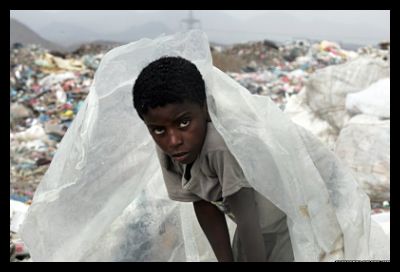
marginalizedJudy Woodruff of the PBS News Hour sat down with United Nations Secretary General, Ban Ki-moon of South Korea. The Secretary General spoke with Woodruff about violent extremism and conflict around the globe, and explained how helping the marginalized could potentially reduce conflict and global poverty.
Violent extremism is perhaps the greatest present threat to world stability because terrorism has no borders; it is a global crisis. There is no definitive solution to violent extremism, which has recently caused thousands to move from their homes and even cost them their lives.

Conflict and global poverty are connected, and the more people are marginalized, the farther conflict will spread. People become marginalized when they are pushed to the edge of society instead of finding a place within it. An EQ Review article states that “some [people] can become skeptical, embittered or violent, and they often model and raise children to think and act similarly.” Violence and conflict become a way of life and a solution to unstable societies and difficult upbringings. The desperation for a “better” life pushes people to drastic measures, increasing marginalization, poverty and violent extremism.

According to an EQ Review article, “political and social turmoil in [many regions] has resulted in the abduction and recruitment of young soldiers, extensive socio-economic and cultural upheaval, and extreme poverty.” The Borgen Project notes “that investments, non-military tools of development, and diplomacy…strengthen our allies and fights the spread of poverty, disease, terrorism and weapons of mass destruction.” Halting the spread of conflict is vital in a new era of technology and transnational terrorism.

But there is hope. By educating the youth of impoverished nations, security and opportunities are both created. Ban Ki-moon states in the interview that the United Nations is doing everything it can to find a solution that will affect global politics as well as global poverty.

– Alaina Grote

Sources: PBS,  USAID,  The Borgen Project
Photo: Yemen Fox

March 11, 2015
https://borgenproject.org/wp-content/uploads/borgen-project-logo.svg 0 0 Borgen Project https://borgenproject.org/wp-content/uploads/borgen-project-logo.svg Borgen Project2015-03-11 16:00:082024-05-27 09:23:24Helping the Marginalized Reduces Conflict
Education, Global Poverty

Education in the Solomon Islands

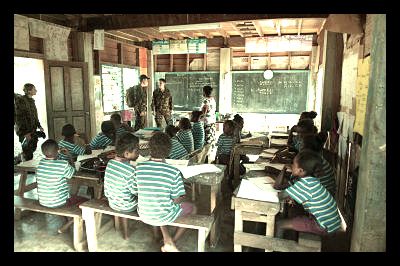
Solomon EducationWhat if you did not have to go to school? For some school-aged children in America, this might be a dream, but for the children of the Solomon Islands, it is a nightmare—and a reality. Due to their high poverty rate, the Solomon Islands do not make education a requirement. Only 2.2 percent of the government’s budget goes toward education, dropping drastically from its 9.7 percent in 1998. Only 60 percent of children even have access to any kind of primary education.

Of those 60 percent, only 72 percent of students complete their primary education. As for secondary school, the current numbers show 32 percent of boys attend, while 27 percent of girls do. Since there are so little resources, students have to take an exam to continue on to secondary school. Depending on their score, they can either be placed into secondary school or not score high enough to earn one of the few positions available.

These statistics all contribute to the 75 percent adult illiteracy rate. While education is not compulsory in the Solomon Islands, it is free for at least primary school. So, why are these numbers showing up?

The Solomon Islands had a civil war from 1998-2003, and once the country began to gain its footing again, a devastating tsunami hit in 2007. These events have only add to the hardships the people of the Solomon Islands face. Since adults have no educational background, the main source of income is through agriculture and farming. This can only get a family by for so long, and many children work alongside their families in lieu of going to school.

If a child does attend school, he or she has to deal with a shortage of teachers and classroom materials. Not only are half of all teachers unqualified, but they also struggle to receive payment for their services. In addition, less than half of the schools have access to adequate drinking water. Hopefully, the government will prioritize education in the coming years and break the cycle of poverty in the Solomon Islands.

– Melissa Binns

Sources: Classbase,  Education in Crisis,  ICDE

Photo: Flickr

March 10, 2015
https://borgenproject.org/wp-content/uploads/borgen-project-logo.svg 0 0 Borgen Project https://borgenproject.org/wp-content/uploads/borgen-project-logo.svg Borgen Project2015-03-10 04:00:582024-05-27 09:23:25Education in the Solomon Islands
Education, Global Poverty

Education in Tajikistan

Tajikistan Education
Tajikistan is a small country located in central Asia that gained independence from the Soviet Union in 1991. A civil war followed for the next six years, which caused the collapse of political regimes and educational systems.

While Tajikistan is one of the poorest countries in the world, the poverty rate decreased from 72 percent in 2003 to 47 percent in 2009. Tajikistan has been working to recover from the effects of the civil war and the global economy, but many remain trapped in a future of poverty due to a significant lack of educational opportunities.

In Tajikistan, children begin school at seven years old and are allowed to continue on to secondary school until age 18. However, many children drop out of school by age 12 to help around the house or to acquire a job, which means that the majority of children are only receiving four years of schooling or less. In addition, 66 percent of children in Tajikistan live in poverty, which affects both mental and physical development. Because of their living conditions, these children usually do not attend school due to economic reasons.

Tajikistan spends 3.8 percent of its GDP on education. Of its total expenditure on education, 73 percent goes to personnel costs, yet teachers’ salaries remain low. These costs leave little for school improvement and teacher training.

However, both Tajikistani officials and citizens are working toward a better educational system. In 2005, Tajikistan joined the Global Partnership for Education, or GPE, which focuses on universal access to quality education. The Tajikistani government spent 68 percent of the educational budget on basic education; yet, there is a funding gap when it comes to implementing the government’s action plan due to a lack of the necessary infrastructure.

The Tajikistani government worked with the GPE to develop the National Strategy for Education Development, which fights to ensure adequate sector coordination in support of the government’s education strategy.

In 2008, Tajikistan received its first grant from GPE for $18.4 million, and it received its second grant for $13.5 million in 2010. The money has been used to construct classrooms safely, provide school furniture and supplies, publish and supply multi-subject textbooks and improve authority training.

Tajikistan is working hard to decrease its national poverty rate, but there is still a lot of work to be done. Without education, children are far more likely to work at young ages, provide for families, take care of homes and continue living in poverty.

– Alaina Grote

Sources: ClassBase, Global Partnership for Education, UNICEF

Photo: Flickr

March 3, 2015
https://borgenproject.org/wp-content/uploads/borgen-project-logo.svg 0 0 Borgen Project https://borgenproject.org/wp-content/uploads/borgen-project-logo.svg Borgen Project2015-03-03 04:00:292020-07-23 16:58:11Education in Tajikistan
Education

Education in Equatorial Guinea Lacking

Read more
January 19, 2015
https://borgenproject.org/wp-content/uploads/borgen-project-logo.svg 0 0 Borgen Project https://borgenproject.org/wp-content/uploads/borgen-project-logo.svg Borgen Project2015-01-19 04:00:182026-03-25 12:54:06Education in Equatorial Guinea Lacking
Children, Education, Global Poverty

Education in Kazakhstan

Read more
January 16, 2015
https://borgenproject.org/wp-content/uploads/borgen-project-logo.svg 0 0 Borgen Project https://borgenproject.org/wp-content/uploads/borgen-project-logo.svg Borgen Project2015-01-16 12:00:012025-10-27 11:52:50Education in Kazakhstan
Page 50 of 67«‹4849505152›»

Get Smarter

  • Global Poverty 101
  • Global Poverty… The Good News
  • Global Poverty & U.S. Jobs
  • Global Poverty and National Security
  • Innovative Solutions to Poverty
  • Global Poverty & Aid FAQ’s
Search Search

Take Action

  • Call Congress
  • Email Congress
  • Donate
  • 30 Ways to Help
  • Volunteer Ops
  • Internships
  • Courses & Certificates
  • The Podcast
Borgen Project

“The Borgen Project is an incredible nonprofit organization that is addressing poverty and hunger and working towards ending them.”

-The Huffington Post

Inside The Borgen Project

  • Contact
  • About
  • Financials
  • President
  • Board of Directors
  • Board of Advisors

International Links

  • UK Email Parliament
  • UK Donate
  • Canada Email Parliament

Get Smarter

  • Global Poverty 101
  • Global Poverty… The Good News
  • Global Poverty & U.S. Jobs
  • Global Poverty and National Security
  • Innovative Solutions to Poverty
  • Global Poverty & Aid FAQ’s

Ways to Help

  • Call Congress
  • Email Congress
  • Donate
  • 30 Ways to Help
  • Volunteer Ops
  • Internships
  • Courses & Certificates
  • The Podcast
Scroll to top Scroll to top Scroll to top