• Link to X
  • Link to Facebook
  • Link to Instagram
  • Link to TikTok
  • Link to Youtube
  • About
    • About Us
      • President
      • Board of Directors
      • Board of Advisors
      • Financials
      • Our Methodology
      • Success Tracker
      • Contact
  • Act Now
    • 30 Ways to Help
      • Email Congress
      • Call Congress
      • Volunteer
      • Courses & Certificates
      • Be a Donor
    • Internships
      • In-Office Internships
      • Remote Internships
    • Legislation
      • Politics 101
  • The Blog
  • The Podcast
  • Magazine
  • Donate
  • Click to open the search input field Click to open the search input field Search
  • Menu Menu

Archive for category: Refugees and Displaced Persons

Information and news on Energy and Electricity

Advocacy, Global Poverty, Refugees and Displaced Persons

Former Vietnamese Refugees Reach Out to Fleeing Syrians

Vietnamese_Refugees
As Syria’s civil war worsens, thousands of Syrians are compelled to abandon their lives and relocate to other countries. Their journeys often include the daunting task of crossing oceans in small vessels that are barely sea-worthy. However, safety does not always await them on the other side.

The mass exodus from Syria has caused no small amount of strife among political leaders as they discuss how to accommodate so many refugees.

Working citizens eye the situation warily, anticipating the incoming Syrians as a threat to their livelihoods. Settling in can be very difficult for refugees when their new community is unwelcoming. Such situations can result in refugees living in squalor and becoming a burden to their new country.

The U.S. agreed to take in 10,000 Syrians in the upcoming year, but the Vietnamese American population has decided that more can be done to ensure the newcomers receive a hospitable welcome. After all, only a few short decades separate the Vietnamese from their own experience as refugees.

When the Vietnam War ended in 1975, roughly 125,000 Vietnamese refugees entered the U.S. by boat, much like the Syrians. If they were lucky, they found housing and a source of income. The unlucky spent years in refugee camps or searched the country for separated loved ones.

Now, as they see their own history playing out before their eyes, Vietnamese Americans strive to generate compassion for the fleeing Syrians.

In California, home to the largest population of former Vietnamese refugees, individuals have organized a 4-mile walk-a-thon to raise money for refugee accommodation. A Twitter campaign has also been established to allow U.S. citizens to voice their support for the Syrian refugees.

Other ways that U.S. citizens can assist in the accommodation and acculturalization of refugees are by volunteering at local resettlement agencies, donating funds and household items, becoming an English tutor and spreading the word about refugee aid.

“I want to see what we can do to help the Syrians because that is us,” says Tom Q. Nguyen, who lost his mother and sister when his family fled Vietnam in the 80’s.

Nguyen and fellow campaigners hope that their efforts will inspire others to take part as well. Perhaps the actions of these former Vietnamese refugees mark a new outlook on refugee accommodation.

According to the UNHCR’s 2015 report, nearly 60 million forcibly displaced persons exist in the world today. Half of these are victims of the turmoil in Syria, Afghanistan and Somalia, and all are in need of a new home.

– Sarah Prellwitz

Sources: Migration Policy 1, Migration Policy 2, NY Daily News, Rescue
Photo: Google Image

October 8, 2015
https://borgenproject.org/wp-content/uploads/borgen-project-logo.svg 0 0 Borgen Project https://borgenproject.org/wp-content/uploads/borgen-project-logo.svg Borgen Project2015-10-08 05:33:082024-05-27 09:28:10Former Vietnamese Refugees Reach Out to Fleeing Syrians
Global Poverty, Health, Refugees and Displaced Persons

Potential Typhoid Outbreak in Syria

Typhoid_Outbreak
The U.N. Relief and Works Agency’s (UNWRA) health program has dramatically decreased the risk of communicable and vaccine-preventable diseases among Palestinian refugees in Syria. However, doing such great work is challenging among crowded refugee camps that are not easily accessible. The threat of contagious diseases is always present.

The threat of a potential typhoid outbreak spreading to the capital of Damascus was prevalent in July, had UNWRA not been allowed to help. The largest “unofficial” camp at Yarmouk emptied of Palestinian refugees after fighting began between Islamic State, local groups and government forces. Refugees are temporarily in Yalda and other towns close by controlled by armed groups that have reached deals with the government. The groups have strong leaders and civilian committees that collaborate with UN agencies.

UNWRA was able to deliver whatever was needed to refugees between April 23 and June 8. They provided 6,000 food parcels each month, and healthcare. Since June 8, UNWRA has no longer been allowed, as a result of assassinations in Yalda, supposedly by insurgents. Those inaccessible places saw the loss of UNWRA host areas for the distribution of water and medical services.

The Syrian Arab Red Crescent and other aid organizations have little access to these areas where there is a strong need for water purification tablets and hygiene kits. In a similar situation last year, access was eventually granted. In other parts of Syria, 10,000 Palestinians have been displaced to a small Aleppo camp with no electricity or water. To the east of Aleppo city, the large Neirab camp is under government control.

UNWRA has done everything it can in the places it can access. UNWRA staff wasted no time when they heard about the potential typhoid outbreak in Yarmouk. They took blood and water samples from those who showed symptoms, and within 24 hours typhoid medicine was delivered to Yarmouk. Currently, the number of cases is decreasing and under control.

UNWRA is hopeful about preventing outbreaks, with its rapid response of reporting cases to UNWRA senior staff, having medicine in Damascus office and 3 month supply kept at clinics. The concern for areas that are not easily accessible is still present.

Agencies are preparing for worsening conditions in Deraa and Aleppo. Before the conflict started in 2011, there were 560,000 Palestinian refugees registered with the UNWRA in Syria; today, there are 480,000, 95 percent of which need constant aid. The number of consultations for medical services has gone up from 100 to 500.

Palestinian refugees are closed off from Jordan and Lebanon, which leaves them with two options: staying in a war zone or being smuggled to Turkey, where they will take unreliable boats to Europe.

UNWRA needs $414 million just for Syria this year due to the 2014 appeal being only half funded. Due to under-funding, it will have to postpone the school year for 700 schools for half a million children unless they receive $101 million from donors by August. A source believes they should qualify, considering they are one of the countries taking part in the US-led campaign against Islamic State in Syria and Iraq, which already has cost $5 billion.

UNWRA devotes half of its budget to education; schools ensure continuity and stability for children in conflicted Syria and Gaza, unstable Lebanon, the Israeli-occupied West Bank and East Jerusalem, and Jordan, all trying to manage the influx of Palestinian and Syrian refugees.

In the past decade, donor contributions have not kept up with population growth. UNWRA offers protection and services to 5 million refugees, but it currently only has enough money to provide relief and healthcare, leaving education out of the equation.

– Paula Acevedo

Sources: Europa, Irish Times
Photo: Mashable

October 2, 2015
https://borgenproject.org/wp-content/uploads/borgen-project-logo.svg 0 0 Borgen Project https://borgenproject.org/wp-content/uploads/borgen-project-logo.svg Borgen Project2015-10-02 08:20:532024-05-27 09:27:29Potential Typhoid Outbreak in Syria
Global Poverty, Refugees and Displaced Persons

Bayern Munich Donates $1 Million to Refugees

soccer
The 2013 UEFA Champions League winner, FC Bayern Munich, is donating $1.11 million to refugees in Germany who arrived via Hungary and Austria. There is a training camp set up to supply food and enroll refugees in German classes. Bayern Munich will also donate soccer equipment to the incoming refugees.

Germany has taken 20,000 refugees in Munich alone and plans on taking 800,000 asylum seekers before the year is over. In 2014, the entire European Union took 626,000 refugees.

There are many aspects about Germany that makes it attractive for refugees. Germany has the strongest economy in Europe and is one of the safest countries in the world. Refugees in Germany get to enjoy a strong human rights record and free education for their children.

The police force in Germany asked Germans to stop donating items for the incoming refugees because the volume of aid they were taking in became overwhelming.

Germany estimates that each refugee costs about $14,500, which means 800,000 refugees will cost $11 billion this year. There will be $6.7 billion set aside in 2016 for refugees agreed to by the government.

Bayern Munich’s example is just a small package of what Germany is offering to refugees. The entire community has been involved in aiding refugees. Industries are going to provide job opportunities for refugees in Germany and there will be recruitment at refugee centers.

On September 12, Bayern Munich walked out with one German child and one refugee child to symbolize integration and to encourage Germany.

– Donald Gering

Sources: Al Jazeera 1, Al Jazeera 2, The Guardian, The Independent, UNHCR
Photo: PBS

September 30, 2015
https://borgenproject.org/wp-content/uploads/borgen-project-logo.svg 0 0 Borgen Project https://borgenproject.org/wp-content/uploads/borgen-project-logo.svg Borgen Project2015-09-30 01:15:222024-12-13 18:05:04Bayern Munich Donates $1 Million to Refugees
Global Poverty, Nonprofit Organizations and NGOs, Refugees and Displaced Persons

German Organization Connects Individuals with Refugees

Today in Germany hundreds of thousands of refugees arrive each year, looking for asylum and safety. Many are from primarily Islamic nations.

The massive influx of people has strained local officials— finding adequate housing for everyone is a challenge.

Many cities have put massive amounts of refugees in old schools or re-purposed shipping containers. Often, the refugees are not welcome in their new neighborhoods due to religious tension. According to National Public Radio, “The western German city of Schwerte even proposed placing 21 refugees in a barracks on the grounds of a Nazi-era concentration camp.”

Berlin Residents Mareike Geiling and Jonas Kakoschke believe that refugees deserve a more humane treatment than mass, impersonal accommodations. This prompted them to create the organization Refugees Welcome— a website that matches refugees looking for asylum with people in Germany and Austria willing to open their homes to these people in need.

“We don’t like the idea of putting these people into one place where many, many people live,” explained Geiling to NPR.

“Many asylum-seekers have to stay there for years … doing nothing, because they are not allowed to do anything. They are not allowed to work, they are not allowed to have German classes sometimes and sometimes it’s not a city, it’s a village and there’s nothing to do and so you get depressed after years and stuff like this,” said Kakoschke.

Kakoschke and Geiling are a couple living in Berlin, and they were the first to open their doors to a refugee in need. The couple matched with a thirty-nine year old Muslim man from Mali, who had recently applied for asylum and is waiting for a working permit. For this reason, Kakoschke and Geiling raise money to cover their new roommates cost of rent and utilities.

NPR reports that the Malian man is afraid to give his name for safety reasons, but said “It surprised me a lot because … the people here don’t want to see people like us in their land.”

Before Kakoschke and Geiling opened their doors to him, the roommate was homeless. “Sometimes I’d take the bus from different sector to different sector at nighttime until, you know, 2:30” in the morning, he says. Then he’d “get out and sleep for 20 minutes and go back on the train again sometimes and go back in the mosque and pray there for 30 minutes and sleep there for one hour.”

Refugees Welcome has been very successful so far on a small scale. The website has matched 122 refugees to welcoming German and Austrian flatmates.

Refugees Welcome reports, “Through Refugees Welcome people have moved in to 80 homes in Augsburg, Berlin, Bonn, Darmstadt, Dortmund, Dresden, Frankfurt, Hamburg, Hanover, Konstanz, Leipzig, Marburg, Munich, Munster, Norderstedt, Offenburg and Wolfratshausen. Through Refugees Welcome Austria (our Austrian sister-organisation) people have moved in to 44 places in Eisenstadt, Knittelfeld, Salzburg and Vienna. The new flatmates are from Afghanistan, Algeria, Bangladesh, Burkina Faso, Cameroon, Gambia, Ghana, Kenya, Liberia, Mali, Niger, Nigeria, Iraq, Iran, Pakistan, Russia, Senegal, Somalia, Sri Lanka, Syria and Tunisia.”

– Aaron Andree

Sources: NPR, Refugees-Welcome
Photo: thegaurdian

September 29, 2015
https://borgenproject.org/wp-content/uploads/borgen-project-logo.svg 0 0 Borgen Project https://borgenproject.org/wp-content/uploads/borgen-project-logo.svg Borgen Project2015-09-29 11:04:592024-05-24 23:42:49German Organization Connects Individuals with Refugees
Education, Global Poverty, Refugees and Displaced Persons

Re:Build System Focuses on Refugee Education

 Build Rebuilds Refugee Education from the Ground Up
One of the main priorities for families living in refugee camps in the Middle East is the education of their children. Architects, nonprofit organizations, and a scaffolding company have teamed up to create the Re:Build construction system, a project that creates low-cost durable buildings built of readily available resources such as sand and soil. The buildings, which are planned to house schools, are easily set up and can be transported to other locations.

Children consist of a large proportion of refugees from Syria, and many of them have been out of school for several years. Building schools and providing them with education provides them with vast opportunities and empowers them to create their futures for themselves.

In order to better refugee education, these mobile, easily constructed schools can be expanded by adding extra modules, built by the refugees themselves, use sustainable materials that are locally and widely available, are weatherproof even in areas with seismic activity, and are designed with their communities in mind.

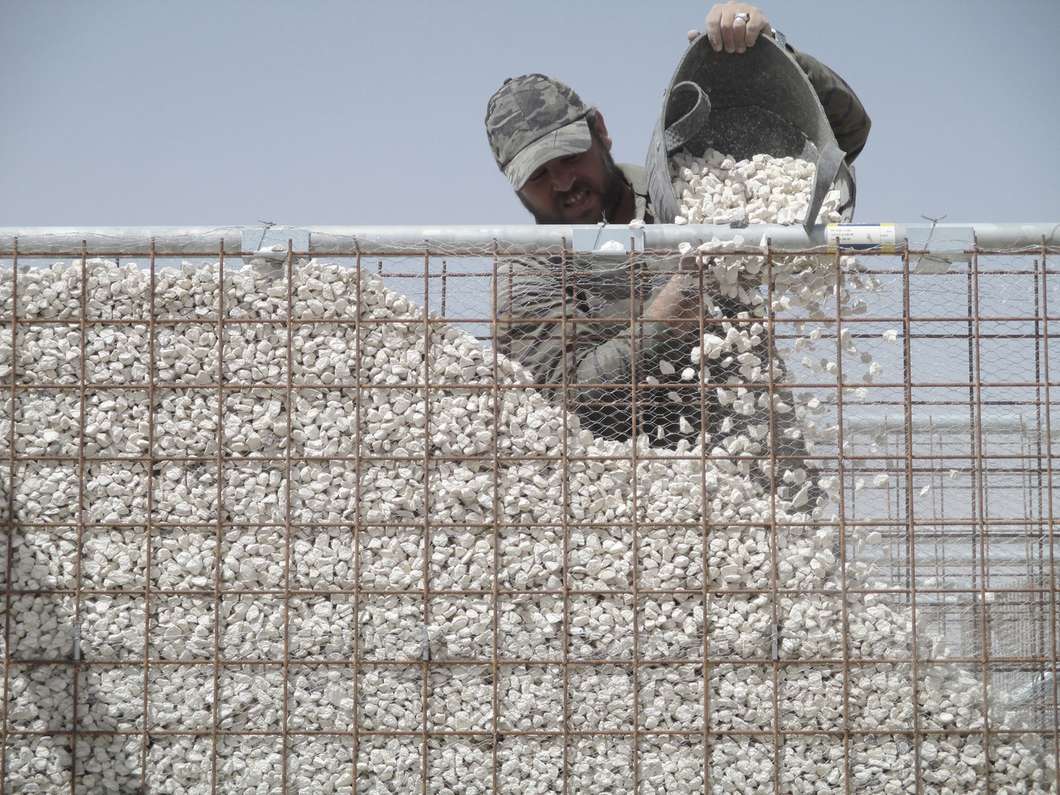
How do these systems work? They use wall frames filled with natural materials such as sand, gravel, or stones. The roof frame is topped with soil to provide insulation and a fertile place for micro-crops to grow. The structures have structures to reroute rainwater, come with solar panels, and have plywood flooring.

The Re:Build construction system was designed and implemented by architects Cameron Sinclair and Pouya Khaezli, nonprofits Save the Children and Relief International, and scaffold company Pilosio Building Peace. Together, they have constructed two schools in Jordan: one at Za’atari camp and another at Queen Rania Park in Amman. The Za’atari camp is the Middle East’s largest refugee camp which has now been existence for three years.

They are not only cost-effective but also mobile–they do not require construction crews to set up. According to Sinclair, many parents of the school’s new students helped construct the building. The cost of each school is still quite high – $30,000 each – but with crowdsourcing campaigns and local nonprofit donations, these schools are beginning to effect great changes for the children who use them.

In times of conflict, when many people feel as though they have no control over their situations and destinies, education can serve as an anchor for the heart.

“We victimize refugees by treating them as second-class citizens instead of understanding that they are some of the most resilient and hardworking people on the planet, said Sinclair. “By engaging the refugees as paid laborers ensures that they once again feel in charge of their own destiny and leave with the skills to reassemble the school back in their home country.”

– Jenny Wheeler

Sources: Huffington Post, “Building the Peace” Award
Photo: Flickr

September 24, 2015
https://borgenproject.org/wp-content/uploads/borgen-project-logo.svg 0 0 Borgen Project https://borgenproject.org/wp-content/uploads/borgen-project-logo.svg Borgen Project2015-09-24 01:30:172020-06-29 18:16:12Re:Build System Focuses on Refugee Education
Aid, Refugees and Displaced Persons

Should We be Accepting Refugees in America?

Accepting_Refugees_in America
As Europe continues to struggle with a steady stream of refugees from Syria, Iraq and beyond, the United States is still debating a proper policy response to the crisis. It begs the question – what are the implications for accepting refugees in America on a large scale?

White House discussions regarding U.S. refugee policy have been held in recent weeks, but it still seems that the Obama administration is far from making a concrete decision.

President Obama has stated that the U.S. will accept around 10,000 Syrian refugees over the next year, but more longstanding U.S. involvement has yet to be confirmed.

In a recent op-ed for the New York Times, director of migration and refugee services of the United States Conference of Catholic Bishops William Canny laid out some key ways that genuine U.S. involvement could greatly aid Syrian refugees.

“In addition, the United States can resettle a much larger number of the 4 million Syrian refugees than the 1,600 we have to date,” Canny says. “The U.S. refugee program could absorb as many as 100,000 Syrian refugees if the political will to do so existed. Security checks are in place to ensure that those resettled are not a threat to us.”

According to the UN, 7.6 million Syrians have been internally displaced since the beginning of the conflict in 2011, and an additional 4.1 million have been displaced outside of the country altogether. The need for increased U.S. response is growing rapidly.

“A robust U.S. commitment to the resettlement of Syrian refugees would encourage other reluctant nations, especially those in Europe, to accept more and to keep their doors open until this horrific conflict can be ended,” Canny continues. “It also would show that the United States is not indifferent to human suffering and remains, as always, a beacon of hope to the world.”

– Alexander Jones

Sources: New York Times, US News, Washington Post
Photo: Google Images

September 20, 2015
https://borgenproject.org/wp-content/uploads/borgen-project-logo.svg 0 0 Borgen Project https://borgenproject.org/wp-content/uploads/borgen-project-logo.svg Borgen Project2015-09-20 14:17:122024-12-13 18:05:07Should We be Accepting Refugees in America?
Aid, Global Poverty, Refugees and Displaced Persons

Solidarity Symi: A Safe Haven for Syrian Refugees

syrian_refugees
The Syria Refugee crisis is becoming increasingly difficult to ignore. With the picture of the young refugee boy whose body washed up on shore grabbing the attention of the world, more people than ever are paying attention to this humanitarian crisis.

With increased awareness of the Syrian Refugees, comes an increase in advocacy (as people in many countries are stepping up to tell their governments how they feel about accepting refugees into their countries) and an increase in activism.

Individuals like hotel owner Andrew Davies and lettings agent Wendy Wilcox on the Greek island of Symi, are stepping up to help these those who are fleeing violence and pain in hopes of finding a better life.

Together, the pair has launched a reception service on the tiny Greek island called Solidarity Symi, using an abandoned post office as their resource headquarters.

This organization is a not-for-profit that works to provide food, clothing, shelter, and medical treatment to destitute Syrians who have crossed over the Mediterranean into Europe.

These heroic individuals work at this project eight hours a day in addition to the jobs they work at to make a living.

There are 30 core volunteers that work to get the refugees taken care of while they are in Symi and to direct them to resources about how to continue their journey safely.

Though some Symi residents worry about the influx of refugees hurting their tourism-based economy, Davies’ thoughts on the matter are simple. “How could we lie on the beach reading books when people were suffering?” he asks.

Many cross the Mediterranean in dangerously overloaded boats, with smugglers who overcharge them or delay the trip. But, in a country torn apart by war, many Syrians are left with no other choice.

As Francine Uenuma of Save the Children emphasizes based on the refugees she has spoken to near Serbia, “They’re fleeing violence. They’re fleeing persecution. And the risks they’re taking, I think, underscore that point.”

Right now, independent operations like Solidarity Symi are especially important in light of the strain on humanitarian aid agencies such as the U.N. High Commissioner on Refugees (UNHCR) and the U.N.’s World Food Program.

Solidarity Symi has raised over £26,000 through a Facebook site and donations from visitors. There are donation boxes set up around the island, and community members are working to raise awareness of the organization through on-site and online mediums so that it can continue to develop.

The Facebook page is also continually updated with items that the organization is in need of, so that those present on the island can make material donations such as soap, travel bags, specific foods, sleeping mats, and even toys for children.

The Solidarity Symi Facebook page is a very positive resource that updates supporters with pictures and posts about how their donations are helping and about refugees as individual people, not simply victims and members of a mass migration.

The people working tirelessly at organizations such as Solidarity Symi are a perfect testament to how each individual has the power to make a positive difference.

For more information about Solidarity Symi, or to donate to the organization, visit their website.

– Emily Dieckman

Sources: Blogspot, Daily Mail, Facebook, NPR 1, NPR 2, Reuters
Photo: cooksailing

September 19, 2015
https://borgenproject.org/wp-content/uploads/borgen-project-logo.svg 0 0 Borgen Project https://borgenproject.org/wp-content/uploads/borgen-project-logo.svg Borgen Project2015-09-19 01:33:272024-12-13 18:05:07Solidarity Symi: A Safe Haven for Syrian Refugees
Education, Refugees and Displaced Persons

Makeshift School Serves Calais Refugees

Makeshift school serves Calais refugees
When refugees imagine the amount of time they will be living in an encampment, they probably do not anticipate staying long — their minds already drift to a possible future beyond the camp’s makeshift walls.

However, as more refugees flee from conflicted countries such as Syria, Afghanistan and Africa, these supposedly temporary living arrangements are beginning to become communities of their own. For a camp in Calais, France, mosques, churches, shops, a barber and, as of last month, a school can be found in the encampment for those passing through.

According to an article by the global campaign A World at School, the largest camp in the northern part of Calais and Western Europe is known as “the Jungle,” housing as many as 3,000 immigrants who wait in the hopes of gaining entrance into the United Kingdom.

Near the Jungle is the English Channel tunnel, known for its connection between France and England, which serves as a potential point of entry for migrants. Despite the danger and increased security around the border zones, migrants are willing to risk everything for the chance to jump on trains and lorries bound for the UK.

Meanwhile, refugees attempt to include aspects of normalcy into their everyday schedules by attending school or passing the time playing a game of dominoes. Makeshift tents and poorly constructed buildings make up the encampment, which is filled with people who have already survived the dangerous trek from their homes in the Middle East and Africa.

Today, it is not uncommon to see a school inside of a refugee camp, so when refugees started asking how to say French words or numbers, a makeshift school was created by Nigerian Zimarco Jones. It was soon up and running, staffed with the help of French volunteers.

Constructed from materials such as branches and wood panels, the makeshift school seats 20 students and faces a blackboard. Since its establishment in July, it has been given the name L’Ecole Laïque du Chemin des Dunes, which translates to The Secular School of Dune Way.

Mostly young men attend the school to learn both English and French and other subjects, but Jones plans to build an additional school for the more than 20 children and 200 women who live in the camp.

The current state of conflict in the world has displaced an astronomical number of children from their homes, wreaking havoc on their childhoods and robbing them of their education. Fortunately, there are opportunities that can be found in those temporary homes and stops along the way to their final destination — some place they earnestly look forward to one day calling home.

– Nikki Schaffer

Sources: A World at School, The Guardian 1, The Guardian 2
Photo: Al Jazeera America

August 23, 2015
https://borgenproject.org/wp-content/uploads/borgen-project-logo.svg 0 0 Borgen Project https://borgenproject.org/wp-content/uploads/borgen-project-logo.svg Borgen Project2015-08-23 01:30:192024-06-04 04:33:48Makeshift School Serves Calais Refugees
Advocacy, Global Poverty, Hunger, Refugees and Displaced Persons

Jessica Watson Visits Syrian Refugees

Syrian_Refugees
Jessica Watson would like to see children around the world pursue their dreams. In order for that to happen, she must first tackle world hunger.

The 22-year-old is a Youth Ambassador for the United Nations World Food Programme (WFP). Hailing from Queensland, Australia and awarded Young Australian of the Year in 2011, Watson is the youngest person to ever sail around the world solo and unassisted, having completed the global voyage when she was 16 years old.

Watson’s most recent expedition, however, brought her to Lebanon and Jordan, where she visited Syrian refugees. Her “Sail with WFP” initiative recognizes the intimidating journey made by young Syrians who have left their homes for Lebanon or Jordan. As WFP’s Youth Ambassador, Watson provided food and support for suffering families.

Founded in 1961, WFP is the largest hunger-fighting organization in the world, supplying food in times of emergency and working with communities to create sustainability. The goal of the organization is to end world hunger and eliminate global poverty. Funded by governments, companies and private individuals, WFP provides annual assistance to more than 80 million people in 75 countries.

In Lebanon, Watson sailed with five Syrian and Lebanese youths from Beirut, Lebanon’s capital, to a northern port. In Jordan, she spent time in the Azraq refugee camp. There, Watson met a single Syrian mother Manal and her eight children. She accompanied the family to the camp’s only grocery store, where refugees buy food with electronic food cards from WFP.

Earlier this year, however, WFP had to reduce refugee stipends due to a lack of funding. As a result, the refugee program is 81 percent underfunded and many Syrian families are struggling to stay alive. The organization requires $138 million to continue helping refugees in Jordan, Lebanon, Egypt, Turkey and Iraq through September.

Watson also visited a Save the Children International youth center in Amman, Jordan’s capital, and hopes her journey will bring attention to the hardships faced by the Syrian people. A WFP Youth Ambassador since her young global voyage, Watson sails towards a new, hunger-free future.

– Sarah Sheppard

Sources: WFP 1, WFP 2, WFP 3
Photo: News Pronto

August 8, 2015
https://borgenproject.org/wp-content/uploads/borgen-project-logo.svg 0 0 Borgen Project https://borgenproject.org/wp-content/uploads/borgen-project-logo.svg Borgen Project2015-08-08 01:30:072024-05-26 23:05:29Jessica Watson Visits Syrian Refugees
Children, Global Poverty, Refugees and Displaced Persons

Burundian Child Refugees Flee to Tanzania

Burundian_Child_Refugees
The remote Nyarugusu refugee camp in Western Tanzania has seen a sharp rise in child refugees from the neighboring country to the east. Children have been flooding over the border to escape violence surrounding the recent elections in Burundi.

The amount of Burundian child refugees arriving to the camp increased from about 1600 at the end of May to approximately 2600 by July 19th.

The children are not just arriving in larger numbers according to Lisa Parrott, interim country manager of Save the Children Tanzania, but they are also reaching the camp in much worse shape physically and mentally, most having walked for days with nothing but the clothes on their backs and no food or water. Many have witnessed atrocious acts of violence in their homes and along the way to Tanzania. Some of the children have even seen their own parents or other family members murdered by militia.

On July 21 2015, Burundian President Pierre Nkurunzizain won re-election after running for a third term. In the wake, violence erupted and gunfire rang out. These elections had been hotly protested with President Pierre Nkurunzizain’s opposition claiming that he was not eligible to run again. After the elections, the opposition boycotted the vote and fighting in the country intensified.

The child refugees arriving at the Nyarugusu refugee camp are not eating properly and are having terrible problems sleeping and interacting with others. About a fifth are infants with severe signs of malnutrition, anemia, malaria, diarrhea and other conditions.

The Nyarugusu camp has become one of the biggest settlements in the world comprised of mostly the Congolese who have lived in the camp since the 1990s. At 60,000 people, the already overcrowded camp has more than doubled with almost 80,000 Burundians entering over the years and the recent influx of children has only made the camp more strained.

The overflow of the population is being housed in churches and schools, causing fears that schools will not be able to operate, starving more children of a valuable education. Competition for resources such as food rations, shelter, cooking facilities and firewood, clothing, health care, and clean water intensifies every day with tensions running high.

Save the Children, an organization working in developing nations to inspire breakthroughs in the way the world treats children and to achieve immediate and lasting change in their lives, believes that every child has the right to survival, protection, development and participation.

Save the Children is on the ground in Tanzania and, with the help of local partners, are setting up child health services such as constructing Temporary Learning Centers (TLC) and creating Child Friendly Places (CFP), expected to reach 1200 children.

Life in refugee camps like Nyarugusu is difficult for thousands of people already mired in extreme poverty, but with groups like Save the Children, those seeking refuge from increasing violence in surrounding communities can find some relief and access to basic human needs.

– Jason Zimmerman

Sources: Save the Children, Reuters
Photo: Flickr

August 7, 2015
https://borgenproject.org/wp-content/uploads/borgen-project-logo.svg 0 0 Borgen Project https://borgenproject.org/wp-content/uploads/borgen-project-logo.svg Borgen Project2015-08-07 01:30:472024-05-27 09:27:14Burundian Child Refugees Flee to Tanzania
Page 19 of 29«‹1718192021›»

Get Smarter

  • Global Poverty 101
  • Global Poverty… The Good News
  • Global Poverty & U.S. Jobs
  • Global Poverty and National Security
  • Innovative Solutions to Poverty
  • Global Poverty & Aid FAQ’s
Search Search

Take Action

  • Call Congress
  • Email Congress
  • Donate
  • 30 Ways to Help
  • Volunteer Ops
  • Internships
  • Courses & Certificates
  • The Podcast
Borgen Project

“The Borgen Project is an incredible nonprofit organization that is addressing poverty and hunger and working towards ending them.”

-The Huffington Post

Inside The Borgen Project

  • Contact
  • About
  • Financials
  • President
  • Board of Directors
  • Board of Advisors

International Links

  • UK Email Parliament
  • UK Donate
  • Canada Email Parliament

Get Smarter

  • Global Poverty 101
  • Global Poverty… The Good News
  • Global Poverty & U.S. Jobs
  • Global Poverty and National Security
  • Innovative Solutions to Poverty
  • Global Poverty & Aid FAQ’s

Ways to Help

  • Call Congress
  • Email Congress
  • Donate
  • 30 Ways to Help
  • Volunteer Ops
  • Internships
  • Courses & Certificates
  • The Podcast
Scroll to top Scroll to top Scroll to top