• Link to X
  • Link to Facebook
  • Link to Instagram
  • Link to TikTok
  • Link to Youtube
  • About
    • About Us
      • President
      • Board of Directors
      • Board of Advisors
      • Financials
      • Our Methodology
      • Success Tracker
      • Contact
  • Act Now
    • 30 Ways to Help
      • Email Congress
      • Call Congress
      • Volunteer
      • Courses & Certificates
      • Be a Donor
    • Internships
      • In-Office Internships
      • Remote Internships
    • Legislation
      • Politics 101
  • The Blog
  • The Podcast
  • Magazine
  • Donate
  • Click to open the search input field Click to open the search input field Search
  • Menu Menu

Archive for category: Human Rights

Information and stories about human rights.

Global Poverty, Human Rights

Human Rights in Iceland

Human Rights in IcelandIceland is a Nordic nation with a population slightly over 300,000 people. Despite its small size, Iceland stands out among other nations in a variety of ways. Geographically, the nation is known for its beautiful sights including volcanoes and hot springs. Economically, the nation boasts an impressive statistics, such as its four percent unemployment rate. Human rights in Iceland are protected fairly well, but certain aspects could be improved.

The United States Department of State’s 2015 Human Rights Report on Iceland concluded that the nation’s biggest failures in this context were to protect women and children from violence. These issues tended to stem from the criminal justice system. For instance, pretrial detainees were forced to share a cell with convicted prisoners, while juveniles were forced to share a cell with adults.

Unfortunately, the report found issues existing beyond the criminal justice system. Discrepancies in access to health care for certain individuals was noticeable. Researchers also found discrimination against people with disabilities in regard to employment and access to public locations. This report clearly demonstrates that Iceland must take measures so that human rights truly include everyone.

However, these few failures do not represent the entire situation in Iceland. In fact, the vast majority of human rights in Iceland are well protected. Freedom of speech and the press are protected by the constitution and the law in Iceland. The law is able to fine and/or imprison anyone who blocks people from this right.

Another area of success is Iceland’s protection of workers’ rights. The government effectively enforces laws that defend workers’ rights to form or join a union. Iceland also uses its laws to protect children from unhealthy work conditions. These laws are effectively enforced, and as a result, there are no known cases of child labor.

Iceland took a step forward in protecting the human rights of women this March by becoming the world’s first country to mandate that businesses demonstrate that they offer equal pay to employees regardless of their gender. This law affects all businesses, public and private, that employ over 25 people.

Human rights in Iceland are not perfectly protected. However, steps such as demanding equal pay for employees regardless of their gender shows that progress is being made.

– Adam Braunstein

Photo: Flickr

August 23, 2017
https://borgenproject.org/wp-content/uploads/borgen-project-logo.svg 0 0 Borgen Project https://borgenproject.org/wp-content/uploads/borgen-project-logo.svg Borgen Project2017-08-23 01:30:252024-05-28 00:16:00Human Rights in Iceland
Global Poverty, Human Rights

Strengthening Communities to Curb Gang Violence in Honduras

Gang Violence in HondurasSan Pedro Sula, Honduras is one of the most dangerous cities in the world. Thus, organizations and local leaders are combating gang violence in Honduras by helping young people find and make their own families.One teenager skateboards with friends he considers brothers. Another works on diagramming a family tree. Others join in soccer

One teenager skateboards with friends he considers brothers. Another works on diagramming a family tree. Others join in soccer games, or hang out at recreation centers. These activities have the same goal: to prevent gang violence from becoming a way of life for the next generation.

In a country where the maras, or gangs, recruit kids as young as 12, it becomes of vital importance that teens and youth find love and support elsewhere.  They want these kids to find support in their friends, families, and neighborhoods.

In the interest of halting gang violence in Honduras, USAID has partnered with local citizens to open nearly 50 outreach centers. Teens can go there to learn computer skills, play musical instruments, and participate in sports. Some outreach centers, like Casa de la Esperanza (House of Hope), organize movie nights and other events. The U.S. has also supported the clearing and revitalizing of 10 abandoned soccer fields to prevent gang violence in Honduras.

Fun activities, when combined with a confident leader, can form stable, even familial, bonds. The best example of this may be Jesse Recinos, who founded the club Skate Brothers. Recinos was nearly killed at the age of 16 after being wrongly accused of stealing from a member of a rival gang. In the aftermath of the experience, he decided to change his own life, and the lives of others, by bringing at-risk youth together to do skateboarding, BMX, rollerblading and breakdancing.

The club is about more than just busting tricks, and Recinos is more than just an instructor. He invites the kids to his house for meals and meets with their school teachers. Recinos is intent on keeping “his guys” away from gang violence and crime. He is at once a teacher, parent, and big brother.

Some programs focus on strengthening trust and communication inside the home, such as Proponte Mas, which offers counseling sessions to teens and young adults who are at risk for joining gangs.

Over the course of a year, the counselors work to reconnect the youth with separated family members. The separations typically occur either because violence has ruptured lines of communication or because relatives have migrated elsewhere.  Extended families draw closer together, offering the youth a strong support system to fall back on.

Being part of a family, the teens learn, also means being accountable. They are encouraged to do their schoolwork and to ask permission before leaving the house. Activities like the family tree diagram help spark an interest in family history. They learn to identify themselves as part of their family before any other group.

Sometimes, accountability to a family goes hand-in-hand with being able to provide for a spouse and children. Proyecto METAS, a program sponsored by the Education Development Center, was founded to provide unemployed young people, particularly at-risk youth or those who had left gangs, with skills they can use in the workforce. By March of 2017, the program had reached 56,000 youth and created 4,000 jobs and internships.

Tragedy still strikes frequently. Children die. Families flee. Moreover, the killers continue to walk away with impunity.  Honduras has one of the highest murder rates in the world: 60 out of 100,000 residents become homicide victims. Rampant corruption among the police and the government means that only 4 percent of these crimes result in convictions.

The American Justice Society (AJS), a Christian nonprofit association, is committed to halting gang violence in Honduras by putting these murderers behind bars. Its teams consist of a lawyer, an investigator and a psychologist, and they assist the government in building homicide and sexual abuse cases. AJS connects victims and witnesses to officials who are trustworthy.

One of the biggest challenges in prosecuting homicides is getting witnesses to appear in court. Witnesses who speak out, particularly against gang members, risk becoming murder victims themselves. The organization says that it can take anywhere from four to 15 visits to convince a witness to testify.

Psychologists provide emotional support for the victims and witnesses and their families. They go over testimony with the witnesses and give them exercises to calm their fears. In cases of sexual abuse, the psychologists continue to work with victims and their families even after the trial is over.

As criminals are put behind bars, halting gang violence in Honduras is, even more, dependent on the country’s youth. For things to truly improve, programs must expand their scope and work with youth who are already gang members.

Those who fight for the protection of human rights must also be kept safe. The U.N. has recently opened a new human rights office in Honduras, and is working to improve relations between human rights workers and the government.

Journalist Sonia Nazario, in a Sunday opinion column for the New York Times, urged the U.S. to put pressure on Honduras to spend more of its budget on violence prevention. She also brought up the problem that much of the aid that the U.S. sets aside for Honduras becomes caught up in U.S. bureaucracy and does not reach the nonprofits and local citizens who need it. There is still work to do. However, at least for now, progress has been made.

– Emilia Otte
Photo: Flickr

August 21, 2017
https://borgenproject.org/wp-content/uploads/borgen-project-logo.svg 0 0 Kim Thelwell https://borgenproject.org/wp-content/uploads/borgen-project-logo.svg Kim Thelwell2017-08-21 07:30:082024-05-24 23:47:16Strengthening Communities to Curb Gang Violence in Honduras
Global Poverty, Human Rights

10 Important Facts About Human Rights in Nigeria

Human rights in Nigeria are a mixed bag. The nation has some strong constitutional rights that it guarantees to its citizens. However, these rights are often undermined by a corrupt government, abuses of power from law enforcement and the latent threat of Islamist insurgency group Boko Haram. Here are 10 facts about human rights in Nigeria.

  1. Freedoms of speech, religion and the press are constitutionally protected human rights in Nigeria. However, freedom of the press is limited through anti-defamation laws with severe penalties. Journalists found to be in violation of these laws have been detained and arrested without trial.
  2. Freedom of assembly is also constitutionally guaranteed in Nigeria, but this freedom is still restricted. If the government deems an event as threatening to national security, it can ban the event from taking place. This power has been used to disrupt peaceful protests by political organizers.
  3. As of December 2016, Nigeria has not yet criminalized police and military use of torture. However, a measure to outlaw torture passed Nigeria’s House of Representatives in June of 2016.
  4. Nigerian security forces frequently engage in human rights abuses. Officers that commit unlawful killings routinely go unpunished. In 2015, Nigerian soldiers unlawfully killed more than 350 Islamic Movement of Nigeria protesters during a road blockade.
  5. Nigerian security forces have also had issues with racketeering. Amnesty International discovered that the Special Anti-Robbery Squad torturing suspected criminals and demanding bribes from their families in exchange for freedom. There have also been reported cases of Nigerian officers abducting people from their homes and arbitrarily arresting civilians. The government often fails to hold offending officers accountable.
  6. Nigeria has more than two million internally displaced persons (IDPs). IDPs are people who have fled from their homes but not their country. One-fifth of IDPs live in overcrowded camps where they do not receive proper amounts of food, water, medical care and sanitation. Thousands have died in these camps due to these conditions. There are also many recorded instances of guards bribing female IDPs for sex.
  7. Discrimination against women is rampant in Nigeria. Little more than 5 percent of Nigeria’s National Assembly seats are held by women. Many families send their sons to school while neglecting their daughters and the law denies women equal right to property. Crimes against women receive harsh penalties, but often go unreported. This past year, Nigeria codified gender based discrimination protections into law.
  8. In 2014, the Nigerian National Assembly enacted a law that criminalizes any expression of a same-sex relationship. Those who are found in violation can be imprisoned for 14 years. The law has enabled police abuses such as detaining suspected homosexuals indefinitely and raiding NGOs that teach HIV prevention. In parts of Nigeria, LGBT persons can be sentenced to death.
    Thousands of civilians have been forcibly evicted from their homes by the Nigerian government. There have been many occasions where these evictions occurred without proper compensation, resettlement and prior notification to homeowners.
  9. The Nigerian government is notoriously corrupt. According to the government, 55 public officials stole $9 billion from the government between 2006-2013. This amounts to roughly a quarter of the nation’s annual budget. Nigeria’s president Muhammadu Buhari has introduced a number of anti-corruption measures and has prosecuted several high profile officials for offenses. However, Buhari’s political opposition has claimed that these reforms are aimed at disproportionately impacting Buhari’s political opponents.
  10. The terrorist group Boko Haram remains as a threat to national security and human rights in Nigeria. Boko Haram’s goal is to overthrow the Nigerian government and install an Islamic caliphate. Its activities are largely responsible for Nigeria’s great number of IDPs and it has received international attention for abducting hundreds of schoolgirls and forcing them into sex slavery. In 2015, Boko Haram lost all of its territory, but many of the children abducted still remain missing. While the group is no longer as powerful as it once was, there is always a chance for resurgence.

Nigeria has quite a way to go before it can be considered a free country, but there is a clear path to improving the record of human rights in Nigeria. The nation as well as NGOs and the international community will have to continue to push anti-corruption reforms. An ethical government can better serve the needs of its citizens and can be better trusted to handle foreign aid responsibly.

Nigeria also needs to institute reforms that will hold members of the police and the military accountable for unlawful actions. Economic development is also crucial to improving human rights in Nigeria. A Nigeria that has prospered through trade and has greater ties to the international community may be more willing to institute social reforms that will create greater opportunities for women and decriminalize homosexuality.

– Carson Hughes
Photo: Flickr

August 21, 2017
https://borgenproject.org/wp-content/uploads/borgen-project-logo.svg 0 0 Borgen Project https://borgenproject.org/wp-content/uploads/borgen-project-logo.svg Borgen Project2017-08-21 01:30:342024-05-28 00:15:3610 Important Facts About Human Rights in Nigeria
Human Rights

Migrant Workers and Human Rights in the UAE

Human Rights in the UAEThe United Arab Emirates (UAE) is one of the richest nations on earth, best known around the world for the city of Dubai and its glitzy developments and jaw-dropping skyscrapers.

A darker side of the Emirates exists concurrently with the nation’s modern image. Human rights in the UAE are sorely lacking, and the experience of some Emiratis, particularly for its migrant workers, is one of labor abuses, indefinite detention and even torture.

Amnesty International has identified repeat offenses where human rights are violated in the UAE. Peaceful critics of the ruling royal family regularly face prosecution without sufficient trials; arbitrary detentions have led to “disappearances” of critics altogether and female Emiratis are largely unprotected under UAE law from sexual violence or domestic abuse.

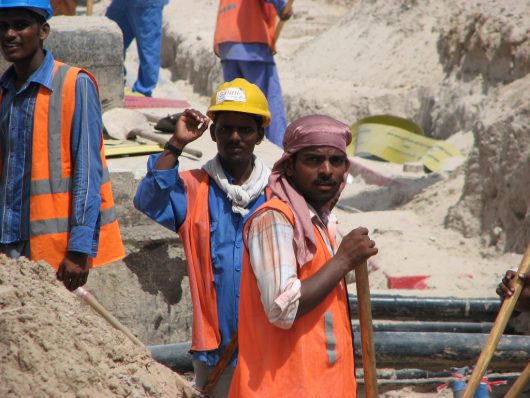
The UAE is a nation of immigrants who make up 88 percent of the population; 65 percent of these are migrant workers from South Asia and this community often faces harrowing violations of their human rights. The ‘kafala’ system requires workers to receive sponsorship from an employer before arriving, making them legally dependent and vulnerable to abuse.

On projects like Saadiyat Island, soon to be home to an NYU campus and a surrogate of the Guggenheim Museum, striking migrant workers have been deported, others have had their passports confiscated and wages have been withheld. In a 2009 report, Human Rights Watch urged the UAE government to reform the kafala system to prevent these abuses taking place. However, subsequent visits to Saadiyat revealed violations to have continued and any reforms put in place to have been inconsequential.

Human Rights Watch, under pressure from the UAE authorities, has to conduct their research and interviews discreetly. As a result, the extent of human rights violations is unclear and difficult to address effectively with any third-party organizations.

However, organizations such as the Tourist Development and Investment Company (TDIC) have taken steps to address the abuse. TDIC has introduced new labor guidelines for employers to prevent passport seizures and ensure fixed working hours. PricewaterhouseCoopers (PwC) acts as a compliance monitor.

Reforms to the kafala system that enable workers to change employers more easily have so far failed to be properly implemented. Under the auspices of the TDIC and the Abu Dhabi Executive Affairs Authority (EAA), human rights in the UAE and its situation for migrant workers could improve significantly.

– Jonathan Riddick

Photo: Flickr

August 20, 2017
https://borgenproject.org/wp-content/uploads/borgen-project-logo.svg 0 0 Kim Thelwell https://borgenproject.org/wp-content/uploads/borgen-project-logo.svg Kim Thelwell2017-08-20 07:30:022024-05-28 00:15:34Migrant Workers and Human Rights in the UAE
Global Poverty, Human Rights

The State of Human Rights in Jamaica

Human Rights in JamaicaIn the 2007 Human Development Index published by the United Nations Development Programme (UNDP), Jamaica ranked 101 of 177 countries – the second-lowest in the Caribbean, ahead of only Haiti. Since then, the nation’s rank has climbed to 94; however, human rights in Jamaica and national human development still face several obstacles that need to be addressed.

Poverty and public security are the primary human rights concerns in Jamaica. Gang violence and violent murders are rampant and affect a majority of the population, especially the poorest. Although there has been a slight decrease in gang activity in the last few years, gang violence still accounts for a majority of murders in Jamaica. Last year, the Acting Police Commissioner reported that 65 percent of murders were linked to gangs.

Police violence is also a major issue. The state’s answer to significant violent crime has largely been to respond with its own violence. Human rights activists in recent years have reported the prevalence of unlawful killings on behalf of the state police force on the order of – or complicit with – higher authorities. Since 2000, it is alleged that the Jamaican constabulary force has killed over 3,000 people. Although these killings have been decreasing since 2010, the numbers are still high. In 2016, there was an average of two police killings per week.

Beyond the killings themselves, international human rights watchdog organizations have claimed that police officers perpetuate an atmosphere of fear. The planting and tampering of evidence, along with the intimidation and terrorizing of witnesses, are commonplace.

Another major obstacle to improving human rights in Jamaica is the treatment of the LGBTQ community. Hate crimes directed at these individuals have been committed both by citizens and the police. Between 2009 and 2012, estimates show that over 200 attacks, including physical attacks, mob attacks and home invasions, were directed at LGBTQ members. More recently, the government has formally acknowledged the issue and has put in place initiatives, such as a division of the police focused on diversity, to help aid the problem.

The state of human rights in Jamaica over the past decade has been improving. Initiatives on behalf of the government and the support and direction of human rights organizations have attempted to systematically address the issues that plagued the Jamaican community, and have already made progress. However, there is still a lot of room for improvement and as long as Jamaica suffers from chronic poverty, human rights issues will always be present.

– Alan Garcia-Ramos

Photo: Flickr

August 19, 2017
https://borgenproject.org/wp-content/uploads/borgen-project-logo.svg 0 0 Kim Thelwell https://borgenproject.org/wp-content/uploads/borgen-project-logo.svg Kim Thelwell2017-08-19 07:30:562024-05-28 00:15:32The State of Human Rights in Jamaica
Global Poverty, Human Rights

Examining Tunisia’s Human Rights Record

Tunisia's Human Rights
In 2011, Tunisia was embroiled in revolution, eventually leading to the resignation of President Zine El Abidine Ben Ali and the formation of a new, free, republic. Although Tunisia’s new government may be free, there is no guarantee that it will have a stellar human rights record. Following the revolution, Tunisia’s human rights record has been imperfect, and its new government still has issues to work out.

According to Amnesty International’s annual report, the biggest threat to human rights in Tunisia is the current nationwide state of emergency, which has been in effect since November 2015. Through this state of emergency, the government military force has been granted an expansion of powers in order to deal with the threat of the Islamic State along Tunisia’s borders. Instead, the military has used its power to take away the human rights and freedom of Tunisian citizens. Tunisia’s Truth and Dignity Commission, which was created to address Tunisia’s human rights violations, reported that it has received reports of more than 62,000 human rights violations.

Among said human rights violations include arbitrary arrests, intimidation and harassment, discrimination and the banning of assembly and free speech. Since the start of the state of emergency, there have been thousands of arrests and house searches, often without a warrant. Accompanying these arrests is a sense of intimidation and harassment, where law enforcement and military officials are threatening people in the name of counter-terrorism. Tunisian citizens are stereotyped, men in long beards and women in religious clothing are explicitly monitored and treated harshly and their homes are searched. These unlawful searches and arrests go against key human rights, including the right to work and freedom of movement – further injuring Tunisia’s human rights record.

The Human Rights Watch notes that Tunisia has been trying to prevent torture and ill treatment towards detainees in their prisons, with the National Constituent Assembly creating a High Authority for the Prevention of Torture, which elected 16 members in March 2016. Using unannounced inspections, torture in prisons and detention sites can be reduced. However, the Tunisian government is still unsure of how to preserve the human rights of citizens in police custody as reports of ill treatment by judges and police officers rise.

Addressing these reports, the U.N. Committee on Economic, Social and Cultural Rights recommended, among other suggestions, that Tunisia should increase accountability amongst these police officers and judges by raising awareness of human rights. Thus, while the government continues to stabilize and search for ways to stem Tunisia’s human rights violations in the midst of the country’s ongoing state of emergency, there is hope that the treatment of its citizens will continue to improve.

– Rachael Blandau

Photo: Flickr

August 19, 2017
https://borgenproject.org/wp-content/uploads/borgen-project-logo.svg 0 0 Borgen Project https://borgenproject.org/wp-content/uploads/borgen-project-logo.svg Borgen Project2017-08-19 07:30:392020-06-16 09:37:21Examining Tunisia’s Human Rights Record
Human Rights

Human Rights Violations in Uganda

Human Rights Violations in UgandaUganda has undergone notoriously gruesome human rights violations. From the terror of the Lord’s Resistance Army to government discrimination against LGBTI groups, the human rights violations Ugandans have experienced have been treacherous. The recent election caused turmoil for Ugandans as many claim the process was neither impartial nor free as it should have been.

President Yoweri Museveni was elected for yet another five-year term in February 2016, putting him in power for at least the next 30 years. The election process was claimed to have been obstructed by removing the freedoms of expression, assembly and association of citizens. Violations of these freedoms were carried out by security forces.

Government officials and police repeatedly tried to keep journalists and media outlets out of commission by using physical force or by shutting down entire operations. For example, soldiers from the special forces stopped a local television station from covering some campaign meetings of the opposing candidate, Dr. Kizza Besigye from the Forum for Democratic Change (FDC). Furthermore, the Uganda Communications Commission blocked social media sites on election day for what they said was “national security reasons.” These violations prevented the flow of information and obstructed citizens’ rights to obtain valuable information.

The police repeatedly interrupted campaign rallies for Besigye by using force against protesters and even arresting Besigye himself, detaining him before releasing him with no charges laid. Police even opened fire on FDC supporters in Kampala, killing one and injuring many others. Throughout the election process, the police targeted FDC supporters and anyone associated with Besigye’s campaign.

Although non-governmental organizations (NGOs) are allowed in the country, they are not given an easy pass. The NGO Act, which went into effect in March of 2016, vaguely presents its policy, leaving room for interpretation as to how it can be applied. Several NGO offices were broken into last year and thieves took computers, internet servers, projectors and more. Although a committee was formed to investigate, no progress on the case has been made.

These human rights violations in Uganda should be a concern for the country, the continent of Africa, and the world. They showcase just how far people can go in mistreating those who disagree with or challenge them. Hopefully with time and continued help from NGOs, human rights violations can be significantly reduced in the country of Uganda.

– Emily Arnold

Photo: Flickr

August 19, 2017
https://borgenproject.org/wp-content/uploads/borgen-project-logo.svg 0 0 Kim Thelwell https://borgenproject.org/wp-content/uploads/borgen-project-logo.svg Kim Thelwell2017-08-19 01:30:052020-06-16 09:24:11Human Rights Violations in Uganda
Human Rights, Slavery

Biram Dah Abeid, the Man Fighting Slavery in Mauritania

Slavery in Mauritania
On an April afternoon in 2012, Biram Dah Abeid held up books of Islamic legal interpretations. A large crowd in front of him watched as he dropped the books into a large box and set them on fire. As the books disintegrated, a tiny part of the legacy of slavery in Mauritania seemed to turn to ash along with them.

The books that Biram Dah Abeid burned contained interpretations of Islamic law that justified slavery. In the North African country of Mauritania, an estimated four percent of the population is currently enslaved.

The origins of slavery in Mauritania are complex. Over 2,000 years ago, Arab slave traders began capturing and enslaving dark-skinned people in the region. Now, slaves in Mauritania are called Haratines. Their owners are light-skinned and are called White Moors.

Slavery in Mauritania was officially banned by the Mauritanian constitution in 1981, but the government made no effort to enforce this. Because large swaths of Mauritania are rural and spread out, many White Moors continued to own slaves. The government did virtually nothing to stop them. Finally, in 2007, Mauritania passed a law making owning slaves a criminal offense. However, as of 2017, only three slave owners have been prosecuted. One of the owners was let out months after his arrest. The other two were sentenced to only a year in prison.

Biram Dah Abeid is fighting against this. In 2008, he started an organization called the Initiative for the Resurgence of the Abolitionist Movement (IRA). The IRA rescues enslaved Mauritanians and engages in large, nonviolent protests to publicize their cause. But Abeid’s protest does not come without cost. In recent years, the Mauritanian government cracked down on IRA activists. After the book burning incident, the President called for Abeid’s execution. Abeid was eventually arrested and detained for months. Three years later, he was arrested again for simply being a member of the IRA. According to the government, it was an “unauthorized organization.” He spent nearly two years in prison before being released.

Being an abolitionist in Mauritania is difficult. Slavery is incredibly entrenched in Mauritanian culture. Most slaves have no concept of who they are, outside of being slaves. And, on top of that, forty-four percent of Mauritanians are impoverished. No matter how much their masters dehumanize them, slaves are hard-pressed to imagine better alternatives. So, for the IRA, ending slavery in Mauritania is not really about removing physical chains. It’s about constructing a new culture—one that doesn’t have slavery as a foundation.

International organizations are now taking note of the vital work the IRA and Biram Dah Abeid are doing. In 2013, Abeid received the U.N. Human Rights Prize. In 2016, he was awarded the Trafficking in Persons Report Heroes Awards.

Ending slavery in Mauritania will be a lengthy process. Changing the mindset of an entire nation does not happen overnight. But the voices of people like Biram Dah Abeid are impossible to drown out. Abeid’s vision is inescapably expansive—in 2019, he plans to run for the Mauritanian presidency. His message is clear: Mauritania needs to become the type of place where anyone can do anything, regardless of how dark their skin is.

– Adesuwa Agbonile

Photo: Flickr

August 18, 2017
https://borgenproject.org/wp-content/uploads/borgen-project-logo.svg 0 0 Borgen Project https://borgenproject.org/wp-content/uploads/borgen-project-logo.svg Borgen Project2017-08-18 07:30:402017-10-18 11:43:00Biram Dah Abeid, the Man Fighting Slavery in Mauritania
Education, Global Poverty, Human Rights

No Education for Canada’s Indigenous Population

Canada's Indigenous PopulationThroughout Canada’s history, the Indigenous peoples of the territories have faced extreme racism, colonialism, hatred and violence. Canada’s Indigenous population has been so negatively represented throughout society, and resources that others take as basic rights have been unavailable to Indigenous peoples.

According to the Conference Board of Canada, Indigenous peoples of Canada’s territories fall far behind the national average on several measures of equity and social cohesion. Indicators of their low averages include poverty, crime rates and income distribution.

The problems that Canada’s indigenous population faces stem from the lack of proper education offered to these individuals. According to Markets Insider, improvements need to be made in education accessibility as well as access to healthcare in order for social outcomes to improve for Indigenous peoples.

Because of the territories’ isolated geographic location, education and social service attainment for Indigenous people are very low, and infrastructure gaps create low social outcomes.

Canadian leaders are working to improve educational outcomes and access to healthcare by implementing policies that protect and support Canada’s Indigenous population. Cultural measures are also being taken to improve emotional, social and material support in areas that are more secluded.

People are pushing to improve these conditions for Canada’s Indigenous population at the educational level, including Maggie MacDonnell, winner of the Global Teacher Prize in March 2017.

MacDonnell grew up in Nova Scotia and witnessed racism and hatred toward Indigenous people throughout her childhood. By viewing injustice toward Indigenous people at such a young age, MacDonnell made it her goal to work in support of her Indigenous students at Ikusik School located in an Inuit village in Northern Quebec.

Because Indigenous peoples have been oppressed for much of Canada’s history, it is important for people like MacDonnell to stand up for their right to a quality education. Education systems like that of Ikusik School are a great benefit to improving the future of Canada’s Indigenous population.

Prime Minister of Canada Justin Trudeau acknowledged MacDonnell’s work and the necessity to improve education for Indigenous students. “As a society, we must acknowledge past mistakes,” Trudeau remarked as he highlighted the victims of Indigenous oppression at Canada 150—the 150th anniversary of the country.

Without proper education, Canada’s Indigenous population will be unable to meet the national average in areas including equity and social cohesion. Breaking away from the habitual oppression that has been inflicted on Canadian Indigenous peoples is a tough task, but with the efforts of Trudeau, Canadian leaders and passionate teachers like MacDonnell, it is becoming more feasible for the future.

– Kassidy

Photo: Google

August 18, 2017
https://borgenproject.org/wp-content/uploads/borgen-project-logo.svg 0 0 Borgen Project https://borgenproject.org/wp-content/uploads/borgen-project-logo.svg Borgen Project2017-08-18 01:30:262020-06-12 09:55:44No Education for Canada’s Indigenous Population
Government, Human Rights

Human Rights in Norway

Human Rights in Norway

Norway is a small Scandinavian country with a population of approximately 4.9 million. It is a parliamentary democracy and constitutional monarchy, and a range of political parties operate freely there.

Recent reports on human rights in Norway show it is one of the best countries for political, civil and individual rights except a few minor, worrying trends in immigration and the rights of religious minorities. “Norway has ranked first on the UN Development Program’s Human Development Index for 12 of the last 15 years, and it consistently tops international comparisons in such areas as democracy, civil and political rights, and freedom of expression and the press.”

Below is a breakdown of characteristic details of human rights in Norway in the past couple of years.

Political pluralism: Norway’s Constitution promotes political pluralism and guarantees it in practice. All political parties from a range of ideological backgrounds participate freely in elections. The country’s political freedom is such that the indigenous Sami population, “the only group in Scandinavia recognized as an indigenous people by international conventions,” has its own legislature, the Sameting, which works to protect the language and political, cultural and economic rights of the group.

Press freedom: Freedom of the press is constitutionally guaranteed and protected in public life. The government subsidizes the majority of newspapers, although private and partisan, in an effort to promote political pluralism and democracy. Citizens’ digital rights are respected. Internet access is free and unimpeded. There is respect for academic freedom, and private discussions are free and vibrant.

The freedom of belief: The freedom of religion is constitutionally guaranteed and respected in practice. Norway is a secular country where the church and the state were separated by a 2012 constitutional amendment. All religious beliefs enjoy freedom, but lately, there is seemingly a rise in anti-Semitic and anti-Muslim violence and harassment.

In 2015, a new special police unit in Oslo – founded to strengthen efforts against hate crimes – reviewed 143 crimes, roughly double the number reviewed in 2014. “In June of this year, Norway became the first Nordic country to propose a ban on the burqa -full face and body covering- in kindergartens, schools and universities.”

Although according to the Huffington Post “very very few” of three percent of Norway’s Muslim population, or roughly 150,000 individuals, wear a niqab – the veil that covers the face, showing only the eyes – it still is a matter of civilian liberty and has to be dealt with accordingly. In August 2015, the U.N. Committee on the Elimination of Racial Discrimination criticized the country for lack of a comprehensive approach to halt these crimes, as it scars the overall picture of human rights in Norway.

Associational/organizational rights: The Norwegian constitution guarantees the rights to assembly and protest. In 2015, following a terrorist attack on a synagogue, hundreds of Norwegians made a “ring of peace” around an Oslo Synagogue to show solidarity with the Jewish community. The right to assembly and strike is guaranteed to labor organizations/unions and workers except for senior civil servants and the military.

Immigration: Like many other European countries, Norway has seen a surge in the immigration in recent years as it has increased fivefold since the 1970s. “In 2015, Norway received asylum applications from 31,000 people, primarily from Syria, Iraq, and Afghanistan; this was a significant increase from the 11,000 applications received in 2014.” The country is witnessing the rise of anti-immigration right-wing politics. Consequently, the controversial practice of refoulment, which the international law forbids, continued in 2015, affecting more than 1,000 people.

Prisoners’ rights: Norway is known globally for its radical humaneness toward prisoners. The incarceration rate is among the lowest in the world at 75 persons per 100,000. In the U.S., it is 10 times higher. There is no death penalty nor lifetime imprisonment, and the maximum sentence for most crimes is 21 years. Norway’s recidivism rate of 20 percent is one of the lowest in the world. However, the country’s capacity has not been sufficient with more than 1,000 prisoners waiting to serve their sentences in recent years.

Individual rights: Norway is also one of the best countries for personal autonomy. Citizens from the European Union do not need a permit to work in Norway. The Gender Equality Act provides equal rights for both men and women. Conscription in armed forces is gender-neutral according to a law that took effect in 2015. In 2013, women won 40 percent of seats in parliament. A gender-neutral marriage act passed in 2009 granted Norwegian same-sex couples identical rights as opposite-sex couples, including in adoption and assisted pregnancies.

Given its credible record in the past, it is very likely that the strong presence of NGOs and civil society networks with the cooperation of government, will strengthen efforts to redress discriminatory practices because they are a threat to pluralism and the positive image of human rights in Norway.

– Aslam Kakar

Photo: Flickr

August 17, 2017
https://borgenproject.org/wp-content/uploads/borgen-project-logo.svg 0 0 Borgen Project https://borgenproject.org/wp-content/uploads/borgen-project-logo.svg Borgen Project2017-08-17 07:30:502024-05-28 00:15:50Human Rights in Norway
Page 23 of 45«‹2122232425›»

Get Smarter

  • Global Poverty 101
  • Global Poverty… The Good News
  • Global Poverty & U.S. Jobs
  • Global Poverty and National Security
  • Innovative Solutions to Poverty
  • Global Poverty & Aid FAQ’s
Search Search

Take Action

  • Call Congress
  • Email Congress
  • Donate
  • 30 Ways to Help
  • Volunteer Ops
  • Internships
  • Courses & Certificates
  • The Podcast
Borgen Project

“The Borgen Project is an incredible nonprofit organization that is addressing poverty and hunger and working towards ending them.”

-The Huffington Post

Inside The Borgen Project

  • Contact
  • About
  • Financials
  • President
  • Board of Directors
  • Board of Advisors

International Links

  • UK Email Parliament
  • UK Donate
  • Canada Email Parliament

Get Smarter

  • Global Poverty 101
  • Global Poverty… The Good News
  • Global Poverty & U.S. Jobs
  • Global Poverty and National Security
  • Innovative Solutions to Poverty
  • Global Poverty & Aid FAQ’s

Ways to Help

  • Call Congress
  • Email Congress
  • Donate
  • 30 Ways to Help
  • Volunteer Ops
  • Internships
  • Courses & Certificates
  • The Podcast
Scroll to top Scroll to top Scroll to top