• Link to X
  • Link to Facebook
  • Link to Instagram
  • Link to TikTok
  • Link to Youtube
  • About
    • About Us
      • President
      • Board of Directors
      • Board of Advisors
      • Financials
      • Our Methodology
      • Success Tracker
      • Contact
  • Act Now
    • 30 Ways to Help
      • Email Congress
      • Call Congress
      • Volunteer
      • Courses & Certificates
      • Be a Donor
    • Internships
      • In-Office Internships
      • Remote Internships
    • Legislation
      • Politics 101
  • The Blog
  • The Podcast
  • Magazine
  • Donate
  • Click to open the search input field Click to open the search input field Search
  • Menu Menu

Archive for category: Food & Hunger

Information and stories on food.

Children, Food & Hunger, Global Poverty

Social Safety Nets Save Malnourished Children in Togo

Children_in_Togo
A large number of children in Nadjote, a small village located 18 km from the city of Dapaong, suffer from serious malnutrition. In order to combat this suffering, the Togolese government has established a safety net program aiming to financially help the most vulnerable households.

Specifically, the government set up a cash transfer program to provide financial assistance to households with malnutrition-suffering children in Togo.

This program is intended to provide a brighter future for children from the most disadvantaged families. Moreover, this program encourages households to obtain birth certificates for their children, offer them with education and health care.

Abna Kolani is one of the beneficiaries. She gave birth to seven children, but three of them died of malnutrition. As a beneficiary, during the past 12 months, she has received monthly financial assistance of 5,000 CFAF—around $9—for the children’s feeding and education.

According to the World Bank article, Abna noted that “With the money I receive each month to provide my youngest child with better nutrition, I can provide healthier food for all my children. I see a big change in their physical condition— their health and hygiene conditions are much better than before.”

“When they are sick, I can take them to the health center to receive care. In addition, the program has allowed me to send my eldest child to school and now all four have birth certificates.” Abna continued.

The project was launched by the Togolese government in 2013 and supported by the World Bank and the Japanese government.

Cooperating with the United Nations International Children’s Emergency Fund (UNICEF), the program is aimed for parents with children between the ages of 0 and 24 months in the Kara and Savanes regions where malnutrition rates are extremely high.

Nanifei Lardja is another mother living in Nadjote mentioned in the World Bank article. Naniferi has five children, and she says, “I buy corn for 2,000 francs, soap for 1,000 francs, and small fish for 1,000 francs. I have my small plot for the vegetables I need and put aside the remaining 1,000 francs for other possible expenses.”

The program gives her not only material support but also confidence for a better future with her children.

“We are very pleased to note that the support activities organized, in particular the educational talks on the rights of children, nutrition, health and basic family practices have produced largely positive effects,” said Joachim Boko, a Social Protection Specialist at the World Bank.

According to Pounpouni Koumaï Tchadarou, the Regional Director for Social Action in the Savanes region and Program Coordinator, this program offers much more than mere financial assistance. Besides the 5,000 francs supplement, this program also provides a range of services, such as reminders of regular prenatal care and children’s register.

“We do everything to ensure that school-age children attend school. We also do home visits to heighten the awareness of the beneficiaries regarding the role played by good hygiene in improving the health of their children,” said Tchadarou.

“One day, you will come back here and see that the children you have helped have become teachers, nurses, and doctors,” said Yom Kouloukitibe, one of the 14,016 recipients to date of this financial assistance.

– Shengyu Wang

Sources: World Bank 1, UNICEF, World Bank 2
Photo: Flickr

October 10, 2015
https://borgenproject.org/wp-content/uploads/borgen-project-logo.svg 0 0 Borgen Project https://borgenproject.org/wp-content/uploads/borgen-project-logo.svg Borgen Project2015-10-10 08:50:422024-05-27 09:28:05Social Safety Nets Save Malnourished Children in Togo
Food & Hunger, Foreign Aid, Global Poverty

Food for Peace, the Past, Present and Future

Food for Peace, the Past, Present and Future
In 2013, NPR reported that “a political war” was brewing over the Food For Peace Act.

Food for Peace, which has been the United States’ primary program for overseas food assistance, is estimated to have benefited 3 billion people in 150 countries.

The program began as a way for the United States to put its surplus foodstuffs to good use across the globe, and has since modernized into a competitive process in which the American government purchases commodities from US farmers (through a competitive process) and then allocates them to needy populations worldwide.

Or at least, most of those commodities are redistributed. There is a portion of that food that is deemed “non-emergency” and placed into the hands of non-profits that are able to sell it for profit. Being non-profit companies, these profits are intended to then be funneled into development initiatives.

In 2013, this tactic of redistribution was the subject of hot debate. Many critics, including Oxfam America told NPR that it was “a horribly ineffective way to pay for local development projects” and that “according to some calculations, at least a third of the money is wasted.”

Fast forward 2 years later and the war seems to be over. Those who called for reforms, like Oxfam America, were victorious. Food for Peace has recently undergone a fine-print makeover intended to streamline the United States’ role as a pipeline that brings nutrition to starving populations.

Senators Bob Corker (R-Tenn) and Chris Coons (D-Del.), members of the Senate Foreign Relations Committee, are leading the charge:

“With limited aid available it is our responsibility to ensure American resources are used in the most effective manner possible,” said Senator Corker. “These necessary reforms will allow us to better promote stability around the world by delivering lifesaving food to those in need more quickly and at a lower cost.”

Senator Coons added that “Our current system for acquiring and distributing food is inefficient and often hurts the very communities it is trying to help.”

So, what will these reforms look like?Food_for_peace

They begin with a more cost-effective method of food procurement. This means that while the current program requires that 100 percent of food be produced in the United States, the reforms would allow US produced commodities as well as regionally produced ones (from places such as Latin America) to be considered for the program.

It will also expand the definition of “commodities” to include vouchers and even cash transfers, which have seen remarkable success in poverty reduction in Randomized Control Trials in Africa.

The reforms will also reduce the number of goods that must be shipped on American-flagged vessels (it is 50 percent currently) which will cut shipping costs an estimated $50 million annually.

For those concerned over how this will affect American shipping interests, a press release has estimated that this would have no tangible effect on the US shipping sector, as only .86 percent of US exports are channeled through Food for Peace.

Finally, the Food for Peace Reforms will deal a fatal blow to the “monetization” aspect—or the portion of food that is given directly to nonprofits–by eliminating this aspect of the program completely.

This comes on the recommendation of the Government Affair’s Office (GAO) who launched an investigation into “monetization” in regards to Food for Peace in 2011. The GAO found that monetization is “an inherently inefficient way to fund development projects and can cause adverse market impacts in developing countries.”

This is at odds with the 2013 claim that it is this program that ensures the continuance of aid assistance regardless of who sits in the oval office.

“If we remove the conditions about how the money should be spent, that money may never be available for those crises, at a key time when we need it,” said Jeffrey Grieco, chief of public and international affairs at International Relief and Development (IRD).

Regardless of the attitude towards monetization, which is likely to spark yet another war in Congress to match the 2013 conflict, these reforms are estimated to release $440 million in funds that could be used to feed 12 million more people. The gains of monetization would have to be at least that strong to hinder this reform bill’s progress through Washington.

– Emma Betuel

Sources: Senate, GAO, NPR
Photo: Google Images, Flickr

October 7, 2015
https://borgenproject.org/wp-content/uploads/borgen-project-logo.svg 0 0 Borgen Project https://borgenproject.org/wp-content/uploads/borgen-project-logo.svg Borgen Project2015-10-07 01:30:402020-06-27 06:49:59Food for Peace, the Past, Present and Future
Development, Education, Food & Hunger, Global Poverty, Health

Improving Nutrition Boosts IQs in Developing World

As Nutrition Improves, Developing Countries Get Smarter
To say poverty is a complex issue is an understatement. The conditions that lead to and perpetuate poverty occur across levels, making it different for individuals, organizations and governments to address. Targeting initiatives toward healthy individual development is imperative to reduce poverty in the long-term.

Poverty, at its core, is a stressor. An inability to gain access to proper nutrition, quality medical care and education greatly affect the well-being of individuals and families.

For children, the effects of extreme poverty are magnified, which has implications for brain development, psychological well-being and ability to handle conflict. Iodine deficiency, which is common in developing countries, can lead to neural tube defects during pregnancy, especially if the fetus is female.

Iodine deficiency is the most common preventable cause of mental retardation in children; the CDC estimates that 18 million children worldwide are born disabled as a result of the deficiency. Currently, two billion people are at risk for iodine deficiency.

Iodine, in addition to other micronutrients, is critical for healthy brain development and functioning. Initiatives to address micronutrient deficiency work to not only reduce world hunger but also ensure that children can have healthy brain development.

Ensuring healthy brain development is not just preventing deficiencies, it gives children increased potential to develop abstract thinking skills. As noted by James Flynn, a psychologist who researches global patterns of IQ scores, intelligence increases as societies modernize.

Through modernization, individuals are more likely to have access to education, have more cognitively demanding work and utilize logic more often in their daily lives. In turn, critical thinking becomes more necessary and there is a need for individuals to have strong working memory and abstract thinking skills.

Flynn has also documented the “Flynn Effect”: as societies develop, the average IQ score increases. This is happening rapidly in developing countries; Kenya, for example, has seen an eleven point increase in IQ scores over a fourteen-year period. In contrast, the U.S. has seen an eighteen point increase over a 55-year period.

While it is difficult to untangle all of the factors contributing to developing countries’ increasing IQ scores, access to education and better nutrition are most likely strong influences on this gain. These countries are developing and modernizing simultaneously, which accelerates the increase in intelligence scores.

Flynn also argues that, in developed countries, the trend towards smaller families have exposed children to more adult speech, which further improves a child’s intelligence. Perhaps it is arguable, too, that as impoverished communities gain access to medical care and family planning and the birth rate reduces, these children reap similar benefits.

As organizations continue to implement programs fighting world hunger and reducing micronutrient deficiencies, this gain in IQ scores for developing countries is an important reminder that at its core, development work is an investment.

Investing in nutrition for individuals in poverty can bring better brain health, which leads to improved academic performance and increased resiliency, thus empowering people both now and in the future.

– Priscilla McCelvey

Sources: CDC, Vintage Books, Scientific American, UNICEF
Photo: Flickr

October 5, 2015
https://borgenproject.org/wp-content/uploads/borgen-project-logo.svg 0 0 Borgen Project https://borgenproject.org/wp-content/uploads/borgen-project-logo.svg Borgen Project2015-10-05 06:22:132024-12-13 18:04:58Improving Nutrition Boosts IQs in Developing World
Food & Hunger, Global Poverty, Health

Folate-Rich Rice for Malnourishment

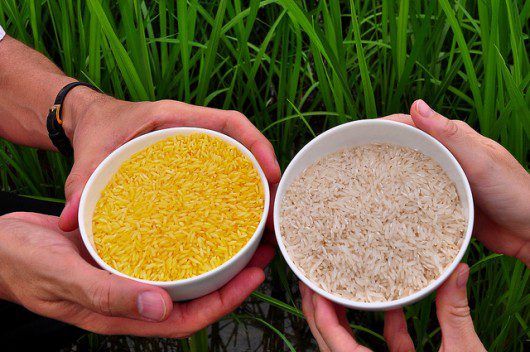
Golden Rice grain compared to white rice
Recently, scientists at the Ghent University have successfully engineered a new folate-rich rice strain. The most notable achievement of this experiment has been the stabilization of the bio-engineered nutrition richness.

Biofortification is a relatively new venture into the field of agricultural biotechnology. It involves modifying the genetic makeup of an agricultural plant to yield a more nutrient-rich product. The results of biofortification of plants have been tested for nutritional value and bio-availability for the consumers, with promising results.

In addition to increasing the nutrition value of food products, scientists are also focusing on making the products more sustainable. New research in this area is committed to not only increasing the dietary value of the crops, but also providing for practical answers for food shortage problems globally. For instance, crops that are more resistant to droughts and natural adversities are being manufactured. Food staples such as grains are being engineered to comprise nutrients from more expensive and inaccessible vegetables.

A significant issue in the provision of sufficient food for the whole world is the problem of food wastage and storage. The world today produces more food per person than ever before; however, food insecurity continues to be an issue with the improper handling and storage of food.

Crops such as rice, wheat and other grains are generally easier to store than most foodstuffs. However, the long-term storage of food deprives them of much of their nutritional value. Micronutrients such as vitamins and minerals are likely to be degraded as a result of long-term storage, as well as the methods of storage.

Folate, or Vitamin B9 as it is popularly known, is one such nutrient. It is found in abundance in leafy green vegetables such as spinach; such vegetables are, however, difficult to store for extended periods of time. Folate is a water-soluble vitamin; consequently, it cannot be stored in the body, and needs to be replenished constantly. Folate deficiency can lead to abnormally large blood cells, and ultimately anemia, which is particularly dangerous for pregnant women.

To tackle this problem, the researchers at Ghent University took a two-pronged approach: making the rice folate-rich, as well as stabilizing the folate to ensure its availability after long periods of storage. They used a folate-binding protein- found originally in animals- to stabilize the folate molecules. The resulting molecule was found to be more resistant to degradation after storage.

The rice strain manufactured has not been introduced commercially as of yet; the public use of the strain remains subject to testing and approval by appropriate authorities. This research is, nevertheless, an innovative step in the quest for engineering more nutritious and healthier crops for ending hunger and malnourishment.

– Atifah Safi

Sources: Ugent, NIH
Photo: cbnnews

October 2, 2015
https://borgenproject.org/wp-content/uploads/borgen-project-logo.svg 0 0 Borgen Project https://borgenproject.org/wp-content/uploads/borgen-project-logo.svg Borgen Project2015-10-02 02:00:352020-06-27 09:33:51Folate-Rich Rice for Malnourishment
Activism, Food & Hunger, Global Poverty

Darden Harvest Aims to Put an End to Hunger


Darden Restaurants, owner of restaurants like Olive Garden and Red Lobster, believes people are their most valuable resource. That being said, they have dedicated much of their time and money to helping end world hunger and poverty.

Their program, Darden Harvest, coordinates food donations to food banks and other charitable organizations across the country.

How it works:
When leftover foods from restaurants are not served to guests, it is packaged, frozen and stored in the restaurant. Nonprofit organizations travel to these restaurants weekly to pick up the food and then donate it to food banks.

The food is then served to those in need in the community. Throughout this process, the quality and safety of the food is ensured by Darden Restaurants’ employees.

What is donated?
Darden Restaurants focuses on donating foods that have a positive impact on health. Twenty-eight percent of the foods donated are vegetables, 27 percent are proteins, 19 percent are soups, 18 percent are pastas and breads, and eight percent are other food items and desserts.

Community Impact:
Since it started in 2003, Darden Harvest has donated more than six million pounds of surplus food to families in need, which is the equivalent of 89 million meals served. Nearly 49 million Americans suffer from hunger, with over 165 million dollars’ worth of food being thrown into landfills each year.

Every year, Darden Harvest observes World Food Day by positively impacting the lives of underprivileged people through food donations. In their 2013 fiscal year, Darden Restaurants donated over 11 million pounds of food to hunger-ridden families.

Darden Restaurants’ team of over 200,000 members has contributed to ending hunger. Just last month, Darden Restaurants created a program to help people feed their families during the busy school semester with their “Buy one, take one” program, which allows families to purchase one meal and take another one home to serve on another night.

– Julia Hettiger

Sources: CNN, Darden, Fool
Photo: Examiner

October 1, 2015
https://borgenproject.org/wp-content/uploads/borgen-project-logo.svg 0 0 Borgen Project https://borgenproject.org/wp-content/uploads/borgen-project-logo.svg Borgen Project2015-10-01 10:52:052024-05-27 09:28:00Darden Harvest Aims to Put an End to Hunger
Food & Hunger, Food Security, Global Poverty, Hunger

World Vision: Let’s Make the World Hunger Free

Hunger_Free

World Vision has launched a new initiative to raise funds for a hunger free world. Through the #hungerfree movement, people can “double up” the cost of their meal and donate the money to fight global hunger.

Presently, more than 795 million people are food insecure, usually as a product of poverty. Food insecurity can mean not knowing where one’s next meal is coming from, not having access to foods with necessary nutrients or not being able to intake enough calories to maintain health.

For individuals facing food insecurity, it affects all aspect of daily life. Food insecurity affects the ability to focus in a school or workplace environment, have healthy physical and neural development and functioning. For mothers, pregnant women and children, these effects are compounded.

Fighting food insecurity and world hunger is a critical component to fighting global poverty. By ensuring people have enough to eat, they can have more energy and ability to be healthy, productive individuals, citizens and communities.

The mid-September launch of #hungerfree by World Vision is timed well for World Food Day 2015 on October 16. The #hungerfree program targets people in Kenya and South Sudan, countries whose food production is dependent on subsistence farming.

Furthermore, the prevalence of hunger in Kenya and South Sudan is also exacerbated by the disproportionate amount of unemployed young people, who are often displaced by conflict and/or climatic shocks.

The #hungerfree initiative works to promote agricultural development in order to implement technologies and provide support to increase food production. By promoting sustainable, long-term development, World Vision hopes to reduce the amount of food aid sent to combat hunger in Kenya and South Sudan and create circumstances that empower communities.

To support #hungerfree, all individuals and groups have to do is “double up” the cost of their meal. The extra funds would be donated to #hungerfree. So, if a meal costs $10, an individual would match the cost of their meal as a donation to World Vision.

The program runs until World Food Day 2015 on October 16. #hungerfree is being run through a partnership between World Vision and the Misfit Foundation, which works to promote donor participation via social media and technology. Currently, World Vision sends aid to 8 million people in 35 different countries annually.

– Priscilla McCelvey

Sources: Hunger Free, World Vision
Photo:  World Vision


September 30, 2015
https://borgenproject.org/wp-content/uploads/borgen-project-logo.svg 0 0 Borgen Project https://borgenproject.org/wp-content/uploads/borgen-project-logo.svg Borgen Project2015-09-30 08:12:442020-06-29 11:54:51World Vision: Let’s Make the World Hunger Free
Food & Hunger, Global Poverty

Fighting for Yemeni Children: More Aid Needed

Yemen_children
The civil war in Yemen has led to the deaths and injuries of over 1,000 children, and 4,300 total deaths, according to Save The Children. The crisis is worsening as the number of recruits to join the fighting has increased to 377 this year from 156 last year, according to Children Under Threat.

Just as concerning is the inadequate amount of humanitarian aid that is being sent to the country. Only 18 percent of the funding needed to address immediate needs has been received.

Stephen O’Brien, UN under-secretary-general for humanitarian affairs had to persuade the UN Security Council to increase aid. O’Brien saw first-hand that 4 out of 5 Yemenis need aid, while 1.5 million are internally displaced.

According to the World Food Program about 13 million, or half of the population is going hungry and 6 million face starvation.

The conflict is preventing the importation of food and other aid. The conflict has also led to the doubling of gas prices, a resource needed for cooking.

On top of the malnutrition among 2 million people, over 2.5 million Yemeni children under age 15 are at risk of contracting measles, which would be 1 million more than 2014.

The months of ongoing conflict is between Houthi rebels, backed by Iran, and forces loyal to exiled government, backed by Saudi Arabia. O’Brien has called for the international community to get the opposing parties to negotiate.

– Paula Acevedo

Sources: ABC, Thomson Reuters Foundation
Photo: Huffington Post

September 30, 2015
https://borgenproject.org/wp-content/uploads/borgen-project-logo.svg 0 0 Borgen Project https://borgenproject.org/wp-content/uploads/borgen-project-logo.svg Borgen Project2015-09-30 00:40:082024-05-27 09:28:06Fighting for Yemeni Children: More Aid Needed
Children, Food & Hunger, Global Poverty, Health, Women & Children

Destigmatization of Breastfeeding in Urban India

Destigmatization of Breastfeeding in Urban India
World Breastfeeding Week is celebrated internationally every year from August 1-7th. Each year, there are various events and activities intended to educate about the benefits and encourage the practice. The theme this year was ‘Women and work – Let’s make it work.’ This year, added emphasis was placed on advocating for widespread maternity leave and other accommodations for working mothers.

Many organizations such as UNICEF, World Health Organization (WHO), and the Breastfeeding Promotion Network of India (BPNI) have worked both independently and jointly with the Indian government to provide information and spread awareness throughout the country. The breastfeeding rates are higher in the rural Northern states than in the urban South.

UNICEF Nutrition Specialist, Gayatri Singh states, “The government of India has laws, policies and programs to protect, promote, and support breastfeeding. UNICEF supports national and state governments in the development and implementation of infant and young child feeding policies and plans for promoting optimal breastfeeding.”

Singh goes on to say, “Communication and advocacy activities on breastfeeding are also a key component of UNICEF’s support. We also support governments to design strategies for social and behavior change communication and in the implementation of the strategies through multiple communication channels.”

In an effort to promote breastfeeding, the Indian government enacted the Infant Milk Substitute (IMS) Amendment Act in 2003 which prohibits any form of advertising claiming newborn formula as an equivalent option.

“In India, between 2006 and 2013, there has been an improvement in the breastfeeding rates. The latest data shows that 44.6% of children are put to breastfeeding within one hour of birth and 64.9% of children under six months of age are exclusively breastfed,” states Singh. He goes on to add that while knowledge of health benefits appear to be even higher, there are societal factors hindering the practice.

Dalvinder Kaur, a public relations specialist, states, “A lot of people, while thinking of breasts, automatically think of sex, as if that’s their primary reason for existence. I feel that it is pretty much the heart of the matter. Women’s breasts are often defined as sex objects–and nothing more. And since sex is basically a taboo in the public realm, breastfeeding ends up being perceived as some sort of indecent, out-of-bounds behavior.”

Dhanya Ranjit, a software engineer and mother speaks on the stigma attached to breastfeeding, “Women find it difficult to breastfeed and more so, to nurse in public because of the lack of support from any quarter. They also don’t see it happening around them. While I was very hesitant to breastfeed my older child in front of others but the encouragement and exposure to information through the Facebook support groups made me realize that it is as natural as an adult eating food in public.”

As is the case with many social movements, the internet can be utilized very effectively to raise awareness and garner support. “Big Latch On” is an international gathering that occurs in many cities during World Breastfeeding Week and event calls for mothers to join together publicly and breastfeed together. Through a social media campaign, a “Big Latch On” event was held this past August 1st in Hyderabad, Telangana, India. The organization started in New Zealand but has spread to many countries around the world.

Recent attempts at normalization in mainstream media have begun to manifest themselves as well. Indian cinema has begun to prominently display breastfeeding such as in the recent blockbuster movie Baahubali. The highly anticipated film cost $40 million and is the most expensive movie in Indian history. Whether purposeful or not, the display of breastfeeding in such a popular film shows marked progress towards shifting attitudes of the viewers.

– The Borgen Project

Sources: India Times, Jantaka Reporter, IBN Live
Photo: Flickr

September 29, 2015
https://borgenproject.org/wp-content/uploads/borgen-project-logo.svg 0 0 Borgen Project https://borgenproject.org/wp-content/uploads/borgen-project-logo.svg Borgen Project2015-09-29 03:33:262024-12-13 18:04:57Destigmatization of Breastfeeding in Urban India
Food & Hunger, Global Poverty, Health

Reducing Food Loss, Waste and Meat Consumption Could End World Hunger by 2030


The United Nations has called for the end of world hunger by 2030 in its Sustainable Development Goals (SDGs). In Goal 2, of 17, the UN outlines the need for the promotion of sustainable agriculture that will improve food security and nutrition while protecting the ecosystem and fighting climate change. Although a tall order, the United Nations Food and Agriculture Organization (FAO) along with the Austrian think tank, International Institute for Applied Systems Analysis, believes that the goal is attainable.

“I don’t think it’s all that ambitious to eliminate hunger,” said Jomo Sundaram, assistant director-general of the UN’s Food and Agriculture Organisation (FAO). He told Reuters he attributes his optimism to rising incomes in much of the world, improvements in the transportation of food, and new technologies that are keeping yields of many key crops on an upward trend.

But in order to achieve the goal of eliminating world hunger, food waste and the inefficiencies of the livestock industry need to be addressed.

Despite the fact that there is currently enough food produced globally to end world hunger, much loss and waste occur postharvest. According to the World Resources Institute (WRI), about 24 percent of all calories currently produced for human consumption are either lost or wasted.

The WRI reports that by reducing postharvest losses there will be more food available to farmers and communities, making food more affordable and accessible to the poor and food insecure. This can be done, the group states, through attainable solutions for developing nations such as pest-resistant packaging and cooling-cellar storage.

Changing dietary habits is another important solution to ending global hunger, particularly shifting from raising cattle as a source of protein to growing fruit, grain, and vegetables. According to the FAO, the amount of human-edible protein that goes into raising livestock is higher than the human-edible protein yielded from livestock. The group estimates that 26 percent of the world’s land that is being used for livestock grazing could produce better and more nutritionally valuable yields if converted to growing plant-based food for human consumption.

In addition to increasing the yield of protein-rich crops, reducing the number of grazing livestock, particularly cows, will also lower annual greenhouse gas emissions. According to the FAO, “Livestock contributes both directly and indirectly to climate change through the emissions of greenhouse gases such as carbon dioxide, methane and nitrous oxide.” The FAO estimates that 18 percent of global greenhouse gas emissions come from livestock.

By implementing better waste prevention systems and simply eating less meat from grazing animals, the fight against global food insecurity could indeed be attainable.

– Claire Colby

Sources: Food and Agriculture Organization 1, Food and Agriculture Organization 2, Huffpost Impact, The Physics Factbook, The World Bank, The World Factbook 1, The World Factbook 2, The World Factbook 3, World Resources Institute
Photo: fao

September 29, 2015
https://borgenproject.org/wp-content/uploads/borgen-project-logo.svg 0 0 Borgen Project https://borgenproject.org/wp-content/uploads/borgen-project-logo.svg Borgen Project2015-09-29 03:14:442024-05-27 09:27:58Reducing Food Loss, Waste and Meat Consumption Could End World Hunger by 2030
Food & Hunger, Food Security, Global Poverty

Partners in Food Solutions

Partners in Food Solutions
One of the most common topics that arise when discussing world hunger and food insecurity is that there are actually more than enough resources to feed all of the people of the world.

The problem isn’t that there is not enough food for everyone, but rather that there is not an efficient way of distributing it. Or, oftentimes, on-location farms do not have the resources to grow enough food for the people in the area who need it.

Partners in Food Solutions (PFS) is a nonprofit organization that works to connect big food companies (such as General Mills, Cargill, Royal DSM and Bühler) with smaller food processors in the developing world to reduce food insecurity.

These large, experienced companies are able to provide small and growing businesses (SGBs) with information on how to increase productivity, improve quality and create all-around safer and more nutrient-rich food for surrounding populations.

In addition, PFS and its partners also help African food companies to develop business and finance skills and make areas such as distribution and packaging as efficient as possible. By supplying technological resources and training, there can be a consistent and reliable sharing of knowledge to help companies keep growing.

Jeff Dykstra, the CEO of PFS, says that “food insecurity in Africa has been often addressed in a reactionary way, and the opportunity that’s there now is to address it in a proactive way.”

At its heart, the organization just wants to create a more efficient and valuable food chain. One of its strengths is that it recognizes the importance of partnerships.

PFS is funded by corporations and private donors and also supported by a devoted base of volunteers. USAID TechnoServe is a PFS partner involved with implementing programs and strategies on the ground in Africa. So, while PFS manages volunteers and designs programs, Technoserve implements the relationships with SGBs.

By working with TechnoServe, PFS is able to evaluate which food companies are the most in need of help and look to be the most successful. The partnership has grown to assist over 700 SGBs in Ethiopia, Kenya, Malawi, Tanzania and Zambia.

Almost 829,000 local farm holders were impacted through projects that are designed to bring expertise to small African food companies. Kykstra said that the money is generating a return into local economies at double the rate of taxpayer investment.

These partnerships are valuable and effective in the fight against global food insecurity. As President Obama himself said on a July 28 visit to the Faffa Food Share Company in Ethiopia, “Having strong corporate partners alongside local businesses can really make a big difference.”

Faffa Food Share is a client of PFS, and also the primary supplier of food for children over 6 months old in the country.

Although the chain of technologies, innovations and partnerships involved in the PFS organization is complicated, the core idea is simple.

The organization’s goal is to help small farms bring their crops to local marketplaces, making them sustainable contributors to their economies, cutting back on unnecessary food transportation expenses and helping entire countries to become self-sufficient when it comes to food.

All of this can be done by sharing knowledge and resources already available to the first world. Stephen Tanda, the managing board member of Royal DSM, calls PFS “the missing link in connecting the need to address malnutrition on the ground and working with companies in Africa to make these safe and high-quality nutritious foods that benefit the local population.”

Partners in Food Solutions is a great example of a lot of moving parts, of all different sizes and spheres of influence, working together to make a better world.

– Emily Dieckman

Sources: General Mills, Partners in Food Solutions, YouTube 1, YouTube 2
Photo: Flickr

September 28, 2015
https://borgenproject.org/wp-content/uploads/borgen-project-logo.svg 0 0 Borgen Project https://borgenproject.org/wp-content/uploads/borgen-project-logo.svg Borgen Project2015-09-28 01:30:212024-12-13 17:54:07Partners in Food Solutions
Page 45 of 78«‹4344454647›»

Get Smarter

  • Global Poverty 101
  • Global Poverty… The Good News
  • Global Poverty & U.S. Jobs
  • Global Poverty and National Security
  • Innovative Solutions to Poverty
  • Global Poverty & Aid FAQ’s
Search Search

Take Action

  • Call Congress
  • Email Congress
  • Donate
  • 30 Ways to Help
  • Volunteer Ops
  • Internships
  • Courses & Certificates
  • The Podcast
Borgen Project

“The Borgen Project is an incredible nonprofit organization that is addressing poverty and hunger and working towards ending them.”

-The Huffington Post

Inside The Borgen Project

  • Contact
  • About
  • Financials
  • President
  • Board of Directors
  • Board of Advisors

International Links

  • UK Email Parliament
  • UK Donate
  • Canada Email Parliament

Get Smarter

  • Global Poverty 101
  • Global Poverty… The Good News
  • Global Poverty & U.S. Jobs
  • Global Poverty and National Security
  • Innovative Solutions to Poverty
  • Global Poverty & Aid FAQ’s

Ways to Help

  • Call Congress
  • Email Congress
  • Donate
  • 30 Ways to Help
  • Volunteer Ops
  • Internships
  • Courses & Certificates
  • The Podcast
Scroll to top Scroll to top Scroll to top