Information and stories on education.
Education in Tuvalu
 After spending seven centuries as a sultanate, the Maldives became a British protectorate in 1887. In 1986, three years after gaining its independence, the country became a republic. Education in the Maldives is faring well, as the island spends about 5.7 percent of its Gross Domestic Product on education. 99.3 percent of its population over the age of 15 can read and write. The country’s functional literacy rate of 98 percent is the highest in South Asia and in the Indian Ocean region.
About 35 percent of the population in the Maldives is under 18 years of age. In order for the country to have a sustainable future, greater social investment in education is required for young children.
Schools in the Maldives are divided into three types: English language primary and secondary schools, Quranic Schools and Dhivehi language primary schools. Primary and secondary education in the Maldives is free. The country’s colleges and universities are managed by the Ministry of Education.
In the past, traditional education in the Maldives was the responsibility of religious leaders and institutions. Known as “edhuruge,” the schools followed the patterns of Quranic schools. Today, the British system of education is followed, but there are still several modern schools that continue to provide Arabic and Islamic education. The system of education in the Maldives is designed within a specific curriculum to foster cultural and religious values in students, as well as so that they may obtain training and employment opportunities. A typical curriculum in schools includes Dhivehi, mathematics, environmental studies, Islam, English, fine arts, physical education, handwriting and study of the Quran.
In 1998, the Maldives College of Higher Education (MCHE) was established and provided Bachelor’s degrees. Before MHEC, only primary and secondary levels of education were available and students who wanted to pursue higher education studies had to go abroad. Since then, however, Maldives National University condensed and upgraded the existing facilities of MCHE in 2011.
UNICEF and the Ministry of Education have created tsunami recovery programs that have enhanced development, raised educational standards nationally and integrated schools in dispersed areas of the islands. This has included the construction of teacher resource centers, programs encouraging active involvement of caregivers in children’s learning, revision of curriculum to reflect national development priorities and knowledge-sharing initiatives at both national and local levels.
There are several vocational training centers and schools scattered throughout the islands. The Vocational Training Center in Male offers training in subjects such as engine repair and maintenance, refrigeration, electricity, welding and machinery. A Rural Youth Vocational Training Program is maintained by the Maldivian government and provides training in atoll localities. Other schools in the country include the Maldives Center for Social Education, Maldives Institute of Technical Education, Science Education Center and Arabic Islamic Education Center.
UNICEF has noted the success of the child-friendly teaching methods which have caused many communities to voluntarily join the educational system. In order to expand participatory learning into secondary schools to continue learning opportunities for interested students, the government of Maldives has developed its own national development programs.
The government of the Maldives needs to maintain and sustain its educational investments and devise innovative solutions to the problems of travel and distance that prohibit many students from learning in an institutional environment. The young population of the country will be the future job-seekers – and leaders – of the country. As such, they deserve the best opportunities education can provide.
– Mohammed Khalid
Photo: Flickr
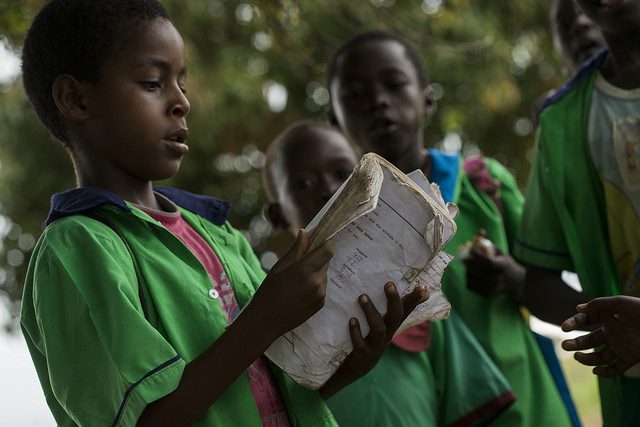 The U.N. has created 17 Sustainable Development Goals (SDGs) for developing countries in order to mobilize efforts to improve the quality of life for people living in poverty. The fourth goal of the SDGs is to have access to quality education. In the SDG 2017 report, research showed that enrollment in primary education is going up, but some countries, such as African countries, are behind in education.
A Global Education Monitoring (GEM) report done by UNESCO found that in sub-Saharan Africa, 41 percent of students in primary education don’t complete basic education. The report also said that 87 percent of students don’t reach the minimum proficiency level in reading. This equates to more than one in four young people in the region that can not read or write proficiently.
There are many factors as to why African countries are behind in education, one of them being poverty. But other factors for this issue have to do with the organization of the education system. The GEM report found that less than half of the developing countries had created standards for primary education. Additionally, education systems did not have the means to monitor how students develop or teachers progress. The lack of organization of an educational system causes classrooms to be overcrowded and poorly resourced with teachers that are not qualified.
There are some programs that are addressing these issues. For example, UNESCO is working to improve the quality of teachers’ abilities and to develop a curriculum to improve the learning experience for students. The program also focuses on teaching students skills that are relevant while also providing gender-inclusive literacy programs.
Another way to improve education in African countries is to invest in technology in schools. Internet access is common for people in developed countries but is not distributed equally around the world. Students that live in African countries could benefit from Internet access because of the access to information and connection to resources.
SDGs are obtainable for all developing countries, including countries in Africa. Further investment in the educational systems, the creation of plans and providing a curriculum that is beneficial for students will help provide children with quality education. Investing in technology will also help students learn and help teachers teach, providing a better future for young people in developing countries.
– Deanna Wetmore
Photo: Flickr
 In April 2017, Malawi president Peter Murtharika signed an amendment into law to outlaw child marriage in the country following a vote in Parliament.
This amendment has greatly affected the role of women and girls in Malawi, because prior to the amendment, girls were allowed to marry at age 15. Consequently, Malawi is ranked 11th in child marriage around the world; however, with the introduction of the new amendment, girls will not be allowed to marry if they are under the age of 18.
Child marriage was a large problem in Malawi and posed various challenges to the lives of girls, including limited access to a proper education. According to Jill Filipovic of The Guardian, girls who are married and have children in their early teenage years find it difficult to obtain an education while maintaining their roles as wives and mothers. Also, a lack of hygiene products like tampons and pads is a serious issue for girls who attempt to receive an education, because girls have to stay home during menstruation if they do not have the proper hygiene products.
However, many steps have been taken to increase girls’ access to education in Malawi. President Murtharika’s amendment to outlaw child marriage was an important step in the right direction for girls, and there are many organizations that are helping girls as well. For instance, the organization Girls Not Brides takes action against countries in which child marriage is allowed.
Furthermore, in May 2017, Neetha Tangirala from the United States Agency for International Development (USAID) reported that radio has served as a “primary source of news and information” for the people of Malawi, including women and girls.
Marshall Dyton, a Mandela Washington Fellow, hosted a radio show in order to stress the importance of girls’ education in Malawi. Dyton’s two-hour-long radio show reached an audience of approximately three million people.
USAID highlights the importance of community inclusion in the fight for gender equality in impoverished areas. Dyton’s radio show is a great example of the work many people are doing to improve girls’ education in Malawi. The radio show, which was organized by the Girl Child Education movement and funded by USAID, helped to start conversations in communities regarding the importance of girls’ education.
The outcome of the radio show was immense; following the broadcast of the radio show, the Muslim Association of Malawi was persuaded to increase access to information regarding education in some of the most rural areas of Malawi. The fight for girls’ education in the wake of the outlaw of child marriage in Malawi is only just beginning.
– Emily Santora
Photo: Flickr

Lithuania is a well-developed country in Europe that has one of the fastest-growing economies in the European Union. Education in Lithuania does not fall behind either, with near-universal literacy and high school enrollment.
Literacy and Enrollment in Lithuania
Lithuania‘s overall literacy rate is 99.83%, and the youth literacy rate (for males and females aged 15-24) is even higher, at 99.95%. The country’s enrollment rates are also high. Enrollment rates for both primary and secondary school exceed 100% (due to enrollment of over- and underage students), sitting at 101.91% and 106.92%, respectively (as of 2022). Furthermore, enrollment in tertiary school was 76.92% in 2022, far greater than the global average (which barely exceeds 50%).
Lithuania’s Education System
In Lithuania, there is compulsory education for children ages 7 to 17. The first compulsory level of education is primary education, which students attend from ages 7 to 11. Primary education teaches children the basics of morality, language, mathematics and the arts, among other subjects necessary to children’s development.
The next level of education is lower secondary education, which is also compulsory. The first stage of lower secondary education lasts four years and teaches more basic skills. The second stage lasts two years and is focused on developing abstract thinking within students. Also, in the second stage, students have greater freedom to choose which subjects to study.
Upper secondary education lasts for two years and is optional. At the end of the two years, students must take leaving examinations. If they pass these exams, they earn a Maturity Certificate, allowing them to pursue higher education in Lithuania. Alternatively, students can attend 3-year vocational schools to obtain both a Maturity Certificate and a Vocational Education Diploma. Either path provides students with the opportunity to move on to higher education.
A Shortage in STEM
Lithuania does not have enough STEM (Science, Technology, Engineering, and Mathematics) graduates who are qualified to take on STEM jobs: almost half of Lithuanian graduates hold positions that do not align with the amount of education they have completed. Furthermore, the proportion of STEM students who are female was just 27.3% in 2023. It is vital that Lithuania address these problems and promote education in STEM to match the needs of the market.
Lithuania is doing so through its vocational education and training program and STEAM plan. Vocational education and training provide Lithuanians with the ability to acquire skills in STEM: although a high proportion of vocational students do pursue STEM fields, STEM vocational education is still underused by the population. However, Lithuania aims to increase interest in STEM through the STEAM plan: there are ten STEAM centers in Lithuania that allow Lithuanians to participate in engaging labs and projects. As of 2024, 20,000 students and 1,000 teachers have participated in these activities.
Overall, education in Lithuania is quite strong. Although the country does face a lack of interest in STEM, its programs are working to change that. Furthermore, Lithuania’s high literacy and enrollment rates indicate a highly educated and capable population.
– Téa Franco, Jackson Meyer
Photo: Flickr

Despite some progress, Tajikistan, a post-soviet emerging nation, faces several obstacles today as a result of poor performance from its education system. Compulsory education in Tajikistan (primary and lower secondary) is free for all children, but, according to the Global Partnership for Education, there are many issues with the education system. Issues include problems with curriculum, minimal teaching and learning resources, deficient learning environments and an “insufficient use of the information system for decision-making and strategic planning.”
Like many other countries, Tajikistan has taken an initiative to solve these issues through the adoption of The National Strategy for Education Development (NSED). The NSED, which will continue until 2020, was approved by the Government in July of 2012. The strategy is separated into three general goals consisting of specific actions to be taken in the near future. The goals are: changing the structure of education, implementing a structural adjustment of the education system and business mechanisms and ensuring equal access to quality education.
While these goals are vague and appear to be far off, the strategy also outlines specific steps for following through with the developmental plan. For example, in the past, education in Tajikistan was based on a knowledge-based model. Part of the “structural” change to education will be constructing the system on a competency-based model instead.
Additionally, in order to implement a structural adjustment of education and business mechanism (another overarching goal), the NSED specifies introducing more early education programs. This would also allow students the liberty to choose which supplementary classes they would prefer to take. Additionally, it discusses “establishing a national education quality monitoring system for all levels” in order to implement these “adjustments.”
In terms of guaranteeing equal access to quality education, the NSED specifies greater access to education for children with disabilities and special needs. It will also ensure that minority students receive education in their native language. Furthermore, there will be a greater focus on providing incentives and means for girls to continue their education beyond the compulsory years.
In Tajikistan, the management of education is a task shared across all levels of government. The federal government takes charge of overall planning, the Ministry of Education monitors state policies and standards and establishes the curriculum. Meanwhile, the local governments supervise primary and secondary education. These levels of government must work together to follow through with the NSED if they wish to achieve its goals by 2020.
– Melanie Snyder
Photo: Flickr
