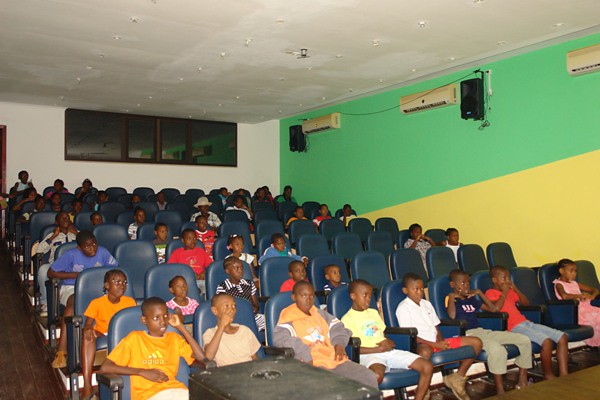
Nestled in the Gulf of Guinea off Africa’s western coast, São Tomé and Príncipe has made education a central focus of its national development strategy. Primary education is compulsory and free, but ensuring quality and equal access remains a work in progress. The adult literacy rate reached around 93% in 2023, up from 74.9% a decade earlier. This reflects significant investment in teacher training, curriculum reform, and school infrastructure since the launch of the Quality Education for All Project (QEFA) in 2014.
Enrollment, Dropouts and System Stress
São Tomé and Príncipe’s school system follows the 6-3-3 structure: six years of primary, three of lower secondary, and three of upper secondary education. Primary school enrollment exceeds 98%, one of the highest in sub-Saharan Africa, according to UNICEF (2022). However, only around 70% of students complete primary education, and the transition rate to lower secondary remains below 60%. This gap highlights a persistent issue: access alone does not guarantee retention or success.
One critical factor behind such a notable imbalance is the shortage of qualified teachers. The Ministry of Education reported that as recently as 2019, nearly 45% of primary teachers lacked formal training, although this figure has steadily improved under QEFA initiatives. Class sizes, particularly in rural communities such as Mé-Zóchi and Caué, often exceed 40 pupils per teacher, creating barriers to individualized instruction. Infrastructure constraints further strain the system. Many schools continue to operate in crumbling facilities with limited sanitation, internet connectivity, and learning materials. Furthermore, the World Bank discovered that less than half of schools had access to functional electricity, halting the rollout of digital literacy programs introduced after the COVID-19 pandemic.
Emerging Reforms, Interventions and Looking Ahead
Education spending accounted for roughly 7.1% of GDP in 2023, one of the highest ratios in Lusophone Africa. The government has pledged to expand funding for early childhood and teacher education, focusing on sustainable models that blend local capacity with international support. Through the Quality Education for All Project II, launched in 2022, São Tomé and Príncipe secured an additional $5 million grant from the GPE, co-financed by the World Bank, to deepen reforms initiated a decade ago.
The program emphasizes three pillars:
- Teacher professionalization, with new certification pathways and continuous coaching.
- Infrastructure modernization, including digital classrooms and renewable energy pilot projects.
- Inclusive education, ensuring that girls, children with disabilities, and those in remote areas receive equal learning opportunities.
As World Bank Country Director Albert Zeufack stated, “São Tomé and Príncipe’s investment in education is an investment in resilience. Each trained teacher represents a promise of social mobility and sustainable growth.” Early signs are promising. Between 2018 and 2023, over 300 teachers completed national training programs, while new preschool teacher courses have boosted early learning enrollment by 12%. National assessments show improved reading comprehension among Grade 3 students, indicating a shift toward competency-based curricula.
If these reforms endure, the nation’s education system will transform from expansion to excellence – turning São Tomé and Príncipe into a model of how small island states can harness education to build equitable, knowledge-driven societies.
– Jeff Zhou
Photo: Flickr
