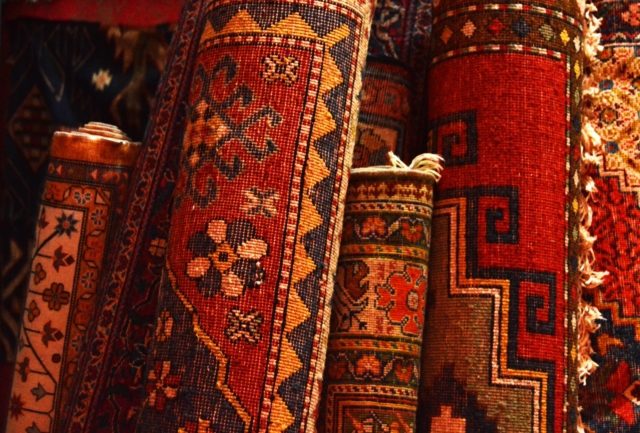
 Between 1915 and 1923, thousands of Armenians were massacred in the Armenian genocide. Many Armenian communities now live around the world, with a significant presence in the United States. Committed to remembering the Armenian genocide, the Armenian Rugs Society has dedicated itself to supporting Armenians on a global scale. Through exhibitions of traditional woven arts and the implementation of social programs, the Society has been able to spread awareness of Armenian culture and educate the public on Armenian history.
The Armenian Genocide
During the 600-year reign of the Ottoman Empire, many ethnicities and religions were living within the controlled territories. The Ottoman Empire was an Islamic state and many non-Muslim minorities were subject to discrimination and persecution. Among these populations were Armenians who primarily followed Armenian Apostolic Christianity.
In the early 20th century, the Ottoman Empire, including the modern-day territory of Armenia, underwent drastic political changes. The Ottoman Empire gave way to a Turkish nationalist movement called the Young Turks. The Young Turks aimed to attain a religiously Muslim and ethnically Turkish state. On April 24, 1915, Turkish officials corralled nearly 250 Armenian scholars, intellectuals and leaders with the express intent to execute. The Armenian genocide lasted until 1923 with an estimated 1.5 million Armenians massacred. Forced conversion to Islam occurred for the few ethnic Armenians who remained.
Armenian’s Today
As of 2019, an estimated three million Armenians inhabit Armenia. About seven million Armenians live in more than 100 countries around the world. In the 1970s, the United States saw a mass migration of Armenians from Lebanon, Syria, Iran and the former Soviet Union. In 2003, roughly 1.2 million Armenians lived in the U.S. due to the conflict and discrimination they experienced elsewhere.
San Fernando Valley in California is one community Armenians have migrated to, making up 40% of the city’s total population. However, the size of the community itself does not guarantee Armenian-Americans’ economic or social welfare. The Los Angeles Times found that while some second or third-generation Armenian-Americans may be wealthy, more recent immigrants still struggle to provide for themselves and live in low-income areas.
Poverty in Armenia is also an issue. In 2019, more than a quarter of citizens in Armenia lived below the poverty line. In addition, more than 20% of the country’s population experienced unemployment in 2020. The Armenian government’s deep issues of corruption affect the poverty rates and the attitudes of citizens. Around the world, Armenians still face the material effects of the Armenian genocide as a result of forced migration. The corruption in their homeland comes with government denial of the genocide itself. Without the lack of support from their government, Armenian citizens live lives of struggle.
The Armenian Rugs Society
To overcome poverty and bring awareness to the Armenian genocide, the Washington-based Armenian Rugs Society was established in 1980 and teaches history through rug weaving. As one of Armenia’s oldest art forms, the Armenian Rugs Society highlights the thousands of years of rug weaving within Armenian culture. The tradition traces back to the brave artisans who worked through decades of hardship. To honor this history, one goal of the organization is to highlight rugs made by orphans who survived the Armenian genocide.
The Armenian Rugs Society, using member contributions, has showcased exhibitions of carefully preserved rugs. The organization has also conducted community events in highly-populated Armenian areas like Glendale, California, hosting its Weaving for Survival conference in the city in 2015. The conference focused on expressing the resilience of Armenian genocide survivors, bringing hope to refugees visiting the exhibit. The show displayed woven rugs, embroideries and lacework made in post-genocidal refugee camps throughout the Middle East. The exhibit’s message was positive, aiming to inspire “the groundwork for a better future for themselves and their children,” through the art and history displayed. The Armenian Rugs Society also teamed up with a nonprofit to teach rugmaking to more than 400 learners in nine different Armenian villages, bringing homage to Armenian culture and creating opportunities for income.
Weaving a Brighter Future
On April 24, 2021, President Biden gave U.S. recognition to the Armenian genocide on its 106-year anniversary. Activist groups and Armenians around the world welcomed this recognition. Biden stated, “Let us renew our shared resolve to prevent future atrocities from occurring anywhere in the world.” The Armenian Rugs Society continues its work to “represent, support and preserve Armenian woven arts” as a reminder of Armenian resilience.
– Madeleine Youngblood
Photo: Unsplash

The Issue of Female Genital Mutilation in Guinea
Background of Female Genital Mutilation
The practice of FGM is deeply rooted in tradition and culture. According to the FGM National Clinic Group, FGM is commonly viewed as a traditional initiation ceremony that marks a girl’s transition into womanhood. Some communities see FGM as an act that increases a girl’s marriageability. Others perform FGM because of the belief that it will ensure girls’ virginity and suppress the sexual desire of women so as to prevent adultery. FGM is a dangerous practice that perpetuates violence against women and holds no health benefits. While the practice of FGM is widespread today, the origins of the practice remain unclear.
Additionally, the practice of FGM is inextricably linked with poverty. UNICEF states that 56% of mutilated Guinean girls aged 0-14 fall in the most impoverished economic quintile. This fact expresses a clear intersectional overlap between gender and class. In particular, lower-income women in Guinea are disproportionately impacted by FGM. The overlap of gender and class reveals a link between women’s rights issues in the fight for global poverty relief.
Abolishing Female Genital Mutilation
Despite the fact that female genital mutilation is banned nationally and internationally, the practice continues in Guinea. The U.N. reported that although the majority of women and girls in other countries are against FGM, in 2012, 76% of women and girls in Guinea were in support of the practice. Guinean women tend to be in favor of the excision due to social pressures and fears of being unable to marry due to being uncut. Global support against the practice has helped to alleviate the suffering of women in Guinea. By amplifying a strong global movement against female genital mutilation, more women will realize the serious health consequences of FGM, and thus, more women will support its ultimate abolition.
In a 2020 publication by Reprod Health, “positive deviance” is seen as an important strategy for women and girls in Guinea. Positive deviance refers to girls challenging cultural norms by denying FGM practitioners access to their bodies without their consent. Reprod Health argues that this can ultimately lead to an updated and reformed public health action that fully rejects and abandons female genital mutilation in the country.
Taking Action Against FGM
The Coordinating Body on Traditional Practices Affecting the Health of Women and Children (CPTAFE) in Guinea advocates for the eradication of FGM in Guinea. CPTAFE’s efforts contributed to an article in the Guinean Constitution “that upholds the right to physical integrity of the person and condemns all forms of inhumane treatment.” This prohibition must be interpreted as banning the practice of FGM. The CPTAFE created four FGM films to raise awareness about the harms of the practice. The organization also educates the public through informative resources, media broadcasts and educational training. The CPTAFE is working with the Guinean government to strengthen legislative prohibitions against FGM.
The Road Ahead
Female genital mutilation is an outright human rights violation. However, there is strong opposition both nationally and globally with the “positive deviance” movement and NGO action and involvement. While progress needs to continue to completely eradicate female genital mutilation in Guinea, these efforts are powerful in the fight to empower women and uphold women’s rights.
– Sebastian Fell
Photo: Flickr
Female Genital Mutilation in Côte d’Ivoire
Female genital mutilation is the process of partially or totally removing the external female genitalia, and is a violation of the human rights of women and girls around the globe. While many strive to ban this non-medical practice, FGM still has a grip on many countries. One such country where FGM is prevalent is Côte d’Ivoire. Here is some information regarding the practice of female genital mutilation in Côte d’Ivoire and the measures to eradicate it.
Female Genital Mutilation in Côte d’Ivoire
Côte d’Ivoire, also known as the Ivory Coast, is a country located along the south coast of West Africa. With a population of about 25 million, FGM practices affect approximately 36.7% of women ages 15-67, the highest prevalence being 60% to 75% among the ethnic groups of the northwest regions of Nord, Nord-Ouest and Ouest. However, girls and women of all ages and from all different regions of Côte d’Ivoire are at risk of FGM.
The prevalence of female genital mutilation in Côte d’Ivoire stems from two reasons, the first being social and cultural traditions. Those who perform the actual cut are typically the older women that make it their living and perform the procedure without anesthesia and the use of medical facilities. Pressure for older girls to undergo FGM often takes place when the prospective husband and his family will not accept a bride that has not experienced it.
The second reason for FGM’s prevalence in Côte d’Ivoire traces back to the large migrant population coming in and out of the country. Many migrants originate from countries where there is little to no legal action against FGM, such as the border nations of Guinea and Mali. The frequent crossing of borders attributes to the high percentages of women and girls who experience FGM in the northwest regions.
Harms of Female Genital Mutilation
Of the four major types of FGM that the World Health Organization (WHO) identified, Côte d’Ivoire practices Type 2. There are no health benefits to any type of FGM, as the non-medical practice mutilates a normal organ of a woman’s body. Instead, FGM harms those who undergo the procedure, and the victims become increasingly at risk to develop health complications in the present moment or in the future. Women and girls who experience FGM largely suffer from the following:
Steps Against Female Genital Mutilation
The government of Côte d’Ivoire created legislation targeting the practice of FGM. Article 5 of the Constitution of Côte d’Ivoire prohibits “female genital mutilation as well as any other forms of degradation of human beings.” Law No. 98-757 of 23 December 1998 criminalized the practice of FGM in all forms, which includes actions by medical professionals and by those who aid in its performance.
Since the creation of Law No. 98-757, few people who practice FGM have experienced prosecution. The Ministry for Women and the Protection of the Child and Solidarity is a major government authority in Côte d’Ivoire. It protects the country’s women and girls and ensures equality in economic, social and cultural areas. From 2008-2012, the government put a National Action Plan in place that protects women and girls from sexual violence, including FGM. Since the National Action Plan’s end, there have been no new talks to implement a new plan.
Looking Ahead
While more work is necessary to completely end female genital mutilation in Côte d’Ivoire and the Ivory Coast, the work of those advocating to end FGM is making a difference in the local communities. Many are starting to see the harms that the practice inflicts. Small steps are still steps toward a brighter future for the women and girls affected.
– Grace Ingles
Photo: Flickr
Providing Clean Water Filters to Ethiopia
Water Studies in Ethiopia
According to Water.org, only around 42% of Ethiopians have access to clean and safe water sources. In rural areas of Ethiopia, access to clean water is even more limited. Severe climate conditions and political issues largely contribute to Ethiopia’s water shortages. Many rural Ethiopians resort to collecting water from water sources that are often contaminated and only serve to spread disease.
The World Health Organization (WHO) outlines the consequences of drinking unclean water. Contaminated water sources lead to the spread of diseases such as cholera and dysentery. Agriculture is central to the lives of almost 95% of people in Sidama. Since agriculture plays a significant role, water is needed for a thriving agricultural industry that supports food security and livelihoods in Sidama.
Desert Rose
Desert Rose is an Ethiopian-based social enterprise that has focused on community development through engineering consulting in rural Ethiopia since 2008. Thomas Berger, a swiss anthropologist, and British engineer, Andrew Smith, established Desert Rose as a force for social good. Desert Rose has come up with a water filter solution to ensure Ethiopian people in rural areas like Sidama have access to clean water.
The water filter called Minch is able to mechanically remove 99.9% of E. coli bacteria. There is no need for chemicals and the filter is much more effective than conventional biosand water filters. The Ethiopian government tested the filter. It is simple to use, “lasting up to two years in rural areas and up to five years in the towns.” The low-cost filter targets impoverished communities in Ethiopia. The water filter is produced entirely in Ethiopia, enabling the company to save on costs and keep the water filter affordable to all. The filter also has “an internal 15-liter water reservoir” to protect water from contamination during storage.
The Minch water filter provides a form of water purification for Ethiopian households who cannot afford to boil water due to the high cost of firewood. After three years in development, by 2019, Desert Rose produced 1,000 water filters. Oxfam bought 50% of these filters for use in its humanitarian efforts. With funding and support, the Minch water filter has the potential to reach large-scale production so that all Ethiopians can have access to clean water.
Water for All
Since water access and poverty are linked, better water access means reduced poverty. According to the United Nations, water is essential for socio-economic development and plays a significant role in decreasing “the global burden of disease and improving the health, welfare and productivity of populations.” With companies and organizations working to improve water access in Ethiopia, poverty in Ethiopia is reduced.
– Jacob Richard Bergeron
Photo: Flickr
The Humanitarian Crisis in Ceuta and Melilla
History of Ceuta and Melilla
After the 15th century fall of Islamic conquest in Spain, the Spanish Christians retook the Iberian Peninsula and widened the territory to include Ceuta in 1479 and Melilla in 1668. Both cities entered European Union (EU) territory along with Spain in 1986.
In 2005, Spain erected a 20-foot-high fence surrounding Ceuta and Melilla to stop migrants from entering the cities. The fence is topped with barbed wire, hundreds of surveillance cameras and approximately a thousand police and Guardia civil units. Since the fence’s construction, the number of migrants crossing through the cities has only increased. In May, 8-10,000 migrants crossed the borders. Some migrants even swam around the fence that separates Morocco from Ceuta and Melilla.
Reasons for Increased Migration
There are two major reasons behind this increase in migrants. The first reason is the COVID-19 pandemic. COVID-19 severely affected the Moroccan economy. Hence, thousands of citizens crossed the Spanish border looking for better economic conditions and social stability.
The second reason is illegal smuggling. Morocco recently took action against the smuggling trade. Illicit smuggling negatively impacted the country’s economy. Despite this harm, smuggling was the main economic source for Ceuta and Melilla along with many northern Moroccan cities. The full shutdown of this trade left citizens in extreme financial deprivation, which led many of them to migrate.
Government Actions
The influx of thousands of migrants and asylum-seekers into Spain’s enclaves created panic among Spanish authorities, who sent the military to deal with the crisis. Subsequently, the military attacked, beat and tear-gassed migrants to deter them from entering the Spanish cities. This reaction to the humanitarian crisis in Ceuta and Melilla has sparked backlash, especially from nonprofit organizations due to violations of EU law and other legal procedures.
A spokeswoman for the nonprofit organization CEAR said that Spanish authorities sent back thousands of migrants, including children, who were supposed to have protection under Spanish law. The President of Catalonia, Pere Aragonès, said that the autonomous community in Spain is willing to shelter migrant children as a “moral imperative” during a parliamentary debate. In contrast, the far-right Vox party’s Ignacio Garriga supported the army’s use of violence against migrants. Additionally, the Euro-Mediterranean Human Rights Monitor warned Spain against violence and suggested providing safe and legal procedures to migrants pursuing protection during the humanitarian crisis in Ceuta and Melilla.
Volunteer Actions
American Red Cross spokeswoman Isabel Brasero, who helped fatigued migrants in Ceuta, said “the city has the means to take care of all the people that arrived at its shores, but you never imagine that you will face this type of situation.” After the military intervention, volunteers in Ceuta donated clothes and cooked food for the migrants. Locals in Ceuta showed solidarity with the migrants and attended the funeral of a teenager who died swimming around the breakwater to Ceuta.
Ceuta and Melilla witnessed a humanitarian crisis that created chaos and outrage in Spain, which caused military action. Nonprofits, volunteers and many others are actively working to help migrants affected by the aftermath of the crisis.
– Zineb Williams
Photo: Flickr
How Postnatal Care in Kenya is Improving
Postnatal care in Kenya lacks proper recognition, however, it is rapidly changing. When it comes to looking after newborn babies and their mothers, the right type of postnatal care is crucial to assure wellbeing. According to the Maternal Health Task Force, more than 60% of the world’s maternal deaths occur during the postnatal period, which is about six weeks after delivery. However, the International Journal of Africa Nursing Sciences reports that this period is the most ignored aspect of maternal care globally. Because of the lack of global acknowledgment, countries suffering from widespread poverty have an even harder time implementing postnatal care policies.
Postnatal Care in Kenya
Kenya tried setting up plans for assistance in the past decades with little success. In 2005, the Ministry of Health in Kenya implemented guidelines increasing the way in which it assesses childcare during the postnatal period. Even though about 80% of the country’s hospitals offer postnatal care, only 42% of Kenyan women give birth in a healthcare facility. This leads to high unreported maternal mortality rates in Kenya. In sub-Saharan Africa, every woman has a one in 16 chance of dying during pregnancy or childbirth.
In order to improve this aspect of the maternal care system, multiple approaches have been proposed as potential solutions to advancing postnatal care in Kenya.
Community-Based Care
Because of these facts, Community Health Workers (CHW) are starting to play a crucial role in healthcare. CHWs can reduce maternal deaths and improve the delivery of healthcare services. Unlike hospitals, CHWs are normally the first point of intersection between the healthcare system and communities. They have more access to mothers who may not be able to afford a hospital birth and can provide them with postnatal care.
Communities select the workers who then serve to give home-based counseling and care services. Because they are well-trained at recognizing diseases, CHWs are held in high regard and receive significant respect in health-related manners. This gives the community the knowledge to know to demand better health services. Additionally, these community workers help link citizens to higher-tier resources.
Better Midwives
In at-home births, midwives are key to ensuring that the whole process occurs smoothly. The Journal of Africa Nursing Sciences states that there should be improved and more professional midwife selections. There should also be supervision of midwives by supportive initiatives in order to ensure qualifications.
These initiatives support work at all levels of postnatal care while providing midwives with positive encouragement. Strong human resources are also necessary for effectively employing these midwives and securing an improved quality of maternal and neonatal care.
Looking Forward
Access to good postnatal care relates to many broad social issues such as poverty and gender equality. However, many are working for advances in postnatal care in Kenya, laying down the plans to make sure maternal services improve. Hopefully, this will lead to healthier children and fewer deaths during childbirth.
– Jack Parry
Photo: Flickr
MapAction Helps Alleviate Hunger in Africa
Climate Change in Africa
In January 2021, the Famine Early Warning System reported that areas in the Horn of Africa were facing food crises due to the locust swarms. A swarm the size of Manhattan can eat the same quantity of food as the whole population of New York and California in just one day. From March 2021 through May 2021, a lack of rainfall in parts of Ethiopia meant that farmers could not prepare their fields for crops or have adequate grass for pasture. The countries most vulnerable to food insecurity are Ethiopia, Sudan and Yemen. Indeed, the persistent lack of rainfall has brought dry conditions to many parts of East Africa.
The disastrous combination of flooding and drought, along with locust infestation, is harshly impacting communities in the region, even more so due to the effects of the COVID-19 pandemic. With COVID-19 lockdowns, communication between relief organizations is difficult. Since April 2020, an organization called MapAction has been working in the eastern and southern parts of Africa, “applying geospatial expertise to humanitarian situations” to improve results. The organization looks to improve communication between Oxfam and its local partners.
Geospatial Analysis
MapAction believes that expert geospatial analysis can help spread resources to populations affected by famine, drought and other emergencies. MapAction works to ensure that emergency aid responders and disaster management agencies have access to crucial data. This data will allow responders to make decisions that will improve food security and relieve hunger in Africa. The team creates map templates and trains locals to update maps. This helps inform Oxfam’s partners about threats to food security, such as when locust swarms move into new areas. MapAction also maps where work has been done to prevent efforts from being wasted through duplication.
MapAction’s Impact
Rupert Douglas-Bate originally conceived the idea for MapAction. Bate formulated the concept while “working as an emergency water engineer in Bosnia in 1994.” Bate realized “that there was a gap in mapped analysis to support the effective planning and delivery of humanitarian aid.” MapAction first started off supporting Oxfam and partners in Kenya and Somalia but intends to assist in Zimbabwe and Zambia too. In the near future, MapAction would like to extend its scope to Malawi, Mozambique, Namibia, Angola, South Africa and Botswana.
Since its inception, MapAction has supported thousands of emergency aid groups in more than 60 humanitarian crises around the world. Furthermore, the organization has helped millions of people who were in danger of starving. The organization has won four Stevie International Business Awards for Company of the Year and an Association for Geographic Information Award for Excellence due to its Ebola assistance in West Africa.
MapAction continues to develop new technologies to improve the effectiveness of humanitarian aid. In the process, it is subsequently reducing the threat of widespread hunger in Africa, preventing millions from falling deeper into poverty.
– Sarah Betuel
Photo: Flickr
Top Two NGOs Tackling Poverty in Malaysia
Poverty reduction in Malaysia was steadily progressing until the COVID-19 pandemic hit. The poverty rate decreased from 7.6% in 2016 to 5.6% in 2019, according to Free Malaysia Today. However, due to COVID-19, the poverty rate rose to 8.4% in 2020. Many argue that the strikingly low poverty rate is an inaccurate reflection of the true state of poverty in Malaysia as it does not account for costs of living and overlooks vulnerable populations. According to U.N. human rights specialist, Philip Alston, “Despite near-universal healthcare and high school enrolment rates for citizens and a growing economy, large parts of the population are being left behind and many people living above the official poverty line are in fact in poverty.” Due to these circumstances, several NGOs are tackling poverty in Malaysia.
Poverty in Malaysia
Alston explains that “Undercounting has also led to underinvestment in poverty reduction and an inadequate social safety net that does not meet people’s needs.” As a consequence, people’s rights to food, shelter and education are in jeopardy. Under the current circumstances, more than 2.7 million Malaysian children come from households that cannot afford the costs of school, and according to the World Bank, 15% of Malaysians experienced moderate-to-severe food insecurity in 2018. However, NGOs are rising to the challenge, attempting to close the poverty gap and end the consequences that go along with it. MyKasih and SOLS 24/7 are leaders in tackling poverty in Malaysia by providing inclusive aid to the B40 (bottom 40% household income range) community through education and food security.
MyKasih
The MyKasih Foundation was founded by Tan Sri Dr Ngau Boon Keat and his wife, Puan Sri Jean Ngau, in 2009. The organization is committed to the long-term goal of empowering the Malaysian community by providing more than just short-term relief. Its efforts in tackling poverty in Malaysia are directed into its two main programs, the Love My Neighborhood food aid program and the Love My School education bursary initiative. MyKasih’s food aid program provides impoverished households with at least RM 80 per month for only a year. This ensures people do not become aid-reliant and are empowered to become self-sufficient while being able to meet their basic needs.
By 2019, MyKasih had provided roughly 280,000 families with RM 260 million worth of cashless aid. In 2018, its contributions were recognized. MyKasih received the 2018 U.N. Malaysia Award for the “Leaving No One Behind” category, honoring its effective distribution of aid “through public-private partnerships.”
SOLS 24/7
In 2000, teacher Raj Ridvan Singh along with his father and brother began SOLS 24/7 in Cambodia to provide informal education to impoverished populations. In 2005, Singh replicated the initiative in Timor Leste. Seeing the success of the endeavor, in 2007 he continued the initiative in Malacca, Malaysia. Singh moved the SOLS 24/7 headquarters to Kuala Lumpur five years later.
Through its diverse educational programs, the organization aims to empower the B40 community in Malaysia. Since its establishment, SOLS 24/7 has provided quality education to more than 500,000 people. The organization as provided more than 800 scholarships to the SOLS Solar Academy, equipping students with skills to thrive in the renewable energy sector. SOLS Community Centers provide training to marginalized and impoverished people, helping them improve on English skills, digital knowledge and personal development.
SOLS 24/7’s efforts are vast, showing its commitment to education and empowerment. Through these efforts, the organization helps Malaysians rise out of poverty by providing them with the skills and knowledge to secure jobs and establish businesses.
Looking Forward
Efforts by SOLS 24/7 and MyKasih in tackling poverty in Malaysia have provided aid and educational services for the socio-economic advancement of B40 families. These two NGOs continue to offer benefits that empower Malaysia’s impoverished communities, providing hope for all Malaysians in need.
– Julia Fadanelli
Photo: Flickr
The Armenian Rugs Society Turns History into Art
The Armenian Genocide
During the 600-year reign of the Ottoman Empire, many ethnicities and religions were living within the controlled territories. The Ottoman Empire was an Islamic state and many non-Muslim minorities were subject to discrimination and persecution. Among these populations were Armenians who primarily followed Armenian Apostolic Christianity.
In the early 20th century, the Ottoman Empire, including the modern-day territory of Armenia, underwent drastic political changes. The Ottoman Empire gave way to a Turkish nationalist movement called the Young Turks. The Young Turks aimed to attain a religiously Muslim and ethnically Turkish state. On April 24, 1915, Turkish officials corralled nearly 250 Armenian scholars, intellectuals and leaders with the express intent to execute. The Armenian genocide lasted until 1923 with an estimated 1.5 million Armenians massacred. Forced conversion to Islam occurred for the few ethnic Armenians who remained.
Armenian’s Today
As of 2019, an estimated three million Armenians inhabit Armenia. About seven million Armenians live in more than 100 countries around the world. In the 1970s, the United States saw a mass migration of Armenians from Lebanon, Syria, Iran and the former Soviet Union. In 2003, roughly 1.2 million Armenians lived in the U.S. due to the conflict and discrimination they experienced elsewhere.
San Fernando Valley in California is one community Armenians have migrated to, making up 40% of the city’s total population. However, the size of the community itself does not guarantee Armenian-Americans’ economic or social welfare. The Los Angeles Times found that while some second or third-generation Armenian-Americans may be wealthy, more recent immigrants still struggle to provide for themselves and live in low-income areas.
Poverty in Armenia is also an issue. In 2019, more than a quarter of citizens in Armenia lived below the poverty line. In addition, more than 20% of the country’s population experienced unemployment in 2020. The Armenian government’s deep issues of corruption affect the poverty rates and the attitudes of citizens. Around the world, Armenians still face the material effects of the Armenian genocide as a result of forced migration. The corruption in their homeland comes with government denial of the genocide itself. Without the lack of support from their government, Armenian citizens live lives of struggle.
The Armenian Rugs Society
To overcome poverty and bring awareness to the Armenian genocide, the Washington-based Armenian Rugs Society was established in 1980 and teaches history through rug weaving. As one of Armenia’s oldest art forms, the Armenian Rugs Society highlights the thousands of years of rug weaving within Armenian culture. The tradition traces back to the brave artisans who worked through decades of hardship. To honor this history, one goal of the organization is to highlight rugs made by orphans who survived the Armenian genocide.
The Armenian Rugs Society, using member contributions, has showcased exhibitions of carefully preserved rugs. The organization has also conducted community events in highly-populated Armenian areas like Glendale, California, hosting its Weaving for Survival conference in the city in 2015. The conference focused on expressing the resilience of Armenian genocide survivors, bringing hope to refugees visiting the exhibit. The show displayed woven rugs, embroideries and lacework made in post-genocidal refugee camps throughout the Middle East. The exhibit’s message was positive, aiming to inspire “the groundwork for a better future for themselves and their children,” through the art and history displayed. The Armenian Rugs Society also teamed up with a nonprofit to teach rugmaking to more than 400 learners in nine different Armenian villages, bringing homage to Armenian culture and creating opportunities for income.
Weaving a Brighter Future
On April 24, 2021, President Biden gave U.S. recognition to the Armenian genocide on its 106-year anniversary. Activist groups and Armenians around the world welcomed this recognition. Biden stated, “Let us renew our shared resolve to prevent future atrocities from occurring anywhere in the world.” The Armenian Rugs Society continues its work to “represent, support and preserve Armenian woven arts” as a reminder of Armenian resilience.
– Madeleine Youngblood
Photo: Unsplash
Online Businesses in Ghana Providing New Jobs
Job Creation
From consumer services to promotions, financing to administrative tasks, retail managing to image consulting, online selling has many job opportunities to offer in Ghana, which had a 4.5% employment rate in 2020. For example, while the digital firm Jumia employs only around 500 people directly in online work, it employs more than 10,000 people indirectly. Online work does not always require people to have advanced technological abilities, only a willingness to learn. Online businesses also create associated non-online jobs.
For example, when people purchase meals and other items digitally, they require delivery. Nowadays, many companies offer delivery by motorcycle or van, creating many delivery jobs. Online businesses in Ghana also provide new jobs through collection posts, which have become more popular during the pandemic. These posts provide a safe and convenient way for customers to collect their goods while minimizing their risk of exposure to COVID-19. Collection posts hire post managers, shipment organizers and receptionists. In addition, some companies, such as Jumia, have encouraged digital businesses to expand by allowing people to collect their online purchases in-store.
Working from Home and New Digitial Stores
Many online businesses offer home-based and other off-site positions. Working from home not only enhances employees’ welfare and decreases stress, but it also helps reduce pollution as fewer people have to travel to work. Virtual connections allow people to associate with a worldwide community and conveniently work and buy what they need without having to travel. Additionally, digital companies can more easily provide short-term work such as contract, part-time and freelance work, which also helps to reduce poverty.
Moreover, in May 2018, a digital food store named Homeshoppa Ghana was introduced in Accra, the country’s capital. Homeshoppa Ghana matches its competitors’ prices in order to provide easily accessible, low-cost, standard groceries to every citizen. Access to stores like Homeshoppa Ghana allows people living in poverty to buy essential items at low prices.
Internet Advancements
The introduction of higher internet speeds and advanced cellphones in Ghana has helped prepare the marketplace for online retailers. By the end of 2017, 10.1 million Ghanaians, or 34%, were using the internet. As of January this year, the number of internet users had increased to 15.7 million. As more people begin to use the internet, online businesses are creating more new jobs in Ghana.
– Jannique McDonald
Photo: Unsplash
5 Books About Human Trafficking
6 Books on Human Trafficking
In order to bring awareness to a global issue, it is important to remain educated and empathetic. These books about human trafficking shed light on modern-day slavery so that the world can do more to address the issue.
– Claire Olmstead
Photo: Flickr