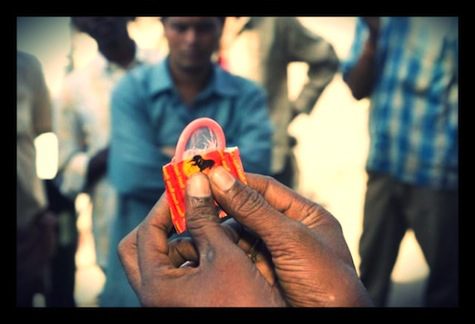
Bill Gates is asking investors and scientists to develop a new gadget—an improved condom.
It may seem like a job for Trojan, but the Bill and Melinda Gates Foundation wants new condoms. The unique request is part of its “Grand Challenges in Global Health” initiative. The program awards grants of $100,000 and follow-up grants of as much as $1 million to individuals who develop solutions to global health issues. The latest report details successful recipients combating malaria, HIV, and tuberculosis.
According to the Grand Challenges website, “Condoms have been in use for about 400 years yet they have undergone very little technological improvement in the past 50 years.” The only major improvements include the switch to latex and quality control measures to test each individual condom during production. Both of these measures increased the effectiveness of condoms, but the basic design of condoms has yet to transform.
Condoms are the most ubiquitous defense against unwanted pregnancy and sexually transmitted diseases. This undervalued resource is a lifesaver in developing countries. Condoms should be necessary for sexual health, but many men and women shy away from using them due to discomfort, societal stigmas, and reduced sensation. Some cultures perceive condom use as a sign that the person has AIDS.
The Gates Foundation hopes to eliminate these concerns so more people will use condoms regularly. The challenge seeks to make prophylactics more user friendly. “If we could make something better, we could have a really substantial effect on HIV prevention and unintended pregnancy in Sub-Saharan Africa and South Asia,” said Stephen Ward, a program officer at the Bill & Melinda Gates Foundation.
The program is limited to condoms rather than multi-purpose prevention devices (such as vaginal rings) because these programs are not readily available worldwide. The condom is still simple enough that it can be distributed at a low cost. Not to mention, condoms are useful even in communities that lack health care professionals. “Any advance or new design that gets people to use condoms would be a big plus,” said Dr. Anthony Fauci, one of the world’s leading AIDS researchers.
Applicants must complete a two-page application by May 7. Two frontrunners have already emerged. Origami, a California company, focused on usability and comfort. They are creating a new silicone injection-molded condom. University of Washington researchers look to increase the effectiveness of anti-HIV drugs. Their model features electrically spun fabric that allows sperm-blocking drugs to dissolve more quickly.
– Whitney M. Wyszynski
Source: Co.Exist
Photo: CNET

US Water Partnership Fights Water Challenges
It’s been one year since former Secretary of State Hillary Clinton announced the start of the U.S. Water Partnership. The partnership consists of public and private sectors and “unites and mobilizes U.S. expertise, resources, and ingenuity to address water challenges around the globe.”
According to the fact sheet, “The USWP is an alliance of 18 U.S. government agencies and 29 U.S. private sector and civil society organizations.” However, the USWP has increased from 47 to 61 partnerships in the last year. They work together to improve water resources worldwide and focus primarily on developing countries.
The partners pledged $610 million dollars on June 20, 2012. Funded projects included: control or elimination of Neglected Tropical Diseases, increased solar power pump stations, and improved desalination projects.
The success of the USWP depends on collaboration and flexibility. Partners are able to work in groups or individually. For example, the Overseas Private Investment Corporation revitalized water purification systems throughout Ghana by providing funds for the Ghana National Water Infrastructure Modernization Project. World Vision helped boost rural and semi-urban schools in India through the “Support My School” campaign, whereas multiple organizations joined forces to provide WASH technologies. These technologies decrease infection and increase public health.
Hattie Babbitt, Chair of the USWP Steering Committee, led the USWP first anniversary event at the National Academy of Sciences on Mar. 21, 2013. She discussed the numerous projects that could not have occurred without the help of the partnership and congratulated the ten new partners. The USWP continues to grow and progress and strives to bring each person safe drinking water.
– Whitney M. Wyszynski
Source: U.S. Water Partnerships
Photo: US Water Alliance
USAID’s NEAT Program in Nepal
The information packets were made to be durable and they contain information on 13 types of crops. The information was prepared for illiterate and semi-literate farmers so charts and photos are used throughout the information packet. Another focus of the NEAT effort is to make it easier for farmers to take their goods to market to sell while also making seeds and fertilizers more easily available to the nearly 70,000 farmers that the program helps.
Overall, the farmers have experienced a gain of $85 million since the program began and nearly all of the program participants have increased market access for their goods. While the NEAT initiative will end this August the resources that USAID has compiled will continue to be helpful for farmers and the aid centers that they have established will continue to be staffed and will offer help to the Nepalese farmers. This is just one more great program that USAID has undertaken to fight poverty worldwide and promote food security.
– Kevin Sullivan
Photo: The Borgen Project
Childhood Stunting Has Long-Term Effects
Healthy nutrition is most important in the first five years of life. In six countries (Afghanistan, Burundi, Ethiopia, Madagascar, East Timor, and Yemen), 50 percent or more of children under 5 years old are stunted. This number is terrifying because stunting can lower cognitive capacity for life. Children who suffer from stunting have a reduced ability to learn. This poor nutrition can affect future earnings and success. Any inadequate nutrition within the first two years of life is permanent and irreversible.
Being four to six inches shorter than their peers is the most superficial concern for stunted children. They are “five times more likely to die from diarrhea due to physiological changes in a stunted body.” Furthermore, the typical stunted brain has fewer cells and fewer connections between cells, which means impaired functioning.
Despite these numerous health effects, childhood stunting continues to receive little to no media attention. Organizations like UNICEF work to combat malnutrition, but people do not realize the effects of this extreme malnutrition.
UNICEF and its partners provide cost-effective solutions, such as vitamin A supplements, iodized salt, and therapeutic foods. Its famous Plumpy’nut is a peanut-based food that helps malnourished children gain up to two pounds per week.
Childhood stunting is preventable, and it is time for people to understand their effects. Numerous studies and organizations name hunger as the “gravest single threat to the world’s public health.” The effects of hunger alter a community’s culture, economy, and overall well-being.
– Whitney M. Wyszynski
Source: TIME
Photo: Fast Company
BRICS Advance Plans for Development Bank
The BRICS countries met in Durban, South Africa last week to finalize plans for the establishment of a New Development Bank that would be led by the quickly developing countries. While the negotiations were not finalized and a plan wasn’t cemented, officials claim that progress is being made.
The BRICS are a group of large, quickly industrializing countries; Brazil, Russia, India, China and South Africa. Early last year they made the announcement that they would consider creating a separate development bank run by the leaders of the developing world for the developing world.
While South Africa’s Minister of Finance stated that the negotiations had been completed the day before the meeting, they apparently were not. However, they say that progress was made and that the New Development Bank will be established soon and that they are pleased with the rapid materialization of a concept that only came into their discussions one year ago.
One of the issues remaining is where the central bank will be built, as each country would obviously like to have such a large institution and the profit and recognition that would come along with it. In response to significant pressure from activist groups and student and humanitarian groups, representatives of the five countries made statements condemning the abuse of humanitarian rights in Syria and pleaded that aid workers and organizations be allowed to freely access the region to provide help for those suffering.
– Kevin Sullivan
Source: Voice of America
Photo: Post
New Vaccine Aimed at Preventing Endemic
Throughout many developing nations, foot and mouth disease is considered an endemic in livestock; especially in Asia, Africa, and parts of South America. Previously, the only vaccines for foot and mouth disease were very fragile and had to be created inexpensive labs with the proper equipment, and needed to be kept refrigerated in order to stay “alive,” preventing possibilities of any long-distance transportation.
Now, researchers have created a synthetic version of the foot and mouth vaccine that does not require refrigeration, making it much more accessible to rural areas where the disease is common. The new vaccine can be transported and even created in developing countries since it can withstand varying temperatures.
Within the last few years, the UK, South Korea, and Japan were all victims of an outbreak of the virus that had originated in Asia. The foot and mouth outbreak in the UK cost the country an estimated 8 billion pounds.
The researchers’ goal of having the foot and mouth vaccine distributed globally in order to stop the virus at the source instead of waiting for an outbreak will now be much more practical with this synthetic version. Scientists say that the new version could be widely available within 6 to 8 years. Researchers are also working on synthetic vaccines for diseases that affect human populations, including polio and human hand, foot, and mouth disease.
– Christina Kindlon
Source: Guardian
The Unequal Reality
The issue is that the majority of these successes are happening on the surface, on the “aggregate” levels as opposed to on the extremely low levels. A report done by Save the Children evinces the hidden inequality behind improvements arguing that only wealthier parts have been directly affected by these successes. For example, rich women in Indonesia now have a skilled attendant; however, between 2007 and 2010, children in poorer households continued to experience severe malnutrition despite overall nutrition improvements.
“Aggregate targets” are dictating such unequal distribution of improvement vs. worsening because governments are naturally choosing to aid and invest in what is easier to help; “this means that those close to the poverty line experience improvements while the very poorest are left behind.” Children are the most vulnerable group affected by such inequality because they are dependent on others for development and growth. Therefore, price increases affect their meal intakes, health budget cuts could cause deaths, and low-quality schools have the potential of keeping these children in poverty. In order to fight off inequality, there is a need for quality services such as availability and equal access to schools and health facilities to all kinds of people.
– Leen Abdallah
Source: South China Morning Post
Gates Foundation Wants New Condoms
Bill Gates is asking investors and scientists to develop a new gadget—an improved condom.
It may seem like a job for Trojan, but the Bill and Melinda Gates Foundation wants new condoms. The unique request is part of its “Grand Challenges in Global Health” initiative. The program awards grants of $100,000 and follow-up grants of as much as $1 million to individuals who develop solutions to global health issues. The latest report details successful recipients combating malaria, HIV, and tuberculosis.
According to the Grand Challenges website, “Condoms have been in use for about 400 years yet they have undergone very little technological improvement in the past 50 years.” The only major improvements include the switch to latex and quality control measures to test each individual condom during production. Both of these measures increased the effectiveness of condoms, but the basic design of condoms has yet to transform.
Condoms are the most ubiquitous defense against unwanted pregnancy and sexually transmitted diseases. This undervalued resource is a lifesaver in developing countries. Condoms should be necessary for sexual health, but many men and women shy away from using them due to discomfort, societal stigmas, and reduced sensation. Some cultures perceive condom use as a sign that the person has AIDS.
The Gates Foundation hopes to eliminate these concerns so more people will use condoms regularly. The challenge seeks to make prophylactics more user friendly. “If we could make something better, we could have a really substantial effect on HIV prevention and unintended pregnancy in Sub-Saharan Africa and South Asia,” said Stephen Ward, a program officer at the Bill & Melinda Gates Foundation.
The program is limited to condoms rather than multi-purpose prevention devices (such as vaginal rings) because these programs are not readily available worldwide. The condom is still simple enough that it can be distributed at a low cost. Not to mention, condoms are useful even in communities that lack health care professionals. “Any advance or new design that gets people to use condoms would be a big plus,” said Dr. Anthony Fauci, one of the world’s leading AIDS researchers.
Applicants must complete a two-page application by May 7. Two frontrunners have already emerged. Origami, a California company, focused on usability and comfort. They are creating a new silicone injection-molded condom. University of Washington researchers look to increase the effectiveness of anti-HIV drugs. Their model features electrically spun fabric that allows sperm-blocking drugs to dissolve more quickly.
– Whitney M. Wyszynski
Source: Co.Exist
Photo: CNET
Emily Oster’s Ted Talk on AIDS in Africa
Emily Oster, a University of Chicago economist, uses the dismal science to rethink conventional wisdom, from her Harvard doctoral thesis that took on famed economist Amartya Sen to her recent work debunking assumptions on HIV prevalence in Africa.
Emily Oster re-examines the stats on AIDS in Africa from an economic perspective and reaches a stunning conclusion: Everything we know about the spread of HIV on the continent is wrong.
She brought up an opinion that more exports means more AIDS and that effect is really big, by testing new data and information about prevalence over time. The data that Emily Oster offers suggests that if you double export volume, it will lead to a quadrupling of the new HIV infection. And this has important implications both for forecasting and for policy. From a forecasting perspective, if we know where trade is likely to change, we can actually think about which areas are likely to be heavily infected with HIV and we can go and try to deploy pre-emptive preventive measures there. Likewise, as we are developing policies to try to encourage exports, if we know there is this externality, we can think about what the right kinds of policies are.
But it also tells us that even though poverty is linked to AIDS in the sense that Africa is poor and they have a lot of AIDS, it is not necessarily the case that impoving poverty in the very short run is going to lead a decline in HIV prevalence.
And she also questioned the HIV prevention case in Uganda, the only country in Sub-Saharan Africa with successful prevention. It is true that there was a decline in prevalence in Uganda in 1990s and they had an education campaign for it. But there was actually something else that happened in Uganda in that period. Their exports went down a lot in the early 1990s and actually that decline lines up really closely to HIV infections at that time, according to Emily Oster.
– Caiqing Jin (Kelly)
Source:Ted Talk
Photo:Flickr
Disabilities are Key in Tackling Global Poverty
The UN’s Millennium Development Goals (MDGs) laid out a number of goals in tackling global poverty by 2015 but left a glaring omission in the equation to aid the world’s poor: serving those who are disabled.
Nearly 70% of the world’s disabled population resides in developing countries, and the World Health Organization (WHO) estimates that 575 million of those disabled live below the poverty threshold. Preventable diseases, such as polio and measles, that are not treated properly in poor and developing countries leave a high number of the population with lifelong disabilities.
Other conditions, such as civil war, lack of health care, and malnutrition also contribute to the problem. In developing nations, a disability is “often seen as a curse, the result of bad luck or witchcraft.” Because of this, disabled individuals and even their families are often shunned from the social community and are left without means to support themselves, and lack access to education and healthcare. In the worst cases, disabled people are left to die.
Although the MDGs include many aid programs with worthy recipients, the disabled population is completely left out although they are some of those who suffer the most. This crucial omission means that this large demographic is left out of specific aid programs. For example, many school-aged children have benefited from MDG education initiatives – but what about the 61 million children who still lack access to education, a majority of whom are disabled?
The UN has somewhat recognized this with the United Nations Convention on the Rights of Persons with Disabilities in 2008. It will be most important for development leaders, when evaluating post-2015 development goals, to include disabled people throughout the developing world in their plans and programs.
– Christina Kindlon
Source: The Guardian
Foreign Aid Creates Jobs in the US
There are many disputing ideas on whether or not America should continue to invest in foreign aid, especially while in the throes of an economic recession. While spending US funds to support countries and people that most citizens will probably never visit or meet may seem counter-intuitive, foreign aid will be a factor in pulling America out of its recession. Lifting developing countries out of poverty creates more customers to buy American products, which in turn creates jobs in America.
Foreign aid job creation is not merely speculation. Currently almost half of US exports go to developing countries and this number can be expected to increase as these new, developing markets continue to open. This will greatly improve the US economy since one in five American jobs, like cell phone chips and food production, are export-based. American businesses recognize the opportunity to grow by alleviating world poverty. In 2012, over 50 US corporations delivered a letter to Congress in support of continuing funding for foreign investment. These corporations included Google, Cisco, Coca Cola, Johnson & Johnson and Caterpillar.
These corporations are aware of the huge potential payoffs of foreign investment. For example, the US has given Mexico $1.7 billion in aid over the past 45 years and now exports $16.3 billion in goods to their neighbor every year. The US has also seen its investment in Brazil offer an enormous return. America exports $35.4 billion annually to Brazil after giving $2.8 billion in aid from 1960-2005. Given that a majority of the United States’ top trading partners had previously accepted aid from the US, it is obvious that foreign aid is a good investment.
Foreign aid does not have to be strictly a question of moral obligation; it is also financially and developmentally smart. Many Congressmen are now referring to foreign aid as investment for this very reason. It may take many years until US citizens see the financial benefits of foreign investments but the eventually, revenues from these new markets will be well worth the wait. Foreign aid is less than 1% of United States’ budget and has the potential to create jobs to bring the US out of rough economic times. Contact your Congressional representatives and ask them to support funding for foreign aid.
– Mary Penn
Source: Orange County Register
Photo: Soda Head