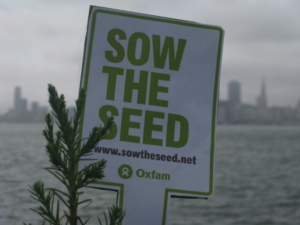
 Founded in 1970, Oxfam America works with people in more than 90 countries to create effective and lasting solutions to end poverty and campaign for social change. Here are 8 things you should know about the organization.
1. Oxfam America works on a global level to reduce poverty, hunger and injustice.
Oxfam America operates on the belief that poverty is wrong. They work on long-term solutions that address the underlying causes of poverty, and campaign for social change. Current Oxfam America projects include GROW, a movement that aims to build a better and more sustainable food system, and Aid Reform, which works to increase the U.S. government’s commitment to poverty-reducing foreign aid.
2. They are trustworthy.
Oxfam America is highly rated by several independent charity evaluators. The American Institute of Philanthropy and Charity Navigator have both given the organization high ratings.
3. They partner with local and national organizations.
Oxfam America aims to help local partners become self-sufficient by building alliances, networks and effective organizations. They create reciprocal relationships, learn about solutions to poverty from their partners, and providing them with funding and collaboration opportunities. Oxfam America works with their partners to provide communities with finance options, disaster and conflict relief, food security, and safe water sources, among many other things. Along with 17 other organizations, Oxfam America is united in the global effort to fight poverty; they work with 3,000 local partners in more than 90 countries and invest more than $1.1 billion annually to poverty-related causes.
4. They act on the belief that fighting poverty is about fighting injustice.
Oxfam America holds the strong belief that poverty usually arises from the violation of people’s basic rights. Acting on this belief, Oxfam America promotes the idea that knowledge is power. By educating individuals on their basic human rights, the organization helps create communities that keep their governments and government officials in check. Accountable governments change the systems that keep people trapped in poverty.
5. The projects they fund are community-driven.
By using solutions that are unique to the location and context of the problem, Oxfam America is developing the most sustainable and appropriate methods to combat global poverty.
6. Poverty puts people in harm’s way.
Oxfam America believes that poverty leaves people and communities in vulnerable conditions. They believe that poverty forces people to live in dangerous areas or build unstable houses in areas prone to natural disasters. Oxfam reports that the impacts of climate change will result in unprecedented pressure on global food prices, which will be a huge burden on the world’s poorest people who already have to spend up to 75% of their income on food.
7. They believe that laws, policies, and institutions have an enormous impact on poverty.
Much like the Borgen Project, Oxfam America works with decision-makers to encourage them to respect the views of the poor communities and to implement foreign aid programs that will be most effective in reducing poverty. By opening dialogues with the people who are directly affected by poverty, Oxfam America is giving a voice to those who need one the most.
8. Everyone can join in with Oxfam’s effort to fight against poverty and injustice.
Oxfam America believes that everyone has a part to play in the fight against poverty; by encouraging individuals to work together, the organization aims to raise awareness and inspire action on the world’s most urgent issues.
– Chloe Isacke
Sources: Oxfam America, The Guardian
Photo: Flickr

El Salvador Fights to Protect Water
The Central American country of El Salvador fights to protect water. Twenty-five percent of the rural population do not have access to potable water, and an estimated 90% of the country’s surface water is believed to be “heavily contaminated.” A preliminary report released last month on the effects of gold mining on El Salvador’s water supply reveals that in areas where mining was conducted, local populations experienced high rates of cancer, kidney failure, and diseases of the nervous system. A 2012 study of the San Sebastián river by a government agency showed that the river contained 9 times the acceptable level of cyanide and 1,000 times the acceptable level of iron. The river is now famous for its unnaturally orange-colored contaminated water.
Water Contamination Sparks Environmentalism in El Salvador
Much of this contamination is the legacy of large-scale industrial metal mining in the resource-rich country. Such mining both uses and contaminates large amounts of potable water. Many citizens of El Salvador also argue that multinational mining companies that claim to bring jobs and economic growth in fact extract resources but contribute little to the local economy.
These negative environmental and economic effects have galvanized Salvadorans in a grass-roots environmental movement, a fight to protect water from mining contamination. Local residents, led in part by those from the canton of San Sebastián, have teamed up with international NGOs to protest mining contamination, publicize the issue internationally, and conduct scientific studies to support their claims that industrial mining endangers the nation’s environment and people. The movement has reached to the top levels of government, with strong national and international repercussions. In 2008, then-President Antonio Saca stopped issuing new mining permits, and the government is currently debating a bill that would make El Salvador the first country to ban industrial metal mining altogether.
International mining companies are fighting back, however. Commerce Group, an American company that operated the mine near the San Sebastián river, and Pacific Rim, a Canadian company, have filed complaints against El Salvador before a World Bank trade tribunal based in Washington, D.C. The companies are suing the Salvadoran government for $400 million dollars for violating their rights as investors. Decisions on these cases have not yet been reached. In the meantime, Salvadorans continue to debate the best ways to preserve their water and devise a model of development that is both sustainable and economically beneficial to all sectors of society.
– Délice Williams
Source: The Guardian, Mining Watch, StopESMining
Photo: Mesa Nacional
Global Nutrition for Growth Compact
The Global Nutrition for Growth Compact was established with the understanding that malnutrition needs to be combated just as much as malnourishment. Malnutrition occurs when a person has an adequate amount of calories but consumes a diet that is lacking in nutrients that are essential for growth and development. On the other hand, malnourishment is a condition resulting from a lack of calories in a diet. While malnourishment can directly lead to death through starvation, malnutrition more than doubles a child’s likelihood of dying due to weakened bodily functions. Poor nutrition is believed to be the primary cause of 45% of child deaths overall.
Fortunately, the number of children in the world who are stunted (or never reach their potential height) as a result of malnutrition dropped from 253 million to 167 million in the two decades between 1990 and 2010. The improvement is credited to a greater understanding of nutritional regimens that prevent malnutrition. Programs that combat malnutrition focus on remedies that emphasize breastfeeding and provide vitamins and nutrients to pregnant women and developing children. Adequate nutrition is critical for pregnant and breastfeeding mothers, as it provides the components needed for infant development and healthy weight gain. Likewise, it is essential that developing children receive vitamins and nutrients for healthy mental and physical growth.
Researchers believe that a million lives could be saved each year through the implementation of a malnutrition reduction program. In addition to saving lives, the program will also provide children with the nutrients they need for full brain development, a component that helps children be successful in school.
– Jordan Kline
Source: IRIN News
Photo: Action Against Hunger
#ThisAbility Portraits Promotes Awareness
The campaign, marked by the hashtag #ThisAbility, encourages people to submit pictures of people overcoming their disabilities in astounding ways. The top 15 photographers will have their work displayed at UNICEF’s Manhattan headquarters, and the top 5 will receive a variety of UNICEF gear.
Nearly 100 million children suffer from a mild or severe disability, according to the report. Though this figure is largely speculative, they add up to 1 in every 20 children aged 14 and younger. While disabilities come in varying degrees, the similarity “lies [in] the shared experience of being defined and judged by what one lacks rather than by what one has.”
Children with disabilities are often seen as inferior to their peers without disabilities. They experience discrimination and marginalization on a daily basis. This is mostly due to a lack of awareness by governments about the extent of the problem.
“Few countries have reliable information on how many of their citizens are children with disabilities, what disabilities they have or how these disabilities affect their lives,” according to the report. Families oftentimes don’t report their child’s disability for fear of ostracism by the community. Because the government is unaware that these children exist in such a great number, the public services never reach those who need it most.
UNICEF is advocating for full ratification of the Convention on the Rights of Persons with Disabilities, which calls for an equalization of social liberties for people living with disabilities. With this report, UNICEF hopes to receive full ratification of the treaty (27 countries still haven’t signed) and to mobilize political action on the international level.
The report ends on a hopeful note: “Disability does not mean incapability: It is the wonderful diversity that enriches humankind.”
– Kathryn Cassibry
Sources: UNICEF, Huffington Post
10 Facts About Poverty in Benin
1. Almost 40 percent of Benin’s population lives below the poverty line.
2. Initiatives supported by the IMF and the World Bank have helped Benin’s economy to grow an average of 4.0 percent annually over the past ten years, raising its national per capita income to $780 in 2011.
3. Benin’s economy relies mostly on the cotton trade, and agriculture is the main source of income for 70 percent of the country’s workforce.
4. Benin’s economy is vulnerable not only because it is based primarily on agriculture but also because re-export trade with Nigeria makes up roughly 20 percent of its GDP.
5. There are an average of 58.54 deaths per 1,000 live births in Benin, giving it the 27th highest infant mortality rate in the world.
6. 44.1 percent of Benin’s population is fourteen years old or younger.
7. The life expectancy in Benin is 56.5 years, shorter than the life expectancies of 165 other countries.
8. Benin ranks 166th on the UN’s Human Development Index out of the 187 countries and territories evaluated.
9. Benin’s hospitals provided .5 beds per 1,000 people in 2010.
10. Extreme poverty has caused human trafficking to increase in recent years. Children can be sold to rich families in neighboring countries for as little as $15.
– Katie Bandera
Sources: World Bank, UNDP, The World Factbook, ABC News
Photo: Voice of Russia
The Economist Considers the Future of Poverty
In the 1990s economic growth soared in developing countries from an average of 4.3% annually to 6% annually. China has been one of the most notable successes, reducing extreme poverty from 84% to 10% while economic growth has continued to accelerate rapidly. As China’s growth slows, it may be difficult for poverty to decline at the same rate as in previous decades. It is also a continuing challenge to raise people above the $1.25 a day line as policies reach for increasingly poverty-stricken communities that are further from the line.
The Economist is very optimistic that the goal of halving poverty again can be achieved. Despite challenges in keeping up the same pace the article argues that the world already knows what to do – it just remains to keep up the good work. They advocate continued trust in marketization and liberalization as the best processes to aid poverty reduction. It is also important to implement policies that reduce inequality and discontinue policies that emphasize inequality. Nothing reduces poverty like free trade.
– Zoë Meroney
Source: The Economist
Photo: The Economist
Global Majority & Potential Water Shortage
Water experts warned that in addition to climate change, inefficient extraction methods and pollution from the runoff of agricultural fertilizers will combine to compromise the world’s freshwater sources. Without more concerted efforts to change this situation, they warn, a global majority with soon face water shortage on a regular basis.
Already nearly a billion people do not have access to clean water. Four and a half billion people live within 50km (31 miles) of an “impaired” water source, one that is either polluted or running dry. People in the 1st world are also vulnerable as pollutants like endocrine disrupters, which have spread into rivers and other freshwater bodies in many parts of the developed world, and have been shown to cause fish to change gender.
UN Secretary General Ban Ki-moon echoed these calls to attend to the global water crisis. In a speech at the United Nations International Day of Biological Diversity, Ban said, “We live in an increasingly water insecure world where demand often outstrips supply and where water quality often fails to meet minimum standards.” He warned that current trends will make shortages all but inevitable.
Along with the scientists and officials meeting at the Bonn water conference, Secretary Ban called for the next set of Millennium Development Goals to include goals related to water sustainability. As one official at the Bonn conference stated, “There is no citizen of the world who can be complacent about this.”
– Délice Williams
Sources: Water in the Anthropocene, The Guardian
Photo: Shale Shock Media
10 Things You Should Know About Oxfam America
1. Oxfam America works on a global level to reduce poverty, hunger and injustice.
Oxfam America operates on the belief that poverty is wrong. They work on long-term solutions that address the underlying causes of poverty, and campaign for social change. Current Oxfam America projects include GROW, a movement that aims to build a better and more sustainable food system, and Aid Reform, which works to increase the U.S. government’s commitment to poverty-reducing foreign aid.
2. They are trustworthy.
Oxfam America is highly rated by several independent charity evaluators. The American Institute of Philanthropy and Charity Navigator have both given the organization high ratings.
3. They partner with local and national organizations.
Oxfam America aims to help local partners become self-sufficient by building alliances, networks and effective organizations. They create reciprocal relationships, learn about solutions to poverty from their partners, and providing them with funding and collaboration opportunities. Oxfam America works with their partners to provide communities with finance options, disaster and conflict relief, food security, and safe water sources, among many other things. Along with 17 other organizations, Oxfam America is united in the global effort to fight poverty; they work with 3,000 local partners in more than 90 countries and invest more than $1.1 billion annually to poverty-related causes.
4. They act on the belief that fighting poverty is about fighting injustice.
Oxfam America holds the strong belief that poverty usually arises from the violation of people’s basic rights. Acting on this belief, Oxfam America promotes the idea that knowledge is power. By educating individuals on their basic human rights, the organization helps create communities that keep their governments and government officials in check. Accountable governments change the systems that keep people trapped in poverty.
5. The projects they fund are community-driven.
By using solutions that are unique to the location and context of the problem, Oxfam America is developing the most sustainable and appropriate methods to combat global poverty.
6. Poverty puts people in harm’s way.
Oxfam America believes that poverty leaves people and communities in vulnerable conditions. They believe that poverty forces people to live in dangerous areas or build unstable houses in areas prone to natural disasters. Oxfam reports that the impacts of climate change will result in unprecedented pressure on global food prices, which will be a huge burden on the world’s poorest people who already have to spend up to 75% of their income on food.
7. They believe that laws, policies, and institutions have an enormous impact on poverty.
Much like the Borgen Project, Oxfam America works with decision-makers to encourage them to respect the views of the poor communities and to implement foreign aid programs that will be most effective in reducing poverty. By opening dialogues with the people who are directly affected by poverty, Oxfam America is giving a voice to those who need one the most.
8. Everyone can join in with Oxfam’s effort to fight against poverty and injustice.
Oxfam America believes that everyone has a part to play in the fight against poverty; by encouraging individuals to work together, the organization aims to raise awareness and inspire action on the world’s most urgent issues.
– Chloe Isacke
Sources: Oxfam America, The Guardian
Photo: Flickr
What “The Purge” Can Teach Us About Human Rights
For a 12-hour period, Americans are permitted to “feed their beasts” by purging themselves of their evil thoughts. All crime is legal — up to and including murder. The only citizens protected from The Purge are “category 10” officials, who viewers are led to believe are the politicians promoting the program. The Purge is glorified in society, and citizens participate without a second thought.
The film follows James and Mary Sandin, a young, wealthy couple who have made their living by selling home security systems to those rich enough to afford them. Though James and Mary choose not to partake in The Purge, they have no option but to protect themselves when their son saves a ‘target’ from being murdered. They must make the decision to protect the refugee or hand him over to those wanting to kill him.
The concept of the film forces viewers to ask themselves what they would do in the Sandins’ situation. For decades, real people have had to make these hard decisions, yet they are portrayed in the film as an abstract concept.
Rwanda. South Africa. Yugoslavia. The Holocaust. Genocide, the systemic killing of specific groups of people, has been going on almost since the beginning of time. At the end of World War II, many nations came together and promised that “never again” would they sit idly by while human beings were massacred.
‘The Purge” is an overt example of genocide. Throughout the film, characters discuss the fact that the poor are the true victims of the program. Because they cannot afford to protect themselves, they make easy targets. The rich in dystopian America have gained a sense of entitlement and view the poor as a drain on the system. They use “The Purge” as an opportunity to cleanse the nation of its “scum” and “pigs.” What is disguised as an opportunity to meet “natural, animalistic urges,” is really just an opportunity to rid the United States of a group of people viewed as undesirable.
Human rights are based on the idea that every person is a moral and rational being and should be treated with dignity. They go beyond just freedom of speech and other rights we hold dear here in the US. They are basic and primal. The very first right assured to any person is the right to life. No one human being is allowed to take the life of another for any reason. And as simple as this concept sounds, history has showed us repeatedly that this right is often disregarded. Freedom of thought, religion, speech, all of these are important, but they mean nothing without the right to life.
What does “The Purge” teach us about human rights? It teaches us that they can easily be ignored. All it takes is for a few people to not stand up and speak out, and even the most basic human right can be lost.
– Allana Welch
Source: European Convention for Protection of Human Rights and Fundamental Freedoms, Human Rights, IMDB
Photo: The Nerdpocalypse
Capital One Honored, Do More 24 Campaign Success
The convention featured speakers of various charitable foundations — including the founding CEO of the Bill & Melinda Gates Foundation and the CEO of Martha’s Table — to discuss philanthropic strategies and stories about businesses and organizations that have greatly helped their communities through donation of time, money, or supplies to those in need.
One important achievement of the conference, in particular, was the launch of the Do More 24 campaign, a short, one-day charity event led by the United Way. The fundraiser focuses on issues related to poverty and access to economic opportunities, student performance in school, and high school graduation rates for minority students. The campaign determined which problems were the most severe in the community, and in turn gave the most donor money to the nonprofits that focus on the most pressing issues. Despite its brevity, the fundraiser was able to generate over $370,000 in just the first 30 minutes and eventually raised over $1.2 million by the end of the campaign.
– Katie Brockman
Source: Washington Business Journal, Do More 24
World Bank Grants Loans for Brazilian Projects
The first project is the Sao Paulo State Sustainable Transport Project. This project aims to improve environmental and disaster management as well as the safety of the transport system in Sao Paulo. Sao Paulo is home to over 40 million people and an efficient and safe transport system is essential to keep this region competitive with the world. More importantly, this project will extend the transport system to regions that have not had access to public transportation. This project will give citizens the opportunity to find jobs in the metropolitan area and hopefully lift them out of poverty.
The second project will help millions of citizens in the South East of Brazil. It is the Belo Horizonte Urban Inclusive Development Policy Loan. This $200 million loan will help with the development of this region, which has been plagued with inequality. This project will focus on development strategies to provide safe housing to all citizens. Belo Horizonte has had increasing economic growth but an increase in irregular housing. The hope is to increase the quality of life of the low-income population.
The third project involves the municipality of Rio de Janeiro which received a $16.2 million loan for the Rio de Janeiro Strengthening Public Sector Management Technical Assistance Project. In the past decade, the administration of Rio de Janeiro has implemented several different programs such as The Family Health Strategy and new education programs to combat the high levels of poverty and inequality in the region. However, the administration does not have the money or power to implement all of these reforms immediately. This loan will help the administration to achieve these reforms.
– Catherine Ulrich
Source: World Bank, Political Press
Photo: Professional Jeweller