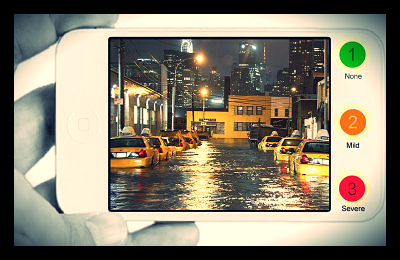
p What was learned from humanitarian efforts through the 2010 earthquake in Haiti and the Indian Ocean tsunami in 2004? Coordination is critical to effective relief efforts.
The United Nations Office for the Coordination of Humanitarian Affairs (OCHA) does just that, brings together humanitarian actors to ensure a coherent response to disasters. In this age of technology information, OCHA has been on the lookout for technological supports. Enter the Digital Humanitarian Network (DHN).
DHN is supporting OCHA and the Philippines Red Cross’s joint ongoing rapid needs assessments through geo-mapping. Geo-mapping combines crowdsourcing from micro-mapping with machine intelligence, to filter and categorize information, which is then pinpointed on virtual maps in real time.
How does this actually work? Through collecting tweets, images, and messages, real time data can be distributed to aid workers. With this up-to-date information, aid workers are informed on the needs, gaps, and accomplishments in their area of focus, allowing them to make better decisions as they move forward with their relief work.
OCHA activated DHN one day prior to the category five Typhoon Haiyan reaching the Philippines. Through the persistent work of thousands of digital humanitarian volunteers worldwide, including media monitors, translators, GIS specialists, statistical analysts, emotional support teams and standby task forces, thousands of tweets were collected and automatically filtered down to a manageable size. The filtering process is based on relevance and uniqueness of the information.
As there are more than 30 million social media users throughout the Philippines, the data collected was substantial. For instance, 230,000 tweets were collected during first 48 hours of landfall. Processing this large amount of data can take up to weeks. Through the work of thousands of volunteers worldwide were these tweets processed in a matter of hours.
The data collected is uploaded to web maps that are easily accessible to aid workers. One such map is the Open Street Map. The Open Street Map was updated through geo-mapping 300,000 times in the typhoon-affected areas in the Philippines during the first three days.
DHN relies on Internet availability to function. Thus, lack of Internet can affect the amount of data DHN is able to collect, consolidate, and distribute. However, DHN has contributed to the collaboration of aid workers during conflict, disasters, crisis, and displacement in South Sudan, the Democratic Republic of the Congo, Samoa, Syria, and now the Philippines. The typhoon in the Philippines is the largest deployment DHN has responded to.
DHN is contributing to relief work by helping to fill the information gap during conflicts and disasters. Through the social media information gathered by DHN, aid workers can work collaboratively, ensuring the most efficient use of resources.
– Caressa Kruth
Sources: IRIN News, DH Network, UNOCHA, Devex, MicroMappers

Teen Suicides Prompt Change in Rape Laws
A teenage girl in Morocco committed suicide last month after being forced to marry her rapist. Her death occurred amidst debate over a controversial article of Morocco’s Penal code which allows rapists to avoid a jail sentence if they marry their victim.
The article in question, Article 475, received global attention after a similar case in March 2012 in which Amina Filali, 16, drank rat poison after being forced to marry her rapist. At the time, activist Abadila Maaelaynine said on Twitter, “Amina, 16, was triply violated, by her rapist, by tradition and by Article 475 of the Moroccan law.”
In Moroccan society, a woman who loses her virginity – even by rape – is considered unfit to marry. “There’s a mentality that says that a girl that’s no longer a virgin is worthless,” said Khadija Riyadi, President of the Moroccan Association of Human Rights (AMDH). She went on to say that families feel like they cannot support an “unmarriagable” daughter and to make her marry her attacker seems like the only solution.
Opponents of Article 475 pressured U.S. president Barack Obama who met with Moroccan King Mohammed VI on Friday to urge the king to repeal the article.
A move to protect women from violence was submitted to the Moroccan parliament earlier this month, a year after the initial idea was proposed. Justice Minister Mustapha Ramid told Al Jazeera, “Until now, it’s still just a law project that’s being considered by parliament but hasn’t been rectified. We have not yet formally edited the article.”
“Delays in legal reform in Morocco are leaving women and girls exposed to abuse,” said Philip Luther, Middle East and North Africa Director at Amnesty International. “Unless the gap is closed between the authorities’ rhetoric about improvements to the law and their delivery of these changes, more lives will be at risk.”
– David Smith
Sources: Al Jazeera, The Telegraph, All Africa
How to Teach Kids to Give Back
1. Teach kids to be empathetic toward others in need. Children naturally want to help others, with a little guidance and encouragement it comes easily. For example, when a child at a playground sees another child fall down, their automatic instinct is to help. Foster this instinct and lead by example. When you’re walking into a store with a food drive bin, toss in a can of soup. Offer change to a homeless man on the street or water to a stray dog. These simple yet impactful acts of giving will instill empathy in children. Also, allow them to see you do this and they will have questions. This opens up conversations about giving at a very early age.
2. Take advantage of every opportunity to give back. There are always times when someone is in need of help. When you spot that need, fulfill it. The help could be as simple as holding a door open for an elderly woman or as big as volunteering at the food bank holiday drive. Moms and Dads are a child’s first and most important role model. Let your kids see that helping others is simple and an everyday occurrence.
3. Create a list of annual charity events the whole family can be involved in. There are many organizations that allow whole family involvement and help from smaller kids. In fact it’s encouraged. For instance, make it a point to give change every time your family sees those familiar bell ringers with their red kettles. Doing this each time will cause your little ones to become excited to give. Use those opportunities to start the dialog about who the money in the red kettles benefits and what a difference they are making. The Tree of Sharing is another great campaign held annually.
Children feel good knowing they are making another child’s Christmas gift wish come true. Trick or Treat for UNICEF is also a fun way for children to give back to others globally. For over 60 years UNICEF has joined little ghosts and ghouls on their journey for treats. Children simply say trick or treat for UNICEF and hold up a UNICEF print out box to hold donations. Participating in the various walks and runs for charity is a perfect way to give back in the warmer months, as well.
Make giving a part of your everyday life and it will become a part of your child’s as well.
– Amy Robinson
Sources: Giving Tuesday
Voss Foundation Brings Clean Water to Africa
At the Voss Foundation’s Women Helping Women luncheon, women enjoyed food, shopping, and good company. Most importantly, they also helped bring clean water to developing nations in Africa. By shopping at a well-curated African bazaar set up in the Dream Downtown hotel, luncheon guests contributed to the cause. The Voss Foundation, a Norwegian water company, works to bring access to clean water to regions in sub-Saharan Africa. At the luncheon, the Voss Foundation spearheaded a bazaar which sold an array of goods such as scarves, jewelry, and woven home goods. The merchandise was created by women whose communities had benefited from Women Helping Women’s work, which includes building wells and latrines and providing sanitation facilities.
According to reports, the event was a success. The event had a big impact on the fashion world as renowned female personalities such as designer Jill Stuart, author Susan Fales-Hill and beauty queen Nana Meriwether, attended the event; their presence alone “underscored an important reality about the water crisis”. In addition, the fact that the attendees were mostly female showed that the water crisis in Africa largely affects females. According to Kara Gerson, the foundation’s director, “women and girls who are responsible for clean water and so they spend hours carrying heavy loads of water on their backs and heads back to their families. There are obviously physical issues with carrying heavy loads of water long distances, there are safety issues when the women are alone and the water that they are carrying might not even be clean”. Model and actress Selita Eban who was honored by Women Helping Women in 2012 for her charity work in Sierra Leone, agrees with this notion.
– Stephanie Olaya
Sources: Voss Foundation, Wall Street Journal
Photo: Action Against Hunger
Tweets Assist Efforts in the Philippines
p What was learned from humanitarian efforts through the 2010 earthquake in Haiti and the Indian Ocean tsunami in 2004? Coordination is critical to effective relief efforts.
The United Nations Office for the Coordination of Humanitarian Affairs (OCHA) does just that, brings together humanitarian actors to ensure a coherent response to disasters. In this age of technology information, OCHA has been on the lookout for technological supports. Enter the Digital Humanitarian Network (DHN).
DHN is supporting OCHA and the Philippines Red Cross’s joint ongoing rapid needs assessments through geo-mapping. Geo-mapping combines crowdsourcing from micro-mapping with machine intelligence, to filter and categorize information, which is then pinpointed on virtual maps in real time.
How does this actually work? Through collecting tweets, images, and messages, real time data can be distributed to aid workers. With this up-to-date information, aid workers are informed on the needs, gaps, and accomplishments in their area of focus, allowing them to make better decisions as they move forward with their relief work.
OCHA activated DHN one day prior to the category five Typhoon Haiyan reaching the Philippines. Through the persistent work of thousands of digital humanitarian volunteers worldwide, including media monitors, translators, GIS specialists, statistical analysts, emotional support teams and standby task forces, thousands of tweets were collected and automatically filtered down to a manageable size. The filtering process is based on relevance and uniqueness of the information.
As there are more than 30 million social media users throughout the Philippines, the data collected was substantial. For instance, 230,000 tweets were collected during first 48 hours of landfall. Processing this large amount of data can take up to weeks. Through the work of thousands of volunteers worldwide were these tweets processed in a matter of hours.
The data collected is uploaded to web maps that are easily accessible to aid workers. One such map is the Open Street Map. The Open Street Map was updated through geo-mapping 300,000 times in the typhoon-affected areas in the Philippines during the first three days.
DHN relies on Internet availability to function. Thus, lack of Internet can affect the amount of data DHN is able to collect, consolidate, and distribute. However, DHN has contributed to the collaboration of aid workers during conflict, disasters, crisis, and displacement in South Sudan, the Democratic Republic of the Congo, Samoa, Syria, and now the Philippines. The typhoon in the Philippines is the largest deployment DHN has responded to.
DHN is contributing to relief work by helping to fill the information gap during conflicts and disasters. Through the social media information gathered by DHN, aid workers can work collaboratively, ensuring the most efficient use of resources.
– Caressa Kruth
Sources: IRIN News, DH Network, UNOCHA, Devex, MicroMappers
Uganda Population at Record High
Today the nation of Uganda has a population of 27.7 million and this number continues to increase. According to the Population Research Bureau (PRB) the 27.7 million people will reach 130 million by 2050. Researchers argue that this high rate of growth will surely keep the nation in financial difficulties. Ugandans already have limited resources and with this projected increase, the country will have to find a way to monitor the nation’s population explosion.
The current state of Uganda is largely due to the government’s lack of intervention and unavailable resources for family planning. PRB has stated that merely 20 percent of married women have available contraception. With such a low percentage it is no surprise that the average amount of children per woman is 6.9. This is an alarming amount considering the global average to be 2.7 children per woman. In fact, several have pointed this issue of high birth rates as being encouraged by Ugandan government officials since President Yoweri Museveni has stated that this population explosion is a “great resource” for Uganda.
This increasing population is also attributed to fertility levels which have escalated since 3 decades ago. The Total Fertility Rate (TFR) has been kept at a high in rural areas compared to urbanized areas. Seeing as Uganda’s Population Report 2013 indicates that 88% of Ugandans live in rural areas, the fertility level is basically high for nearly all Ugandans. According to the Uganda Bureau of Statistics, there has been a markedly low infant mortality rate which coupled with the high fertility rate, has led to this extraordinary population growth.
Most Ugandans living in rural areas face extreme poverty, with poor infrastructure, limited supplies, lack of healthcare and famine in specific areas of the region. Several government officials are concerned whether the current demographic will impede economic growth. Some argue that the large population will begin a transformation, given how countries such as China and India have improved their economies after the pressure of rapid growth. The World Bank argued in a recent report that economic growth in Uganda would rise if fertility rates dropped and households learned to save or invest their money. What is certain is that today’s world population of 6.6 billion is expected to reach 8 billion by 2025 and Uganda will soon find itself having one of the highest populations among China and India.
– Maybelline Martez
Sources: World Watch, UBOS, Daily Monitor
Crisis in China: Online Child Trafficking
While technology provides many benefits to an ever-globalizing world, it also has several down falls. With technology comes the digital marketplace, including online black markets. Throughout China and the world, traffickers, doctors and parents are using the Internet to sell children and babies for cash.
A young couple from southern China was arrested last week for posting their baby for sale online, International Business Times (IBT) reports. This child was priced at 40,000 Yuan, about $6,500 USD. A child trafficking activist who –pretending to be an interest buyer – intercepted the advertisement, alerted authorities and met the father at a nearby hospital where he was then arrested. The parents claimed they intended to put the child up for adoption, but were unaware of the proper procedures.
A similar incidence occurred a month earlier. Another couple sold their daughter for 50,000 Yuan via an online auction. The couple then used the money to purchase material items such as shoes and Apple products. According to the Telegraph, the parents expressed that selling the child was in the child’s own interests: “We did not give the baby away for money but to give [the baby] more security.”
Doctors have also been caught selling newborn children, though these transactions are not necessarily online. Just recently, an obstetrician from Fuping was arrested for selling a newborn child to traffickers after convincing the mother that the baby was too ill to survive. Under these false pretenses, the mother willingly gave the child over to the hospital. Shortly after, the mother changed her mind, demanded the baby back and called the police. According to the Daily Mail Online, police are investigating at least seven similar cases in the region.
Online trafficking represents the newest phase of a longstanding problem in China. Child trafficking rings have been operating for years, generating outlandish profits. In August, authorities broke up a major trafficking network spanning more than four Chinese provinces and trafficking ten children annually, says IBT. The willingness of parents to sell their children to traffickers stems from factors such as deep poverty and lack of education.
– Mallory Thayer
Sources: The Daily Mail, International Business Times
What Has Become of Pol Pot’s Regime?
Pol Pot’s Khmer Rouge regime is known for the most extreme case of genocide in modern history. The ultra-communist regime killed teachers, intellectuals, foreigners, business owners, and almost anyone who did not adhere to the Pol Pot ideology. Nearly two thirds of Cambodia’s population was slaughtered from 1975 to 1979.
In 1994 the Khmer Rouge party was outlawed. In 1997, Pol Pot was arrested by one of his own colleagues, Ta Mok. A year later, Ta Mok was arrested by Cambodian officials for his crimes during the Khmer Rouge years. Mok, “the Butcher,” was notorious for his cruelty as one of the top regime members. Kaing Guek Eav, known by his nickname Duch, was arrested in 1999. Duch was a prison chief at S-21 prison, where 17,000 Cambodians died.
The UN recommended an international tribunal and truth commission try the Khmer Rouge leaders for war crimes and crimes against humanity. The trials began in the early 2000s and are ongoing. Pol Pot died the night the Khmer Rouge agreed to turn him over to an international tribune. Whether his death was a suicide or due to natural causes remains debated.
Few major regime members were arrested, and many, including Ta Mok, died before reaching trial. The most recent trial is of “big brother number two” and former president Khieu Samphan. Both men are aging and ill, leading many to doubt these criminals will ever face justice. While the judicial system is ‘fair,’ their trials raise questions over whether the punishment fits the crime.
The leaders of the Cambodian genocide have gone largely unpunished. A combination of international bureaucracy, corrupt Cambodian government, and residual fears of the regime have prevented justice. Cambodia remains an unstable country, and some fear that continuing the war crimes trials will only stir up political unrest.
– Stephanie Lamm
Sources: Peoples of the World, Reuters, PBS
Photo: World Without Genocide
4 Children’s Books on Global Issues
Children are the future. Today, our youngest generation has the ability to learn about global issues through reading. Check out the educational books below:
1. Clean Water for Elirose by Ariah Fine
This book tells the story of Maria and her friends who love all kinds of different drinks. When they learn about a girl their age who doesn’t have clean water to drink they set out to help her find access to what she lacks. Literature review site goodreads.com describes it as a “[…] children’s picture book about the lack of clean drinking water in the world and how we can help.” All profits from this book go to support clean water projects.
2. Little Things Make Big Differences: A Story About Malaria by John Nunes and Monique Nunes
Little Things Make Big Differences: A Story about Malaria, is a story about a young Tanzanian girl named Rehema. The story focuses on Rehema’s battle with one of the world’s most fatal diseases, malaria. When she was a baby, Rehema was infected with the disease but survived because her parents were able to get treatment for her. In the book, Rehema describes what children in rich countries can do to help fight malaria.
3. The Secret River by Marjorie Kinnan Rawlings
This book depicts how poverty affects families, with a focus on kids. Rawlings’ children’s book tells the story of a girl poet named Calpurnia and her family who worry that they will go hungry because there are no fish left in the river. Luckily, Calpurnia meets a medicine woman in the forest who helps her find the way to a secret river, teeming with catfish, which appears only when desperately needed and disappears when the heart and belly are full. The ending teaches kids that there is always a way to help aid those in need.
4. The Can Man by Laura E. Williams
Laura E. Williams provides a sweet but direct lesson about poverty in today’s society. Williams tells the story of a young boy named Tim who fantasizes about getting the skateboard of his dreams. But Tim’s parents can’t afford to buy him the skateboard for his birthday, so he puts on rubber gloves and starts collecting cans in a quest for cash. Soon he finds himself racing a homeless can collector to gain access to the best spots in the neighborhood for cans. As he gets to know “The Can Man,” Tim learns there are things in life more valuable than any object.
– Stephanie Olaya
Sources: Good Reads: Clean Water for Elirose, Good Reads: Global Issues for Kids, One, Huffington Post
Photo: Clean Water for Elirose
Volunteer in the UAE
Are you ready to volunteer in the UAE?
The Borgen Project offers volunteer opportunities throughout the UAE. These positions allow flexibility and are telecommuting, so they can be done from home. These volunteer openings are a great way to be part of a global community and connect to an international network of volunteers who are want to make change for the world’s poor.
Do you like to write about international affairs? Perhaps a writer or journalist position is right for you. Want to make changes at the policy level? Become an advocate! Whether you live in Dubai, Abu Dhabi or anywhere in the United Arab Emirates, anyone can apply for the openings. Internship opportunities also exists. Click the links below to see available openings.
What is The Borgen Project?
The Borgen Project is an innovative organization that is working to engage the public in efforts to reduce global poverty. We train even the smallest voice to make a difference and to take pride in being part of the political process. Voters don’t call Congress anymore, even though our political system is built on our representatives acting on the will of the people. Make a difference in your lifetime!
Top 3 Reasons to Volunteer in the United Arab Emirates
Photo: Digital Media in UAE
5 Books by Eastern European Authors that you should read
One of the best ways to begin the fight against global poverty is to immerse yourself in another culture. Eastern Europe is region rich with folklore and literary tradition. Whether you are looking to become further acquainted with Eastern European culture, or have an interest in promoting development and human rights in the region, curling up with some of Eastern Europe’s best works is a wonderful place to find inspiration.
1. The Metamorphosis by Franz Kafka
Kafka was one of the foremost existentialist authors in the world. Czech by heritage, Kafka wrote many novels and short stories, but none more famous than his novella The Metamorphosis. The novella is the story about a salesman named Gregor who wakes up one day and discovers that he has transformed into a giant insect.
2. The Unbearable Lightness of Being by Milan Kundera
Taking place during the Prague Spring of 1968, this novel is a classic story of a man torn between his love for a young woman he has just met and his old playboy habits. But much more than that, it is an exploration of our choices as humans and chance events that influence our lives. The “unbearable lightness of being” is when we forget the weight of what happens in our existence.
3. Between the Woods and the Water by Patrick Leigh Fermor
Although Patrick Leigh Fermor was a British author, Between the Woods and the Water is a story about the Balkans and Eastern Europe at its core. It is a memoir about Fermor’s attempt to cross all of Europe on foot. Stories about crossing the Danube, Budapest, and the mystical landscape of the Balkans and Carpathian mountains all abound in this exciting journey.
4. Café Europa: Life After Communism by Slavenka Drakulic
This work is a collection of essays by Croatian journalist Slavenka Drakulic. A humorous, but always poignant work, Café Europa is an exploration of how former U.S.S.R. states are dealing with post-Communism.
5. The Good Soldier Svejk by Jaroslav Hasek
This piece is a biting satire on war and politics. Written by Czech author Jaroslav Hasek, the book tries to piece together the devastation of World War I by creating a fictional story about a well-meaning Czech man in the Austrian army.
– Taylor Diamond
Sources: Good Reads, Rick Steves