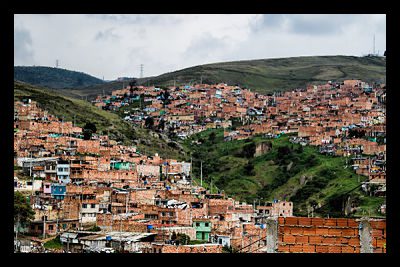
Poverty in Colombia remains an issue but progress has been made. In the 1980s, the capital city of Colombia, Bogota, started to implement a program of economic stratification of urban populations. The city ranked populations from one to six, one being the most poor and six being the wealthiest. Essentially, the stratification was supposed to direct city officials where to charge more for basic services like water and sanitation, and where to charge less. This program was officially codified into law in 1994.
Proponents of the program, like former Bogota mayor Enrique Peñalusa, say that the stratification only helps the government to serve the poor better by focusing infrastructure projects and providing cheaper services. Opponents, however, say that it makes mobility for the poor more difficult by legally separating them out, as well as increasing stigma around poverty.
When mapped out by strata, it is clear to see the physical separation of economic classes in the capital city. The wealthiest populations are clumped together in the northern part of the city while the poorest are in the south and along the outer edges. The distribution of wealth in the city is compartmentalized, depreciating an already underserved population.
Armed conflict in Colombia has been persistent for this century and half of the last. Due to this, Colombia has one of the highest rates of internally displaced persons (IDPs) in the world, reaching over five million in 2013. Many of these IDPs move to cities, especially Bogota. This shift has led to a large population without housing or resources, creating slums and shantytowns in and around the city.
Especially significant when looking at urbanization in Bogota is the development of a much poorer, extremely marginalized class on the outer edges of the city, where slums have grown significantly. Two of the largest slums, Altos de Cazuca and Ciudad Bolivar, house hundreds of thousands of people and are host to a myriad of social problems, most notably violent crime and poor access to essential resources like clean water, health care and education.
Conflict in the country has caused and contributed to countless problems, not in the least a robust drug trafficking industry. While peace talks with armed guerilla groups and narcotraficantes are ongoing, the outcome and impact for the urban and displaced poor that have been affected but not directly involved in the operations of these groups is not clear.
Levels of poverty have declined overall in Colombia in the last decade. Even more promising is the dramatic decrease in urban poverty in the two biggest cities in the country: Bogota and Medellin. While the legal stratification of urban citizens and rapid rates of urbanization have contributed to poverty in Bogota, the progress made against urban poverty is substantial. From the years 2005 to 2012, poverty has only fallen 7.6 percent in small cities in Colombia, but in Bogota and Medellin the rate has fallen 23.3 percent.
– Caitlin Huber
Sources: UNHCR, UCL, ABColombia, Business Insider, World Bank, IFHP
Photo: Pasion y Vida

Education in Comoros
Uzbekistan’s Progress in Eradicating Hunger
This year, the Global Hunger Index (GHI) ranks Uzbekistan at 5.7 percent for its undernourished population from 2011 to 2013.
More than 800 million people suffer from hunger and the GHI examines 120 of the low-income countries that account for the vast majority of global undernourishment.
In the last 14 years, Uzbekistan has shown a steady improvement in eradicating hunger, with a decline from 3.6 million to 1.7 million of the country’s population facing food insecurity.
However, the country is still in need of renewed political commitment to achieving food security in order to continue making progress against hunger, which not only stunts physical, intellectual and even economic growth but can also lead to death.
Yuriko Shoji, the recently appointed Food and Agriculture Organization (FAO) Sub-regional Coordinator for Central Asia and country representative for Uzbekistan, spoke on the topic at a launch event at Tashkent State Agrarian University.
“Despite good progress made in the past two decades and an increasingly favorable environment, the full potential of agriculture – and food security for everyone – have yet to be achieved,” said Shoji. “With renewed political commitment, and good practice that can be shared with the world, food security of each and every household is within reach.”
Shoji highlighted the key requirements for overcoming the limitations to prioritize food security and nutrition issues. The event served as a platform for discussing global hunger and malnutrition.
Uzbekistan’s positive trend to combat malnutrition serves Millennium Development Goal (MDG) 1 of halving the proportion of undernourished people by next year. It’s a goal that is within reach if Uzbekistan and other developing countries continue making political efforts toward food security.
According to the FAO, 63 developing countries have reached the MDG target and six more are on track to reach it by 2015.
Though Uzbekistan has seen significant progress in hunger, the country must continue to set the path for others that remain chronically undernourished in order to meet next year’s MDG target.
– Chelsee Yee
Sources: The Guardian, UN, Data Wrapper
Photo: EurasiaNet
Japan’s Economy Failing
Japan is currently facing a dour economic situation comparable to 2011 when a tsunami struck Japan’s eastern coast. Following the tsunami, Japan’s economy started to shrink to 6.9 percent and is now down to its lowest rate since the environmental disaster.
Economists attribute Japan’s most recent third-quarter recession to lack of investment in housing in addition to a rise in taxes enacted as a part of a series of reforms. The value-added tax (VAT) has caused the world’s third-largest economy to shrink into recession.
The unpopular rise in taxes comes at an unfortunate time for current Prime Minister Shinzo Abe who is seeking reelection.
Another burdening issue for Japan is the vast economic debt it has garnered. The debt is due to the inequality between revenue and expenditures and Tokyo’s inability to address this serious problem.
As a major player in the world economic system, Japan’s recession is affecting U.S. markets as well. It could negatively impact the U.S. economy because Japan consumes a large number of U.S. goods as its fourth-largest trading partner. A surprising number of American-brand luxury retailers rely on Japanese consumers to buy their products.
On the bright side, however, the country is currently projected to increase the quantity of exports as demand is likely to rise. Japan is currently pursuing low interest rates offered by the central bank on long-term borrowing. This will allow Japan to rise slowly out of public debt while not incurring the backlash of high interest rates.
Prime Minister Abe outlined a three-step solution to resolve the economic crisis in 2012. First, the Bank of Japan increases inflation followed by increased government monetary spending including a hefty stimulus package. The last step of “Abenomics,” as the Prime Minister’s plan has been dubbed, is to completely restructure the system by implementing tax cuts and other long-term reforms.
Abenomics is essentially the coupling of short-term policies with long-term, structural reforms aimed at strengthening the overall economy. However, the projected benefits of “Abenomics” have yet to be seen and increased taxes have plunged the economy into recession.
Eventually, the system is meant to result in higher wages that will allow an increase in consumer spending over time.
– Maxine Gordon
Sources: Yahoo Finance, The Economist, Trading Economics, CFR, Reuters
Photo: Foreign Affairs
Combatting Malnutrition in Bolivia
Malnutrition is devastating Bolivia, with over 75 percent of households lacking access to basic food items. Conditions are much worse in the indigenous and rural communities, especially among children and pregnant women. Almost a quarter of Bolivian children suffer from hunger, while one in three children under the age of five suffers from stunting — a result of chronic malnutrition. Bolivia has the second-highest stunting rates in Latin America and the Caribbean, indicating the urgent need for food security solutions.
Furthermore, among women of childbearing age, nearly 27 percent are considered so anemic that they are at risk of passing iron deficiency to their unborn children. Anemia is often the result of poor dieting, which in certain parts of Bolivia is based on cheap carbohydrates such as rice and other starchy foods high in fat.
In response to this long-standing reality, the Government of Bolivia established a National Zero Malnutrition program in 2006 to combat severe malnutrition among the most vulnerable populations. The nonprofit organization Action Against Hunger has taken on parts of the plan and has aimed to provide long-term food security and agricultural support while strengthening the healthcare system to better serve children who are chronically malnourished.
By working closely with local communities, Action Against Hunger is able to propose alternative methods to deal with seasonal hunger, including diversifying livelihood options, promoting diet diversification and ensuring affordability of more nutritious foods.
In addition, the organization has provided sustainable solutions for Bolivia’s ongoing drought problem. In 2010, the country was facing a severe drought that caused widespread water scarcity and staple crop damage. Action Against Hunger immediately secured water supplies for over 50 communities, while also helping over 4,000 farmers retool their destroyed harvests. Moreover, the team is working on community-based agricultural projects in Rio Grande’s lower basin, and other areas prone to drought, by promoting techniques that maintain soil moisture and avoid soil destruction. Some methods include demonstrating proper crop rotation techniques and teaching ways to overcome livestock overgrazing. These projects are already making great strides in combating malnutrition in Bolivia and are paving the way to a healthier and more prosperous country.
– Leeda Jewayni
Sources: FSD International, IADB, Action Against Hunger
Photo: BCPS
Women’s Empowerment Program in Afghanistan
Often in the news for its ongoing bloody conflict, Afghanistan has now made headlines for a much different reason. In early November, the United States Agency for International Development (USAID) invested $216 million in developing Promote, a program that focuses on the training, promotion and education of over 75,000 Afghan girls that will lead to a greater contribution from women in the country’s development. The million dollar investment has made Promote one of the largest women’s empowerment programs supported by USAID.
The five-year plan consists of four parts that aim to “improve women’s rights groups, boost female participation in the economy, increase the number of women in decision-making positions within the Afghan government and help women gain business and managerial skills.” Program planners will seek out women ages 18-35 who have had at least a secondary education to enroll in Promote. USAID is also seeking another $200 million commitment from additional donors that will assist them in their objectives.
Both President Ashraf Ghani and Chief Executive Officer Abdullah Abdullah attended the launch of Promote in Kabul, along with USAID Administrator Dr. Rajiv Shah. The men were keen on giving women more power and voice in government decisions and wanted to continue the extraordinary progress Afghan women have made since the collapse of the Taliban regime in the early 2000s.
U.S. Ambassador-at-large for Global Women’s Issues Catherine Russell has acknowledged this progress and emphasized that women must be even more present “at the table” and in greater numbers. First Lady Rula Ghani also added that Promote should not only reach out to women in urban areas but also the young girls in Afghanistan’s many provinces.
With help from USAID, Afghan women have already made vast improvements in health, education and empowerment. Maternal mortality has reduced exponentially leading to a 20-year increase in life expectancy and the number of girls in school is much higher, compared to 2002 when there was virtually none present. USAID hopes that Promote will continue encouraging and empowering women in Afghanistan, key components that are essential to the country’s own economic prosperity and national security. Or, as Dr. Shah puts it, “by investing in women as champions for development, we can advance peace and broad-based growth across Afghanistan.”
– Leeda Jewayni
Sources: USAID, Tolo News, Feminist.org
Photo: Washington Post
G20 Leaders Tackle Gender Employment Gap
At the G20 Summit 2014, leaders have agreed to tackle the persisting gender employment gap in their respective countries. The final agreement is to decrease the gap by 25 percent by 2025.
The gender employment gap varies from region to region. Developed regions generally have a lower gap, while developing regions have a higher gap. Currently in OECD countries, where the gap is one of the lowest, there is a 12 percent difference between the sustained, legal employment of men and women. In North Africa and the Middle East, where the gap is the one of the highest, there is a 50 percent difference in employment between men and women.
Ways of tackling the gap also vary region-to-region and country-to-country. Approaches include increasing access to education and childcare and making maternity leave options more attractive and widely available. More innovative approaches include things like fostering women in business and finance, creating opportunities for women in the public sector and encouraging investment in higher education for women.
Reaching the goal of decreasing the gap by 25 percent will add 100 million jobs for women across the world and add $1 trillion to the global economy.
In 2015, Turkey will take over leadership of the Summit. As the G20 country with one of the highest gender employment gaps, as well as its position at the crossroads of Europe, Asia and the Middle East, Turkey and its leadership will be in the spotlight on this issue. For them especially, tackling the gap will mean pulling a large number of people into the workforce, which will create opportunities for households in poverty to have another income-generator.
The G20, in an official statement, said that this agreement “will significantly increase global growth and reduce poverty and inequality.” The G20 acts, in some ways, as an agenda-setter for the rest of the world. Effects on the gender employment gap could be seen in much more impoverished areas of the world simply because it is being addressed by the biggest economies in the world market. Employing women and expanding the workforce increases generated income, possibly creating drastic, positive outcomes for poorer, smaller economies.
– Caitlin Huber
Sources: The Australian, Work Place Information, University of Toronto
Photo: Employer Rights Blog
Compassion in Community Service
His Holiness the 14th Dalai Lama made a recent visit to Princeton University to discuss the second half of the school’s informal motto “…in the service of all nations” a motto coined by former U.S. President Woodrow Wilson. During the Dalai Lama’s talk, he centered on the idea that there is a universal need for compassion. He believes that at the center of both service and scholarship is compassion. The compass to your life, he urged, can be guided and the answers will always appear clear when “your intentions matter, develop your heart, be honest with yourself, work very hard at these things, and let them direct your efforts.” He stressed these points to Princeton University students and faculty as they were looking for ways to increase their community service in the area. The Dalai Lama believes that any action of compassion has to be preceded with an external action of service for it to be sincere and maintainable.
Compassion, the Dalai Lama pointed out, must be coupled with hard work. During his talk he recognizes that he did not easily become the 14th Dalai Lama easily. As a testament to his self-discipline, he wakes up every morning 3 a.m. and begins his rituals, including three hours of meditation. Although his rituals seem extreme, he pointed out that people should not be commanded to service, forced against their will into spiritual discipline or compassionate acts. True compassion arises from a sincere affection for the other.
Another element that he focused on was the real mover of all things is love. The Dalai Lama often says that American universities are adroit in developing the mind, but not the heart. How often do people do service work intentionally and focused on developing the capacity for love? There must be a correlation, he stressed, drawn between academic excellence and kindheartedness in order for schools to be more compassionate in their actions.
Speaking through his interpreter, the Dalai Lama said: “When we talk about human connection and compassion, the focus is the person, not their culture… the primary emotion at a basic human level is that of love; the secondary level is differences; that’s where complex emotions like jealousy and competitiveness arise.” Anything that you project outward once began and came from inward. In order to give compassion you must cultivate it within yourself. Doing community service is not robot work, it takes real thoughtful actions, care and connections. Just like Newton’s law for every action there is an equal or opposite reaction, the source of compassionate action must be love.
The Dalai Lama encouraged the students at Princeton to make the world a much more peaceful place by aligning their positive energies and having a deep commitment to service.
– Charisma Thapa
Sources: Huffington Post, Princeton University
Photo: Flickr
Girl Rising: A Campaign to Educate Our Girls
Breaking the cycle of poverty and creating the cycle of education, empowerment and uplifting out of poverty. “Girl Rising,” a feature-length documentary centers on these ideas, shining light on the importance of educating our girls around the world. Millions of girls across the globe are seen useful for one thing: reproduction. Girl Rising focuses on educating girls enabling them to use their voice that they were given to stand up for their rights, wait till they are stable to have their own family and educate their children, families and communities. By breaking those obstacles that girls face from the day that they are born.
Girl Rising focuses on removing those barriers that limit these girls such as young marriage, gender-based discrimination and violence, domestic slavery and sex trafficking. Removing these barriers will not only lead to stronger, healthier, safer and more vibrant girls, it will improve the outlook of the world as a whole.
Girl Rising, created in 2013, has since turned into a global movement and has been viewed by millions across the world in campuses, neighborhoods, communities and cities across the world in order to raise awareness and funds. You can bring Girl Rising to your classroom, campus, organization and community. There are so many opportunities to raise awareness. Join the community, host a screening, facilitate a fundraiser and invest in girls education. The options are limitless.
Girl Rising is also in partnership with USAID working on the Girl Rising’s Empowering Next Generations to Advance Girls Education (ENGAGE) project. Launched in 2014, the project focuses on teaching communities to value girls by understanding their worth and the benefits of educating and empowering them. Currently, the project works in India, the Democratic Republic of Congo and Nigeria, with hopes to grow and give all girls a chance to go and stay in school, and become healthy, functioning members of their communities and society as a whole.
The Girl Rising ENGAGE campaign works to create a better world for girls by:
Girl Rising has a teaching opportunity for educators to utilize the free Girl Rising Educator’s Edition and the Girl Rising curriculum. This can lead to engaging students in meaningful discussion and lessons that encourage them to think critically about the importance of educating girls.
The Girl Rising movement is on its way of establishing a name from its beginnings as a documentary to a force that is changing the educational climate for girls across the world. CNN International was so enraptured by the Girl Rising phenomena that the network continues to celebrate the world of girls in the series new “A Girl’s World.” The series chronicles the story of seven girls in seven different countries all writing unique stories of their own. Following their ambitions, dreams, adversaries, the seven girls may all be different but they can come together with their newfound voices. “Girl Rising” and “A Girl’s World” are reminders to value and honor your grandmothers, mothers, daughters, sisters and the girls of the world.
To become an advocate and learn more about Girl Rising follow here.
– Charisma Thapa
Sources: Girl Rising 1, Girl Rising 2, CNN
Photo: Scarlet Called Scout
Encouraging Empathy Through Education
The subject matter is not science or history, but human empathy. The class is conducted by an adult teacher who is assisted by a young infant. The teacher helps the students process the growth of the child, among other experiences, in order to establish a greater sense and understanding of empathy.
Children between the ages five and twelve are taking classes on empathy. The first program started in Canada in 1996 with a mission “to build caring, peaceful and civil societies through the development of empathy in children and adults.” Founder and educator Mary Gordon is the brainchild of the program.
The classes have proven to result in increased emotional intelligence, understanding and direct empathy toward classmates. This has resulted in securing foundations against bullying, discrimination and aggression that is commonly found in schools today.
The goal of the program is to increase human empathy. The classes serve as a unique personal journey for each student. Many students may not have stable lives at home so being given the chance to speak their minds, understand their feelings and empathize with their classmates consequently establishes real human connections.
For eighteen years the program has been extremely successful. It has spread across the world from North America to New Zealand and Ireland.
Comparative research has shown that the program has positive effects on bullying, neuroscience, acts of kindness and cognitive skills within the children. Almost 80 percent of Roots of Empathy students worldwide have ‘increased peer acceptance.’ According to the Healthcare Quarterly these effects last up to three years after the student has been enrolled in the program.
Scotland is the first country to provide Roots for Empathy in every council. This has become a phenomenon that has drastically increased empathy and decreased aggression in Scotland’s youth.
During Roots of Empathy one of the major themes is ‘love grows brains.’ Students are actively taught to think about why a baby in the classroom would be crying, or why someone would feel a certain way. Rather than ignore these feelings they are taught to process them, talk about them and release them in a loving manner.
The students incorporate neuroscience into their studies as they watch a child grow from two to four months old at the start of their school year. This is so the children can watch a child grow at their greatest learning period of a person’s lifespan.
Focusing on empathy has proven to reduce bullying, increase cognitive skills and the ability to understand others feelings in order to create a more cohesive world.
– Charisma Thapa
Sources: Positive News Roots of Empathy
Photo: Flickr
Poverty in Colombia: Stratification, Urbanization Aid
Poverty in Colombia remains an issue but progress has been made. In the 1980s, the capital city of Colombia, Bogota, started to implement a program of economic stratification of urban populations. The city ranked populations from one to six, one being the most poor and six being the wealthiest. Essentially, the stratification was supposed to direct city officials where to charge more for basic services like water and sanitation, and where to charge less. This program was officially codified into law in 1994.
Proponents of the program, like former Bogota mayor Enrique Peñalusa, say that the stratification only helps the government to serve the poor better by focusing infrastructure projects and providing cheaper services. Opponents, however, say that it makes mobility for the poor more difficult by legally separating them out, as well as increasing stigma around poverty.
When mapped out by strata, it is clear to see the physical separation of economic classes in the capital city. The wealthiest populations are clumped together in the northern part of the city while the poorest are in the south and along the outer edges. The distribution of wealth in the city is compartmentalized, depreciating an already underserved population.
Armed conflict in Colombia has been persistent for this century and half of the last. Due to this, Colombia has one of the highest rates of internally displaced persons (IDPs) in the world, reaching over five million in 2013. Many of these IDPs move to cities, especially Bogota. This shift has led to a large population without housing or resources, creating slums and shantytowns in and around the city.
Especially significant when looking at urbanization in Bogota is the development of a much poorer, extremely marginalized class on the outer edges of the city, where slums have grown significantly. Two of the largest slums, Altos de Cazuca and Ciudad Bolivar, house hundreds of thousands of people and are host to a myriad of social problems, most notably violent crime and poor access to essential resources like clean water, health care and education.
Conflict in the country has caused and contributed to countless problems, not in the least a robust drug trafficking industry. While peace talks with armed guerilla groups and narcotraficantes are ongoing, the outcome and impact for the urban and displaced poor that have been affected but not directly involved in the operations of these groups is not clear.
Levels of poverty have declined overall in Colombia in the last decade. Even more promising is the dramatic decrease in urban poverty in the two biggest cities in the country: Bogota and Medellin. While the legal stratification of urban citizens and rapid rates of urbanization have contributed to poverty in Bogota, the progress made against urban poverty is substantial. From the years 2005 to 2012, poverty has only fallen 7.6 percent in small cities in Colombia, but in Bogota and Medellin the rate has fallen 23.3 percent.
– Caitlin Huber
Sources: UNHCR, UCL, ABColombia, Business Insider, World Bank, IFHP
Photo: Pasion y Vida