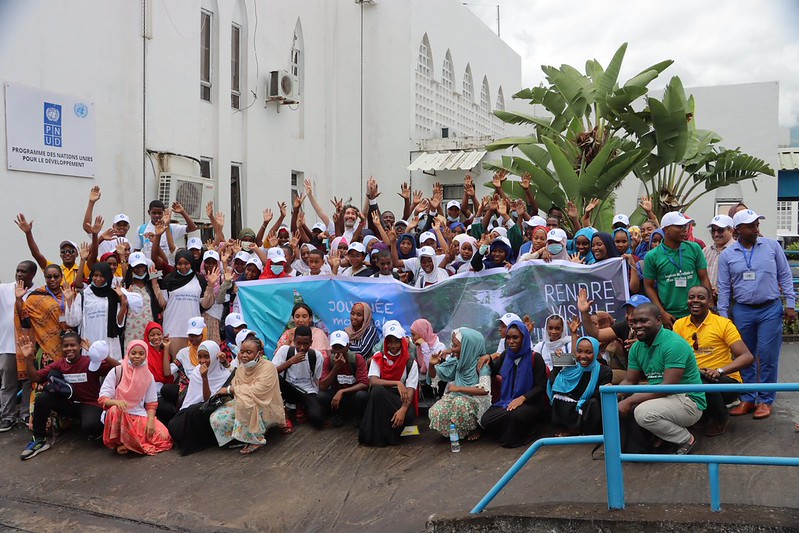
Known as one of the poorest countries in the world, the Comoros, an archipelago in the western Indian Ocean, has struggled to get children enrolled in schools. Education in the Comoros is mandatory from the age of 6 to 16, yet a large portion of the population still attains little to no education at all. Primary school lasts for six years, followed by seven years of secondary school. However, given that the country only has one university, many students seek higher education abroad.
As of 2023, Comorians attained an average of 6.0 years of schooling, leading to an adult literacy rate of around 62% (in 2022). While under French rule from 1841 to 1975, the Comoros based its education system after that of France. Today, the education system is composed of the formal school, taught mainly in French, and the Quranic school, due to the vast majority of Comorans being Sunni Muslims. Most children enroll at Quranic school first and then attend primary school.
More girls actually attend primary and secondary school than boys, and the primary school graduation rate for both is upwards of 80%. However, only 65% of girls and 61% of boys are enrolled in secondary school. Furthermore, the country has an 86% learning poverty rate (learning poverty is defined as the inability of children aged 10 to comprehend a text intended for their age level).
The Comoros faces numerous challenges that have resulted in these substandard learning rates. Education is difficult for many students to access. Furthermore, schools lack necessary infrastructure, and there are not enough teachers and materials to help students adequately learn. Finally, the Comoros is not able to manage its education system very effectively.
However, a new program called Advanced Innovative Methods to Promote Learning (AIM4Learning), funded by the International Development Association and International Bank for Reconstruction and Development, holds promise in improving the Comoros’s education system. Though this $1.54 billion program broadly targets Eastern and Southern Africa, the Strengthening Education for Better Education Outcomes (REACH) initiative aims to deliver more specific improvements to the Comoros’s education system.
By utilizing $23.32 million (provided by the International Development Association and the Global Partnership for Education), REACH will reform the Comoros’s school curriculum to foster learning in children, improve school environments by expanding infrastructure, and will also reform the management of schools in the Comoros. In doing so, REACH will address many of the Comoros’s most pressing problems in education.
REACH will aid all of the Comoros’s public schools and hopes to improve the experiences of all of the Comoros’s teachers and students. If all goes as planned, 136,469 students and almost 4,000 teachers will benefit throughout the country.
Although the Comoros has struggled to provide children with the education they need, initiatives such as REACH will hopefully allow more children to attain a better education. Improving education in the Comoros will be important to ensure the development of the nation and the well-being of its citizens.
– Leeda Jewayni, Jackson Mayer
Photo: Flickr
