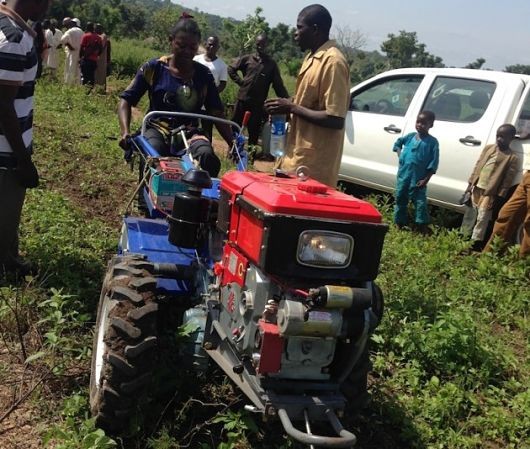
Nigeria is home to 35 million small farmers, 80 percent of whom hire laborers to help cultivate their fields. However, a shortage of labor combined with the expense of maintaining their land leads to vast under-cultivation, late planting and lost profits.
Access to better farming equipment would combat the labor shortages, but Nigerian farmers by and large cannot afford individual tractor ownership. The country lags an estimated 750,000 tractors behind the global average of tractors per 100 square kilometers of farmland.
A new company, Hello Tractor, believes they have a solution. Introducing a “smart tractor” designed for versatile use on small farms, Hello Tractor offers their product for $3,500, about the cost of cultivating 16 small farms in Nigeria.
Smart tractors are networked to the company’s cloud software, which connects tractor owners with farmers in need of equipment. Much like ride-sharing organization Uber, Hello Tractor’s sharing economy is designed to supply farmers with a low-cost, efficient alternative to time-consuming traditional labor.
“It takes about 40 days of manual labor to prepare the land,” said Jehiel Oliver, Hello Tractor founder. “Our tractors do it in eight hours.”
As with Uber, the Hello Tractor system operates by way of mobile technology, as the company clearly outlines: “A farmer simply sends a text requesting tractor service and our powerful software pairs that request with the nearest Smart Tractor owner in the market.”
Tractors then arrive within days of the request and enable farmers to complete the required labor 40 times more quickly than they would have been able to without tractor service. Farmers also use mobile banking to pay smart tractor owners for services, approximately one third of the cost of hiring manual laborers.
Hello Tractor asserts their smart tractors will enable higher land utilization as farmers more efficiently cultivate land, leading to a 25 percent increase in income and improved food security for Nigerian communities. The company believes that by its second year, use of smart tractors will enable 27,000 farmers to plant and harvest crops in a more timely and cost-effective manner.
They also estimate that 715 smart tractor owners and 2,500 service jobs will be created by the second year, offering those jobholders increased earning potential.
Hello Tractor also hopes to establish a lasting, sustainable system in Nigeria and other sub-Saharan countries. With farming resources often supplied by organizations dependent on grants and public funds, in Nigeria such equipment is limited in scale and impact. Oliver’s company hopes to promote economic growth from return on smart tractor investments and increased crop yields that will propel the nation toward greater self-sufficiency.
Based on Hello Tractor’s work, Oliver has been selected as a 2015 Echoing Green Fellow. Over the course of the next two years, fellows will receive funding ranging up to $90,000 to advance the implementation of their visions. Fellows also have the opportunity to participate in leadership development events and benefit from mentorship by top business professionals.
Oliver spoke fervently about Hello Tractor’s work: “We utilize technology to meet real needs for people that have been highly marginalized. These are women farmers who are living on, in some instances, two dollars a day or less. They have families.”
“For us to be able to bring technology to this population, to improve livelihoods, is powerful,” he continued. “And in a sustainable way. We’re really excited about it. We’re passionate about the cause.”
– Emma-Claire LaSaine
Sources: Hello Tractor, USAID, Echoing Green, ChicagoInno
Photo: ChicagoInno

China’s Central Bank: RRRs and Rural Villages
With official approval from the State Council, China’s central bank decided to cut reserve requirement ratios and benchmark interest rates for the third time in nearly five months in July. These cuts will specifically affect commercial banks that serve agricultural and rural areas, as well as provide loans to small businesses. The reserve requirement ratio (sometimes called the deposit-reserve ratio, or the RRR) is a regulation from the central bank which sets a minimum ratio (or fraction) of customer deposits that banks must hold in reserves (as currency, or note) within the bank. A decrease in RRR allows banks to more easily lend money to the institutions it supports, as a smaller amount of physical cash is required to finance loans.
Adjusting the RRR is common practice in China and is often used as a tool of domestic monetary policy. The deposit-reserve ratio has been altered several times in recent years and this is, in fact, the fourth round of interest cuts since 2014. While central banks in many nations refuse to make similar types of cuts in light of liquidity concerns, China has in the past shown leadership in this type of aggressive monetary policy. Such a policy is intended to allow for a positive credit flow towards rural and poverty-stricken areas.
Despite China’s rapid rise in recent years, growth has lately slowed—representing a transition from an economy characteristic of a rapidly-emerging nation, to a growth rate that is less fast-paced, but more sustainable. This new round of cuts reveals a strategy by China to restructure its borrowing mechanisms, as well as boost and stabilize its economy. Part of this strategy involves offering competitive advantages and lending options to small, independent businesses and agricultural enterprises.
This change, a lowering of the deposit-reserve ratio by 50 basis points (bps) for banks lending to rural, agricultural areas and to small businesses is intended to encourage financial institutions to invest in farmers, micro-businesses and rural development in many poverty-stricken areas of China. China explained its most recent round of cuts in the deposit-reserve ratios and benchmark interest rates by citing plans to “stabilize economic growth, upgrade structure and lower financing costs in society,” and describes the cuts as “conducive for financial institutions to support mass entrepreneurship and innovation.”
The new measure allows institutions to more easily lend money to small businesses in rural China and will provide more credit influx towards these small (but crucial) enterprises, which make up an important part of China’s economy. The cuts not only lower the costs of financing small enterprises but lower loan rates. This allows China’s financial institutions to encourage innovation and entrepreneurship amongst the least developed areas of society.
– Melissa Pavlik
Sources: CCTV, The New York Times, The People’s Republic of China
Photo: China.org.cn
World Bank Approves Millions for Ghana’s Gas Project
Ghana’s Sankofa Gas Project will soon be getting help from the World Bank in the sum of $700 million. It is the hope that with such an infusion of funds, Ghana will be able to address its serious energy needs through development and affordable domestic natural gas production.
The Republic of Ghana is a small African sovereign nation situated off the coast of the Atlantic Ocean and in the Gulf of Guinea. With a population of approximately 25 million, it has enjoyed a growing economy and is anticipated to be the first African country to become developed between 2020 and 2029.
“Ghana Vision 2020,” as their economic plan is called, also projects it to be a newly industrialized country between 2030 and 2039. However, in recent years, despite its energy-rich natural resources, the nation has suffered macroeconomic shocks partly due to challenges being faced by the country’s power sector.
Ghana is believed to have between 5 billion barrels and 7 billion barrels of petroleum in reserves, which is the fifth-largest in Africa and the 21st to 25th largest proven reserves in the world. It also has up to 1.7×1,011 cubic meters (6×1,012 cubic feet) of natural gas in reserves, which is the sixth-largest in Africa and the 49th largest natural gas proven reserves in the world.
Yet, public resources have been significantly drained in recent years. The government has spent millions in fuel subsidies as water shortages for hydropower, erratic gas supplies from external sources and delays in the development of domestic gas resources and new power plants have led to frequent power outages mostly affecting the poor. The new project is meant to help offset these issues with the development of the vast natural energy resources Ghana has.
Recently, the World Bank’s Board of Directors approved a unique combination of two guarantees for the Sankofa Gas Project—one from the International Development Association (IDA) and another from the International Bank for Reconstruction and Development (IBRD).
The IDA payment guarantee of $500 million will support timely payments for gas purchases by Ghana National Petroleum Corporation and an IBRD Enclave Loan guarantee of $200 million will enable the project to secure financing from its private sponsors.
Together, the guarantees are expected to mobilize $7.9 billion in new private investment for offshore natural gas, representing the biggest foreign direct investment in Ghana’s history.
The Sankofa Gas Project and its exploration and commercialization of the gas, located 60 kilometers (37.37 miles) offshore will fuel up to 1,000 megawatts of clean power generation, replacing polluting and expensive oil-burning electricity.
The Sankofa field is expected to begin production in 2018, and, once operational, Ghana will be able to reduce its oil imports by up to 12 million barrels a year and cut carbon emissions by 1.6 million metric tons of carbon dioxide annually.
The energy project will be crucial in securing Ghana’s natural gas resources and a more affordable reliable power supply. It will also be essential for economic development and a boost in the quality of life for Ghanaians and the rest of Sub-Saharan Africa.
– Jason Zimmerman
Sources: The World Bank, Bloomberg, Graphic
Photo: WAdr
Congress’s Newest International Basic Education Caucus
Last week, Representative Dave Reichert (R-WA) and Representative Mike Quigley (D-IL) officially launched the newest caucus in Congress: the bipartisan International Basic Education Caucus.
These two members came together across party lines to encourage a commitment from both Republicans and Democrats in support of basic-quality education around the world. The caucus, officially launched on June 24, 2015, is encouraged and supported by several partner organizations, including the Global Campaign for Education (GCE-US), RESULTS and the Basic Education Coalition. It aims to promote understanding in the 114th Congress of the many global issues associated with inadequate primary education in developing countries — including increasing economic and security issues in the United States. The caucus is intended to encourage its members — and Congress at large — to think of universal education not just as an altruistic good, but as a critical strategic advantage for the United States.
With over 121 million children and adolescents out of school around the world, U.S. funding for international education in developing nations has become increasingly important. Education is the key to breaking the cycle of poverty in these nations. The caucus will not only promote understanding of the types of challenges that arise from a lack of quality, universal education, but will also encourage bipartisan legislation to address these challenges.
One such piece of legislation is the Education For All Act, which has been introduced in previous sessions of Congress, most recently in 2013 by Congresswoman Nita Lowey (D-NY) and Congressman Reichert (R-WA). The bill, which had 76 cosponsors in the House and the Senate, was intended to amend the Foreign Assistance Act of 1961, to include further assistance for developing nations in order to promote universal primary education around the world. It simultaneously strengthened the U.S.’s commitment to global education and supported the means by which developing societies could become sustainable and independent. Though the bill did not pass when introduced, it is possible that the new caucus will bring about increased support for similar pieces of legislation in coming sessions.
While there are numerous congressional caucuses that do very little, there appears to be a reason to be optimistic when considering the future of the International Basic Education Caucus. The caucus will take part in numerous activities, including sponsored briefs on basic education issues, congressional receptions in coordination with partner organizations and letters to the presidential administration and to various world leaders. Such activities are intended to help increase support in Congress for basic international education programs, improve understanding of the seriousness of global education issues among world leaders and establish the means with which to respond to attacks on education, such as recent attacks on schools by Boko Haram in Nigeria or by the Taliban in Pakistan.
Representative Reichert commented upon the caucus’s launch, saying, “If we are going to spread freedom, promote economic growth, enhance stability and security and alleviate poverty around the world, the best way to do that is by first ensuring every young child […] has access to basic education.”
An innovative and historic effort, the bipartisan International Basic Education Caucus has the potential to make a real impact in developing nations and the world at large.
– Melissa Pavlik
Sources: Basic Education Coalition, Congressman Mike Quigley, National Education Association
Photo: Flickr
Massive Open Online Courses Take the World by Storm
The New York Times declared 2012 the year of the MOOC – Massive Open Online Courses. They have made a huge splash since then. Organizations like EdX and Coursera have spread knowledge online to millions across the world. Where are these online courses most common? The developing world.
Both Coursera and EdX are based in the United States but are more popular in places like China, Rwanda and Brazil. A lot of the popularity in the idea of MOOCs is their ability to reach everyone, especially those that might not have access to the knowledge and content divulged by the online courses.
Interestingly, MOOCs have only recently jumped on the radar of policymakers in governments of low-income countries. Electrical engineering professor in El Salvador, Carlos Martinez, took an electrical circuits class on EdX and thought it was so good that he began an adventure around El Salvador advocating for MOOCs.
Why did he have to advocate? Because his own university did not support his ideas about the online courses. After his journey, he enrolled 50 of his electrical engineering students and ran the class ad hoc, without grades or official assignments, with an experiment in a hallway every week instead of a proper lab.
There have even been reports of the developing world being “MOOCed out,” that they were not effective and that very few individuals who began a course online actually completed it. However, if utilized correctly, MOOCs can be a powerful tool for education in the developing world.
Martinez explained the best benefits of MOOCs —“I want to let the new ideas in, raise the bar and change the curriculum.”
This is exactly what MOOCs can be used for. While online courses are valuable opportunities for individual learners, they are even more useful when utilized in small groups of informal learners to supplement already existing education, according to Martinez. More and more, users of MOOCs in other countries are creating a new education model by “combining screen time with face time.” By mixing the two, small groups of informal learners foster a learning environment through sharing ideas with peers and mentors. It gives learners a taste of education from the first world.
A perfect example of the power of MOOCs used in a group is Kepler University to supplement formal university education in a group setting in Rwanda. They hope that their blend of MOOCs and lecture-style courses can make an impact on the education of potential undiscovered talents.
One of the huge advantages of MOOCs is that they level the playing field. They bring elite education to anyone with Internet access. With the growing spread of the Internet, more and more will have access to the great wealth of online courses.
— Greg Baker
Sources: Slate, New York Times, World Bank, Technology Review, Al Jazeera, The Verge
Global Poverty Ignored at GOP Debate
While the potential Republican presidential candidates wasted no time discussing illegal immigration and the Clinton Administration at this Thursday’s GOP debate, one topic was noticeably absent from the table: global poverty.
According to the U.S. Census Bureau, in the United States alone there are around six million more people living below the poverty line than there were in 2008. About 45 million Americans are registered as poor—around 15 percent of the country’s total population.
On a more global scale, according to UNICEF, 22,000 children die worldwide every day due to poverty-related causes. In 2014 alone, 98,000 died in India due to a lack of sanitation, clean drinking water and nutrition. In 2014, over 82 million people in China lived on less than $1 a day.
Still, even in the face of such pressing issues, the GOP candidates chose to spend their allotted speaking time by further alienating women, immigrants and the poor. According to The Huffington Post, the words “immigration” and “illegal” were spoken around 40 times during the debate, while “poverty” and “poor” chalked up only three and four mentions, respectively.
Presidential campaign debates should be a platform for discussing the country and the world’s most prominent issues. If this GOP debate was any indication, the current Republican Party presidential candidates care little about the world’s poor.
– Alexander Jones
Sources: Deutsch, McCoy, Redden
Photo: Flickr
World Bank: Public in Favor of Global Health Initiatives
The study asked respondents in France, Germany, Japan, the United States and the United Kingdom a series of questions about global issues. A total of 4,000 interviews were conducted, including some that focused on members of the public with university degrees who follow global news closely.
The study reached three important conclusions.
First, many people were concerned about global health and outbreaks of infectious diseases. This is largely due to the outbreak of Ebola, which made headlines around the world in previous months.
In total, 72 percent of those polled followed Ebola news closely over the past year. Among those respondents who are college-educated and who follow global news closely, 85 percent followed Ebola news closely.
Many respondents (31 percent) ranked global health as one of their top three important concerns, just behind terrorism (60 percent) and global warming (40 percent).
Respondents were also concerned that their country was not ready for the next global health outbreak. According to 40 percent of responses, the global community will face an epidemic within the next ten years. Those living in the United States, the United Kingdom and France were most concerned about global infectious disease preparedness.
Finally, and perhaps most importantly, respondents in the survey agreed that it would be of great benefit to increase funding for global health measures in the developing world.
Doing so, most believed, would protect their own countries from the spread of infectious diseases originating abroad. Many felt this would be cost-effective and were supportive of doctors and nurses from their own countries going abroad to help.
The results shed light on changes in public perception of global health following the Ebola outbreak. The anxiety stemming from that event has launched global health into the forefront of international issues, alongside terrorism and global warming.
There is hope that this increased awareness might result in greater levels of funding for preventive measures.
– Kevin McLaughlin
Sources: Devex, Newsweek, World Bank
Sources: Pixabay
New Efforts to End TB
Tuberculosis (TB) is a disease that is largely associated with countries’ health care systems and with other factors relating to health such as nutrition, sanitation and housing. Therefore, it is crucial to help combat TB in developing countries, especially where the disease continues to be a problem.
In 2014, the World Health Assembly approved the End TB Strategy, which aims to end the epidemic of Tuberculosis by 2035. Because of this, the Stop TB Partnership Task Force is developing a plan to make significant progress toward the End TB Strategy goal.
Additionally, Ministers of Health from Brazil, Russia, India, China and South Africa (BRICS) developed a strategy to help end Tuberculosis in their countries. The Ministers established a plan that would provide universal access to medicines for all people with Tuberculosis in BRICS countries, as well as low or middle-income countries. Also, they developed a 90-90-90 goal. In BRICS countries, 90 percent of people should be screened for Tuberculosis, 90 percent should be diagnosed and started on treatment and 90 percent of treatments should be successful. Scientific research on things like drug-resistant strains of Tuberculosis and service delivery of TB were also agreed upon by the Ministers. Given that 50 percent of all TB cases and about 60 percent of MDR-TB cases occur in BRICS countries, these efforts could make a large impact.
There are also two new drugs that can be used to treat Tuberculosis: bedaquiline and delamanid. These drugs can help fight TB strains that are resistant to other antibiotics. The United States Agency for International Development (USAID) and the Johnson & Johnson affiliate, Janssen Therapeutics, will provide bedaquiline to patients for free in more than 100 low and middle-income countries where people are suffering from strains of Tuberculosis that are resistant to two or more antibiotics.
Tuberculosis is still a problem in developing countries. There are 24,000 new cases and 4,000 deaths from the disease every day. Recently, however, there have been many new efforts that aim to end TB. If we continue to try and combat Tuberculosis, the tides will change in the war against this disease.
– Ella Cady
Sources: Impatient Optimists, Stop TB, WHO
Photo: Stop TB
Clean Drinking Water in Kenya
Water and sanitation. Proper access to both is an issue that bedevils developing countries all over the world, and Kenya is no different. A new water-dispensing service is trying to change that.
Water has always been a huge issue in development work. Its importance is paramount to life itself – without water, humans cannot survive. While millions of people in the developing world do have access to water, oftentimes it is not safe for drinking. This causes diseases to spread and death to follow.
The Millennium Development Goals (MDGs) set out targets for clean drinking water. Goal 7, Target 7.C’s aim was to “halve, by 2015, the proportion of the population without sustainable access to safe drinking water and basic sanitation.” This goal was met five years ahead of schedule – between 1990 and 2012, 2.3 billion more people gained access to safe drinking water. However, some have claimed that Target 7.C set the bar too low in terms of achievement.
A major issue connected to clean drinking water is access to proper sanitation for all. While the clean drinking water MDG has been met, sanitation has not done as well. One billion people still openly defecate all around the world, for lack of a better option. This then affects drinking water – it is a vicious cycle.
Part of the problem with supplying clean drinking water to the world’s population is that it is growing, making the task even harder. The population of Nairobi in 1963 was 300,000. Now, it is home to 4.2 million, and this figure is expected to grow to 14 million by 2050. If the world cannot supply its current population with clean drinking water, then how will it possibly keep up with the globe’s rapidly expanding populace?
The answer might begin with four new water dispensers that have been installed in Nairobi’s slums, which might help to change Kenya’s water infrastructure. They operate like vending machines – put money in, and water is dispensed out. This has reduced both the cost of water for slum residents as well as the distance needed to travel to acquire it. The water is purer and cleaner than other options – before the machines were installed, many residents got their water from sellers that dragged jerry cans on carts through the streets. Without water pipes in the slums, this was the only option.
The water-dispensing machines present a cheaper and cleaner option than the street vendors. It is a win-win situation for all involved – the government, who has put the machines in place, makes money on the water, and the citizens pay cheaper prices. Before, people would venture to neighborhoods with water pipes and break them to siphon off water, essentially stealing water from the government.
Now, prices are six times cheaper than they were before. Pre-dispensing machine, water prices hovered around three shillings, the equivalent of around three pennies in the U.S. Now, prices have been reduced to half a shilling. This might not seem like much, but to some that are unemployed or only make US$2 a day, the reduction is huge.
The payment system is done through mobile payments or water smart cards that residents can load money on. The machines are also operated by local residents who earn up to 40 percent of the profits from the machines as an incentive to keep them running and prevent vandalism. If Nairobi can continue to set an example for what these machines can do, they might go much further than a few slums in Kenya’s capitol.
– Gregory Baker
Sources: The Guardian, All Africa, UN
Photo: Stratfor
“Smart Tractors” Help Small Farmers Grow Profits
Nigeria is home to 35 million small farmers, 80 percent of whom hire laborers to help cultivate their fields. However, a shortage of labor combined with the expense of maintaining their land leads to vast under-cultivation, late planting and lost profits.
Access to better farming equipment would combat the labor shortages, but Nigerian farmers by and large cannot afford individual tractor ownership. The country lags an estimated 750,000 tractors behind the global average of tractors per 100 square kilometers of farmland.
A new company, Hello Tractor, believes they have a solution. Introducing a “smart tractor” designed for versatile use on small farms, Hello Tractor offers their product for $3,500, about the cost of cultivating 16 small farms in Nigeria.
Smart tractors are networked to the company’s cloud software, which connects tractor owners with farmers in need of equipment. Much like ride-sharing organization Uber, Hello Tractor’s sharing economy is designed to supply farmers with a low-cost, efficient alternative to time-consuming traditional labor.
“It takes about 40 days of manual labor to prepare the land,” said Jehiel Oliver, Hello Tractor founder. “Our tractors do it in eight hours.”
As with Uber, the Hello Tractor system operates by way of mobile technology, as the company clearly outlines: “A farmer simply sends a text requesting tractor service and our powerful software pairs that request with the nearest Smart Tractor owner in the market.”
Tractors then arrive within days of the request and enable farmers to complete the required labor 40 times more quickly than they would have been able to without tractor service. Farmers also use mobile banking to pay smart tractor owners for services, approximately one third of the cost of hiring manual laborers.
Hello Tractor asserts their smart tractors will enable higher land utilization as farmers more efficiently cultivate land, leading to a 25 percent increase in income and improved food security for Nigerian communities. The company believes that by its second year, use of smart tractors will enable 27,000 farmers to plant and harvest crops in a more timely and cost-effective manner.
They also estimate that 715 smart tractor owners and 2,500 service jobs will be created by the second year, offering those jobholders increased earning potential.
Hello Tractor also hopes to establish a lasting, sustainable system in Nigeria and other sub-Saharan countries. With farming resources often supplied by organizations dependent on grants and public funds, in Nigeria such equipment is limited in scale and impact. Oliver’s company hopes to promote economic growth from return on smart tractor investments and increased crop yields that will propel the nation toward greater self-sufficiency.
Based on Hello Tractor’s work, Oliver has been selected as a 2015 Echoing Green Fellow. Over the course of the next two years, fellows will receive funding ranging up to $90,000 to advance the implementation of their visions. Fellows also have the opportunity to participate in leadership development events and benefit from mentorship by top business professionals.
Oliver spoke fervently about Hello Tractor’s work: “We utilize technology to meet real needs for people that have been highly marginalized. These are women farmers who are living on, in some instances, two dollars a day or less. They have families.”
“For us to be able to bring technology to this population, to improve livelihoods, is powerful,” he continued. “And in a sustainable way. We’re really excited about it. We’re passionate about the cause.”
– Emma-Claire LaSaine
Sources: Hello Tractor, USAID, Echoing Green, ChicagoInno
Photo: ChicagoInno
The US Army’s Failed Anthropology Experiment
In 2006, a program dubbed the Human Terrain System was introduced to the U.S. Army as an anthropological effort to learn more about the culture of the Iraqi and Afghan people. The program aimed to combine social science with military intelligence to gain more Intel on the cultural factors at play in the countries’ high level of extremism and terrorism. HTS faced substantial criticism from the start, from both experts in anthropology and war, as well as from both left and right-sided politics. The program cost taxpayers an estimated $700 million over a span of seven years before it was halted. The program ended in September of 2014, but the defeat of the program was widely unknown, at least from a public standpoint, until just recently.
Despite the criticism, a multi-sector approach to the conflict in the Middle East could have the potential for tremendous reward. The brisk implementation, lack of adequate organization and training and high level of criticism seemed to completely deplete any and all advantages that HTS could have brought to U.S. efforts. It is widely known and supported that investment in encouraging development in areas of underdevelopment is generally a long term investment in decreasing conflict and therefore strengthening homeland defense. In fact, 84 percent of military officers said that strengthening non-military tools, such as diplomacy and development efforts, should be at least equal to strengthening military efforts, and yet the U.S. spends a tiny fraction of foreign spending on alleviating poverty. Understanding the culture in which soldiers are living and interacting within would be of a tremendous value for U.S. troops. So, why, then, was the introduction of HTS faced with so little support?
For one, the program was developed and implemented rather quickly, and without adequate research and planning. There was little training for workers who would be immersed in an area of high combat, intense climate and a language barrier, which not only put the workers in danger, but also took away from their ability to adequately gather information and inform troops.
Additionally, posing the project as an anthropology initiative posed serious ethical concerns. Some viewed it as the U.S. army gaining knowledge of the culture and its people to more efficiently subjugate violence against them. The anthropological community strongly upheld that argument, which contributed to a lack of support and expertise in that area contributing to the program. Additionally, on the ground, this dilemma brought on varying degrees of suspicion among Iraqi and Afghan people, which could further put the HTS workers in danger.
Also, the lack of adequate leadership and development of the program left room for major problems in mismanagement, corruption, racism and sexual harassment. The program was cited for hiring unqualified workers at all levels. The impossible work environment and lack of general expertise and professional knowledge rendered the program nearly ineffective.
Overall, the program, at first glance, would seem potentially invaluable for both domestic military leaders and for the troops actively engaged on the ground. However, the mismanagement and lack of seriousness of the program made for an ineffective and potentially dangerous program. The quiet termination of the program was needed, but it also further complicated the issue of future efforts in combining social science with military activism. Instead of using the program as a one time effort that failed and from which we can move on, we should use the failure as a learning opportunity. Using experts from both fields to create a working program with credible leadership and intensive training could not only give the U.S. Army an advantage, but also decrease overall violence in the areas where implemented. We also need to remove some of the strict labels put on such projects due to the political associations they may have, which could influence the support of projects, something they really lack.
– Emma Dowd
Sources: Bloomberg, Foreign Policy
Photo: Newsweek