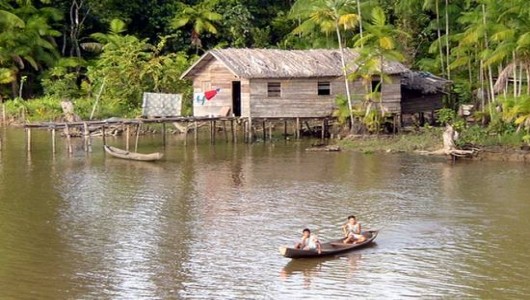
In Brazil, home to the world’s largest Amazonian rain forest, an ever-increasing number of young children are joining the workforce as so-called “river children.” These river children make a living and help support their families by canoeing up to the side of larger barges and tourist boats, where they climb on board and attempt to sell goods such as ingas, an elusive jungle fruit that is particularly popular with ferry passengers.
Following a process of bargaining, the children then climb off the boats with the few rials earned in their pockets, only to have to canoe back home for the entire length of the river that passed beneath them while they were above deck.
An Al Jazeera documentary created in 2011 and reviewed in the past week, titled The River Traders of Brazil, helped shed light on the shadowy lives of Brazil’s “River Children.” The documentary focused on the life of Jesse, an 11-year-old boy who lived along the narrowest stretch of the Tajapuru River in the Amazonian basin in northern Brazil.
Jesse, like the other river children working on the Tajapuru river, made a few rials for his family of 12 adults and 16 children by engaging in the river trading business. As the beginning of the documentary illustrates, Jesse and the other river trader children were initially tolerated and even treated warmly by crew members on the barges. The opening scene pans to an image of Jesse and a young girl sharing a plate of pasta in the underground cabin of a boat, with the narration smoothly announcing over the image “on the boat, there is always food set aside for the river children.”
However, as the documentary progresses, noticeable friction between the river children and the adult crew workers grows more and more. A captain, who claims that he always takes down the names of the river children, tells the camera that the information he has been taking down in his notebook has been increasing in recent years, with an ever-increasing number of stray children climbing aboard.
Further on in the documentary, it becomes obvious why.
Jesse, like his fellow classmates, attended school—which was an hour away by canoe—sporadically at best (the documentary claims he never went for longer than one month at a stretch). A scene with Jesse and his teacher films them on opposite sides of an argument: the teacher, trying to encourage the children to come to school more often, argues, “You are already so good on boats. Think about how much better you could be if you knew how to read and write.”
But Jesse, who comes from a family where the existence of daily food depends upon the pennies brought into the house each day by river-trading activities, counters that making the one-hour canoe journey in search of an education is ultimately futile.
Later in the documentary, the friction between the crew and the children reaches its breaking point, with the crew becoming openly more hostile to the swarms of young children tying their canoes to the sides of their boats.
The viewer discovers that part of this hostility lies in the fact that young river children, frustrated with the instability that a river trade life has to offer, have begun to turn to piracy. Jesse, along with his brothers and some of his cousins also turned to crime, only to come to a fatal end shortly thereafter following an attempted heist where he was killed by an angry crewman.
The fate of Brazil’s river children is little known outside of the small Northern Amazonian river communities directly affected by river trade activity. Yet the Al Jazeera documentary, initially filmed in 2011, and reviewed more recently within the past week, marks an important first step in unearthing the dangerous lives lived by so many desperate and juvenile Brazilian children. The young individuals risk everything, rowing against raging and intolerable currents and facing intolerance, even violence, at the crew members who await them, in the hopes of earning a few pennies for their families a day.
– Ana Powell
Sources: Al Jazeera, Huffington Post
Photo: Ultimate Journey

Rebuilding Education in Sierra Leone
Before the Revolutionary United Front crossed from Liberia into Sierra Leone and started the 12-year war, Sierra Leone had one of the best education systems in Africa. Rebuilding education in Sierra Leone since has been a challenge and Ebola has made it even more difficult.
Only 48.09 percent of the population above the age of 15 in Sierra Leone are literate. Primary school enrollment is over 130 percent due to the amount of non primary school aged Sierra Leoneans who are attending classes because they missed out on educational services during the war. The UN estimates that 64 percent of primary aged children are enrolled in school.
During the 12 years of the war, there was no education unless the families fled to Guinea or Liberia. Out of the crisis of the civil war came an opportunity to ensure education would grow and enhance the livelihoods of Sierra Leoneans.
The Netherlands provided funding to the Cross Border Schools Project in Sierra Leone and has trained over 3,000 educators. After completing the training programs, teachers plan their own lessons and find their teaching methods are making a bigger impact.
Education in Sierra Leone is taken seriously by the government. Sierra Leone spends 14 percent of its national budget on education, which is much higher than most other countries in the region.
Other improvements have been made as well. 76 percent of Sierra Leonean children complete primary school and many go on to junior secondary education. However, 50 percent of primary school teachers still have no qualifications.
It cost $20 to send a Sierra Leonean to school and 70 percent of Sierra Leone families are living on less than a dollar a day. Poverty, child marriage, pregnancy and sexual abuse are the most significant barriers to education for girls in Sierra Leone.
UNICEF works on ensuring girls are attending school through building classrooms, providing sanitation facilities, training teachers and providing learning materials. The rights of girls in the classroom are protected through rights-based and gender-sensitive environments that helps girls succeed in the classroom.
Sierra Leone is still healing from the wounds left by the Revolutionary United Front during the civil war, but education is gradually improving and the youth are benefiting from the revival of education.
– Donald Gering
Sources: Al Jazeera, Global Partnership, Social Progress Imperative, UNICEF 1, UNICEF 2, UNICEF 3
Photo: Just Giving
Are Memes the Future of Social Change?
Unless you have been living under a rock for the past few years, you know that memes are simple and often hilarious images with text superimposed on the picture. This text can be witty, sarcastic, crass or even rude. Regardless of the meaning behind memes, there is no doubt that they are found almost everywhere on the Internet.
Currently, there are several databases that exist to hold the plethora of memes, all different and diverse in nature. Sites where you can create your own meme are in the dozens, giving the creator complete freedom to do what they want with the medium.
While the freedom of the medium is liberating, it has also been put to use in several egregious ways. Racism, misogyny and homophobia, for example, are a few harmful ideas that memes have been used to perpetuate.
However, where there is darkness, there is light. There are many positive and supportive memes to counteract the bad. Memes that convey happiness, hilarity and positivity all exist and are spread over the Internet.
While the freedom that memes permit can lead to negative messages or outcomes, it is important to realize that the same freedom allows for creativity and expression. This expression, paired with the flexibility and easy accessibility of the Internet, allows a popular meme to become viral in a matter of hours.
Memes usually are used as a mechanism of social commentary, and recently there has been an outcropping of them that have been purely political in nature. These memes can still be designated as satire, but never before has a medium of satire been so widely spread and altered to comment on the political and social standing of the world around us.
If this trend continues, the possibilities for potential positive social change are endless. It can all happen with the creation of a simple image and text.
– Alysha Biemolt
Sources: Smithsonian, Huffington Post, Know Your Meme, About, Political Memes
Photo: Nieman Journalism Lab
The CERIA Project Targets Early Childhood Education
In the Indonesian district of Malaka, children are finally being provided with an opportunity to create a better future for themselves. Save the Children has partnered up with the H&M Conscious Foundation to improve educational conditions for children within this impoverished region of the world.
Malaka used to be part of the Belu district in East Nusa Tenggara province. It was so severely underdeveloped that the government decided to establish Malaka as its own district in 2012, hoping to finally spur development. Unfortunately, the district’s citizens are still fighting to break out of the poverty cycle.
Malaka contains 15 elementary schools filled with children seeking a quality education. Most children cannot afford to wear shoes to school. When they finally arrive on foot to their classrooms, they typically face deteriorating walls, lack of access to water and collapsing roofs.
Poor personal hygiene and health combined with the schools’ poor physical conditions often results in prolonged student sickness. To make matters worse, children are oftentimes juggling a language barrier as well.
Hailing from places like East Timor and belonging to ethnic groups that rely on different languages, many of the students do not speak Indonesian. The people of Malaka use five local languages representing the region’s indigenous tribes. Regardless of lack of comprehension, however, the material is taught primarily in Indonesian.
Primary school teachers often employ physical punishment as they deem necessary, causing many students to live in fear. In lower grades especially, it is not uncommon for students to fail their studies or have to repeat a grade due to some combination of the aforementioned factors.
In August 2014, Save the Children pledged to embark on a three-year project focused on improving education for around 2,850 children in the area. Since then, the charity has been working side by side with the H&M’s Conscious Foundation to build 15 new preschools and renovate the 15 existing Malakan schools.
Like Save the Children, the H&M Conscious Foundation seeks to improve children’s education. In addition, the independent organization works to empower women and provide access to clean water in developing countries.
The Conscious Foundation teamed up with STC to launch the Children in Early Grades Reach Incredible Achievements (CERIA) Project three years ago. CERIA also doubles as the Indonesian word for “cheerful.”
The CERIA project is targeting early education in order to achieve long-term effects. It aims to increase enrollment and attendance at quality preschools, improve teaching methods and school readiness for young students and reduce first-grade repetition rates.
The program is targeted at a total of 30 poor rural communities scattered throughout Malaka. Within each early childhood education center, there will be two classrooms able to accommodate 20 to 30 students. Some students are already benefiting from the progress made on renovations last year.
CERIA also offers free teacher training programs to improve the quality of education. Since the majority of teachers in Malaka are volunteers lacking a background in education, this has been an especially effective tool for improvement.
By its conclusion in 2017, the CERIA project is expected to benefit Malaka’s 2,400 elementary school teachers, 450 preschoolers and 180 primary and preschool teachers. There is no telling what accomplishments these properly educated children and teachers will be able to achieve in the long run.
– Sarah Bernard
Sources: Jakarta Globe, H&M
Photo: Compassion International
The Child River Trade Workers in Brazil
In Brazil, home to the world’s largest Amazonian rain forest, an ever-increasing number of young children are joining the workforce as so-called “river children.” These river children make a living and help support their families by canoeing up to the side of larger barges and tourist boats, where they climb on board and attempt to sell goods such as ingas, an elusive jungle fruit that is particularly popular with ferry passengers.
Following a process of bargaining, the children then climb off the boats with the few rials earned in their pockets, only to have to canoe back home for the entire length of the river that passed beneath them while they were above deck.
An Al Jazeera documentary created in 2011 and reviewed in the past week, titled The River Traders of Brazil, helped shed light on the shadowy lives of Brazil’s “River Children.” The documentary focused on the life of Jesse, an 11-year-old boy who lived along the narrowest stretch of the Tajapuru River in the Amazonian basin in northern Brazil.
Jesse, like the other river children working on the Tajapuru river, made a few rials for his family of 12 adults and 16 children by engaging in the river trading business. As the beginning of the documentary illustrates, Jesse and the other river trader children were initially tolerated and even treated warmly by crew members on the barges. The opening scene pans to an image of Jesse and a young girl sharing a plate of pasta in the underground cabin of a boat, with the narration smoothly announcing over the image “on the boat, there is always food set aside for the river children.”
However, as the documentary progresses, noticeable friction between the river children and the adult crew workers grows more and more. A captain, who claims that he always takes down the names of the river children, tells the camera that the information he has been taking down in his notebook has been increasing in recent years, with an ever-increasing number of stray children climbing aboard.
Further on in the documentary, it becomes obvious why.
Jesse, like his fellow classmates, attended school—which was an hour away by canoe—sporadically at best (the documentary claims he never went for longer than one month at a stretch). A scene with Jesse and his teacher films them on opposite sides of an argument: the teacher, trying to encourage the children to come to school more often, argues, “You are already so good on boats. Think about how much better you could be if you knew how to read and write.”
But Jesse, who comes from a family where the existence of daily food depends upon the pennies brought into the house each day by river-trading activities, counters that making the one-hour canoe journey in search of an education is ultimately futile.
Later in the documentary, the friction between the crew and the children reaches its breaking point, with the crew becoming openly more hostile to the swarms of young children tying their canoes to the sides of their boats.
The viewer discovers that part of this hostility lies in the fact that young river children, frustrated with the instability that a river trade life has to offer, have begun to turn to piracy. Jesse, along with his brothers and some of his cousins also turned to crime, only to come to a fatal end shortly thereafter following an attempted heist where he was killed by an angry crewman.
The fate of Brazil’s river children is little known outside of the small Northern Amazonian river communities directly affected by river trade activity. Yet the Al Jazeera documentary, initially filmed in 2011, and reviewed more recently within the past week, marks an important first step in unearthing the dangerous lives lived by so many desperate and juvenile Brazilian children. The young individuals risk everything, rowing against raging and intolerable currents and facing intolerance, even violence, at the crew members who await them, in the hopes of earning a few pennies for their families a day.
– Ana Powell
Sources: Al Jazeera, Huffington Post
Photo: Ultimate Journey
How Online Marketplace is Reducing Food Waste
Millions of tons of food are wasted every year in developed countries and the United States is one of the worst offenders, with more than 40 percent of the food supply ending up in dumpsters and landfills rather than on people’s plates. Sadly, the problem has only been getting worse. In 2012, the United Nations was responsible for 35 million tons of wasted food, representing a 20 percent increase from 2000. In 1980, food accounted for 10 percent of U.S. total waste, but today, it accounts for over 20 percent, with Americans wasting more food than plastic, paper, metal or glass.
The issue of food waste is worse in developed countries, where many see food as expendable. But even in wealthy countries, people struggle with hunger. Over 805 million people worldwide suffer from food insecurity, yet enough food is produced to feed everyone on the planet. Furthermore, wasting food is both economically and environmentally unsustainable. Efforts that provide food that could have been wasted to those who truly need it are becoming increasingly important.
Feeding America is making a concentrated effort to eliminate food waste in the United Nations. They are the largest domestic hunger-relief organization in the United States, with a nationwide network of 200 food banks. Feeding America provides over 3.3 billion meals to 46 million people a year through its 600,000 food pantries and meal programs. Their latest initiative, Online Marketplace, is specifically intended to prevent food waste.
Launched in Feb. 2014, Online Marketplace utilizes technology to safely, quickly and effectively recover excess food from local food service outlets. By doing so, Feeding America hopes to reduce food waste while simultaneously providing more meals to people in need. It is primarily geared towards businesses like restaurants or bakeries, which handle perishable food in smaller quantities, therefore producing lots of waste while donating very little.
Online Marketplace directly connects potential donors to meal service programs and food pantries. First, new donors are educated on donation protocols, such as food safety guidelines and standard operating procedures. Next, they are connected with their nearest food bank, which directs them to local food pantries and meal programs to which they can directly donate. Distributors can then pick up food from the donor and transport it to local people in need as soon as possible, sometimes even making deliveries on the same day.
Currently, Online Marketplace is projected to recover 740 million more meals per year for people in need. Feeding America recently received a $1.6 million Google Global Impact Award for using technology to fight hunger. This money will allow the program to expand and feed even more people.
The Online Marketplace program could easily become a model for other developed countries to follow. If such programs catch on, redirecting food waste from the landfill to the dinner table could benefit millions worldwide. Educating those in the food service industry about food waste and simplifying their donation process will encourage more people to get involved in the ongoing battle against world hunger.
– Jane Harkness
Sources: Feeding America 1, Feeding America 2, Feeding America 3, New York Times, Washington Post
Photo: City Fruit
Backpack PLUS Project Empowers Health Workers
The Backpack PLUS project was established in 2013 with the purpose of empowering community health workers (CHWs). These CHWs are the front-line workers of health delivery; they are often unpaid, volunteer workers that carry out the goals of a given health project.
When it comes to making a difference in global poverty, CHWs are absolutely vital. According to the Backpack PLUS research, a well-trained, well-deployed CHW can decrease child mortality of a community by 25 percent.
The purpose of Backpack PLUS is to “create a reference framework to gather the best practices, assess gaps and align partners to scale up existing and future CHW initiatives.” The project is more than just a tool kit for the workers; it is a system of solutions to real-world problems.
Backpack PLUS has two faces: physical and structural. The physical backpacks that CHWs receive contain key drugs, commodities, diagnostics and tools. The structural side of the program has to do with training, efficiency and thoroughness. This aspect of the program is deeply researched to maximize their results.
In 2013, the project launched into its design phase, where technical partners, policy makers, suppliers and other initiatives collaborated in search of a solution. Since 2013, the project has been focused on field research in Uganda and Senegal where they work to find the most efficient system for CHW aid relief.
The next phase of the project will be developing country plans, mobilizing resources and sharing tools, with a focus on collaboration between workers and between countries.
As of now, Backpack PLUS has partnered with UNICEF, MDG Health Alliance, Save the Children, PSI, the One Million CHW Campaign and Frog Design. This project aims to attack global poverty by empowering workers.
This project is large scale. The purpose is widespread, systematic change that will have a huge impact. Undeniably, the current health delivery system is fragmented, which is why Backpack PLUS’s goal is to unify the process.
– Hannah Resnick
Sources: Backpack PLUS, One Million CHW Campaign, UNICEF, UNICEF
Photo: Frog Design
Growing Investment in Africa Spurs Domestic and International Growth
According to Charles Brewer, managing director for DHL Express Sub-Saharan Africa, an update in the way investors perceive the continent has been the source of increased funding. Economic growth, coupled with an improved business environment and strengthened infrastructure, has caused foreign investment to hit a historic high. Sufficient infrastructure is key to successful development because it lowers the expense of logistics. In the past, supply chain costs were nine times greater in Africa than in other continents. Deals, such as DHL Express’s, not only expands the frontier for international corporations but also lends to growth within Africa as well. Brewer predicts millions more in investment dollars from his company alone in 2015.
“With increased Foreign Development Investment and macroeconomic growth, I believe that Africa will become an economic powerhouse in the future. The region is abound with untapped opportunities and has much scope for growth,” says Brewer.
With more and more people benefiting from international aid and earning money, the consumer base in Africa has grown rapidly. This provides immense opportunities for companies to move into these countries and provide previously undeveloped services. Brewer lists 18 countries where his company has planned major projects. Such economic development will also provide more jobs to African workers and increase spending across the economy, leading to even more economic growth and future foreign investment. Companies such as DHL Express will help reinforce the business environment and create opportunities for African businesses all over the world. In this way, Africa is not a market to be cornered by the rest of the world; the world is a market soon to be cornered by Africa.
– Jenny Wheeler
Sources: IT News Africa
Photo: Flickr
No Over-the-Counter Aspirin in Delhi Spotlights Government Action
The Delhi government has banned the sale of nonsteroidal anti-inflammatory drugs (NSAIDs) without a prescription. The restriction is set to last from August 15 until November 30, which is peak dengue fever season. For patients with dengue fever, NSAIDs can increase the risk of hemorrhage or death. Other precautions taken include increasing the number of beds available and keeping extra NS1 Antigen detection kits, blood and supplies in hospitals.
Additionally, all government buildings, including hospitals, have been asked to procure the National Center for Disease designed mosquito-proof air coolers (MPCs). Mosquito nets will also be provided to sentinel surveillance hospitals. The government has also made moves to reward or penalize those areas where breeding is or is not found, respectively. New warnings are expected to be drafted featuring more correct and simplified information so that the public can be better informed of the change and why it is being implemented.
Because dengue fever plagues nearly the entire developing world, it can be considered a developing country disease. The people that are most affected rely on correct information and government action to protect themselves. The cooperation of the Delhi government in response to an impending potential for a health crisis showcases how both health officials and government officials can work together to bring about a more efficient action. The ban will likely be successful in decreasing dengue-related deaths and could perhaps serve as a model for other places where dengue fever claims the lives of many. The emphasis on encouraging correct public knowledge of risks and preventing the spread of misinformation is a huge step towards public transparency and again can serve as a model.
The cross-sectional cooperation and move to enact such a ban before peak dengue season is also noteworthy, as the government was able to act quickly enough that they should see drastic results with the ban in regards to dengue-related deaths. Cooperation and a prevention-based movement are both good indicators of the success of a public health initiative. Results pending, the Delhi restriction can serve as a model prevention program for not only other countries plagued with dengue fever but for other illnesses with known risky associations.
– Emma Dowd
Sources: Financial Express, India Times, Merinews
Photo: One Healthcare Worldwide
Five Facts About Education in Tunisia
Since the 1980s, Tunisia has experienced success in increasing its human development index score through investments in education and improving the quality of life. However, there are challenges to providing quality education in Tunisia due to unorthodox practices, such as private tutoring practiced by educators.
Here are five facts about education in Tunisia:
1. Tunisia ranks ninth in the world in private tutoring and 70 percent of students participate in tutoring services. About 54 percent of these students received private tutoring from their own teachers. Many of these private lessons include parts of the curriculum that are only available through payment.
2. In order to combat corruption in the education system, Tunisia has an external integrity analysis of education. This allows the country to take appropriate actions to reduce corruption. Recommendations to Tunisia’s government include implementing a new code of conduct for teachers and reforming the admission process for universities.
3. Tunisia ranks 69th in the world in access to basic knowledge. Basic knowledge includes literacy, primary school enrollment, secondary school enrollment and gender parity in secondary school enrollment.
4. About 82 percent of people over the age of 15 are considered to be literate, which ranks Tunisia 93rd in the world in literacy. In 2008, the World Bank reported that 96.79 percent of people between the ages of 15 and 24 were literate, which provides a strong foundation of hope for the future of literacy in Tunisia.
5. The mean years of schooling in Tunisia have increased 4.5 years since 1980 and Tunisia remains one of the top countries in Africa for access to information. Around 43.8 percent of the population has access to the Internet, which contributes to a better education for students.
Education in Tunisia is showing remarkable progress in enrollment numbers for higher education and access to primary education. It will remain important in Tunisia to engage students and their parents to ensure educational reform is successful.
– Donald Gering
Sources: Open Society Foundation, Social Progress Imperative, Trading Economics, UN, UNDP
Photo: Tunisient Tunisia
Golden Temple in India Feeds 100,000 Per Day
Every year, thousands of tourists line up to see the Taj Mahal in India, which is the most popular tourist destination in the country. In Amritsar, India, a Golden Temple serves 100,000 meals to the hungry every day, which is more people than the Taj Mahal attracts in a day.
The Sikhs believe the langar is a symbol of equality and not just a place for people to come eat for free. The kitchen needs an extensive number of ingredients each day, including 12,000 kilos of flour and 13,000 kilos of lentils. Most of the food is paid for up to two years in advance through donations.
At the langar, everyone gets a free hot meal regardless of their socioeconomic status or their religion. There are 450 people running the kitchen with the help of hundreds of volunteers. Over 300,000 plates, spoons and bowls are washed each day.
“There are only three things in our religion,” says a Sikh volunteer from California. “Chant the name of God, sing religious hymns and volunteer. I work as long as my legs allow me to stand.”
About 15 percent of the people in India are undernourished and 194 million people are hungry. This means a quarter of the undernourished people in the world belong to India. Also, India’s population is one of the fastest-growing populations in the world; it will one day become the most populous country.
More than 3,000 children in India die every day from illnesses related to poor nutrition. Hunger in India remains an alarming issue due to rising food prices and available agricultural land. While food grain production is increasing, it hasn’t been sufficient enough to feed the entire population.
Volunteering goes beyond the Golden Temple: donations from around the world help reduce hunger for thousands of people in India. Akshaya Patra, an NGO in India, feeds 1.4 million schoolchildren every day.
India hosts a large number of mega kitchens that feed people all over the country. Despite the rapidly growing population, the percentage of people who are undernourished and hungry is declining.
– Donald Gering
Sources: Al Jazeera, Good News Network, India Food Banking, India Times, Social Progress Imperative, UNDP, WFP
Photo: SkitHub