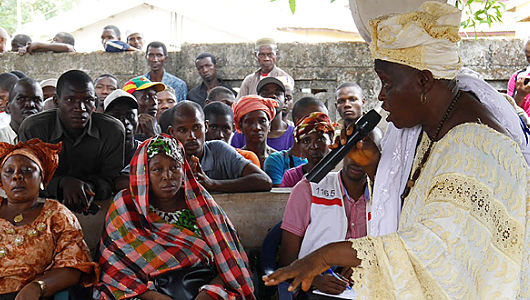
In May 2015, Ebola emerged again in Guinea. This time in an area that had not experienced the virus before, in the town of Tanene in the Dubreka Prefecture. The World Health Organization (WHO) is putting lessons previously learned from five outbreaks in the Democratic Republic of Congo (DRC) as well as Guinea’s outbreak in 2014 to good use in Tanene.
Community engagement is key to putting an end to Ebola, and one of WHO’s social mobilization experts, Marie Claire Therese Fweto Mwanza, is at work in Guinea.
Mwanza helped end five of the seven outbreaks in DRC, the last one in three months. She has trained 60 colleagues to currently provide social mobilization work in Guinea. Social mobilization is a process to raise awareness of a development objective, in this case, how to prevent the spread of Ebola, through dialogue in the community.
Social mobilization also raises the demand for action needed to accomplish the objective. In Guinea, the dialogue transpires at the community level with the help of allies. Community networks, civic and religious groups and other related partners coordinate efforts to induce the change necessary to stop Ebola.
WHO, the Ministry of Health of Guinea, U.S. Centers for Disease Control, Red Cross Guinea and United Nation Children’s Fund all came together to launch a surveillance campaign in June.
Mwanza, who has worked for WHO for 27 years, is confident that her experience in other campaigns will be effective in Guinea.
Before any surveillance work could take place, it was essential to understand the community so that the dialogue could be tailored in order to be effective. According to Mwanza, listening is one of the most important skills.
Speaking with compassion and being careful in conversations is also essential to making headway. These traits encourage the community to participate in the surveillance and take measures to protect themselves and their families.
One of the problems is the rumors that spread throughout a community. In Guinea, almost 60% of the people believed that blood was being sold. Mwanza knew how to deal with this situation because of lessons learned in 2012 in DRC. She said that the rumor was so entrenched in DRC that families hid their sick relatives in the forest and attacked Doctors Without Borders.
In order to deal with this at that time, Mwanza said they had to find out how this rumor took hold. Fifty nursing students were trained to survey community members.
Guineans told them, “When you go to an Ebola Treatment Unit, your heart is punctured, and 20 liters of blood are drawn. Your genitals are cut off, and your blood and organs are sold on the international black market.” Armed with this information, aid workers were able to tailor their messages and their next steps.
In DRC, the next step was to help people see with their own eyes how patients are treated in ETUs, so three community leaders were outfitted in personal protective equipment (PPE) and saw how patients were provided food and were not having organs cut or being killed.
Next, these leaders went door-to-door with Mwanza’s social mobilization team and Ebola survivors to testify in the community that an ETU saves lives. Such testimonies build trust among community members who then not only bring sick families into an ETU but also help trace and find contacts.
The same procedure worked in regard to a rumor about safe burials. A victim of Ebola must be buried by people wearing personal protective equipment. But families prefer to be able to touch the loved ones they are burying.
They were also afraid that organs were being cut out. After dressing a family member in PPE and having him participate in the burial of a loved one, he was able to testify to community members that a safe burial is necessary and appropriate.
Mwanza explained that they approached Guinea in the same way, “Not only did we engage communities to help with educating their neighbors about Ebola, we also encouraged them to actively participate in community surveillance and contact tracing.” Mwanza and her team trained 250 surveillance officers and 25 supervisors from the community to work actively in their own areas in Guinea.
On the first day of the surveillance campaign, rumors still thrived. Many Guineans heard that Ebola teams were coming to disinfect their homes and give them injections, so they shut their doors or temporarily left home. When the community members who stayed home and were visited by the surveillance team told their neighbors that the campaign was safe, many families returned home.
After that, surveillance teams were able to carry out intensive door-to-door visits. Teams explained the risks, the prevention measures and the importance of declaring illnesses and deaths. The Ministry of Health provides free healthcare for all cases during the campaign as well as soap and food during the 21-day surveillance period.
These measure are intended to encourage people to declare illnesses and deaths and allow them to stay at home to take care of family members.
Further community engagement was employed through key groups, such as religious, youth, women and workers’ unions. Representatives were invited to speak to the community to emphasize the campaign message: cooperate with Ebola teams, be vigilant and share information.
Resistance to respond to Ebola in Guinea is still a concern; for example, rumors still abound and people don’t believe that Ebola is real. However, WHO continually assesses community reaction and uses what it learns to adapt its methods to combat misinformation. In this way, progress is being made in Tanene.
“People are listening to programmes about Ebola on community radio, signs and stickers are posted throughout the villages and important conversations are taking place on the streets,” Mwanza declared.
She noted that children and youth are especially effective in the community engagement process. Children bring home messages about Ebola from school. Youth can have a strong influence in a Guinean community in regards to Ebola. One young man left this powerful message in the dirt outside his home: “Stop Ebola.”
– Janet Quinn
Sources: UNICEF, WHO 1, WHO 2
Photo: WHO

Surfing Waves Aids Communities in Peru and Nicaragua
WAVES for Development International, founded toward the end of 2004, is a nonprofit organization based in Peru whose mission is to connect tourists and surfers to volunteer opportunities and grassroots initiatives to effectively work together in communities in both Peru and Nicaragua.
One of WAVES commanding principles is to inspire world travel and cultural exchange through surfing as well as spreading social entrepreneurship, healthy living and life skills. WAVES stands for water, adventure, voluntourism, education and sustainability, which encompasses the organization’s five pillars of beliefs and goals.
Water and adventure are associated with the thrill of surfing, something the members of WAVES for Development International live their lives doing. The made up word, voluntourism, captures their goal of connecting tourists with volunteer opportunities to give back to the communities they visit.
These volunteer activities assist locals with education and sustainability, two concepts the organization believes are needed for places to thrive. With the belief that education is highly important in poorer communities, WAVES uses natural and local resources to help developing communities educate their youth and empower them to create bigger and better things.
Another belief they act upon is there are four main aspects to sustainability; ecological, economic, social and political. WAVES’ projects work to assist communities in environmental conservation, safe economic and political practices and to bring the community together as a whole to help with the projects and celebrate their culture.
WAVES connects tourists with volunteer activities in three different categories; surf voluntourism, which allows people to volunteer in surfing communities in Peru and Nicaragua, advocacy and education, where volunteers assist with educating youth to become effective leaders and network of partnerships, in which the volunteerism focuses on the overall convergence of people and organizations who work together to make the world a better place.
The WAVES team consists of volunteers from all over the world, including Spain, South America, Africa and the United States. Team members have come together to assist developing communities in Peru in an effort to bring a new force of individuals to the world.
While the organization was created in Peru and primarily helps communities there and in Nicaragua, WAVES for Development International has recently teamed up with members in and around Montreux, Switzerland to form WAVES Peru and WAVES Switzerland, allowing the two to reach a wider audience and give back to more communities through their shared love of surfing.
– Julia Hettiger
Sources: WAVES, Volunteer Match, Great Nonprofits
Photo: Flickr
How The Water Project Empowers Girls
In many rural communities throughout sub-Saharan Africa, hundreds of people are unable to access safe, clean water, suffering from several different diseases and illnesses as a result. Relying predominantly on women and girls to walk miles away from home to collect water – dirty water that makes them and their families sick – the communities are gender biased and women are not considered as important as men.
Unclean water and gender inequality limits the potential of many people and communities, and contributes to the cycle of extreme poverty.
The Water Project, however, is determined to change this. A nonprofit organization that brings sustainable water projects to communities in sub-Saharan Africa, The Water Project provides those communities with access to clean water and the means to maintain proper sanitation.
Admirably, the organization seeks to instill hope in suffering communities by making clean water the norm. Clean water improves health, breaks down poverty and supports education.
Lack of access to clean water and proper sanitation, however, is the primary reason that girls drop out of school. They spend valuable learning time walking to streams or ponds to gather water, only to eventually drink it and get sick. The Water Project, however, empowers girls by bringing safe, clean water to their communities.
In addition to improved health conditions, clean water strengthens opportunities for quality education. Access to safe water ensures that girls remain in school, which opens the door to future careers and earned wages. Because women reinvest up to 90 percent of their income back into their households, compared to 40 percent by men, this is imperative.
The efforts of The Water Project have inevitably taught communities to see the value of women and potential of girls. It has unlocked a generation of leaders. Education provides endless opportunities, but clean water liberates, encourages and inspires.
– Sarah Sheppard
Photo: The Water Project
Oculostaple: A Medical Device Revolution
Oculostaple is a tool that is designed to restore vision in people with drooping eyelids, or ptosis. Ptosis can have any number of causes, from Myasthenia gravis (an autoimmune, neuromuscular disorder) to a stroke, a tumor, or simply old age.
It was designed by undergraduate students at Georgia Tech, Drew Padilla, Jacki Borinski, and Mohamad Ali Najia. Najia is now the CEO of the Oculostaple company.
The device works by simultaneously cutting away excess muscle and sealing up the cut that it creates. Before, correcting the issue was the result of a surgery that took about 45 minutes in an operating room. With Oculostaple, drooping eyelids can be resolved with local anesthesia in a doctor’s office, in a procedure that lasts about five minutes. It will also decrease the cost of each individual surgery by about $5,000.
Due to its impressive features, the Oculostaple recently received second place in the National Institute of Health Design by Biomedical Undergraduate Teams (DEBUT) Challenge. The award, given to undergraduate students, was based on the impact the new invention would have on clinical care, the significance of the problem being addressed, the ingenuity of the design, and the creation of a prototype.
It’s not widely available just yet – the Oculostaple team is working with the Global Center for Medical Innovation (GCMI) to create it into a marketable medical device that will eventually be completely disposable.
GCMI is a nonprofit organization that brings together players in the medical device community to help “enhance their product development, shorten time to market, and potentially achieve significant cost savings” in the process of bringing the devices to market. Oculostaple also won first place last year at Georgia Tech’s fall Capstone Design Expo, and second place at its Inventure Prize competition.
While 200,000 Americans undergo surgery to correct drooping eyelids each year, the possibilities for this new device extend far beyond helping Americans be able to see better (and drive safer). Ophthalmologists throughout the medical community are excited for the device, which will make this surgery easy to perform. As the Oculostaple website states, it “also has broad applicability in laparoscopic, gastrointestinal, and biopsy procedures.”
Imagine the possibilities in treating diseases in poorer countries with the creation of technology like this. Gastrointestinal problems are common in third world countries, as people don’t always have access to clean water. Oculostaple could mean safer, faster, cheaper, and more effective treatment for a wide range of problems.
This surgical clamp removes the problem that sometimes occurs in eyelid surgery: the doctors accidentally cut their own sutures as they are trying to cut off excess muscle. Now, both parts of the procedure can be done simultaneously.
In an interview with Charlie Bennett, Najia described the process of how the device came to be, from the beginning, running tests on microwaved pieces of chicken skin, to redesigning the concept again and again, to being halfway out of the stadium with his teammates when their first place at their school’s Capstone competition was announced. Through it all, he said, “I think it’s been a very worthwhile endeavor.”
The development of a revolutionary device is an excellent example of how people throughout the medical community are working everyday to make a healthier world. Whether they are seasoned medical professionals or undergraduate students, they can make a difference, and they are.
– Emily Dieckman
Sources: Devices, NIH, Georgia Institute of Technology, News Medical, North Avenue Lounge, Oculostaple
Photo: Flickr
How Education Affects Wealth and Prosperity in the United States
Fifteen-years-ago, education was a golden ticket to a good secure job in the United States. The idea was to go to school, get a four-year degree and land a good career. College education was just that: education. Disciplines did not matter as much as the actual degree.
Times have changed. Increased pressure from other countries has created strong competition and graduating Americans are not given preference over other people anymore. Employers are looking for the skill sets necessary to complete the job and they are not afraid to outsource to get it.
Specialization has become more and more trendy and two-year degrees and specific training courses have surged in popularity. A May 2015 study from Georgetown University suggests that college graduates will earn $1 million more than high school graduates.
This is not new as it has been widely known for a while. The kicker though, the highest paying majors earn $3.4 million more that those with the lowest paying majors.
The study suggested that STEM related fields heavily out paid social sciences. For example, a bachelor’s degree in engineering or architecture earns an average of $83k annually over the course of their career, while a graduate degree holder in education earns $60k over their career on average.
The relationship is quite complex. Another influencing factor was whether graduates worked in the for-profit, nonprofit or public sector; which industry they worked for; and whether they participated in professional development after they had started their careers. Educators working business jobs, for example, would make more than an engineer working as a teacher.
As time has gone by, humanity studies have declined and business and STEM degrees are on the rise in America. This is heavily influenced by what is in demand in the labor market. Business degrees make up 26 percent of college-educated workers. Although humanity majors are down, liberal arts and humanity class enrollment has gone up due to more rigorous general education requirements.
Attainment is another major finding in the study. Among the 15 major groups, biology and life sciences majors are most likely to earn a graduate degree, while communications and journalism majors are the least likely to earn a graduate degree. Fifty-eight percent of biology and life sciences majors earn a graduate degree, compared to 21 percent of communications and journalism majors.
Better counseling and mentorship programs are needed to help future students become fully educated about the degrees they decide to pursue before enrolling. An August 2015 study from the Federal Reserve Bank of St. Louis looked at how college degrees affected a person’s income and ability to manage financial hardships such as the recession. They analyzed data from 1992 to 2013 to determine trends, reporting wealth and income correlations with racial and ethnic groups.
They found that regardless of skin color or ethnicity, the median net worth of families headed by someone with a four-year degree was 3.6 to 9.8 times larger than families headed by less-educated persons. However, when it came to race, the landscape looked a lot different in terms of handling recessions.
Asians and Caucasians who had four year degrees withstood economic recessions better than their uneducated counterparts and typically accumulated more wealth over the long run. Blacks and Hispanics fared worse. The study concluded that Hispanic and black families with degrees typically fared “significantly worse” than those without degrees. College-educated Hispanic and black families experienced declines in wealth during and after the economic collapse of 2008.
The higher education system in the United States has been continuously scrutinized for not doing enough to provide opportunities for minorities. This is an easy narrative to blame for all the problems. The reality is much more complex. Racism does affect mental health and has led to many problems in society that affect economics and social welfare but there is still much unknown according to the study.
The U.S. must fund more studies and strategize better on how to deal with these imbalances. Further research is needed to understand why there are such disparities in wealth among racial and ethnic groups.
– Adnan Khalid
Sources: Center on Education and the Workforce, Federal Reserve Bank of St. Louis
Photo: Rainbow Educational Consulting
Struggles of Cuban Youth in the Face of Political Change
Although it is banner global news that the U.S. embassy has reopened in Cuba after 50 years of nonexistent relations, young Cubans are less than thrilled about the development. A reestablishment of an American-Cuban relationship may change the political/economic environment for some higher-ups, but it is unlikely to change anything for a young generation in Cuba that faces daily turmoil.
Despite much buzz surrounding the shift that is underway in the country, a sense of cynicism remains among the Cuban youth who believe that the ideals of Fidel Castro’s revolution are dated and irrelevant in the modern age. Hope of prosperity is shrouded by the belief that the Cuban government will not possibly allow young lives to change.
“Change? My life won’t change,” said 17-year-old Yunior Rodriguez Soto, gesturing to the dilapidated basketball court that surrounded him as evidence. “[The government] won’t let it happen […] That’s just how they are.”
The youth are open to political freedom and socioeconomic reform, but due to the Cuban government’s desire to maintain control and reach the highest possible level of national economic success, it is unlikely that changes will trickle down to their level.
Efforts of the government to balance economic growth with state control are causing private sector development to be difficult. Thus, the overgrown public sector is failing to persuade young people to stay in Cuba and start families. They have no guarantee that if they work hard they can support themselves and their children.
Government prices make buying products difficult for small business owners, and Cubans are often forced to turn to the black market in order to get the supplies they need at affordable prices. This black market activity does little to bolster the national economy.
While many developing nations see large youth populations, Cuba faces a serious demographic problem in their lack of young people. Approximately 20 percent of the Cuban population is over 60, making it the oldest Latin American nation, on average. Like Japan and the nations of Northern Europe, Cuba is a society struggling to support their older citizens without a thriving youth population on the economic rise.
There is evidence of a growing Cuban economy–new bars, clubs, and restaurants opening daily in Havana. But the lives of many Cubans have barely improved. The citizens opening these establishments were better off to begin with than many living on the streets. As one young Cuban remarked “the only way to see change is to make a boat and sail off.”
Cuban citizens want the change in their country to be immediate and to live up to the hype, but officials continue to insist that steps toward change will be gradual and take a while to pay off.
Cuba faces a conundrum–it is the youth that they most need to be involved in order for the country to prosper, but it is the youth who are least optimistic that the nation can change. The young people of Cuba, like those in other countries, on the whole are not overly interested in politics. Without some inspiration, it is unclear when the Cuban economy will see any significant change for its impoverished youth.
– Katie Pickle
Sources: New York Times, BBC
Photo: Flickr
World Bank Finances Poverty Reduction Projects in Laos
On August 17, the World Bank signed an agreement with the Lao People’s Democratic Republic to finance three projects aimed at increasing the efficiency and reliability of electricity, facilitating quality health and nutrition for women and children and building necessary infrastructure, such as roads, health clinics, schools and drinking water systems.
The World Bank has approved a US$68 million loan, which will be divided among the projects. The Power Grid Improvement Project will receive the greatest sum, US$30 million, with the Health and Nutrition Development Project and Poverty Reduction Fund II Project endowed with US$26.4 million and US$11.6 million respectively.
Although Laos has successfully provided most citizens with electricity, there are still problems. After a distribution loss in 2014 of 24 percent, greater than the 13 percent national average, Laos’s Xaythany district of capital city Vientiane has become the target area for the Power Grid Improvement Project.
The experience of increasing electricity efficiency will provide a building block, serving as a jumping off point for further improvements across the country.
With the Health Governance and Nutrition Development Project, the Lao PDR government aims to bolster women and children’s healthcare by providing free services. If successful, the project will reduce the instances of stunted growth and wasting from lack of nutrition. In order to accomplish better childhood nourishment, the program will promote breastfeeding.
Also on the agenda is developing a communication strategy that will effectively promote healthy child and infant feeding practices. Along with nourishment, maternal mortality will be targeted by means of providing better access to family planning resources and antenatal care.
The project also hopes to increase the number of births facilitated by a skilled health worker.
Through the Poverty Reduction Fund II Project, the Lao PDR government will work to establish infrastructure that serves the country’s marginalized communities. Schools are of particular note, as UNICEF reports that of Laos’s poorest 20 percent, only 5.3 percent are able to attend early childhood education.
Construction of drinking water systems is also important. At present, nearly 40 percent of rural inhabitants don’t have access to improved drinking water sources.
These projects are expected to substantially contribute to Laos’s development, building upon the country’s past poverty reduction success.
– Emma-Claire LaSaine
Sources: World Bank, UNICEF
Photo: Flickr
Social Mobilization and Fighting Ebola in Guinea
In May 2015, Ebola emerged again in Guinea. This time in an area that had not experienced the virus before, in the town of Tanene in the Dubreka Prefecture. The World Health Organization (WHO) is putting lessons previously learned from five outbreaks in the Democratic Republic of Congo (DRC) as well as Guinea’s outbreak in 2014 to good use in Tanene.
Community engagement is key to putting an end to Ebola, and one of WHO’s social mobilization experts, Marie Claire Therese Fweto Mwanza, is at work in Guinea.
Mwanza helped end five of the seven outbreaks in DRC, the last one in three months. She has trained 60 colleagues to currently provide social mobilization work in Guinea. Social mobilization is a process to raise awareness of a development objective, in this case, how to prevent the spread of Ebola, through dialogue in the community.
Social mobilization also raises the demand for action needed to accomplish the objective. In Guinea, the dialogue transpires at the community level with the help of allies. Community networks, civic and religious groups and other related partners coordinate efforts to induce the change necessary to stop Ebola.
WHO, the Ministry of Health of Guinea, U.S. Centers for Disease Control, Red Cross Guinea and United Nation Children’s Fund all came together to launch a surveillance campaign in June.
Mwanza, who has worked for WHO for 27 years, is confident that her experience in other campaigns will be effective in Guinea.
Before any surveillance work could take place, it was essential to understand the community so that the dialogue could be tailored in order to be effective. According to Mwanza, listening is one of the most important skills.
Speaking with compassion and being careful in conversations is also essential to making headway. These traits encourage the community to participate in the surveillance and take measures to protect themselves and their families.
One of the problems is the rumors that spread throughout a community. In Guinea, almost 60% of the people believed that blood was being sold. Mwanza knew how to deal with this situation because of lessons learned in 2012 in DRC. She said that the rumor was so entrenched in DRC that families hid their sick relatives in the forest and attacked Doctors Without Borders.
In order to deal with this at that time, Mwanza said they had to find out how this rumor took hold. Fifty nursing students were trained to survey community members.
Guineans told them, “When you go to an Ebola Treatment Unit, your heart is punctured, and 20 liters of blood are drawn. Your genitals are cut off, and your blood and organs are sold on the international black market.” Armed with this information, aid workers were able to tailor their messages and their next steps.
In DRC, the next step was to help people see with their own eyes how patients are treated in ETUs, so three community leaders were outfitted in personal protective equipment (PPE) and saw how patients were provided food and were not having organs cut or being killed.
Next, these leaders went door-to-door with Mwanza’s social mobilization team and Ebola survivors to testify in the community that an ETU saves lives. Such testimonies build trust among community members who then not only bring sick families into an ETU but also help trace and find contacts.
The same procedure worked in regard to a rumor about safe burials. A victim of Ebola must be buried by people wearing personal protective equipment. But families prefer to be able to touch the loved ones they are burying.
They were also afraid that organs were being cut out. After dressing a family member in PPE and having him participate in the burial of a loved one, he was able to testify to community members that a safe burial is necessary and appropriate.
Mwanza explained that they approached Guinea in the same way, “Not only did we engage communities to help with educating their neighbors about Ebola, we also encouraged them to actively participate in community surveillance and contact tracing.” Mwanza and her team trained 250 surveillance officers and 25 supervisors from the community to work actively in their own areas in Guinea.
On the first day of the surveillance campaign, rumors still thrived. Many Guineans heard that Ebola teams were coming to disinfect their homes and give them injections, so they shut their doors or temporarily left home. When the community members who stayed home and were visited by the surveillance team told their neighbors that the campaign was safe, many families returned home.
After that, surveillance teams were able to carry out intensive door-to-door visits. Teams explained the risks, the prevention measures and the importance of declaring illnesses and deaths. The Ministry of Health provides free healthcare for all cases during the campaign as well as soap and food during the 21-day surveillance period.
These measure are intended to encourage people to declare illnesses and deaths and allow them to stay at home to take care of family members.
Further community engagement was employed through key groups, such as religious, youth, women and workers’ unions. Representatives were invited to speak to the community to emphasize the campaign message: cooperate with Ebola teams, be vigilant and share information.
Resistance to respond to Ebola in Guinea is still a concern; for example, rumors still abound and people don’t believe that Ebola is real. However, WHO continually assesses community reaction and uses what it learns to adapt its methods to combat misinformation. In this way, progress is being made in Tanene.
“People are listening to programmes about Ebola on community radio, signs and stickers are posted throughout the villages and important conversations are taking place on the streets,” Mwanza declared.
She noted that children and youth are especially effective in the community engagement process. Children bring home messages about Ebola from school. Youth can have a strong influence in a Guinean community in regards to Ebola. One young man left this powerful message in the dirt outside his home: “Stop Ebola.”
– Janet Quinn
Sources: UNICEF, WHO 1, WHO 2
Photo: WHO
Syrian Brain Freeze: An Uneducated Generation
The Syrian refugee crisis is one of the largest humanitarian crises of our time. Since the conflict began almost five years ago, more than seven million Syrians have been displaced and four million are living in refugee camps in neighboring countries. Among those four million, one million are children.
Syria had one of the best education rates in all of the Middle East before conflict erupted during the Arab Spring. Almost all of Syrian children were enrolled in primary school, and literacy rates were above 94 percent. That all changed once violence consumed the nation.
Basic education enrollment in Syria went from 100 percent to an average of 50 percent, but heavy conflict zones such as Aleppo have seen enrollment rates as low as 6 percent.
Syria is a vortex of intertwining complex problems, such as war and violence, that has leading nations and nongovernment organizations preoccupied with exerting their most valuable resources into their main objective: preserving human life and dignity.
The consequence of this is that other important issues such as education, sanitation and economic development are being neglected. Together, they will have dire consequences on the future of Syria.
An entire generation of Syrians may go uneducated. According to Save the Children, three million Syrian children overall are out of school. That means three million youth are deprived of economic opportunities, and more are susceptible to be recruited by radical and extremist groups that promise them a future of prosperity.
The violence has decimated educational facilities around Syria as well. It is estimated that to repair or replace damaged facilities, it would cost an estimated 2 billion GBP. More importantly, the resulting uneducated population will impact the future Syrian economy in a large way.
It is estimated that the future economy will lose 5.4 percent of its GDP because of the lack of skilled workers. This equates to almost 1.5 billion GBP.
There is hope, though. The United Nations had called for $224 million to ensure that the Syrian youth receive education. The United Nations also passed two resolutions to help aid reach its destination faster: resolution 2165 and 2191, which, among other things, authorized United Nations aid operations into Syria from neighboring countries without requiring the consent of the Syrian government.
Private companies such as Pearson, one of the largest publishers of education books in the world, are donating money to help educate the children. Pearson is planning to spend 1 million euros to help find solutions for Syria’s refugee education crisis and another 500,000 euros to support two education centers in Amman, Jordan.
With so many parents attempting to send their children to school, private schools with their subsidized programs are attempting to fill the void. While some may question the ethics behind building private institutions to provide humanitarian aid, Rob Williams, Chief Executive of War Child U.K.—a campaign that works to protect children in war—believes they might help.
He says that “there is evidence that private solutions can be quicker and the cost per pupil lower than with government solutions.” A combination of public and private projects will help quickly address a huge growing problem.
It may not be a permanent solution, but at the moment all resources available must be allocated to providing the necessary aid to end the conflict. The United States must also contribute and urge other nations to end the conflict and protect the children. An educated Syria will be better equipped to deal with the uncertain future.
– Adnan Khalid
Sources: The Guardian, Save the Children 1, Save the Children 2, Save the Children 3, United Nations
Photo: Flickr
Developing Countries Need to Raise Enrollment of Disabled Children
A new report released last week by Human Rights Watch (HRW) has detailed how an estimated 500,000 children with physical and mental disabilities are not enrolled within South Africa’s primary education system.
The monitoring group underscores within their report the growing trend worldwide of children with disabilities failing to become enrolled in primary education programs, specifically in developing countries and regions grappling with conflict.
The report was compiled based on individual interviews with 70 parents across South Africa; researchers traveled throughout KwaZulu-Natal, Limpopo, Gauteng and the Northern and Western Capes in late 2014.
In reference to South Africa, the report asserts, “Although the government claims it has achieved the MDG of enrolling all children in primary schools by 2015, HRW found that in reality, across South Africa many children with disabilities are not in school.”
The report also details the failure of many primary schools to accommodate disabled students and provide adequate educational services, as well as inherent discrimination against certain students through the application of additional fees.
Hannah Kuper, the co-director of the International Centre for Evidence in Disability at the London School of Hygiene and Tropical Medicine, argued in a recent interview, “Many, if not most, of disabled children are not enrolled in schools in developing countries. We need to raise awareness that disabled children have the right to attend school, and that including them often involves only small changes in the school or teaching methods, or even just in attitudes.”
She offered potential solutions for this problem in detail — “The first thing that we need is more data in order to know how to enroll children with disabilities in school. We need to know which children are most excluded and why, in order to see how to overcome these barriers. And we need to know what works best to address the needs of disabled children when they are in school, so that they can have the best education possible.”
The Malawian Ministry of Education announced that they had successfully mainstreamed over 90,000 disabled children into their primary school systems as part of their Inclusive Education Program. The program has also offered funding for structural modifications to schools, including the installation of ramps and handicap restrooms compatible with disabled students.
The author of the HRW report, Elin Martínez, questioned the complacency of the South African government in discriminating against education opportunities for disabled children. “The South African government needs to admit that it is not providing quality education to all of its children – in fact, no schooling at all to many who have disabilities.”
Qinisela, a South African mother of an eight-year-old with Down’s Syndrome, told HRW researchers, “We tried to put him in a [mainstream] school but they said they couldn’t put him in that school because he has disabilities […] because of Down’s Syndrome he isn’t like other children so they [said they] can’t teach him. At the therapy, they promised to phone if there’s a space in a special school. I’ve been waiting since last year.”
The Sustainable Development Goals (SDGs), which were designed by the United Nations to replace the near completed Millennium Development Goals (MDGs), will be put into place next year and include several regulations intended to improve the lives of disabled children, specifically within primary education and employment.
South Africa has attempted to remain active in the push disability advocacy, as they adopted policies to prohibit the exclusion of disabled children from primary education in 2001 and were one of the first countries to ratify the United Nations Disability Rights Convention in 2007. Despite these significant policy advancements, many officials have expressed concerns about disabled children’s access to primary education not just in South Africa, but across the developing world.
Jo Bourne, the Chief of Education for UNICEF, warned in a press statement, “Despite recent progress, there are still some 59 million primary-age children and 65 million adolescents out of school—often children living in poverty, girls, children with disabilities, children from ethnic minorities, children living in conflict or those engaged in child labour. These children and young people are among the most disadvantaged citizens from across the developing world and are not only excluded from the opportunity of education and learning for their own individual development, they are missing out on the opportunity to contribute to their communities and economies when they reach adulthood.”
– James Thornton
Sources: Malawi Nyasa Times, The Guardian
Photo: The Guardian
Debates Over Deworming
Although multiple studies have found that worm infections in developing countries should be treated with deworming pills, there is some debate within health organizations as to who qualifies for treatment. Currently there are 280 million children that are being treated for worms worldwide, but some experts believe that this is excessive.
When people are infected by worms, they suffer multiple ailments, primarily internal bleeding, which can lead to a loss of iron and anemia. Worms also cause diarrhea and malabsorption of nutrients. Compounding the problem, people also suffer a loss of appetite, which means they ingest less food overall. People most at risk are children and women of childbearing age.
Deworming people, especially children of a young age, has shown to be an effective measure to ensure that they stay in school for longer periods of time. A study conducted in Kenya after a deworming program showed that school absenteeism decreased by 25 percent. Even improved attendance in schools in which no children were treated within a three kilometer radius was remarked.
However, diagnosis is relatively expensive in developing countries because it involves a lab analysis of fecal matter, costing four to ten times the price of treatment. Some experts therefore recommend that mass deworming programs be carried out where a large number have been found to be infected.
This is currently the World Health Organization’s policy. Some scientists have challenged this practice, claiming that the available evidence is not enough to assure the safety or necessity of mass treatments. They believe that a lack of teachers, rather than absent children, are the cause of most problems in education in developing countries.
The deworming medication itself is extremely cheap, at just 30 to 40 cents per child. Many studies have suggested that this is a cost effective way of getting kids to go to school. These children also performed better at academic tests eight year later and at cognitive tests ten years later. In the southern United States, a deworming campaign in the early 1900’s had the same effects.
– Radhika Singh
Sources: The Conversation, Harvard University, Voxeu, WHO
Photo: Answers