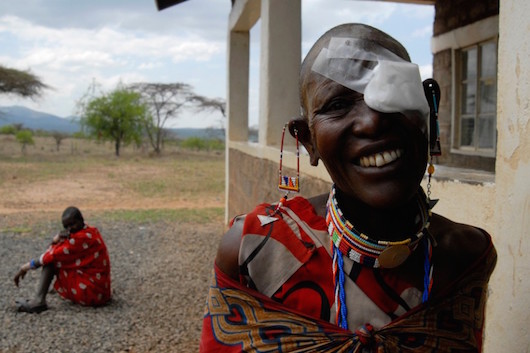
 According to the International Trachoma Initiative (ITI), trachoma remains the world’s leading infectious cause of blindness. Pfizer Inc., along with several partners has been working to provide critical trachoma treatment, particularly for patients in developing countries.
What is Trachoma?
Trachoma is an infectious disease caused by bacteria. It is spread through contact with eye discharge from an infected person – via hands, towels, sheets and in some cases, eye-seeking flies. The infection thrives in areas with poor sanitation and limited access to water for personal hygiene.
Without treatment, trachoma develops into a condition called trichiasis. Trichiasis causes the upper eyelids to turn inwards and scrape the eyeball, a painful condition that eventually leads to blindness.
In 2014, the World Health Organization (WHO) estimated that 232 million people were at risk of developing trachoma. Studies indicate that trachoma is endemic in 51 countries with more than 80 percent of sufferers concentrated in 14 countries.
To help combat the spread of trachoma, Pfizer along with ITI and the International Coalition for Trachoma Control announced the corporation’s 500 millionth donation of the tablet Zithromax, a trachoma treatment antibiotic used in countries across Africa and Asia.
The partners are working together as part of an Alliance for the Global Elimination of Trachoma by 2020 (GET 2020) led by the WHO. The Alliance is an expansive collaboration of more than 100 governments, non-governmental organizations and private sector partners.
The SAFE Strategy
Together the group has implemented a WHO recommended strategy called SAFE:
Surgery to treat the blinding stage of the disease
Antibiotics to treat infection
Facial cleanliness to help reduce transmission, and
Environmental improvement including access to water and sanitation.
ITI pointed out trachoma was once endemic in Europe and the United States. Before the use of antibiotics, trachoma disappeared due to improved living standards.
Today, antibiotic treatment provides a short-term cure, especially when the whole community is treated. However, reinfection can occur, typically within six months if hygiene and the environment don’t improve. For this reason, it is essential that the full SAFE strategy is in place in trachoma-endemic communities.
Paul Emerson, the Director for ITI said, “Trachoma traditionally affects the people at the end of the road, they’re the forgotten people, they are people with a very little political voice. Because trachoma is a hidden disease it is very difficult for people to care. Well, we do care. And we want to reach all of those people.”
– Kara Buckley
Sources: Carter Center, Sight Savers, Trachoma Coalition, Trachoma.org
Photo: Google Images

Ghalib Khalil’s Impact on Advocacy
The actions of individual people like Ghalib Khalil have been cited as the spark for many great advocacy and social movements. As Nelson Mandela once said, “It is time for the next generations to continue to struggle against social injustice and for the rights of humanity. It is in your hands.”
Ghalib Khalil: A Movement
This is exactly what took place in 2010 in Pakistan after the country was devastated by flooding. Ghalib Khalil, inspired to help his country recover from the natural disaster, realized that his own solitary efforts would not be enough to make a big difference. Guided by the advice of a teacher, the 15-year-old created the Rescue Pakistan Youth Foundation. Networking for the organization on Facebook, Khalil used his connections to mobilize support and a volunteer force of several hundred Pakistanis.
This volunteer force engaged in door-to-door collections to help make a difference, but Khalil knew that he still wanted to make a bigger impact. By reaching out to large international corporations and other non-governmental organizations (NGOs), Khalil was able to dramatically expand his impact on advocacy. Due to the creation of Rescue Pakistan Youth Foundation, he successfully raised more than $100,000 to aid in relief efforts.
Since then, Khalil’s impact on advocacy has only continued and increased. After Pakistan recovered from the flood, Rescue Pakistan Youth Foundation continued to take donations for local community projects, but Khalil has set his sights on the struggle for peace. Peacetide, originally named Friends Without Borders, is an international advocacy campaign that focuses on promoting mutual respect and peaceful relations between Israel and Palestine, India and Pakistan, Greece and Turkey, Kosovo and Serbia.
The campaign is aimed at 14 to 25-year-olds, using visual storytelling through videos, pictures, art, inspirational quotes and personal testimonials for peace from its members. To date, the campaign’s main promotional platform on Facebook has more than 40,000 followers.
Both Rescue Pakistan Youth Foundation and Peacetide have achieved a positive impact on advocacy on a grassroots level while helping to educate, promote international peace and make a tangible difference in local communities in Pakistan. The secret to the popularity of Khalil’s organizations is connection, which is perfectly summed-up in Peacetide’s motto, “Goodness is growing one friend at a time.”
– Claire Colby
Sources: Peacetide Facebook Page, The Xrtaordinary, International Political Forum
Photo: Flickr
Employing Young People with Disabilities in Zambia
The International Labor Organization (ILO) has launched an innovative new pilot program to improve access to vocational training and employment for young people with disabilities in Zambia. ILO has been working with the Zambian government since 2012 to make training institutions more inclusive, and this new program will augment that effort.
Zambia currently has 300 vocational training institutions serving over 33,600 students, but ability-based discrimination during enrollment has lead to high levels of exclusion and unemployment for many young people. ILO hopes this program will change that.
“The program will give young people with disabilities the skills they need to enter the open labor market,” the report read.
ILO currently audits training institutions against international standards to identify barriers to entry, ease of campus accessibility and adaptability of curricula for students with special needs. Recommendations are then made to the colleges to make improvements.
Instructors also undergo disability awareness training that includes not only insight into the physical limitations of students but also ways in which students are hindered by societal attitudes and stigma. Instructors are then supported in finding ways to overcome these obstacles.
Under the new pilot program, 20 teachers at five training institutions will take courses on how to build inclusive educational environments, and they will become certified to train other teachers, creating a sustainable education model. Training for new teachers will also be redesigned to include disability inclusion from the outset.
Partner colleges have embraced these efforts. “Our goal is to be a fully inclusive vocational training institution within three to five years,” said Samuel Mayo, Chief Executive of Lusaka Technical and Business College.
But discrimination continues beyond education into working life in Zambia, where over 45 percent of young people with disabilities are unemployed. Employers hesitate to hire these candidates because they incorrectly assume there will be costs associated with doing so. They might also assume that these candidates will require complicated special accommodations, which has also proven to be untrue.
In response, ILO held a roundtable discussion on the business-case benefits of hiring qualified candidates regardless of ability. The event brought in 50 representatives from private companies and launched the formation of the Zambia Business and Disability Network, which now works to build capacity for inclusive hiring practices among employers.
While the organization works primarily with business leaders to foster inclusive workplace attitudes, it has also partnered with hiring agencies to develop skills and confidence for candidates of all abilities.
ILO is confident that this program’s sustainable model will allow it to have a broader impact outside of Zambia. “By being both a source and a catalyst of knowledge-sharing and innovation, the ILO program is helping countries around the world achieve better results for men and women with disabilities,” they say.
– Ron Minard
Sources: ILO, UN, WHO
Photo: Flickr
Google Launches Wi-Fi in Uganda
Google launched Wi-Fi in Uganda for the first time as part of a project to broaden access to affordable high-speed Internet.
Google is making the wireless network available to local Internet providers, who can then charge customers for access. Wi-Fi is now available in 120 key locations in Uganda’s capital, Kampala.
According to statistics, Uganda has nearly 8.5 million Internet users, which makes up 23 percent of the population.
The use of smartphones has dramatically increased in Africa, but high-speed Internet access continues to be too expensive for many Africans to enjoy. Google is working to make access to high-speed Internet affordable for them.
Google estimates that one day of unlimited data using the network will cost around 1,000 Ugandan shillings, the equivalent of 30 cents in the United States, but local providers will ultimately decide how much they want to charge customers for access to the network.
Google said they hope that by improving Internet capacity in the city, local companies will be able to offer faster broadband access for cheaper.
Ugandans would like to see Internet access in rural and hard to reach areas as well.
So far, Google has laid 500 miles of cables in Uganda in order to establish a fiber-optic network. They are working on a more expansive project to improve web infrastructure in Africa.
There are plans to expand the project to the Ghanaian cities of Accra, Tema and Kumasi.
Facebook and Microsoft are also working on their own projects in developing countries with hopes that the whole world will soon have access to Internet.
Tech Times said they believe the more connected countries are, the better the world could be. Google is working to do its part to ensure more places around the globe have Internet access. Wi-Fi in Uganda is just the start of what the company said they hope to achieve.
– Jordan Connell
Sources: AllAfrica, BBC News, Tech Times
Photo: Flickr
Mongolia’s Palliative Care Program Gains Traction
However, Mongolia recently exceeded expectations, ranking 28 out of 80 countries in the 2015 Index. The country’s success is largely due to its National Palliative Care Program which was spearheaded by Dr. Odontuya Davaasuren.
Palliative care is defined as a multidisciplinary approach to medical care for people with serious illnesses.
According to the World Health Organization (WHO), 40 million people require palliative care each year especially in countries with aging populations and where the incidence of noncommunicable diseases is high.
In Mongolia specifically, 79 percent of deaths are the result of noncommunicable diseases such as cancer and cardiovascular disease.
Dr. Davaasuren was first inspired to create the program after participating in the 2000 Palliative Care Conference in Stockholm. In a letter to the International Palliative Care Resource Center (IPCRC), Dr. Davaasuren said she was amazed that such a program did not exist in her country.
However, turning a dream into a reality was no easy feat for the Mongolian doctor. Many of Dr. Davaasuren’s assertions were initially met with criticism during the program’s introduction.
For example, the use of opioids as a form of treatment was traditionally frowned up because health care providers feared that patients would become dependent on the drugs.
Per her IPCRC letter, the doctor held steadfast to her belief that “It is a human right to receive palliative treatment, even when the disease is not curable” and continued to work on introducing the program.
The National Palliative Care Program was created based on four foundational measures: public health policy changes, the indispensability of available drugs for palliative care, the education of health care professionals in palliative care, as well as the actual integration into the overall national health care system.
Notably, since 2005, all medical schools in Mongolia integrated palliative care into their education programs.
At the 67th World Health Assembly in January 2014, the World Health Executive Board called on health systems worldwide to improve upon their palliative care systems. According to the WHO, doing so is “fundamental to improving the quality of life, well-being, comfort and human dignity for individuals.”
– Jocelyn Lim
Sources: IPCRC, Odontuya Davaasuren et al., Quality of Death Index, 2015, United Nations, World Health Organization
Photo: Google Images
Pfizer Announces 500 Millionth Trachoma Treatment
What is Trachoma?
Trachoma is an infectious disease caused by bacteria. It is spread through contact with eye discharge from an infected person – via hands, towels, sheets and in some cases, eye-seeking flies. The infection thrives in areas with poor sanitation and limited access to water for personal hygiene.
Without treatment, trachoma develops into a condition called trichiasis. Trichiasis causes the upper eyelids to turn inwards and scrape the eyeball, a painful condition that eventually leads to blindness.
In 2014, the World Health Organization (WHO) estimated that 232 million people were at risk of developing trachoma. Studies indicate that trachoma is endemic in 51 countries with more than 80 percent of sufferers concentrated in 14 countries.
To help combat the spread of trachoma, Pfizer along with ITI and the International Coalition for Trachoma Control announced the corporation’s 500 millionth donation of the tablet Zithromax, a trachoma treatment antibiotic used in countries across Africa and Asia.
The partners are working together as part of an Alliance for the Global Elimination of Trachoma by 2020 (GET 2020) led by the WHO. The Alliance is an expansive collaboration of more than 100 governments, non-governmental organizations and private sector partners.
The SAFE Strategy
Together the group has implemented a WHO recommended strategy called SAFE:
Surgery to treat the blinding stage of the disease
Antibiotics to treat infection
Facial cleanliness to help reduce transmission, and
Environmental improvement including access to water and sanitation.
ITI pointed out trachoma was once endemic in Europe and the United States. Before the use of antibiotics, trachoma disappeared due to improved living standards.
Today, antibiotic treatment provides a short-term cure, especially when the whole community is treated. However, reinfection can occur, typically within six months if hygiene and the environment don’t improve. For this reason, it is essential that the full SAFE strategy is in place in trachoma-endemic communities.
Paul Emerson, the Director for ITI said, “Trachoma traditionally affects the people at the end of the road, they’re the forgotten people, they are people with a very little political voice. Because trachoma is a hidden disease it is very difficult for people to care. Well, we do care. And we want to reach all of those people.”
– Kara Buckley
Sources: Carter Center, Sight Savers, Trachoma Coalition, Trachoma.org
Photo: Google Images
5 Tips on How to Host Refugees at Your Home
5 Tips on How to Host Refugees at Your Home
Hosting refugees can be a very rewarding experience and can make a huge difference in their lives.
– Jordan Connell
Sources: AOL, The Guardian, World Relief
Photo: Flickr
NetsforLife: Making Strides Toward Malaria Eradication
NetsforLife Steps In
NetsforLife is working to reduce the number of malaria deaths in Africa. Since its inception in 2005, this partnership of corporations, foundations, NGOs and faith-based organizations has distributed nearly 22 million mosquito nets in 17 malaria-endemic countries of sub-Saharan Africa.
However, the organization’s efforts to eradicate malaria extend beyond net distribution. According to its website, NetsforLife also ensures that communities receive adequate training on the value of these nets as well as “the right way to use and maintain them.”
Too often, mosquito nets have been used for fishing or as bridal veils instead of the vital purpose for which they were created.
In addition to educating communities on the proper use of nets, the organization also specifically targets remote areas that typically do not receive care from national healthcare systems.
NetsforLife calls on the help of local leaders and community volunteers or “malaria agents” to provide the necessary education and support to civilians.
Malaria Prevention is Key
According to the WHO, prevention is an important aspect of combatting malaria. The malaria parasite, Plasmodium, multiplies quickly, allowing it to build up resistance to malaria medicines. Mosquito nets and more specifically, insecticide-treated nets (ITNs), play a crucial role in prevention efforts.
While significant headway has already been made with the number of malaria cases declining to 214 million in 2015 from 262 million in 2000, there is still much work left to be done to eradicate the disease. To that end, the WHO launched “The Global Technical Strategy for Malaria, 2016 – 2030” which aims to reduce malaria incidence and mortality by 90 percent.
With over 100,000 volunteers, NetsforLife continues to do its part to help achieve these goals. So far, the organization has reached 41.7 million individuals and counting.
– Jocelyn Lim
Sources: NY Times, NetsforLife, World Health Organization (WHO) 1, World Health Organization (WHO) 2, World Health Organization (WHO) 3
Photo: Google Images
Top 3 Ways to Prevent Hunger
According to the Word Food Programme, around 795 million people globally do not have enough food to lead active lives. Lack of nutrition leads to a number of other health problems among the world’s poor such as disease, stunted growth and even death. Here are three methods that can help prevent hunger:
1. Invest in Agriculture
Agricultural investment prevents hunger in the long and short term because it allows the poor to become more independent. Most of the world’s poor live in rural areas where agriculture is the source of income and food.
More investment is needed for programs that provide farmers with land incentives, train them on how to maximize their produce and teach them when and what to plant throughout the year.
Through such programs, farmers will not only be able to feed their family but also sell their harvests for profits.
In turn, parents can invest in their children’s education and end the generational cycle of poverty. This financial stability could also mean less pressure on parents to force their daughters into early marriage.
2. Financial Planning
With unpredictable climate and political changes in developing countries, financial planning acts as a safety net in case of drought, famine or war.
Financial security gives families a head start when they are displaced due to conflict and also helps prevent hunger during times of drought.
Training farmers on how to save and invest their money also allows them to invest in machinery and livestock to maximize their productivity and prevent malnutrition.
3. Focus on Women
Empowering women by educating them on agriculture and giving them the resources to provide for their families will make households mores sustainable. The tradition of gender inequality is what makes hunger inheritable in developing countries.
Each year, around 19 million children are born underweight because their mothers were not adequately nourished during pregnancy. More often than not, malnutrition continues through infancy because their mother’s breast milk does not provide enough nutrients.
In addition, weak immune systems due to malnutrition allow the transmission of HIV/AIDS from mother to child. HIV/AIDS treatments and prenatal health care ensure the birth of healthy babies.
A program combining these three methods to prevent hunger would ensure impoverished communities are able to sustain healthy lives and break the cycle of poverty and hunger.
– Marie Helene Ngom
Sources: WFP, AIDSInfo
Picture: Google Images
Fonkoze Bank Assists Haiti’s Poor
Using a unique stair-stepping model, Fonkoze Bank helps put money into the hands of some of Haiti’s poorest people. Stationed in Port-au-Prince, Haiti and Washington D.C., Fonkoze has operated for 11 years, working with citizens in Haiti to improve their financial standing and rise out of poverty.
Fonkoze Bank was founded by Father Joseph Philippe, a Haitian priest who made it his goal to help rural Haiti become economically stable.
While Fonkoze Bank helps people of different backgrounds, its primary focus is Haitian women, who are considered to be Haiti’s “poto mitan,” or Haiti’s “backbone”. Women are the head of the household in 44 percent of all Haitian homes and are the largest contributors of small commerce.
Fonkoze Bank is divided into 45 branches which encompass all of Haiti. Since inception, the Bank has provided financial, health and education assistance to more than 60,000 people through its four-step model.
Step One: Chemen Lavi Miyo
Chemen Lavi Miyo stands for “pathway to a better life” and is the first step in Fonkoze’s stair-stepping model. During this step, Fonkoze Bank provides women with the tools and resources needed to escape poverty and transition to a life of self-sufficiency.
Step Two: Ti Kredi
Ti Kredi, which is Haitian for “little credit” is where the microfinance portion of Fonkoze’s services comes into play. The six-month program assists women, especially those coming from vulnerable backgrounds, to develop business skills through education and training to help ensure success as micro-entrepreneurs.
On average, 92 percent of Ti Kredi participants graduate from the program. Successful graduates are able to cut their hunger rates by one-third and close to 100 percent of graduates are able to send their children.
Step Three: Solidarity
The Solidarity Program permits groups of five women, called solidarity groups to take out loans to help maintain their businesses during tough economic times.
Teams of five or six solidarity groups will meet a few times a month at “solidarity centers”. The women not only develop plans to repay their loans but also support each other’s businesses in the process. This helps promotes solidarity among micro-entrepreneurs in different geographic locations.
Step Four: Business Development
The final step of Fonkoze’s stair-stepping model is business development. During this step, women are able to take out loans surpassing the amounts they received in the second and third steps. They are also able to participate in a 12-month program giving their businesses the potential to take off and even thrive.
As of 2013, Fonkoze Bank had distributed more than $30 million in loans and continues to positively impact the lives of women who have been unable to access traditional funding from urban banks in Haiti.
– Julia Hettiger
Sources: Fonkoze, Charity Navigator, Grameen Foundation
Picture: Google Images
HelloFood Celebrates Third Anniversary
HelloFood, an online portal that allows customers to order food and have it delivered, recently celebrated its third anniversary.
HelloFood began as a 1970s-style website in November 2012. It was the first online food portal in Africa and took around one minute to load. The company only received two orders on their first day, but it was the start of an incredible journey to revolutionize how people eat in Africa, according to It News Africa.
HelloFood provides food from a listing of more than 270 restaurants. More than 125,000 customers order food every six seconds during the lunchtime hours on the site. The company then delivers food to homes and offices where customers can pay upon delivery.
Joe Falter, CEO and Founder of HelloFood, said, “It was just a basic website [when it started]. Far from what it looks like now.”
HelloFood has grown 20 percent each month over the last 36 months. It has tripled in size in the last 12 months and now has 500 employees, 50 percent of whom are women. It News Africa reports the delivery riders have traveled the equivalent of 100 times around the Earth.
HelloFood has also created mobile shopping apps, allowing customers to keep up with changing trends and technologies.
“I’m incredibly proud of what our team has achieved — building this business from nothing to dominate 11 African markets, and change the way that hundreds of thousands of people order food on a daily basis,” Falter said. “However, we’ve only scratched the surface, the potential for this business model is stratospheric and right now more than ever we are buzzing about the opportunity to reach more customers and ensure a stress-free ordering experience.”
According to Biztech Africa, the company plans to expand to other major towns and provide job opportunities to people across Kenya.
As part of its third-anniversary celebrations, the company discounted food up to 40 percent on Black Friday. HelloFood said they hoped to reach the highest ever sale of food ordering in Africa on Black Friday.
– Jordan Connell
Sources: Biztech Africa, It News Africa
Photo: Google Images