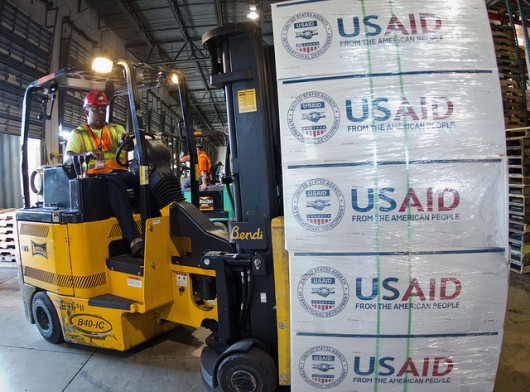
 U.S. foreign aid has had a variety of strategic and humanitarian purposes throughout the 20th century. Although initiatives have changed across the decades to address the global “hot topics” of the day, the focus has always been on using aid to address crises, create security and spark development.
U.S. distribution of foreign aid began at the onset of World War I, when in 1914, President Hoover created the Commission for the Relief of Belgium (CRB) to combat a severe food shortage in German-occupied Belgium and Northern France.
In 1917, the U.S. Food Administration provided food for the United States Army and to the millions of people affected by World War I.
International development as a tool for foreign policy began following World War II. The Marshall Plan, diverting $13 billion in aid, allowed Europe to rebuild its infrastructure and strengthen its economy.
In 1949, President Harry S. Truman proposed an international development assistance program. This Cold War initiative sought to reduce poverty, increase production in developing countries and combat communism by helping countries thrive under capitalism.
In 1961, President Kennedy signed the Foreign Assistance Act, which created USAID. The president also introduced the Peace Corps the same year, which was intended to spread America’s goodwill and positive image across the globe.
In the 1970s, the Foreign Assistance Act underwent substantial changes that gave food, nutrition and healthcare aid priority when assisting a foreign nation.
In the 1980s, we saw the introduction of a new method of aid giving: using celebrities to gain support for a cause. In 1985, the Live Aid concert, featuring stars like Led Zepplin, Queen, Tina Turner and Madonna, raised $140 million toward fighting poverty and hunger in Africa. This was at a particularly urgent time due to a major drought in Ethiopia that caused widespread famine.
In the 1990s, with the end of the Cold War, USAID’s top priority of U.S. foreign aid became sustainable development, focusing on aid that would help nations become self-sufficient.
One of the major U.S. foreign missions was in Somalia in 1992. Famine and ongoing civil war in Somalia led to a humanitarian relief effort by sending troops and delivering basic supplies. Although the military intervention was largely unsuccessful, it served as a learning point for how both U.S. and U.N. interventions should be conducted.
The 2000s created an extra urgency around foreign aid as a means of creating stability. Development is included as one of three pillars of U.S. national security.
The President’s Emergency Plan for AIDS Relief was created in 2003 and President George W. Bush created the Millennium Challenge Corporation in 2004.
Some politicians argue that the U.S. should solve its own humanitarian issues before getting involved in other countries. However, America’s role as a world power makes it impossible for the country to turn a blind eye to the plights of other nations.
History has shown that U.S. foreign aid, if monitored and updated correctly, can do great things to fight poverty and ensure security.
– Taylor Resteghini
Sources: Oxfam America, PBS, USAID
Photo: Flickr

What is Happening with Haiti’s Delayed Presidential Elections?
The eight Haitian presidential candidates refused to participate because of the irregularities that occurred in the first round of elections. An official audit including 78 tally sheets from the first round of presidential elections found irregularities in all sheets, the Hill reports. Haiti’s electoral council, the CEP, did not conduct a further investigation.
The irregularities in the electoral process include Jovenel Moise, President Michel Martelly’s chosen successor, being reported to the CEP as being in first place in the election but an exit poll found that only six percent of respondents voted for him, according to the Hill. This, along with many other examples of government-backed fraud has instigated Haitians to respond with violence.
In a poll executed in October 2015 by an independent research group in Brazil, 82 percent of Haitians agreed with the statement: “As far as I can see, this election is fair, there is no fraud,” the Hill reports. However, when the same poll was conducted after the irregularities came out, almost 90 percent of respondents disagreed with the statement.
According to the Hill, the United States, the U.N. and the Organization of American States are pushing for presidential elections to take place as soon as possible so that Haiti can reestablish order. Though filling the presidential position is desired, it could also be perceived as a positive that Haiti now has more time for the election. More time to select a proper candidate would allow Haiti to restore faith in the electoral process.
Fortunately, lawmakers chose the country’s Senate leader, Jocelerme Privert, as provisional President of Haiti on Feb. 14, 2016, as reported by the New York Times. Privert’s chief task will be to smooth political divisions that have left the people of Haiti without an elected president properly chosen by the voters themselves.
Privert is also working on how and when to go about the formal presidential election and has said they will be held as soon as possible. Former President Martelly departed from office as well, as he was barred from a consecutive term. Privert’s leadership and Martelly’s departure will hopefully help in easing violent outbreaks and tensions.
– Kerri Whelan
Sources: The Hill, NY Times
Photo: Flickr
A Brief History of US Foreign Aid Initiatives
U.S. distribution of foreign aid began at the onset of World War I, when in 1914, President Hoover created the Commission for the Relief of Belgium (CRB) to combat a severe food shortage in German-occupied Belgium and Northern France.
In 1917, the U.S. Food Administration provided food for the United States Army and to the millions of people affected by World War I.
International development as a tool for foreign policy began following World War II. The Marshall Plan, diverting $13 billion in aid, allowed Europe to rebuild its infrastructure and strengthen its economy.
In 1949, President Harry S. Truman proposed an international development assistance program. This Cold War initiative sought to reduce poverty, increase production in developing countries and combat communism by helping countries thrive under capitalism.
In 1961, President Kennedy signed the Foreign Assistance Act, which created USAID. The president also introduced the Peace Corps the same year, which was intended to spread America’s goodwill and positive image across the globe.
In the 1970s, the Foreign Assistance Act underwent substantial changes that gave food, nutrition and healthcare aid priority when assisting a foreign nation.
In the 1980s, we saw the introduction of a new method of aid giving: using celebrities to gain support for a cause. In 1985, the Live Aid concert, featuring stars like Led Zepplin, Queen, Tina Turner and Madonna, raised $140 million toward fighting poverty and hunger in Africa. This was at a particularly urgent time due to a major drought in Ethiopia that caused widespread famine.
In the 1990s, with the end of the Cold War, USAID’s top priority of U.S. foreign aid became sustainable development, focusing on aid that would help nations become self-sufficient.
One of the major U.S. foreign missions was in Somalia in 1992. Famine and ongoing civil war in Somalia led to a humanitarian relief effort by sending troops and delivering basic supplies. Although the military intervention was largely unsuccessful, it served as a learning point for how both U.S. and U.N. interventions should be conducted.
The 2000s created an extra urgency around foreign aid as a means of creating stability. Development is included as one of three pillars of U.S. national security.
The President’s Emergency Plan for AIDS Relief was created in 2003 and President George W. Bush created the Millennium Challenge Corporation in 2004.
Some politicians argue that the U.S. should solve its own humanitarian issues before getting involved in other countries. However, America’s role as a world power makes it impossible for the country to turn a blind eye to the plights of other nations.
History has shown that U.S. foreign aid, if monitored and updated correctly, can do great things to fight poverty and ensure security.
– Taylor Resteghini
Sources: Oxfam America, PBS, USAID
Photo: Flickr
What Does Goat Poop Have to Do With Global Poverty?
Anyone who has ever seen a goat knows that these animals are professionals at consuming and digesting almost anything they can manage to get inside their mouths, whether it be straw, corn cobs or even a shirt. The reason these animals are so successful at digesting non-food items is, in part, thanks to the fungi that live in their digestive tracts, which can attack and break down fibrous materials.
Researchers are now looking to these fungi as a way to transform certain plants into alternative energy sources.
According to an article in Forbes Magazine, new research shows that the fungi found in goats’ stomachs – and eventually their excrement – are adaptable enough to stop breaking down goat food and start attacking something new. In this case, plant material for renewable biofuel.
The results are potentially beneficial for addressing global poverty in developing countries.
For a long time, coal has been a popular fuel source in “energy impoverished” nations. The low price tag on the substance makes it a popular energy source for countries like India and China, which are experiencing extreme poverty and rapidly increasing energy demands.
But while cheap, coal is also a major producer of dangerous fossil fuels. According to Rachel Kyte, climate envoy for the World Bank, coal has a powerful negative impact on global poverty, not only through health costs for the world’s poor but through long-term social disadvantages as well.
A Standard & Poor’s assessment found that the more impoverished a country is, the more negatively climate change affects its residents. Floods and agricultural shocks, which come as a result of climate change, often hit low-income people the hardest. This population has no option to migrate, insulate themselves from harm or recoup losses.
The goat poop solution might be just what developing countries need to access a low cost, low impact energy source. It is an unlikely but viable option to lower fossil fuel emissions and move toward clean energy solutions.
– Jen Diamond
Sources: Forbes, The Guardian, Think Progress
Photo: Scoopnest
Katchi Abadis and Koliwadas: Plans for South Asian Slums
Now imagine that instead of Arthur Dent, an entire community faces such a predicament.
This was the case for the low-income community of Afghan Basti in Pakistan. On May 21, 2014, government-backed workers armed with bulldozers came to commence with roadworks. The Central Development Authority (CDA), which holds municipal responsibilities for Islamabad, had already demolished 25 stalls and five rooms nearby as part of the work.
According to Tribune journalist Maha Musaddiq, the bulldozing team was met with outcries as elders and children came out in protest of their forced eviction.
Enter July 2015. Despite protests, the CDA demolished sector I-11 in Islamabad. The sector was a low-income community similar to Afghan Basti. Both communities are known as ‘katchi abadis’.
What has motivated these evictions are claims on the part of the CDA that katchi abadis house criminals and terrorists. Umer Gilani, a lawyer for the Foundation for Fundamental Rights, challenges these allegations, seeing them as unfounded. He is not alone.
Tasneem Ahmed Siddiqui, an urban planner, has called for a paradigm shift in urban planning, taking Islamabad’s katchi abadis as an unfortunate example of what happens when a city is planned for the rich and fails to account for those laborers who might work for them.
According to the Tribune, Siddiqui has since proposed a solution to the Supreme Court.
Meanwhile, in Karachi, a new city district called DHA City is being constructed. But to some, the plan has committed the mistake Siddiqui outlined: there are no residences marked for drivers, housemaids or other staff.
A proposal has been submitted to the prime minister for a low-cost housing scheme.
Where protests in Pakistan have occurred over urgent circumstances — forced eviction with bulldozers at-the-ready — Indian koliwadas, or fishing villages, have protested their classification as slums.
Specifically, it is Mumbai’s Worli Koliwada, a historical fishing village, home to the Koli people who make up the city’s oldest residents.
Times of India journalist Priyanka Kakodkar reports that the land in question has been seen as valuable by property surveyors — and classifying the koliwada as a slum would open up the historical area to development.
The plan, however, was abandoned after locals vehemently objected to it.
It has instead been suggested that the local community try to develop and rehabilitate the area.
– The Borgen Project
Sources: Times of India, Tribune 1, DNAIndia, Tribune 2, Pakistan Today, Tribune 3
Photo: Wikipedia
Sharing the Land in the DRC
Sharing the Land uses GIS and GPS mapping technology to compile land claim and conflict data as well as road names, neighborhood boundaries, geographic features and points of interest. Data comes from household surveys and government records. The maps are already being used to settle land disputes between individuals, families and large companies in Beni.
Archip Lobo, Sharing the Land’s project leader, grew up in eastern Congo amidst violence and severe abuse of human rights, much of which revolved around land disputes. Though the country has a tragic and ongoing history of violence, Lobo felt that land disputes were preventable and not a grounds for continued, unhindered violence.
Rampant conflicts over land began when King Leopold of Belgium usurped much of the land from Congolese chiefs and initiated a tyrannous rule over eastern Congo in the late 1800s. With a new form of governance entangled in the traditional ways of land management, violence became prevalent.
In the years since Congo gained its independence from Belgium on Jun. 30, 1960, the country has endured great instability, insecurity, corruption and pervasive violation of human rights. Removing land disputes as a cause for violence is a step in the right direction for bringing Congo towards a peaceful future.
Sharing the Land provides Beni with data-driven land management practices instead of relying on differing traditions or interpretations of inheritance rights. While the project aims to bring peace through nonviolent land dispute resolutions, it is also reducing disputes in the first place by making the information publicly available and educating all those involved in urban planning.
According to Texas A&M, 85 percent of court cases in Beni relate to land disputes. The Sharing the Land initiative is already making progress to reduce this statistic in Beni.
This project has two immediate benefits. First, official maps using government data help to standardize the land purchasing process. It also enables land managers to continue to add and update data on the stable ArcGIS platform so that land ownership can be accurately and reliably documented.
Aside from using GIS software to map the land, the Sharing the Land project is encouraging community leaders, government professionals, civil society organization representatives, lawyers and the greater community to collaborate in understanding the origins and consequences of land conflict and together engineer viable solutions.
To date, with the help of ConDev and USAID, Sharing the Land has mapped 531 land parcels and documented 29 conflicts. This year, the organization will collaborate with UN-Habitat to provide land management training to government officials in several Congo provinces in an effort to strengthen and standardize urban planning.
Sharing the Land envisions that this new aspect of the project will position a new generation of government officials to enforce and continue to develop peaceful and sustainable land management practices.
– Mary Furth
Sources: IRIUCBC, Codev Center 1, USAID, Codev Center 2, USAID, Eastern Congo
China to Implement Five Year Poverty Eradication Plan
Though China, which contains one-fifth of the world’s population, successfully met the Millennium Development Goals (MDGs), lifting 470 million people out of extreme poverty, there are still 70 million individuals living in extreme adversity and whom a new poverty eradication plan would greatly benefit.
China’s ruling party has asserted that it will take all necessary measures to eliminate extreme poverty within the country. “No single poor region nor an individual living in poverty will be left behind” when the country accomplishes the goal of “building a moderately prosperous society” by 2020, said President Xi Jinping at the meeting, according to an article in the Business Standard.
Rachel Middleton noted in the International Business Times that economic reform in the last 35 years has amplified the gap between the country’s rich and poor. Hence, the government realizes its collective responsibility to implement a poverty eradication plan that will lift the remaining 70 million individuals out of poverty by 2020.
Fu Ying, Chairperson of the National People’s Congress Foreign Affairs Committee, who attended the meeting, said Xi appealed to all levels of government to undertake measures to ensure the poor in rural areas, who make up the majority of individuals living below the poverty line, have access to food, clothing, housing, health care and education. Xi specifically underscored the urgency of local level involvement in poverty reduction and development.
Sub-group discussions during the meeting focused on goal achieving initiatives that would transform the poverty dynamic in China within five years. In one discussion group attended by Fu Ying, there was a suggestion that detailed surveys would allow for individual plans equipped to meet diverse local conditions.
According to Fu, information disseminated via localized surveys would, in turn, help working-age individuals find income enhancing employment, give a safety net to aid those unable to work, relocate individuals living in extremely harsh environments and provide adequate health care and education.
Stamping out extreme poverty in China will be challenging but to meet that goal in five years, 22 heads of provinces and cities located in western China have signed letters of responsibility with the central government and they will be held accountable for falling short of the target.
China’s economic achievements over the last several decades are extraordinary; however, they do have obstacles to overcome: IMF data states the per capita GDP of China is only one-seventh of the U.S. and it will take over 50 years for that gap to close between the two. China makes up 22 percent of the world’s population but only has a 2 percent share of global spending on healthcare. The U.S. percentage of global healthcare spending, by comparison, is 13.6 percent.
China’s task will be challenging but the government understands the enormous risk of failing to implement a poverty eradication plan to address extreme poverty.
– Heidi Grossman
Sources: Business-Standard, Huffington Post, IB Times
Photo: Flickr
AmeriCares Sends Aid to Fiji for Recovery Efforts
Category five super-cyclone Winston made landfall in Fiji on Feb. 22, 2016. With winds of up to 180 mph, Winston was both the strongest cyclone to ever hit Fiji and the strongest cyclone on record to make landfall in the South Pacific archipelago overall. Fortunately, AmeriCares has stepped in to support Fijians in need.
AmeriCares, an emergency response and global health organization based in Stamford, Connecticut, is currently helping Fijians in their recovery and relief efforts. The organization has dispatched an emergency response team of volunteers to provide the medical care and assistance that some inhabitants require. AmeriCares has also prepared approximately 5,000 pounds of medical and relief supplies to deliver to Fiji.
Founder Robert C. Macauley first conceived of AmeriCares during the Vietnam War. In 1975, he and his wife sent an aircraft to Vietnam in order to airlift 300 infant orphans to safety in California. In order to do so, Macauley was forced to take a mortgage out on his house.
Since then, AmeriCares has worked in over 140 countries. These countries include North Korea, where the organization has sent medical supplies since 1997 — and Syria, where $7 million in medical aid has been delivered since 2012.
Approximately 909,389 people inhabit 110 of the 332 islands that compose Fiji. In Cyclone Winston’s wake, 347,000 now find themselves in need of humanitarian aid, of whom 120,000 are children, says UNICEF.
42 Fijians have been confirmed dead and some of the villages within the more remote islands of Fiji are thought to have been completely obliterated by the storm. An article by the Huffington Post reports that 35,000 are currently living in evacuation centers, some of which are running low on supplies.
https://www.youtube.com/watch?v=mXXk1U7HgSw
Two major hospitals were also damaged by the cyclone, according to AmeriCares’ website. AmeriCares’ aid may thus prove an important component in supplementing some of the infrastructural support that was lost in the cyclone.
– Jocelyn Lim
Sources: AmeriCares, The Huffington Post, UNICEF, William Grimes
Coca-Cola Joins the African Market
In order to expand and diversify, Coca-Cola has joined the African market in partnership with Chi Ltd, Nigeria’s largest juice and dairy maker. According to the African Business Review, U.S. consumption of soda has dropped by 25 percent, whereas Africa’s consumption of juice and soda has grown by 21 percent. Thus, it is no surprise that Coca-Cola wants to expand in Africa and open itself to non-soda markets in the process.
The merging of Coca-Cola and Chi Ltd will provide new employment opportunities, as well as increase investments into the Nigerian economy. Business Wire claims, “The agreement will allow both companies to leverage their respective investments and expertise to further drive innovation, optimize efficiency and strengthen route-to-market to accelerate growth and increase consumer availability and choice.”
Coca-Cola’s desire to diversify and join the African market is also based partly on the fact that the brand has come under fire recently for allegedly contributing to the obesity crisis. The World Health Organization has encouraged governments to place a tax on sugary drinks, similar to Mexico’s 10 percent tax.
However, by partnering with Chi Ltd, Coca-Cola can transform their market and adopt a new high-growth value dairy category. Nathan Kalumbu, president of Coca-Cola’s Eurasia & Africa Group, is thankful for this opportunity and states, “For more than 30 years Chi’s leadership has built a greatly admired business that has quickly grown to become Nigeria’s leading producer and distributor of value-added dairy and juice products and we are delighted to enter the next phase of our growth journey together.”
Coca-Cola wants to gain back the trust of consumers and Chi Ltd is one of Nigeria’s most admired companies in the domain of food and beverages. Chi Ltd’s products help cater to the diverse needs and palates of every segment of Africa’s dynamic population. Through the African market, Coca-Cola has a fresh start and Chi Ltd has the resources and connections necessary to succeed and expand.
– Megan Hadley
Sources: Business Wire, African Business Review
Photo: Flickr
AIR May Prove Crucial to Neonatal Care
Breathing problems are at the root of 1.8 million stillbirths and neonatal deaths that occur every year. Many of these deaths could have been prevented if health facilities had adequate equipment and proper training programs available.
Having worked with over 1,000 healthcare providers in Uganda’s Helping Babies Breathe (HBB) program, Dr. Data Santorino is intimately familiar with this issue. Alongside Kevin Cedrone, Craig Mielcarz and Dr. Kristian Olson, Dr. Santorino developed the Augmented Infant Resuscitator (AIR) as an inexpensive and effective solution.
AIR is an add-on to already existing emergency ventilation equipment that provides real-time feedback to birth attendants. The feedback incorporates both an assessment of the quality of emergency ventilation administration and “actionable cues” for users to take up.
These cues are vital to the babies under neonatal care. They not only help users improve their performance but also build their confidence in the abilities that they have to care for the newborn.
Because the feedback also helps to improve skills, AIR alleviates former inadequacies in neonatal resuscitation training. With the device, users can put their skills to use while also learning and maintaining proper practices.
AIR may prove especially helpful in developing countries where proper equipment is often too costly or inaccessible and training of healthcare professionals remains seriously insufficient.
Currently, birth attendants administering emergency assisted ventilation will periodically stop the process in order to manually check and monitor the baby’s heart rate. This interruption within the first “golden minute” after a baby is born could prove detrimental, according to Santorino, as the lack of oxygen could either kill the baby or cause other health issues such as brain damage.
As the first place winner for the best pitch at the Boston Children’s Hospital Innovation Tank, AIR continues to be developed and improved. Its first deployment is projected for January 2017.
– Jocelyn Lim
Sources: Elsevier, Augmented Infant Resuscitator, Boston Children’s Hospital, MIT Ideas Global Challenge
Photo: Flickr
Types of Foreign Aid
America’s foreign aid budget for 2016 is expected to be around $37.9 billion. The goals of American foreign aid involve a mixture of strategic and humanitarian efforts. Therefore, the types of foreign aid the government administers are aimed at addressing a variety of issues.
Various initiatives are represented by five different categories, as outlined by Congressional Research Service:
While the types of foreign aid are varied, the most important part of any U.S. foreign aid program, as Texas Representative Kay Granger appropriately noted, is that it be “carefully guided and targeted at a specific issue…it can and must be effective.”
– Taylor Resteghini
Sources: Borgen Project, Center for Global Development, Congressional Research Service, U.S. Foreign Assistance
Photo: Global News