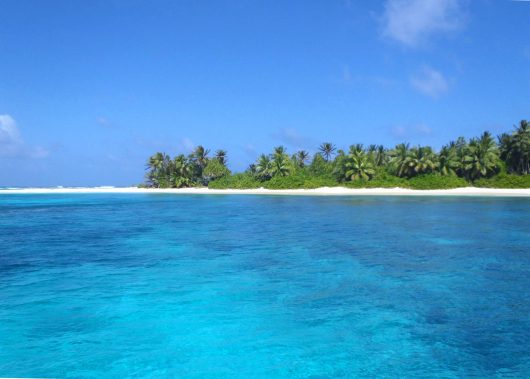
The Marshall Islands are two strings of atolls located in the North Pacific between Australia and the Hawaiian Islands. Their main exports are marine goods, coconut products, and handicrafts. Marshallese climate can be unpredictable, with climate change directly impacting the islands. In addition, securing sufficient sources for fresh water is a constant struggle. Because of these issues, many inhabitants of the islands live in poor circumstances, with bad health and little access to energy sources.
Since their year of independence in 1986, the Marshall Islands Government has been engaged in an uphill battle of physical, economic and environmental survival. Fortunately, there are a number of international lifeguards who are helping to keep the Marshallese government afloat.
The United States (U.S.)
One problem the Marshall Islands Government does not have to worry about is military security. Though it is a sovereign state, its military protection is provided by the U.S. But security is not the only service that the United States provides to the islands. The U.S. affords educational, medical and infrastructural aid, and donates funds in an effort to help the islands eventually attain economic self-sufficiency.
Roughly 50 percent of the revenue that the government obtains is gathered from foreign aid, and a large portion of this comes from U.S. coffers due to an agreement entitled the “Compact of Free Associations” which exists between the two nations.
Federal Emergency Management Agency (FEMA)
Though it is an entity within the structure of the United States government, FEMA merits particular mention. Operating under the supervision of the Department of Homeland Security, FEMA’s standard focus is the prevention, response and recovery from disasters that occur within U.S. borders. However, due to the Compact of Free Associations, the agency is also obliged to assist the Marshall Islands when disasters arise.
Just this year, the Marshall Islands have been experiencing one of the worst droughts in their nation’s history, collecting only a quarter of the rainfall that they typically obtain. On April 1st, Marshallese President Hilda Heine declared a state of emergency, and on April 28th FEMA announced that it has allotted federal disaster assistance to the Marshall Islands Government. Millions have been spent in past years on similar disasters.
Australia
The Marshall Island’s southern neighbor, Australia, is dedicated to supporting the islands in the economic and climatic issues. Between the Marshall Islands and two other North Pacific states, the Australian Government has pledged almost $10 million within the next fiscal year.
Australia’s goal is to increase access to water, sanitary facilities, and education. Additionally, Australia is helping to introduce a new public school system and spreading gender equality awareness throughout the islands. Many of these objectives have been reached through the sponsored delivery of water containers and the establishment of better education and scholarships to continue on to higher schooling.
The United Nations (U.N.)
The Marshall Islands and other low-lying countries are particularly susceptible an increase in global temperature. It is projected that low-lying countries like the Marshal Islands will be submerged, or at least uninhabitable, if the global temperature rises just 2 degrees Celcius above pre-industrial levels.
In response to this dilemma, the U.N. has held multiple conferences over the last months in an effort to promote awareness and compliance to goals regarding carbon emissions. Just last month 175 countries were gathered in Paris to sign an agreement on the reduction of fossil fuel usage. The U.N. noted that this conference marked the largest number of countries to sign an international agreement at one time in the history of the world.
The Japan International Cooperation Agency (JICA)
A less recognized, but equally engaged organization is the Japan International Cooperation Agency. JICA focuses on what they call “inclusive development,” which emphasizes individual initiative in evaluating one’s own situation to improve it. JICA simply provides the resources necessary to carry out these improvements.
For the Marshall Islands, JICA is carrying out programs to improve waste control and worldwide education programs. JICA has been training volunteers to travel world-wide in an effort to address these issues, and in 2015 alone almost 3,500 volunteers traveled to the pacific to assist in humanitarian aid projects.
Despite the aid that these organizations are providing to the Marshall Islands, many inhabitants of the country live without the basic necessities of life. Further efforts are needed bring these individuals out of poverty. According to the World Bank, development must begin within the Marshall Islands Government. They commented, “The growth in the economy would be strengthened and sustained by the government’s commitment to reform.” The rest of us simply need to do our part.
– Preston Rust
Photo: Flickr

Books and Butter: Ending Poverty in Costa Rica
Poverty in Costa Rica continues to be an ongoing issue as the country suffers from a lack of infrastructure, weak educational system and high food prices. President Barack Obama recently announced a plan to provide $1 billion in aid to Central American countries. This plan curiously omitted Costa Rica from its list, citing “place-based security strategies” as the reason.
Costa Rica’s troubled neighbors—El Salvador, Guatemala and Honduras, together known as the “northern triangle”—certainly deserve the attention of U.S. policymakers. In El Salvador, the most violent country on earth that is not at war, the homicide rate stands at 90 per 100,000 residents.
From 2009 to 2013, the number of asylum seekers from these countries in the U.S. has seen a sevenfold increase to 2.7 million people. In fact, some analysts are calling this exodus a “Central American Spring” sparked by drug trafficking, violence and extortion.
Though its rule of law has remained intact, Costa Rica shares a similar poverty experience. Poverty in Costa Rica stands at 22.4 percent of the population, a number that has fluctuated little since the 1990s. Roughly 60 percent of the Costa Rican workforce is unskilled. However, the demand for skilled workers continues to increase thanks to new free trade agreements and the privatization of most government enterprises.
This trend is not likely to change if U.S. foreign aid is diverted exclusively to northern triangle states. Alejandra Obando-Hernandez, a researcher at American University’s School of Public Affairs, finds that unskilled Costa Rican parents exhibit “low expectations regarding future benefits of their children’s education.”
There are two reasons for these low expectations that point to how U.S. aid could be effectively utilized in this country. The first is the “books” issue, or the persistent shortcomings on metrics like desertion, teacher training and pedagogical innovation. Only 15.6 percent of Costa Rican children live in homes with some form of post-secondary education; of all students, only 46 percent graduate from high school.
Hernandez attributes these statistics to a lack of school infrastructure and inadequate teacher training. Among the insufficient resources in secondary schools are science labs (61 percent), library rooms (35 percent), computer labs (24 percent) and computers (35 percent). In addition, 20 percent of secondary schools lack sufficient classrooms to host their students.
The second problem is the “butter” issue, or the unnecessary burden that food places on the poorest fifth of Costa Rican families. These high food prices are caused by price controls and agricultural protectionism.
In the case of rice, one sole corporation is authorized to import this staple at low, world market prices. That rice is then sold domestically at higher, price-fixed rates.
According to the Food and Agriculture Organization (FAO) of the United Nations, Costa Rica has the third most expensive rice in the world. A basic food basket costs $42.37 compared to the monthly income of $82 for the poorest fifth. Once two school-going children are factored, the cost of education rises to 104 percent of monthly income.
U.S. aid to help poverty in Costa Rica could help improve these statistics by supplementing educational subsidies (already strong) and alleviating the shock to firms releasing their monopoly status. Doing so would create a stronger, more stable regional partner capable of counteracting the rampant violence in the rest of Central America.
– Alfredo Cumerma
Photo: Wikipedia
Besieged Areas in Syria Receive Foreign Aid
Syria has been engaged in a heated civil war since March of 2011. It is the deadliest conflict of the 21st century to this point. This war has killed over 250,000 individuals and displaced another 11 million Syrians. In addition, the government has surrounded besieged areas in Syria, preventing aid from reaching them.
Late in the evening on June 16, a U.N. convoy carrying food, medicine and emergency supplies for 37,500 people reached one of the besieged areas in Syria, al Waer. This relief is the first of its kind for the people of al Waer in months.
Jens Laerk, spokesman for the Office of Coordination of Humanitarian Affairs (OCHA) said that a second convoy to provide aid for the remaining 75,000 inhabitants should arrive within the next few days.
U.N. Humanitarian adviser Jan Egeland points to the significance of the convoy. He said that the besieged suburb surrounded by government troops had “been without supplies for more than three months.”
OCHA estimates that 5.47 million Syrians live in besieged and “hard to reach” areas. Numbers are difficult to confirm, due to conflicting reports from the Syrian government and U.N.
After the United Nations placed pressure on the Syrian government, the World Food Program has been able to breach blockades around several besieged areas.
They have worked with the U.N., Syrian Red Crescent, Red Cross and other relief organizations to provide much needed foreign aid to areas that have not seen relief in months or even years.
Earlier this month, a U.N. convoy reached the Damascus suburb of Darayya with aid for the first time in over four years. Shortly after the convoy left, the Syrian government dropped 28 barrel bombs from helicopters.
Because aid has been considerably scarce, and the government has been inconsistent in allowing supply convoys to enter besieged areas in Syria, the U.N. feels the urgency to provide help. They are considering sending supplies via air drop.
This is an especially risky and inefficient tactic. The U.N. believes that sending supplies in this fashion could be dangerous without approval from Syrian president Bashar al-Assad.
The Syrian government recently said that it would allow foreign aid convoys more access to besieged areas. Government officials said that they would also allow air drops to areas under duress from the Islamic State.
As long as the government keeps its word, this could be good news for those living under siege. For the first time in a long time, they will have increased access to food, medicine and other essentials.
– Aaron Parr
Photo: UNHCR
Toronto Joins the 2016 World Partnership Walk
Each year the Aga Khan Foundation Canada, (AKFC), an international development organization and registered charity, hosts the event. AKFC is a nonprofit international development agency helping to find solutions to alleviate global poverty. The organization focuses on improving the living conditions of those living in poverty, regardless of faith, origin or gender.
On May 29, there were over 10,000 participants in Toronto, who gathered at the Metro Hall in David Pecaut Square. Last year, more than 40,000 individuals participated in the event from Montreal, Ottawa, Regina, Vancouver and Victoria, helping to raise over $7 million.
Canadians are motivated to mobilize and donate to the event because they want to see global poverty levels reduce even further. According to the World Bank, there are 1 billion fewer people living in poverty globally than there were 25 years ago.
Many families are driven to participate in the annual event, as 100 percent of the donations go toward AKFC programs. In addition, the event offers memorable experiences through activities that inform, educate and entertain all participants from the young to the old.
Based in Canada, AKFC works to promote the discussion of global issues and works to build partnerships with Canadian institutions. The organization began operations in 1980 and kicked off its first walk in 1985 when a group of women from Vancouver raised $55,000. Now, the event is held in 10 cities each year and AKFC has raised $95 million since the first walk.
The 2016 World Partnership Walk is the largest event in Canada supporting international development in 14 countries. AKFC concentrates specifically on improving access to education and healthcare, food security, producing economic opportunities and constructing strong communities and local institutions.
– Kimber Kraus
Photo: Flickr
Battling Disease: The World’s Leading Killer
According to a recent study by WHO, HIV-related deaths are still amongst the top ten leading causes of death in the world, killing on average 1.5 million people in 2012. Additionally, diseases such as malaria, although easily curable, remain a massive threat, especially to developing nations such as Southeast Asia and Africa.
In 2015, 214 million new cases of malaria were transmitted worldwide. Young children below the age of five are especially vulnerable to this disease. In the same year, approximately 306,000 children died from malaria, 292,000 of which were from Africa.
However, while such diseases remain at large, great measures are being taken not only to cure, but to prevent these global killers from winning. In regards to the malaria epidemic, one of the Millennium Development Goals, known as “target C,” is currently working on reducing malaria transmission, successfully battling disease and decreasing spread by 75 percent. Moreover, WHO’s Global Technical Strategy for Malaria 2016-2030 is working to reduce malaria mortality rates by 90 percent, as well as eradicating the disease in 35 countries.
Other leading killer diseases can be prevented through basic hygienic practices, such as diarrheal diseases and dysentery. Yet, about 2.2 million people die from diarrhea, most of whom are children in developing countries that lack sufficient sanitary irrigation. However, sanitation efforts and campaigns supported by WHO, CDC, the U.N. and similar global non profits all work on bringing filtration and sanitary water accessibility to developing nations.
All in all, while disease should be recognized as a major threat, it is only as powerful as the measures taken to prevent and cure it. Global health organizations continue to instill sanitary and other preventable practices in nations to battle disease, in the hopes of ending these global killers.
– Jenna Salisbury
Photo: Flickr
Poverty in the Democratic Republic of The Congo
Since the development of the Democratic Republic of the Congo—commonly known as the DRC or the DR Congo—the nation has been the center of what many historians refer to as “Africa’s World War.” Although the country is vastly populated with an innumerable amount of resources, poverty in the Democratic Republic of the Congo still defines the lives of children and adults.
Examining Poverty in the Democratic Republic of the Congo
Causes
One of the main causes of poverty in the Democratic Republic of the Congo is health threats, specifically a malaria outbreak, which resulted in approximately 6.7 million cases nationwide in 2009. Infectious diseases, like malaria, divert intentions for economic investments, threaten public health and contribute to child mortality rates.
Yet, health risks are not the only notable sources of poverty in the Democratic Republic of the Congo. It is estimated that there are about 4 million orphans whose population has been created not only by disease but also by the intense conflict in the area.
However, the violent area of South Kivu is gradually returning to a more peaceful and prosperous region, improving the lives of people in the conflict zones.
Solutions
In 2001, the World Bank reengaged with the DRC by providing financial and technical assistance through the application of several emergency plans to aid in the recovery of the health of the region’s people.
Projects like the Karhale Water Supply Project improved public access to potable water for 2,750 households in Bukavu, reducing travel time by placing water standpipes in strategic locations. With more access to potable water, Bukavu significantly reduced the transmission of water-borne illnesses, like the parasitic worm infection, schistosomiasis.
More recently, the World Bank’s assistance has shifted its efforts to supporting institutional capacity through the Enhancing Governance Capacity Project (PRCG) and the Public Administration Capacity Building Project (PRC-GAP).
Before the PRCG closed in February 2016, the project implemented new human resource management and public finance systems in the central and provincial governments of the region, which allowed the South Kivu Province to double its revenue between 2009 and 2014.
The project’s final goal is to reorganize the current government to permit the development of economic performance at the local level. Currently, the project has facilitated the rehabilitation of eight centers to facilitate the ongoing training of government officials throughout the nation.
The DRC will be able to reduce its dependency on external technical assistance via resources such as training at universities and higher education institutions. The Catholic University of Bukavu benefitted directly from this project, as it now runs one of the most recognized centers for excellence for the area.
When visiting Bukavu for the first time, the World Bank Country Director for the DRC, Ahmadou Moustapha Ndiaye, explained in a 2016 press release how the World Bank progresses with the success of the nation. “Our goal is to lay the foundation for sustainable development in the South Kivu Province, and throughout the country, which entails establishing efficient and transparent institutions and management systems.”
– Veronica Ung-Kono
Photo: Flickr
Poverty in Ethiopia: An Overview
Like many of the African nations that have gained their independence from a European power, poverty in Ethiopia has been exacerbated by regional conflict that caused widespread poverty to infect communities across the country.
Ethiopia was one of the first countries to claim their independence in 1896 after the Italians were rejected from the nation. Unfortunately, geopolitical conflict continued to plague the nation as the neighboring Eritrea staked a claim to its own independence in the late 20th century. The tension culminated in a border war at the turn of the century.
The social malady that most affects Ethiopia is malnourishment. In 1984, famine struck the nation which required a huge foreign aid response from the Western world. Ever since then, the Ethiopian government has had trouble feeding its large population of over 86 million. The nation remains reliant on Western nutritional support as their developing economy starts to emerge from its fledgling status.
Ethiopia’s GDP per capita began an early improvement in the 1990s, as the country began its recovery from conflict and famine in the 1980s. The Eritrean dispute forced GDP per capita down once again until the mid-2000s. Since then, Ethiopia’s growth has exploded to $541.87 up about 400 percent. The progress in the economy has helped reduce poverty rates significantly.
According to data from the World Bank, poverty in Ethiopia fell from 44 percent in 2000 to 30 percent in 2011. Fertility rate, which is highest in the poorest countries, fell from 7.0 in 1995 to 4.6 in 2011. Undernourishment, one of the biggest issues in Ethiopia, dropped from 75 percent in 1990-1992 to 35 percent in 2012-2014. These are just a few of the signs of an improving society.
Even so, there is still a long way to go. Based on the United Nations Development Programme’s Human Development Index, Ethiopia ranks 174th out of 187 countries. In order to improve that statistic and further fight hunger, the East African country needs to improve its use of its valuable arable land. The Rural Poverty Portal estimates that “only about 25 percent of its arable land is cultivated.”
Expanding Ethiopia’s agricultural base is, perhaps, the most efficient way of reaching the population spread out over the country. In 2014, it was estimated that over 78 million people live in rural areas, while the remaining are concentrated in urban hubs. Providing better technology for food production and better infrastructure for distribution could be an ideal way to attack malnutrition.
The International Development Research Center conducted a case study called “Ethiopia: Breaking the Cycle of Poverty in Ethiopia.” The author, Mike Crawley, investigated deeper into the “simple problem” that plagues the population, “not enough food.” His research found that individual farmers are limited in their production abilities by “too small landholdings, poor agricultural practices, and lack of potable water.”
The solution? Change the way these individual farmers operate so that they can help themselves and their community. The organization’s team sought to convince “farmers to think about whether they could begin to make some positive changes on their own rather than wait for assistance from outside.” The mentality that helping the community is not outside the purview of helping oneself is one that will be essential in the fight against poverty in Ethiopia.
– Jacob Hess
Photo: Flickr
UN, ILO Push for Enforcement of Child Labor Laws
On World Day, June 12, the U.N. announced a renewed focus on child labor laws and supply chains. With so many children working, the U.N. says that all supply chains potentially use child labor.
Child labor encompasses “work that deprives children of their childhood, their potential and their dignity, and that is harmful to their physical and mental development.”
The International Labor Organization (ILO) and the U.N. have declared that nations must pass legislation in order to make lasting change. National governments need to adopt and enforce legislation that defines child labor and protects children against it.
Don’t child labor laws already exist?
Yes: ILO Convention No.182 helps to define the worst forms of child labor and makes a long term goal of the effective elimination of the issue. Also, Convention No. 138 sets the legal age at which a child may begin working.
For most member states of the U.N., the basic minimum age of labor is 15, with the possible exception of 14-year-olds in developing nations. The ILO stresses that no person under the age of 18 should be doing hazardous labor.
Considering that Convention No. 138 was written in 1973 and No. 182 in 1999, the goal of ending child labor is by no means a new one.
While conditions have improved since the inception of these conventions, 215 million children still take part in child labor today. Their employers often force them to work in the drug or sex trafficking industries. Some of these children are even forced to tote a gun and kill others.
Because child laborers number in the hundreds of millions, eradication may seem impossible. Fortunately, however, the numbers are dropping.
As more nations adopt the ILO’s conventions on child labor, the problem continues to diminish. In 2000, only 93 countries had ratified Convention No. 138 and established a minimum age for child labor.
That same year, some 16 percent of children aged 5-17 were exposed to child labor worldwide. The most recent statistics from 2014 show that the number has dropped to 13.9 percent.
As the number of countries that have ratified Convention No. 138 jumps to 169, these small improvements will continue to grow in power and significance.
The real improvement comes with the ratification of Convention No. 182. Since 1999, hazardous child labor has dropped from an estimated 171 million children in 2000 to 85 million today. In addition, 180 countries have ratified this convention.
Ratification of these child labor laws and conventions has been effective in diminishing the problem, but it has not been enough to eradicate child labor.
In order to enforce child labor laws, governments must raise awareness of the problem. In addition, they must enact laws that enforce minimum working age and acceptable working conditions for children.
With World Day’s focus on child labor and its ensuing push for enforcement of ILO Conventions 182 and 138, world leaders will work to decrease the number of child laborers over the coming years.
-Aaron Parr
Photo: Pixabay
Five Ways the Marshall Islands Government is Staying Afloat
The Marshall Islands are two strings of atolls located in the North Pacific between Australia and the Hawaiian Islands. Their main exports are marine goods, coconut products, and handicrafts. Marshallese climate can be unpredictable, with climate change directly impacting the islands. In addition, securing sufficient sources for fresh water is a constant struggle. Because of these issues, many inhabitants of the islands live in poor circumstances, with bad health and little access to energy sources.
Since their year of independence in 1986, the Marshall Islands Government has been engaged in an uphill battle of physical, economic and environmental survival. Fortunately, there are a number of international lifeguards who are helping to keep the Marshallese government afloat.
The United States (U.S.)
One problem the Marshall Islands Government does not have to worry about is military security. Though it is a sovereign state, its military protection is provided by the U.S. But security is not the only service that the United States provides to the islands. The U.S. affords educational, medical and infrastructural aid, and donates funds in an effort to help the islands eventually attain economic self-sufficiency.
Roughly 50 percent of the revenue that the government obtains is gathered from foreign aid, and a large portion of this comes from U.S. coffers due to an agreement entitled the “Compact of Free Associations” which exists between the two nations.
Federal Emergency Management Agency (FEMA)
Though it is an entity within the structure of the United States government, FEMA merits particular mention. Operating under the supervision of the Department of Homeland Security, FEMA’s standard focus is the prevention, response and recovery from disasters that occur within U.S. borders. However, due to the Compact of Free Associations, the agency is also obliged to assist the Marshall Islands when disasters arise.
Just this year, the Marshall Islands have been experiencing one of the worst droughts in their nation’s history, collecting only a quarter of the rainfall that they typically obtain. On April 1st, Marshallese President Hilda Heine declared a state of emergency, and on April 28th FEMA announced that it has allotted federal disaster assistance to the Marshall Islands Government. Millions have been spent in past years on similar disasters.
Australia
The Marshall Island’s southern neighbor, Australia, is dedicated to supporting the islands in the economic and climatic issues. Between the Marshall Islands and two other North Pacific states, the Australian Government has pledged almost $10 million within the next fiscal year.
Australia’s goal is to increase access to water, sanitary facilities, and education. Additionally, Australia is helping to introduce a new public school system and spreading gender equality awareness throughout the islands. Many of these objectives have been reached through the sponsored delivery of water containers and the establishment of better education and scholarships to continue on to higher schooling.
The United Nations (U.N.)
The Marshall Islands and other low-lying countries are particularly susceptible an increase in global temperature. It is projected that low-lying countries like the Marshal Islands will be submerged, or at least uninhabitable, if the global temperature rises just 2 degrees Celcius above pre-industrial levels.
In response to this dilemma, the U.N. has held multiple conferences over the last months in an effort to promote awareness and compliance to goals regarding carbon emissions. Just last month 175 countries were gathered in Paris to sign an agreement on the reduction of fossil fuel usage. The U.N. noted that this conference marked the largest number of countries to sign an international agreement at one time in the history of the world.
The Japan International Cooperation Agency (JICA)
A less recognized, but equally engaged organization is the Japan International Cooperation Agency. JICA focuses on what they call “inclusive development,” which emphasizes individual initiative in evaluating one’s own situation to improve it. JICA simply provides the resources necessary to carry out these improvements.
For the Marshall Islands, JICA is carrying out programs to improve waste control and worldwide education programs. JICA has been training volunteers to travel world-wide in an effort to address these issues, and in 2015 alone almost 3,500 volunteers traveled to the pacific to assist in humanitarian aid projects.
Despite the aid that these organizations are providing to the Marshall Islands, many inhabitants of the country live without the basic necessities of life. Further efforts are needed bring these individuals out of poverty. According to the World Bank, development must begin within the Marshall Islands Government. They commented, “The growth in the economy would be strengthened and sustained by the government’s commitment to reform.” The rest of us simply need to do our part.
– Preston Rust
Photo: Flickr
The AMAR Foundation Model of Aid Distribution
The AMAR Foundation works to improve the conditions of approximately 3.4 million internally displaced Iraqis by utilizing local expertise to build long-term solutions.
The organization, founded in 1991 by Baroness Emma Nicholson, is a London-based charity with the goal of improving education, health care and emergency aid to some of the world’s most disenfranchised and impoverished people.
Their model is simple: AMAR works closely with on-the-ground experts, as well as local leaders, to implement entirely local programs that are tailored to the needs of the community.
In lieu of sending in volunteers from other countries, AMAR cooperates with existing services to locally source the materials and expertise needed to improve living conditions. Outside intervention is kept to a minimum and communities are encouraged to build themselves from the inside out.
Communication is the key to the success of this aid model. In a 2015 Jordan Times article reporting on AMAR’s efforts to stem an outbreak of cholera in Iraq, it is proffered that raising awareness about public health and common diseases is one of the most crucial pieces of improving the health of a community.
Communication is key not only in improving public health but also in ensuring the success of locally-based aid efforts like those the AMAR Foundation organizes.
Local collaboration is by no means a new idea, but the AMAR Foundation’s astonishing success utilizing this model within Iraq provides great hope for the future of foreign aid worldwide.
Without the help of major international funding, AMAR has managed to establish a clinic in northern Iraq that serves more than 600 patients a day, as well as multiple mobile health clinics that can be operated by locals. Since 2005, their clinics have helped over 4 million Iraqis.
Although today only a few organizations embrace a model that favors entirely local implementation, the AMAR foundation continues to provide an example of the great success that can come from on-the-ground solutions.
– Sage Smiley
Photo: Defense Video Imagery Distribution System
Candidates for UN Secretary General: the Future
As UN Secretary General Ban Ki-Moon’s term comes to an end in 2016, the selection procedure for the next leader has been underway since January. The position is indeed invested with the prestige and heavy responsibilities as old as the organization itself – but the promises of candidates and the unprecedented public stage the selection process is taking this year indicate the body is adapting to new currents as well.
The UN General Assembly website lists nine official candidates for UN Secretary General:
The disclosed Vision Statements of these candidates address a variety of policies, but many focus on the issue of structurally reforming the UN body, especially the Security Council. Their approach on reform ranges from Natalia Gherman’s “zero tolerance policy on mismanagement, fraud, abuse, corruption and unethical behavior” to Vuk Jeremic’s promise for utilizing social media to communicate with youth and ensure transparency. Economic empowerment of women worldwide and consistent effort for Sustainable Development Goals were also recurring topics.
The selection procedure is expected to be the most transparent in the UN’s 70 years of history, as the UN General Assembly will organize public debates in London and New York. Not only will diplomats of all 193 member’s states attend, but the event will be open to social organizations and individuals as well. A video of the event will be released on the UN website – the first round of informal dialogues and Q&A sessions with the civil society board has already been uploaded. Compared to how all debates and hearings were held behind closed doors until Secretary General Ban Ki-Moon’s election, this constitutes a big step in guaranteeing the equity in deciding the leadership of the world’s largest coalition of nations.
Following the principle of regional rotation, the next Secretary General is most likely to be selected from Eastern Europe. But many organizations, such as Equality Now, are also arguing for a fair gender representation. The first female UN Secretary General would not only be a symbolic empowerment for female politicians worldwide but would also increase the body’s knowledge in women’s issues. “A woman as secretary general would send a strong signal of progress,” said Phumzile Mlambo-Ngcuka, head of UN Women.
– Haena Chu
Photo: Flickr