 Georgia’s policies aimed at reducing poverty have been successful, especially regarding efforts to modernize the labor market and increase access to assistance for large portions of the population. The country’s gross national income per capita rose from $3,000 in 2010 to $5,702 in 2023, along with reducing poverty in Georgia by roughly 35% in a timespan of over a decade. There is a continued sense of urgency to address and curb poverty.
Despite these efforts, in 2024, the Georgian government backtracked on European Union accession talks. This forced successful policies that reduced poverty to be abandoned, leaving only unproven strategies. The resulting suspension of some foreign aid in the form of investments will harm citizens by hindering national economic growth and slowing trade. Furthermore, some Georgians in rural regions and minority groups, consisting of Azerbaijanis and Armenians, still face high levels of poverty due to the government’s limited current legislation focused on their needs.
Ethnic tensions in Georgia are prevalent, stemming from the need to preserve the unique identity of Georgians, especially from outside invaders, including Russia. Georgia has two breakaway regions, Abkhazia and South Ossetia, both striving for independence. However, the Georgian government and people have been skeptical of foreign influence in the regions and the potential for disruption to the Georgian identity, according to the Carnegie Endowment for International Peace.
This fear, along with the hindrance of the government viewing minorities as lesser members of the nation, has restricted support and Georgia’s hope to curb poverty in predominantly minority regions.
Black Sea Importance and Access
The Black Sea is of great importance to Georgia, allowing access to beneficial trade resources and international partnerships. Partnerships between foreign nations can also enhance security, unify independent countries and provide protection in this dynamic region. Without the Black Sea, Georgia would be unable to utilize ports to facilitate trade and resource distribution.
Also, the Blue Economy or ocean resources used for economic growth, is vital to Georgia. A recent project from the European Climate, Infrastructure and Environment Executive Agency increases support for fisheries, coastal and maritime tourism and maritime transport, according to the European Commission.
Besides ports, oil and gas pipelines also flow through and around the Black Sea, creating a significant trade route from nations such as Russia and Turkey to nations in Europe. The ability for nations to tap into Western markets is key to maintaining national economic growth and potential job growth, ensuring that the nation thrives and that poverty can be reduced.
This is beneficial not only to individual nations in the region but also to the U.S., which has the goal of minimizing adversary movements in conflict zones and areas of high trade interest. Specifically, nations that can rely on Western nations for trade and an economic boost will become less dependent on Russian trade and influence. Additionally, their national independent movements will be protected, according to the Foreign Policy Research Institute.
Georgia’s Ports
Georgia’s unique location between the Black Sea and the Caspian Sea, along with neighboring Azerbaijan, allows the country to connect seven landlocked countries. It promotes trade between Europe and Asia. According to the National Library of Medicine, Georgia maintains aspirations of being a direct hub between Europe and Asia, with added economic growth, infrastructure and development. Trade agreements are vital in preserving and increasing Georgian dominance on the Black Sea to become a significant trade and support nation in a time when foreign influence downplays the nation.
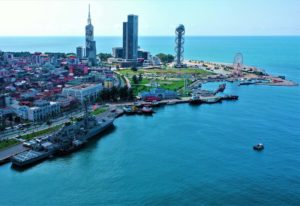
The Batumi Sea Port, located near the southwest corner of the nation, is designed to deal with cereal cargo and petroleum goods. According to the Logistics Cluster, the port transfers goods from land-based transport to ships. It also handles trade vessels and military ships from the U.S. and NATO. These military vessels dock to support regional security through joint exercises and training. By maintaining a strong flow of trade and military ships through their ports, Georgia ensures a positive economic output and strong international cooperation while maintaining security against threats.
Ongoing Strife in the Black Sea
With Russia’s ongoing expanded war against Ukraine, originating in 2014, the Black Sea is still a threatened region, facing military threats, environmental risks and disruptions to vital shipping routes. Primarily at the start of the war, the Russian Navy increased warship presence in the Black Sea and since then, both the Russian Navy and the much smaller Ukrainian Navy have utilized sea mines to deter advances from both sides.
However, with the presence of warships and mines, coastal authorities continue to warn marine traffic of the dangers, ultimately creating uncertainty in trade routes and the potential for disasters, according to the NATO Shipping Center. Environmental risks are also occurring, with mines and oil spills from Russian oil tankers harming the Black Sea shipping lanes and wildlife. Aging tankers in Russia’s shadow fleet, used to evade oil price caps, are at higher risk of spills or navigation failures. Collisions involving these vessels also disrupt trade and daily life in regions like Crimea.
With Russian deals to implement new naval policies and create new bases to house warships, Georgia will be at a disadvantage. Continued disruptions to trade and Russian influence to bar additional Georgian efforts to secure new ports and infrastructure relating to trade will negatively impact the Georgian economy and reduce poverty in Georgia.
A Future for Georgia and the Black Sea
Georgia continues to find new ways to reduce poverty. A report supported by the United Nations Development Programme (UNDP) describes how investments in social security, health care and education will help reduce poverty. To create long-lasting economic growth, the Black Sea’s role must be at the forefront of future deals. Prioritizing investment, tourism and port development will boost jobs, raise incomes and improve regional trade efficiency, key steps toward reducing poverty in Georgia.
– Avery Kachmarsky
Avery is based in Los Angeles, CA, USA and focuses on Business and Politics for The Borgen Project.
Photo: Flickr

The Bold Plan To End Youth Unemployment in Eswatini
This crisis stems largely from Eswatini’s skills gap, one of the world’s widest. Consequently, young people’s skills due to training or education are far below what employers require. In 2017, Eswatini ranked 136/139 in the International Labor Organization Skills Mismatch Index. Furthermore, more than 50% of Eswatini’s workforce holds jobs in the informal sector, leaving many young people without wage protections.
High youth unemployment can fuel poverty and inequality, with 53% of the population already living below the poverty line. Furthermore, as young people are discouraged by repeated failures in the job market, many may leave the labor market altogether. This lost potential threatens to hold back progress and risks entrenching young people in cycles of dependency and social instability.
The Eswatini Youth Employment Opportunities Project
Recognizing the severe economic and social risks posed by youth unemployment, the World Bank has stepped in with a bold response. It launched the Eswatini Youth Employment Opportunities Project to help the country harness the full potential of its young population. The first component of the World Bank’s project aims to expand income-earning opportunities for young people.
The scheme will specifically target 30,000 young people, at least 50% female and provide targeted support in the agricultural sector, aiming to promote self-employment opportunities. Given the size of Eswatini’s farming population, this can revolutionize the farm job market and lower youth unemployment in Eswatini.
Smarter Youth Welfare Spending
The project’s second component shifts the focus from skills and income generation to ensuring that support reaches the most vulnerable youth. Indeed, this will involve the development of a digital Eswatini Social Registry to provide relevant data that will allow the Eswatini government to target welfare resources more effectively.
This part of the plan is essentially an effort to ensure that the Eswatini government’s welfare spending on young people is used as efficiently as possible. If this program can ensure that the resources of Eswatini’s government are being spent efficiently, it could unlock millions of dollars that can be spent on the welfare of Eswatini’s youth.
Final Remarks
The Eswatini Youth Employment Opportunities Project represents more than an economic program; it signals a potential turning point for the nation’s future. The plan effectively combines direct income-generating initiatives with more efficient social protection systems. In doing so, it aims to address the immediate need for jobs and the structural barriers that keep young people from accessing the labor market.
– Adam Walsh
Photo: Wikimedia Commons
FSPK Offers Hope: Homelessness in Kiribati
The Impact of Climate on Homelessness in Kiribati
Recent World Bank research indicates that sea levels could rise by as much as 0.5 meters between 2070 and 2110, potentially flooding 50% to 80% of Kiribati’s major urban areas. But even ahead of this daunting statistic, climate-related disasters such as flooding and extreme weather events have already worsened the housing crisis.
In June 2025, the Kiribati National Statistics Office reported that 60% of households that experienced climate disasters in the past year sustained home damage, primarily due to strong winds and heavy rain. Nearly 4,000 people had to leave their homes, underscoring the urgent need for emergency housing and the growing challenge of homelessness in Kiribati.
Despite the challenges, most residents maintain a deep attachment to their land and traditions and are reluctant to leave. In response, the Foundation for the Peoples of the South Pacific Kiribati (FSPK) is a local nonprofit leading local efforts to combat homelessness and housing insecurity. Here are examples of three key initiatives making a difference today.
Modular Affordable & Climate-Resilient Housing Initiatives
In Kiribati’s crowded capital, families average 7.3 members and often live in open shacks packed closely together. Additionally, there are frequent land disputes, and many have resorted to creating their own sea walls made from coral as an attempt to hold off flood waters. To address these housing issues, FSPK partnered with Karmod to introduce modular, quick-build homes that offer sustainable, flood-resistant shelter for vulnerable communities. These serve as faster shelter solutions for vulnerable communities facing threats from rising seas. These homes are a direct response to the increasing homelessness in Kiribati, driven by sea-level rise and climate-related disasters.
Women & Youth-Driven Climate Resilience
Thanks to FSPK’s partnership with Action on Poverty, women and youth who past leadership excluded from decision-making in community planning are now leading community-based adaptation efforts. Resilience projects include digging freshwater wells and kitchen gardens, efforts which boost food and water security, and therefore reduce the need for forced, climate-related relocation. By deliberately targeting those most vulnerable to climate impacts and housing insecurity, the program empowers women and children to recognize their role in adaptation and building a more resilient future.
Advocacy for Government and Donor Support
In March 2025, FSPK co-developed a proposal in partnership with the Kiribati government, targeting an international climate finance mechanism called the Adaptation Fund Board. The proposal aims to secure funding for climate resilience efforts, specifically by engaging donor governments and mobilizing national and international NGO support. The proposal also highlights the impact of initiatives led by FSPK and local communities, and encourages ongoing government collaboration to develop scalable solutions.
Looking Ahead
Homelessness in Kiribati continues to rise as climate threats intensify, putting countless residents at risk. However, local organizations like FSPK, are leading effective solutions, bringing hope and stability to these vulnerable communities. To help ensure a safer future for Kiribati, supporting groups like FSPK and donating to climate-focused housing initiatives is more important than ever.
– Kaitlin Reed
Photo: Pexels
Senegal’s Sustainability Progress: Achieving the First Three SDGs
SDG 1: No Poverty
The SDG 1 focuses on ending all poverty around the globe. Being a developing country, Senegal experiences high rates of poverty in some regions. However, the poverty rate is steadily decreasing, going from 53% in 2011 to 18% in 2021.
The Sahel Adaptive Social Protection Program (SASPP), a policy that has assisted in decreasing poverty in Senegal, seeks to improve social protection systems, support programs that help all individuals make a living (such as Yokk Koom Koom), provide emergency aid for vulnerable households and strengthen institutions.
SDG 2: Zero Hunger
The purpose of the SDG 2 is to end hunger, improve nutrition, promote sustainable agriculture and attain food security. Senegal has made progress in the fight against hunger, improving its Global Hunger Index score from 17.1 in 2020 to 15.3 in 2024.
Although there is still room for improvement, organizations like The Hunger Project focus on further declining Senegal’s hunger rate and continuing Senegal’s sustainability progress. The Hunger Project is a non-profit organization that operates on the “Epicenter Strategy,”
which works to establish sustainable and self-reliant epicenters in Senegal, assisting communities in accessing safe food resources.
SDG 3: Good Health and Well-Being
The SDG 3 works to promote healthy lives and the general well-being of all individuals. Although COVID-19 caused worldwide setbacks in health, Senegal’s sustainability progress continued to improve in several areas. Through consistent development of modern practices and medicine, maternal mortality has decreased from 356.7 deaths per 100,000 live births in 2015 to 237.4 deaths in 2023; the number of people reported as needing assistance due to Neglected Tropical Diseases (NTD) has gone from 5.6 million in 2020 to 4.1 million in 2023; and by 2021, only 1.3% of households were spending more than a quarter of their budget on basic healthcare.
Caritas Internationalis is a Catholic relief organization that has provided health support in Senegal since 1966. Caritas administers medication, prevents illnesses, and provides treatment programs with life-saving supplies.
Conclusion
Organizations like The Hunger Project and Caritas Internationalis, alongside The Sahel Adaptive Social Protection Program, have helped tremendously in reducing poverty and hunger, promoting well-being and more. Despite trials and tribulations, Senegal’s sustainability progress is on a steady incline.
Senegal 2050– a “National Transformation Agenda”– outlines goals that are similar to those of the United Nations. With the continued support of organizations and policies, several of the Sustainable Development Goals may be achieved by 2050.
– Casey Relyea
Photo: Flickr
Who Am I?: The Influence of Mahmoud Darwish on Palestine
The master lyrical poet constantly asks for answers to who he is; however, Mahmoud Darwish never stood alone and never failed to call out to the Palestinian people he wrote for. Though Darwish sadly passed away in 2008, his work remains just as influential for the people of Palestine, who have always been the heart of his work.
The Healing Power of Poetry
Reading and writing poetry offers incredible mental benefits, even going so far as to decrease pain in the sick. In a study conducted in 2016, researchers observed how listening to or reading music and poetry could affect pain, depression and hope within adult cancer patients.
The findings were remarkable; the study directly identified “both music and poetry produced a similar improvement in the pain intensity. The two therapies also affected depression scores and only poetry increased hope scores.” The “hope score” mentioned in the study refers to a measurement of a patient’s optimism, which was solely increased by listening to poetry.
Writing for Palestinians
Born in 1941, Mahmoud Darwish published his first poetry collection at 22, titled “Leaves of Olives.” At this point, he had been put on house arrest and imprisoned by the Israeli government; Darwish’s back-and-forth with the Israeli government began when he was 14. Darwish’s influence on Palestinian voices has been an incredibly valuable tool and continues to be so today.
Being Palestinian himself, Darwish wrote to the people of Palestine, sharing their anxieties, suffering and love for their home. Darwish witnessed the beginning of it when he was a young boy. Born in al-Birwa before it became a part of Israel, Darwish watched the expansion of the Israeli army firsthand. Al Jazeera, an independent news organization operating out of Qatar, explains the unique significance of Darwish’s writing to his Palestinian audience: “For Palestinians, words are often the only weapon available to fight back, finding the power to shape perception.” Poetry’s power is not only one of healing, but one of hope. Darwish’s influence on Palestine reveals that.
Exile, Famine and Tragedy in Gaza
Since Darwish’s sad passing in Houston, Texas, his beloved homeland has become more dangerous as conditions worsen. The Israel-Gaza ceasefire expired in March 2025 and it remains unclear if any new progress has been made in peace talks between Hamas, Israel and the U.S.
Right now, starvation has become an incredibly pressing issue, with the BBC reporting that “almost one in three people in Gaza are going days without eating.” Malnutrition and famine are adding to an already immense body count. However, active humanitarian efforts are taking place across the globe.
Gaza’s Poets Today
This past July, a young Palestinian named Mohammed Moussa had his work posted on the Instagram account gazapoets, in which he writes, “How do you capture starvation in words? Hollow bowls, hollow promises, bellies aching like silent bombs…” Moussa mentions Darwish in another piece of writing, an article, telling the story of Moussa’s literary beginnings. In the same article, the other emerging poets Moussa interviewed named Darwish as one of their favorite poets. Darwish’s influence remains impressive, even among younger Palestinians.
It cannot be downplayed how much of an inspiration Darwish was during his life, even now as conditions continue worsening in Gaza. His name still holds significant power and hope. Darwish’s words remain as pertinent in 2025, still speaking to those struggling beneath war, famine and displacement. Currently, the #mahmouddarwish tag on TikTok contains 20,000 videos. The videos range from celebrating the work and language of the late poet to using his art to bring attention to the humanitarian crisis in Gaza.
– Peyton Worsham
Photo: Pixabay
Top 10 Facts About Poverty in Zimbabwe
The 2024 El Niño-induced drought further pushed the country into a dire humanitarian crisis. However, a favorable 2025 harvest has offered some respite, improving livelihoods and food security for millions. Despite these recent positive developments, underlying issues remain, underscoring the need for sustained support and long-term solutions.
Facts About Poverty in Zimbabwe
Organizations Providing Aid
Despite these challenges, organizations like Action Against Hunger (ACF) and the World Food Program (WFP) are stepping up their efforts to meet the urgent needs of vulnerable Zimbabweans.
ACF provides cash transfers to farmers and households with malnourished children, while ensuring these children receive the necessary medical referrals. Its actions benefited a total of 8,000 people. The organization has also prioritized access to clean water, constructing and refurbishing boreholes and mini water systems that now serve water to more than 19,000 individuals.
Meanwhile, WFP strengthens rural farming communities by training farmers on climate-smart farming techniques, encouraging traditional small grain cultivation, diverse horticulture and animal farming. WFP also introduces agricultural risk insurance, alongside savings and credit products.
Final Remarks
While the successful 2025 harvest has provided a temporary relief, it highlights Zimbabwe’s acute vulnerability to climate shocks. Continued funding and collaboration between the government and international partners are critical for building long-term resilience, ensuring sustainable development and preparing for future crises linked to climate instability.
– Juliette Delbarre
Photo: Flickr
The Synonymity of Disability and Poverty in Burundi
Disability and Poverty in Burundi
With only 14.78% of its population living in urban areas, Burundi is the least urbanized country in Africa. As such, Burundi relies on small-scale farming to maintain its economy. This means that financial well-being is directly connected to physical ability. For many Burundians who experience limitations, this way of life makes it extremely difficult to support themselves.
While the exact metrics for Burundians with disabilities have not been adequately documented, the World Health Organization (WHO) estimates that around 10-15% of any given country’s population experiences some form of disability. Due to the country’s limited health care system, many Burundians with physical disabilities are not being adequately treated or given solutions to compensate for a lack of mobility, which makes them unable to work.
In an economy that values labor as a commodity, disability is synonymous with poverty, and the statistics support this. According to the National Library of Medicine, “68% of men and 75% of women with disability were affected by multidimensional poverty compared to 54% and 46% of their peers without disability.”
Emerging Solutions
In 2014, Burundi ratified the Committee on the Rights of Persons with Disabilities. The Burundian Constitution was revised to include Article 22, which “reaffirms the protection and equality of everyone before the law and that no one may be subject to discrimination, including, among others, on the ground of disability.”
Legislation like this is a tremendous step in the right direction to ensure that Burundians with disabilities can dispel stigma and discrimination to open up opportunities for themselves in the workforce. Financial stability is an important component of ensuring that people with disabilities are afforded the same respect as nondisabled persons.
The United Nations Children’s Fund (UNICEF) is also striving to improve the treatment of those with disabilities in Burundi. With a specific focus on youth, the organization makes it its mission to study how children with disabilities face social exclusion, barriers to equal education, and inaccessibility to social services. Furthermore, its strategy is to prepare the next generation to be more inclusive and understanding of their peers.
Conclusion
Efforts from both the government and organizations like UNICEF protect the rights of people living with a disability and in poverty in Burundi, while challenging the discrimination that hinders social acceptance.
– Zoey Kartchner
Photo: Flickr
How Enhanced Rock Weathering in Africa Is Turning Heads
The new technology, Enhanced Rock Weathering (ERW), offers a dual solution to two of Africa’s most pressing challenges: unstable climatic conditions and food insecurity. ERW captures carbon dioxide (CO2) directly from the atmosphere by accelerating a natural geological process. At the same time, minerals from the rock revitalize depleted, acidic soils, leading to dramatic increases in crop yields and farmer incomes.
How It Works
The science behind ERW is surprisingly simple. The natural weathering of rocks regulates Earth’s climate by pulling CO2 from the air. ERW turbocharges this process by increasing the surface area of available rock. Finely crushed silicate rock, typically basalt, is spread across agricultural fields.
When rainwater mixes with CO2 in the atmosphere, it forms a weak acid that inevitably falls to the ground and reacts with the rock dust. This reaction converts the CO2 into stable bicarbonate ions that are eventually washed into rivers and oceans, where the carbon is locked away for a projected 10,000 years.
Initial Outcomes of Enhanced Rock Weathering in Africa
While the climate benefits are global, the local impact is life-changing. Many African farmers have struggled with degraded, acidic soils that reduce crop growth for years. With ERW, the basalt dust acts as a slow-release natural fertilizer, replenishing the soil with essential nutrients like calcium, magnesium and phosphorus. It also raises the soil’s pH, making it less acidic and more fertile.
The results are starting to turn heads. In collaboration with ERW company Mati Carbon, farmers in India are reporting increased rice yields “in excess of 20%” with Mati Carbon’s CEO, Shantanu Agarwal, stating that results will be even more pronounced on the most degraded soils.
A recent pilot study in Kenya conducted by the climate-tech startup Flux in collaboration with the United Nations Convention to Combat Desertification proves Mati Carbon right. The study found that applying basalt dust to maize fields increased grain yields by an average of 47.5%, with some farms noting a yield increase of more than 200%. For the participating farmers, this translated into an economic gain of more than $326 per hectare, per harvest, a transformative sum for families living in subsistence conditions.
The Carbon Credit Connection
Another beautiful aspect of these new programs is their business model. All the profits from increased crop yield go straight to the farmers. Companies like Flux and Mati Carbon sell the carbon credits to climate-conscious corporations, then provide the rock dust to farmers free of charge.
The farmers benefit immediately from healthier soils and bigger harvests and credit purchasers solidify their commitment to the environment. Enhanced rock weathering is gaining traction with a sustainable business model, concrete outcomes and increasing interest from the corporate sector.
Into the Future
Mati Carbon, the company that recently won the $50 million XPRIZE for Carbon Removal, aims to support 30,000 smallholder farmers by the end of 2025. Nairobi-based Flux has also set an ambitious goal of generating $300 million in additional income for African farmers by 2030. Early indicators of enhanced rock weathering in Africa point to a win-win situation. However, there are still concerns about the cost of crushing and spreading.
As the technology scales from pilot projects in Kenya, Zambia and Tanzania to larger initiatives across the continent, it promises to turn millions of hectares of African farmland into catalysts for both environmental restoration and human prosperity.
– Levi Ravnsborg
Photo: Pixabay
What Does the Israel-Iran War Mean for Iranians
Economy Pre-Conflict
Iran’s economy, like the majority of the Middle East, depends upon access to power sources: natural gas and oil. These resources are invaluable for Iran and have become its most powerful bargaining chip throughout the Israel-Iran War.
Oil and gas power the Iranian economy and make it an area of interest for the Western world. As of 2024, Iran’s Gross Domestic Product (GDP) was roughly $434.24 billion. While the overall GDP is significant, different units of measurement paint a different picture for the common people living in Iran. When examining Iran’s GDP per capita, the country ranks 117th out of nearly 200. Trade sanctions have worn Iran’s economy down. As a result, it cannot hold the weight of an all-out war. While oil makes up 17% of Iran’s exports and its energy sources bring in a great deal of money, the sanctions greatly limit the economic growth of Iran. Every plan to recover the Iranian economy involves improving relations with the Western world to get the sanctions lifted.
Iran Focus, a nonprofit news outlet that reports on Iran, Iraq and the Middle East as a whole, reported as recently as June 9, 2025, that “in Tehran, 55% of individuals’ income is spent on housing” as inflation batters and bruises civilians. Nearly 75% of Iranians live below the poverty line and as the Israel-Iran War progresses, the percentage could rise.
Impact of the War
Already, the people of Iran are struggling to provide for themselves and their families. The ongoing conflict means even their lives are at risk. On June 15, 2025, the number of deceased Iranians was roughly 224. Civilians have fled from Tehran in droves and Iran’s retaliation could worsen financial hardship. According to The National, another news source that is also reporting on Iran, state collapse could be imminent for the nation. The rial, the currency of Iran, could lose more value. The Israel-Iran war has driven Iran to a tipping point.
Humanitarian Aid in Iran
The most immediate danger to the Iranian people is the Israel-Iran War. In the days after the U.S. allied itself with Israel, global headlines focused on the potential for escalating violence. Thankfully, de-escalation has been orchestrated and the back-and-forth bombing has come to a rest.
Nonprofit organizations are working hard to help the struggling people of Iran. The Center for Human Rights in Iran offers consistent coverage of the ongoing events while focusing on civilians and those who are directly in the line of fire. Its focus is on documenting all human rights issues in Iran and it has been in action since 2008.
Another organization that has global reach but still operates within Iran is Relief International. Relief International targets the damage caused by natural disasters while also building schools and offering financial assistance to struggling citizens. Relief International has a collection of testimonies from people the organization has directly helped; such reminders of good news can serve as a resource for motivation.
Looking Ahead
The Israel-Iran ceasefire remains fragile and recent events show how quickly tensions can escalate. Yet, there is still reason for hope. Humanitarian organizations working in Iran continue to prioritize the needs of civilians, many of whom have little influence over the conflict but bear its heaviest burdens. Their efforts highlight the importance of international attention and support in creating a path toward stability.
– Peyton Worsham
Photo: Flickr
People Living With HIV/AIDS in Samoa
Health Care Capacity: Data-Driven Constraints
As of 2022, Samoa allocates 6.3 % of its gross domestic product (GDP) to health, one of the highest rates among Pacific Island nations, compared to a global average of 9.8%. However, this spending is stretched: the government covers approximately 75% of that, with external aid contributing 13% and out-of-pocket spending comprising 11%.
Despite this investment, Samoa’s health workforce remains critically low, with only 0.55 physicians per 1,000 people. This falls far below the global average of 1.7 and the European Union’s 4.1 per 1,000. The World Health Organization (WHO) recommends at least 2.5 medical professionals (including nurses, midwives and physicians) per 1,000 people, yet Samoa’s national average remains below that. Rural areas fare worse, with just one health worker per 1,000 people, while some urban centers report up to eight per 1,000, according to International Health Strategies.
The imbalance means rural communities are underserved, central hospitals are overburdened and preventive outreach is limited. Faced with a dual disease burden, noncommunicable diseases like diabetes and rising infectious threats like HIV and Tuberculosis (TB) limit the workforce and curtail Samoa’s ability to mount widespread prevention and treatment campaigns.
HIV/AIDS in Samoa
As of the most recent public reports, Samoa has reported only 12 individuals living with HIV, all receiving antiretroviral treatment and in stable health, with no new locally acquired cases since 2020. A national population of approximately 216,000 (2023) means HIV prevalence is 0.005%, far below the Western Pacific regional average of 0.1%. Since 1990, 24 total cases have been recorded, with 11 still living as of the 2016 UNAIDS report. Still, low testing rates, 4–5 % of the population yearly, suggest some infections may go undetected.
People living with HIV/AIDS in Samoa often face significant stigma, leading to discrimination in their workplace and their communities. This social exclusion contributes to job loss and a lack of access to support services. This traps individuals in cycles of poverty. In a small economy, where every job counts, the loss of employment due to health-related stigma is especially damaging.
Global Support and Development Goals
International aid has been vital in Samoa’s fight against HIV/AIDS, funding prevention and treatment efforts that also strengthen education and health care. Viewing HIV as both a health and development issue makes aid more impactful and sustainable.
A key project supporting Samoa’s HIV response is the Global Fund–backed Multi-Country Western Pacific Integrated HIV/TB Program. It was implemented by the United Nations Development Project (UNDP) and Samoa’s Ministry of Health. The program focuses on testing, prevention, treatment and community outreach across 12 Pacific nations.
Conclusion
HIV/AIDS in Samoa is more than just a medical concern. It is a challenge that intersects poverty, social justice and economic development. Combating the epidemic requires medicine, education, compassion and strong international partnerships.
– DeMarlo Jon Gray
Photo: Unsplash
Fighting Poverty in Georgia: The Role of Black Sea
Despite these efforts, in 2024, the Georgian government backtracked on European Union accession talks. This forced successful policies that reduced poverty to be abandoned, leaving only unproven strategies. The resulting suspension of some foreign aid in the form of investments will harm citizens by hindering national economic growth and slowing trade. Furthermore, some Georgians in rural regions and minority groups, consisting of Azerbaijanis and Armenians, still face high levels of poverty due to the government’s limited current legislation focused on their needs.
Ethnic tensions in Georgia are prevalent, stemming from the need to preserve the unique identity of Georgians, especially from outside invaders, including Russia. Georgia has two breakaway regions, Abkhazia and South Ossetia, both striving for independence. However, the Georgian government and people have been skeptical of foreign influence in the regions and the potential for disruption to the Georgian identity, according to the Carnegie Endowment for International Peace.
This fear, along with the hindrance of the government viewing minorities as lesser members of the nation, has restricted support and Georgia’s hope to curb poverty in predominantly minority regions.
Black Sea Importance and Access
The Black Sea is of great importance to Georgia, allowing access to beneficial trade resources and international partnerships. Partnerships between foreign nations can also enhance security, unify independent countries and provide protection in this dynamic region. Without the Black Sea, Georgia would be unable to utilize ports to facilitate trade and resource distribution.
Also, the Blue Economy or ocean resources used for economic growth, is vital to Georgia. A recent project from the European Climate, Infrastructure and Environment Executive Agency increases support for fisheries, coastal and maritime tourism and maritime transport, according to the European Commission.
Besides ports, oil and gas pipelines also flow through and around the Black Sea, creating a significant trade route from nations such as Russia and Turkey to nations in Europe. The ability for nations to tap into Western markets is key to maintaining national economic growth and potential job growth, ensuring that the nation thrives and that poverty can be reduced.
This is beneficial not only to individual nations in the region but also to the U.S., which has the goal of minimizing adversary movements in conflict zones and areas of high trade interest. Specifically, nations that can rely on Western nations for trade and an economic boost will become less dependent on Russian trade and influence. Additionally, their national independent movements will be protected, according to the Foreign Policy Research Institute.
Georgia’s Ports
Georgia’s unique location between the Black Sea and the Caspian Sea, along with neighboring Azerbaijan, allows the country to connect seven landlocked countries. It promotes trade between Europe and Asia. According to the National Library of Medicine, Georgia maintains aspirations of being a direct hub between Europe and Asia, with added economic growth, infrastructure and development. Trade agreements are vital in preserving and increasing Georgian dominance on the Black Sea to become a significant trade and support nation in a time when foreign influence downplays the nation.
The Batumi Sea Port, located near the southwest corner of the nation, is designed to deal with cereal cargo and petroleum goods. According to the Logistics Cluster, the port transfers goods from land-based transport to ships. It also handles trade vessels and military ships from the U.S. and NATO. These military vessels dock to support regional security through joint exercises and training. By maintaining a strong flow of trade and military ships through their ports, Georgia ensures a positive economic output and strong international cooperation while maintaining security against threats.
Ongoing Strife in the Black Sea
With Russia’s ongoing expanded war against Ukraine, originating in 2014, the Black Sea is still a threatened region, facing military threats, environmental risks and disruptions to vital shipping routes. Primarily at the start of the war, the Russian Navy increased warship presence in the Black Sea and since then, both the Russian Navy and the much smaller Ukrainian Navy have utilized sea mines to deter advances from both sides.
However, with the presence of warships and mines, coastal authorities continue to warn marine traffic of the dangers, ultimately creating uncertainty in trade routes and the potential for disasters, according to the NATO Shipping Center. Environmental risks are also occurring, with mines and oil spills from Russian oil tankers harming the Black Sea shipping lanes and wildlife. Aging tankers in Russia’s shadow fleet, used to evade oil price caps, are at higher risk of spills or navigation failures. Collisions involving these vessels also disrupt trade and daily life in regions like Crimea.
With Russian deals to implement new naval policies and create new bases to house warships, Georgia will be at a disadvantage. Continued disruptions to trade and Russian influence to bar additional Georgian efforts to secure new ports and infrastructure relating to trade will negatively impact the Georgian economy and reduce poverty in Georgia.
A Future for Georgia and the Black Sea
Georgia continues to find new ways to reduce poverty. A report supported by the United Nations Development Programme (UNDP) describes how investments in social security, health care and education will help reduce poverty. To create long-lasting economic growth, the Black Sea’s role must be at the forefront of future deals. Prioritizing investment, tourism and port development will boost jobs, raise incomes and improve regional trade efficiency, key steps toward reducing poverty in Georgia.
– Avery Kachmarsky
Photo: Flickr