 Paper for Water is a non-profit organization located in Dallas, Texas that transforms lives through origami practices. In 2011, two sisters, Katherine and Isabelle Adams, ages five and eight years old, discovered that millions of people in the world do not have clean water resources. Furthermore, in impoverished countries, young women often skip school to walk miles in search of clean drinking water. So, the Adams sisters decided to make a difference by handcrafting origami ornaments for donations to build a well for an Ethiopian community. After raising more than $10,000, when their original goal was to raise $500, the Adams sisters established their corporation, Paper for Water. Here is how origami provides access to clean water.
Now, Katherine and Isabelle Adams, ages 14 and 16, work alongside hundreds of volunteers across North Texas. Since 2011, Paper for Water has raised over $2 million, helping fund 200 water projects in numerous countries. Paper for Water has trained over 1,000 people the art of folding origami. It has graced over 48,000 people with access to clean water through implementing water wells in deprived communities.
Paper for Water and Education
Additionally, Paper for Water educates local communities in the global water crisis. There are approximately 2.5 billion cases of diarrhea every year in children less than five years old. Diarrhea accounts for about 760,000 deaths in children under five years old annually. Diarrhea is now the second leading cause of death in children across the world, advancing AIDs, malaria and measles combined. Caused by unsafe drinking water and poor sanitation conditions, diarrhea is one obstacle developing communities across the globe face.
Paper for Water stresses the importance of clean water well building through their past 120 educational talks, which reached 14,000 people. Paper for Water’s informational efforts gained the attention of influential social media platforms, such as Nickelodeon’s HALO Effect, the Kleenex Corporation, Martha Stewart Living, People Magazine and CBS.
Where Paper for Water Does Business
Paper for Water currently sells its origami ornaments on their online store and in some temporary stores as specified online, such as Neiman Marcus and Galleria Dallas. The beautiful, ornate decorations are Paper for Water’s primary source of financial donations. Each profit from an ornament sold goes straight into Paper for Water’s efforts of water well building abroad. So, with each paper folded, with each origami created, Paper for Water provides access to clean water. Nevertheless, Paper for Water relies on monthly donors of $10 a month to help maintain its goal of installing one water well per month.
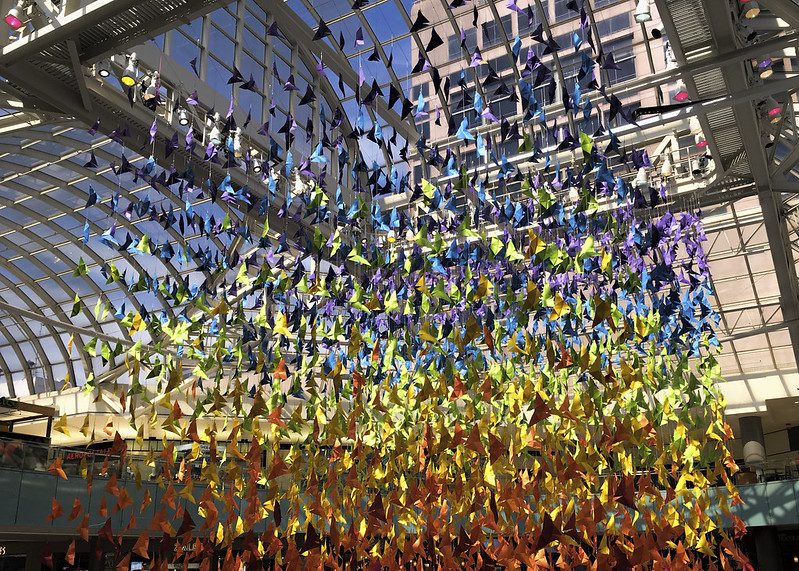
Paper for Water has partnered with businesses across North Texas, instituting large installations of their elegant crafts. In 2017, Paper for Water constructed 350 origami ornaments for Neiman Marcus’ Christmas Book. This partnership with Neiman Marcus enabled two schools in Kenya to receive water wells. Galleria Dallas and Mo Wax Visual partnered with Paper for Water in 2018, crafting over 4,000 origami butterflies for their “Fold to Flight” display. Galleria Dallas Mall provided Paper for Water with a temporary store during the summer installation. The Crow Museum of Asian Art’s Lotus Shop in Downtown Dallas also installed a Paper for Water exhibit. The magnificent origami piece exhibits a collaborative project with Ekaterina Lukasheva, a famous origami artist.
Current Partnerships and Success
Paper for Water also has partnerships across the United States through its essential volunteer base. Multiple groups of volunteers appear across the nation, consisting of the Well Wishers Group, the Paper Dolls Group, Paper for Water’s Youth Representatives Worldwide, NorthPark Presbyterian Church, Volunteers of All Ages Group and several families and school clubs across America. With the help of volunteers making origami ornaments, the organization can make a difference and administer clean water resources globally.
Paper for Water is transforming lives one piece of paper at a time. Through designing origami pieces, the organization combines art and philanthropy, supplying the world’s thirsty with clean water wells. Paper for Water hopes to end the world water crisis and continues to make and sell origami ornaments every day. Paper for Water’s website provides multiple options to get involved in the cause, from purchasing origami ornaments to learning how to make origami to volunteering or donating monthly.
– Kacie Frederick
Photo: Flickr

Health Policy Evolution in Laos
5 Facts About Health Policy Evolution in Laos
At all levels, governments around the world are developing policies to improve healthcare in their countries. The COVID-19 pandemic has highlighted glaring issues in healthcare infrastructure worldwide. Additionally, Laos is a prime example of a country taking concrete steps to respond to the issue.
– Pratik Koppikar
Photo: Flickr
3 Innovative Technologies Stopping Malaria
3 Innovative Technologies Stopping Malaria
Stopping malaria is a focus for many African communities and there are many organizations looking into possible solutions to stop the spread and hopefully eradicate this disease. Estimates determine that eradicating malaria by 2040 would save 11 million lives and surge $2 trillion of economic growth. Advancements like these three innovative technologies stopping malaria are making this future vision possible.
– Brett Muni
Photo: Flickr
Afghan Teenage Girls Innovate Low Cost Ventilator
Covid-19, Ventilators, and Afghanistan
One of the major challenges facing countries around the world during the Covid-19 pandemic is a lack of essential supplies, specifically ventilators. The virus oftentimes infects people’s lungs and makes it difficult to breathe. Ventilators work as life-saving equipment and help people breathe when they can no longer do it on their own. However, they are extremely expensive pieces of machinery. It usually costs around $30,000 per ventilator. As a result, this makes them highly inaccessible, especially when there is an influx in demand.
Afghanistan has 15,750 confirmed cases of Covid-19, though experts believe this number to be an underestimate due to a lack of available tests. Herat, home of the Afghan Dreamers, has 2,689 confirmed cases of Covid-19 and is the second most affected city in the country. As of April 2020, the entire country of Afghanistan had only approximately 300 ventilators.
Creation
Armed with this information and a passion to help the world, the Afghan Dreamers set out to make a low-cost ventilator. They engineered their machine using a design from the Massachusetts Institute of Technology (M.I.T) and parts from old Toyota Corollas. Producing their ventilator cost around $500, a steep decline compared to the machinery’s aforementioned $30,000 price tag.
Though the girls may make innovation look easy, creating their ventilator was no simple task. First, they had to find a design to follow. After much searching, they came across the design from M.I.T., which was open source and purposefully low cost. Once they were able to get to work, they had to ensure they were staying safe. They all worked on a different part of the ventilator. When they had to meet up, they made sure to take precautions, such as wearing gloves and masks, to protect themselves from potential health risks. They did all of this while fasting for Ramadan.
What’s next?
The next step for the Afghan Dreamers is getting the Health Ministries in Herat and Kabul to approve their prototype ventilator. If the Health Ministries approve the design, then factories can begin replicating the girls’ machine. This would speed up production and allow the country to create many more of the life-saving devices. Though getting their ventilator approved may seem like a challenge, the young women are no strangers to hard work.
The Afghan Dreamers is a remarkable group that strives to change the world. The young women on the team are innovative, strong-willed and dedicated to creating solutions to difficult problems. By engineering a low-cost ventilator, they have provided an opportunity not only for improving healthcare but also hope and inspiration to people—especially women and girls.
– Paige Musgrave
Photo: Flickr
5 Causes of Poverty in Nicaragua
Nicaragua is one of the poorest nations in the continental Americas. With a population of 6.5 million, the country’s chronic cycle of poverty has links with consistent political instability and conflict, high inequality between urban and rural populations, dependency on agricultural exports and natural disasters. Nicaragua’s unusual response to COVID-19 — which has entailed no formal quarantine measures and an underreporting of infections — will surely impact its level of poverty as well. Here are five causes of poverty in Nicaragua.
5 Causes of Poverty in Nicaragua
Concluding Thoughts
While these five causes of poverty in Nicaragua determine that poverty and inequality could increase in upcoming years due to COVID-19 and political turmoil, the people of Nicaragua should still have hope. The country experienced great success in slashing poverty from the mid-2000s to the mid-2010s. In 2005, 48.3% of the population lived below the poverty line, with 17.2% living in extreme poverty. Those percentages have since decreased by 18 and nine points, respectively, thanks to the current government’s investment in social welfare programs. These programs include Hambre Cero, which offers plants and animals to women heads-of-household; Usura Cero, which provides women micro-loans; Plan Techo, which provides roofing materials for families in need; and Agua Segura, which provides clean water. In addition, NGOs such as Self-Help International are working to advance agriculture, feed children, empower women and provide community nutrition for the people of Nicaragua.
– Tirza Morales
Photo: Flickr
How Origami Provides Access to Clean Water
Now, Katherine and Isabelle Adams, ages 14 and 16, work alongside hundreds of volunteers across North Texas. Since 2011, Paper for Water has raised over $2 million, helping fund 200 water projects in numerous countries. Paper for Water has trained over 1,000 people the art of folding origami. It has graced over 48,000 people with access to clean water through implementing water wells in deprived communities.
Paper for Water and Education
Additionally, Paper for Water educates local communities in the global water crisis. There are approximately 2.5 billion cases of diarrhea every year in children less than five years old. Diarrhea accounts for about 760,000 deaths in children under five years old annually. Diarrhea is now the second leading cause of death in children across the world, advancing AIDs, malaria and measles combined. Caused by unsafe drinking water and poor sanitation conditions, diarrhea is one obstacle developing communities across the globe face.
Paper for Water stresses the importance of clean water well building through their past 120 educational talks, which reached 14,000 people. Paper for Water’s informational efforts gained the attention of influential social media platforms, such as Nickelodeon’s HALO Effect, the Kleenex Corporation, Martha Stewart Living, People Magazine and CBS.
Where Paper for Water Does Business
Paper for Water currently sells its origami ornaments on their online store and in some temporary stores as specified online, such as Neiman Marcus and Galleria Dallas. The beautiful, ornate decorations are Paper for Water’s primary source of financial donations. Each profit from an ornament sold goes straight into Paper for Water’s efforts of water well building abroad. So, with each paper folded, with each origami created, Paper for Water provides access to clean water. Nevertheless, Paper for Water relies on monthly donors of $10 a month to help maintain its goal of installing one water well per month.
Paper for Water has partnered with businesses across North Texas, instituting large installations of their elegant crafts. In 2017, Paper for Water constructed 350 origami ornaments for Neiman Marcus’ Christmas Book. This partnership with Neiman Marcus enabled two schools in Kenya to receive water wells. Galleria Dallas and Mo Wax Visual partnered with Paper for Water in 2018, crafting over 4,000 origami butterflies for their “Fold to Flight” display. Galleria Dallas Mall provided Paper for Water with a temporary store during the summer installation. The Crow Museum of Asian Art’s Lotus Shop in Downtown Dallas also installed a Paper for Water exhibit. The magnificent origami piece exhibits a collaborative project with Ekaterina Lukasheva, a famous origami artist.
Current Partnerships and Success
Paper for Water also has partnerships across the United States through its essential volunteer base. Multiple groups of volunteers appear across the nation, consisting of the Well Wishers Group, the Paper Dolls Group, Paper for Water’s Youth Representatives Worldwide, NorthPark Presbyterian Church, Volunteers of All Ages Group and several families and school clubs across America. With the help of volunteers making origami ornaments, the organization can make a difference and administer clean water resources globally.
Paper for Water is transforming lives one piece of paper at a time. Through designing origami pieces, the organization combines art and philanthropy, supplying the world’s thirsty with clean water wells. Paper for Water hopes to end the world water crisis and continues to make and sell origami ornaments every day. Paper for Water’s website provides multiple options to get involved in the cause, from purchasing origami ornaments to learning how to make origami to volunteering or donating monthly.
– Kacie Frederick
Photo: Flickr
5 Facts About Poverty in the Czech Republic
In the European Union, the Czech Republic ranks second in terms of the risk of its population falling below the poverty line. A record low of 3.4% of the Czech Republic’s population is at risk of poverty according to Eurostat data. This is in comparison to the average of 10% of the European Union’s population that poverty threatens. With that in mind, here are five facts about poverty in the Czech Republic.
5 Facts About Poverty in the Czech Republic
These five facts about poverty in the Czech Republic highlight a few key points. New government measures have helped in the fight against poverty as well as the growth of the Czech economy. Young people have been doing extremely well in the country which has helped bring the overall poverty rate down. However, the nation can still do more work in the fight against poverty, especially in terms of helping female workers in the country and making housing more affordable. Overall, one can be optimistic about how the Czech Republic is taking further steps to reduce poverty in the country.
– Zachary Laird
Photo: Flickr
7 Facts about Healthcare in Denmark
Denmark is a country in Northern Europe. It is one of the wealthiest countries in the world and is notable for its healthcare. In addition, the Social Progress Index 2017 rated Denmark first in the world for quality of life. Denmark also scored 99.28% in nutrition and basic medical care. Here are seven facts about healthcare in Denmark.
7 Facts About Healthcare in Denmark
Overall, healthcare in Denmark is high quality and provides general, equal and free services to all citizens. However, the Danish healthcare system is not perfect, and some citizens experience poor health. With stable wealth and advanced technology, Denmark has the potential to solve its healthcare challenges and continue to provide quality services to its citizens.
– Yilin Che
Photo: Flickr
10 Facts about Access to Clean Water in Palestine
Palestine is a sovereign state in the Middle East that contains both the Gaza Strip and West Bank. It is undergoing conflict with Israel, with Israel in control of the West Bank and the Gaza Strip. Today, many Palestinians live with limited access to clean water, which disturbs their ability to live peacefully. Here are 10 facts about access to clean water in Palestine.
10 Facts About Access to Clean Water in Palestine
One can infer from these facts that the Palestinian water crisis is severe. Organizations such as UNICEF, MECA and HWE are working to provide greater desalination processes and improve water and sanitation infrastructure in Palestine. Even an ordinary citizen can help by donating money to a project such as The Maia Project to help Palestinians obtain access to clean and safe drinking water.
– Ayesha Asad
Photo: Flickr
Fighting Homelessness in Senegal
Street Youths of Dakar
In Senegal, homelessness especially affects many children. In the capital city of Dakar, which has a population of 1.06 million people, an estimated 40,000 street youths are without shelter. Some of these children are Talibes. Talibes are “youths from Koranic schools known as daaras who are forced to beg for money. There are also those who fled such schools. Others come from broken families or have lost their homes because of poverty.”
Recently COVID-19 and the resulting lockdown have exasperated the lives of these homeless children in Senegal. The thin protection these children once had in small generosities from restaurants and pedestrians have been erased as services and public pedestrian presence have gone dormant for lockdown. Lackluster sanitation and drug usage compound the street youths’ vulnerable position amid the COVID-19 pandemic. As of early July 2020, Senegal has reported thousands of cases of COVID-19 and under 100 deaths.
Helping Hands
In April, Senegal’s Ministry of Family launched a coronavirus emergency plan for street children, opening up about 13 educational social centers and other venues in Dakar. Outside of government support, NGOs like the French-Senegalese Village Pilote has aided homeless children in Dakar sprung into action. Village Pilote offers homeless children in Senegal meals and shelter as well as space for recreation. Issa Faye, a 19-year-old living on the street told Reuters: “Because of the disease people were avoiding us, we had problems getting (medical) treatment, and also the police kept running after us. Only this centre accepts children and youngsters our age and from the streets…”
Value of Aid
COVID-19 highlights how easily vulnerable demographics such as the homeless street youths of Senegal can be left behind without consideration, underscoring the value of aid. Supporting funding for the International Affairs Budget to address the consequences of the pandemic is also essential to protecting the health, security and economic interests of all Americans.
– Caleb Hughes
Photo: Flickr
The Organization Advocating for Developing Countries
The Chicago Council on Global Affairs commits itself to raising awareness on “global issues of the day” and advocating for developing countries. Founded in 1922, the organization has raised awareness for global poverty through social media, podcasts, articles and rallies. The organization has not only raised money and awareness to the cause of global poverty, but it has also educated the world on how individuals can shape the future of the earth without bias. It shows how a person has the ability to provide aid to another who is starving, undereducated, ill or impoverished. The organization exhibits how to turn people’s lives around through supporting global initiatives and programs that aid the world’s poor.
Raising Awareness
Weekly podcasts focusing on various international issues allow listeners to gain knowledge of the problems facing developing nations. The podcasts allow listeners to find out about service events happening near them, giving them the ability to act and support what is going on to help developing nations.
Listeners and supporters can also submit questions to the council on global issues. Following the same podcast format, the council educates the public on international problems, solutions to those problems and how the listeners have the chance to support the cause as well. This weekly podcast has an open submission throughout the week and tackles a new topic during each session.
As well as podcasts, the Chicago Council on Global Affairs also uses social media resources to educate people. For the last three years, the council has released public surveys, asking questions regarding the importance of global affairs. The organization allows those surveyed to state his/her opinion on why he/she thinks it is important to aid the world’s poor. Additionally, the survey also asks questions and public opinion on global, political issues facing countries.
As well as using social media sources, the council holds events globally to raise awareness of global issues. These events tackle problems such as immigration, hunger in developing countries, the need for education in developing nations, and various other topics. These events allow everyday individuals to serve people globally, whether that be through the donation of time or money. Furthermore, these events give the opportunity to make a difference and help the problem.
How the Council Fights Hunger Internationally
In addition to advocating for developing countries by reaching out to the public, the Council focuses on how its own efforts can benefit the poor. For example, in 2009, the council lent its voice in support of Feed the Future, the Obama Administration’s USAID’s food security initiative. This initiative focuses on solving food scarcity for 23.4 million people living under the poverty line, globally. This program set in motion a task force within the Chicago Council on Global Affairs that examined how the application of technology to agriculture could facilitate “food system transformations,” that would potentially usher in a new agriculturally urbanized world.
Through the efforts of this task force and many others, over 900 innovations have emerged to feed the hungry and impoverished. These innovations have lifted approximately 5.2 million families out of hunger. Meanwhile, its efforts also raised over $3 billion to stunt food scarcity between 2011 and 2018. Additionally, agricultural sales have generated $12 billion across the globe. This program has economically supported countries such as Ethiopia, Ghana, Tanzania, Bangladesh, Benin, Kenya and many others.
Looking Forward
While the Chicago Council on Global Affairs works on advocating for developing countries by highlighting the needs of those facing starvation, extreme dehydration, political misconduct and other debilitating circumstances, it goes a step further. It also provides solutions to fix those problems, supplying resources for those who want to help but do not know how to do so, such as by providing donations to those in need and utilizing social media to raise awareness. Through these efforts, the Council shows that an individual does not need wealth or pomp but a willing heart and some time to make a difference in this world.
– Alexis LeBaron
Photo: Flickr