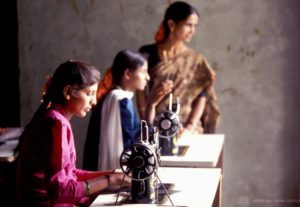
 Over the last decade, empowering women in poor communities has become a focal point in India. That is because about 50.7 million people live in extreme poverty in India, yet, as of 2019, only 20.7% of women in India are part of the labor force. Moreover, the country has recently seen a drop in its GDP from 6.1% to 5% and is attempting to recover from its uncertain economy. As a result, one solution that many nonprofit organizations and the government have recognized is investing in the population that is living under the poverty line. Specifically, many groups are empowering women in India through sewing.
Today, being able to sew can be an acclaimed vocational skill. Over the past decade or so, embroidery has become an empowering tool for women in India, and a traditional craft. With this understanding, nonprofits have implemented many initiatives in India to empower women and help their families out of poverty.
Sewing the Seeds & Samugam Trust
Sewing the Seeds is a nonprofit organization that partnered with the NGO Samugam Trust to begin a women’s sewing initiative. The plan supports women in impoverished communities by creating economic stability using creativity and the traditional craft of stitching. Bruno Savio and Gayle created Sewing the Seeds to use sewing to empower women in India living in poverty.
Savio’s father opened the Samugam Trust in 1991 to support the educational training of the underprivileged, the rehabilitation of leprosy patients and those who are physically challenged. Bruno Savio has continued his father’s legacy as director of Samugam and partner of Sewing the Seeds. Gayle backpacked across India about 40 years ago. During her journey, she saw an opportunity to empower women in the country through vocational training.
Savio and Gayle recognized that more than 50% of women in India are illiterate, and only 29% of women in India are actively employed. Additionally, those who are employed are paid 46% less than men holding the same positions. Sewing the Seeds and Samugam Trust realize that investing in women is smart economics and essential to reducing poverty. With this in mind, the initiative provides the training, financial assistance, materials and communal space to empower women while preserving local craft traditions.
Samugam Trust has supported the initiative since 2011, with the first collection of products introduced online in 2018. Sewing the Seeds and Samugam Trust have supplied training and machines for 130 women. The importance of this initiative is to empower women in India in a way that is holistic and long term in its support.
Shakti.ism
Shakti.ism also supported empowering women in India through sewing by launching a sustainable livelihood project. The starting goal is to reach out to 10 tribal and disabled Indian women to provide vocational training. To successfully supply these resources Shakti.ism is partnering with Samugam Trust and Sewing the Seeds to empower impoverished women. Recently, they chose 10 women from diverse backgrounds including disabled mothers.
Shakti.ism continuously raises money to cover instruction fees, supplies, daily stipends for trainees and administrative costs such as quality control. Most products are crafted from repurposed saris (a traditional Indian woman’s dress) and are to be sold online. Shakti.ism is empowering women in India as a way to support families living in underprivileged rural areas of India, as well as decrease the wage disparity while increasing the trainees’ self-confidence and skills.
Usha Silai School
Included in the community-based initiative is Usha Silai (sewing) School. This initiative has reportedly set up over 15,000 sewing schools across India with the support of the Digital Empowerment Foundation NGO and Sikana. To further their reach and enhance their programs, Usha and Sikana co-created a video program to train illiterate women. The enhanced program has increased the initiative’s outreach while providing skills to gain a livelihood to women in rural India.
The Digital Empowerment Foundation supplies technological information for rural citizens to use to their advantage. For example, they supply internet-dependent tools that can provide access to training and create socioeconomic equality. Specifically, they provide internet and digital tools in rural community centers that partner with Usha Silai School.
Community-based initiatives that provide sewing empowerment for women in poverty have been essential for the growth of rural India. Sewing has become a highly desired vocational skill and is a powerful tool for those living in poverty. Recognizing the long term impact of vocational training, NGOs provide this solution-based approach across India to bring self-confidence and skills to women.
– Sumeet Waraich
Photo: Flickr

7 Facts About Healthcare in Tokelau
7 Facts About Healthcare in Tokelau
Tokelau Health Strategic Plan 2016-2020
In August 2016, Tokelau launched a new initiative to better its healthcare infrastructure, called the Tokelau Health Strategic Plan. This plan has three parts: short-term goals in 2016 to 2018, intermediate goals from 2018 to 2020, and long-term goals for 2020 and beyond. Furthermore, Tokelau’s healthcare plan has created four key ideas to help guide the country’s healthcare initiatives. These ideas are developing healthcare infrastructure, improving general public health, improving governance of healthcare services and creating better clinical services for the island’s population.
The most important aspect of the plan is the construction of a National Referral Hospital in Nukunonu, the largest of the three atolls. With the creation of the new National Referral Hospital, Tokelau would be able to alleviate the issues caused by its decentralized healthcare system.
The World Health Organization (WHO) has been working in conjunction with the Tokelau government to see this plan through. WHO outlined these priorities to oversee the advancement of Tokelau’s healthcare:
Tokelau faces many challenges ahead as it looks to improve its healthcare system. The majority of these challenges come from a lack of economic means and a decentralized healthcare system. However, with international aid and the healthcare plan, the government can work to improve healthcare for all of its citizens’ benefit.
– Anushka Somani
Photo: Flickr
3 Effects of Inadequate Road Infrastructure in Uganda
3 Effects of Inadequate Road Infrastructure in Uganda
The Ugandan Government’s Solution
The U.N. recommended that the Ugandan government implement a Decade of Action to target road safety from 2011 to 2020. In order to succeed, Uganda had to follow certain guidelines set by the U.N. They included working with local governments to create a better infrastructure and educating the public on road safety. So far, the Ugandan government has completed only 40% of the plan, but it is an ongoing process.
The U.N.’s main criticism of Uganda’s policies is that there is no method of implementing road safety. The UNRA does not have sufficient jurisdiction to engineer roads in the best way to deal with heavy traffic, steep cliffs and mudslides. However, the UNRA continues to work on road projects to improve infrastructure in Uganda. For example, the China Communications Construction Company finished the Mubende – Kakumiro – Kagadi road with asphalt in January 2020.
Road infrastructure in Uganda still needs tremendous improvement. By continuing to create contracts with private countries and enforcing road safety laws, the Ugandan government can work toward bettering inadequate road infrastructure. In doing so, Uganda would advance toward reaching the U.N.’s Decade of Action guidelines.
– Sarah Litchney
Photo: Flickr
Ethiopia’s Hydroelectric Expansion
Ethiopia is a young, developing country that is currently investing in hydroelectricity to meet the energy demands of a growing population. Currently, only 44% of Ethiopians have access to electricity. As the population continues to grow within the country, citizens’ access to electricity will be a cause for great concern. Ethiopia’s hydroelectric expansion is addressing the energy crisis and powering the country’s economic growth, at the same time.
Naturally Sourced
Ethiopia is well situated to harness the natural, kinetic energy of water because the Nile River runs through the northern part of the country. However, hydroelectricity does require the construction of costly dams. In this same vein, Ethiopia recently built one costing $1.8 billion. While expensive, once built, these dams provide an abundance of energy for many generations. Currently, Ethiopia’s hydroelectric expansion has achieved a 3,813-MW capacity for a population of roughly 108 million people.
As the Blue Nile begins in Ethiopia, the country does not have to worry about other nations damming the river upstream and thus, (hypothetically) cutting off its supply of water. Ethiopia’s geographic advantage thereby increases its energy autonomy. Additionally, hydroelectric energy is renewable and reliable because it is not dependent on variable weather conditions as is the case with other renewable, energy resources.
Growing Demand
Ethiopia’s population is growing at a staggering rate of 2.56% per year. Notably, less than 50% of the population has access to hydroelectricity. To help people escape poverty in the modern age, they must have access to an electrical grid. Access to electricity does not guarantee prosperity, but the lack of electricity almost ensures poverty.
Ethiopia is one of the leading African nations in hydroelectric energy and is continuing to invest in more dams. In 2016, Ethiopia embarked on a joint venture with China and built one of the largest roller-compacted dams in the world. Although dams are vulnerable to droughts — they provide clean, renewable energy that is not dependent on highly variable weather patterns, such as wind and sunlight. Ethiopia cannot solely depend on hydroelectricity and instead, must continue to increase its energy supply to meet an ever-growing demand. Nearly 40% of Ethiopia’s population is younger than 14-years-old. As this population matures, it will further increase the demand for energy within the country. The booming population will continue to slip into poverty if it does not invest in a hydroelectric infrastructure that can support such a population growth rate.
Positive Growth
Hydroelectricity provides abundant energy. Yet, it requires an electrical grid to transport that energy across the country and perhaps equally as important, from an economic standpoint — into neighboring countries. Not only has Ethiopia built more hydroelectric dams, but it has also expanded its entire energy infrastructure. Ethiopia strives to become an energy hub for Africa as it exports electricity to Sudan, Djibouti and Kenya. Although 29.6% of Ethiopia’s population lives below the poverty line, there is a great reason to hope that this number will decrease as the economy further develops. Ethiopia currently has the 13th highest industrial growth rate at 10.5%, annually. The economy is rapidly growing, largely supported by Ethiopia’s hydroelectric expansion.
– Noah Kleinert
Photo: Wikimedia Commons
Clouds Used to Generate Water in Nepal
Margot Krasojevic Architecture will be responsible for a device that has the capability of extracting water in Nepal from clouds and store it for later use. Importantly, due to humidity and a landscape that is copious with mountain ranges and hilltops — this region of Asia would benefit greatly from water irrigation. The clouds that naturally form in the region will allow for a maximum of 5,000 liters of water production per day. This water, in turn, will be held in a water reservoir.
Water Irrigation and Reservoirs
The majority of the potential 5,000 liters of excess water in Nepal will likely serve to water tea and other crops. About 70% of all freshwater that is taken from the source is used for growing crops. Notably, a negative aspect of relying on water irrigation to feed crops is that, compared with water for in-home use, only 50% of the water returns to a natural water source. The remaining 50% — farmers/workers lose through leaking pipes or evaporation from watered plants. This stands in stark contrast when looking at in-home (and business) water use — where 90% can return to natural water supplies through sinks and toilets.
The potential (daily) 5,000 liters of cloud water that would be used for irrigation will be held in a man-made lake, known as a reservoir. Reservoirs are used when there is not enough rain flow for water to naturally hydrate vegetation. The water stored in this advanced, cloud-water, irrigation system should have a protective covering and cleaning mechanisms inside of it, to protect water from evaporation and accumulated sediment buildup.
The Commissioning of Margot Krasojevic Architecture
Having a well-functioning, cloud-water irrigator with minimal evaporation and sediment buildup will benefit the 6.1% of Nepali citizens who live on less than $1.90 per day. The process to draft worthy architects for the project included informing architects of what was expected and then choosing between various concept designs. The concept design turns into more complex scale drawings and ends with a finished structure.
The finished structure used to obtain water in Nepal will include landscape-inspired contours and solar power. In that same vein, this architecture firm has a plethora of environmentally-friendly structures. The founding architect of Margot Krasojevic Architecture, Dr. Margot Krasojevic, believes that other builders should design based on social changes and environmental events of the past as well. Dr. Margot Krasojevic would also like to see the footprint of modern technology in building designs.
Dr. Krasojevic believes that architects should have guidelines for building projects. Project guidelines should incorporate proportions of materials that are renewable and not damaging to the environment. Also, Dr. Krasojevic believes that it would be wise for builders to aid in the preservation of the planet’s limited resources. She sees the potential in extra steps taken to mitigate environmental depredation and resource misuse.
Architects and Project Commissioners: A Joint Effort
As Nepal commissioned this architecture firm to build a sustainable structure, there may be changes/additions needed for the structure. Architects can work hand-in-hand with the commissioners of projects and take feedback and alter projects as necessary. As the leaders look to procure useful water in Nepal, the need for continued supplies of water and interplay between structure and environment may add more dimensional depth to the project. Nepal will positively benefit from this structure and its potential to increase water-security within the country.
– DeAndré Robinson
Photo: Pikist
3 Innovative Solutions Reducing Poverty in Pakistan
The COVID-19 pandemic has led to a major health care crisis in Pakistan. It also reversed years of effort into the elimination of poverty. The poverty rate declined from 64% to 24% in 2015 which occurred over a period of 20 years. However, with the arrival of COVID-19, the poverty rate in Pakistan could increase to 40% according to the International Monetary Fund (IMF).
Impacts of the Pandemic on Pakistan
Pakistan’s GDP growth is also predicted to decline by 3% as a result of the pandemic. In addition, agriculture accounts for 20% of Pakistan’s GDP and 43% of its labor force. The continuation of lockdowns with no end in sight is negatively affecting transportation, labor and the consumer market. Consequently, it affects the millions of people working in the agriculture industry. Around 17 million children and youth are missing important vaccinations for diseases such as polio. Moreover, several million more people are suffering from food insecurity due to the pandemic, bringing the total to 43 million. Those most at risk are the people who live below the poverty line and groups such as women, children, senior citizens, the disabled and minorities.
As more and more of these people fall below the poverty line, Pakistan is coming up with different innovative solutions that can cater to the millions of people that are experiencing multidimensional poverty.
3 Innovative Solutions to Reducing Poverty in Pakistan
While poverty in Pakistan has been an issue, these innovative solutions are proving successful at reducing poverty in Pakistan. Through their continued work, the quality of life for Pakistan’s people should only improve.
– Abbas Raza
Photo: Flickr
Eliminating Tuberculosis in Madagascar
Madagascar, a country off the southeastern coast of Africa, comprises of tuberculosis cases among its citizens of low socioeconomic status. In 2012, 70.7% of the Malagasy population was living below the poverty line and in 2017, the incidence rate for tuberculosis in Madagascar was 233 cases per 100,000 people. Encouraged and perpetuated by poverty, this disease makes Madagascar the perfect candidate for an outbreak.
Tuberculosis, commonly known as TB, is the most infectious fatal disease in the world. Although it is a very treatable illness, it kills more than 1 million people annually across the globe. The vast majority of TB diagnoses and deaths derive from individuals residing in poor, developing nations.
Risk Factors
Lack of quality living conditions, nutrition and healthcare amplify the risk of getting tuberculosis in Madagascar. Limited access to toilets and handwashing facilities for the majority of Malagasy people have left many at risk. According to CIA World Factbook data, sanitation facility accessibility in Madagascar was unimproved for 88% of the total population in 2015. TB is also the leading cause of death for people with HIV. As of 2018, there were roughly 39,000 Malagasy people diagnosed with HIV but only 20,865 known TB cases that also had documented HIV statuses. Without quality systems in place to document HIV and TB rates across the country, solving the epidemic in Madagascar will not be easy.
The Global Fund Support
The added historical stigma surrounding TB makes matters worse. While already struggling financially, patients often fear that exposing their diagnosis will cause them to lose their jobs. This stigma is combated through support systems like The Global Fund, an organization that provides relief for epidemics through fundraising and education for those affected by TB. The fund’s employees act as a support system, thus debunking the shame that infected patients may feel due to their diagnosis.
In 2018, The Global Fund’s donations and work helped cure 33,000 patients with tuberculosis in Madagascar. For 2020-2022, the organization projects that a total of $18,045,448 will go toward tuberculosis management in Madagascar. In 2017, these funds helped increase Madagascar’s TB treatment success rate to 84%.
Biotechnological Solutions
Although TB is preventable and curable, Madagascar lacks the necessary medical tools to diagnose and treat this disease. Not only are there minimal supplies, but there is also a need to expand and strengthen Madagascar’s ability to analyze TB samples according to Niaina Rakotosamimanana, the head of the mycobacteria unit at the Health Institute of Madagascar.
Researchers from the Health Institute of Madagascar, Stony Brook University and Oxford University are also collaborating to find solutions for this issue. These institutions are working together to grant access to a portable and affordable tool, the MinION. The MinION helps to diagnose and efficiently test the resistance of TB strains to antibiotics, while at the same time being a cheap, affordable option that is accessible to Malagasy people.
Tuberculosis is still one of the top 10 leading causes of death in Madagascar, but the country is making significant progress towards the eradication of the disease. The efforts Madagascar is taking in tracking TB are positive steps that contribute to the fight against this epidemic.
– Sophia McGrath
Photo: Pixabay
Eliminating Gender-Based Violence in Zimbabwe
Gender-based violence continues to threaten the safety of millions of girls and women around the world while infringing upon their most basic human rights. According to the World Bank, gender-based violence affects one in every three women globally. Zimbabwe in particular is still struggling to combat this issue, but is working to find solutions. Though gender-based violence in Zimbabwe remains a major societal issue, organizations like the Musasa Project are providing hope for a safer future.
Consequences of Gender-Based Violence
Beyond its negative effects on survivors, gender-based violence is also damaging to economic and social structures as a whole. According to the World Bank, gender-based violence results in a loss of about 3.7% of a country’s total GDP. Failure to address issues impacting the well-being of women has also been proven to contribute to poverty. Poverty cannot be alleviated without the protection of and equality for women and girls around the world.
Gender-Based Violence in Zimbabwe
In Zimbabwe, gender-based violence is especially prevalent. Nearly 50% of the country’s women have experienced either physical or sexual violence at some point in their lifetime. Meanwhile, one in three of these women have experienced physical or sexual violence before the age of 18.
Gender-based violence in Zimbabwe is so common that it is steadily becoming a normalized part of Zimbabwean culture; 48.6% of women between the ages of 15-24 years believe that “wife-beating” can be “justified under at least one condition.”
The Musasa Project
Hoping to educate Zimbabwean women about the injustices and abnormalities of gender-based discrimination, Sheelagh Stewart and Jill Taylor Musasa created the Musasa Project. Founded in 1988, this Zimbabwe-based NGO offers a wide range of support and relief services to survivors of gender-based violence. The organization also seeks to eliminate violence against Zimbabwean women by changing regressive laws, beliefs and practices perpetuating gender-based violence.
The Musasa Project offers valuable resources to about 3,000 Zimbabwean women every year including counseling services, legal aid, temporary safe shelters, medical assistance, educational programs and support through a toll-free helpline.
The Musasa Project’s most extensive work is its counseling services, which serve a high volume of emotional and physical abuse survivors every year. Many women also depend on the Musasa Project’s legal aid services and 24-hour telephone support line. In just three years, the Musasa Project attended to the cases of more than 14,000 women.
A Better Future
The organization is currently working towards expanding its educational resources to a broader population and offering programs designed specifically for those convicted of sexual assault and domestic violence. In doing so, the Musasa Project ultimately aims to reduce gender-based violence in Zimbabwe through awareness and education.
Though the Musasa Project only operates in four regional offices in the cities of Masvingo, Harare, Gweru and Bulawayo, its resources and services are making significant strides in reducing gender-based violence across the whole of Zimbabwe. Acknowledging that one of the most meaningful ways to create change is through law and policy-making, the project works closely with the Zimbabwean government to enforce laws pertaining to gender-based and domestic violence.
The Musasa Project’s plethora of resources for victims, perpetrators and the general public raises awareness about the injustices of gender-based violence and gains support for the eradication of this issue. This project and its multifaceted approach to protecting women and girls provides hope that gender-based violence in Zimbabwe will eventually vanish.
– Stacy Moses
Photo: Flickr
Updates on SDG Goal 1 in India
India and the Sustainable Development Goals
Along with being one of the fastest developing economies in the world, India has played a tremendous role in the formulation of the United Nations Sustainable Development Agenda 2030. The SDGs consist of 17 goals, 169 targets and 306 national indicators. Although the SDGs is an exhaustive list, it has not stopped India from making substantive progress towards achieving most of these goals.
Goal one of the SDGs of the U.N. Sustainable Development Agenda is the complete elimination of poverty in every form by 2030. From 2008 to 2018, the poverty rate in India halved as the percent of Indians living in poverty dropped from 55% to 28%. The good news is that India is on track to eliminate extreme poverty by 2030. However, it is important to recognize recent trends to gain a better perspective on where India stands in the race to achieve SDG goal 1.
Updates on SDG Goal 1 in India
Hope for the Future
As India aims to achieve its goal on time, a glance at recent trends gives an optimistic view of the future of India. India owes its reduction in poverty to its thriving economy and to the coordinated efforts of its government and the U.N. Beginning with the government of 2014, India has made successful attempts in distributing essential commodities to its most vulnerable communities. For instance, electricity, clean water and sanitation. Through a robust anti-poverty scheme, India has granted 90% of its population access to electricity. Additionally, a whopping 99.45% of its population has access to basic sanitation. The latter number is up from 40% in 2014.
The evidence suggests that governments can effectively tackle poverty when they have the means to do so. The past decade in India is a prime example. However, India is only halfway through in achieving SDG goal 1. In order to continue its progress, it is imperative to recognize the benefits of coordinated government initiatives that are supported by our own. For the county’s thriving economy and progress towards SDG goal 1 in India can only sustain itself through the support of the effective government.
– Aadil Khan
Photo: Flickr
Empowering Women in India Through Sewing
Today, being able to sew can be an acclaimed vocational skill. Over the past decade or so, embroidery has become an empowering tool for women in India, and a traditional craft. With this understanding, nonprofits have implemented many initiatives in India to empower women and help their families out of poverty.
Sewing the Seeds & Samugam Trust
Sewing the Seeds is a nonprofit organization that partnered with the NGO Samugam Trust to begin a women’s sewing initiative. The plan supports women in impoverished communities by creating economic stability using creativity and the traditional craft of stitching. Bruno Savio and Gayle created Sewing the Seeds to use sewing to empower women in India living in poverty.
Savio’s father opened the Samugam Trust in 1991 to support the educational training of the underprivileged, the rehabilitation of leprosy patients and those who are physically challenged. Bruno Savio has continued his father’s legacy as director of Samugam and partner of Sewing the Seeds. Gayle backpacked across India about 40 years ago. During her journey, she saw an opportunity to empower women in the country through vocational training.
Savio and Gayle recognized that more than 50% of women in India are illiterate, and only 29% of women in India are actively employed. Additionally, those who are employed are paid 46% less than men holding the same positions. Sewing the Seeds and Samugam Trust realize that investing in women is smart economics and essential to reducing poverty. With this in mind, the initiative provides the training, financial assistance, materials and communal space to empower women while preserving local craft traditions.
Samugam Trust has supported the initiative since 2011, with the first collection of products introduced online in 2018. Sewing the Seeds and Samugam Trust have supplied training and machines for 130 women. The importance of this initiative is to empower women in India in a way that is holistic and long term in its support.
Shakti.ism
Shakti.ism also supported empowering women in India through sewing by launching a sustainable livelihood project. The starting goal is to reach out to 10 tribal and disabled Indian women to provide vocational training. To successfully supply these resources Shakti.ism is partnering with Samugam Trust and Sewing the Seeds to empower impoverished women. Recently, they chose 10 women from diverse backgrounds including disabled mothers.
Shakti.ism continuously raises money to cover instruction fees, supplies, daily stipends for trainees and administrative costs such as quality control. Most products are crafted from repurposed saris (a traditional Indian woman’s dress) and are to be sold online. Shakti.ism is empowering women in India as a way to support families living in underprivileged rural areas of India, as well as decrease the wage disparity while increasing the trainees’ self-confidence and skills.
Usha Silai School
Included in the community-based initiative is Usha Silai (sewing) School. This initiative has reportedly set up over 15,000 sewing schools across India with the support of the Digital Empowerment Foundation NGO and Sikana. To further their reach and enhance their programs, Usha and Sikana co-created a video program to train illiterate women. The enhanced program has increased the initiative’s outreach while providing skills to gain a livelihood to women in rural India.
The Digital Empowerment Foundation supplies technological information for rural citizens to use to their advantage. For example, they supply internet-dependent tools that can provide access to training and create socioeconomic equality. Specifically, they provide internet and digital tools in rural community centers that partner with Usha Silai School.
Community-based initiatives that provide sewing empowerment for women in poverty have been essential for the growth of rural India. Sewing has become a highly desired vocational skill and is a powerful tool for those living in poverty. Recognizing the long term impact of vocational training, NGOs provide this solution-based approach across India to bring self-confidence and skills to women.
– Sumeet Waraich
Photo: Flickr
Fighting Malnutrition in Sub-Saharan Africa Through Investment
Consequences of Malnutrition
For African nations, current statistics on malnutrition paint a grim picture: nearly every country south of the Sahara reports at least 10% of children as underweight. The problems caused by widespread malnutrition—regardless of age—are apparent. According to World Bank statistics, malnourished children typically provide far less value later in life, losing an average of 10% of their potential lifetime earnings. Likewise, a malnourished mother may conceive a similarly deficient child with congenital disabilities and an equal risk of low productivity. While it is simple to recognize malnutrition as a source of other regional issues, identifying the underlying causes of malnutrition has proven to be more complicated.
The Complex Causes
Malnutrition is not exclusively caused by undernutrition. In many cases, the low variety of available foods causes developmental problems in children, which contributes to those mentioned above poor professional outcomes. The region’s poverty causes discrepancies in the food distribution of local towns, with communities becoming dependent on staple crops like grains while missing out on fruits, meats and other nutrient-dense foods. With surveys reporting that 39% of families in sub-Saharan Africa suffer precarious access to food, these cereal crops are the only way for many families to avoid going to sleep hungry.
This lack of nutritional variety primarily stems from the region’s poor-quality infrastructure. Without proper roads, many rural farmers struggle to bring their crops to market, making the trade of goods essential to a running economy—and a balanced diet—nearly impossible. With better economic conditions as well as simple roads, citizens could gain crucial access both physically and financially to foods they could not previously afford.
The Need for Investments
Food insecurity is not the only issue plaguing sub-Saharan Africa: with various forms of poverty—including fiscal, water and energy poverty—also demanding attention, it appears that a fix for one issue may have to envelop the other problems as well. Fortunately, improving the infrastructure for one of these issues incidentally benefits the others.
The region needs massive investments for projects like dams, bridges, power plants and namely roads. Experts advocate this investment on multiple grounds: not only would it assist in fighting malnutrition, but it also represents a sensible investment. Investment specialists recommend this action, and private companies in the U.K. have seen greater returns on investments to Africa than anywhere else in the world, according to the Overseas Development Institute.
A Future Worth Fighting For
Fortunately, current world leaders began to listen to this advice. Organizations like The World Bank have already organized the financial framework to fund ambitious projects fighting malnutrition globally. With Chinese investment into Africa totaling nearly $300 billion from 2005-2018, countries in sub-Saharan Africa are starting to receive the foreign investment necessary to feed their people adequately.
Fighting malnutrition in sub-Saharan Africa is no small task, but the current trend of investment shows promise for the future. The Infrastructure Consortium of Africa reported that between 2013-2017, the mean annual funding for infrastructure development was $77 billion, double the average from 2000-2006. If investment continues, much-needed dietary improvements could finally become a reality. Perhaps in the next ten years, a variety of foods will quite literally be a walk down the road for African families.
– Joe Clark
Photo: Flickr