• Link to X
  • Link to Facebook
  • Link to Instagram
  • Link to TikTok
  • Link to Youtube
  • About
    • About Us
      • President
      • Board of Directors
      • Board of Advisors
      • Financials
      • Our Methodology
      • Success Tracker
      • Contact
  • Act Now
    • 30 Ways to Help
      • Email Congress
      • Call Congress
      • Volunteer
      • Courses & Certificates
      • Be a Donor
    • Internships
      • In-Office Internships
      • Remote Internships
    • Legislation
      • Politics 101
  • The Blog
  • The Podcast
  • Magazine
  • Donate
  • Click to open the search input field Click to open the search input field Search
  • Menu Menu

Archive for category: Water

Technology, Water

Water Billboards: Turning Humidity Into Potable Water

Water-Billboards
Receiving only a half-inch of precipitation annually, the 7.6 million residents of Lima, Peru are in the midst of a serious water shortage. One point two million Limans do not have running water at all, and 700,000 people have no access to clean water for drinking or bathing. With advanced climate change affecting the natural water sources of the Andes, engineers from Peru’s University of Engineering and Technology (UTEC) have turned to science, and specifically water billboards, for an answer.

Like a magician pulls a rabbit from a hat, they’ve figured out a way to pull water from thin air.

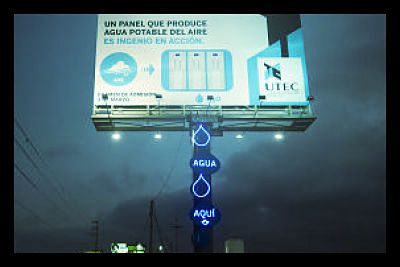
The process of scientific magic occurs inside a billboard in Lima’s Bujama District, erected by a group of UTEC engineers in partnership with marketers from the Mayo Publicidad ad agency. The billboard takes advantage of Lima’s high degree of humidity, nearly 90 percent in the summer months, and transforms this moisture into usable water.

When moist air hits the billboard, five condensers cool it and convert it into liquid form. The newly created water goes through reverse-osmosis purification and then flows into a 20-liner storage tank at the billboard’s base. The filtration system is simple and straightforward, though not entirely self-sufficient, because it uses electricity from Lima’s power lines.

Active for 3 months, the billboard has had a significant effect. It has produced nearly 2,500 gallons of water, averaging 26 gallons a day. According to the UTEC engineers involved, this is equivalent to the water consumption of hundreds of families per month.

Efforts have been made in the past to magically pull water from the air. Most notably Eole, a French company, installed a wind turbine in Abu Dhabi that was said to generate more than 370 gallons of water a day. The commercial launch of this technology, however, came at too high of a price.

That’s the genius of UTEC’s water billboard – if the technology expands, it will be inexpensive to install thanks to funding from advertisers. The inaugural billboard costs only $1,200 to construct, and advertises both UTEC and the technology itself. UTEC has not gone unrewarded, since the erection of the billboard enrollment has substantially increased. It hopes that companies will see UTEC’s own results and seek to advertise on water billboards themselves.

It is unclear whether more billboards like this one will be installed throughout Lima, but UTEC’s water billboard has successfully started new discussions about providing clean water. Advertising can be more than a commercial tool; it has potential as an effective method of helping those in need.

– Katie Pickle

Sources: Popular Mechanics, Time
Photo: Fast Coexist
June 6, 2015
https://borgenproject.org/wp-content/uploads/borgen-project-logo.svg 0 0 Borgen Project https://borgenproject.org/wp-content/uploads/borgen-project-logo.svg Borgen Project2015-06-06 04:00:292020-07-17 20:39:11Water Billboards: Turning Humidity Into Potable Water
Global Poverty, Health, Nonprofit Organizations and NGOs, Water

Ceramic Filters for a Cleaner Future

Ceramic_Filters_for_a_Cleaner_Future
Rural South Africa faces many challenges. The prevalence of HIV/AIDs is partnered with high rates of other diseases, both infectious and non-communicable.

Limpopo Province is among the poorest of South African communities, with a 34 percent poverty rate. In addition, Limpopo also has one of the lowest rates of accessible drinking water. Only 44 percent of the population has regular access to potable water. The Mukondeni Filter Factory located in Ha-Mashamba is addressing limited water access with a new kind of water filter that could be a game-changer for communities where access to clean water is a challenge.

Pure Madi is a nonprofit run by the University of Virginia in partnership with the University of Venda in Thohoyandou, South Africa. Pure Madi designed the ceramic water filter of the same name to provide a sustainable solution to the world’s growing water problems. Pure Madi, named after the Tshivenda word for water, is cheap to make, simple to use and long-lasting.

The ceramic filters are flowerpot-shaped clay pots that can treat between one and three litres of water in an hour. Local clay is mixed with sawdust and shaped into a pot, then fired in a kiln. As the ceramic hardens, the sawdust burns away, leaving a porous matrix that will filter particulates out of the water. It is then treated with a dilute solution of silver nanoparticles inside and out. These nanoparticles lodge in the pores of the filter and kill pathogens like Eschericia coli and Vibrio cholera.

The filters are designed to fit into five gallon buckets that rural families commonly use to haul water. By the time water has passed through the filter, a reported 99.9 percent of all pathogens have been killed and filtered out. The filters last for about five years and are inexpensive, as a result, there is almost no access barrier.

Access to clean water is crucial to the development of communities. Without clean water, hygiene and health are almost impossible to maintain and agriculture suffers from low yields and substandard product. One could say that development grows from the groundwater up. Without access to clean water, communities lack functional sanitation services, experience constant illness and unproductive farms. Such hindrances keep a population from exploring the business and education opportunities required for further development.

Every year, between three and four million people die from waterborne diseases easily preventable with modern technology. Cholera and E. coli, rare in the developed world, are a major threat in areas without water filtration services.

The Mukondeni Filter Factoy will eventually be able to produce over 500 filters a month. Pure Madi’s 10-year plan is to build sister factories all over rural South Africa and eventually other countries as well. Pure Madi has stated that its ultimate goal is to serve 500,000 people with new filters every year.

– Marina Middleton

Sources: How Stuff Works, Azo Materials, Tree Hugger, Gizmag, UVA Today
Photo: Flickr

April 19, 2015
https://borgenproject.org/wp-content/uploads/borgen-project-logo.svg 0 0 Borgen Project https://borgenproject.org/wp-content/uploads/borgen-project-logo.svg Borgen Project2015-04-19 04:00:262020-07-03 08:21:59Ceramic Filters for a Cleaner Future
Global Poverty, USAID, Water

USAID’s Water Fund

USAID was one of many organizations to celebrate World Water Day on March 22. USAID’s Water and Development Strategy focuses on using water programs in developing countries to improve health and fight poverty.

In 2014, Senator Paul Simon created the Senator Paul Simon Water for the World Act, which passed unanimously in the House and Senate, and was signed into law by President Obama. The Act supports more targeted, effective and sustainable investments in water, sanitation and hygiene, known as WASH programs.

Both the Act and Water Strategy recognize that WASH programs need to be sustainable, designed to have lasting impact over time in order to better the lives of future generations. They also need to build stronger foundations for those countries.

Approximately 2.5 billion people live without access to sanitation every day, and another 748 million live without safe drinking water. Unsanitary environments and infected water increase the chances of lifelong illnesses, low incomes, malnourishment and fatalities. In fact, an estimated 622,000 children die each year from diarrheal diseases, which is most often water-related. Every minute, a child dies from a water-related disease.

For many, the closest access to a water source is miles away, requiring hours of walking in the hot sun. Water.org conducted a survey of 45 African countries, the majority answering that women and children bear the primary responsibility for water collection in the majority of households.

If every gallon of water was supplied, women and children would have more time to take care of their homes, loved ones, attend school and earn money. For every safe sanitation facility, another girl could spend more time in school during her menstruation, avoiding the risk of sexual assault when she does not have access to a facility.

The work to increase access to water and sanitation will reduce enormous suffering. In the 2013 Fiscal Year alone, USAID’s worldwide programs helped make sanitation facilities available to nearly 1.3 million people and improved access to drinking water for more than 3.5 million people.

– Alaina Grote

Sources: Water.org,  USAID 1,  USAID 2
Photo: USAID

April 2, 2015
https://borgenproject.org/wp-content/uploads/borgen-project-logo.svg 0 0 Borgen Project https://borgenproject.org/wp-content/uploads/borgen-project-logo.svg Borgen Project2015-04-02 12:00:292024-05-27 09:23:32USAID’s Water Fund
Global Poverty, Sanitation, Water

Obstacles in Water and Sanitation Goals

water_and_sanitation
Currently, approximately 2.5 billion people around the world do not have access to basic sanitation services, according to the World Health Organization (WHO).

On November 19, the UN released a report highlighting the gaps in water and sanitation progress. “Water and sanitation are essential to human health. Political commitment to ensure universal access to these vital services is at an all-time high,” said WHO Director of the Department of Public Health and the Environment, Dr Maria Neira. “International aid for the sector is on the rise. But we continue to see major financial gaps at the country level, particularly in rural areas.”

Ninety-four countries were surveyed in the UN-Water Global Analysis and Assessment of Sanitation and Drinking-Water report. Data revealed that over 80 percent of these countries have enacted national policies for drinking-water and sanitation, with over 75 percent enacting policies for hygiene as well. The report also recognized that international aid for improved water and sanitation conditions is increasing. Aid rose from $8.3 billion to $10.9 billion between 2010 and 2012- an increase of 30 percent. Most recent increases in international aid have been the result of strives toward the Millennium Development Goals.

However, WHO points out the major gaps in the MDGs. Approximately 748 million people lack access to clean drinking water sources while a billion people have no sanitary system in place and are forced to practice open defecation.

Still today, hundreds of millions of people lack clean water and soap to wash their hands. This leads to transmission of diarrhoeal disease which is the second largest killer of children under five. Lack of clean water can cause many other water-borne diseases as well, including cholera, typhoid and hepatitis while poor sanitation can cause debilitating diseases like blinding trachoma, intestinal worms and schistosomiasis.

WHO reports that the key obstacles which inhibit progress to water and sanitation development include insufficient funding and weak national capabilities to carry out water, sanitation and hygiene (WASH) initiatives. While statistics show that international aid is increasing, 80 percent of countries have declared that their current financial resources are too low to meet WASH targets.

The funding gap is even more extreme in rural areas which represent the majority of people in need of sanitation and water systems. According to the new report, less than 10 percent of WASH financing goes to improvement in rural areas. Additionally, the report cites challenges in implementing WASH programs in national institutions like schools and health facilities. Fewer than 30 percent of surveyed countries have institutional WASH plans that are being fully carried out, funded and reviewed.

Despite these obstacles to WASH and Millennium Development Goals, many are still hopeful that countries will get back on track to achieving their targets.

“Now is the time to act,” says Michel Jarraud, Chair of UN-Water and Secretary-General of the World Meteorological Organization. “We may not know yet what the post-2015 sustainable development agenda will look like. But we do know that water and sanitation must be clear priorities if we are to create a future that allows everyone to live healthy, prosperous and dignified lives.”

 – Meagan Douches

Sources: UN, UNHCR, WHO
Photo: U.S. Chamber Foundation

December 9, 2014
https://borgenproject.org/wp-content/uploads/borgen-project-logo.svg 0 0 Borgen Project https://borgenproject.org/wp-content/uploads/borgen-project-logo.svg Borgen Project2014-12-09 12:00:062024-06-05 01:58:19Obstacles in Water and Sanitation Goals
Health, Water

Water for South Sudan

South Sudan lies in the northeastern region of Africa, an area dangerously close to the equator. Due to its location, the country experiences droughts six months of every year and consistent temperatures around 120 degrees. In a place with these conditions, water is crucial.

Every day the people of South Sudan struggle to find water; oftentimes traveling miles only to find water that is contaminated with parasites and bacteria.

Water for South Sudan (WFSS) is an organization that is dedicated to eliminating the struggles facing those in South Sudan to find not just water, but safe water. Nationally it is based in Rochester, New York. The organization believes that with increased access to water comes increased access to education as well as a dynamic economy.

As of this past May, Water for South Sudan had drilled 217 wells for the people of South Sudan. A well can supply clean water to thousands of people. With this expansive progress, over 500,000 South Sudanese are now finally accessing clean water.

According to Guide Star, the basis of contributions to Water for South Sudan come from organizations like schools and churches. Yet, individuals rank as a close second, bringing in over $216,000 from 2011 to 2012.

Water for South Sudan has experienced  some difficulties. In December of 2013, conflict arose in Juba, the capital city. However, founder of WFSS, Salva Dut, continued the organization’s aid and continues to advocate for peace.

“We should not give up on that,” said Salva. “War comes and goes in South Sudan, but we will find a way to be peaceful. Peace will come from the people.”

Salva Dut, along with other members, frequently reach out to the U.S. and even travel to Washington D.C. to implore the U.S.’s continued aid and support.

Due to continuous aid, more than just physical ailments have been alleviated. Since these December conflicts, better relationships are being formed among the previously warring people, proving that with increased numbers of wells and a consistent supply of water, people have the ability to better get along.

In addition, the time saved by women and children walking to access water can in turn be dedicated to an education. Thus, gender gaps are beginning to be narrowed, which can only advance the economy.

It starts with a single effort, a single focus, like increased access to water, to influence the long-term goals the world is aiming to achieve.

– Kathleen Lee

Sources: Guide Star
Photo: Huffington Post

September 29, 2014
https://borgenproject.org/wp-content/uploads/borgen-project-logo.svg 0 0 Borgen Project https://borgenproject.org/wp-content/uploads/borgen-project-logo.svg Borgen Project2014-09-29 12:00:122024-05-27 09:21:49Water for South Sudan
Global Poverty, Water

The Benefits of the LifeStraw

In the United States, the LifeStraw is a popular tool for those interested in backpacking and hiking. But while these uses might be popular, it was never intended to be the primary function of the plastic device.

For those unaware, the LifeStraw is a plastic personal water filter designed by a company of the same name. The product allows an individual to take contaminated water and clean it. According to studies, the device removes a minimum of 99.9999 percent of waterborne bacteria and can fit into a pocket. Additionally, the LifeStraw contains no moving parts or batteries, which increases its longevity.

In addition to the regular LifeStraw, there is a LifeStraw Family. The latter is capable of filtering up to 18,000 liters of water, an amount that would be able to sustain a four-person family for three years. The individual product can filter 1,000 liters, and can sustain an individual for one year.

The LifeStraw was introduced and field-tested in 2005 as an on-the-ground relief for humanitarian crises. Feedback was positive and it is now available in the United States since it passed EPA standards for clean water.  Shortly after the test period ended, the product was honored with the TIME magazine invention of the year award.

The LifeStraw is hailed as one of the most cost-effective and eco-friendly ways to bring water to the 884 million people who do not have access to a clean water supply, but is not meant to supplant other, more traditional humanitarian solutions.

One LifeStraw success story comes from an island nation of Kiribati, located in the central tropical Pacific Ocean. Around one in 20 infants do not survive due to malnutrition that is often caused by dehydration.  In a response to this, Carol Armstrong started the Island Rescue Project. While the campaign has traditional, large-scale methods of curbing this high death rate, it also encourages the use of low-tech simple solutions.

To no surprise, the LifeStraw is among the highest rated of these. Armstrong commented on the ability of the device to sustain an individual for up to a year. It was especially promising compared to the other solution—the “sodi method.” This method involves putting water into an empty plastic bottle and letting UV rays hit it. After seven hours, the water should be clean to drink.  However, the water will only be clean for a few days and it will not clean the water to the standard that the LifeStraw does. But it’s a solution that anyone can do, and at virtually no cost.

– Andrew Rywak

Sources: ABC, Men’s Journal, Digital Journal, Hills News
Photo: Future of Cities

August 31, 2014
https://borgenproject.org/wp-content/uploads/borgen-project-logo.svg 0 0 Borgen Project https://borgenproject.org/wp-content/uploads/borgen-project-logo.svg Borgen Project2014-08-31 12:00:162024-06-05 01:58:08The Benefits of the LifeStraw
Government, Water

Pollution in Nigeria Ignored

Amnesty International has recently released a report claiming that United Nations Environmental Programme’s 2011 recommendations for pollution cleanup in the Ogoniland region of Nigeria have been ignored.

In 2011, UNEP found that pollution in Nigeria was caused by government negligence and, specifically, by the oil company Shell. UNEP was commissioned by Shell to review the area in an attempt to convince the locals to allow for their return.

Shell left the Ogoniland in 1993 amid a wave of protests. The company has been trying to reconcile with the locals ever since.

However, the UNEP report did not produce findings favorable to Shell, as it stated that people in Ogoniland have “been living with chronic pollution all their lives.”

For example, drinking water was found to have high levels of the known carcinogen benzene, and the amount was 900 hundred times higher than what the World Health Organization considers safe.

The UNEP concluded that it would take 25-30 years to clean up the oil pollution left behind by Shell.

Three years later, yet another watchdog organization is saying that pollution is still a serious problem in Ogoniland.

Amnesty international led a joint report with Friends of The Earth Europe, Center for Environment, Human Rights and Development, Environmental Rights Action and Platform to say that “in the three years since UNEP’s study was published, the government of Nigeria and Shell have taken almost no meaningful action to implement its recommendations.”

Recommended measures like emergency water supplies were said to be “erratic” by the locals. Water was infrequent and often smelled bad.

Shell has been slow to decommission much of the equipment they left behind in 1993. This equipment is subject to corrosions, which contributes to further pollution.

There are also continuing oil spills, but Shell blames the government. Shell believes the spills occur because gangs break the pipelines to steal the crude oil, and it is the governments responsibility to deal with this.

Amnesty International and other groups involved in the joint report call for Shell to stop making excuses and take responsibility for the devastation they have brought upon Ogoniland and its people. This situation is far worse than what a brief summary can explain. To see the full report, click here.

– Eleni Marino

Sources: Amnesty International, The Guardian
Photo: The Guardian

August 18, 2014
https://borgenproject.org/wp-content/uploads/borgen-project-logo.svg 0 0 Borgen Project https://borgenproject.org/wp-content/uploads/borgen-project-logo.svg Borgen Project2014-08-18 10:57:472024-05-27 09:21:10Pollution in Nigeria Ignored
Activism, Nonprofit Organizations and NGOs, Water

Teenager Leads Water Purification Campaign

While NGOs and governmental organizations often lead the charge in the fight for clean drinking water, one Indian teenager is leading the way on her own.

The teenager is a 16-year-old girl named Prakriti Singh.

“After my grandfather died of jaundice and certain reports about water contamination in Delhi, I toured interiors of Bihar studying water scarcity and contamination issues,” she said in an interview with the Press Trust of India. “But it wasn’t feasible for me to work there, hence I decided to start with Delhi.”

She said that more than 200 families living in Madanpur Khadar consume unsafe drinking water. Because of this, she sent water samples to a laboratory for analysis.

To raise the necessary funds for the purification system, Singh baked and sold cakes. She obtained some money in donations from companies who responded to her requests.

Thanks to the helping hand of Project Why, an NGO with experience in the area, a local school became the home of the water purification system. The system is an Aqua Pristine RO 250 LPH and it can purify some 1,500 liters of water daily.

According to Singh, both families and students of the school maintain access to the clean drinking water. Because of the educational deficiencies with respect to water awareness in the area, Singh decided to appoint “water ambassadors” throughout the school. The ambassadors help to inform the population about clean drinking water.

Since the installation, Singh has helped to install another purification system. She intends to install another one in the future.

India, which has a population of over 1.2 billion people, is one of the fastest growing countries in the world. However, in a country where diarrhea, hepatitis and typhoid kill on a regular basis, maintaining access to legitimate water sources is key to a healthy population.

– Ethan Safran

Sources: The Hindu, CIA
Photo: electropolishing

August 11, 2014
https://borgenproject.org/wp-content/uploads/borgen-project-logo.svg 0 0 Borgen Project https://borgenproject.org/wp-content/uploads/borgen-project-logo.svg Borgen Project2014-08-11 11:10:362024-05-27 09:20:53Teenager Leads Water Purification Campaign
Water

Tanzania’s Struggle for Potable Water

As the largest country in East Africa, about one-third of the land in Tanzania is waterless. A little under 50 percent of Tanzania’s citizens do not have access to clean water, totaling around 21.6 million people.

Although there are three lakes that surround Tanzania, it is extremely difficult for individuals to find access to potable water if they do not live near one of these bodies of water.

While there have been attempts to address the situation, there has not been much success. In 1971, the Rural Supply Program was introduced in the hopes that the government would be able to provide free, clean water to the citizens of Tanzania. A lack of donors and technology have led to the low success rate of this project.

In 2002, Tanzania began major reforms in the water sector, and still insists that by 2025, it will have more comprehensive access to safe, clean water. Reforming the water sector has recently made the country a target for foreign donor support. Germany’s state aid agency is one donor that has been extremely involved in providing Tanzania’s water sector with aid.

Private sector donations are also coming from various types of companies. H&M, a Swedish retailer, has created a three-year program that will pair with Wateraid to “improve water provision and sanitation facilities in 36 schools in the rural Manyara district. As well as immediate assistance, H&M hopes the intervention will influence government thinking about water-related issues in schools.”

Wateraid is also working to solve the sewerage issues in Dar Es Salaam, Tanzania’s largest city. The initiative is a for-profit one that removes waste from latrine pits for a small charge in order to reduce disease and improve quality of life in the city.

As a country, Tanzania has become a guinea pig for “water stewardship approaches that involve the wider business community.” The Water Futures Partnership (WFP) has been instrumental in this endeavor.

Although many attempts have been made to rectify the water situation, public awareness still remains a pressing issue. People are accustomed to disposing their waste in the river and unfortunately still fail to recognize that they are not only contributing to the lack of potable water but are also facilitating the spread of water-borne diseases.

In order to make sure the program has a chance of success, there needs to be more open communication and collaboration between the organizations trying to improve access to potable water and the individuals in the populations they are trying to help.

– Jordyn Horowitz

Sources: The Water Project, allAfrica
Photo: Wikimedia

July 28, 2014
https://borgenproject.org/wp-content/uploads/borgen-project-logo.svg 0 0 Borgen Project https://borgenproject.org/wp-content/uploads/borgen-project-logo.svg Borgen Project2014-07-28 04:00:512024-05-27 09:18:27Tanzania’s Struggle for Potable Water
Development, Global Poverty, Sanitation, Water

“The Drinkable Book”

When Theresa Dankovich began researching the sanitizing potential of silver nanoparticles in 2008, little did she know that her work would contribute to “The Drinkable Book.” The book is actually a filtration kit equipped with a filter box and a book with pages that offer sanitation advice and function as filter sheets.

Designed by researchers at the University of Virginia, Carnegie Mellon University and WATERisLIFE (a nonprofit dedicated to providing clean water, sanitation and hygiene services worldwide,) “The Drinkable Book” operates as a cheap purification kit that eliminates 99.9 percent of bacteria found in water — comparable to the quality of tap water in the U.S. Each page from the book can filter up to 100 liters of water, and each book has 20 sheets of paper. That’s enough clean water to last one person’s needs for four years, WATERisLIFE claims.

But how does it work exactly? The book is printed like any other, except the pages are lined with silver nanoparticles, which costs only a few extra cents. As needed, one can rip out a half-sheet of paper from the book, place it in the filter box, which also serves as the book’s cover, and allow the silver ions to attach to and kill harmful bacteria. The water seeps through the paper, leaving it safe to drink. Tips for clean drinking are also printed on every sheet with food-grade ink.

Dankovich, the chemist who conceived the idea, says the product is one of the cheapest ways to make water safe to drink. “It doesn’t require power and it’s very intuitive,” she said.

Last year, Dankovich field-tested the product in South Africa, and she now plans to take it to Ghana for more tests. “Our main goal is to reduce the spread of diarrheal diseases, which result from drinking water that’s been contaminated with things like E. coli and cholera and typhoid,” Dankovich said.

For the 3.4 million people who die each year from water-related diseases, the innovative product offers renewed hope. It’s cheap to produce, inventive and one of the niftiest products WATERisLIFE has seen in recent years.

“The Drinkable Book” has the potential to enhance the lives of an untold number of individuals worldwide. But the implications don’t stop there. Women spend a collective 200 million hours a day to find and collect water that is safe to drink. If those same women had access to “The Drinkable Book,” millions of hours would be saved — hours that could be used for work, education and social activities to enrich and extend the lives of family members.

– Joseph McAdams

Sources: Wired, NPR, Adweek, Water.org
Photo: Wired

July 17, 2014
https://borgenproject.org/wp-content/uploads/borgen-project-logo.svg 0 0 Borgen Project https://borgenproject.org/wp-content/uploads/borgen-project-logo.svg Borgen Project2014-07-17 16:00:262024-05-27 09:18:33“The Drinkable Book”
Page 49 of 57«‹4748495051›»

Get Smarter

  • Global Poverty 101
  • Global Poverty… The Good News
  • Global Poverty & U.S. Jobs
  • Global Poverty and National Security
  • Innovative Solutions to Poverty
  • Global Poverty & Aid FAQ’s
Search Search

Take Action

  • Call Congress
  • Email Congress
  • Donate
  • 30 Ways to Help
  • Volunteer Ops
  • Internships
  • Courses & Certificates
  • The Podcast
Borgen Project

“The Borgen Project is an incredible nonprofit organization that is addressing poverty and hunger and working towards ending them.”

-The Huffington Post

Inside The Borgen Project

  • Contact
  • About
  • Financials
  • President
  • Board of Directors
  • Board of Advisors

International Links

  • UK Email Parliament
  • UK Donate
  • Canada Email Parliament

Get Smarter

  • Global Poverty 101
  • Global Poverty… The Good News
  • Global Poverty & U.S. Jobs
  • Global Poverty and National Security
  • Innovative Solutions to Poverty
  • Global Poverty & Aid FAQ’s

Ways to Help

  • Call Congress
  • Email Congress
  • Donate
  • 30 Ways to Help
  • Volunteer Ops
  • Internships
  • Courses & Certificates
  • The Podcast
Scroll to top Scroll to top Scroll to top