• Link to X
  • Link to Facebook
  • Link to Instagram
  • Link to TikTok
  • Link to Youtube
  • About
    • About Us
      • President
      • Board of Directors
      • Board of Advisors
      • Financials
      • Our Methodology
      • Success Tracker
      • Contact
  • Act Now
    • 30 Ways to Help
      • Email Congress
      • Call Congress
      • Volunteer
      • Courses & Certificates
      • Be a Donor
    • Internships
      • In-Office Internships
      • Remote Internships
    • Legislation
      • Politics 101
  • The Blog
  • The Podcast
  • Magazine
  • Donate
  • Click to open the search input field Click to open the search input field Search
  • Menu Menu

Archive for category: Technology

Information and stories about technology news.

Global Poverty, Technology

3 Ways Billboard Advertising Can Help Humanity

Not many people appreciate huge billboards blocking out landscapes and pushing companies’ products on such a large scale. Some companies are using innovative methods to change this perception of billboard advertising and clean the environment for their communities. This blend of environmentalism and economics allows companies to sell their brand while cleaning the air and water in their cities. These three types of billboards are doing just that:

1. River-Filtering Billboards

The Pasig River in Manila, the capital of the Philippines, has been devastatingly polluted for decades. A Japanese company has plans to clean up the river through the use of floating billboard advertising.

Shokubutsu Hana, a Japanese cosmetics brand, teamed up with the Pasig River Rehabilitation commission, Vetiver Farms and agency TBWA\Santiago Mangada Puno to design an advertisement using a grass called vetiver. Vetiver has the ability to filter water that passes through its system, cleaning pollution out of 2,000 to 8,000 gallons of water per day. It can filter out nitrates, phosphates and heavy metals, all of which are found in the Pasig.

The billboard is planted to spell out “clean river soon,” an encouragement to the community that their river is being cleansed of pollution. This phrase also serves as a reminder to passersby to avoid throwing garbage in the water. With the success of this billboard, there are plans to create more floating advertisements along the river.

2. Water-Purifying Billboards

The fifth-largest city in the Western Hemisphere is Lima, Peru. It is also located in the middle of a coastal desert, and it sees approximately half an inch of precipitation per year, while also averaging 83 percent humidity. Poor families in Lima cannot afford the exorbitant price of water — a basic necessity to survive.

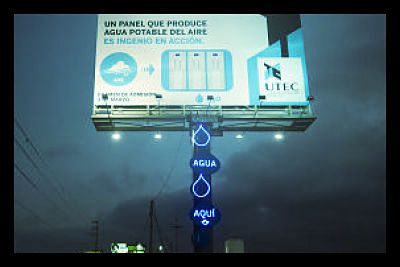
The University of Engineering and Technology (UTEC) has developed a new billboard that pulls moisture from the atmosphere and converts it into drinkable water — all to advertise for the school. Although it requires electricity to run, the billboard is far easier than the unclean wells that many Lima citizens currently use. It has the capacity to produce 9,450 liters in three months, which is enough to sustain hundreds of families. The idea was the brainchild of advertising agency Mayo DraftFCB, with the hope that the billboard would draw students into engineering at UTEC, while also providing a service to the many people in need.

3. Air-purifying Billboards

In addition to the lack of water, the air quality in the city of Lima, Peru is the poorest in South America. A recent increase in construction has created a toxic atmosphere for many of the city’s residents. The pollutants near these sites cause disease, and possibly even cancer. Again partnering with Mayo DraftFCB, UTEC has developed an air-purifying billboard to alleviate the air pollution caused by growing construction.

The billboard purifies the air as much as 1,200 trees, creating a safe place to breathe within a radius of five city blocks. The billboard dissolves pollutants into water before releasing clean air back into the street. That waste water can then be recycled back into the system, and all of this happens while using only about 2,500 watts of electricity per hour.

UTEC is not the first brand to purify the air with a billboard. Back in Manila, in 2011, Coca-Cola created a billboard that actually contained plants, in partnership with the World Wide Fund for Nature. It is made up of 3,600 Fukien tea plants, which combined removed almost 50,000 pounds of carbon dioxide in a year. The plants grow as the background, forming a silhouetted Coca-Cola bottle. Even the pots the tea plants grow in are recycled from old Coca-Cola bottles. All the plants are watered through trickle irrigation, which drips water down the billboard.

Both billboards provide a healthy environment for citizens who pass through the pollutant-free area.

— Monica Roth

Sources: Fast Company, Visual News, Time, FCB Mayo, Gizmag, Triple Pundit
Photo: Shaw Contract Group

June 27, 2014
https://borgenproject.org/wp-content/uploads/borgen-project-logo.svg 0 0 Borgen Project https://borgenproject.org/wp-content/uploads/borgen-project-logo.svg Borgen Project2014-06-27 09:35:232024-12-13 17:53:543 Ways Billboard Advertising Can Help Humanity
Global Health, Technology

Father Invents Bionic Pancreas for Diabetic Son

Type 1 diabetes diagnoses break the hearts of parents to almost half a million children worldwide each year. Once caught, the implications of a lifestyle change are immediate and lifelong, and worried parents will continuously contemplate their child’s safety and future.

Such was the case for Ed Damiano, who was told that his infant son David was a Type 1 diabetic at only 11 months old. From that moment on, Ed and his wife, Toby Milgrome, became 24-hour human monitors of their son’s blood sugar levels. Diabetes is a condition that does not sleep. As a matter of fact, sleep is one of the most dangerous events of a diabetic’s life since blood sugar levels can surge, which can result in death.

Ed has gone as far as to make it a habit to check his son’s levels in the middle of the night while he sleeps, even now that he is 15 years old. He has also displayed another significant response to address his son’s disease – developing a “bionic pancreas.”

Ed is part of a team of scientists at Boston University who are now pushing the bionic pancreas into its first long-term testing period with volunteer diabetics after recent approval. Previously, 20 adults and 32 adolescents monitored in hotel rooms for five days were hooked up to the devices with almost full dietary freedom. The results, published in the New England Journal of Medicine, showed that the participants were healthier than when administering levels themselves.

Traditionally, diabetics test blood sugar levels several times a day with a portable device that uses small blood samples. If blood sugar is too low, the diabetic takes a glucagon hormone injection; if blood sugar is high, they take an insulin injection to lower it. A diabetic’s pancreas does not produce these hormones naturally, making sugar toxic to their blood.

The new bionic pancreas automatically checks blood sugar levels regularly. It is secured to the patient’s abdomen with tiny tubes inserted under the patient’s skin. The device decides when to make glucagon or insulin increases without any manual operation. Levels can be read real-time with the use of an app on an Apple gadget.

Study participants such as Ariana Coster, a 23-year-old diabetic, expressed how great the feeling of neglect can be – even simply eating a cookie without having to check blood sugar levels. For David and his parents, they are just relieved that the device is likely to be ready by the time he goes off to college in a couple of years.

“My whole life I’ve just known – just had this knowledge that my dad is going to have this bionic pancreas out when I go to college,” says David. “I’m confident in him. He works really hard – really hard.”

— Edward Heinrich

Sources: Time, NPR, USA Today
Photo: Public Broadcasting

June 26, 2014
https://borgenproject.org/wp-content/uploads/borgen-project-logo.svg 0 0 Borgen Project https://borgenproject.org/wp-content/uploads/borgen-project-logo.svg Borgen Project2014-06-26 20:53:292024-12-13 17:50:20Father Invents Bionic Pancreas for Diabetic Son
Global Poverty, Health, Technology, Water

Clean Water From a Box

As of 2005, one in six people are without access to clean water. Perhaps they spend a huge fraction of their income to gain access to a truck that distributes clean water to them, which, ultimately, might not even be clean. They might simply drink available water that holds dangerous bacteria, or that is laced with chemicals. Slightly less than 1 billion people wake up knowing that their first demand of the day is to find any source of water at all.

It isn’t as if water purification hasn’t been perfected in a number of other contexts. Drug companies purify water in huge quantities to produce medicine. The U.S. Navy found methods by which drinking water could be desalinated.

But both of these methods lack the level of portability needed to address the issue of water deprivation in impoverished regions. Methods like chlorine tablets exist, along with reverse osmosis plants. Yet problems of portability persist. It’s possible only some pollutants get purified, and others remain. Sometimes parts are too expensive to replace or are difficult to find.

The struggle with water purification for those in poverty has obviously been a long one, but it looks like the end might be in sight. It comes in the form of a plain-looking box, no larger than a mini refrigerator. Behind its design is a unique story, and its benefits have been a long time coming.

Dean Kamen has been working on what he calls the Slingshot for over 10 years. The inventor of the Segway, Kamen came to the project when Baxter International asked for his help. They had built a device to perform a procedure called peritoneal dialysis, which uses sterile saline to filter a patient’s blood. Kamen’s job was to refine and improve the machine.

It required huge amounts of purified water, or what amounted to multiple gallons a day for each patient. Kamen and his team turned to a simple scientific principle to solve their problem: they recycled the energy used when water evaporates. Now, Kamen has a device that he says can “take any input water, whether it’s got bioburden, organics, inorganics, chrome and… make pure water come out.” Kamen explains that the Slingshot could provide perfectly clean water using less power than a typical hairdryer.

Kamen’s last challenge is getting the Slingshot where it needs to go. Alongside Coca-Cola in October of 2012, Kamen announced plans with the company to bring the Slingshot to remote regions of Africa and Latin America. The partnership had already sent 15 of the machines to Ghana in 2011. Also involved in the process were the Inter-American Development Bank and Africare.

But Kamen has even bigger plans. His next project will work to reach even more people in need of clean water with his energy-efficient Stirling generator, solving the lack of electricity that could inhibit the use of the Slingshot. In the near future, Kamen has made it quite possible that millions of people will no longer face water insecurity.

— Rachel Davis

Sources: Popular Science, HowStuffWorks, Coca-Cola
Photo: Business Week

June 26, 2014
https://borgenproject.org/wp-content/uploads/borgen-project-logo.svg 0 0 Borgen Project https://borgenproject.org/wp-content/uploads/borgen-project-logo.svg Borgen Project2014-06-26 18:25:532024-05-26 23:58:00Clean Water From a Box
Development, Economy, Global Poverty, Health, Technology, Water

TaiwanICDF Provides Clean Water

April 11 marked the official opening ceremony commemorating the completion of a new, groundbreaking water supply system made possible by the Haitian government, the Red Cross Society of the Republic of China and the International Cooperation and Development Fund of Taiwan (TaiwanICDF.) The new water system will reportedly supply safe and clean domestic water for over 90 percent of the area’s inhabitants.

In January 2010 a magnitude seven earthquake devastated Haiti and rendered about 1 million Haitians homeless, a number of which relocated from its capital, Port-au-Prince, to New Hope Village in Savane Diane. As a result, the need for accessible and clean water  increased exponentially, and the new system accommodates this need and serves as a sustainable, long-term solution. TaiwanICDF reportedly showed residents how to maintain and fix the system in the event that it breaks down.

The Taiwanese ambassador to Haiti, Peter Hwang, attended this special celebration, as did TaiwanICDF’s Secretary General, Tao Wen-lung. Wen-lung said the system would provide enough water not only for over 200 homes, but additionally for the village’s health facility, school and nearby agricultural irrigation needs. He described it as “a real godsend for local residents.”

In a video on the TaiwanICDF website, a local resident describes the arduous three-hour process he formerly endured to transfer water from a far-away source back to his home. Now, he has a quick and easy water source practically in his backyard. In the video, the resident also thanks TaiwanICDF for their instrumental role in developing and maintaining the system in his village.

China and Taiwan are hosts to numerous humanitarian organizations. TaiwanICDF is particularly focused on infrastructural and economic development for long-term stability in needy nations and regions, as well as technical cooperation, humanitarian assistance and international education and training. This type of maintainable, long-term investment in developing nations has provided a model by which helpful contributions in such countries can make significant long-term differences.

– Arielle Swett

Sources: ICDF, Taipei Times
Photo: Taiwan Today

June 18, 2014
https://borgenproject.org/wp-content/uploads/borgen-project-logo.svg 0 0 Borgen Project https://borgenproject.org/wp-content/uploads/borgen-project-logo.svg Borgen Project2014-06-18 04:00:272024-06-05 01:57:33TaiwanICDF Provides Clean Water
Global Health, Sanitation, Technology, Water

No Ordinary Novel: The Drinkable Book

In the age of tablets and e-books, there is one book everyone should have a hard copy of.

It doesn’t matter where you live or who you are, millions of people die each year from drinking contaminated water. That’s why the humanitarian organization WaterIsLife has partnered up with the advertising agency DDB to develop The Drinkable Book.

The Drinkable Book looks normal on the outside and is just a few inches thick with about 20 printed pages, but on the inside the book contains the gift of fresh water.

The book not only contains step-by-step instructions on how to purify drinking water, including simple things like washing hands and not leaving trash near a water source, but its pages are also filters to help purify water around the world.

“One of WaterisLife’s biggest challenges (beyond providing clean water) is teaching proper sanitation/hygiene, so this was a perfect opportunity to not only introduce the new filters, but also to do it in a way that meaningfully addresses both problems,” said Brian Gartside, the senior designer of The Drinkable Book in an interview with Slate.

Each page of The Drinkable Book is coated in bacteria-killing silver nanoparticles and can be torn out and used as a water filter. The pages kill the bacteria that cause cholera, E.coli and typhoid, among other diseases and can last up to a month each time they are used.

“A lot of water issues aren’t just because people don’t have the right technology, but also because they aren’t informed why they need to treat water to begin with,” says Theresa Dankovich, the chemist who developed the filter paper.

To use the book, you rip one of the pages in half and slide it into the filter box — which doubles as a cover for the book — and pour contaminated water through. After a few minutes, the bacteria in the water is reduced by 99.9%  and is comparable U.S. tap water.

“Our main goal is to reduce the spread of diarrheal diseases, which result from drinking water that’s been contaminated with things like E. coli and cholera and typhoid,” Dankovich says in the interview. “And we think we can help prevent some of these illnesses from even happening.”

Trying to prevent diseases caused by contaminated water truly aids in the fight against global poverty. Helping those people without access to a clean water source fight contaminants and battle disease means the people who would have previously been ill have a chance to live.

This chance could mean they have the opportunity to work, to open a new business, to expand to new markets or even visit other countries, and have more resources to make life better for themselves and the place they grew up in.

WaterIsLife printed an initial run of 100 copies in English and Swahili to be sent to Kenya and distributed among the impoverished people there, but the brand also plans to distribute The Drinkable Book around the world.

– Cara Morgan

Sources: HuffPost, NPR, Slate, TheGistOfWater
Photo: Design Boom

May 27, 2014
https://borgenproject.org/wp-content/uploads/borgen-project-logo.svg 0 0 Borgen Project https://borgenproject.org/wp-content/uploads/borgen-project-logo.svg Borgen Project2014-05-27 04:00:082024-12-13 17:53:52No Ordinary Novel: The Drinkable Book
Economy, Technology

Marketplaces Connected to Global Artisans


Etsy
is an online marketplace for consumers to purchase art and handmade crafts from global artisans. It is also a Certified B Corporation, meaning that the company operates as more than a profit-seeking business; it is a company that uses its power to solve social and environmental problems.

Etsy is not the only company focused on improving the lives of global artists. GlobeIn launched in 2013 to help connect local artisans to the global economy. Many artists featured on GlobeIn’s online marketplace may not even be familiar with the idea of the Internet, but they now have a way to expand sales of their crafts.

GlobeIn focuses its efforts in nine countries with regional managers, who oversee shipping and money transfers to the artisans. The website presents the story of the artists along with their products. The artisans decide the price of the items and they receive the full amount. GlobeIn’s local infrastructures are managed by regional directors, who help artists get their product listed on the online marketplace.

In contrast, Etsy users rely on the online marketplace to sell their crafts. Etsy was established in 2005 and continues to grow. The website hosts 875,000 sellers from all over the world, and the company is working on creating more international websites that operate in more languages to reflect the 147 countries of the sellers.

GlobeIn is a newer company—it was established in 2013—and caters to those who may not be able to use Etsy because of language barriers or lack of access to the Internet. Both companies are fighting global poverty by giving access to those who otherwise would not have access to the global online marketplace.

Both companies share a mission to connect local artists to the global community through an online marketplace. By giving these artists a platform on which to sell their crafts and goods, Etsy and GlobeIn help bring income to the artists and to make their stories known.

– Haley Sklut

Sources: Etsy, GlobeIn, Mashable, Venture Beat

Photo: WordPress

May 22, 2014
https://borgenproject.org/wp-content/uploads/borgen-project-logo.svg 0 0 Borgen Project https://borgenproject.org/wp-content/uploads/borgen-project-logo.svg Borgen Project2014-05-22 08:00:132024-06-05 01:57:26Marketplaces Connected to Global Artisans
Aid Effectiveness & Reform, Global Health, Technology

Tsetse Fly Repellant in the Near Future?

The people of sub-Sahara Africa may no longer need to fear the bite of the tsetse fly. In an April 24, 2014, Business Weekly article, “Net Closing On Serial Killer Parasite,” Kate Sweeney reported, “Cambridge genome scientists and international colleagues are closing in on new weapons to eradicate deadly diseases spread by the tsetse fly.”

According to the World Health Organization, tsetse flies, blood-sucking insects, transmit Trypanosomiasis, commonly known as sleeping sickness, as well as other diseases to humans and animals in over 30 African nations. Sleeping sickness initially causes joint stiffness, weakness and fever. Over time though, it results in neurological damage and eventually, death. If one identifies the disease early enough, there are drugs to cure sleeping sickness in its initial stages. In 2001, the World Health Organization initiated a large campaign against the disease via early detection and reduced the number of reported cases significantly. In 2010, the number of cases reported dropped below 10,000 for the first time in 50 years.

In 2014, scientists believe a better understanding of the tsetse fly will help eliminate African sleeping sickness completely. The Cambridge genome scientists contribute to a team of 146 scientists from 78 research institutes. The Business Weekly article stated that this international team, “analyzed the genome of the tsetse fly and its 12,000 genes that control protein activity.” This analysis found that tsetse flies have very actives tsal genes in their salivary glands that crave blood.

According to The New York Times’ article, “New Tool to Fight Deadly Tsetse Fly”, a team at Yale University, one of the 78 universities, “found several spots on the genome they hope will eventually lead to better insecticides or repellents.” When studying other insects, such as fruit flies and mosquitos, scientists created repellants after determining weaknesses in their genetic composition. Therefore, this new understanding of the tsetse fly’s tsal genes could lead to new repellant technologies.

As stated in the Huffington Post article, “Tsetse Fly Genome Decoded, May Hold Clues to Fighting African Sleeping Sickness” John Reeder, head of the World Health Organization’s program for research and training in tropical diseases, said, “Sleeping sickness threatens millions of people in 36 countries in sub-Saharan Africa. Many of the affected populations live in remote areas with limited access to adequate health services, which complicates the surveillance and therefore the diagnosis and treatment of cases.” His words illustrate the importance of tsetse fly genome decoding for Africa. A repellant or insecticide to fight tsetse flies would be a more feasible solution compared to the difficult detection of the disease and distribution of drugs to cure it in Africa.

– Jaclyn Ambrecht

Sources: The Huffington Post, The New York Times, Business Weekly, WHO

May 3, 2014
https://borgenproject.org/wp-content/uploads/borgen-project-logo.svg 0 0 Borgen Project https://borgenproject.org/wp-content/uploads/borgen-project-logo.svg Borgen Project2014-05-03 04:00:182024-05-26 23:30:32Tsetse Fly Repellant in the Near Future?
Development, Global Poverty, Poverty Reduction, Technology

Israeli Entrepreneurs and Global Development

In recent years, Israel has often been dubbed “Startup Nation” – a hub for entrepreneurship and innovation. Tel Aviv is ranked the world’s second startup ecosystem behind California’s Silicon Valley, and Israeli entrepreneurs set up around 600 to 700 million new tech companies each year. These entrepreneurs are extraordinary when it comes to implementing creative ideas and raising early stage funding, contributing to Israel’s record of having the largest venture capital industry per capita in the world.

There are certainly explanations for the success of Israel’s startup scene; a well-educated entrepreneurial population, long work hours, strong funding and high employment for new startups can all be seen as contributing factors. But while Israeli citizens are doing an incredible job of setting up their companies, they have not yet established a history of building long-lasting ones. Instead, it is common for Israeli startups to sell out to larger firms after a few years. These larger firms are almost always foreign companies, who quickly acquire the startups and convert them into research and development centers.

Lately, however, the trend appears to be shifting. Israeli entrepreneurs are making efforts to build lasting, full-fledged businesses. Additionally, more Israeli companies are striving to go public in the United States. Around 70 companies listed on the NASDAQ are Israeli or affiliated with Israel in some way – the most out of any other country, with the exceptions of only the United States and China.

Israel is also looking to use its booming startup scene to contribute to global development. A Devex article noted that new companies should focus on pressing issues like poverty and child mortality, emphasizing the need to concentrate “not only on creating the next Waze to help people navigate around traffic, but also to find solutions for some of the world’s most pressing development challenges.”

Currently, 1.2 million people live in extreme poverty, and 19,000 children under the age of five die each day. Many of those deaths are preventable, and Israel’s track record of startup victories could be the answer. Recently, 70 young entrepreneurs, innovators and international development professionals met at the 2014 Israeli Designed International Development (ID2) to discuss entrepreneurship for global development. These 70 people are at the vanguard of social entrepreneurship – designing medical devices to fight cervical cancer, developing online platforms to address high unemployment in rural areas, providing a way for the poor to design and pursue their own community impact projects.

Helen Clark, the head of the United Nations Development Program, was reportedly “blown away” by the entrepreneurial strength of the ID2 participants. And ID2’s venue of choice – Israel – was well-chosen. Israeli entrepreneurs are already making great strides toward development challenges and social betterment. For example, the Chilean government successfully alerted millions of citizens to an approaching tsunami in early April with the help of eVigilo, an Israeli startup that serves as a mass notification and emergency communication platform. With its innovative spirit and entrepreneurial clout, Israel is capable of producing many more social enterprises like this. In time, “Startup Nation” could truly make its mark in global development.

– Kristy Liao

Sources: Devex, Forbes, Wharton, JNS
Photo: Baruch College

April 28, 2014
https://borgenproject.org/wp-content/uploads/borgen-project-logo.svg 0 0 Borgen Project https://borgenproject.org/wp-content/uploads/borgen-project-logo.svg Borgen Project2014-04-28 18:16:322024-06-05 01:57:24Israeli Entrepreneurs and Global Development
Technology

Internet.org

Currently two-thirds of the world’s population, a staggering 5 billion, live without access to basic internet. A lifestyle difficult to imagine here in the U.S. and other countries that have integrated internet into virtually every aspect of our daily lives. Internet.org, a group of powerful allies, is dedicated to utilizing their combined resources to change this.

Internet.org is an innovative partnership spearheaded by Mark Zuckerberg, the founder of Facebook,who is  committed to reducing the cost of bringing internet access to the world. The plan is to provide universal access to internet by lowering the cost of serving data by tenfold and reducing the amount of data required to run basic apps by the same amount. These major cost reductions are the keys to reducing the cost of internet access 100-fold. This is the amount of cost reduction that would make it possible to for a worldwide internet providing infrastructure to exist and this group is determined that it can be achieved through technological innovation.

According to Internet.org, providing universal internet access is a fundamental step in the struggle for global resource equality. Access power is so valuable today because the internet is “the backbone of the knowledge-based economy.” This statement recognizes the global shift currently taking place since the advent of the internet that is moving society from a mainly resource-based economy to knowledge-based economy. By providing another 5 billion people across the world to the knowledge economy an unprecedented change could take place., driving the economy up, and impacting poverty worldwide.

“The internet’s impact on global growth is rising rapidly. The internet accounted for 21% of GDP growth over the last five years among developed countries… the internet is also a catalyst for job creation,” according to McKinsey & Co. While this kind of economic growth may not be immediate, the plan has potential to stimulate economies worldwide.

In order to achieve this feat, Internet.org is delving into some large-scale innovative projects to combat even larger technological and socal challenges. Some of these include high-altitude, long-endurance planes, satellite systems and even lasers.

The founding members of this group are impressive, including tech giants Ericsson, Mediatek, Opera, Samsung, Nokia and Qualcomm. Looking at this short list of big names, it is not surprising that some have immediately questioned whether there are purely capitalist motives for these companies that are being disguised behind a humanitarian agenda.

However, in Deloitte’s study on the “Value of Connectivity” they found that “expanding internet access in developing countries to levels seen today in developed economies, we could increase productivity by as much as 25 percent, generating $2.2 trillion in GDP and more than 140 million new jobs, lifting 160 million people out of poverty,” while also having the ability to “deliver critical information on nutrition, hygiene and disease prevention. Once connected, people gain access to basic tools like health information, financial services and education that can help them live fuller, better lives and join the worldwide economy.” With the promise of this kind of massive economic benefit in the developing world, many believe that the motives behind this cooperative effort are somewhat irrelevant.

The concern over hidden agendas may provide the project with the high level of visibility both from those who are critical and those who are supportive. Ultimately, time will be what tells us if this project is able to have the kind of success that will drive the change that it expects.

– Leonna Spilman

Sources: Internet.org, McKinsey & Company

Photo: La Nacion

April 21, 2014
https://borgenproject.org/wp-content/uploads/borgen-project-logo.svg 0 0 Borgen Project https://borgenproject.org/wp-content/uploads/borgen-project-logo.svg Borgen Project2014-04-21 04:00:062024-12-13 17:50:14Internet.org
Global Poverty, Technology

Facebook Sends Drones to Africa

Facebook_Solar_Powered_Drones
When you think of robot drones, what is the first image or information that comes to mind? If you are like me, your brain probably imagined military drones patrolling the Middle East, gathering intelligence and firing missiles. This type of drone has become popular thanks to our recent military engagements and the push by drone manufacturers to utilize them for domestic law enforcement purposes.

Let us put these images of militarized drones aside and come back to a happy place where instruments are used for peace. This is precisely what U.S. technology companies are trying to do with their investments in drone manufacturers. Google made headlines when it announced its new adventure, Project Loon, which seeks to provide internet and network capabilities using balloons in the stratosphere.

Not to be outdone, Facebook, Inc. has plans to buy a drone manufacturer in hopes to use the high altitude crafts to send network signals to communities across the African continent. With two- thirds of the planet currently without internet, technology companies are now racing to conquer these untapped markets.

Facebook’s effort is a part of a larger project called Internet.org. Founded by Ericsson, Mediatek, Opera Software, Nokia, Qualcomm, Samsung and Facebook, the group believes in bringing internet to every person throughout the planet. The group, moreover, feels this is too much responsibility and too important a goal for one company or government to achieve alone.

Utilizing Facebook’s Connectivity Lab, groups of scientists and engineers are designing drone satellites that can fly over remote areas and send network signals to the people living there. Cruising at about 65,000 feet, Facebook estimates that a satellite-equipped drone can provide signal to a city-sized area of territory with a medium population density. Furthermore, solar panels will allow the drone to store energy during the day and use its batteries during the night.

Although this project is in its early stages, companies such as Facebook and Google are providing hope for the millions across the globe still stuck in poverty. A study by Deloitte illustrates the potential and value for internet connectivity. Out of the 4.7 billion people currently living without internet, a majority are in poor and many disadvantaged regions. The report estimates that economic activity as a result new internet connectivity could generate $2.2 trillion in additional GDP and 140 million new jobs.

The benefits of spreading internet technology around the globe are too great to pass up. While most governments are stuck in a state of austerity and can’t spend on research and development, private industry and non-governmental organizations are picking up the slack. With time and greater investment of resources, the world is poised to become more connected than ever.

– Sunny Bhatt

Sources: Internet.org, Deloitte, Business Insider
Photo: Liberty Beat 

April 10, 2014
https://borgenproject.org/wp-content/uploads/borgen-project-logo.svg 0 0 Borgen Project https://borgenproject.org/wp-content/uploads/borgen-project-logo.svg Borgen Project2014-04-10 10:08:052024-12-13 17:50:13Facebook Sends Drones to Africa
Page 80 of 88«‹7879808182›»

Get Smarter

  • Global Poverty 101
  • Global Poverty… The Good News
  • Global Poverty & U.S. Jobs
  • Global Poverty and National Security
  • Innovative Solutions to Poverty
  • Global Poverty & Aid FAQ’s
Search Search

Take Action

  • Call Congress
  • Email Congress
  • Donate
  • 30 Ways to Help
  • Volunteer Ops
  • Internships
  • Courses & Certificates
  • The Podcast
Borgen Project

“The Borgen Project is an incredible nonprofit organization that is addressing poverty and hunger and working towards ending them.”

-The Huffington Post

Inside The Borgen Project

  • Contact
  • About
  • Financials
  • President
  • Board of Directors
  • Board of Advisors

International Links

  • UK Email Parliament
  • UK Donate
  • Canada Email Parliament

Get Smarter

  • Global Poverty 101
  • Global Poverty… The Good News
  • Global Poverty & U.S. Jobs
  • Global Poverty and National Security
  • Innovative Solutions to Poverty
  • Global Poverty & Aid FAQ’s

Ways to Help

  • Call Congress
  • Email Congress
  • Donate
  • 30 Ways to Help
  • Volunteer Ops
  • Internships
  • Courses & Certificates
  • The Podcast
Scroll to top Scroll to top Scroll to top