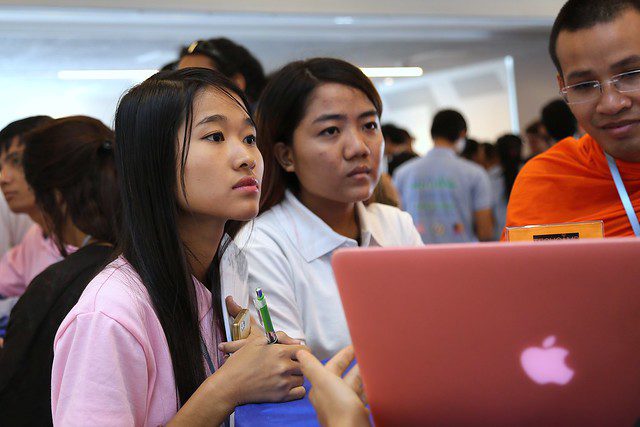
Vietnam sits at a crucial point as its economic development is currently facing difficulties with labor and capital forces that could hinder proper and sustainable development. Therefore, Vietnam must rely on a boost in productivity to successfully increase the country’s GDP growth. At this moment Vietnam’s science, technology and innovation system can provide numerous advantages in accomplishing its goal of building a sustainable economy. By taking proper advantage of its science and innovation, Vietnam could create numerous opportunities for its future.
Vietnam’s Successes
While Vietnam has a long history of respected and reputable scientific research, particularly in agriculture and biology, its innovation system is only beginning to emerge. Vietnam has numerous advantages it can utilize in order to improve its science, technology and innovation (STI) system.
Geographically, Vietnam is one of the most dynamic regions in the world. Over the past 2 decades, Vietnam has seen strong economic development and a massive reduction in poverty rates. In 1993, the percentage of Vietnamese people in poverty was 58, but by 2011 the percentage had dropped to 12. Vietnam’s education system and educational efforts have also been largely successful. The education systems success is demonstrated by a 98 percent literacy rate in Vietnam.
Furthermore, since the nation becomes industrialized, it has seen an increase in exports of an eclectic variety. Previously exports have been predominantly in agriculture, which it has maintained. However, in 2009, its exports expanded to include electronic equipment (5 percent), jewelry (5 percent) and machinery (4 percent).
Obstacles and Solutions
Vietnam’s current science, technology and innovation (STI) system contains several weaknesses. They include a lack of proper infrastructure, poor research and development in the business sector and weak STI government policies. Vietnam is also faced with several threats to its STI system such as a slowdown in economic growth in recent years, failure to prepare for international cooperation and failure to improve government and business institutions to deal with corruption.
To address these threats and weaknesses to innovation the World Bank has formulated a list of recommendations to serve as solutions to these problems. The list includes:
- Improving the framework for innovations: All aspects of Vietnam’s framework, including infrastructure, the business sector, openness to trade and foreign direct investment and the tax system affect Vietnam’s innovative system.
- Improving governance of innovation system: The government plays an integral role in regulating all aspects of STI systems, including setting priorities and ensuring adequate performance.
- Strengthening the human resource base for innovation: Improving the educational system and allowing current workforce members opportunities to improve their skills as well as placing heavier emphasis on soft skills is essential for innovation.
Looking Forward
With the proper development of Vietnam’s science, technology and innovation System, the country has numerous potential opportunities to pursue. It could lead to a positive social and economic impact on the country’s population. Vietnam’s economic system has the potential to be upgraded and diversified with the development of a dynamic business sector. Lastly, the improvement of Vietnam’s STI system could be the driving force to sustaining Vietnam’s recent economic development.
– Randall Costa
Photo: Flickr
 Access to education and literacy are two of the most important tools for positive growth in developing nations. Each new educated, literate and technologically-savvy generation can bring with it a host of
  Last December, Beyoncé performed at the Global Citizen Festival in South Africa, a festival aimed at ending global poverty. The 2018 festival was in honor of Nelson Mandela, former South African president and activist who died in 2013. Over 90,000 people attended the festival, which raised $7.1 billion worldwide. The highly anticipated performance garnered high viewership and engagement worldwide, and parts of the performance were streamed online. However, this was not the beginning of Beyoncé’s charity work in South Africa. Her foundation, BeyGood, has spotlighted local organizations for years. Now, BeyGood plans to return to South Africa twice a year to help develop and execute its community outreach plan. In doing so, BeyGood created the BeyGood Fellowship Program.
 Every eight minutes, a child goes missing in India, becoming yet another one of the estimated three to nine million
  Innovations in sub-Saharan Africa are emerging, aiming to improve sanitary conditions and facilitate access to medical care, directly combatting some of the region’s most prominent health crises. Due to health and sanitation concerns being a primary factor in high rates of illness and morbidity, advances in technology are progressively bettering the quality of life of many citizens in these regions.
 Water is an essential but limited resource that is unfairly allocated in many parts of sub-Saharan Africa. Although one of the Millennium Development Goals (MDG7) is to lower the number of people that currently live without
 Ever since she was a child, Alyssa Milano has spent almost all of her entire life in the public eye. Memories of “Who’s the Boss?” and “Charmed” come to mind when recalling her television career. Moreover, of late, Milano was featured prominently at the Brett Kavanaugh Supreme Court hearings, along with involvement in the #MeToo movement. Few know that Alyssa Milano is a philanthropist who gives to charity regularly on both global and domestic level. This is a closer look at some of the humanitarian efforts of Alyssa Milano.
 Today, social entrepreneurship is growing rapidly in size, scope and support. An unprecedented number of organizations are using entrepreneurship as a strategy to address social problems like poverty, at-risk youth and hunger. Social entrepreneurs are developing creative and innovative organizations that give people the tools, education and resources to become an entrepreneur. As entrepreneurs, they can serve their own communities, improving health, decreasing hunger, creating safer environments and accessing clean water. Here are five organizations using social entrepreneurship to help create jobs in developing countries.