• Link to X
  • Link to Facebook
  • Link to Instagram
  • Link to TikTok
  • Link to Youtube
  • About
    • About Us
      • President
      • Board of Directors
      • Board of Advisors
      • Financials
      • Our Methodology
      • Success Tracker
      • Contact
  • Act Now
    • 30 Ways to Help
      • Email Congress
      • Call Congress
      • Volunteer
      • Courses & Certificates
      • Be a Donor
    • Internships
      • In-Office Internships
      • Remote Internships
    • Legislation
      • Politics 101
  • The Blog
  • The Podcast
  • Magazine
  • Donate
  • Click to open the search input field Click to open the search input field Search
  • Menu Menu

Archive for category: Advocacy

Information and news on advocacy.

Advocacy, Economy, Education, Women and Female Empowerment

Organizations That Are Investing in Women

Investing in Women
Investing in women can cause multiple benefits for the economy, food security and healthcare. There are many organizations that have programs for women’s education and there are some that solely concentrate on getting women access to what they need. Two organizations that are dedicated to women are Womensphere and the Women’s International League for Peace and Freedom (WILPF). By supporting and helping women around the world, these organizations are creating growth in developing countries.

Womensphere was founded in 2007 by Analisa Balares, who is currently the chief executive. Balares started Womensphere with the goal of unleashing women’s potential to lead and transform the world. Womensphere does this by investing in programs that educate or help develop women and girls, mobilizing others to do the same and hosting its own conventions where women can collaborate and share their skills.

Womensphere is investing in women by hosting conventions that allow women to share their accomplishments. One of these conventions is an award ceremony for different organizations that are making a difference for female activism. One award recipient, Nicole Schwab, received the Luminary Award for her Gender Equality Project. This project is working to close the global gender gap by developing a global standard assessment for companies that is non-gender based. This allows women to be included more and have opportunities at higher positions. So far the project tested its idea on seven companies and five countries and hope to use this assessment framework for companies globally. Womensphere also funds and develops different leadership projects that advance women as public, societal, or entrepreneurial leaders.

WILPF was established in 1915 that is dedicated to bringing women around the world together to end violence for peaceful political, societal, and economic climates for all. WILPF four main programs as of this year are disarmament, human rights, women, peace and security and lastly crisis program. All of these programs unite women around the world to solve common problems that are happening in multiple areas. To achieve this WILPF creates awareness on issues like women’s rights as well as financing initiatives that advocate against violence.

The Disarmament Program started in 1915 when the organization was established. In 1999, the Crisis Program was developed to coincide with it. These projects are decreasing violence that directly affects women and children. The programs do this through monitoring, advocacy and reporting military spending. These programs also work to control and decrease various weapon systems to disallow any unnecessary violence.

Both of these organizations see the importance of empowering women and are dedicated to bringing women together. According to the Global Citizen, there are plenty of reasons why supporting women has a positive impact on society. One of these reasons is that women can change the global economy. Studies show that 90% of what women earn goes back to their families. The more women work, the more they spend on their children’s needs, food and healthcare. Education and awareness of childbirth and sex can cause lower maternal deaths of young children and decrease the number of teen pregnancies.

There are many benefits to investing in women and Womensphere and WILPF are just two organizations that are helping empower women and giving women more opportunities.

– Deanna Wetmore

August 10, 2017
https://borgenproject.org/wp-content/uploads/borgen-project-logo.svg 0 0 Kim Thelwell https://borgenproject.org/wp-content/uploads/borgen-project-logo.svg Kim Thelwell2017-08-10 01:30:402024-05-28 00:15:17Organizations That Are Investing in Women
Advocacy, Global Poverty, Refugees, Women & Children

Shay Mitchell Empowers Women and Children

Shay Mitchell Empowers Women and Children
Award-winning Pretty Little Liars Actress Shay Mitchell has been very active outside of her role as Emily Fields, continuing to do much more with her travel experiences than simply finding new foods or relaxing by the beach.

Mitchell empowers women and children who live in oppressive and poverty-ridden countries by interacting with them and learning what it is that these people face every day in order to survive.

One company that Mitchell supports is an ethical fashion and lifestyle brand called Raven + Lily. In her channel’s official YouTube video about her 2015 trip to India, Mitchell explains how Raven + Lily helps fight poverty by giving women a sustainable income.

Mitchell endorses the company by showing her viewers each product that Raven + Lily produces, how the employed women make them and how purchasing from these women will help give them a life that they deserve.

“Women in this Muslim community are not allowed to work outside their home,” Mitchell explains. She continues to state that Raven + Lily allows these women to work from inside their homes, respecting their culture yet giving them a stable and secure income.

Mitchell ended her trip by attending a festival of love and color, which is a local tradition where the citizens covered her in organic colors as they all danced together. This is one of the many ways that Shay Mitchell empowers women and children by participating in events that allow her to relate to everyday citizens on a fundamental level.

Mitchell told In Style magazine that the most difficult part of the trip for her was seeing the extreme poverty in India. She goes on to say that while it is overwhelming, the most important thing to do is to focus on helping these people one person at a time because every struggling citizen matters.

In July of this year, Mitchell posted a photo with children she met while in Syria in the Azraq Syrian Refugee Camp. “Kids should be kids,” she said in a recent Facebook post, talking about how resilient the children are and talking about how much that she missed them already.

During this time, Care.org posted a photo of Mitchell visiting with Syrian children whose dreams are to attend film school. This is in support of CARE’s refugee film school at the Azraq camp.

With Snapchat stories filled with smiling kids, a personal YouTube video showing support for Raven + Lily and verbal support for women and children living in oppression and poverty, Shay Mitchell empowers women and children by being an active advocate for better treatment of struggling citizens around the world.

– Noel McDavid
Photo: Flickr

August 9, 2017
https://borgenproject.org/wp-content/uploads/borgen-project-logo.svg 0 0 Kim Thelwell https://borgenproject.org/wp-content/uploads/borgen-project-logo.svg Kim Thelwell2017-08-09 07:30:112024-12-13 17:58:25Shay Mitchell Empowers Women and Children
Advocacy, Health, Nonprofit Organizations and NGOs

Increasing Surgical Care for Cleft Conditions

Increasing Surgical Care for Cleft Conditions
One of every 500-750 children worldwide is born with a facial deformity known as a cleft lip or cleft palate. If left untreated, the condition can result in social isolation and serious health concerns, such as malnutrition and infection. There is a clear need for increasing surgical care for cleft conditions.

While cleft conditions can almost always be reversed, many impoverished and/or rural families are unable to access affordable care in order to get their children the necessary medical attention. Operation Smile believes that all patients deserve exceptional surgical care regardless of where they are born or how much money their families make.

Operation Smile has been executing life-saving surgical procedures for children around the world for over 35 years. Their advocacy efforts expounding the importance of increasing surgical care for cleft conditions have touched millions. Consequently, their donor base continues to grow. In the month of July, the organization has plans to execute several medical missions in Ho Chi Minh City, Vietnam; Tame, Columbia and Ambato, Ecuador, to name a few.

Beyond the numbers, Operation Smile prides itself on personable and compassionate care. CEO and founder Dr. Bill Magee asks of his donors, “What if this was your child who needed the surgery?” He notes how this consideration makes people realize that the work he does not only rewarding but absolutely necessary.

Adding to the personal nature of the organization, it focuses on individual stories of patients and their families both before and after the life-altering surgery.

The healing story of Siham, a young girl from Morroco, demonstrates just how difficult overcoming the social obstacles of looking different than your peers can be. Every time she left her house, people tormented her in the streets. After only a few weeks of school, Siham dropped out because of the bullying she had endured. Doctors informed her that surgery was possible, but Siham knew that her family would never be able to afford the travel expenses to reach the hospital, let alone the procedure itself.

Stories like Siham’s touch readers at a personal level and help increase the reach of the organization’s successes.

Powered by its compassionate donors and volunteers, Operation Smile has provided hundreds of thousands of free cleft condition surgeries for children and young adults in developing countries. This care has grown exponentially since its beginning in 1982. One element that makes this organization unique from many other medical nonprofits is that it works within the local community’s health providers and cultural norms rather than independently to provide comfortable care for their patients. Each mission is different. Some require importing medical equipment and others need local expertise.

While the root cause of cleft conditions is not yet clear, Operation Smile and other organizations are researching ways to prevent the deformity. For over 30 years, the nonprofit has grown its donor and volunteer bank exponentially. In addition, it has gained valuable experience in unique areas by teaming up with local medical programs in developing countries.

The success of Operation Smile in increasing surgical care for cleft conditions lies in its sustainable practices. They involve local community volunteers and emphasize the importance of donations to fund the services rather than charging patients. The organization benefits everyone involved and will likely continue to grow.

– Sarah Coiro
Photo: Flickr

August 7, 2017
https://borgenproject.org/wp-content/uploads/borgen-project-logo.svg 0 0 Borgen Project https://borgenproject.org/wp-content/uploads/borgen-project-logo.svg Borgen Project2017-08-07 07:30:122024-05-28 00:15:07Increasing Surgical Care for Cleft Conditions
Advocacy, Global Poverty

Mobilizing Youth in Cambodia


As more youth in Cambodia become politically aware, the country has seen significant strides by these individuals in advocating for change.

Such advocacy makes sense in light of changing technologies. As Ou Ritthy, the founder of a Cambodian discussion group, states: “Youth have two things: Information — from social media — and smartphones. They are more independent in terms of information.”

Not only has this allowed Cambodia’s youth to become more educated regarding governmental matters, but it has opened up opportunities for political networking. Through applications such as Facebook, these individuals can now unite through common interests. Together, they can plan rallies, organize volunteer efforts or simply instigate debate.

Furthermore, these efforts are having a bigger impact than ever before. As the New York Times reports, “Two-thirds of the population is under 30,” meaning youth in Cambodia now have the greatest capacity to bring about political change.

Student Thy Sovantha serves as one example. Sovantha created a Facebook page and posted Youtube videos supporting Sam Rainsy, the opposing candidate to Cambodia’s current prime minister Hun Sen, during the country’s 2013 elections. Her actions resulted in thousands of followers.

Sovantha is not the only one who opposes Sen, however. Youth protests were widespread during the 2013 elections, and efforts against his rule continue to this day. Cambodia’s elections later this year will be the final determinant of his power.

“The image of Cambodia in the international community has been damaged because they can see that…Cambodia is moving to dictatorship,” comments Ren Chanrith, a member of Cambodia’s Youth Resource Development Programme.

Regardless of Cambodia’s future regarding Sen, it is certain that youth in Cambodia will continue to have a big impact in what lies ahead for the country. This demographic change, combined with new technology, puts Cambodia’s youth at the forefront of politics.

– Genevieve DeLorenzo

Photo: Flickr

May 11, 2017
https://borgenproject.org/wp-content/uploads/borgen-project-logo.svg 0 0 Borgen Project https://borgenproject.org/wp-content/uploads/borgen-project-logo.svg Borgen Project2017-05-11 01:30:032024-05-28 00:00:16Mobilizing Youth in Cambodia
Advocacy, Global Poverty, Health

How Advocacy Cures Depression


Feeling down or uneasy? It could be time to donate to a worthy cause. A growing body of evidence shows a strong correlation between poverty and multiple forms of mental illness, including depression. The good news is that the inverse is also being proven true; reducing poverty improves mental health, not only for those receiving aid but also for those who provide it. Here are some of the most recent findings on how advocacy cures depression:

According to Spring.org, people in the U.S. have become 5 percent less happy over the past decade, despite average household earnings increasing in the same period of time. The same study determined that Norway and Denmark were the happiest countries, compared to America’s position as the 14th happiest.

“I don’t think Denmark has a monopoly on happiness. What works in the Nordic countries is a sense of community and understanding in the common good,” Meik Wiking, CEO of Copenhagen’s Happiness Research Institute stated by way of explanation. The effects of poverty on depression were shown to be quite clear: the unhappiest countries, which include Liberia, Yemen, Rwanda and Syria are all among the poorest on earth.

The implication of the study seems to add another line to the old adage: money may not be able to buy happiness, but it may be able to buy happiness for someone else in need. Science is discovering that the giver also benefits—one study of 846 people from the American Journal of Public Health found that the act of helping others creates an increased tolerance to stressful life events.

Altruistic acts, such as raising awareness for charitable causes, have been shown to result in numerous psychological and physical health benefits including reducing stress, maintaining a positive life perspective and even boosting longevity.

Crick Lund, University of Capetown psychologist and head of the international consortium called PRIME (Programme for Improving Mental Health Care), is another key researcher in determining how advocacy cures depression. He has dedicated his career to providing mental health treatment for people living in low-income and low-resource areas. His research on the link between poverty and depression is being conducted across five sub-Saharan countries in Africa and is expected to show early results by 2018.

The next time the blues hits, it may be worth considering getting the squad together to volunteer at the local shelter or make a donation to a nonprofit such as The Borgen Project. Since advocacy cures depression, not only will it make life better for someone who truly needs it, it will make the giver feel great too.

– Dan Krajewski

Photo: Flickr

April 20, 2017
https://borgenproject.org/wp-content/uploads/borgen-project-logo.svg 0 0 Borgen Project https://borgenproject.org/wp-content/uploads/borgen-project-logo.svg Borgen Project2017-04-20 01:30:102024-06-05 02:12:15How Advocacy Cures Depression
Advocacy, Education, Global Poverty, Women and Female Empowerment

5 Outstanding Advocates for Women’s Education

Malala Yousafzai is a brave Pakistani advocate for young women’s education and the youngest ever Nobel laureate. An attempt was made on her life when she was shot in the head by militants, and she has faced many other obstacles. Yousafzai is one among hundreds of advocates around the world fighting for women’s education. More than 63 million girls are still not enrolled in school, and fewer than 10 percent of teenage girls finish secondary school. Here are five more outstanding advocates for women’s education.

  1. Neelam Ibrar Chattan
    Chattan has advocated for peace for young women in Pakistan since she was a teenager. She grew up in the same town as Yousafzai. While Yousafzai was being attacked, and the Taliban were taking over Pakistan, Chattan launched a campaign called Peace for a New Generation, promoting education and extracurricular activities for girls and boys. Even though she and her family face various threats, she remains fearless in helping children and young adults get the education they need.
  2. Michelle Obama
    The former First Lady, along with her husband, former President Barack Obama, launched the Let Girls Learn organization in March 2015. The organization works with communities and leaders of third-world countries to promote girls’ education. She has also visited Africa and raised $27 million in funding for young women’s education in Liberia. Michelle Obama hopes that more people will continue fighting for young women’s education.
  3. Graca Machel
    Machel has fought not only for young women’s education, but also against childhood marriage. She acknowledged that women and children “pay the highest prices” from war in Nigeria. Her hard work has led to the Graca Machel Trust.
  4. Angelique Kidjo
    A Grammy-nominated West African singer and songwriter, Kidjo is also a UNICEF goodwill ambassador and the founder of the Batonga Foundation. She uses her talents as a singer and her passion for young women’s education to effect important change. She continues to work with the Batonga Foundation, supporting secondary and higher education for girls in Africa by improving school infrastructure, increasing enrollment, granting scholarships, providing financial support for families, and spreading community awareness.
  5. Ellen Johnson Sirleaf
    As the first female president in an African country, Liberian President Sirleaf has been a huge supporter of general women’s rights, including women’s right to vote and women’s right to education. She has used her power to expand the quality of education in preschool and primary education by joining the Global Partnership for Education in 2007. Despite dealing with the Ebola crisis in 2015, she worked hard to reopen schools and provide quality education for all students.

In the face of widespread and systemic adversity, millions of women around the world do not have education as a birthright. These five advocates of women’s education are advancing an agenda of equality that will empower and uplift communities forever.

– Emma Majewski

Photo: Flickr

April 8, 2017
https://borgenproject.org/wp-content/uploads/borgen-project-logo.svg 0 0 Borgen Project https://borgenproject.org/wp-content/uploads/borgen-project-logo.svg Borgen Project2017-04-08 01:30:312020-04-30 12:04:185 Outstanding Advocates for Women’s Education
Advocacy, Global Poverty

Why Foreign Aid is Hurting Africa? It’s Not

foreign aid hurting africa

Why is foreign aid hurting Africa? Is foreign aid hurting Africa? Relax it’s not. While there are certainly examples of aid done right and aid done wrong, the reality is when done correctly (which it usually is) aid is extremely effective.

Why do people say aid is hurting Africa? Let’s be honest, it bothers us to see human suffering and we feel guilty that we’re not doing something about it. In the end, we’re more than happy to buy into an excuse to do nothing. You’ll see this play out in every country. Talk to the “have’s” in any country and they’ll usually tell you why the “have not’s” can’t be helped. Regardless of whether you visit South Africa or India, as an outsider it’s usually quite disturbing hearing a person driving a Mercedes explain to you why the starving child living on the streets outside his mansion can’t be helped. In our never-ending pursuit to be at peace with ourselves, it’s far easier to maintain our lifestyle and buy into doing nothing is better than something.

Four of the ten fastest-growing economies are African countries that have received foreign aid.

    1. Ethiopia 9.7
    2. Turkmenistan 9.1
    3. Democratic Republic of the Congo 8.6
    4. Myanmar 8.3
    5. Uzbekistan 7.9
    6. Cote d’Ivoire 7.8
    7. Papua New Guinea 7.6
    8. India 7.6
    9. Bhutan 7.6
    10. Mozambique 7.3
      Annual average GDP growth % (2014-2017)
      (Business Insider)


Good News in the War on Poverty

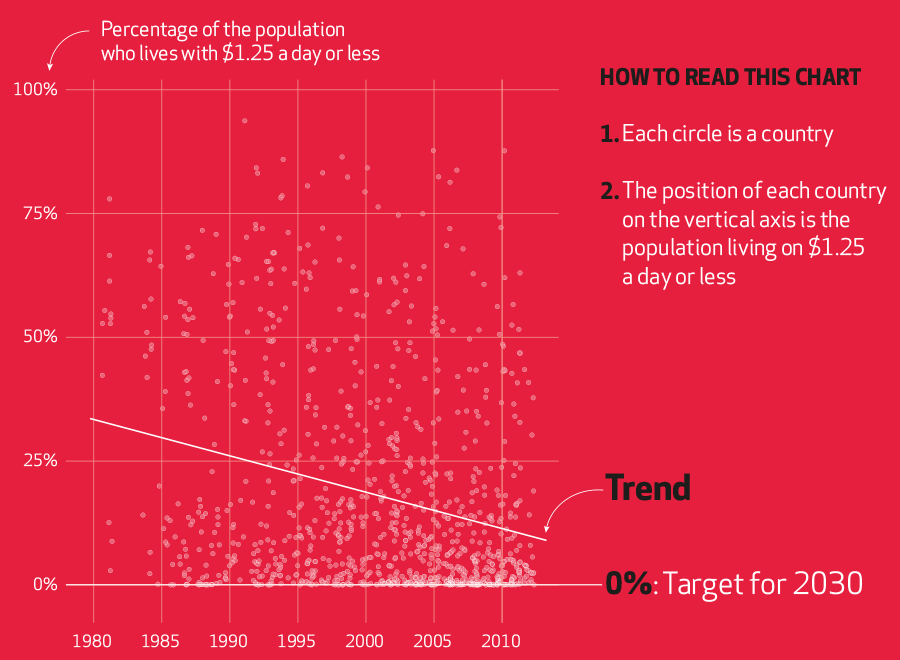
In 2015 The United Nations completed The Millennium Development Goals which began in 1990. Over that period, remarkable results have been achieved.

  • In 1990, nearly half of the population in developing regions lived on less than $1.25 a day. This rate dropped to 14% in 2015.
  • The total number of people living in extreme poverty has declined by more than half from 1.9 billion to 836 million.
  • The number of underfed people has been almost cut in half from 23.3% to 12.9%
  • Primary school enrollment has risen to 91% from 83%.
  • Sub-Saharan Africa achieved a 20% increase in primary school enrollment from 2000 to 2015.
  • The number of primary school-aged children who were out of school dropped from 100 million to 57 million over the past 15 years.
  • The literacy rate of those between 15 and 24 years old has risen from 83% to 91%.
  • The proportion of girls in school in Southern Asia has risen from 74 girls for every 100 boys to 103 girls for every 100 boys
  • Women now make up 41% of paid non-agricultural employments, an increase from 35%
  • The under-five mortality rate dropped from 90 to 43 deaths per 1,000 live births and the number of under-five deaths dropped from 12.7 million to almost 6 million despite the boom in global population
  • The number of globally reported measles cases declined by 67% since 2000 and measles vaccinations helped prevent nearly 15.6 million deaths
  • Maternal mortality declined by almost half
  • New infections of HIV decreased by approximately 40% since 2000
  • The use of Antiretroviral Therapy by AIDS patients increased from 800,000 in 2003 to 13.6 million which has averted 7.6 million deaths between 1995 and 2003
  • Over 6.2 million malaria deaths have been averted since 2000
  • The tuberculosis mortality rate fell by 45% saving an estimated 37 million lives
  • Official development assistance from developed countries increased by 66% in real terms since 2000 and 5 countries (Denmark, Luxembourg, Norway, Sweden, and the UK) exceeded the 0.7% Gross National Income UN assistance target
  • Internet usage is up from 6% in 2000 to 43% in 2015 connecting 3.2 billion people worldwide

(USAID)


aid hurting africa


January 22, 2017
https://borgenproject.org/wp-content/uploads/borgen-project-logo.svg 0 0 Borgen Project https://borgenproject.org/wp-content/uploads/borgen-project-logo.svg Borgen Project2017-01-22 09:45:362024-06-04 01:08:19Why Foreign Aid is Hurting Africa? It’s Not
Advocacy, Education, Global Poverty

Mexico’s Oportunidades Program

Mexico's Oportunidades
Although parents in Mexico generally are aware of the long-term benefits of education, they sometimes pull their children out of school and send them to work. This is indicative of the vicious intergenerational cycle of poverty that afflicts many Mexican families.

The goal of the Oportunidades Program — Mexico’s primary anti-poverty program — is to put an end to this cycle by improving the health and education of the children. It represents 46.5% of the country’s federal annual anti-poverty budget and has so far benefitted 6 million people since its beginning in 1997.

The program conditionally supplements the families’ incomes and provides monetary educational grants so that parents can afford to send their children to school. Families are chosen by socio-economic evaluation and payments are given to the female head of the family.

The chief components of the program are as follows:

  • Education: Grants are provided for primary school students all the way through high school. As students progress in their educations, the grants become slightly higher for girls than for boys. This has resulted in an enrollment increase of 20 percent for girls and 10 percent for boys in secondary school.
  • Health: Government public health institutions provide basic health care for families with particular emphasis on preventative health care. As a result, children between the ages of one and five have a 12 percent lower incidence of illness. There has also been an 11.8% drop in anemia among children under age two.
  • Nutrition: Families receive about 155 pesos monthly in order to increase the quality of the children’s food consumption. Nutritional supplements are also provided for small children and pregnant women.

Up to a third of the decrease in poverty in rural areas can be attributed to the Oportunidades Program, according to a 2014 world bank report. The International Food Policy Research Institute (IFPRI) also evaluated the program’s effectiveness and found that after three years, children in rural areas have increased their school enrollment, have improved diets and have received better medical attention.

Recently the Oportunidades Program, now called Prospera, has spread to urban areas and extended high school education grants. The program has also been successfully replicated in 52 countries in Latin America, Asia and Africa.

Oportunidades’ resounding success proves that conditional cash transfer programs, even on a large scale, do in fact reduce poverty and prepare the country for long-term economic growth. This investment in human capital — primarily the children’s well-being and education — is an exemplary way to not only reduce poverty but eliminate it.

– Liliana Rehorn

Photo: Flickr

January 21, 2017
https://borgenproject.org/wp-content/uploads/borgen-project-logo.svg 0 0 Borgen Project https://borgenproject.org/wp-content/uploads/borgen-project-logo.svg Borgen Project2017-01-21 01:30:422020-05-27 07:43:35Mexico’s Oportunidades Program
Advocacy, Refugees

How ‘Extreme’ is the U.S. Refugee Screening Process?

How "Extreme" is the U.S. Refugee Screening Process?
As global concern about terrorism has grown in the past several years, so has demand for strict security measures regarding the resettlement of refugees. The U.S. refugee screening process was a common theme in the 2016 presidential debates. Both Donald Trump and Hillary Clinton spoke on the issue, and some constituents called for “extreme vetting” of refugees coming into the U.S. What many people don’t know is how extensive the existing process is.

The resettlement process begins with applicants identifying themselves to the U.N. Refugee Agency, the UNHCR. Applicants present the UNHCR with all identifying documents and, after an interview, the organization determines whether or not they qualify as refugees. Only applicants who are strong candidates for refugee status move forward in the process. This number equates to less than 1 percent of refugees worldwide.

The average time an applicant spends waiting to be resettled after being approved as a refugee by the UNHCR is anywhere between 18 months and two years. During this time, the applicant’s case is carefully reviewed and screened by a number of different resources.

After receiving official refugee status from the UNHCR, the applicant is referred for resettlement to the U.S. by the U.N., a national embassy or an NGO. The applicant goes through a series of security checks run by law enforcement and intelligence agencies. In the U.S., these bodies include the FBI, the National Counterterrorism Center, the State Department and the Department of Homeland Security (DHS).

The screenings look for any indication that the applicant could pose a threat to domestic security, such as connections to known terrorists or past criminal history. The screening process is repeated if new information comes to light during any point of the resettlement process.

Next, the applicant goes through an in-person interview with a U.S. Homeland Security officer who has been specially trained to interview refugees. Fingerprints are taken at the time of the interview and scanned against the DHS biometric database, which contains watch-list information and details regarding any previous immigration accounts overseas. The applicant then goes through a medical screening and may be treated for communicable diseases if necessary.

Applicants also go through intensive cultural classes and are matched with U.S. partner agencies that will assist them when they arrive at their new homes. Prior to departure, applicants undergo one more security screening to check for any new information. Upon arrival in their new cities, months’ worth of cultural orientation helps them adjust properly to living in the U.S.

Overall, the existing U.S. refugee screening process is methodical and rigorous.

– Peyton Jacobsen

Photo: Flickr

December 7, 2016
https://borgenproject.org/wp-content/uploads/borgen-project-logo.svg 0 0 Borgen Project https://borgenproject.org/wp-content/uploads/borgen-project-logo.svg Borgen Project2016-12-07 01:30:452024-12-13 17:56:05How ‘Extreme’ is the U.S. Refugee Screening Process?
Advocacy, Global Poverty

Has the Rwandan Genocide Taught Us to Say ‘Never Again?’

Rwandan Genocide

The Borgen Project sat down with Brian Endless, a political science professor at Loyola University Chicago and an academic expert on the Rwandan genocide. Since 2007, Endless worked closely with Paul Rusesabagina, the inspiration for the film “Hotel Rwanda,” to raise awareness about misconceptions surrounding the 1994 Rwandan genocide.

How and why did you initially become interested in the Rwandan genocide?

“[My interest] started around the time I started grad school. I had always focused on the Security Council, and I had a lot of experience with it. I was immersed in the genocide from the beginning from an international perspective. I knew what was happening and saw it as a huge failure of the U.N. I saw everything from the perspective of the outside world.

I didn’t really know how little I knew about Rwanda until 2007 when I met Paul Rusesabagina, who had become an international spokesperson for Rwanda. I had no idea about the history of the civil war and internal conflicts that led up to the genocide. From 2007 on, I went on a pretty steep learning curve, picking up everything that I could about what was happening inside of Rwanda.”

Can you summarize your experience learning about and advocating for awareness of the genocide after 2007?

“From extensive talks with Paul and members of the Rwandan expatriate community, I learned that while the international public saw the situation as Hutus killing Tutsis, what was actually happening was the latest in a series of civil wars. I was surprised by the fact that an enormous number of Hutus died during the genocide, and that a Tutsi dictatorship had replaced a Hutu dictatorship, and that a small percentage of Tutsis was ruling and committing substantial human rights violations.

I did an enormous amount of academic reading and I followed a lot of court cases as things came into the public press. I started actively working with Paul and writing speeches for him and things to be published and publicly disseminated. The Hotel Rwanda Paul Rusesabagina Foundation was first campaigning to inform the public that there were still problems. The situation was really just, ‘meet the new boss, same as the old boss’ with a population that was being discriminated against. Rwanda was also a very friendly government to the United States, so it was difficult getting information out and advocating for truth and reconciliation in Rwanda.”

What were the biggest driving factors behind the genocide?

“It’s a story that dates back to pre-colonial times. By 1990, a Hutu government was in charge but didn’t have enormous control over the country. Tutsi groups in Uganda started a civil war to take back the country. Tutsis were largely winning the war in 1993, and there was a peace plan. By early 1994, the peace plan was breaking down. Hutu extremists started to bring out negative views against the Tutsis. In part, it was a plan to try to stop the Tutsi invasion by encouraging Hutus to demonize Tutsis. They focused especially on internally-displaced youth who were pushed out of their homes as the Tutsis invaded.

That’s effectively where the genocide started. The genocide officially started when the plane carrying the president of Rwanda and the president of Burundi was shot down in early April 1994. That triggered the genocide, and Hutu Power radio began to say, ‘It’s time to chop down the tall weeds,’ which was code to kill the Tutsis.”

How did the international community fail to become involved in the Rwandan genocide?

“We had just come out of Somalia, where 18 U.S. army rangers had been killed. The Clinton Administration used this as an excuse to pull us out. What happened was the U.S. public became more against using forces in places they didn’t understand or that weren’t strategic. Rwanda was a place where nobody had close ties. There were really no great natural resources, thus we let it happen and let it go on. People in the U.S. and in Europe didn’t realize it until we saw it on CNN, and our politicians had no interest in getting us involved in another war that could end up like Somalia.”

What do you think should have been done?

“Really the question is: If we’re going to say ‘never again’ after a genocide, we have to decide if we mean it or not. So far, we haven’t meant it. We’re not willing to put resources on the ground even when we know what’s happening, and in the case of Rwanda, we absolutely knew that genocide was happening.”

What do you think can be done to prevent future genocides around the globe?

“I think in the future, a piece of it is: how can we make the American people more interested and more knowledgeable about what happens in other parts of the world? If the press chose to highlight these things, they would become more important. Advocacy groups need to convince both press and politicians that these are issues of interest to Americans. People need to understand that we have some culpability because we have our fingers pretty much every place in the world. People too often think, ‘Oh, that’s not our problem,’ or, ‘Oh, they should solve their own problems.’ A big piece of our own problem is that we don’t look at things from a humanitarian perspective.”

Endless continues to advocate for the elimination of genocide by working with Paul Rusesabagina’s foundation and teaching classes at Loyola University Chicago. Endless’ insights into the Rwandan genocide offer a path to an international community that can genuinely say “never again” to genocide.

– Peyton Jacobsen

Photo: Flickr

December 5, 2016
https://borgenproject.org/wp-content/uploads/borgen-project-logo.svg 0 0 Borgen Project https://borgenproject.org/wp-content/uploads/borgen-project-logo.svg Borgen Project2016-12-05 01:30:532024-12-13 17:55:56Has the Rwandan Genocide Taught Us to Say ‘Never Again?’
Page 37 of 77«‹3536373839›»

Get Smarter

  • Global Poverty 101
  • Global Poverty… The Good News
  • Global Poverty & U.S. Jobs
  • Global Poverty and National Security
  • Innovative Solutions to Poverty
  • Global Poverty & Aid FAQ’s
Search Search

Take Action

  • Call Congress
  • Email Congress
  • Donate
  • 30 Ways to Help
  • Volunteer Ops
  • Internships
  • Courses & Certificates
  • The Podcast
Borgen Project

“The Borgen Project is an incredible nonprofit organization that is addressing poverty and hunger and working towards ending them.”

-The Huffington Post

Inside The Borgen Project

  • Contact
  • About
  • Financials
  • President
  • Board of Directors
  • Board of Advisors

International Links

  • UK Email Parliament
  • UK Donate
  • Canada Email Parliament

Get Smarter

  • Global Poverty 101
  • Global Poverty… The Good News
  • Global Poverty & U.S. Jobs
  • Global Poverty and National Security
  • Innovative Solutions to Poverty
  • Global Poverty & Aid FAQ’s

Ways to Help

  • Call Congress
  • Email Congress
  • Donate
  • 30 Ways to Help
  • Volunteer Ops
  • Internships
  • Courses & Certificates
  • The Podcast
Scroll to top Scroll to top Scroll to top