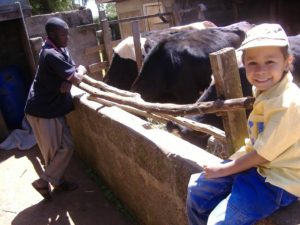
 Dairy farming is a competitive business worldwide. Small and large scale dairy farmers alike face similar obstacles—slim margins, a fragile product and a decreasing market. Kenya produces 5 billion liters of milk every year and the dairy industry accounts for 5%-8% of the country’s total GDP. This large proportion of GDP means that innovations in dairy farming offer significant potential to improve the livelihoods of thousands. In light of this economic fact, new industry actors are emerging to transform dairy farming in Kenya.
EASYMA 6.0
Finding reliable buyers is a difficult task. In many cases, Kenyan dairy farmers are forced to sell to local traders that pay unfair prices. When the digital scale and supply chain system EASYMA 6.0 was introduced in 2014, however, conditions for dairy producers improved. In collaboration with USAID-funded programs, Kenyan tech agencies developed and deployed EASYMA 6.0 into local communities.
The process of EASYMA 6.0 starts with farmers weighing their milk at designated buyer collection centers. Producers then get an automated receipt as well as an immediate advance. This system ensures that farmers receive fair compensation for the quantity of product they supply. Ultimately, this innovation makes it easier for farmers to earn a fair living wage.
In addition to providing security in payments, EASYMA 6.0 also enhances transparency and record-keeping within the dairy industry. As a result, more than 22,000 Kenyan dairy farmers now have access to farm extension services, financial products and even livestock insurance through EASYMA 6.0.
Mazzi Milk Jug
Although a seemingly small and simple issue, spoiling milk can lead to large losses for dairy farmers in Kenya. Spoiled milk can lead to huge losses, negating much of the hard work performed by farmers. Without viable ways to fix the issue, farmers will continue to lose a valuable part of their product—and, thus, their incomes—every year.
In developing countries, safely delivering milk and dairy products is the hardest challenge farmers face. Small-scale farmers produce 80% of the milk in Kenya. Due to small-scale farmers’ insufficient access to quality storage and refrigeration, a significant amount of milk is spoiled during delivery. This struggle prompted the development of Mazzi, a durable and inexpensive jug that prevents spills and slows curdling.
Traditional jugs, or jerry cans, leave dairy products vulnerable to contaminants that cause spoilage. Additionally, traditional jugs are also fragile and very hard to clean. The Bill and Melinda Gates Foundation worked with Global Good and Heifer International to find one key solution to this issue: Mazzi.
Mazzi is a 10-liter reusable plastic container that prevents spills, limits contamination and is easy to clean. Mazzi has a wide mouth that allows farmers to use two hands during the milking process, ultimately increasing productivity. The invention also has a detachable black funnel that enables farmers to determine whether cows have udder infections, as well as a stackable lid that helps with transport and makes the product easy to clean.
The Mazzi jug will only cost $5, compared to competitors priced around $30. By increasing incomes through improved yields, this inexpensive innovation is transforming dairy farming in Kenya and improving the lives of farmers in the process.
MyFugo
Many farmers rely on the dairy industry to make a living, yet Kenya has not adopted technology to improve yield. MyFugo is a software application that is projected to increase milk production in Kenya by helping farmers monitor their cows in real-time. Allan Tollo, the app’s founder, explains that “the app helps the farmer monitor his cows throughout the day enabling them to tell what time their cow will be on heat for it to be served at the right time.”
The MyFugo technology operates by using a Smart Cow Collar. Farmers place the device on their cows and receive notifications on their smart devices of the exact time their cow is in heat. Farmers can increase milk production by reducing the calving period by more than six months. This innovation eliminates prevents farmers from missing cow fertility dates, decreases calving intervals and lowers feeding and treatment costs.
The app is free to use, but the collar costs $150. Although expensive upfront, animals will produce more calves in their lifetime leading to higher milk production, increased revenues and greater economic stability for dairy farmers in the long-term.
MyFugo has registered 8,000 farmers already and is constantly working to grow its user base. The app can track animals at any location, as well as identify their risk of disease. Farmers also gain easier access to veterinary doctors and loans. With many small farms traditionally lacking access to veterinary care and financial loans, this innovation offers the potential to transform dairy farming in Kenya.
Broad Impact
Many farmers are reluctant to embrace new technologies that challenge traditional farming techniques. However, these innovations are steadily transforming dairy farming in Kenya and creating unparalleled opportunities for farmers to earn a successful living. With new technology and easy access to records, dairy farming in Kenya is traveling a new road toward lasting progress. The successful integration of technology in Kenya’s dairy farming industry demonstrates the potential of future innovation in the agricultural industry at large.
– Sienna Bahr
Photo: Flickr

Ax the Tax to Solve Period Poverty in Australia
Period poverty in Australia impacts women and girls across the nation and has only worsened in the days since the coronavirus swept the globe. However, Australian authorities have noted this issue, and have taken action to alleviate some of the hardship for women in need.
Period Poverty for Young Girls
Women’s Agenda Australia, a small team composed of reputable, all-female journalists reporting on gender equality issues in their country, defines period poverty as “the inability to purchase sanitary products [that] presents a significant obstacle to health, comfort, and engagement with school and community activities.” The publication released an article regarding period poverty’s effect on young girls; the women they feature have to deal without necessary sanitary products, all while trying to navigate the high school experience, which is difficult in its own right no matter the resources a student may have.
Though research about period poverty in these scenarios is rather limited in terms of the scale of the problem in educational institutions, administrators can vouch for the fact that poor menstrual management impacts the emotional and physical wellbeing of adolescents, thereby affecting attendance. Dr. Ruth Knight from The Australian Centre for Philanthropy and Nonprofit Studies expands on this issue, sharing that she has “been told girls use socks or rolled up toilet paper with underwear left on the floor or in bins while toilets are only accessible at certain times of the day. Unfortunately, what is a basic human right is often seen as a taboo topic.”
The Impact of the Coronavirus
The implications of COVID-19 worsened period poverty all across the globe, and Australia is not exempt from repercussions. As the nation put stay-at-home orders in place, components of the production process of feminine hygiene products ended up shut down due to the need to manufacture other sanitary products directly linked to slowing the spread of the virus. For example, the program manager of Water, Sanitation and Hygiene Initiatives, or WASH, Australia, described how one of its partners, Plan International, an independent development and humanitarian organization working for children’s and women’s rights, experienced supply chain disruption reducing its ability to produce pads.
Though precautions against COVID-19 are of utmost importance, menstrual hygiene concerns persist and even worsen due to this newfound neglect. Plan International compiled a report titled “Periods in a Pandemic” to detail this issue and used evidence from directly impacted Australian civilians to illustrate their cause. One of the document’s quotations from a woman they identify as a “young Australian” reads, “Due to bulk buying it has been extremely hard to find any products at all, and when you do find them, they are quite expensive.”
Solutions
Australian authorities have not completely turned a blind eye to period poverty. As of January 2019, the list of Goods and Services Tax (GST) exempt products now includes tampons. The campaign to “axe the tax,” as original advocates for the movement touted, was made a reality through a unanimously approved deal amongst state and territory treasurers in Melbourne along with Federal Official Josh Frydenberg back in 2018. This game-changing decision occurred, despite the $30 million Australia lost in tax revenue as a repercussion. The unanimity of the push for the removal of the tax demonstrates that officials recognize the issue, even though it may not be on the radars of Australians at the local level (such as those of the people that could play a hand in stopping period poverty in schools).
Young girls face period poverty in Australia every day and often miss out on pieces of their education as a result. Though little research has occurred on period poverty in this sector of the nation’s population, adolescents are monitored in tandem with their access to schooling, through attendance, academic performance, and the like. Therefore, though the hardship that these young women face appears to be the worst part of the problem, women beyond school age likely face the same challenges, even though unmonitored. COVID-19 only worsened the issue, as priority went to sanitary products pertaining to the virus over those created for menstruation. Period poverty in Australia is on the radar of the nation’s authorities, however, as proven by the country’s abolition of the tax on tampons in 2019.
– Ava Roberts
Photo: Pexels
Making Health Care in India Accessible
India, the second-most populous country in the world, faces a surprising paradox in its health care system. Though it has become a hub for high-quality medical treatment at supposedly affordable costs, health-related expenses cause as many as 63 million people in India to fall into poverty annually. As a result, it is essential that the country makes improvements to health care in India in order to improve its accessibility to those in poverty.
Fixing a Faulty Health Care System
As of 2015, prime minister Narendra Modi proposed the National Health Policy (NHP) to provide universal health care in India, regardless of socioeconomic status. This new policy also guarantees free public health care for those living below the poverty line.
This policy suggests an ambitious reform. Private practitioners continue to dominate India’s health care market. In fact, the private sector provides approximately 70% of health care.
Many more barriers come with delivering a new and improved health care program. With a severe shortage of medical professionals, financing issues and the public’s general lack of trust in the country’s ability to implement effective health care resources, India faces a problem in reforming its health care system.
This has presented a problem for citizens and the government alike. The government wastes expenditures on underutilized resources. Meanwhile, the private sector could include illegally trained doctors and possible medical malpractice, which may entail dangerous treatment and unnecessary expenditures for citizens. The prevalence of private health care partnered with poor insurance regulations results in up to 70% of medical costs from out-of-pocket expenditures, which exacerbates the economic stresses that the nation’s poor feels.
Lack of Public Trust
The driving force behind the underutilization of health care in India is public mistrust. People typically seek help from village doctors first, who are typically closer in proximity to their homes. Many citizens are also wary of poor service in public systems: many patients experience disrespect or the public systems overcharge them for various medical expenses and treatments.
Many citizens hesitate to turn to public hospitals until it is their last resort. There are cases of individuals earning less than INR 10 per day who would seek private care facilities rather than obtain government-granted medical care.
Cases like these are some in a pool of many. There are cases of mothers waiting hours before receiving help in labor, or individuals struggling to pay for necessary medications.
The expensive price tag of private practitioners makes quality care essentially inaccessible to those living in poverty. The prevalence of many low-income individuals desperate to pay high price tags for private care as opposed to visiting free, government-funded institutions presents a clear exclamation: health care in India experience reform to prioritize the trusts and needs of its residents.
Addressing the Problem
As low-income individuals face difficulty in obtaining quality health care, a number of organizations that readily seek to help continuously emerge.
HelpAge India has been around for multiple decades and has earned multiple accolades (NGO Leadership & Excellence Award, Times Social Impact Award, etc.) for its continued support of elderly populations in India. This NGO provides free medical care (cataract surgeries, cancer care, etc.) that would otherwise be unaffordable to many individuals in India.
The Smile Foundation has also focused on providing equitable medical care, especially to underprivileged families. The Smile Foundation provides easier access to health care in slums and lower-income communities and also promotes health care awareness within these communities.
The Rural Health Care Foundation also provides health care to low-income communities all across India. It provides primary care diagnoses, medications and cataract/cleft lip surgeries for those who are unable to pay for these procedures.
These organizations are a few of many seeking to improve systems of health care in India. The implementation of a new and improved health care system is ongoing. However, a combination of both newfound public optimism and institutional change is necessary to ensure health care access to everyone.
– Vanna Figueroa
Photo: Flickr
How TikTok Has Fought Poverty in India
Dreams can come true in the most unusual ways. For some Indians, their dreams came true through a teenage-oriented, pop song-dancing social media app called TikTok. In the ever-growing age of the internet, TikTok has been able to connect India’s poor with the rest of the world, something that no other platform has been able to accomplish. TikTok has fought poverty in India by making simple workers into celebrities. The once monopolized entertainment industry is now wide open for aspiring actors and artists. TikTok has made what many found to be a dark and dirty life into one of glitz and glamour.
A Unique Platform
TikTok is not the first social media app to exist in India. Well-established platforms like Facebook and Instagram have been in the Indian market for years, however, none of them have received the enormous popularity that TikTok has experienced. Projections have indicated that TikTok will reach 125 million users in India by the end of 2020. This is more than Instagram’s 79 million, and six times more than Snapchat’s 18 million.
This success is attributable to a few reasons. One, TikTok has been able to bridge the historic divide between religion and wealth. While India has abolished many direct forms of discrimination, there is still a large amount of prejudice within the country. India only abolished its caste system in 1950. This system has placed millions of people into poverty with very little opportunity to get out of it. While far and between, there are still occasional conflicts between Muslims and Hindus.
Social media like Facebook and Instagram are personal. Any prejudice that someone holds in the real world can easily persist online. But with TikTok, many of these rooted divides go away. TikTok has fought poverty in India by creating a social environment that is free of class, religion and prejudice.
People who were once put down or turned away because of their backgrounds are now free to express themselves. This especially benefits the poor and marginalized.
Uprooting Bollywood
Traditionally, getting into the entertainment industry required large sums of money. Camera equipment, actors, sets and special effects all add up to create quality content. TikTok, however, just requires a smartphone. Editing, special effects and music are all part of the app. TikTok has fought poverty by giving everyone access to these amazing tools. Despite a large inequality in wealth, around 340 million people use smartphones in India.
This means that many of the poor in India can produce content that is just as good as the rich and people are paying attention to it. In India, the music industry and Bollywood are one and the same. In fact, many aspiring artists and actors have been turned down because of Bollywood’s iron grip on the entertainment industry. The majority of successful music is from large companies, not small indie artists.
But TikTok has fought poverty by providing tremendous opportunities for those who had none. Gathering a fanbase attracts sponsorships as well as attention from movie studios. There are many stories of Indians in poverty who rose to Bollywood fame through TikTok. Not only does TikTok subvert the grip that large companies like T-Series have on the entertainment industry, but they also provide opportunities for aspiring artists and actors.
Security Concerns
Despite TikTok’s tremendous positive impact on India, there are still many concerns about the app. Many people question the threat that TikTok poses.
Authorities have linked TikTok back to the Chinese government, which could undermine national security. On June 29, 2020, the Indian government banned TikTok along with 59 other apps. There was public outrage against this action, and many hope that TikTok will return in the future, but for now, things remain uncertain.
While on the rise, India still has a large population in poverty. Around 268 million Indians remain below the poverty line.
However, help can come in unusual ways. TikTok has fought poverty in India by bridging historic divides, providing opportunities for the poor and marginalized, and subverting powerful monopolies in the entertainment industry. While there is still some uncertainty as to the security of the app, TikTok has proven to be a force of good for millions of people in India.
– Evan Weber
Photo: Pixabay
Bootleg Alcohol in Asia: An Insidious Problem
An Unaddressed Epidemic
The problem of fake alcohol has roamed around Asia for countless years. Unregulated distilleries and bathtubs produce counterfeit alcohol before it is distributed under the radar. It is estimated that up to 30% of alcohol in China is fake, with illegal alcohol having infiltrated even well-established bars and pubs under the guise of well-established liquor brands.
Much of the incentive in producing bootleg alcohol in Asia often comes from high import taxes on liquor, or even so far as government prohibition in certain countries. With higher restrictions on liquor sales, many people choose to turn to the black market as their only option.
Various countries have suffered from the effects of counterfeit alcohol. In Indonesia, 300 people have died from consuming counterfeit alcohol between 2014 and 2018 alone. The World Health Organization (WHO) estimates that half of all liquor consumed in India is contraband. This causes numerous cases of methanol poisoning, drunk driving incidents and exacerbating domestic abuse incidents. In 2019, 154 individuals in India had died from methanol poisoning alone.
Consequences, Risks and Poverty
Bootleg alcohol, typically made of dangerous chemicals, disproportionately affects communities facing poverty. Living in poverty is a leading risk factor for alcohol consumption.
Multiple factors make alcohol consumption particularly more threatening to poor communities. The addictive nature of alcohol combined with the weaker support networks and resources (counseling services, healthcare systems, etc.) in low-income communities make these populations vulnerable to prolonged alcohol abuse. Alcohol expenditure could limit the total amount for individuals to spend on food, healthcare and education. Most importantly, the health risks and hospitalization fees associated with alcohol could further exacerbate many families’ financial situations.
The risks associated with poverty and alcohol consumption combined with the cheaper price tag of bootleg alcohol in Asia further amplifies the problems faced by low-income communities. The WHO states that the limited medical resources for poor communities lead to high mortality rates for methanol poisoning.
What Now?
Counterfeit alcohol in Asia continues to run rampant for a straightforward reason: it is taboo. This taboo also makes it highly neglected. Although the WHO encourages public health campaigns addressing illicit alcohol production, few have tackled this issue head-on.
Organizations such as the Methanol Institute (MI) are one of the few that chose to lead the movement in addressing undocumented alcohol production. MI has partnered with countless organizations such as Mitsubishi, BP and Methanex. It provides market support and public awareness for methanol poisoning from counterfeit alcohol.
As of 2013, MI partnered with Lifesaving Initiatives About Methanol (LIAM) to create a pilot campaign in Indonesia to provide community education for citizens to recognize bootleg liquor and combat methanol poisoning. In December 2014, MI-LIAM-trained hospital staff were able to save the first two lives from methanol poisoning. As of 2015, MI-LIAM received funding to continue its effort in Indonesia. Moreover, they garnered approval to expand training in Vietnam.
While bootleg alcohol in Asia continues to be a persisting problem, awareness efforts have slowly highlighted the seriousness of this epidemic. As a handful of brave organizations spearhead efforts to mitigate this issue, many of us hope for others to follow along this path to recovery.
– Vanna Figueroa
Photo: Flickr
8 Facts About Healthcare in Nigeria
Healthcare in Nigeria leaves a lot for people to desire. The system is inefficient and inequitable, although there are some stories of success. Here are eight facts about healthcare in Nigeria.
8 Facts About Healthcare in Nigeria
Today, Nigeria faces an uphill battle. The country needs to address healthcare inequality and a lack of a qualified healthcare workforce to continue developing on a global scale. The country has taken some measures to modernize its healthcare infrastructure and more are on the way.
– Evan Kuo
Photo: Flickr
GivePower: Solar Technology Alleviating Poverty Worldwide
Solar Technology: A Solution to Poverty
Solar technology presents a solution to this growing, global, water crisis. This is because solar technology holds the power to supply clean water and efficient energy systems to communities located in virtually any part of the world. Since 2013, GivePower has worked to help some of the world’s poorest countries gain access to a source of clean, renewable and resilient energy. This has in turn allowed for more readily available, clean drinking water, agricultural production and self-sustaining communities. For example, in 2018 alone, GivePower granted access to clean water, electricity and food to more than 30,000 people in five countries. Since its founding, GivePower has completed projects in the following six countries:
Solar Technology Alleviating Poverty: Today and Tomorrow
Renewable, clean and resilient energy has granted many populations the ability to innovate. In this way, other basic, yet vital human needs are met. Using solar technology alone in alleviating poverty has been enough to create water farms that provide clean water to thousands. With water and energy for innovation — agricultural production flourishes. This, in turn, addresses hunger issues while also working toward economic development. Having already touched the lives of more than 400,000 people, GivePower and solar technology present a promising solution in alleviating global poverty.
– Stacy Moses
Photo: Flickr
Innovations Transforming Dairy Farming in Kenya
EASYMA 6.0
Finding reliable buyers is a difficult task. In many cases, Kenyan dairy farmers are forced to sell to local traders that pay unfair prices. When the digital scale and supply chain system EASYMA 6.0 was introduced in 2014, however, conditions for dairy producers improved. In collaboration with USAID-funded programs, Kenyan tech agencies developed and deployed EASYMA 6.0 into local communities.
The process of EASYMA 6.0 starts with farmers weighing their milk at designated buyer collection centers. Producers then get an automated receipt as well as an immediate advance. This system ensures that farmers receive fair compensation for the quantity of product they supply. Ultimately, this innovation makes it easier for farmers to earn a fair living wage.
In addition to providing security in payments, EASYMA 6.0 also enhances transparency and record-keeping within the dairy industry. As a result, more than 22,000 Kenyan dairy farmers now have access to farm extension services, financial products and even livestock insurance through EASYMA 6.0.
Mazzi Milk Jug
Although a seemingly small and simple issue, spoiling milk can lead to large losses for dairy farmers in Kenya. Spoiled milk can lead to huge losses, negating much of the hard work performed by farmers. Without viable ways to fix the issue, farmers will continue to lose a valuable part of their product—and, thus, their incomes—every year.
In developing countries, safely delivering milk and dairy products is the hardest challenge farmers face. Small-scale farmers produce 80% of the milk in Kenya. Due to small-scale farmers’ insufficient access to quality storage and refrigeration, a significant amount of milk is spoiled during delivery. This struggle prompted the development of Mazzi, a durable and inexpensive jug that prevents spills and slows curdling.
Traditional jugs, or jerry cans, leave dairy products vulnerable to contaminants that cause spoilage. Additionally, traditional jugs are also fragile and very hard to clean. The Bill and Melinda Gates Foundation worked with Global Good and Heifer International to find one key solution to this issue: Mazzi.
Mazzi is a 10-liter reusable plastic container that prevents spills, limits contamination and is easy to clean. Mazzi has a wide mouth that allows farmers to use two hands during the milking process, ultimately increasing productivity. The invention also has a detachable black funnel that enables farmers to determine whether cows have udder infections, as well as a stackable lid that helps with transport and makes the product easy to clean.
The Mazzi jug will only cost $5, compared to competitors priced around $30. By increasing incomes through improved yields, this inexpensive innovation is transforming dairy farming in Kenya and improving the lives of farmers in the process.
MyFugo
Many farmers rely on the dairy industry to make a living, yet Kenya has not adopted technology to improve yield. MyFugo is a software application that is projected to increase milk production in Kenya by helping farmers monitor their cows in real-time. Allan Tollo, the app’s founder, explains that “the app helps the farmer monitor his cows throughout the day enabling them to tell what time their cow will be on heat for it to be served at the right time.”
The MyFugo technology operates by using a Smart Cow Collar. Farmers place the device on their cows and receive notifications on their smart devices of the exact time their cow is in heat. Farmers can increase milk production by reducing the calving period by more than six months. This innovation eliminates prevents farmers from missing cow fertility dates, decreases calving intervals and lowers feeding and treatment costs.
The app is free to use, but the collar costs $150. Although expensive upfront, animals will produce more calves in their lifetime leading to higher milk production, increased revenues and greater economic stability for dairy farmers in the long-term.
MyFugo has registered 8,000 farmers already and is constantly working to grow its user base. The app can track animals at any location, as well as identify their risk of disease. Farmers also gain easier access to veterinary doctors and loans. With many small farms traditionally lacking access to veterinary care and financial loans, this innovation offers the potential to transform dairy farming in Kenya.
Broad Impact
Many farmers are reluctant to embrace new technologies that challenge traditional farming techniques. However, these innovations are steadily transforming dairy farming in Kenya and creating unparalleled opportunities for farmers to earn a successful living. With new technology and easy access to records, dairy farming in Kenya is traveling a new road toward lasting progress. The successful integration of technology in Kenya’s dairy farming industry demonstrates the potential of future innovation in the agricultural industry at large.
– Sienna Bahr
Photo: Flickr
The Fight Against Poverty in New Zealand
New Zealand is a lush island country in the Pacific Ocean. It comprises two main islands; the North Island (Te Ika-a-Māui) and the South Island (Te Waipounamu) in addition to about 600 smaller island landmasses. With a total population of approximately 5 million people, it is not the most populous of countries, but New Zealand has garnered worldwide recognition as a tourist destination. This is partly due to its stunning ocean views, rolling green hills and jagged mountainsides. In fact, New Zealand is a sought-after location for films, with popular movies like “the Lord of the Rings” showcasing the natural beauty of the area. However, such an idyllic and prosperous country has a darker underbelly. Poverty exists in New Zealand despite its ranking as a developed country.
The Facts
In New Zealand, significant economic restructuring beginning in the 1980s has resulted in prosperity for some and poverty for others. In 1984, the national poverty rate was 9%. Comparatively, in 2016, the poverty rate was 15%. This represents a decrease from the peak poverty rate of 22% in 2004 but still remains significantly higher than before the mid-1980s as a direct result of economic change, including hard hits during the 2008-2011 global recession.
According to the New Zealand Council of Christian Social Services, about “one in seven households” experience poverty. In addition, 20% of families do not have access to adequate supplies of food due to financial hardships, according to the 2002 National Children’s Nutrition Survey. This means that more than 328,000 children in New Zealand (29%) came from “a low-income household” in 2019.
When people do not have access to financial and emotional resources, their health is more likely to suffer. New Zealand illustrates this as children experiencing poverty “are more than twice as likely” to require hospitalization than children who are not impoverished. Impoverished children are also far more likely to experience health consequences like heart disease, obesity and substance addiction. These problems often follow children into adulthood, perpetuating the cycle of poverty.
Vulnerable Groups in New Zealand
There is an inequitable distribution of poverty in New Zealand, with Pacific Peoples and the Māori experiencing higher levels of poverty than other ethnicities. A shocking 40% of Pacific Peoples are “living in significant or severe hardship” with Māori coming in second as nearly one-third of the Māori population experiences the same conditions. Additionally, poverty hits children harder than other groups of people. In addition, “New Zealand has one of the worst rates of child abuse in the developed world.”
According to UNICEF, “a child dies every five weeks” due to violence in New Zealand. Experiencing or seeing violence as a child can lead to negative long-term effects like drug use, early pregnancy, anxiety and mental disorders and can compound the effects of poverty into adulthood.
Families living in poverty need to spend their time and energy on survival. Due to circumstances of necessity and poverty, impoverished families typically prioritize education and health less. This creates a cycle of more people living in poverty, intensifying the circumstances of poverty over time. If more people come out of poverty now, fewer people will continue to live in poverty in the future. Preventing the inequitable effects of poverty is vital in increasing the standard of living for many people across New Zealand, especially the most marginalized groups.
Steps to Reduce Poverty in New Zealand
By 2030, New Zealand aims to decrease the number of children living in poverty by at least 50%, in line with its commitments to U.N. Sustainable Development Goal 1. The government of New Zealand has implemented policies to reduce poverty, including strategies to make housing more affordable and accessible as housing costs are a major reason why many residents struggle financially. New legislation has emerged, including the Child Poverty Reduction Act 2018, which outlines a detailed 10-year strategy to reduce child poverty in the nation. The Child and Youth Wellbeing Strategy helps further child poverty reduction by including measures like extending parental leave to 26 weeks, providing increased resources for abuse victims, “[increasing] the minimum wage to $20 per hour by 2021″ and expanding parenting support resources.
Over the past 10 years, New Zealand has reduced poverty rates, and with new, aggressive legislation, should see a boost in those percentages as time goes on.
– Noelle Nelson
Photo: Flickr
5 Facts About Hunger in Canada
In May 2024, The Financial Post blamed the country’s high cost of living and housing for pushing the country to “a critical turning point.” This assessment was based on Food Banks Canada’s 2024 Poverty Report Card that over 44% of people felt worse off than the previous year, with the Food Insecurity Rate of 22.9% earning the country a grade of F on that poverty measure compared to a C for 2023. Poverty was distributed inequitably by age, household structure and living situation, race (“visible minority”) and Indigenous identity. Inflation and housing costs have increased financial pressure, with 32% of people reported to be struggling to access affordable and fresh food.
5 Facts About Hunger in Canada
Addressing Food Insecurity
One group addressing Canada’s hunger issues is Food Secure Canada. This alliance of individuals and organizations has worked with communities across the country for 20 years to encourage food policies and programs in support of “just, healthy, and sustainable food systems.” The organization’s activities include research projects and knowledge-based activities, policy campaigns, and events and networking activities. For example, in November 2023, they held an Indigenous & Black Peoples’ Food Sovereignty Advisory Circle planning project in British Columbia. Other activities include a Youth Caucus and the Coalition for Healthy School Food—with more than 260 member organizations, Canada’s largest school food network.
– Staff Reports
Photo: Flickr
Updated: August 20, 2024
Two Organizations Combating Youth Hunger in the Philippines
Youth Hunger in the Philippines
One of the organizations making a tangible impact on youth hunger in the Philippines is Destiny Ministries International. One of its pastors, Ariel Tenorios, based in the City of Calamba, Laguna, has spearheaded a campaign to feed homeless youth on the streets. He also raises money to give aid packages to these malnourished children. His work has spread throughout the provinces to the General Santos City/Mindanao areas. Tenorios has helped children during the COVID-19 pandemic by provisioning meals to college-aged students and families struggling with food insecurity. To distribute these resources, his team goes from family to family in the poorer areas and gives out bags of food to those in need.
Another way in which Destiny Ministry International helps youth hunger in the Philippines is through social media. So far, the organization has been able to help hundreds of children and families struggling on the streets. One big issue during this time is mental health, with a lot of the youth on the streets struggling with anxiety and depression. Through its work, the organization has helped rehabilitate those in need. For example, it can help people work through suicidal thoughts by providing for their needs.
A Personal Touch
Norita Metcalf knows what is like to help out in these areas. Metcalf was born in the Philippines, living in the province of Cavite from birth to the age of 21. While she currently lives in the United States, she still works with various churches and organizations that focus on youth homelessness and food insecurity in the Philippines. Metcalf takes frequent trips back to the Philippines to help in both tangible and remote ways.
On her most recent trip to the Philippines, aiding Destiny Ministries International, she saw another level of poverty. She described cardboard houses, multiple stories high, that people made to give families some form of a roof above their heads, even if it is as thin as cardboard. This showed Metcalf a new level of poverty than what she personally experienced as a child in the Philippines. While there, she helped fundraise and pass out food to address this problem.
Destiny Ministries International
However, the work of Destiny Ministries International has helped make a tangible difference. Metcalf describes the ways in which people struggled not only with food insecurity but also mental health issues resulting from malnourishment and poverty. The provision of funds and food go a long way for these people. Many college-aged youths on the streets told Metcalf about the feeling of hopelessness associated with the lack of food. Even a small glimmer of hope resulted in the subsiding of suicidal thoughts and depression, thanks to the aid of Destiny Ministries International. Overall, its work has helped hundreds and reduced food insecurity for families struggling during the pandemic.
Children International
Another organization that has aided with youth hunger in the Philippines is Children International. This organization has sponsored over 43,000 kids and 14 community members for over 37 years. It helps tackle malnutrition through screening every child and identifying those who need intervention. Additionally, monitored supplemental feeding in community centers help these children regain their strength and correct their weight-height ratio. Children International also aids parents through nutrition classes that teach about healthy meals on limited budgets, so that children will not remain malnourished.
Through its community centers, such as the Kaligayahan Center (meaning “happiness” in Tagalog), the organization serves thousands of children in different areas. In this center alone, it provides medical and nutritional services to more than 5,100 children. The work that this organization does therefore helps to combat youth hunger in the Philippines. As a result, it helps stop the early deaths and malnutrition that Filipino youths often suffer through due to malnutrition.
Looking Forward
These two organizations demonstrate two different ways to fight impoverished conditions and youth hunger in the Philippines. The stark statistics on how many are affected show that stepping up to the challenge is a necessary step toward change. However, the fight is not done with just these two organizations. As demonstrated by Metcalf’s story, food insecurity is a serious issue that needs a coordinated response in the Philippines.
– Kiana Powers
Photo: Flickr