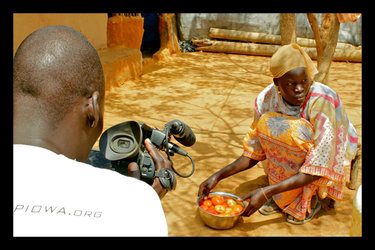
A story is best told by someone who was there. Whereas many documentaries as made by directors and producers passionate about the cause they are filming for, there is a difference between an outsider shooting their subjects, and the subjects shooting themselves.
The organization FilmAid had initially begun to screen videos and films at refugee camps. These films were mostly educational, providing those living in refugee camps with important safety and health information. They also showed films for purely entertainment purposes in order to help lighten the mood and spirit at the camps. In 2011, however, the organization’s branch in Dadaab, the world’s biggest refugee camp in Somalia, began a special project entitled “Dadaab Stories” where it began to train the refugees to work the cameras themselves and have the chance to tell their stories from their perspective.
Dadaab was built in the 1990s to house 90,000 refugees. Today, it is the home to over 500,000 refugees. Describing life in a refugee camp is difficult; insiders know more and have been around longer than an outside film crew.
Ryan Jones, an American videographer who joined FilmAid’s project in 2011, said that the part of the appeal of the program that it strays from the usual model of “an American film crew coming into a camp and spending a short period of time there and shooting some kind of 90-minute doc we hope to get into Sundance.”
Refugees have made various videos such as an emergency response video regarding a cholera outbreak, a safety video for rape awareness, the camp’s orientation film, a music video for the local group Dadaab All Stars, and documentation of actress Scarlett Johansson’s visit.
In October of 2011, however, a kidnapping incident involving Doctors Without Borders created intense restrictions and security issues which prevented the FilmAid team from coming back to Somalia. Since then, the refugees have been trying to manage posting videos and have begun to make their camp-wide newspaper The Refugee available online.
This project has not only taught the refugees a new and unique skill they would otherwise not have the chance to learn, but it gives them a creative outlet to truly show the world what life in a refugee camp is like. They may not be making feature length films or Sundance-worthy documentaries, but their progress and work are so valuable that it could never be put into a simple award category.
– Deena Dulgerian
Source: Co.EXIST

Colon Misses Out on Panama’s Economic Growth
The Panama Canal is framed by Panama’s two largest cities. At one end is Panama City, a vibrant, bustling metropolitan center that is currently experiencing some of Latin America’s greatest growth. At the Canal’s other end, just forty miles away, lies the city of Colon, where potable water, electricity, structurally sound buildings, and meaningful work are all in short supply for the city’s 220,000 residents.
Panama has had an average economic growth of nine percent every year for the last five years. This is due in large part to foreign investment and development in Panama City, where Central America’s first subway is currently under construction. The tallest building in Latin America, a 70-story Trump hotel and condominium, is not out of place among newly constructed skyscrapers, malls, and restaurants.
But Colon has not enjoyed the same booming industrial and commercial development. The city has the largest duty-free trade zone in the Western hemisphere, which has long been a point of contention between residents and developers. Recent development within the zone has benefited businesses there, but not the city at large. The duty-free zone caused social unrest last year when Panama’s president passed a law allowing sale of land in and near the zone. Residents feared this would displace them from their homes and hurt their incomes. Several were killed in the protests.
The economic inequality between Colon and Panama City stems in part from racial segregation and discrimination. Racism is a long-standing problem in many Latin American countries, and Panama is no exception. Those with light skin are often viewed more favorably than those with dark skin in terms of wealth, attractiveness, and ability.
Colon is predominantly black, while Panama City has a larger percentage of European descendants. Many believe that racial discrimination has played a role in Colon’s economic depression.
The stark disparity between Panama City and Colon is an example of the unequal economic growth occurring all over the world. In many places, wealth remains concentrated where it is already abundant, while the poor remain poor, and grow poorer. Correcting this imbalance will require a multifaceted, in-depth, strategic approach that the world’s poor are unable to implement themselves. Therefore, those who have the means to do so are responsible for working to make humane living conditions and economic security realities for every person on the planet.
– Kat Henrichs
Source: NY Times
Photo: AP
Mobile Banking With M-Pesa
Here in the U.S., cell phone apps such as ‘Venmo’ that allow simple and quick money transfers have revolutionized the way we exchange money. However, with mobile banking as well as Venmo-like apps, they require all users to actually have a bank account. While speed and efficiency are a huge pro about these apps, they, as they are, wouldn’t necessarily be as successful a venture in the developing world.
M-Pesa (meaning mobile ‘money’ in Swahili) has grown to be the most successful mobile financial service in the developing world. Started in 2007, the company’s main goal wasn’t necessarily convenience but had the more objective of creating an app that people without bank accounts can use. Bank accounts usually must maintain a minimum balance or have other requirements many people living in developing areas just cannot meet.
M-Pesa users only need two out of three things: a mobile phone and an ID card or passport. With these in hand, they can do numerous things just from their phone: deposit and withdraw money, transfer between different accounts (even to those without an M-Pesa account), manage their transactions, pay their bills, and even purchase mobile minutes. With about 1 in 5 sub-Saharan Africans actually having a bank account, M-Pesa opens up an entire world for people to exchange money freely without being tied down to a bank.
The company manages an individual’s account through their phone number. As part of Safaricom’s and vodacom’s networks (service operators in Kenya and Tanzania: think Verizon or AT&T), only those who receive their service through these companies can take advantage of the system. Once money is transferred, users can cash out at various retail outlets or stores that normally sell cellphone minutes.
M-Pesa was initially created to help the transfer of funds for people receiving microfinanced loans because it helped keep rates down, as it cut out the direct contact with money. Now, it operates in 5 countries including Afghanistan, South Africa, Kenya, Tanzania, and India. It reaches 15 million users in Kenya alone.
– Deena Dulgerian
Sources: Co.Exist, Wikipedia
Photo: Hapa Kenya
Dadaab Stories: By the People, For the People
A story is best told by someone who was there. Whereas many documentaries as made by directors and producers passionate about the cause they are filming for, there is a difference between an outsider shooting their subjects, and the subjects shooting themselves.
The organization FilmAid had initially begun to screen videos and films at refugee camps. These films were mostly educational, providing those living in refugee camps with important safety and health information. They also showed films for purely entertainment purposes in order to help lighten the mood and spirit at the camps. In 2011, however, the organization’s branch in Dadaab, the world’s biggest refugee camp in Somalia, began a special project entitled “Dadaab Stories” where it began to train the refugees to work the cameras themselves and have the chance to tell their stories from their perspective.
Dadaab was built in the 1990s to house 90,000 refugees. Today, it is the home to over 500,000 refugees. Describing life in a refugee camp is difficult; insiders know more and have been around longer than an outside film crew.
Ryan Jones, an American videographer who joined FilmAid’s project in 2011, said that the part of the appeal of the program that it strays from the usual model of “an American film crew coming into a camp and spending a short period of time there and shooting some kind of 90-minute doc we hope to get into Sundance.”
Refugees have made various videos such as an emergency response video regarding a cholera outbreak, a safety video for rape awareness, the camp’s orientation film, a music video for the local group Dadaab All Stars, and documentation of actress Scarlett Johansson’s visit.
In October of 2011, however, a kidnapping incident involving Doctors Without Borders created intense restrictions and security issues which prevented the FilmAid team from coming back to Somalia. Since then, the refugees have been trying to manage posting videos and have begun to make their camp-wide newspaper The Refugee available online.
This project has not only taught the refugees a new and unique skill they would otherwise not have the chance to learn, but it gives them a creative outlet to truly show the world what life in a refugee camp is like. They may not be making feature length films or Sundance-worthy documentaries, but their progress and work are so valuable that it could never be put into a simple award category.
– Deena Dulgerian
Source: Co.EXIST
#GlobalPOV Project: Who Sees Poverty?
“We are the millennials and we are on a mission to make poverty history.”
Those are the words of Ananya Roy, a professor at UC Berkeley and well-regarded as an expert on global poverty, international development, and social change. In a series of videos, Professor Roy lectures on a certain theme dealing with global poverty while Abby VanMuijen, story artist for the #GlobalPOV Project, visualizes and draws on the paper what she sees in her head in a similar fashion to the videos produced in the RSA Animated Series.
The theme of the first video released was “Who Sees Poverty?” Professor Roy discusses how poverty emerged as a priority on a global scale. She calls it the democratization of development. As organizations like USAID, the World Bank, and the United Nations make ending global poverty the main goal through initiatives such the Millennium Development Goals, so we become the generation of global citizens that will continue working to end it, the ‘generation of millennials,’ through constant mobilization and inspiration.
“The ‘we’ who sees poverty is also the ‘we’ who acts on poverty,” says Professor Roy.
The second video released by the #GlobalPOV Project discusses the effects of consumerism and consumption on poverty. With a brief introduction from story artist VanMuijen, the video discusses the need to change how the products we buy are produced, traded and consumed to reduce the impact on the global poor.
“We can solve it, but not by sheer luck or chance,” says VanMuijen in regards to the world. “We must be taught the way.”
Implemented by the Blum Center for Developing Economies at UC Berkeley, the #GlobalPOV Project imagines new ways of looking at and combating global poverty and inequality. Established in March 2006, the Blum Center for Developing Economies works to improve the lives of those living in extreme poverty through investing in technologies and systems and inspiring others to do their part.
– Rafael Panlilio
Source: GlobalPOV
Who cares?: A Documentary About Social Entrepreneurship
Those are the words spoken by one of the many social entrepreneurs interviewed in the Portuguese film “Quem se Importa?” directed by Mara Mourão. Translated to English, the film’s title means “Who cares?” which is the question answered throughout the film.
Shot in 20 different locations in a short span of just 40 days, the film highlights the lives of people all around who are changing the world through social entrepreneurship. Featured in the film is Nobel Peace Prize winner Muhammad Yunus along with a handful of Ashoka fellows. From a Canadian educator teaching empathy to children to a Brazilian priest who became a banker, the theme is clear: everyone can change the world.
A social entrepreneur interviewed puts it well when he says, “Before we can create our own world, we must imagine what kind of world we want to live in and then start doing that.”
The film was screened earlier this year at the 13th Social Enterprise Conference at Harvard and will be featured at the 27th annual Washington DC International Film Festival
– Rafael Panlilio
Source: Ashoka
Third World Children Read First World Problems for Water
Rich in very dark satire, Water for Life presents a hard-hitting video of children in impoverished conditions reciting complaints such as “[I hate] when my mint gum makes my ice water taste too cold,” which is said by a child in what looks to be a boarding house for kids. All of the gripes read in the video have been chosen from the Twitter hashtag First World Problems. Water for life hopes this video will assist the organization in battling poor water sanitation.
According to UNICEF, poor water sanitation is among the leading causes of illness and death in the world. To combat this, Water for Life is providing a water purifier called “The Straw.” The Straw works to filter out waterborne diseases such as typhoid, cholera, dysentery, and guinea worm. By donating $10 to Water is Life, members of the first world can send this water purifier to a community in need of clean potable water.
– Pete Grapentien
Source Huffington Post
Neglected Tropical Diseases
India, Brazil, China, and Italy are the world’s leading G-20 countries where more than 2/3 of cases of visceral leishmaniasis (this disease causes a chronic illness like leukemia) are reported. In addition to that, G-20 countries and Nigeria account for “almost half of the world’s cases of hookworm infection, while…schistosomiasis cases [which are] responsible for chronic renal disease, female genital ulcers, and liver disease – are [found largely] in Nigeria, South Africa, Brazil, China, and Saudi Arabia.” There are also several types of NTDs including Chagas, which is a type of heart disease, that are found in Eastern and Southern Europe and Southern U.S. Therefore, it is safe to say that NTDs exist everywhere in the world but affect those who suffer from extreme poverty, as opposed to assuming that these diseases are exclusive to poor developing nations only where GDP is low.
The good news is that USAID support led to low-cost packages of necessary medicines that will tackle such diseases to be delivered, and their access is enabled, to more than 250 million people in low and middle-income nations. However, other countries besides the U.S. and Britain, are barely contributing to defeat these diseases. Thus, there is a need to pressure G-20 countries to commit to what the World Health Organization (WHO) labels “preventive chemotherapy,” referring to these medicines that would help fight NTDs. Preventive chemotherapy is proven to be extremely cost-efficient because it typically costs about $ 0.50 per person a year. According to the World Health Organization, 1.9 billion people need such preventive chemotherapy measures and only 700 million are currently receiving these medicines.
– Leen Abdallah
Youth Solutions
In South Asia, around twenty percent of the population is between the ages of 15 and 24. The region suffers from a lack of employment opportunities and with a projection of more than a million youth entering the labor force every month over the next twenty years, this is a problem that will only intensify. The idea behind this project is that the solution to massive unemployment should come from the youth themselves.
The World Bank and Microsoft are launching the project in Bangladesh, Maldives, Nepal, and Sri Lanka calling for proposals on how to use the information and communications technology to address the problems of lack of skills development and unemployment. One grant of US$10,000 to $20,000 will be given to each of these countries to the winners for use in carrying out their projects.
– Rafael Panlilio
Source: World Bank
IMF Study Shows Possible Consequences of Economic Recession
Although global poverty within the last decade has improved, over 1.2 billion people worldwide still live on $1.25 a day, and the IMF warns that the global economy that initially brought millions out of poverty is still extremely unsteady and at risk of failing.
The report cites global unemployment numbers, which are at a 20-year high, that shows unemployment around the world is now at 40 percent. The report goes on to state that an economic event, such as the recession of 2007-2009, could have significant negative effects on the world’s poorest people. Experts are alarmed with the recent economic woes in Cyprus that caused “eurozone chaos,” and also cite that the U.S. and Europe are close to another economic downturn.
Doubts in the U.S. economy have been exacerbated by the recent sequester, in which spending cuts could lead to hundreds of thousands of job furloughs and losses.
– Christina Kindlon
Source: Huffington Post
Celebs Participate in 2013 Clinton Global Initiative University
The event focuses on five main areas of interest relating to global issues, including poverty alleviation, public health, peace and human rights, education, and environment and climate change. The event is expecting around 1,200 participants to attend this year. Washington University is the host college this year because of its dedication “to training the next generation of civic leaders.”
Although the general public is not permitted into the event, some sessions can be viewed online via streaming video here.
– Christina Kindlon
Source: KMOV