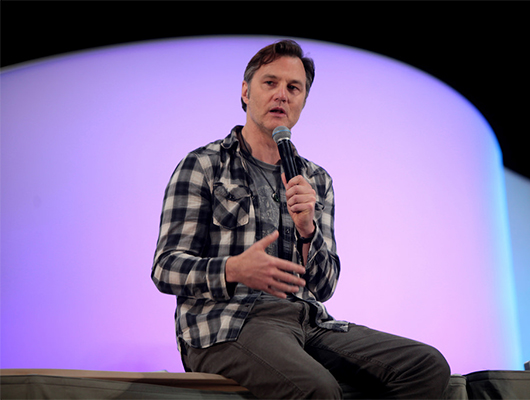
 Last week, David Morrissey, actor on “The Walking Dead,” visited Lesvos, Greece with UNHCR and rescued Syrian refugees on a boat that was drifting in the Mediterranean for 10 hours.
According to UNHCR, there are more than 19.5 million people in extreme conditions from war that need help. Currently, with global dislocation at an all-time high, more than 4 million are Syrian refugees.
This year alone, 80,000 Syrian refugees have fled to Greece in hopes of finding safety. Morrissey took part in a rescue system with Greek coast guards who save up to 15 boats a day.
“There is a new Greek tragedy unfolding, and I am deeply shocked by what I have seen and the stories shared with me. The main protagonists of this human drama are Syrian refugees who make up over 60 percent of the arrivals to Greece and are facing incredibly high risk odds to cross the sea from Turkey,” Morrissey said.
Aside from visiting camps and tending to Syrian refugees, the British actor’s response to this crisis was to board coast guard boats and travel across the ocean to search for Syrian refugees to save their lives.
In a video posted by 5 News, Morrissey can be seen on a lifeboat helping crying children aboard. The actor patted their backs and reassured them several times of their safety.
“So, that was pretty intense,” Morrissey said after the rescue. “We got all of these people off the boat. They don’t know how long they’ve been in the water. The children, particularly, are very traumatized by the event.”
Many children, like some that Morrissey rescued, travel to safer countries without the security of their parents. Morrissey spoke to one of these children — a 13-year-old Syrian boy named Mohammed.
For two years, Mohammed has been traveling with a man he refers to as his uncle, Morrissey said. The boy has journeyed to Turkey, Iraq and Greece, where he met Morrissey.
According to Morrissey, Mohammed was very frightened of the future, yet still hopeful. Exiting the boats, many Syrian refugees, like Mohammed, are often welcomed by Greek locals.
Many Greeks offer help to the incoming Syrian refugees in the form of food, water and shelter. One of the volunteers, a woman named Melinda from Molyvos, Greece, said that she speaks to the coast guard daily, so that she can prepare a proper amount of sandwiches for the refugees entering the island. Despite her humanitarian efforts, she and the country are still struggling to cope with this massive influx of people.
“We have the same number of people who arrived here in one year arriving in just one day,” she said. “We are all doing our best, and people’s generosity and support is astounding. But, it is too much to cope with it all at this level.”
Greece’s tourism industry is taking a large hit. At its worst, 50,000 tourists a day were withdrawing vacation rentals to the Greek Isles. The industry is suffering so badly that Greek politicians are trying to spin the refugee crisis as a plus for tourists.
According to the European Union, this crisis will not end soon. As some refugees attempt to flee to wealthier areas, new resources put in place may keep them from leaving the country. Countries like Hungary and Macedonia have made plans to strengthen their borders, so that other countries like Greece are refugees’ only hope.
With fewer and fewer places to escape to safety, Greece’s notoriously beautiful beaches have become littered with life jackets and the remains of rubber dinghies, Morrissey said. The refugee camps, once a safe zone for its occupants, are now in danger of disease, and the toilets were unusable.
Morrissey said he was completely shocked by the conditions that the Syrian refugees must endure because their homeland is not safe anymore. The UNHCR, with the help of Morrissey and many others, offers protection, assistance, emergency response, shelter and durable solutions for this ongoing crisis.
The agency has helped millions of people and continues to create viable answers for people in need. With millions of displaced people, the organization’s aid is needed more than ever. For more information about the UNHCR and how to help, visit unhcr.org.
– Fallon Lineberger
Sources: Breitbart News, Daily Mail, Look to the Stars, The Guardian, UNHCR 1, UNHCR 2, UNHCR 3, YouTube
Photo: Flickr

What Could GMOs Do to Eliminate Global Poverty?
“Genetically modified organism,” or GMO, is a popular term rampant in mainstream Western food culture. Being critiqued for being unhealthy and harmful to the human body, GMOs have gotten a bad reputation.
Many companies like Chipotle, 365 (Whole Foods store brand) products, and Annie’s products pride themselves in earning a non-GMO sticker from the Non-GMO Project, certifying that they have gone through the motions to avoid GMOs in their food.
However, although sometimes controversial in Western culture, GMOs are transforming the agriculture platform all over Africa. GMOs serve as an efficient tool to use when farming.
In all forms of farming, GMOs serve as a way to curb diseases from reaching crops and increase the number of crops grown. An organism developed in laboratories helps poor farmers to not only be efficient but to earn more money for their families.
However, putting the economic advantages of farming with GMOs aside, many are against GMOs because of the potential health problems they present for the human body.
Due to obesity, a lack of government oversight and harm to the environment, many are against the integration of GMOs in agriculture. Others have also accused those who have patented GMOs (like Monsanto) of only pushing them forward so they can make a profit.
A positive is that it helps to defend crops who are potential candidates for diseases. According to AAAS, GMOs “pose no greater risk than the same foods made from crops modified by conventional plant breeding techniques.” But many, like the Non-GMO Project and Responsible Technology, suggest otherwise.
According to some, the use of GMOs can put money into the pockets of poor farmers, which, in turn, helps to eliminate extreme poverty. Their ability to provide food for those in their region would also help people who are not farmers. They would be able to provide food at a lesser cost.
However, should the overall health of people be sacrificed so they can eat consistently? Is the push for GMOs to be used really for the benefit of the poor farmers or the companies who have patents on them?
Perhaps GMOs should be used until those in extreme poverty have the ability to purchase crops that are less damaging to their long term health.
The debate over the use of GMOs on those in extreme poverty will continue to develop.
– Erin Logan
Sources: The Guardian, Non-GMO Project, AAAS, Huffington Post, UC Berkley, Responsible Technology,
Photo: The Guardian
Leonardo DiCaprio Foundation Raises Over $40 Million
At a recent fundraising gala, the Leonardo DiCaprio Foundation (LDF) raised more than $40 million. This money was dedicated to preserving the last of Earth’s wildlife, habitat, and fragile ecosystems.
DiCaprio stated during the opening ceremony, “We’ve decimated our forests, wildlands, polluted and overfished our rivers and oceans; all the key ecosystems that not only serve as a home to our planet’s biodiversity but also make life here for us possible”.
The event itself, an annual affair, focused its current efforts on protecting key species like the tiger, rhino, shark, and mountain gorilla by working with governments to conserve the jungles, coral reef and forests they call home.
The LDF was able to raise such a large amount of money in a single evening by holding a live auction, presented by the LDF’s long-term partner Julius Baer and other co-sponsors like Chopard and Armani.
The live auction sold an extensive collection of fine art, luxury items and uniquely memorable lifetime experiences. Some of the items sold were an estate home on Leonardo DiCaprio’s own Belize Island that was sold for over $11 million, a private concert with Elton John sold twice for a total of $3 million, and a limited re-edition of Rodin’s “The Thinker” sold for close to $2 million. This shortlist of expensive items were a few of the many auctioned off at the gala event. In addition, several key figures at the event donated simply out of the kindness of their hearts for this worthy cause.
Starting in 1998, the LDF has stated its mission of protecting the world’s last wild places. The LDF implements solutions that help restore balance to threatened ecosystems, ensuring the long-term health and well being of all Earth’s inhabitants. Since that time the Leonardo DiCaprio Foundation (LDF) has worked on some of the most pressing environmental issues. The LDF has made several strides with grantmaking, public campaigns and media initiatives to focus efforts on protecting the biodiversity of the world.
With accomplishments like this, it is truly satisfying to see the LDF tirelessly strive to make a difference.
– Alysha Biemolt
Sources: Look to the Stars, Leonardo DiCaprio, Calfund
Photo: Flickr
Underaged African Footballers Forced into Contracts Abroad
According to a BBC investigation, this past February, 23 underage footballers from Africa were imported from their respective countries to play in Laos. The investigation claims that Champasak United, the club in question, had planned to develop the players and then capitalize on their sale or trade. IDSEA Champasak Asia African Football Academy is the unregistered academy partnered with the club in Laos. The players are mostly from Liberia, but also Sierra Leone and Ghana. Some of the players in question were even as young as 14 years old.
FIFA regulations restrict recruitment of players under 18 years old to clubs or academies.
Multiple players have reported that the work conditions were rigorous and their living quarters were overcrowded. Players stayed in dimly lit rooms and slept on old worn out mattresses.
One of the players, Kesselly Kamara of Liberia stated, “It’s hard to live in a place with no windows. It made sleeping very difficult, because you are thinking about your life.”
The faux contracts the players signed claimed to provide a monthly salary of $200, living accommodations and three meals per day. These provisions were not provided as frequently as promised or in most cases, not at all.
Pressure from FIFA released 17 of the players from their contracts. However, six players have decided to remain at the academy and take their chances.
Since Liberia does not have a football academy of their own, the young players were desperate to develop their skills. Often promised a celebrity status and financial riches, young players are eager to begin their careers and provide for their families. This is unfortunately the case in many African countries.
The former Captain of Champasak United, Alex Karmo, is a Liberian himself who has since left the club. From the perspective of a young Liberian player, the absence of their own academy coupled with the recruitment and promises of a fellow countrymen would make an easy decision. These agents can make anywhere between $3,000-10,000 per player.
It would, however, be a serious oversight to assume that this practice occurs only in these West African countries or on the African continent.
“Today we have criminal activists threatening world football and the young players, so it’s important to work together. Fifa will have to be on top of this battle,” says Jean-Claude Mbvounim. Mbvounim is the founder of “Foot Solidaire”, an anti-trafficking organization advocating for young players in Africa.
The organization estimates that as many as 15,000 young African footballers as young as ten years old are trafficked out of and within the continent. He states that one of the main difficulties is simply determining and distinguishing what is professional, amateur and recreational levels.
Foot Solidaire currently offers advocacy services to young players in Africa and is beginning to operate in the same function in France. It is planned to be known as the “European Network Foot Solidaire” and expand to other countries in Europe such as Spain, Germany, Belgium, Portugal and Italy.
The efforts of his organization have certainly gained traction and publicity internationally. In April of last year, perennial powerhouse FC Barcelona was found by FIFA to have violated rules regarding players under 18 and were in turn sanctioned and fined. While the severity of cases involving underage players cannot always be compared, the fundamental principle of protecting the young footballers reigns paramount.
– The Borgen Project
Sources: BBC 1, Friday Magazine, BBC 2, Play the Game
Walking Dead Actor Rescues Syrian Refugees
According to UNHCR, there are more than 19.5 million people in extreme conditions from war that need help. Currently, with global dislocation at an all-time high, more than 4 million are Syrian refugees.
This year alone, 80,000 Syrian refugees have fled to Greece in hopes of finding safety. Morrissey took part in a rescue system with Greek coast guards who save up to 15 boats a day.
“There is a new Greek tragedy unfolding, and I am deeply shocked by what I have seen and the stories shared with me. The main protagonists of this human drama are Syrian refugees who make up over 60 percent of the arrivals to Greece and are facing incredibly high risk odds to cross the sea from Turkey,” Morrissey said.
Aside from visiting camps and tending to Syrian refugees, the British actor’s response to this crisis was to board coast guard boats and travel across the ocean to search for Syrian refugees to save their lives.
In a video posted by 5 News, Morrissey can be seen on a lifeboat helping crying children aboard. The actor patted their backs and reassured them several times of their safety.
“So, that was pretty intense,” Morrissey said after the rescue. “We got all of these people off the boat. They don’t know how long they’ve been in the water. The children, particularly, are very traumatized by the event.”
Many children, like some that Morrissey rescued, travel to safer countries without the security of their parents. Morrissey spoke to one of these children — a 13-year-old Syrian boy named Mohammed.
For two years, Mohammed has been traveling with a man he refers to as his uncle, Morrissey said. The boy has journeyed to Turkey, Iraq and Greece, where he met Morrissey.
According to Morrissey, Mohammed was very frightened of the future, yet still hopeful. Exiting the boats, many Syrian refugees, like Mohammed, are often welcomed by Greek locals.
Many Greeks offer help to the incoming Syrian refugees in the form of food, water and shelter. One of the volunteers, a woman named Melinda from Molyvos, Greece, said that she speaks to the coast guard daily, so that she can prepare a proper amount of sandwiches for the refugees entering the island. Despite her humanitarian efforts, she and the country are still struggling to cope with this massive influx of people.
“We have the same number of people who arrived here in one year arriving in just one day,” she said. “We are all doing our best, and people’s generosity and support is astounding. But, it is too much to cope with it all at this level.”
Greece’s tourism industry is taking a large hit. At its worst, 50,000 tourists a day were withdrawing vacation rentals to the Greek Isles. The industry is suffering so badly that Greek politicians are trying to spin the refugee crisis as a plus for tourists.
According to the European Union, this crisis will not end soon. As some refugees attempt to flee to wealthier areas, new resources put in place may keep them from leaving the country. Countries like Hungary and Macedonia have made plans to strengthen their borders, so that other countries like Greece are refugees’ only hope.
With fewer and fewer places to escape to safety, Greece’s notoriously beautiful beaches have become littered with life jackets and the remains of rubber dinghies, Morrissey said. The refugee camps, once a safe zone for its occupants, are now in danger of disease, and the toilets were unusable.
Morrissey said he was completely shocked by the conditions that the Syrian refugees must endure because their homeland is not safe anymore. The UNHCR, with the help of Morrissey and many others, offers protection, assistance, emergency response, shelter and durable solutions for this ongoing crisis.
The agency has helped millions of people and continues to create viable answers for people in need. With millions of displaced people, the organization’s aid is needed more than ever. For more information about the UNHCR and how to help, visit unhcr.org.
– Fallon Lineberger
Sources: Breitbart News, Daily Mail, Look to the Stars, The Guardian, UNHCR 1, UNHCR 2, UNHCR 3, YouTube
Photo: Flickr
Americans with Disabilities Twice as Likely to Live in Poverty
On Sunday, July 26, 2015, the Americans with Disabilities Act will turn 25 years old, marking the anniversary of a major landmark in establishing equality for those with both physical and mental disabilities. A quarter of a century after the enactment of the law, people with disabilities still face difficulty finding jobs or making ends meet. As the largest minority group in the United States, Americans with disabilities are twice as likely to live in poverty, compared to Americans without any form of disability.
In an article published by NPR, columnist Pam Fessler examined the disparities faced by people with disabilities, disparities that sometimes come as a direct result of the Americans with Disabilities Act. In her piece, Fessler interviewed Debbie Eagle, a blind woman who had an interesting theory as to why those with disabilities face such hardships finding employment.
Eagle’s theory was as follows: “Employers are scared to hire us because they don’t know what kind of accommodations we require. And if they don’t meet what we consider to be reasonable accommodations, they’re afraid we’ll sue them.” While there is no evidence to support this claim, consider the fact that in 1990, when the Americans with Disabilities Act was passed, 28.4% of adults with disabilities were employed, while as recently as 2013, only 14.4% of the same demographic were employed. Eagle’s theory may very well hold water with data such as this.
Another article raising concern about the lives of disabled people in poverty was published recently by Will Reeve, the son of the late Christopher Reeve, who was best known for his portrayal of Superman during the 70’s and 80’s, but was also known as a champion for the disabled after becoming paralyzed due to a horseback-riding accident. Reeve made the argument that the Americans with Disabilities Act did wonders for those with disabilities, but needs to do more in this day and age.
Reeve wrote, “560,000 people with disabilities never leave their homes because of transportation difficulties, and those who do face considerable obstacles.” He went on to make the connection that because of certain inabilities to travel, many people with disabilities are marooned at home and fall into poverty because of a lack of services to assist them. Almost one-third of people with disabilities live below the poverty line. This statistic is frightening considering we are preparing to celebrate the landmark anniversary of legislation that was supposed to give rise to equality.
– Diego Catala
Sources: NPR, USA Today
Photo: The ADA Legacy Project
3 Organizations Helping Entrepreneurs in Africa
Economic development in Africa has been progressing at tremendous speeds over the last two decades, opening even the most rural entrepreneurs of the continent the chance to succeed in their endeavours. A number of nonprofits have made it their mission to help entrepreneurs in Africa succeed.
African Entrepreneur Collective (AEC)
Established in Rwanda in 2012, AEC now supports over 100 entrepreneurs as they develop and grow their businesses. Though many organizations focus on the initial establishment of new businesses, the AEC provides on-going support and consultation to fledgling entrepreneurs and helps them grow their businesses over time. The African Entrepreneur Collective has tailored their focus to a number of areas: business development, African Innovation Prize for students, low-cost funding, tech and SPRING, focused on innovations for girls.
The organization stated, “In order to create more jobs in Africa, we find the people who are already creating jobs, and help them do it better.”
Self Help Africa
Self Help Africa has been working for 30 years to help farmers in nine countries transition from subsistence farming to farming as a means of income. Self Help’s mission is to strengthen agricultural systems, improve access to goods and services and provide rural communities with market opportunities. In 2014 alone, the organization assisted 290,000 smallholder farmers and had 1.8 million beneficiaries. Some recently highlighted activities by the organization include hosting beekeeping training for a rural Ugandan village, funding a dress-making business in Tanzania and helping a goat farmer in Uganda expand his breeding stock.
WomensTrust
WomensTrust is a New Hampshire-based organization working to empower women in Ghana to break the cycle of poverty and build better lives for themselves and those around them. The organization focuses on three main aspects: microlending for business expansion, education and healthcare. To date, the organization has served over 2,300 clients and supplied more than $400,000 in loans to Ghanese women.
– Gina Lehner
Sources: Women’s Trust, Self Help Africa, African Entrerpreneur Collective
Photo: The Renegade Times
Russian Healthcare Declines
A lack of accessible health service or transportation options had compelled these ill residents to prostrate themselves on the cold steel in hopes of hitching a ride to metropolitan centers with hospitals.
Even in city centers like Moscow and St. Petersburg, the situation has become dire. Hunger strikes aimed at preventing the healthcare cuts have occurred in the past two years in both of these major metropolises.
Stories like these call attention to the increasingly desperate state of Russia’s healthcare system, which has experienced significant consolidation and downgrading. In response, many Russians, as these incidents indicate, are quite literally willing to die for better healthcare.
The fierce will for state-sponsored, universal healthcare coverage has persisted since the Soviet era, while the quality of Russian healthcare has not. According to The Moscow Times, “from 2005 to 2013 the number of health facilities in rural areas fell by 75 percent, from 8,249 to 2,085. That number includes a 95 percent drop in the number of district hospitals, from 2,631 to only 124, and a 65 percent decline in the number of local health clinics, from 7,404 to 2,561.” In March of 2015 leaked government reports claimed that over 10,000 medical professionals in the capital had been laid off after the closure of 28 clinics and hospitals. The reports outlined 14,000 further firings leading up to 2017.
Between the years of 2013-14, 90,000 medical workers lost their jobs despite reports of significant shortages of personnel across the country. That same year, The Audit Chamber, a government agency, had attributed the 3.7 percent spike in hospital deaths to spending cuts. In total, 18,000 Russians needlessly lost their lives.
This is all a part of the Russian Government’s recent ‘optimization’ which aims to eliminate inefficiency by consolidating healthcare resources in larger hospitals. Consequentially, it entails the closure of smaller more local treatment centers.
Putin and his administration are determined in their efforts. They seem to have ignored funding and personnel issues and have instead lauded the healthcare system during a meeting in April 2015. Contrary to their own government reports, they claimed an alleged increase in rural medical coverage and a $4 billion expansion of healthcare funding.
For the doctors that have survived ‘optimization’, life in the workplace has become chaotic. Bloomberg News reported on a female family doctor who had to increase her workday from eight hours to 12 hours. On top of this, she admitted to working three weekend shifts per month for the past year.
One clinic has restricted the average appointment time between the doctor and patient to a mere 12 minutes. This gives the doctor just enough time to fill out paperwork.
Those unwilling to compromise effective treatment will defy these strict time limits. This comes at a cost, however, as many doctors have been forced to regularly work overtime in order to provide adequate care.
For patients, this entails excessive waiting times for treatment. With so few staff, they can expect to wait hours just to meet with a specialist. Those in need of ultrasounds often get put on a six week waiting list. Last year one could expect an ultrasound in a matter of days.
Tired of waiting, many Russians have sought better medical care by taking to the streets in protest. Several demonstrations challenging recent healthcare developments took place in Moscow during the fall and winter of last year.
With approval ratings for the country’s healthcare system under 20 percent according to a recent poll, Putin has also displayed some hesitation. During a conference in the fall of last year, he admitted that his administration had not yet considered everything. If protests continue it is perhaps possible even the notoriously headstrong Putin will alter the course of Russia’s healthcare.
– Andrew Logan
Sources: Bloomberg, The Moscow Times, Radio Free Europe/ Radio Liberty, The Washington Post
Photo: Bloomberg Business
Katniss Everdeen in Peru: Women Use Bows and Arrows
Although it is not a method for battle or hunting in America, shooting a bow and arrow is still the weapon of choice for Wachiperi people in the Peruvian Andes.
Traditionally, the bow was designated for male use. For centuries, men used bows to snag monkeys, other mammals, fish, and birds. While men hunted, women gathered medicinal plants and performed household chores. Boys began training in archery and hunting at age five, while girls learned to help their mothers with cleaning and cooking.
Today, however, the traditional practice is evolving because of modern-day influences. Women and girls do not want to rely on men for food, and therefore, want to learn the ancient art of archery.
For the most part, the Wachiperi community supports this decision.
Sergio Pacheco, a skilled Wachiperi archer says, “The world is modernizing, and women are starting to want to use the bow. They say ‘We are just women in the family, so what happens when our father dies? We need to learn this to be able to take care of our families.’”
Pacheco spoke at the Smithsonian Folklife Festival in June 2015. A skilled archer and traditional doctor amongst Wachiperi people, he shared his cultural knowledge, skills, and wisdom with the audience.
Pacheco explained how hunting has become more difficult due to loggers and miners, who have destroyed the natural habitat of former prey. Men are typically gone for longer days in search of game.
He also described the jaguars that often threaten the Wachiperi community. Twice, he has used bows and arrows to kill the animals.
In addition to discussing hunting practices, Pacheco sang healing songs—called esuwas—for the crowd. He says, “Pills hurt your body because they are chemicals. When I’m sick, I cure myself with only plants.”
Despite his persistence that traditional medical practices are better, he does not question the younger generations—male or female—when they ask to learn archery.
Watch out Katniss Everdeen, you might have some competition coming from Peru!
– Kelsey Parrotte
Sources: Amazon Books, NPR, Smithsonian Institution
Photo: Smithsonian Institution
How John Oliver Blends Activism and Comedy
The audience bursts into laughter. However, while John Oliver is all about getting laughs on his show “Last Week Tonight,” when it comes to blending the comedian and the activist, he’s not joking around.
The above quote is from a segment on sweatshops in the clothing industry, particularly modern, cheaper retailers.
“It seems sweatshops aren’t one of those 90s problems we got rid of like Donnie Wahlberg,” Oliver said. “They’re more like one of those 90s problems we’re still dealing with, like Mark Wahlberg.”
Oliver’s use of his comedic platform as a springboard for his activism makes sense. Prior to his television show’s launch, Oliver was known for his role as a correspondent on “Jon Stewart’s The Daily Show,” and famously filled in for the beloved host in June of 2013, while Stewart was overseas filming his directorial debut.
The difference between Stewart and Oliver’s areas of focus is subtle but significant. Stewart focuses on news and current events, approaching them with a fresh spin, an important trait in a daily program. Oliver, on the other hand, focuses on issues. From food waste, which Oliver compares to Rascall Flatts in that “it can fill a surprising number of stadiums even though many people consider it complete garbage,” to tobacco giant Phillip Morris International threatening to sue Togo, a country with a GDP of just 4.3 billion dollars (“when your GDP is only a couple of billion more than the box office of Avatar, a protracted legal case is not really what you need.”) Oliver takes on major topics not just for laughs, but for information.
What is also unique about Oliver is how he encourages his audience to get involved. In his segment on the tobacco industry, for instance, Oliver christened “Jeff the diseased lung in a cowboy hat” as the new face of Marlboro. Oliver spread t-shirts of the diseased lung in Togo and billboards in Uruguay. Oliver also encouraged his audience to support the new icon, which mocked the tobacco industry’s marketing tactics, particularly in the developing world. It is through this type of culture jamming that Oliver achieves the power of comedy as a medium that influences social change.
Ultimately, “Last Week Tonight” could have been another late night television show, perhaps made a bit edgier due to its placement on HBO. But due to John Oliver’s social activism and experience gained while working with the great Jon Stewart, the show has become an informative springboard for activism, something with great impact on both its audience and the world at large.
– Andrew Michaels
Sources: Last Week Tonight: Fashion, Last Week Tonight: Food Waste, Last Week Tonight: Tobacco, Splitsider
Photo: HBO – Last Week Tonight
Native Crops: The Solution to Africa’s Food Crisis?
A 2010 study recently highlighted in Nature found that, in most cases, indigenous plants contained much higher concentrations of key nutrients, such as vitamins A and C, than non-native varieties. In the case of the native Moringa tree, its leaves pack three times more vitamin A than carrots and seven times more vitamin C than oranges.
While some modified non-native crops do contain much higher percentages of certain nutrients, such as the well-known “Golden Rice” which was created to combat vitamin A deficiency, the harsh climate in much of Africa makes growing non-native crops much more challenging. In addition to having considerable nutritional content, indigenous crops are hardier and faster growing than their exotic counterparts.
With predictions of global climate change causing weather patterns to become more erratic, with sudden rains and long periods of drought, native plants that have spent thousands of years adapting to Africa’s already intense climate could offer a much more reliable food source in the face of such dramatic changes. “Most of the traditional varieties are ready for harvest much faster than non-native crops, so they could be promising options if the rainy seasons become more erratic—one of the predicted outcomes of global warming,” wrote Cernansky, author of the Nature article.
Despite their advantages, native crops make up only a tiny fraction of total agricultural sales. In Kenya, native plants only account for roughly 6 percent of the market, despite the country seeing a 25 percent increase in the land area dedicated to native plants from 2011 to 2013. Much of the lag is due to poor or unreliable infrastructure restricting access to market opportunities. According to Lusike Wasilwa, assistant director of horticulture at Kenya Agriculture and Livestock Research Organisation, more research is needed to address the issues of production, storage and marketing of native plants.
While it is clear that native plants will not be able to solve Africa’s food crisis overnight, they may offer a cheap and elegant solution in the future.
– Gina Lehner
Sources: SciDev.net, Mother Jones
Photo: SciDev.net