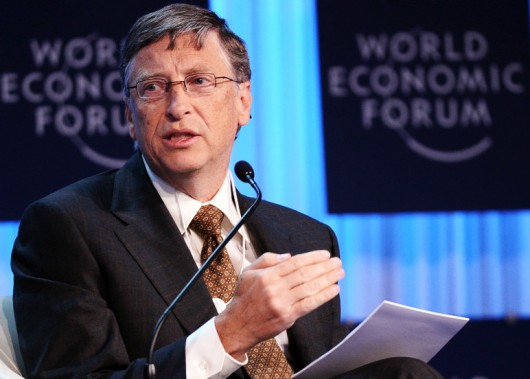
The Bill and Melinda Gates Foundation gave (RED), an organization that fights AIDS, the best 10th-anniversary gift ever: a $50 million match for all Global Fund donations in 2016.
The foundation announced its pledge at the 2016 World Economic Forum in Switzerland according to Look to the Stars.
(RED) and the Fight Against Aids
“Over the past decade, (RED) has enrolled millions of people and dozens of brands in the global fight against AIDS,” said Bill Gates, co-founder of the Bill & Melinda Gates Foundation, in a statement at the 2016 World Economic Forum.
“Today’s match will provide the Global Fund with up to $100 million to help save 60,000 lives, prevent 2.3 million new infections and generate more than $2 billion in economic gains for developing countries,” he said. “That’s an amazing return on investment.”
The Bill and Melinda Gates Foundation and the (RED) campaign has actively supported the Global Fund over the years.
Since its inception in 2006, (RED) has raised $350 million thanks to partners, events and products sold according to the organization’s website.
“We owe a debt of gratitude to all the companies, the creative collaborators and the activists who step-up to fight AIDS with (RED),” said (RED) CEO Deborah Dugan in a statement in January 2016.
A portion of the profits from (RED) branded products, like Beats by Dr. Dre Solo 2 headphones, Apple iPods and GAP clothing, benefit the Global Fund to Fight AIDS, Tuberculosis and Malaria.
The Gates and the Global Fund
The Global Fund was established in 2002 to end AIDS, malaria and tuberculosis as epidemics through government, civil society and private sector partnerships according to its website.
To date, the Gates Foundation has contributed a total of $1.4 billion to the Global Fund, which includes the issuance of the long term promissory note of $750 million according to the Global Fund’s website.
“The Global Fund is one of the most effective ways we invest our money in every year,” said Bill Gates at the 2012 World Economic Forum. “By supporting the Global Fund, we can help to change the fortunes of the poorest countries in the world. I can’t think of more important work.”
The Bill and Melinda Gates Foundation and the (RED) campaign even partnered together through Snapchat in honor of World AIDS Day 2015.
Every time a user sent a Snapchat message using a (RED) filter, the Bill and Melinda Gates Foundation agreed to donate $3 to the organization’s fight against AIDS according to Re/code.
– Summer Jackson
Photo: CNN

Sustainable Development of Coffee in South Sudan
This April, the U.S. Agency for International Development (USAID) announced it would contribute $3.18 million to foster the growth of South Sudan’s coffee industry. This investment is a continuation of Nespresso’s and TechnoServe’s efforts that began in 2011, according to a spokesperson for the USAID.
Focus on Local Farmers
Nespresso and TechnoServe work with local farmers to ensure efficient coffee production occurs while progressing South Sudan’s commercial channels.
This program will continue for three years and will focus on increasing local coffee farmers’ income while alleviating poverty levels.
An example of the work already being done by Nespresso and TechnoServe is the creation of South Sudan’s first wet mills. These wet mills serve the function of processing coffee cherries into coffee beans.
Nespresso’s spokesperson, George Clooney, has opined that grassroot developments are the first steps toward ensuring a country’s economic sustainability.
Further, this investment will enable further training for local farmers and the USAID has the goal of reaching 1,500 farmers, 25 percent of whom are women.
A Crece study in Colombia demonstrated the effectiveness of Nespresso’s work showcasing that local farmers in Colombia experienced 41 percent increased economic output.
The international nonprofit organization named The Rainforest Alliance, describes Crece as a study, “analy[zing] the impact that the Nespresso AAA Sustainable Quality™ Program has had in the lives of coffee farmers in Colombia during the period 2009 to 2011.”
Bringing South Sudan to the Coffee Market
When describing Colombian farms specifically, Nespresso stated, “…farms outperformed a control group of non-member farms in three areas.” These areas include higher environmental values and higher social impact.
Through training of farmers, leaders of the Nespresso organization hope to alleviate poverty and act as the first brand to offer coffee from South Sudan.
A local farmer describing the benefits received from the program told USAID, “We can now afford to take our children to good schools and meet the basic needs of the family. This wouldn’t have been possible without that technical support.”
– Mayra Vega
Photo: Flickr
Bank Loans in Bangladesh Open Doors for Poor Farmers
Nearly half of the population in Bangladesh work in the poor agricultural sector where they have traditionally been excluded from accessing credit facilities that could improve their livelihoods.
To help farmers lift themselves out of poverty, USAID’s Development Credit Authority has partnered with Bangladeshi banks to provide customized financing options that fit the needs of local communities. Here are Benefits of Small Loans in Bangladesh.
3 Benefits of Small Loans in Bangladesh
The availability of loans in Bangladesh that are customized for small borrowers will go a long way to benefit farmers, their families and local communities.
– Emily Milakovic
Photo: Flickr
The International Poverty Line as an Assessment Tool
Pinning down the definition of poverty is essential for the multitude of global organizations looking to improve the well-being of the global population. Measuring just income can leave out information about a community’s environment.
The World Bank’s International Poverty Line
The World Bank’s International Poverty Line is one of the most popular measures of poverty for all kinds of relief organizations. Between 2008 and 2015, this measure was defined as those individuals living on less than $1.25 a day. By this measure, “just over 900 million people globally lived under this line in 2012” and projections for 2015 pin the amount as over 700 million.
Last year September, the International Poverty Line was moved up to $1.90 a day to account for inflation and the cost of goods in various countries.
When an organization redefines the way poverty is assessed, it can change the people whom it targets and the scope of its operations. In that way, adjusting the parameters needs to be a careful, precise process in which the target population is not misrepresented.
How Is It Used?
The World Bank uses an International Poverty Line measuring an individual’s daily purchase power so that it can gauge the population who can meet their “minimum nutritional, clothing and shelter needs” in their country. Using an average of various national poverty lines, the international financial group generates its International Poverty Line from calculations involving purchasing power parity exchange rates.
A Project Syndicate article, however, reported on the Spring Meetings in Washington D.C. in which the World Bank would begin “[recommending] additional metrics.” The establishment of the Commission on Global Poverty will research new ways to assess the quality of life that look beyond income.
The author of the article mentions an analysis done at Fundacion Paraguaya, a Paraguayan organization which spearheads “Poverty Spotlight.”
This initiative uses the power of data to help “families self-assess their level of poverty in 50 indicators grouped into 6 dimensions of poverty which are: Income & Employment, Health & Environment, Housing & Infrastructure, Education & Culture, Organization & Participation and Interiority & Motivational.”
Poverty Spotlight’s approach allows for a customized solution to the specific situation in which a family might find themselves. In addition, Fundacion Paraguaya says that the method “breaks down the often ‘overwhelm’ concept of poverty into a series of smaller manageable poverty problems.” In more ways than one, relief becomes more of a system of change than a cash donation.
Reshaping Poverty Relief Campaigns
The World Bank’s efforts to research assessment methods using multidimensional analysis could reshape poverty relief campaigns across the globe. Adopting an indicator like the Social Progress Index could change how societies are viewed. According to this measurement, the United States is ranked 16th in the world while Norway and Sweden are ranked 1st and 2nd.
The International Poverty Line will be reevaluated this month by the Commission on Global Poverty. No matter what is deemed important in rating living conditions, the goal of reducing the resulting number will prevail.
– Jacob Hess
Photo: Flickr
India Sets New, Higher Education Standards
On Mar. 28, 2016, figures for the New Delhi, India budget were released. They showed an increase in attention to education standards. According to the Times of India, the 2015 plan allocated 24 percent and emphasized attention to classroom infrastructure and model resources. This year, 2016, that number has increased to 25 percent, with a focus on quality education and teacher training programs.
Prioritizing the Quality of Education
Presented by the Aam Aadmi Party (AAP) government, the annual budget of Rs 46,600 will extract 95 percent of its expenses from its own resources and five percent from the central government. These figures are according to Delhi Finance Minister and Deputy Chief Minister Manish Sisodia. Other notable allowances in the plan are housing and urban development, public transportation, road infrastructure, and women’s safety and empowerment projects.
That the education standard tops the list, however, says much about the district’s plans and India’s promising development as a whole. On Mar. 31, Prime Minister Narendra Modi announced a restructuring of India’s national education system. The policy will shift from access to education to educational quality. The World Bank ranked the country’s gross enrollment ratio (GER) at a rate of 114 percent in 2012.
Sarva Shiksha Abhiyan (SSA) and Rashtriya Madhyamik Shiksha Abhiyan (RMSA), both governmental programs to enhance access and quality to primary and secondary education, will receive improvements. Evaluation will be implemented to document grade-wise learning goals, target learning weaknesses, and improve teacher accountability.
The prime minister also announced the introduction of 800 vocational schools. These will be specified secondary school training that provide students with tools to compete in a competitive global market.
Help from Outside Organizations
There are disparities between school attendance, literacy rates, and adequate educational infrastructure within rural and non-rural schools. The improved education standards will seek to improve these disparities the most. The India Education Fund (IEF) is a U.S. based foundation with the mission for providing high standard education to millions of Indian children trapped in the cycle of multi-generation poverty due to lack of privilege and marginalization. The organization is an example of an international group founded with the mission of education equality in India.
With the help of outside organizations, the provision of scholarships and resources to those unable to utilize public education, and the improvements of quality and accountability from within, the Indian government hopes to address the needs of its next generation of learners.
Better Education for Better Quality of Life
Delhi’s budget increase in public education serves as a microcosm of India’s focus as a nation. With increased enrollment, gender diverse classrooms and educational accessibility in poorer areas, the country has made significant progress as an emerging player in the international stage. Data released from the Brookings institute demonstrate direct correlation between higher education standards, clean water, functioning toilets and improved quality of life.
India’s steadfast dedication to country-wide educational improvement shows promise for its citizens.
– Nora Harless
Photo: NY Times
World Humanitarian Summit: Humanitarian Aid Improvements
In March 2016, U.N. Secretary General Ban Ki-Moon announced proposals for improving the effectiveness of humanitarian aid. These suggestions will be brought forth at the first World Humanitarian Summit (WHS) in May 2016 in Istanbul. Proposals to be discussed include ending refugee limbo, increasing refugee access to education, and localizing disaster response.
According to IRIN, the U.N. has worked in consultation with over 20,000 people for improvements in crisis response. The summit will cover the trends and findings pertaining to the utilization of humanitarian aid more efficiently through future crises that arose from this work.
With the influx of refugees to Europe at its highest since WWII, improving the assistance system will be a top priority at the WHS. Concerning the refugee crisis, the summit hopes to merge ideas on how to address the problem more equitably for all states. For instance, the Secretary General recommends that more countries share the financial and hosting responsibilities.
Other ideas that the summit will deliberate upon include providing sustainable livelihoods for refugees in their host countries. This involves providing more immediate access to education rather than refugees remaining in a period of limbo. Another innovative idea to be discussed is a “global finance package,” which would deliver increased funds to hosting countries.
Ban Ki-Moon will also advocate for Security Council members to abstain from vetoing resolutions potentially aiding and preventing crises and atrocities, states IRIN.
In order to successfully provide aid, Ban Ki-Moon says that following international law is an essential factor. Too often hospitals and schools are bombed and destroyed, further disabling quick and effective humanitarian aid provisions. The summit will debate how to competently ensure that international law is respected by all states.
The conference’s discourse on improving humanitarian assistance will also mention the need to localize financing and to empower local organizations.
One round table at the summit will be called “Catalysing Action To Achieve Gender Equality,” covering issues pertaining to gender equality in the face of crises. Myriad women’s needs are left behind in displacement settings. This roundtable will discuss solutions to women’s inclusion in decision-making during crises.
The program’s website states, “The summit is an opportunity to confront these global challenges head-on and generate greater global leadership and political will to end conflict, alleviate suffering, and reduce risk.”
– Mayra Vega
Photo: Flickr
The UNDP and Global Partners: Shaping Agenda 2030
In a February 2016 meeting that marked the 50th anniversary of the United Nations Development Program’s (UNDP) founding, representatives from more than 120 countries, including Ministers and Heads of Government from over 80 U.N. Member States, gathered in New York’s General Assembly to navigate the trajectory of the 2030 Sustainable Development Goals (SDGs). According to the UNDP, the meeting had a clear agenda: to transform ideas into “actions and results.”
The Ministerial Meeting itinerary included several thematic subgroup debates that focused on implementation questions, derived from topics that included eradicating poverty—leaving no one behind, protecting the planet and sustainable development, preventing violent conflict and building peaceful societies, managing risk and building resistance and financing the SDGs.
Opening the meeting with a speech, Helen Clark, Administrator of the UNDP, said that the fundamental purpose in which it was created, remains the same and is “more relevant than ever—that is, to support countries to eradicate poverty in a way which simultaneously reduces inequality and exclusion, while protecting the planet on which we all depend.”
She added that the Agenda 2030 will require increased preemption, receptiveness and improvement on the part of the development program, and that global cooperation was pivotal to poverty eradication and lasting development.
Clark emphasized the need for global consensus and said that meeting discussions “strongly suggest that there is a shared understanding of the road ahead for development and for UNDP as a trusted and strategic partner.”
Ministers and UN partners unveiled strategies to assist the UNDP in its effort to support countries’ SDG goals. Clark suggested that analyses and proposals materialized from discussions at the meeting will be used as a benchmark for the framework of future UNDP work as a global partner.
– Heidi Grossman
Photo: Flickr
Gates Foundation Pledges $50 Million to (RED) Campaign
The Bill and Melinda Gates Foundation gave (RED), an organization that fights AIDS, the best 10th-anniversary gift ever: a $50 million match for all Global Fund donations in 2016.
The foundation announced its pledge at the 2016 World Economic Forum in Switzerland according to Look to the Stars.
(RED) and the Fight Against Aids
“Over the past decade, (RED) has enrolled millions of people and dozens of brands in the global fight against AIDS,” said Bill Gates, co-founder of the Bill & Melinda Gates Foundation, in a statement at the 2016 World Economic Forum.
“Today’s match will provide the Global Fund with up to $100 million to help save 60,000 lives, prevent 2.3 million new infections and generate more than $2 billion in economic gains for developing countries,” he said. “That’s an amazing return on investment.”
The Bill and Melinda Gates Foundation and the (RED) campaign has actively supported the Global Fund over the years.
Since its inception in 2006, (RED) has raised $350 million thanks to partners, events and products sold according to the organization’s website.
“We owe a debt of gratitude to all the companies, the creative collaborators and the activists who step-up to fight AIDS with (RED),” said (RED) CEO Deborah Dugan in a statement in January 2016.
A portion of the profits from (RED) branded products, like Beats by Dr. Dre Solo 2 headphones, Apple iPods and GAP clothing, benefit the Global Fund to Fight AIDS, Tuberculosis and Malaria.
The Gates and the Global Fund
The Global Fund was established in 2002 to end AIDS, malaria and tuberculosis as epidemics through government, civil society and private sector partnerships according to its website.
To date, the Gates Foundation has contributed a total of $1.4 billion to the Global Fund, which includes the issuance of the long term promissory note of $750 million according to the Global Fund’s website.
“The Global Fund is one of the most effective ways we invest our money in every year,” said Bill Gates at the 2012 World Economic Forum. “By supporting the Global Fund, we can help to change the fortunes of the poorest countries in the world. I can’t think of more important work.”
The Bill and Melinda Gates Foundation and the (RED) campaign even partnered together through Snapchat in honor of World AIDS Day 2015.
Every time a user sent a Snapchat message using a (RED) filter, the Bill and Melinda Gates Foundation agreed to donate $3 to the organization’s fight against AIDS according to Re/code.
– Summer Jackson
Photo: CNN
Kellogg Helps Women Smallholder Farmers Globally
Food manufacturing company Kellogg has teamed up with TechnoServe, an NGO focused on entrepreneurial initiatives in Third World areas, to launch an initiative helping female smallholder farmers receive training in climate-smart agriculture.
The initiative was unveiled on March 8, International Women’s Day. The work will predominately be focused in India to help 12,000 women who are smallholder farmers get access to tools, financing and agricultural inputs. A program will also be created in South Africa to train 400 women in improving the quality and quantity of their yields.
According to GreenBiz, the number of smallholder farmers around the world has been on the rise, and almost half of them are women. In developing countries where smallholding is a common practice, men are typically the ones trained in business transactions and financing. About half of India’s population is a part of smallholder families, and much of this group suffers from extreme poverty.
Diane Holdorf, Kellogg’s Chief Sustainability Officer, said in the GreenBiz report, “We know that in many of these societies, these women face very significant challenges; they lack access to training, lack access to financing and lack access to seeds that would really help them to improve their agricultural yields and livelihoods.”
Kellogg, like most multinational food companies, relies on international farmers to grow its ingredients. In India, GreenBiz reports that roughly 23,258 smallholder farmers supply the honey, wheat, rice, and maize that Kellogg uses in its nearby production.
About a year and a half ago, when the U.N. and the global business community began drafting Sustainable Development Goals to address world poverty, Kellogg investigated how to help female smallholder farmers. Kellogg then began a pilot program with TechnoServe to teach 3,000 smallholder farmers about sustainable farming, and now have established this official initiative.
With global warming becoming a growing issue, many farmers around the world are challenged with shorter planting seasons, droughts or floods. As a result, according to GreenBiz, Kellogg believes that helping smallholder farmers adjust will be both good business and good corporate citizenship.
– Kerri Whelan
Photo: Flickr
Takeaway from Reading “Half the Sky”
Reading a book like Half the Sky illuminates how unfair our world is. Though women make up about half of the world’s population, they are consistently discriminated against, overlooked and are in some cases, treated as second class citizens.
It is not surprising that the authors of Half the Sky, Nicholas D. Kristof and Sheryl WuDonn, are award winning writers for their work in raising awareness about the reality most women face in their countries in relation to discrimination.
Written as a series of essays, this book has two parts. The first part of the essay highlights the oppression and discrimination against women especially in developing countries and how this problem is often overlooked due to corruption, lack of strong justice systems and the patriarchal state of these nations.
The second part focuses on practical ways to create this “movement and effect the change needed” to address these situations.
From the beginning to the end of this enlightening book, it is obvious that the writers are very knowledgeable on their topic of discussion and their work shows extensive research in different areas of discrimination within different locations in developing countries.
From discussing issues such as women being promised work and ending up in sexual slavery and imprisonment, to illuminating health issues within developing countries such as women and girls ending up with fistulas after birth, women dying from HIV and AIDS, women and girls going through female genital mutilation as well as being overlooked in terms of getting an education, this book paints a sad reality of women’s lives in the developing world.
The most fascinating point that arises in the book is the fact that culture is the main catalyst for the way women are treated in their societies. In our dynamic world, culture in the developing countries seems unchangeable, especially in relation to its negative aspects. Another surprising fact in the book is the idea that older women in some of these societies are perpetrators of discrimination towards other younger women in the society.
Here, this is quite a deviation from what the “West” has portrayed in development; the idea that men are the main perpetrators of women’s oppression.
Half the Sky not only raises awareness about the injustices women faces but it also advocates for women to fight for their rights by speaking up and resisting the discrimination they face. Though the book points out a few strong and relentless women like Usha Narayane, Sunitha and Krishna who do exactly this and fight for justice, it highlights that most women in the developing world are vulnerable and are unable to get access to their rights.
Half the Sky is the voice of the vulnerable, uneducated and oppressed women in the developing world.
– Vanessa Awanyo
Photo: Google Images
5 Facts on Wangari Maathai and the Green Belt Movement
In 2004, Wangari Maathai became the “first African woman to receive the Nobel Peace Prize” for her humanitarian work. Here are some interesting facts about her life and mission with the Green Belt Movement.
5 Facts About Wangari Maathai and the Green Belt Movement
What makes Maathai’s movement a phenomenon is the very idea that she helped mobilize African women in contributing to sustainable development, tree-planting, integrating themselves into Kenya’s democracy. Her campaign also created awareness about the importance of women’s rights.
Wangari Maathai, through her humanitarian work, is not only a heroine for her country but also for all Africa and women as a whole. She passed away in 2011, however, her legacy will forever serve as a form of empowerment for women in Africa.
– Vanessa Awanyo
Photo: NPR