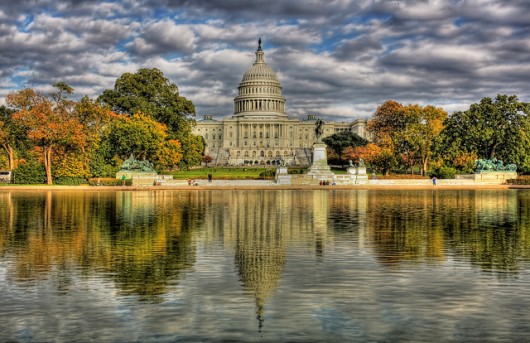
There is widespread confusion regarding the difference between a congressman and a senator. While it’s clear that a senator is a member of the Senate, does the term “congressman” include senators, or does it refer exclusively to members of the House of Representatives? And what comprises the “Congress” of the United States?
The Constitution of the United States, Article I, Section 1, says, “All legislative powers herein granted shall be vested in a Congress of the United States, which shall consist of a Senate and House of Representatives.”
Merriam-Webster defines “Congress” as “a particular congress; especially: the congress of the United States that includes the Senate and the House of Representatives.”
So, both the Senate and House of Representatives make up the U.S. Congress. Shouldn’t this mean that the term “congressman” applies equally to both a senator and a representative?
According to Merriam-Webster, a “congressman” is “someone (especially a man) who is a member of a congress and especially of the U.S. House of Representatives.”
Unwritten Rules: The Difference Between a Congressman and a Senator
Herein lies the central confusion. It is technically correct to use the term “congressman” in relation to any elected representative from either House or Senate. However, it is also clear that when a person refers to a “congressman,” they are more often than not referring to a representative from the House.
This situation is further complicated by the gender-specific nature of the term “congressman.” In its place, it is possible to use the gender-neutral term “congressperson,” which Merriam-Webster defines as “a congressman or congresswoman.” The website for the U.S. House of Representatives affirms that the terms “congressman” and “congresswoman” are equally valid.
Having determined the appropriate designations for each type of elected representative, it is worth noting that there are some other basic differences between a senator and a member of the House of Representatives.
The guidelines for the election and apportionment of each are outlined in the United States Constitution, and by subsequent amendments to the Constitution.
Representatives and senators both are elected by popular vote in each state in the U.S. However, while each state elects exactly two senators per term, the number of representatives per state are apportioned according to the state’s population.
Representatives are elected for two-year terms, and senators are elected for six-year terms. To be eligible for appointment as a representative in the House, an individual must be at least 25 years old and have been a U.S. citizen for seven years. The eligibility requirements of senators are slightly stricter, as an individual must be at least 30 years old and have been a U.S. citizen for nine years to be elected as a senator. In either case, the individual must be a resident of the state in which they are running for office.
While the House has the power to vote on impeachment, the Senate has the power to conduct the trial of the impeached individual.
The Senate has exclusive powers, including the fact that treaties cannot be ratified without the Senate’s consent. Senators also confirm presidential appointments to office, such as appointments for justices of the Supreme Court.
Legislation, however, must be approved and ratified by both the House and the Senate before it can be enacted.
– Katherine Hamblen
Photo: Flickr

How Many Members of Congress Are There?
The legislative branch is responsible for drafting and passing bills that are then sent to the President of the United States, or the executive branch, for signage and finalization. Although the Senate and the House work together under the auspices of Congress, on a day-to-day basis, they function separately from one another.
How Many Members of Congress Are in Each Chamber?
The Senate consists of 100 members, two from each state in the United States determined relatively in a straightforward way. The only possible change in the size of the Senate could come from the admission of a new state into the union, according to VoteTocracy.
A senatorial term is six years in length with approximately “one-third of the total membership of the Senate” elected every two years, according to the United States Senate website.
The number of members in the House of Representatives, on the other hand, is a more complex determination. Although the number of members of the House is stably 435, the power and jurisdiction that these members hold is subject to change and is often in flux.
The 435 members of the House represent the 435 congressional districts of the United States. According to the Constitution, these “political subdivisions have about equal populations, to maintain the ‘one person, one vote’ standard.”
Aside from the simple standard of approximately equal population distribution, there are difficult political contests involved in drawing the definitive lines of these districts and this process, termed gerrymandering, which are responsible for constant congressional battles.
In addition to the members of Congress who represent the 50 states, there is a delegate sent from the District of Columbia who holds minimal to no voting privilege.
The segments of Congress total 535 members with voting privileges and an additional delegate from the District of Columbia. In order for the legislative body of our nation to run smoothly, each and every member must dutifully serve his role.
– Liz Pudel
Photo: Flickr
Musicians Who Fight Poverty in Unorthodox Ways
Can you name at least three musicians who fight poverty in unorthodox ways? In a recently announced project, major hitters in the music industry will be joining together to produce a new album aimed at reducing poverty around the world. Some of the musicians already attached to the project include stars like Kanye West, Ellie Goulding and Mumford & Sons.
The album, entitled Metamorphoses, will be sponsored by Global Citizen, a nonprofit that brings people together to fight global poverty. This project is a logical extension of the organization’s previous work, which often includes organizing major concerts to raise funds and build awareness for poverty-fighting efforts.
What makes Metamorphoses unique is the fact that fans have been called upon to submit lyrics, poems, and even short stories for the musicians to incorporate into the 12 tracks. According to Global Citizen’s CEO, Hugh Evans, this highly interactive process will include material from people all over the world, making the project “a truly global tribute to our collective responsibility” to fight poverty.
How will the album ultimately help alleviate poverty? Producers are planning to employ slightly unorthodox methods that sidestep traditional fundraising techniques. Instead of buying the album with actual currency, fans can “purchase” Metamorphoses by making commitments to take action to fight poverty.
This kind of outreach has the potential to build lifelong warriors against poverty, as opposed to one-time donors. Those who “buy” the album are offering to engage with the anti-poverty movement through direct action, such as educating their elected officials about the issue and petitioning those with law-making power.
The project itself was dreamed up by Global Citizen in partnership with Ben Lovett of Mumford & Sons. According to Lovett, the “crowd-sourcing” of material makes the project especially exciting. “Metamorphoses has the potential to break down our preconceptions of the voices of creativity, what different people around the world are thinking and who has the right to be heard,” Lovett claims.
Set to be released in the Fall of 2016, Metamorphoses is destined to be an exciting and unique album with the potential to do a lot of good and foster activism through the power and process of creating music, according to Global Citizen.
– Jennifer Diamond
Photo: Flickr
What is the Difference Between a Congressman and a Senator?
There is widespread confusion regarding the difference between a congressman and a senator. While it’s clear that a senator is a member of the Senate, does the term “congressman” include senators, or does it refer exclusively to members of the House of Representatives? And what comprises the “Congress” of the United States?
The Constitution of the United States, Article I, Section 1, says, “All legislative powers herein granted shall be vested in a Congress of the United States, which shall consist of a Senate and House of Representatives.”
Merriam-Webster defines “Congress” as “a particular congress; especially: the congress of the United States that includes the Senate and the House of Representatives.”
So, both the Senate and House of Representatives make up the U.S. Congress. Shouldn’t this mean that the term “congressman” applies equally to both a senator and a representative?
According to Merriam-Webster, a “congressman” is “someone (especially a man) who is a member of a congress and especially of the U.S. House of Representatives.”
Unwritten Rules: The Difference Between a Congressman and a Senator
Herein lies the central confusion. It is technically correct to use the term “congressman” in relation to any elected representative from either House or Senate. However, it is also clear that when a person refers to a “congressman,” they are more often than not referring to a representative from the House.
This situation is further complicated by the gender-specific nature of the term “congressman.” In its place, it is possible to use the gender-neutral term “congressperson,” which Merriam-Webster defines as “a congressman or congresswoman.” The website for the U.S. House of Representatives affirms that the terms “congressman” and “congresswoman” are equally valid.
Having determined the appropriate designations for each type of elected representative, it is worth noting that there are some other basic differences between a senator and a member of the House of Representatives.
The guidelines for the election and apportionment of each are outlined in the United States Constitution, and by subsequent amendments to the Constitution.
Representatives and senators both are elected by popular vote in each state in the U.S. However, while each state elects exactly two senators per term, the number of representatives per state are apportioned according to the state’s population.
Representatives are elected for two-year terms, and senators are elected for six-year terms. To be eligible for appointment as a representative in the House, an individual must be at least 25 years old and have been a U.S. citizen for seven years. The eligibility requirements of senators are slightly stricter, as an individual must be at least 30 years old and have been a U.S. citizen for nine years to be elected as a senator. In either case, the individual must be a resident of the state in which they are running for office.
While the House has the power to vote on impeachment, the Senate has the power to conduct the trial of the impeached individual.
The Senate has exclusive powers, including the fact that treaties cannot be ratified without the Senate’s consent. Senators also confirm presidential appointments to office, such as appointments for justices of the Supreme Court.
Legislation, however, must be approved and ratified by both the House and the Senate before it can be enacted.
– Katherine Hamblen
Photo: Flickr
Info About Child Soldiers: What You Need to Know
According to DoSomething.org, “in the last 15 years, the use of child soldiers has spread to almost every region of the world and every armed conflict. Though it is hardly possible to define an exact number, thousands of children soldiers are illegally serving in armed conflict around the world.”
Eight Facts About Child Soldiers
There are some extreme cases where children volunteer to become soldiers because it is a better option to the reality they face every day. They see this as an outlet from their current situation.
– Isabella Rolz
Sources: Child Soldiers, Do Something, Humanium
Photo: Flickr
Mike Mlombwa: From Surviving To Thriving In Africa
Mike Mlombwa, the owner of CountryWide Car Hire, began his fame and fortune in the slums of Mwanza. As a child, Mike grew up in homes all around the village because his mother couldn’t afford to raise him. Friendly neighbors paid for his education, and in exchange he would work in gardens and tend to the cattle.
Humble Beginnings
However, after completing his primary education, Mlombwa was unable to find anyone in the local village to further fund his education. As reported by BBC news, as a teenager, Mlombwa walked 50km (30 miles) to the nearest industrial city, Blantyre, because he could not afford bus fare.
In the commercial capital of Blantyre, Mlombwa found refuge in the church, where he stayed and began a part-time job that paid for his secondary schooling. Eventually, Mlombwa made enough money to buy his first car, allowing him to travel and buy stock in Zambia, South Africa and Mozambique. Shortly after Mlombwa acquired several cars and CountryWide Car Hire was born.
According to How Africa, Mlombwa remembers thinking, “the business became flooded [by competitors], especially from India…So I sat down and thought: What should I do?” He concluded that he would need a loan in order to expand his company, but the banks were hesitant to give him one due to his lack of prior education.
Yet Mlombwa was persistent, and he turned to various car owners for more vehicles in exchange for 20 percent commission. With a new fleet of cars, his business became profitable, and the banks granted him a loan.
The State of CountryWide Car Hire Today
Today, CountryWide Car Hire has over 80 vehicles and is a well-established service provider in the transport sector and carters for the car rental industry. Mlombwa still sees room for improvement, and he is now seeking to double his fleet. He is also constructing a number of hotels to add to his customer service venue, states How Africa.
When Mike Mlombwa reflects on the impoverished village he came from, he thanks God for the opportunities he was given. Although he was never able to attend college, Mlombwa stated, “I am happy to face challenges and I am happy I became an entrepreneur. And to be honest, I don’t see it as a regret that I did not finish my schooling because now I can employ people with masters degrees.”
Mlombwa acknowledges that now he has a name in the world, and he plans on sharing his success strategies with others. One of the most important qualities an entrepreneur can have is patience, because most entrepreneurs want fame and fortune right away. The key is to start small and grow strong, which is exactly what Mike Mlombwa did.
– Megan Hadley
Sources: BBC, Country Wide Car Hire, How Africa
Photo: Flickr
Chimamanda Ngozi Adichie: A Literary Success
Chimamanda Ngozi Adichie, a Nigerian novelist, nonfiction and short story writer sets the stage for African literature and young women everywhere. She is both a prominent feminist and one of the most prominent authors of African Literature, as reported by Vogue and The Times Literary Supplement.
Ten Facts About Chimamanda Ngozi Adichie
– Megan Hadley
Photo: Flickr
Solar Power in Developing Countries: An Affordable Future?
While those who grew up in the United States may take electric devices such as heaters and computers for granted, many people around the world remain off-the-grid. According to INTASAVE-CARIBSAVE’s website, about 1.5 billion people worldwide currently do not have access to energy.
The organization believes that introducing solar power in developing countries will be a key strategy for reducing the negative effects of global poverty. Access to electricity translates to better health, nutrition and overall quality of life.
The vision of INTASAVE-CARIBSAVE is to help build a “world that responds to the opportunities and challenges of a changing climate and provides an equitable and sustainable future for all.” In order to achieve this goal, the organization focuses on using innovation to create solutions for problems facing communities in developing countries.
One of the most recent projects has been efforts to bring energy to rural Africa through solar power advancement. INSTASAVE’s energy division has expertise in developing Solar Nano Grids – or “SONGs” – which are designed to work efficiently and be installed easily in even the remotest of locations.
The SONGs bring clean, affordable energy, which does not burden African families with burdensome equipment. The devices do not even use cables, like the outdated and cumbersome grid model offered to rural communities.
The implications of INSTASAVE-CARIBSAVE’s efforts are vast and powerful. Not only does clean energy improve life expectancy and healthcare outcomes by bringing reliable electricity to hospitals and pollution from charcoal-burning out of homes, but it also has the potential to empower entrepreneurs in their businesses. For example, a cattle farmer with access to power can keep milk up for sale longer with the help of an electric refrigerator.
Dr. Murray Simpson is the mastermind behind this important branch of the nonprofit’s work. “It’s not energy just for energy’s sake, but actually providing positive impacts in terms of development,” Simpson said in an interview with Planet Experts. He explained that this work empowers women and helps children in terms of health and education. “It means micro-credit and environmental impacts, building impacts, and enabling micro-enterprise and entrepreneurialism across the African continent,” he said.
– Jen Diamond
Sources: Intasave, Enviroliteracy , Huffingtonpost, Planet Experts
Photo: Flickr
How to Get a Job Working for Congress: 10 Tips
Wondering how to get a job working for Congress? We’ve demystified the process and distilled it into 10 possible paths to take.
10 Tips to Get a Job Working for Congress
All things considered, it is vital to be open to various positions when searching for a job working for Congress. Networking with the right people, having the proper credentials and letting congressional leaders know that you are determined could all lead to a job on Capitol Hill.
– Megan Hadley
Sources: Congress Foundation, Roll Call, eHow, Career Cast
Photo: Flickr
Should the World Be Worried About the Guinea Ebola Flare-Up?
In March of 2014, the Ebola virus ravaged countries in western Africa, quickly becoming the deadliest occurrence of the disease since 1973. As of January of this year, there have been a total of 28,637 thousand reported cases and 11,315 thousand deaths classified as probable, confirmed and suspected. This month, yet another Ebola flare-up is ravaging western Africa.
While the full force of the Ebola spread has been contained, health professionals are still fighting to drop the number of cases to zero. This month, a total of five people have died in Guinea’s recent Ebola flare-up. Naturally, the question arises whether or not this recent flare-up will spread to the same epidemic levels that West Africa had seen in the past.
Ultimately, the major difference between this recent Ebola flare-up and the huge outbreak of 2014 is that health professionals have been closely monitoring the situation. The Alliance for International Medical Action (ALIMA) has reopened its treatment unit in Nzerekore the area most affected. UNICEF also has a team in the region providing protective equipment and medicine.
The Guinea Ebola flare-up began in mid-March when the World Health Organization was alerted to three potential deaths and two suspected cases of Ebola. The emergency coordination mechanism was then reactivated, according to the WHO’s official statement, “deploying dozens of epidemiologists, surveillance experts, contact tracers, vaccinators, social mobilizers, health promoters, and infection prevention and control experts to support the effort.”
Writing for Care2, Steve Williams notes, “It’s important to emphasize that these new cases represent a contained incident.” A similar Ebola flare-up occurred in Sierra Leone in March, but this sudden rise in Ebola incidence was declared contained by the WHO. As a response to the Guinea flare-up, WHO is tracking 816 people that have come in contact with people contaminated with the virus or virus-ridden corpses.
Liberia is also taking steps to prevent new cases. The country has decided to close its border with Guinea. Lenn Eugene Nanobe, the country’s information minister, told Reuters, “We have ordered the border with Guinea closed with immediate effect. The border will remain closed until the situation in Guinea improves.” WHO declared Liberia Ebola free last January.
Reuters reported recently that Dr. Margaret Chan, the WHO director-general, accepted the recommendations of a committee of independent experts who called for lifting any travel and trade restrictions affecting Guinea, Liberia and Sierra Leone. “The Ebola outbreak in West Africa is no longer a Public Health Emergency of International Concern (PHEIC),” Chan told a news briefing at WHO headquarters in Geneva.
– Michael A. Clark
Sources: BBC, Care2, Newsweek, Reuters 1, Reuters 2, Reuters 3, World Health Organization
Photo: Flickr
Girl Rising Works to Advance Girls’ Education
Girl Rising is a campaign to both improve and bring awareness to global education for girls. One of the primary ways they attract attention to this issue is through storytelling in the form of film.
In 2013, the film “Girl Rising” was released. It follows the stories of nine girls from impoverished countries around the world: Haiti, Sierra Leone, Peru, Ethiopia, Afghanistan, India, Nepal, Egypt and Cambodia.
Each girl’s story has a well-known narrator. According to an article in the Los Angeles Times, the cast includes Anne Hathaway, Meryl Streep, Liam Neeson and Cate Blanchett. Many of the actors involved do separate philanthropic work related to educating and empowering women.
The film was directed by the Academy Award-winning director Richard Robbins, who also came up with the idea for the film. He made sure that the focus of the movie remained on the stories of the protagonists.
To help the girls communicate, Robbins told Huffington Post, he implored the film’s writers to spend time with the girls in order to effectively tell their stories. While the film “Girl Rising” came before the current campaign to spread awareness for girls’ education, Robbins says, over the course of making the film, it became “clear that we needed to build an organization that was capable of working in all the ways the film alone could not.”
Girl Rising now partners with NGOs including CARE and Room to Read in their mission to bring education to girls globally.
In collaboration with the Pearson Foundation, Girl Rising also offers a curriculum that educators can use to bring awareness to the issue of education for girls who have difficulty accessing it on their own. Factors that contribute to this lack of access are poverty, a reaffirmation of a cult of domesticity for women and foregoing education in order to get married and have children.
Girl Rising is also currently carrying out a campaign called ENGAGE, or Empowering Next Generations to Advance Girls’ Education. ENGAGE is a “USAID-supported public-private partnership” which is “working in India, Nigeria and The Democratic Republic of the Congo, pairing storytelling with local social action campaigns.”
The website for Girl Rising offers multiple options for those interested in getting involved in the cause, be it anything from donating money, to using Girl Rising’s curriculum in their schools, to raising awareness by organizing a viewing of the Girl Rising film.
– Katherine Hamblen
Sources: Girl Rising, LA Times, Huffington Post
Photo: Vimeo