Poverty is a condition in which income is not enough to afford access to necessary goods, services and infrastructure needed to sustain a quality living standard. Securing and maintaining the means to satisfy adequate nutrition, healthcare, shelter, clothing and other humane safety provisions requires significant funds.
Past Printing
Imagine post-World War I Germany in the 1920s. To fund its military during the war and satisfy reparations thereafter to the Allied nations, the German government’s solution to producing more national income was simple — it commissioned 130 printing companies to print more money.
This, however, gave rise to increasing inflation in which their currency, the German mark, unsupported by a gold standard, became virtually worthless. With every printing press, creating more money became perpetually futile, and the German mark was more useful for a child’s arts and crafts project than it was to purchase food and clothing.
A New Kind of Tech
Less than a century later, technology and three-dimensional (3D) printing has allowed us to not only print currency with regular modifications (so as to prevent counterfeit bills), but to also print the very goods and supplies purchasable with said currency.
Three-dimensional printing employs the use of specialized technology called “additive manufacturing” — computer aided design and modeling software produce a virtual rendering of just about any three-dimensional object.
A 3D printer then reads a data file and melts raw material, such as plastic, metals and concrete, and with laser technology deposits that material through a nozzle. Layer upon layer, the virtual model forms the tactile facsimile.
New Story
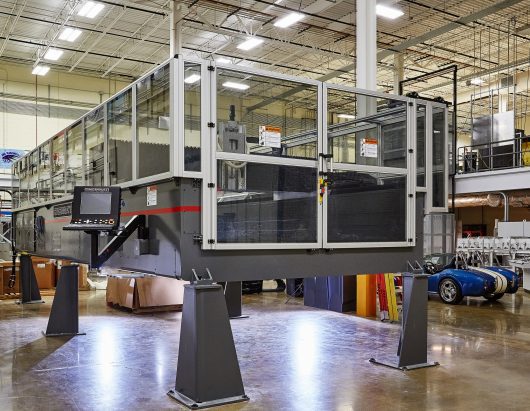
A California-based non-profit organization, New Story, wants to sponsor printing-improved homes in El Salvador — Central America’s smallest and most population-dense nation. New Story has also partnered with the company ICON, an Austin, Texas construction technology company, to remedy housing shortages in El Salvador through ICON’s industrial Vulcan 3D printer.
At this year’s South by Southwest festival in Austin, ICON debuted its cement, single-story, 650-square-foot prototype home, a 3D rendering from the Vulcan printer. ICON claims it can erect such a home for $10,000 and in less than 24 hours time. The model is sleek with white concrete and features a living room, bedroom, bathroom and arched porch.
New Story aims to build 100 3D printed homes in El Salvador by 2019, compounding its previous accomplishments in the building of over 700 traditionally constructed homes in Bolivia, El Salvador, and Haiti; the corporation also built 1,300 worldwide.
Revitalizing Slums
ICON maintains it can trim 3D-printed building costs down to $4,000 and that its Vulcan printer can make a home as large as 800-square-feet. 3D printed homes are considered far more cost effective than the typical home. In El Salvador, a nation of over 6 million people, 35 percent of the population lives below the poverty line. Housing shortages are said to affect 944,000 families, amounting to 6 out of 10 families with insufficient housing.
And as 68 percent of El Salvadorians lived in urban areas in 2017, latest estimates from 2005 show 29 percent of El Salvador’s urban population lived in slum housing. Slum dwelling is defined as a group of people under the same roof without improved water and sanitation, durable housing or all of the above.
Preventing Natural Disasters
El Salvador’s geography leaves its buildings’ integrity exceptionally susceptible to natural hazards such as earthquakes, hurricanes, floods and volcanic eruptions. It is precariously situated along the Pacific Ring of Fire, a global seismic belt where 81 percent of the world’s earthquakes occur.
Ninety-five percent of El Salvadorians are said to be at risk of a natural disaster. In November 2009, Hurricane Ida displaced 15,000 people and damaged no less than 2,500 homes. New Story is currently fundraising $600,000 for research and development and another $400,000 for the community of 100 3D printed homes in El Salvador.
3D printed homes and building materials originated in Europe. A Dutch company, Dus Architects, built one of the first prototypes, — a small pavilion structure — in Amsterdam in March 2014. In September 2014, Chinese company, WinSun Decoration Design Engineering, used their custom 3D printer to create 10 homes with a cement blend of construction waste and glass fiber. This material incorporation lent more efficient material use to an already eco-friendly production.
3D Printing Around the Globe
The first inhabitable 3D printed home was recently erected in Nantes, France in April 2018 and tenancy is expected this June. The University of Nantes and the Nantes Digital Sciences Laboratory developed the five-bedroom home and a machine called the Batiprint3D built its frame in 18 days.
3D printing has also been proposed by the U.K.-based Oxfam, a confederation of 20 charitable organizations, to aid disaster relief by reproducing its water, sanitation and hygiene kits. Oxfam and non-profit 3D printing company, Field Ready, provided medical instruments and water pipe fittings in response to Nepal’s 2015 earthquake that claimed the lives of 9,000 people and injured 16,800.
There are several predecessors that have used, or plan to use, 3D printing for home construction and humanitarian efforts. But New Story and ICON lead the way with their campaigns to actualize proposals, print homes and alleviate homelessness and unsafe housing without for-profit interest.
Home is Where the Hard-drive Is
According to the United Nations, over one billion people worldwide live in slum housing — ramshackle homes fortified with scrap metal and founded on unfinished or dirt flooring.
New Story wants to transform slums worldwide into safe living communities; to that end, El Salvador stands to benefit first ahead of the rest of international community with the advent of livable 3D printed homes and requisite funding. All donations to New Story are matched up to $1 million.
– Thomas Benjamin
Photo: Flickr

Home is Where the Hard Drive Is: 3D Printed Homes in El Salvador
Poverty is a condition in which income is not enough to afford access to necessary goods, services and infrastructure needed to sustain a quality living standard. Securing and maintaining the means to satisfy adequate nutrition, healthcare, shelter, clothing and other humane safety provisions requires significant funds.
Past Printing
Imagine post-World War I Germany in the 1920s. To fund its military during the war and satisfy reparations thereafter to the Allied nations, the German government’s solution to producing more national income was simple — it commissioned 130 printing companies to print more money.
This, however, gave rise to increasing inflation in which their currency, the German mark, unsupported by a gold standard, became virtually worthless. With every printing press, creating more money became perpetually futile, and the German mark was more useful for a child’s arts and crafts project than it was to purchase food and clothing.
A New Kind of Tech
Less than a century later, technology and three-dimensional (3D) printing has allowed us to not only print currency with regular modifications (so as to prevent counterfeit bills), but to also print the very goods and supplies purchasable with said currency.
Three-dimensional printing employs the use of specialized technology called “additive manufacturing” — computer aided design and modeling software produce a virtual rendering of just about any three-dimensional object.
A 3D printer then reads a data file and melts raw material, such as plastic, metals and concrete, and with laser technology deposits that material through a nozzle. Layer upon layer, the virtual model forms the tactile facsimile.
New Story
A California-based non-profit organization, New Story, wants to sponsor printing-improved homes in El Salvador — Central America’s smallest and most population-dense nation. New Story has also partnered with the company ICON, an Austin, Texas construction technology company, to remedy housing shortages in El Salvador through ICON’s industrial Vulcan 3D printer.
At this year’s South by Southwest festival in Austin, ICON debuted its cement, single-story, 650-square-foot prototype home, a 3D rendering from the Vulcan printer. ICON claims it can erect such a home for $10,000 and in less than 24 hours time. The model is sleek with white concrete and features a living room, bedroom, bathroom and arched porch.
New Story aims to build 100 3D printed homes in El Salvador by 2019, compounding its previous accomplishments in the building of over 700 traditionally constructed homes in Bolivia, El Salvador, and Haiti; the corporation also built 1,300 worldwide.
Revitalizing Slums
ICON maintains it can trim 3D-printed building costs down to $4,000 and that its Vulcan printer can make a home as large as 800-square-feet. 3D printed homes are considered far more cost effective than the typical home. In El Salvador, a nation of over 6 million people, 35 percent of the population lives below the poverty line. Housing shortages are said to affect 944,000 families, amounting to 6 out of 10 families with insufficient housing.
And as 68 percent of El Salvadorians lived in urban areas in 2017, latest estimates from 2005 show 29 percent of El Salvador’s urban population lived in slum housing. Slum dwelling is defined as a group of people under the same roof without improved water and sanitation, durable housing or all of the above.
Preventing Natural Disasters
El Salvador’s geography leaves its buildings’ integrity exceptionally susceptible to natural hazards such as earthquakes, hurricanes, floods and volcanic eruptions. It is precariously situated along the Pacific Ring of Fire, a global seismic belt where 81 percent of the world’s earthquakes occur.
Ninety-five percent of El Salvadorians are said to be at risk of a natural disaster. In November 2009, Hurricane Ida displaced 15,000 people and damaged no less than 2,500 homes. New Story is currently fundraising $600,000 for research and development and another $400,000 for the community of 100 3D printed homes in El Salvador.
3D printed homes and building materials originated in Europe. A Dutch company, Dus Architects, built one of the first prototypes, — a small pavilion structure — in Amsterdam in March 2014. In September 2014, Chinese company, WinSun Decoration Design Engineering, used their custom 3D printer to create 10 homes with a cement blend of construction waste and glass fiber. This material incorporation lent more efficient material use to an already eco-friendly production.
3D Printing Around the Globe
The first inhabitable 3D printed home was recently erected in Nantes, France in April 2018 and tenancy is expected this June. The University of Nantes and the Nantes Digital Sciences Laboratory developed the five-bedroom home and a machine called the Batiprint3D built its frame in 18 days.
3D printing has also been proposed by the U.K.-based Oxfam, a confederation of 20 charitable organizations, to aid disaster relief by reproducing its water, sanitation and hygiene kits. Oxfam and non-profit 3D printing company, Field Ready, provided medical instruments and water pipe fittings in response to Nepal’s 2015 earthquake that claimed the lives of 9,000 people and injured 16,800.
There are several predecessors that have used, or plan to use, 3D printing for home construction and humanitarian efforts. But New Story and ICON lead the way with their campaigns to actualize proposals, print homes and alleviate homelessness and unsafe housing without for-profit interest.
Home is Where the Hard-drive Is
According to the United Nations, over one billion people worldwide live in slum housing — ramshackle homes fortified with scrap metal and founded on unfinished or dirt flooring.
New Story wants to transform slums worldwide into safe living communities; to that end, El Salvador stands to benefit first ahead of the rest of international community with the advent of livable 3D printed homes and requisite funding. All donations to New Story are matched up to $1 million.
– Thomas Benjamin
Photo: Flickr
Strengthening the Democratic Governance in Libya
There has been a battle over national governance in Libya ever since the dismantling of the Muammar Gaddafi authoritarian regime in the 2011 Arab Spring. A majority of Libyans are hopeful for a unified democratic governance in Libya; unfortunately, the Fragile State Index has listed Libya in the top 25 most fragile states in the world.
Political History in Libya
Dr. Federica Saini Fasanotti, a fellow at the Brookings Institution, described that “Libya has never been (truly) unified.” In a conversation on October 6, 2017 at the Center for Strategic and International Studies (CSIS) headquarters, Dr. Fasanotti described the historical significance of conflicts and changes of power in relation to rule of law in Libya.
Throughout the history of Libya, the state had many different rulers, contributing to the divided government. Up until 1911, the country was an autonomous territory under the rule of the Ottoman Empire. After 1911, Libya was controlled by the Italians in the western world’s quest for colonies. Then, in 1951, the Allied powers of World War II granted Libya independence, and the state created a federal constitution and monarchy; in 1969, Muammar Gaddafi led a coup d’état of the monarch.
Local, Regional and Strategic Issues
Dr. Fasanotti described the three fundamental issues to democratic governance in Libya. The local issue is the many internal divisions caused by the history of political upheavals and usage of tactics like Gaddafi’s ‘divide and rule’ concept — a tactic where different ethnicities and tribes are pitted against one another. The regional issue is the absence of current leadership to direct the country on the path of democratic governance. The strategic issue is the presence of terrorism, troublesome migration patterns and economic beneficial resources.
Alice Hunt Friend, a Senior Fellow with the International Security Program at the CSIS, stated,“It is very hard to take these complex, contingent situations and hundreds of years of history and translate it into prescriptive policies.”
Civil Society Formation by USAID
The United States Agency for International Development (USAID) supports the project of Libya Elections and Governance Support Program to create effective practices for sub-national governance. The duration of the program is from October 2012 to September 2019.
The goal of creating municipal governments in Libya has served as an attempt to fill the national governance void. In the southern desert city of Sabha, the USAID assisted in the formation of a community center to provide the citizens the opportunity to engage in the decision-making process.
Uniting Communities
The community center attempts to create partnerships between people of different ethnicities and tribes to form ideas out of mutual interest. The additional partnership between local leaders and citizens assists in creating transparency and credibility with the government.
To have local municipalities work together to create a stable national government — like the community center in Sabha — is the goal of the civil society formation by the USAID; local authorities’ soft power has extremely high value.
Democratic governance in Libya has a formulation in municipalities and initiatives at the local level that once implemented, can reach national proportions.
– Andrea Quade
Photo: Flickr
Microentrepreneurship and Women Entrepreneurs Are Alleviating Poverty in India
Small-scale enterprises have been a large part of industrialization as well as job creation in India. As defined by the Micro, Small and Medium Enterprises Development (MSMED) Act of 2006, a microenterprise in India is a small business in which the investment in plant and machinery is no more than $ 40,000. Microentrepreneurship and women entrepreneurs are alleviating poverty in India, particularly because up until the past couple of decades women were a largely untapped source of economic potential.
Women Entrepreneurs in India
The Government of India has defined women entrepreneurs as those whose enterprise has a minimum financial interest of 51 percent of the capital and is made up of at least 51 percent female workers. Although rural women in India are mainly responsible for agricultural production, domestic duties and childcare, their economic status is low in a male-dominated society. Women in India have been able to raise their economic status and fight poverty in their country by taking charge of microenterprises.
Increasing the participation of women in micro, small and medium enterprises is an important stepping stone to alleviating poverty in India because not only does it engage women in productive work outside their homes, but it also empowers them and improves family health. In addition, women entrepreneurs can provide society with different management, organization and business solutions because of their different perspectives and skills.
Self-Help Groups (SHGs)
One major resource for women entrepreneurs in India are the Self-Help groups (SHGs) provided by the Government of Bihar and supported by the World Bank. These groups are part of what is known as “Jeevika”, the Bihar Rural Livelihoods Project. (“Jeevika” means “livelihood” in Hindi.)
SHGs provide skills training, access to markets and finance as well as business development services. There are 45 million rural women in India who have been empowered by these SHGs under the National Rural Livelihoods Mission (NRLM) in 2011. The NRLM has saved $ 1.4 billion, leveraged $ 20 billion from commercial banks and is helping nearly 3.3 million women farmers increase agriculture and livestock productivity. Here are some success stories that, with the help of such programs, show how women entrepreneurs are alleviating poverty:
Future of Microenterprises
Women have, therefore, been able to use household skills to knit, stitch, weave and embroider for developing their microenterprises. They have also been able to use their technical skills and raw farm materials to earn substantial incomes and small agricultural units.
In conclusion, one reason the future of economic growth in India looks bright is that women entrepreneurs are alleviating poverty with their growing microenterprises. That is to say, the empowerment of women in India goes hand-in-hand with the auspicious development of microenterprises.
– Connie Loo
Photo: Flickr
How the Media Misrepresents Brazil
Brazil is a big country and within all its expanse the number of slums, known as favelas, is also large. In 2010, the Brazilian Institute of Geography and Statistics revealed a count of 15,688 slums with 11.4 million residents (this study is done every decade). The low-income, crowded areas are often featured in articles from all around the world. However, most of the press coverage on favelas focuses on sensational aspects such as violence, crime and drug trafficking—this illustrates how the media misrepresents Brazil.
Media Misrepresents Brazil
An article from NBC News, for example, lists five facts about favelas painting a picture of it based on wrongdoing, poverty and danger. The piece defines a slum as “a hotbed for crime and drugs.” Similarly, one of the articles published by The Guardian describes a favela as a place for “guns, drugs and Bandidos.”
Articles are not the only example of how the media misrepresents Brazil. TV news (including those on Brazilian channels), movies and Brazilian soap operas often reinforce favelas as dangerous places. “People create a narrative where favelas are a territory of barbarism and don’t have any contact with the outside world. It’s an idealization of a place where only terror thrives,” writes the researcher Felipe Botelho Corrêa about the Oscar-nominated movie, City of God, which is set in a favela in Rio de Janeiro.
Undeniably the violence rates in favelas are high. However, these pieces help perpetuate a stereotype of Brazil—an idea that slums are neighborhoods where there is only space for crime, violence and drug trafficking.
Initiatives Promoting Favelas
In fact, great initiatives take place in favelas as well. One of these is Favela Mais, a project created by Brazilian Service of Support for Micro and Small Enterprises (SEBRAE), that encourages entrepreneurship in favelas such as Heliópolis and Paraisópolis in São Paulo. “These businesses generate jobs and profit, helping the community to grow because the money stays in the neighborhood,” says Guilherme Afif Domingos, the president of SEBRAE.
The journalism school, Énóis, is another project that is trying to transform the reality in favelas. It was founded in 2009 in Capão Redondo, one of the most violent neighborhoods in São Paulo’s outskirts, by journalists Amanda Rahra and Nina Weingrill. Énóis started as onsite workshops and in 2014 it launched an online platform offering journalism courses. Currently, the school has 4,000 registered students, who have written more than 20 articles about life in favelas.
Besides these social initiatives, favelas are genuinely spaces of great cultural diversity and expression. They are the birthplace of many Brazilian artists and famous singers such as MV Bill, Tati Quebra Barraco, Carlinhos Brown and Anitta. Anitta started singing in a choir at a Catholic church located in an impoverished neighborhood in Rio de Janeiro. Currently, she is among 50 singers in the Social 50 Billboard ranking and earns up to $ 500,000 per show.
Media in Brazil: The Way Forward
Agência de Notícias das Favelas, a news agency focused on events happening in favelas, is trying to shift how the media represents Brazil. The organization is helping break the stereotype of slums as places associated with criminality and violence. On its website, the agency is defined as “an NGO that wants to expand the struggle to democratize favela’s information to the world, with its own residents as protagonists.”
Initiatives like these destigmatize favelas and help with its social and economic growth. The traditional media should give these stories more attention. Only then will favelas be fairly represented as the creative and inspirational places they are.
– Júlia Ledur
Photo: Flickr
How the US Benefits from Foreign Aid to Malaysia
Last year, President Donald Trump proposed to cut U.S. foreign aid, offering even less money to go towards helping other countries. Any cuts to aid would have a major impact on recipient countries, considering that only about 1 percent of the United States’s federal budget goes to foreign aid. When discussing how much or how little the U.S. should be giving to help other countries, the question is often raised of how the U.S. benefits from foreign aid.
There are a few overall benefits that the U.S. receives when giving foreign aid to countries, such as promoting democracy and good governance, providing access to clean water, improving learning environments and helping end maternal and child mortality. The U.S. has a planned foreign assistance budget of $2 million for Malaysia in 2019. What are the U.S. benefits from foreign aid to Malaysia specifically?
A focus of the Department of State’s relations with Malaysia is promoting peace and security. Within Malaysia specifically, the U.S. hopes to strengthen cooperation on law enforcement, nonproliferation, counterterrorism, rule of law and expand military ties. The U.S. benefits from foreign aid to Malaysia by helping to strengthen regional and global institutions, creating better allies in Malaysia. David Miliband, president of the International Rescue Committee, remarked that global terrorist threats such as ISIS “grow out of poverty, instability and bad governance”. In giving foreign aid to countries like Malaysia, the U.S. benefits by combating major terrorist threats before they can even form, along with creating allies if and when terrorism does develop.
The U.S. Benefits from Foreign Aid to Malaysia Through Unique Manufacturing Partnership
Along with creating strong allies to fight against terrorism, the U.S. benefits from foreign aid to Malaysia as a partner in manufacturing. By promoting economic development through aid, Malaysia can further develop its production services, which provide many advantages and savings for American companies.
In a recent interview, vice president of global electronics company Flextronics Mark Shandley noted that many of the company’s customers felt more comfortable manufacturing their products in Malaysia than in other countries such as China. Shandley noted that this may be because of the “perception of intellectual protection” found in Malaysia, which is notably missing in China. Along with this, he noted that it could be more cost-effective to manufacture in Malaysia. China has a value-added tax, which is charged to non-Chinese companies and can be as high as 4 percent. However, Shandley notes that this is noticeably missing from Malaysia, resulting in lower production costs.
The U.S. benefits from foreign aid to Malaysia by forming close ties between the two countries’ militaries and in the production of goods. U.S. foreign aid helps create partnership diplomatically and helps spread democracy within the country. This, in turn, helps create allies when needed and helps lessen the birth and spread of terrorist groups. Along with this, the U.S. can develop a strong production partnership that may be even more beneficial than the already existing alliance with China. All of these benefits reinforce the advantages of continued foreign aid, in Malaysia and all over the world.
– Marissa Wandzel
Photo: Flickr
10 Facts About Poverty in Shanghai Everyone Should Know
Shanghai sits on China’s central coast and is becoming a wildly popular tourist destination for visiting foreigners as well as Chinese nationals. With an amazing city skyline, incredible subway transportation and popular nightlife, it can be hard to imagine or see those living in poverty beneath the glamour. Here are 10 facts about poverty in Shanghai that are important to remember.
10 Facts About Poverty in Shanghai:
The World Bank defines poverty as those living on less than $1.90 per day, and by those standards, China has eradicated all urban poverty. China’s ability to lift its citizens out of poverty is unprecedented but as great as this is, keeping an eye on the middle class will be important for economic health.
Most concern for poverty is for those in the countryside, as people leave for the cities due to a lack of available jobs. The Chinese government’s goal is to eradicate poverty in all of China by 2020 and it has started this process by creating social reforms and looking at its redistributive policies.
These ten facts about poverty in Shanghai would be incomplete without the mention of the growing middle class. It is estimated that the middle class will grow to 75 percent of the population by 2022 and as of 2013 the average Shanghai family’s disposable income was ¥48,841 a year.
Some may see the wealth of Disneyland and compare it to the poverty in the villages nearby. However, it looks as if Disneyland take part in the place to eradicate poverty. Disneyland has helped create infrastructure for rural places by bringing subway lines and freeways to the Pudong district as well as creating jobs for those in northern Shanghai.
Small homes built from a past and poorer era are being torn down and residents are being encouraged to relocate. Relocated citizens are given a monthly housing stipend by the government, which unfortunately is not always enough for the interim of the construction.
Wealth seems to be rising as from 2000 to 2008 luxury home construction saw an increase by ten versus smaller homes decreasing by 60 percent. While this has occurred naturally in the past, there is a new focus on building new homes and forcing relocation.
Approximately 39 percent of Shanghai’s residents are estimated to be long-term migrant workers. Migrant workers are people who have moved from more rural communities into the cities looking for work. Their income is unsure as is their housing and many migrant workers are susceptible to poverty.
The Chinese government is causing a migration reversal with the end goal of eradicating poverty. The government is forcing migrant workers out of the city and back to their hometowns by shutting down businesses and houses based on health coeds. Some feel it is unfair to have this forced lifestyle imposed on them, while others think this process would have occurred naturally because the cities are becoming too expensive.
Part of the migration reversal is a focus on urbanization–turning China into various urban centers. The government is becoming more focused on creating government-subsidized homes for those in rural areas. This relocation is estimated to see of 9.8 million people moved across China from 2016 to 2020.
These 10 facts about poverty in Shanghai all come down to growth and disparity. There is still a huge disparity between wealth and poverty, luxury and necessities, opulence and simplicity, but things are improving. While the methods may not be agreed upon, Shanghai is a beacon for the changing China.
– Natasha Komen
Flickr
New Developments in the Healthcare Sector of Timor-Leste
Timor-Leste is a young country, and has been facing many difficulties since its independence. One of these difficulties is trying to improve the currently underdeveloped healthcare sector of Timor-Leste.
Timor-Leste’s History of Instability
Timor-Leste only officially became a sovereign nation on May 20, 2002. This came after years of violence and turmoil that led to much of the infrastructure in the nation being destroyed. With the destruction of this infrastructure, along with the casualties caused by the violence, many citizens of Timor-Leste were left unemployed and living in poverty. Another result of this violence was the sudden decline in healthcare professionals. Many of the nation’s doctors and specialists left the country during this time, leaving the healthcare sector of Timor-Leste unable to adequately care for all of its citizens.
This combination of poverty and lack of healthcare professionals has been problematic in Timor-Leste in recent decades. In 2017, 41.8 percent of the population of Timor-Leste was living below the poverty line, and as a result of this poverty, many individuals do not have the means to travel long distances when seeking medical attention. Due to the lack of healthcare professionals, clinics and hospitals are not easily accessible to all parts of the nation. Because of this, many individuals cannot get treatment for illnesses that would otherwise be preventable, and this leads to an increased spread of disease.
Improving the Healthcare Sector of Timor-Leste
The government of Timor-Leste has recognized this problem and is taking steps to improve the healthcare sector of Timor-Leste. The government created a Strategic Development Plan that it aims to complete by 2030, which details how it intends to improve the health system for the citizens of Timor-Leste. The three areas that it identifies as needing improvement are health services delivery, human resources for health and health infrastructure.
Part of the government’s plan to improve health services is to increase the number of health facilities in Timor-Leste. By 2030, Timor-Leste intends to have enough health centers to service the entire nation and to have each center equipped with the professionals needed to properly run it.
In addition to the government of Timor-Leste recognizing the importance of improving the healthcare sector of Timor-Leste, independent organizations in the nation are also working towards achieving a healthier Timor-Leste. The Jesuit mission in Timor-Leste opened the Centro de Saúde Daniel Ornelas health center in September of 2017. This health center will provide medical services to the students and staff of Colégio de Santo Inácio de Loiola and Instituto São João de Brito, as well as the local community of Ulmera and the greater Liquiçá district. The citizens in these areas did not have sufficient access to healthcare facilities in the past, and the opening of this health center will help to meet this need.
The healthcare sector of Timor-Leste is still recovering from the turmoil that the nation experienced while gaining its sovereignty, but it can be seen that Timor-Leste is not a nation doomed to survive without sufficient access to health services for its citizens forever. Between the commitment that the government of Timor-Leste has made to improving the health of its citizens, and groups such as the Jesuits in Timor-Leste working to improve the health of their own community, a healthier Timor-Leste is well on its way.
– Nicole Stout
Photo: U.S. Air Force
The Benefits of Literacy: Five Ways Literacy Fights Poverty
It seems an obvious statement to suggest that reading and writing can improve one’s life. Is it as obvious, however, that if everyone could read and write, 171 million people would be lifted out of poverty? These taken-for-granted, simple skills have the power to change our world. Literacy fights poverty in often unheralded ways and the effects of literacy reach beyond the walls of any classroom.
The Economy of Literacy
An economy’s success lies in the spending power of its people. This comes only through more opportunities, more developed skills, better employment and higher salaries.
Employment creation has proven to be the most effective tool in poverty reduction and better employment only comes through better education. In fact, on average, one year of education is estimated to increase wage earnings by 10 percent, and in places like sub-Saharan Africa, by as much as 13 percent.
The numbers are clear. While literacy fights poverty and helps to stabilize the economies of developing nations, illiteracy costs the world about $1.19 trillion every year.
Literacy and Health
Literacy fights poverty in the healthcare arena as well. Being literate helps people better understand health concerns and better educate themselves when it comes to healthcare. This is especially important in developing countries, where disease can dictate a cycle of poverty. The statistics linking literacy and generational health provide clarity:
Literacy Empowers
Inequality, specifically gender inequality, stifles economies and prevents generational growth. Two-thirds of the illiterate population of the world are women. It is no surprise, given the destructive social dynamics of so many underdeveloped nations, that every year 15 million girls under the age of 18 are married. Often, these girls see this as their only option when they cannot afford a good education.
Educated women become empowered and take control of their own lives. Education fosters personal autonomy and creative and critical thinking skills, which provide a wider economy and community. According to the World Bank, better-educated women tend to be healthier, have fewer children and marry later in life.
Resilience and Community
Literacy fights poverty through the power of the possible. Without literacy, a lack of choices commits millions to a prison of doubt. Reading and writing have been proven to increase self-confidence, help make informed decisions and provide new job prospects.
Additionally, literacy provides distractions and new pathways away from the prospects of crime or child soldiery. In fact, literacy makes it 50 percent less likely that people will commit robbery or murder.
Overcoming obstacles of this magnitude takes an enormous amount of resiliency. Education provides the will-power to build it up. In a world where 123 million 15- to 24-year-olds cannot read, the need for literacy has never been more apparent.
The End of a Cycle: Literacy Fights Poverty
According to the United Nation’s Global Education Monitoring Report, new evidence suggests that increasing the years of schooling among adults by two years would help lift nearly 60 million people out of poverty. If ending poverty is the ultimate goal, it may well be that literacy is a starting point. Literacy allows other development goals to happen.
Literacy creates opportunities for people to develop skills to provide for themselves and their family, while at the same time positively impacting each generation through raised expectations and increased self-esteem. Literacy fights poverty much like the feet of a duck fight against the water beneath it. Though it may not always be seen, much work lies below the surface.
– Daniel Staesser
Photo: Flickr
Alipay a Model for the Gamification of Philanthropy
Alipay, China’s largest third-party online payment platform, has reshaped the landscape of payment services in China for the last decade. At present, Alipay has a user base of 520 million people, handles more than 170 million transactions per day and accounts for more than two-thirds of mobile payments in China.
Credit card use only has about 400 million patrons. Alipay rules China’s mobile payment market with absolute authority. A Forbes article claims that “cash really is becoming a thing of the past” because a “smartphone (with Alipay) will do nicely”.
Such immense popularity of the platform opened the door to the utilization of its unprecedented user-engagement for social good. Ant Farm came into being, representing the balance between marketing strategy and fulfillment of social responsibility.
Ant Farm is a pre-installed online game program inside the Alipay mobile phone application, in which users keep a virtual chicken as a pet. Through daily payments via Alipay users can feed their chicken and collect hearts to be donated to charity projects.
The parent company of Alipay and Ant Farm, Ant Financial, is working closely with governmental offices like Jiangsu Sihong Poverty Alleviation Office and more than 1,200 charity organizations. According its 2016 Corporate Social Responsibility Report, Ant Financial’s philanthropy platform has raised more than $140 million for the services provided to its partner nonprofits.
On top of the basic construct, developers have added many interactive mechanisms to boost Ant Farm’s participation. For example, playing with the pet chicken can also generate hearts and users can interact with their friends’ farms. Eventually, more and more users are engaged, funding more and more philanthropic projects.
Ant Farm is a successful model of the gamification of philanthropy, attracting hundreds of thousands of people to take part in charity projects, which is much more efficient and larger in scale than traditional models of philanthropic fundraising like donation boxes. In addition, by implementing the basic elements of an online game, Ant Farm has more charm than other heavy-hearted fundraising strategies.
Other companies have also engaged in social projects through gamification of philanthropy. Tencent, one of China’s internet and technology giants, has also cooperated with nonprofits working to provide education for left-behind children in impoverished regions by creating donation venues in its online games. In certain Tencent games, users can donate their equipment in exchange for reward or recognition.
Tencent Foundation chairman Guo Kaitian believes that with the help of online platforms like Ant Farm, “charity is now everywhere around us, and it is now the life attitude with innovation and participation”.
– Chaorong Wang
Photo: Flickr
Developing Education in Niger
Niger is one of the least developed countries in the world, ranking last out of 187 countries on the Human Development Index. Education in Niger is affected by the country’s struggling economy.
With a gross national income of just $641 per capita, roughly 60 percent of Niger‘s population lives under the poverty line. One of the many causes for the country’s poverty is a high birth rate. As more children are born, more food is needed, but as more food is needed the area of arable land shrinks. Food becomes a daily difficulty for families and other necessities are overshadowed, including education.
Education in Niger
Niger’s population is 70 percent illiterate and the average length of time a student is enrolled in a school is only one year. Fortunately, this situation has not been overlooked as the Nigerien government and other global organizations have come to the table with several programs and other plans to address this issue.
The Nigerien government has partnered its own Niger Threshold Program with the Millennium Challenge Corporation to reduce corruption, promote land titling, register more businesses and improve girls’ educational outcomes.
This cooperation led to the involvement of the U.S. Agency for International Development and the development of the Niger Education and Community Strengthening (NECS) program. The goal of this program is to improve educational opportunities for children while fostering links between the state and local communities. NECS is to be implanted in 150 villages across the seven regions of Niger.
Planning for Improvement
The government has also implemented an education and training sector plan that began in 2014 and will go through 2024. The plan outlines the priorities for education in Niger:
Accessibility for Children
Children are still more often forced to work rather than attend school. This is especially true during harvest periods and in the northern regions of the country where nomadic children have no access to school at all. To further increase literacy and education in Niger, schooling has been made compulsory for children seven to 15 years of age. However, attendance rates remain low, particularly for girls.
There are no complete and detailed statistics that showcase the number of schools, colleges, universities, teachers and students in the country. However, this data is not necessary to understand that education in Niger is still fundamentally lacking. Through the prudent programs and priorities of the Nigerien government, and from the help of global partners, education in Niger is certainly on its way to development.
– Aaron Stein
Photo: Flickr