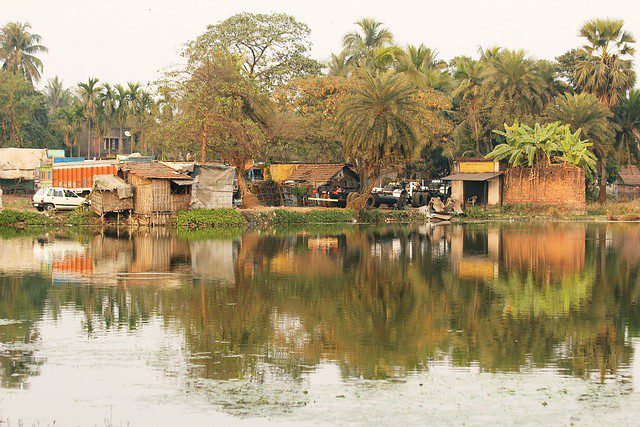
 In 2017, the people in Mumbai, India saw something strange happening with the stray dogs of the city. The dogs all seemed to be turning a light blue color. People reported to the Maharashtra Pollution Control Board that a company in the Taloja Industry area was dumping indigo dye, which was primarily used by that company, in the local Kasadi river. The dogs were hunting for food in the area and, consequently, their fur was turned blue. Authorities quickly shut down the factory to prevent more dye from entering the river, but the question remained about how toxic this dye is not only to the animals but the locals as well? With the long history of indigo dye and India, why has this only recently become a problem?
Indigo Dye in India
Indigo is a natural dye, but unlike most natural dyes, indigo dye penetrates clothes directly when heated. Indigo dye and India are correlated because the country had been using it naturally for centuries. Now, however, most factories use a chemical agent called mordant to increase the number of clothes produced in less time. Mordants can be just acidic, not necessarily toxic, but most companies choose to use mordant with aluminum and chromium. Both of these can cause great damage to the ecosystem. Factory wastewater can poison rivers, killing plants, animals and poisoning drinking water for the people of India.
Even without mordants, natural indigo dye is not great for the environment either. It is slow to decompose and darkens river water, so flora and fauna starve from lack of sunlight. That is why the dogs of Mumbai turned blue upon entering the river. The best approach to preventing toxic dyes from entering and poisoning the rivers is prevention and filtration. If factories used local plants for dyes, that would help filtration. Prevention is tricky. Scientist Juan Hinestroza is working on using nanotechnology to apply dye directly to cloth fibers. If this is successful, it would make toxic dyes and mordants obsolete.
Water Pollution
Groundwater, rivers and streams are being severely affected by this fashionable color. With such a high demand for cheap clothes in indigo, like denim jeans, factories and workshops find cheap, quick ways to produce products at high volumes. Tirupur, India is home to many factories specifically used for making and dyeing clothes. These factories have been dumping the wastewater from production into rivers in the area. Despite tougher regulations, they continue the process, rendering local and groundwater undrinkable.
With dying waters and a rising population, India is struggling to clean up its rivers. The fight is far from over, and people have turned to the government for an answer. Activists are heading to court to get municipalities and states to rise and take action. They started with one demand for the restoration for the Mithi river, a river polluted with dye, paint and engine oil. Citizens started legal petitions then gathered volunteers to get other rivers in the area cleaned up. After a terrible flood in 2005, dams were built to reduce overflow, which was helpful because the rivers are now split it in two.
Back To Nature
India is one of the few countries that produce indigo and denim clothes at high volumes, so the ways of naturally applying indigo to clothing is a long lost art. However, one designer is working to change that. Payal Jain, a fashion designer in India, is bringing back the natural ways of getting indigo straight from the plant and onto the clothes. Using mud and intricate wood carvings, artisans use this method to print the color directly to the fabric. Bringing back traditional ways of dying could relieve the environment from toxic, synthetic dyes.
Blue dogs appearing in the streets, poisoned rivers and groundwater, crops dying and limited access to clean drinking water are all direct results of indigo dye waste being dumped into the rivers. As long as factories continue to dump dye waste into rivers, this problem will persist. The citizens of India are coming together to clear the neglected rivers and push for tougher regulations on clothing factories. With the government’s support and the use of new scientific methods to dye clothing, Indigo dye in India could remain popular without being dangerous.
–
Kayla Cammarota
Photo: Flickr
Causes of Human Trafficking in Africa
A theft of human life and an exchange of money for someone’s dignity: this is what makes up the horrific crime of human trafficking. Human trafficking is an ever-present issue across the globe, and the number of victims the number of victims rises each year. While there are countless contributing factors, the causes of human trafficking in Africa are particularly alarming.
Human trafficking is a prevalent issue in Africa, where law enforcement agencies often lack resources that are readily available in other countries. This results in police officers with less training and funding and makes it difficult for police to properly execute in cross-border intelligence causing a larger amount of human trafficking.
More than 800,000 people are trafficked across international borders annually and many victims of human trafficking migrants are from Somalia and Eritrea which means that international communication is crucial. One of the causes of human trafficking in Africa can be linked to law enforcement that lacks the training to cooperate with neighboring countries in order to prevent and interrupt this crime.
Human traffickers often seek the most vulnerable populations. In South Africa, an estimated 30,000 children are trafficked each year. Furthermore, in countries like Kenya, Zimbabwe and Ghana, girls as young as eight years old are sold as brides.
Immigrants that are attempting to reach Europe, the Middle East and Italy are often left vulnerable. In 2016, of 11,000 women arriving in Italy in search of a better life, 80 percent were from Nigeria, and many will likely be forced into prostitution and become sex trafficking victims.
However, there is also progress being made to combat this crime. Technology is quickly advancing and in Nigeria, it is being used to stop trafficking. In 2003, a Nigerian app called ‘iReport’ launched, allowing people to report human trafficking across the country. To date, iReport has secured 359 cases.
Kenya has also taken strides in efforts to resist and combat human trafficking. In 2014, Victim Protection Bill was passed, helping to provide support to victims and increasing convictions by building a stronger prosecution case. Since many victims are terrified of their attackers, this bill provides safety for those that want to prosecute or come forward.
While the causes of human trafficking in Africa are complex, there is clear progress being made to address them. Nations are constantly developing new solutions to combat human trafficking and support victims of these crimes.
– Emme Chadwick
Photo: Flickr
Period Poverty Is A Worldwide Struggle
Period Poverty Is Everywhere
In developed countries, the greatest challenge is fighting the stigma and taxes that accompany what should be a basic healthcare product. The European Union’s five percent tax on sanitary products, known as the ‘tampon tax’, is one of the biggest indicators that something has to change, with 1 in every 10 girls currently unable to afford sanitary products. A nationwide study done in the U.K. showed that over 137,000 girls skipped school regularly due to period poverty. Until 2018, U.S. federal prisons were charging for feminine products. New laws are being passed mandating that menstrual products be provided in public settings, showing change on the horizon but there is still a long way to go.
While women in the U.S. and Europe are fighting stigma, unfair taxes and unequal treatment in regard to period poverty, in underdeveloped countries the situation is even worse. Women and girls in poor countries struggle to gain access to sanitary products on a regular basis.
A study conducted in Uganda showed that close to two-thirds of girls missed at least one day of school each year due to period poverty. In addition to supplies being a commodity, the stigma women face in certain countries borders on taboo. Some cultures believe that those who are menstruating are considered ‘unclean’ or ‘bad luck’, leading to ostracizing and ridiculing these women and girls. In certain regions of Nepal, girls are banished to ‘menstrual huts’ where they must remain shunned until their cycle has ended.
Negative Effects of Living in Period Poverty
Women and girls living in period poverty suffer from more than just embarrassment and societal stigma. In addition to girls missing school, there are physical repercussions to not having sanitary supplies as well. According to the U.N. International Children’s Emergency Fund (UNICEF), poor menstrual hygiene can lead to reproductive disorders, urinary tract infections and urogenital diseases, and the risk for infections in those living in period poverty is much higher than those who aren’t.
Fighting Period Poverty
Organizations such as PERIOD, Freedom4Girls and HappyPeriod are working to address the stigma behind menstrual products and to end period poverty through advocating, educating and serving girls across the U.S. Founded by women who understand what it’s like to live in period poverty, these companies are committed to fighting for girls around the world. By providing sanitary products and supplies, they are allowing young girls and women to continue education and lead their lives unaltered by this natural biological occurrence.
Despite being a natural biological occurrence shrouded by stigma for hundreds of years, period poverty is finally coming to the forefront of the public’s concern. It is demonstrating itself to be a worldwide issue that does not discriminate amongst class or culture. PERIOD founder Nadya Okamoto describes the importance of this issue perfectly, “If we invest in women’s empowerment as a key to global development, we need to unite around a universal menstrual movement to ensure that all women and girls are able to discover and reach their full potential.”
– Olivia Bendle
Photo: Flickr
How a Better Healthcare System in Angola Can Help Fight Overpopulation
The Republic of Angola is a large country in Central Africa with a continuously growing population of 31 million people. Angola is on the west coast of Sub-Saharan Africa and is one of the continent’s largest countries with 1.2 million square kilometers. As a comparison, it is a little less than twice the size of the state of Texas. With the current growth, Angola‘s population will triple in less than 50 years. This could pose a problem for the healthcare system in Angola as overpopulation is already becoming an issue.
Overpopulation
Angola has one of the world’s highest fertility rates as the average woman will have more than five children in her lifetime. However, the country also has the highest child mortality rate in the world with 187 per 1,000 live births. For those who do survive infancy, one in five children will die before reaching their fifth birthday. Angola ranks 23rd in the world due to its high maternal mortality rates with 477 deaths per 100,000 births.
But how exactly does the mortality rate result in overpopulation? It is all about the odds. Since one in five children on average die before they reach the age of five, families are more inclined to have more children so they have a higher chance to have at least one child reaching adulthood. A number of causes are responsible for the deaths in Angola. Among them are malaria, acute respiratory and diarrhoeal diseases, tetanus, malnutrition and more. More than just because of these initial causes, the mortality rate is so high due to the inadequate health system still being rebuilt.
A weak healthcare system
The healthcare system in Angola is split into two parts: private and public. A majority of the hospitals and clinics are close to the capital, Luanda, and very few are located in other parts of the country. Although treatment at the public level is free, the majority of the population is still limited when it comes to medical care. Due to the understaffed, underfunded and underprepared personnel, often times locals and visitors alike choose to receive treatment at the private level instead. While private clinics are considered to be better than public clinics, there is still much to improve. Pharmacies are mostly in the capital and are often extremely understocked. Hospitals will sometimes lack the necessary equipment or funds for important procedures. Angola also faces a significant shortage of physicians, with only 2,000 in the entire country.
By improving the healthcare system in Angola, the mortality rate would decrease enough to stabilize the fertility rates. Vaccines can heavily improve the current health of Angola’s population and prevent diseases from spreading. Currently, 929 health facilities out of 2409 perform routine vaccination activities. With access to sustainable clinics that provide vaccines throughout the country, the healthcare system in Angola would start to improve the lives of the citizens and lower the mortality rates.
Through strategic planning and patience, the healthcare system in Angola will be able to stabilize the current health status of its residents and help slow the overpopulation process in the country.
– Madeline Oden
Photo: Wikimedia Commons
Indigo Dye Is Affecting the Water Supply in India
Indigo Dye in India
Indigo is a natural dye, but unlike most natural dyes, indigo dye penetrates clothes directly when heated. Indigo dye and India are correlated because the country had been using it naturally for centuries. Now, however, most factories use a chemical agent called mordant to increase the number of clothes produced in less time. Mordants can be just acidic, not necessarily toxic, but most companies choose to use mordant with aluminum and chromium. Both of these can cause great damage to the ecosystem. Factory wastewater can poison rivers, killing plants, animals and poisoning drinking water for the people of India.
Even without mordants, natural indigo dye is not great for the environment either. It is slow to decompose and darkens river water, so flora and fauna starve from lack of sunlight. That is why the dogs of Mumbai turned blue upon entering the river. The best approach to preventing toxic dyes from entering and poisoning the rivers is prevention and filtration. If factories used local plants for dyes, that would help filtration. Prevention is tricky. Scientist Juan Hinestroza is working on using nanotechnology to apply dye directly to cloth fibers. If this is successful, it would make toxic dyes and mordants obsolete.
Water Pollution
Groundwater, rivers and streams are being severely affected by this fashionable color. With such a high demand for cheap clothes in indigo, like denim jeans, factories and workshops find cheap, quick ways to produce products at high volumes. Tirupur, India is home to many factories specifically used for making and dyeing clothes. These factories have been dumping the wastewater from production into rivers in the area. Despite tougher regulations, they continue the process, rendering local and groundwater undrinkable.
With dying waters and a rising population, India is struggling to clean up its rivers. The fight is far from over, and people have turned to the government for an answer. Activists are heading to court to get municipalities and states to rise and take action. They started with one demand for the restoration for the Mithi river, a river polluted with dye, paint and engine oil. Citizens started legal petitions then gathered volunteers to get other rivers in the area cleaned up. After a terrible flood in 2005, dams were built to reduce overflow, which was helpful because the rivers are now split it in two.
Back To Nature
India is one of the few countries that produce indigo and denim clothes at high volumes, so the ways of naturally applying indigo to clothing is a long lost art. However, one designer is working to change that. Payal Jain, a fashion designer in India, is bringing back the natural ways of getting indigo straight from the plant and onto the clothes. Using mud and intricate wood carvings, artisans use this method to print the color directly to the fabric. Bringing back traditional ways of dying could relieve the environment from toxic, synthetic dyes.
Blue dogs appearing in the streets, poisoned rivers and groundwater, crops dying and limited access to clean drinking water are all direct results of indigo dye waste being dumped into the rivers. As long as factories continue to dump dye waste into rivers, this problem will persist. The citizens of India are coming together to clear the neglected rivers and push for tougher regulations on clothing factories. With the government’s support and the use of new scientific methods to dye clothing, Indigo dye in India could remain popular without being dangerous.
Photo: Flickr
Will India’s Second Green Revolution Be Organic?
The First Green Revolution
Along with many other developing countries, India overhauled its agricultural systems in the 1960s and replaced them with a western industrial model that relied on expensive technology, GMOs and agri-chemicals. By narrowing the crop variety to mainly corn, wheat and rice, Asian countries doubled their grain yield and cut poverty in half. As time has passed, however, the Green Revolution proved to be problematic for many developing countries. Though it has spurred incredible grain production and increased income in rural communities, it has also polluted the environment, depleted the water table and created economic disparity.
Because genetically modified wheat and rice require more water than their organic counterparts, Indian farmers have been draining the groundwater supply, causing the water table to drop approximately three feet each year. Intensive farming has also exhausted the soil, depleting it of nitrogen, phosphorous and iron. Farmers now use three times the amount of fertilizer that they used to for the same crop yield. Many farmers find themselves in debt because they cannot keep up with the costs of new water pumps, patented seeds and fertilizer. This is why states like Sikkim are calling for an organic Second Green Revolution.
The Sikkim Revolution
Sikkim has reversed the industrial farming policies of the Green Revolution at a time when governments and philanthropists are calling for a Second Green Revolution. Chief Minister Kumars believes that countries should not “carry out any kind of development work and business at the cost of the environment.” Still, there has been much debate about what a Second Green Revolution should look like. Should countries increase reliance on genetically engineered crops and pesticides or move towards more sustainable but lower-yield organic practices?
The transition to organic farming in Sikkim has helped 66,000 families and increased rural development and sustainable tourism. A movement to invest in sustainable farming practices is growing around the world, leading institutions like the U.N. International Fund for Agricultural Development (IFAD) to invest in organic farming. IFAD President Gilbert F. Houngbo has stated that reversing conventional farming practices can fight food insecurity while improving nutrition and alleviating poverty. Though organic farming systems produce 10 to 20 percent less than conventional systems, they regenerate the soil and create fewer environmental costs.
An Unconventional Compromise
With the world poised to reach a population of more than nine billion by 2050, there is debate as to whether organic agriculture can feed the whole world. Industrial technologies and pest-resistant strains of rice and wheat have undoubtedly helped feed a rising population and reduce global poverty over the last 50 years. A recent meta-analysis of 66 studies comparing conventional and organic agriculture found that a Second Green Revolution needs the best of both systems. Though organic farming greatly increases the productivity of soil, making it more resilient to climate change, genetically modified crops could also play an important role in certain areas since they are designed to endure droughts and saltwater intrusion from rising sea levels.
At the end of the day, conventional or organic, there is actually plenty of food to go around. Global agriculture produces 22 trillion calories every year. If food were distributed equally and not wasted, every person on the planet could consume 3,000 calories a day. Though this may never be the case, organic states like Sikkim are choosing to make their calories count, by making them pesticide free and environmentally friendly. Whether India’s Second Green Revolution will be organic is still unsure, but Sikkim is setting a powerful precedent, and other states and countries are following suit.
Photo: Flickr
3 International Children’s Peace Prize Winners
Each year, the winner of this prestigious award receives a study and care grant and a platform to promote their ideas to help other children around the world. Also, KidsRights invests £100,000 in a project fund in the winner’s area of work in their home country.
Here are three children who have won the International Children’s Peace Prize.
3 International Children’s Peace Prize Winners
Each year, the International Children’s Peace Prize recognizes children that have done extraordinary things to change their own destinies as well as help other young people around the world.
– Komalpreet Kaur
Photo: Unsplash
Solutions for Addressing Faecal Sludge and Septage Issues
What is Faecal Sludge and Septage?
In order to understand how to help low and middle countries discard waste, it must first be explicitly stated what this waste is and how hazardous it is to the environment. Fecal sludge and septage are the two most abundant and environmentally damaging types of waste excreted by the entire global population. Fecal sludge refers to the excess solids and slurry from the storage of blackwater or excreta. Septage refers to the liquid and solid material pumped from a septage tank or cesspool, containing urine and feces.
When unregulated, fecal sludge and septage are key contributors to environmental pollution. In primarily agricultural societies, such as those in low and middle-income countries, the treatment of sludge is unhygienic because there is no access to proper ways of disposal. Across the globe today, 4.5 billion people lack access to safely managed disposal services of waste. The effects of improper sanitation facilities have extremely harmful impacts on not only the environment but also overall human health.
How Does This Book Help?
Taylor worked alongside the Global Water Security & Sanitation Partnership (GWSP) as well as the Bill & Melinda Gates Foundation to publish the book in order to make it unique from other published books on waste treatment.
This book, in particular, focuses on how to build affordable sanitation facilities for low-income countries, whereas other guides are aimed at building more expensive technologies with resources unavailable to low and middle-income countries. Improper disposal of fecal waste can be life-threatening when it affects water content, and lower income countries often do not have the resources available to prevent contamination.
The overall goal of the book is to break down the process of the sanitation of fecal sludge septage for lower income countries with expanding cities and towns. As a result, the guide is flexible to many different environments and resources. The aim of Taylor, GWSP and the Bill & Melinda Gates Foundation is not only to reverse the damages to health and the environment as a result of improper treatments of waste, but also to stop these problems before they start.
According to worldatlas.com, the top three countries with the lowest access to sanitation facilities are South Sudan with 16 percent of its population having access to improved sanitation facilities, Madagascar with 18 percent and the Republic of Congo with 20 percent. Access to clean water and sanitation is recognized as a human right, though not legally. “Faecal Sludge and Septage Treatment: A Guide for Low and Middle Income Countries” is being published with the goal of helping these countries claim this right because they need help. The book will launch at Stockholm World Water Week on Wednesday, August 29, 2019.
Photo: Pixabay
Four Top Speeches on Girls’ Education
Despite major headway, particularly in global poverty alleviation, there are still significant social and cultural barriers to education for girls around the world. Modern third-wave feminism and contemporary feminist jurisprudence itself continue to prioritize the elimination of gender-based discrimination in all facets along with its focus on intersectionality.
As girls’ education remains one of the most prevalent social issues of today, the following are some of the top speeches on girls’ education that prove to be inspiring and revolutionary not only in their content and scope but also their context and timelessness.
Four Top Speeches on Girls’ Education
These four incredible women have been an inspiration to women and girls around the world. They have tirelessly fought for equality for women and an equal chance at education. These four women delivered the four top speeches on girls’ education.
– Shivani Ekkanath
Photo: Pixabay
Winch Energy: A Brighter Future in Sierra Leone
Effects of Lack of Electricity
Sierra Leone’s power sector has been experiencing “decades of underinvestment.” Public health facilities cannot offer quality healthcare due to the lack of electricity. It was reported that Sierra Leone could reduce the infant mortality rate by 40 percent if clinics in rural areas had better “lighting for night time births.” Without improved access to electricity, Sierra Leone will continue to remain in the dark.
In 2014, Sierra Leone, along with the rest of West Africa, had experienced one of the biggest Ebola outbreaks. It caused devastating effects to many communities, economies and public health systems across West Africa. Due to the Ebola outbreak, the quality of public health worsened in Sierra Leone, especially in the areas with high rates of poverty and lack of electricity.
Winch Energy
Winch Energy is a global energy developer that creates sustainable solutions for off-grid distributed power. Its goal is to improve power generation and eliminate unequal telecommunications access. It works to improve electricity distribution to people all over the world, especially to those who don’t have access to running water, communications and electricity. The Ministry of Energy in Sierra Leone has signed a contract with Winch Energy in efforts to bring direct electricity access to 24 villages and towns in Sierra Leone through the installation of solar-mini grids.
Winch Energy has already begun the first phase of the project. It has installed 12 mini-grids in northern Sierra Leone, and the company hopes to make them operational by June 2019. This first phase of the project is said to benefit 6,000 people. During the second phase of the project, another 12 mini-grids will be installed by October 2019, which will benefit another 24,000 people.
The installation of mini-grids in Sierra Leone can make electricity easily accessible and even better the quality of life. Things such as printing, television, internet and refrigeration can become common in these towns and villages. Electricity will also help public health facilities improve the quality of service, which will help better the quality of life among the people of Sierra Leone.
This project could help increase income within the community and improve the current socio-economic status of Sierra Leone. Providing access to electricity has the potential to create jobs and better the quality of life in rural areas of the country. Development and access to electricity come hand in hand. This is how Winch Energy is paving the way to a brighter future in Sierra Leone.
Feminist Foreign Policy: Progress Around the World
Feminist Foreign Policy
According to the Centre for Feminist Foreign Policy (CFFP), “a feminist approach to foreign policy provides a powerful lens through which we can interrogate the hierarchical global systems of power that have left millions of people in a perpetual state of vulnerability.” In other words, feminist foreign policy involves making domestic and global gender equality issues a central focus of the government. It is a multidimensional policy with the goal of improving women’s and marginalized groups’ experiences and quality of life. Its goal is to explore the effects of the patriarchy, capitalism and racism.
Origins
In 2014, Sweden became the first country to prioritize feminist foreign policy, led by Swedish Foreign Minister, Margot Wallstrom. Subsequently, the government applied a systematic gender equality perspective throughout Sweden’s entire foreign policy plan.
In 2018, Sweden released its feminist foreign policy manual which took a deeper dive into the policy. The manual contains lessons on women’s rights and includes work and research from the last four years. The manual includes topics about economic emancipation, sexual violence and women’s political participation.
Other Countries’ Views of Feminist Foreign Policy
Under the power of Justin Trudeau, Canada has adopted a foreign feminist policy. In 2017, Chrystia Freeland, the Canadian Foreign Minister, stated that “It is important and historic that we have a prime minister and a government proud to proclaim ourselves feminist. Women’s rights are human rights.” Also in 2017, Canada’s aid program was renamed the Feminist International Assistance Policy because the government felt that the best way to reduce poverty and create a peaceful and inclusive world was to promote empowerment of girls and women, and equality of the sexes.
New Zealand is ranked ninth of 144 countries when it comes to gender equality, according to the Global Gender Gap Index 2016 by the World Economic Forum. It was also the first country to give women voting rights, which happened in 1893. But according to Jacinda Ardern, New Zealand’s Prime Minister, “There is no room for complacency.” The country will continue to work towards supporting girls and women in education, ending domestic violence and closing the pay gap. “This work will continue until we have equality,” says Ardern.
In the U.S., Hillary Clinton stated at a 2010 TEDWomen event that equal gender rights would create more stable and secure nations and that the inequality between genders is a threat to domestic and global security. This idea went on to be known as the Hillary Doctrine. It is also written in the Quadrennial Diplomacy and Development Review of 2010 that the protection and empowerment of women is key to foreign policy and safety of the United States.
Although there are still gains to be made when it comes to gender equality in foreign policy, definite improvements have been achieved, especially in the last 10 years. While some countries have fully embraced the idea of feminist foreign policy, many have yet to make it a focus. Sweden has caused a ripple effect and made an impact when it comes to gender equality on a national and international level.
– Malena Larsen
Photo: Flickr