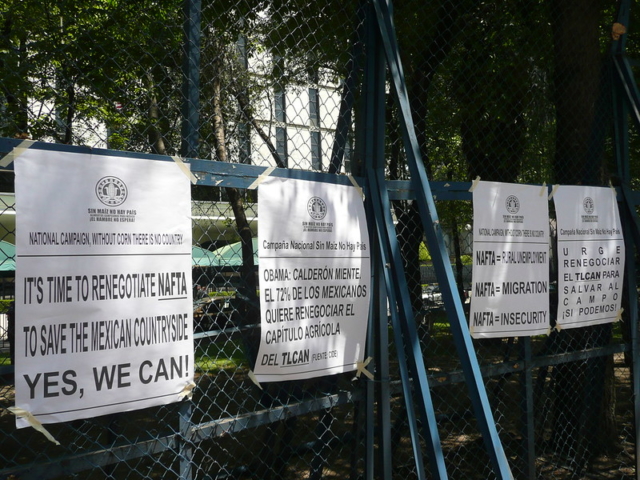
In December 2019, the United States House of Representatives passed the United States–Mexico–Canada Agreement, ushering in a new paradigm for trade between the three North American countries. In doing so, it ended a 30-year trading period governed by the North American Free Trade Agreement (NAFTA). This was a landmark trade deal that George H. W. Bush initiated in 1989 with the passage of the U.S. Canada Free Trade Agreement. Negotiations with Mexico ensued, with Canada joining the talks and a conclusion of a deal between the three, signed into force under the administration of Bill Clinton in 1994. With the adoption of the USMCA, the previous agreement has become obsolete. One can now assess the legacy of the North American Free Trade Agreement, though the countries will update and analyze the agreement throughout the next few years as the components of the new deal take effect.
Proponents and Opponents of NAFTA
NAFTA broke ground in neoliberal terms. Free trade principles that Bush, Margaret Thatcher and Ronald Regan championed dissolved tariffs and liberalized trade with a focus on the agriculture, textile and automobile industries. Supporters of the deal proclaimed the benefits that the deal would bring, including boosting the trade and economies of the three countries, particularly Mexico’s developing one. They forecasted that Mexicans would find better jobs in Mexico. Therefore, they would stay, rather than immigrating illegally to the United States. Furthermore, NAFTA would benefit U.S. and Canadian companies seeking markets for goods and cheap labor.
There were many arguments against NAFTA from the onset. Critics jeopardized the legacy of the North American Free Trade Agreement before it even started. Headlined by then third-party U.S. presidential candidate Ross Perot, opponents claimed that opening the Mexican border to free trade principles would result in what he called a “giant sucking sound” as companies outsourced American jobs to Mexico to seek lower wages.
The Results
With the benefit of hindsight, experts now say that NAFTA had neither as good nor as bad of an impact on the economies of the United States, Canada and Mexico as some initially predicted. Like many things, the reality lay in the middle. While trade objectively increased, even tripled by some accounts, American jobs did indeed flee to Mexico. Many left the Midwest and created the so-called Rust Belt. An article published by the Economic Policy Institute details the extent of the losses, contending that 682,900 jobs suffered in the U.S. at NAFTA’s expense. Many of these job losses, 60.8 percent, were in manufacturing. Supporters predicted manufacturing would see an increase of up to two million in five years.
In short, U.S. companies benefited at the detriment of Mexican families. Further, two million Mexican families with previous engagement in farming activities lost their livelihoods. In addition, small businesses closed in the 10s of thousands. Between NAFTA and subsequent free trade deals with countries like Peru, Colombia and some Central American and Caribbean countries, millions experienced displacement from their homes and fled. Many fled to the United States, proving to exacerbate illegal immigration rather than alleviate it. Mexico did see an increase in jobs for a while, especially in the automotive industry, expanding from 120,000 to 550,000 since 1994. However, this has not been nearly enough to offset the harm caused; even when accounting for a boost in trade and considerable improvement in foreign direct investment to Mexico from $15 to $100 billion.
The Potential Future
Overall, companies in the U.S., Canada and Mexico benefited in some ways from free trade. Generally, this left a significant legacy of the North American Free Trade Agreement. However, it came at a substantial loss for individuals and worsened existing problems like outsourcing and illegal immigration. The biggest hope for the future lies in the United States–Mexico–Canada Agreement. The USMCA, agreed to by the three countries, passed with bipartisan support in the House of Representatives. Ideally, it will right some of the wrongs that NAFTA inflicted, while continuing to promote trade and economic growth in North America.
– Alex Meyers
Photo: Flickr

Menstruation, Education and Poverty
Each day, more than 800 million women and girls menstruate, yet people often leave periods out of conversations regarding poverty, global health and progress. Menstruation, education and poverty link together. Most who menstruate experience their first period between ages 10 and 16. Menstruation can cause other complications for children already in poverty. Despite efforts to include menstruation in these conversations, stigma and shame still often prevail when discussions arise.
In order to have a healthy period, people need access to clean water and sanitation. More than 35 percent of the world’s population lack these necessities. Without necessary hygiene measures, menstruation can result in illness and death.
Menstruation, Education and Poverty
In addition to these concerns about physical well-being and safety, menstruation can negatively affect a child’s education in a number of ways. Lack of proper sanitation and menstrual hygiene products such as tampons and sanitary pads can lead to missed school days around the time of a period.
When logistical concerns combine with the common stigma about periods and menstruation, people who menstruate miss out on valuable education. In Ghana, a nation where 8 percent of people live in extreme poverty, over 95 percent of students who menstruate reported frequent absences from school due to their period.
Fighting Back
While stigma and the lack of access to sanitary products continue to be a problem, various global initiatives are acting to combat this threat to health and safety. In 2013, the German nonprofit WASH United named May 28th Menstrual Hygiene Day, aiming to educate the public and fight stigmatization around menstruation globally.
May 28th is more than just a day to educate and enact action. It also symbolically ties to menstruation. May, the fifth month of the year, represents the average of five days that menstruation lasts each cycle. The number 28 represents the average length in days of a menstrual cycle.
WASH United is not the only organization realizing the importance of including menstruation in the conversations surrounding poverty and global health. The global nonprofit PERIOD is working to provide quality menstrual care, education and opportunities for those who menstruate. The Pad Project works on the ground in impoverished areas installing sustainable, locally sourced machines that produce pads, creating both necessary sanitary products and jobs. These two nonprofits both additionally stress the importance of proper menstrual care in order to ensure that menstruation does not limit a child’s education.
Looking Forward
Menstruation is not just a concern for the 26 percent of the global population who experiences it. There is a great need for education on the process and common challenges of menstruation in order to improve health and access to necessary care. In the fight to improve menstrual health around the globe, it is imperative that people teach menstruation as a natural, biological process that is healthy for the body, and not something that is shameful or unsanitary.
When people who menstruate have confidence in the tools they use during their period, as well as access to basic needs of water and sanitation, then menstruation, education and poverty can begin to destigmatize and children can face less of a barrier in obtaining the schooling, comfort and safety they deserve.
– Elizabeth Reece Baker
Photo: Wikimedia Commons
6 Facts About Women’s Health in Madagascar
Madagascar is the world’s second-largest island country off the coast of East Africa. It is also among the poorest countries in the world with a poverty rate of over 75 percent. This poverty rate has inevitably affected the accessibility and quality of health care and the consequent overall health of Malagasy women. These are six facts about women’s health in Madagascar.
6 Facts About Women’s Health in Madagascar
These six facts about women’s health in Madagascar show that with one of the world’s worst poverty rates, women in Madagascar are struggling to maintain their health and find safe places to deliver their children. However, groups like the Jhpiego are working to reach out to the women who need help the most in Madagascar. As a result, many women are receiving prenatal and antenatal care for the first time as well as access to health clinics with experienced health care workers. Overall female health in Madagascar is improving and USAID and Jhpiego show no signs of stopping their aid to women’s health in Madagascar.
– Amanda Gibson
Photo: Flickr
10 Facts about Child Labor in Myanmar
Myanmar was a prosperous country at the beginning of the 1960s. However, when Myanmar came under the rule of an oppressive military junta from 1962 to 2011, it became one of the world’s poorest nations. Many considered the former military regime in Myanmar to be one of the most oppressive and abusive regimes in the world, committing serious human rights and humanitarian law violations against civilians, including women and children. Child labor is one of the prevalent issues that the government is trying to tackle, but it remains common in Myanmar.
The International Labour Organization (ILO) defines child labor as work that negatively affects children’s mentality, physicality or morality and interferes with their schooling. The worst forms of child labor include slavery, sexual exploitation, illicit activities or work that by nature is likely to harm the health, morals or safety of children.
Despite the new government body’s attempt to eradicate child labor, it remains a huge challenge in Myanmar due to its limited resources. Here are 10 facts about child labor in Myanmar.
10 Facts About Child Labor in Myanmar
Since the transition to a new government in 2011, Myanmar’s human rights records have been improving. Although child labor is still prevalent in Myanmar due to poverty as well as cultural norms, the government is taking steps to address this issue with the collaboration of the ILO and various NGOs.
These 10 facts about child labor in Myanmar highlight some of the challenges facing the government, but also many great potentials to eradicate child labor in Myanmar through national and international efforts to ensure better lives and rights for the children of this Asian nation.
– Minh-Ha La
Photo: Flickr
Vision Care in Developing Countries
DIFF is a sunglass company in Southern California that emerged in 2014. DIFF began with the intention of challenging the norm and doing good in the world. It has partnered with many charities over the years to help supply vision care in developing countries.
The Need for Vision Care in Developing Countries
Over one billion people in developing countries suffer from presbyopia. Presbyopia typically starts around the age of 40 and causes a gradual loss of close-up vision. For people in developing or impoverished countries, having clear vision is incredibly important in the workforce, especially if the jobs include skills like sewing, weaving and carving. About 2.5 billion people worldwide need eyeglasses to see clearly but are unable to access them. As many as 239 million children live with uncorrected vision. A lack of access to vision care puts another obstacle in the way of children in school without the ability to read easily and inhibits the ability of those in the workforce to do their jobs.
Eyeglasses for Everyone
For every pair of glasses that DIFF sells, it donates a pair of reading glasses to someone in need. DIFF partnered with many charities over the years to achieve this, including its original partner, Eyes on Africa. Eyes on Africa is a nonprofit organization that emerged in 2005 that provides eyeglasses to those in Africa who lack access to vision care. Through this partnership alone, DIFF has provided glasses to over 20,000 people in need. Restoring Vision is another organization DIFF has partnered with. Restoring Vision is the largest nonprofit provider of reading glasses to people living in poverty. Through DIFF’s partnership with Restoring Vision, it has helped over 150,000 people improve their vision.
Vision Care for All
DIFF has also partnered with an organization called SVOSH. SVOSH is a student chapter of the larger Volunteer Optometric Services to Humanity (VOSH). Under this organization, groups of optometry students provide eye exams to impoverished communities in developing countries. It also provides visual assistance and treatments for visual ailments with the help of DIFF’s funding. Projections determined that this partnership would provide vision aid to over 10,000 people around the world in 2017.
The necessity for vision aid is a facet of poverty that people often overlook, but should not neglect. Providing vision care to people in developing countries, whether that be optometry visits or providing a pair of reading glasses, can change the lives of those 2.5 billion people in need of vision aid. Accessible vision care will help millions of children struggling in school in developing countries. According to research, giving a child the appropriate vision aid is beneficial to the equivalent of an extra six months of schooling. Giving people in poverty the gift of sight makes work easier to find and to keep.
– Amanda Gibson
Photo: PeakPx
Legacy of the North American Free Trade Agreement
In December 2019, the United States House of Representatives passed the United States–Mexico–Canada Agreement, ushering in a new paradigm for trade between the three North American countries. In doing so, it ended a 30-year trading period governed by the North American Free Trade Agreement (NAFTA). This was a landmark trade deal that George H. W. Bush initiated in 1989 with the passage of the U.S. Canada Free Trade Agreement. Negotiations with Mexico ensued, with Canada joining the talks and a conclusion of a deal between the three, signed into force under the administration of Bill Clinton in 1994. With the adoption of the USMCA, the previous agreement has become obsolete. One can now assess the legacy of the North American Free Trade Agreement, though the countries will update and analyze the agreement throughout the next few years as the components of the new deal take effect.
Proponents and Opponents of NAFTA
NAFTA broke ground in neoliberal terms. Free trade principles that Bush, Margaret Thatcher and Ronald Regan championed dissolved tariffs and liberalized trade with a focus on the agriculture, textile and automobile industries. Supporters of the deal proclaimed the benefits that the deal would bring, including boosting the trade and economies of the three countries, particularly Mexico’s developing one. They forecasted that Mexicans would find better jobs in Mexico. Therefore, they would stay, rather than immigrating illegally to the United States. Furthermore, NAFTA would benefit U.S. and Canadian companies seeking markets for goods and cheap labor.
There were many arguments against NAFTA from the onset. Critics jeopardized the legacy of the North American Free Trade Agreement before it even started. Headlined by then third-party U.S. presidential candidate Ross Perot, opponents claimed that opening the Mexican border to free trade principles would result in what he called a “giant sucking sound” as companies outsourced American jobs to Mexico to seek lower wages.
The Results
With the benefit of hindsight, experts now say that NAFTA had neither as good nor as bad of an impact on the economies of the United States, Canada and Mexico as some initially predicted. Like many things, the reality lay in the middle. While trade objectively increased, even tripled by some accounts, American jobs did indeed flee to Mexico. Many left the Midwest and created the so-called Rust Belt. An article published by the Economic Policy Institute details the extent of the losses, contending that 682,900 jobs suffered in the U.S. at NAFTA’s expense. Many of these job losses, 60.8 percent, were in manufacturing. Supporters predicted manufacturing would see an increase of up to two million in five years.
In short, U.S. companies benefited at the detriment of Mexican families. Further, two million Mexican families with previous engagement in farming activities lost their livelihoods. In addition, small businesses closed in the 10s of thousands. Between NAFTA and subsequent free trade deals with countries like Peru, Colombia and some Central American and Caribbean countries, millions experienced displacement from their homes and fled. Many fled to the United States, proving to exacerbate illegal immigration rather than alleviate it. Mexico did see an increase in jobs for a while, especially in the automotive industry, expanding from 120,000 to 550,000 since 1994. However, this has not been nearly enough to offset the harm caused; even when accounting for a boost in trade and considerable improvement in foreign direct investment to Mexico from $15 to $100 billion.
The Potential Future
Overall, companies in the U.S., Canada and Mexico benefited in some ways from free trade. Generally, this left a significant legacy of the North American Free Trade Agreement. However, it came at a substantial loss for individuals and worsened existing problems like outsourcing and illegal immigration. The biggest hope for the future lies in the United States–Mexico–Canada Agreement. The USMCA, agreed to by the three countries, passed with bipartisan support in the House of Representatives. Ideally, it will right some of the wrongs that NAFTA inflicted, while continuing to promote trade and economic growth in North America.
– Alex Meyers
Photo: Flickr
9 Facts about Life Expectancy in Bahrain
The Kingdom of Bahrain is the island nation between Saudi Arabia and Qatar. This former British protectorate achieved its independence in 1971. Since the discovery of oil in the mid-20th century, Bahrain’s petroleum industry has been the backbone of the country’s economy and has become one of the wealthiest countries in the world. With its newfound wealth, the Bahraini government invested in public welfare, infrastructure and public sectors. This led to a steady increase in life expectancy in Bahrain.
9 Facts about Life Expectancy in Bahrain
Life expectancy in Bahrain is very much related to the country’s economy. Since the discovery of oil in the 1930s, the Bahraini government used their newfound wealth to bolster the country’s infrastructure and health care for its citizens. With the help of international funds such as the Saudi Fund for Development, Bahrain is further bolstering its health care system. However, the country’s declining oil industry and the pollution that they cause does give rise to concerns about the future of life expectancy in Bahrain
– YongJin Yi
Photo: Flickr
7 Facts About Poverty in Iran
In recent years, absolute poverty in Iran has risen drastically. Action is necessary in order to provide for basic needs and prevent more Iranians from falling under the poverty line. Here are seven facts about poverty in Iran.
7 Facts About Poverty in Iran
In Iran, 26 million people are living in absolute poverty. However, with more support from the Iranian government and better relations with the U.S., Iran should be able to prevent the increase in poverty in its country.
– Lisa Di Nuzzo
Photo: Flickr
10 Facts About Sanitation in the Philippines
Sanitation in the Philippines is a major issue with more than 24 million people living without improved sanitation. With one-third of the population living in poverty, access to clean water and sanitation is essential to improving conditions. Here are 10 facts about sanitation in the Philippines.
10 Facts About Sanitation in the Philippines
These 10 facts about sanitation in the Philippines show that the Philippines and sanitation have had a fraught relationship. However, with increased efforts from both the national government and nonprofit organizations, more people gain access to water and sanitation systems every year. As aid increases, there is no doubt that the effectiveness of sanitation in the Philippines will improve as well.
– Anna Sarah Langlois
Photo: Flickr
5 Athletes Who Rose From Poverty
Sports have always been integral in society. They serve as an outlet for many to escape their daily troubles and exist as a way to unify groups of people. Athletes in modern times are lauded for their skill and their lavish lifestyles. However, the truth of the matter is that many of these competitors did not grow up with the privileges they have earned today. These are five athletes that rose from poverty.
5 Athletes Who Rose From Poverty
Sports are an avenue for athletes to get their stories heard. These five athletes who rose from poverty are a small sample of athletes who have endured a significant amount to attain success. As acclaimed Olympian, Emil Zatopek once said, “An athlete cannot run with money in his pockets. He must run with hope in his heart and dreams in his head”.
– Jai Shah
Photo: Flickr
Cooking in Africa: Burn Design Lab
Cookstove visionary Peter Scott initially started Burn Design Lab (BDL) in 2010. After growing concerned about the deforestation issue in Africa, Scott became determined to develop the world’s best cookstoves. With parts from Bob Powell’s metal shop Meadow Creature and a workplace in Vashon’s Sheffield Building, BDL was ready to expand and test new designs. In 2013, Paul Means joined BDL as Research & Testing Manager, and between 2013-2016, a natural draft wood stove—which would become the Kuniokoa—came to be. By 2015, Peter Scott had left BDL to work with Burn Manufacturing Company to create a charcoal-burning stove. Now under Mean’s leadership, BDL has expanded its partnerships to Kenya, the Philippines, Guatemala and Ghana.
Burn Design Lab’s Process
Over time, BDL has established a detailed iterative approach to its development process. Instead of a hard step-by-step process of stages, the group has adopted more of a cyclical process. One cycle consists of conceptual design, computer-aided design, prototype fabrication, user research and laboratory and field testing. After a cycle, testing results and user input then goes back into the process to further improve the design. An iterative approach makes versioning easier and guarantees every step. Though this process may seem lengthy and repetitive, it offers a rapid turnaround and is easily adaptable. With this plan in mind, BDL has been very successful approaching many of its beneficent products.
Past Projects
In the past, Burn Design Lab has been quite successful executing different plans and solutions. In partnership with Burn Manufacturing Co. in Kenya, BDL developed in The Kunioka in 2016 for use in East Africa. With financial support from the U.S. Department of Energy and investments from Unilever and Acumen, this wood-burning stove revolutionized Kenya and Tanzania’s agriculture industry. Not only was this stove incredibly eco-friendly, but it was also cost-effective for farmers and plantation workers at only approximately $38.
In addition to its past projects such as The Kunioka, BDL has also been successful in its current endeavors. Right now, BDL has a partnership with the Burro Brand Ltc. to develop an improved shea roaster for the citizens of Ghana. The current process for roasting shea kernels is very unsustainable and has many health consequences. BDL and Burro have worked through many design and testing iterations to produce the best product for utilization. The goals of the project include reducing wood fuel consumption by 40 percent and reducing carbon emissions by 90 percent. As one can see, BDL has worked tirelessly to produce cookstoves that are both sustainable and secure.
Lasting Impact
Burn Design Lab has created a profound solution to a global problem. According to National Geographic, some three billion people cook with open or barely contained fires, leading to many negative consequences such as smoke inhalation. Other health concerns that people associate with this cooking style are respiratory infections, eye damage, heart and lung disease and lung cancer. As a matter of fact, open cooking fires produce about 400 cigarettes worth of smoke an hour. Sadly, those in low and middle-income countries must resort to this as they do not have easy access to reliable and sustainable energy.
BDL has made it its mission to design clean-burning cookstoves that release fewer emissions and require less fuel. With support and determination, Burn Design Lab is saving lives, promoting economic empowerment in developing nations and fighting deforestation.
– Srihita Adabala
Photo: Flickr