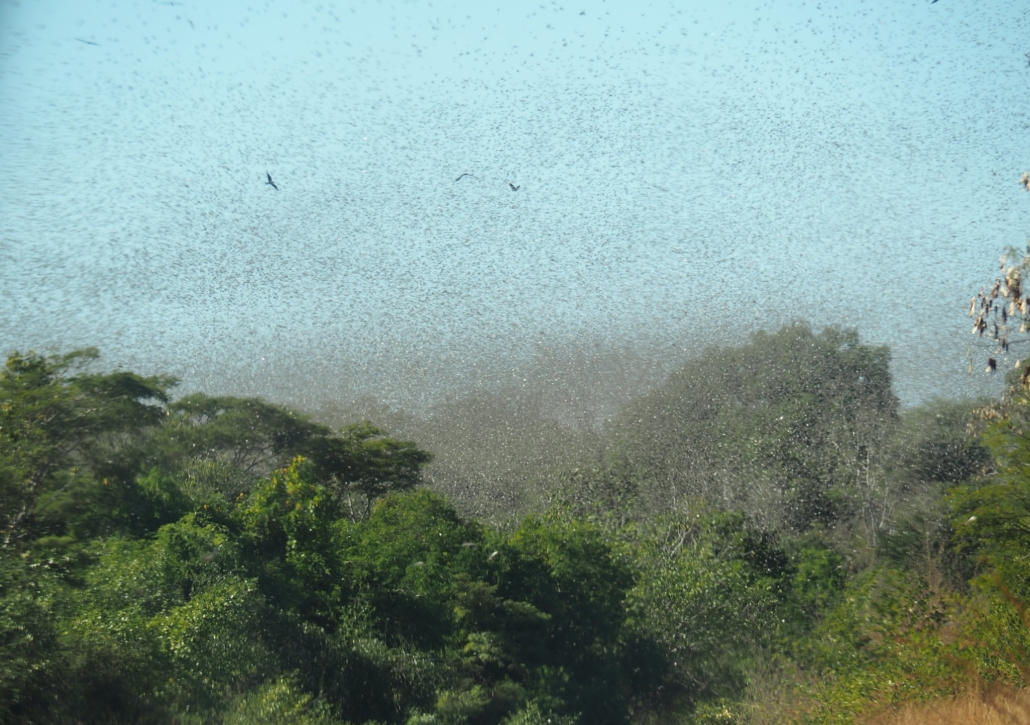
Scientists based in Nairobi, Kenya, with the Intergovernmental Authority on Development Climate Prediction and Applications Center, are successfully combating the worst surge in locusts in 70 years by predicting the conditions and location of future swarms with a supercomputer. The new technology has shown to predict with 90 percent accuracy so far and has saved food crops in Uganda. The scientists’ hope is that a supercomputer in East Africa will protect crops from locusts for other countries as well. Locusts are large, tropical grasshoppers. They threaten the food security of many East African countries such as Uganda, Somalia, Ethiopia and Kenya.
The Locust Problem
Since biblical times, locusts have plagued the MENA region (Middle East, North Africa, Afghanistan and Pakistan). Locusts eat and destroy vital crops. The traditional spraying of pesticides has controlled the spread of locusts. However, between shortages in pesticides, armed conflicts and climate change, locusts have made a startling resurgence.
In addition to the shortage of pesticides, countries like Kenya lack expertise in controlling the threat to their food supply. Ethiopia is facing the same threat and does not have enough planes to spray its fields. The country needs planes to spray in hard-to-reach areas where workers cannot exterminate. Meanwhile, civil wars in Yemen and Somalia prevent any coordinated response to the surge of the plant-devouring bug. Furthermore, exterminators in those countries have no guaranteed safety in times of war.
Some have blamed the rise of locusts in the region primarily on the extended rainy season and warming seas that have accelerated egg hatching, with strong cyclones spreading the insect farther. According to The United Nations Food and Agriculture Organization (UNFAO), people need to address the problem soon. If not, the number of locusts could multiply up to 400 times by June 2020. This could leave approximately 25 million people hungry. The organization warned that the locusts, which have a generation life cycle of three months, have grown 20 times more each new generation.
A Supercomputer in East Africa Can Protect Crops from Locusts
Satellite information scientists, such as Kenneth Mwangi of the Intergovernmental Authority on Development Climate Prediction and Application Center, used a supercomputer model to predict areas of locust breeding that they did not monitor on the ground. The model fills in the information gaps of where new swarms could hatch.
By determining where there may be an upsurge in hoppers, the model is able to target likely areas of breeding for future pesticide spraying. To get to those areas before eggs hatch is crucial in preventing the spread. It also saves money by preventing an uncontrolled swarm. Young locusts or juveniles eat vegetation and reproduce well in 50-70 percent humidity levels and temperatures between 86 F and 104 F.
To date, the supercomputer has predicted where these areas are likely to be with a 90 percent accuracy rate according to the scientists involved. The Weather and Climate Information Services for Africa Program out of the United Kingdom funds the technology. It uses data such as humidity, soil moisture, wind currents, vegetation cover and temperature to predict where locusts will lay their eggs. The supercomputer then sends the prediction model information to other African countries so they know where to spray. This represents a critical period of time so that the people can begin their cropping season without incident. Major crops in Uganda include cotton, sorghum, millet and maize.
In one instance, the supercomputer warned the Ugandan Government of the likely migration path that locusts would take as they crossed the border from Kenya to Uganda. Then, the government mobilized the army to assist with the spraying efforts and killed millions of locusts and eggs. Uganda has not seen anything like it since the 1960s.
The supercomputer has proven to be an important tool at combating a new (and old) agricultural foe in East Africa. The ability to predict new breeding grounds and swarm migrations in the region has the potential to limit damage. It can also limit the cost of extermination on a grand scale. Uganda is evidence, thus far, of its effectiveness. But the UNFAO warns that if people do not mitigate the crisis soon, the new cropping season will coincide with a booming locusts population that would leave millions without the food on which they depend.
– Caleb Cummings
Photo: Flickr

Agroforestry: Improving Food Security in Honduras
Alley Cropping
For years, agroforestry has been transforming the lives of farming families by increasing food security in Honduras. However, before the introduction of alley cropping to farms in the country, crop failure continued to devastate farmers. While other agroforestry techniques have minimized the damage resulting from flooding, erosion and drought, alley cropping has proven to be a more successful method of crop farming. Alley cropping involves planting rows of crops between trees. This methodology creates an integrated ecosystem that improves and nourishes soil that supports both crop quality and quantity, thus increasing the amount the farmers are paid so that they can afford to support their families.
The Inga Foundation was the first to introduce and teach alley cropping techniques to Honduran farmers through demonstrational farming. These farmers also had the opportunity to obtain seeds from the demonstration and start their own alley cropping systems. According to the Inga Foundation, more than 300 farming families have been able to achieve food security through the new alley cropping method, and this number is only increasing as alley cropping starts to catch on.
Benefits of Alley Cropping
Alley cropping regenerates degraded land, which helps crops grow.
Alley cropping increases the nutritional value of fruits and vegetables.
Unpredictable weather can be withstood, meaning crops are more resilient.
Alley cropping is sustainable and benefits the natural environment.
Families can stay on one plot of land without having to migrate to others due to soil degradation.
Inga Trees in Alley Cropping
In Honduras, Inga trees are among one of the most popular and successful trees used in alley cropping systems. The Inga Foundation’s demonstration farm showcased hedgerows of Inga trees, which are known to revitalize the soil and support crop growth. Here are a few reasons why the Inga tree was chosen as the model for alley cropping.
Inga trees grow fast. This allows farmers to quick-start their alley cropping without much of a waiting period.
Not only do Inga trees tolerate poor soil, but they nourish it.
Inga trees reduce weeds.
Seasonal pruning of Inga trees generates firewood and fuelwood for families.
Inga trees produce edible fruit.
Because the Inga tree is both incredibly resilient and easy to grow, more and more farmers are seeking out their seeds in order to better provide for their families. This tree, when paired with agroforestry, is playing a huge role in improving food security in Honduras.
The benefits that come from agroforestry methods like alley cropping can mean the difference between life and death for some families in Honduras. Thankfully, the Inga Foundation has allowed for the breakthrough of improved farming which has saved hundreds of Hondurans from the burden of food insecurity.
– Hadley West
Photo: Flickr
10 Facts About Sanitation in Belize
Belize has increasingly become a popular tourist attraction over the past several years. Not only is it a favorite among celebrities, but it is also a place where many non-famous people choose to purchase property. Vast natural ecosystems and welcoming locals draw visitors to the country for rest and relaxation. As the nation continues to evolve, byproducts of expansion take a toll on the preservation of natural resources, in turn creating waste and other issues that affect sanitation in Belize.
10 Facts About Sanitation in Belize
Most of Belize’s infrastructures are stable and use the latest technology. The growth of Belize and the growing health of its citizens are evidence of these facts. There is a definite standard in place to ensure little to no impact on the environment. Business and commerce are on an upward trend. The government plays a significant role in growing the nation’s civil framework as well as addressing issues of sanitation in Belize. Belize is a country with a unique ecology. Its popularity as a place to unwind, and perhaps stay, is growing.
– Julie Jenkins
Photo: Pixabay
A Supercomputer in East Africa to Detect Locusts
Scientists based in Nairobi, Kenya, with the Intergovernmental Authority on Development Climate Prediction and Applications Center, are successfully combating the worst surge in locusts in 70 years by predicting the conditions and location of future swarms with a supercomputer. The new technology has shown to predict with 90 percent accuracy so far and has saved food crops in Uganda. The scientists’ hope is that a supercomputer in East Africa will protect crops from locusts for other countries as well. Locusts are large, tropical grasshoppers. They threaten the food security of many East African countries such as Uganda, Somalia, Ethiopia and Kenya.
The Locust Problem
Since biblical times, locusts have plagued the MENA region (Middle East, North Africa, Afghanistan and Pakistan). Locusts eat and destroy vital crops. The traditional spraying of pesticides has controlled the spread of locusts. However, between shortages in pesticides, armed conflicts and climate change, locusts have made a startling resurgence.
In addition to the shortage of pesticides, countries like Kenya lack expertise in controlling the threat to their food supply. Ethiopia is facing the same threat and does not have enough planes to spray its fields. The country needs planes to spray in hard-to-reach areas where workers cannot exterminate. Meanwhile, civil wars in Yemen and Somalia prevent any coordinated response to the surge of the plant-devouring bug. Furthermore, exterminators in those countries have no guaranteed safety in times of war.
Some have blamed the rise of locusts in the region primarily on the extended rainy season and warming seas that have accelerated egg hatching, with strong cyclones spreading the insect farther. According to The United Nations Food and Agriculture Organization (UNFAO), people need to address the problem soon. If not, the number of locusts could multiply up to 400 times by June 2020. This could leave approximately 25 million people hungry. The organization warned that the locusts, which have a generation life cycle of three months, have grown 20 times more each new generation.
A Supercomputer in East Africa Can Protect Crops from Locusts
Satellite information scientists, such as Kenneth Mwangi of the Intergovernmental Authority on Development Climate Prediction and Application Center, used a supercomputer model to predict areas of locust breeding that they did not monitor on the ground. The model fills in the information gaps of where new swarms could hatch.
By determining where there may be an upsurge in hoppers, the model is able to target likely areas of breeding for future pesticide spraying. To get to those areas before eggs hatch is crucial in preventing the spread. It also saves money by preventing an uncontrolled swarm. Young locusts or juveniles eat vegetation and reproduce well in 50-70 percent humidity levels and temperatures between 86 F and 104 F.
To date, the supercomputer has predicted where these areas are likely to be with a 90 percent accuracy rate according to the scientists involved. The Weather and Climate Information Services for Africa Program out of the United Kingdom funds the technology. It uses data such as humidity, soil moisture, wind currents, vegetation cover and temperature to predict where locusts will lay their eggs. The supercomputer then sends the prediction model information to other African countries so they know where to spray. This represents a critical period of time so that the people can begin their cropping season without incident. Major crops in Uganda include cotton, sorghum, millet and maize.
In one instance, the supercomputer warned the Ugandan Government of the likely migration path that locusts would take as they crossed the border from Kenya to Uganda. Then, the government mobilized the army to assist with the spraying efforts and killed millions of locusts and eggs. Uganda has not seen anything like it since the 1960s.
The supercomputer has proven to be an important tool at combating a new (and old) agricultural foe in East Africa. The ability to predict new breeding grounds and swarm migrations in the region has the potential to limit damage. It can also limit the cost of extermination on a grand scale. Uganda is evidence, thus far, of its effectiveness. But the UNFAO warns that if people do not mitigate the crisis soon, the new cropping season will coincide with a booming locusts population that would leave millions without the food on which they depend.
– Caleb Cummings
Photo: Flickr
5 Human Trafficking Awareness Apps Everyone Should Know
5 Human Trafficking Awareness Apps
While they are not the only ones out there, these are apps can increase human trafficking awareness in small, practical ways. They are all free, easy to use and can make all the difference.
– Megan McKeough
Photo: Pxhere
How Microgrids Could End Global Energy Poverty
Around 840 million people around the world have no access to electricity. Global energy poverty is prevalent with most living in developing nations in South Asia, Latin America and rural Africa. In India, more than 300 million people lack access to electricity. In Sub-Saharan Africa, that number is twice as high.
Energy poverty or the lack of access to modern energy services, including electricity and clean cooking facilities, remains a barrier to global prosperity and individual well-being. That is why ensuring basic energy for 100 percent of the world’s population by 2030 is one of the United Nation’s Sustainable Development Goals. Yet, at the current rate of progress, 650 million people will still live in the dark. Microgrids have the potential to improve that course and eliminate global energy poverty.
What are Microgrids?
Microgrids or mini-grids are small, localized power grids. They can operate on their own using local energy generation without needing a connection to a larger power grid. Renewable resources power most along with diesel back-up and batteries.
Microgrids can power fridges, fans, irrigation pumps and other basic machinery. With microgrid energy, families can power appliances that save time on household chores, farmers can increase crop yield with irrigation and schools can light their classrooms.
Benefits of Microgrids
With low costs and high yields, microgrids could end global poverty. The price of batteries, solar and other energy technologies has been decreasing since 2010, in turn reducing the cost of microgrids. The International Energy Agency named localized power grids as the most cost-effective option to deliver electricity to more than 70 percent of the unconnected. Continued innovation will further drive cost reduction.
Microgrids are also modular, easy to transport and simple to install. This makes them especially valuable in remote and rural areas.
Use of Microgrids
In India and Sub-Saharan Africa, microgrids are already electrifying and transforming communities. SmartPower India, with support from the Rockefeller Foundation, has used microgrids to power more than 100 villages and serve 40,000 people. Since the project launched in 2015, carpenters and tailors have more than doubled their productivity, farmers have built cold storage facilities to keep produce and entrepreneurs have opened small businesses. Local economies grew by $18.50 per capita.
In Kenya, a solar company is using microgrids to deliver power to villages deep in the African bush. SteamaCo’s microgrids supply 10,000 households and businesses across 25 villages with electricity. This has allowed for businesses to trade longer, students to study after dark and communities to grow more independent.
A lack of access to modern, reliable and affordable energy services hinders communities and cripples economies. It is time to turn the light on for the billions of people without access to electricity. Microgrids could end global energy poverty.
– Kayleigh Rubin
Photo: U.S. Marine Corps
Understanding the Venezuela Crisis
Venezuela’s socioeconomic debacle has been grabbing headlines over the past few years, especially as the crippling inflation rate—recently eclipsing 10,000 percent—hit the country’s economy and began to unravel its health sector. But these are just two of the key components to understanding the Venezuela crisis and its various impacts as the humanitarian crisis continues to debilitate the region following many years of unrest.
Many Years of Strife
Since the death of former Venezuelan President Hugo Chávez in 2013 and the appointment of the current leader, Nicolás Maduro, the country has experienced a dire financial crisis as a result of low oil prices and financial mismanagement. Various power struggles and changes within the country’s National Assembly marked the political and humanitarian crisis that ensued.
The country’s military largely continues to back Maduro despite domestic, international and widespread condemnation of his authoritarian government. The political crisis has now spread to all levels of the economy and society, with nearly 4.5 million individuals having fled Venezuela due to the escalating unrest.
Following anti-government protests in 2014 after the victory of Maduro’s party the previous year, the economy and health care sector began their plunge and had all but collapsed by 2016. Malnutrition, child mortality and unemployment rates began to rise as a result. The United Nations estimates that the undernourishment rate in the country has quadrupled since the year 2012, putting more than 300,000 lives at risk due to limited access to medical treatment and medicines. Aid and relief efforts continue to face major hindrances due to mounting strife.
As the economic and humanitarian crisis grew over recent years, there was significant backlash and condemnation from foreign nations including the U.S. followed by significant international sanctions, especially over the increasingly authoritarian measures that Maduro took to pass laws autonomously and virtually unchecked.
Venezuela’s Refugee Crisis
Another dimension to understanding the Venezuela crisis is its refugee crisis as the economic and political problems have resulted in a dire humanitarian emergency. Since the beginning of the crisis back in 2014, over 4.6 million Venezuelans have fled the country. Mass displacement and humanitarian challenges continue mostly unabated due to integration obstacles, immigration and border pressures.
In 2019, the UNHCR-led joint effort, the Regional Refugee and Migrant Rescue Response Plan, along with the International Organisation of Migration (IOM) called for the provision of $738 million in assistance to countries in the Caribbean and Latin America that were dealing with the impacts of the migrant exodus. Unfortunately, the Venezuelan refugee crisis remains one of the most underfunded in the world.
Aid and Other Positive Developments
Throughout 2019, the Venezuelan government under Maduro refused aid relief headed by Brazil, Colombia and the U.S., relying on Russia’s 300 tons of humanitarian assistance instead which included food as well as medical supplies. The World Health Organisation (WHO) has been overseeing foreign aid, especially medical and food supplies from Russia and other countries. However, at the same time, aid relief and efforts such as the distribution of crucial medicines have stalled owing to the escalating political crisis and mounting corruption.
The U.S. and President Donald Trump have not only pledged humanitarian financial assistance but have declared their support for the democratic opposition group led by Juan Guaidó. In October 2019, USAID signed a major development agreement with Guaidó’s shadow government, thereby raising aid and assistance to $116 million and allocating a further $568 million to helping Venezuelans displaced by the conflict. Though the U.S. and its allies remain committed to toppling Maduro’s regime and reinstating rule of law, they are in serious conflict with Maduro’s international allies, namely Russia, Turkey and China.
Hope for the Future
The Center for Prevention Action from the Council on Foreign Relations believes it is imperative to consider important policy options to help promote democracy as well as channel crucial humanitarian aid and assistance, perhaps even by means of forced humanitarian intervention and post-transition stabilization.
Even though the Venezuelan crisis at times may seem to be reaching an impasse, it remains possible that the humanitarian and pro-democracy efforts of foreign powers could ultimately lead to a post-Maduro scenario. The year 2020 will be an important year in determining the ultimate fate of the country and the internal power struggles. The international community will hold an indispensable role in helping to create a better understanding of the Venezuela crisis and to help create a promising future for the country.
– Shivani Ekkanath
Photo: Wikipedia Commons
5 Foreign Aid Projects in Vietnam
Vietnam’s economy has grown remarkably over the last two decades. However, this growth would not have been possible without foreign aid to Vietnam. USAID’s work in supporting Vietnam’s economic growth and development is an excellent example of foreign aid at work. Here are five exceptional foreign aid projects in Vietnam that foster hope for positive results around the world.
5 Foreign Aid Projects in Vietnam
USAID development projects foster hope around the globe. Like in Vietnam, these projects convey the message that foreign aids are constantly working toward positive change for many.
– Hung M Le
Photo: USAID
The Impact of Coronavirus On the Global Economy
Over the past several months, the outbreak of the fast-spreading pandemic of coronavirus or COVID-19 has taken the world by storm. In efforts to stop the pandemic from spreading and provide aid to the sick, many countries are closing borders and imparting quarantine policies on citizens. Not only is the coronavirus taking lives, but it is also heavily impacting the global economy in terms of billions of dollars.
Efforts to Curb COVID-19
Currently, the WHO has reported 234,073 confirmed global cases and 9,840 deaths from the coronavirus. This pandemic is extremely contagious and spreads through respiratory fluids, which is why it is important to cover the mouth when coughing and washing hands frequently. The CDC recommends washing hands every hour for at least 20 seconds.
International governments are also closing borders and canceling flights to slow the impact of coronavirus. Further, people from CEOs to politicians and regular citizens are promoting social distancing. All over the world, authorities are telling people to only leave home when necessary like to buy groceries, travel to work, exercise or receive medical care. In Jordan, curfews exist that are punishable with jail time if people do not abide by them. Meanwhile, the United Kingdom is asking retired doctors and medical professionals to help fight the outbreak.
Organization Action
Organizations are also taking action to fight the outbreak. Organizations like the Gates Foundation, Wellcome and the Mastercard Impact Fund are contributing large sums to support economically impacted communities. The Gates Foundation and Wellcome have donated up to $50 million, and the Mastercard Impact Fund has committed up to $25 million. The CEO of Apple, Tim Cook, has announced the company will donate to “groups on the ground” that are in specific contact with those ill. Specific to the Gates Foundation, its initial donation is a part of the $100 million it has committed to help fight the outbreak and provide aid relief.
Additionally, the co-founder of Alibaba, Jack Ma, has donated $14.4 million to help develop a vaccine to reduce the impact of coronavirus. Ma has provided $5.8 million to support two Chinese government research organizations in tackling vaccine production. The rest of the funds are going towards prevention protocols. According to the latest CDC situation report, the first vaccine trials are in progression. Furthermore, the WHO has set up an international study in many countries to compare different treatments.
Impact on the Global Economy
From a financial standpoint, the pandemic is slowly weakening the global economy and will continue to do so until the situation is under control. So far, the impact of COVID-19 is billions of dollars of government money to go towards aid needs, prevention technology and protection measures. Estimates determine that the impact of coronavirus will have cost nearly $2 trillion by the end of 2020. However, some countries like the U.S. are already receiving billions of dollars in bailouts.
With an abundant amount of action per nation, generous donations and hard-work from medical professionals, it is the hope of many that the pandemic will soon take a more positive turn. It is important to take adequate measures to stay safe during the pandemic. Safety precautions allow a slower spread and provide medical professionals and the health care system time to reduce the impact of the virus. Additionally, these measures will aid in providing therapeutic resources and developing vaccines.
– Sarah Mobarak
Photo: Flickr
10 Facts About Sanitation in Pakistan
Pakistan had a population of 210 million people as of 2017 and is the world’s fifth-most populous country. Further, it is surprising that Pakistan’s GDP has grown 3.3 percent in a single year considering that 24 percent of its population lives below the national poverty line. Poverty has contributed to citizens’ ongoing struggle with inadequate sanitation. Here are 10 facts about sanitation in Pakistan.
10 Facts About Sanitation in Pakistan
Pakistan’s impoverished citizens experience sanitation issues the most. The solutions are fairly simple but Pakistan’s acceptance of outside support will be a substantial step. If one considers the progress that Pakistan is already making to change the lives of people facing sanitation challenges in Pakistan, it is clear that the country should be able to implement real change and help communities thrive for years to come.
– Amelia Sharma
Photo: Flickr
Tackling Iron Deficiency in Developing Countries
Challenges
There continues to be skepticism and disbelief about iron-deficiency in some low-income countries. In fact, many government officials and individuals do not recognize the correlation between fatigue or low-productivity and low iron intake. And, as such iron deficiency is regarded as a hidden disease. This further impacts the availability of accurate, reliable and comparable data on iron deficiency in some of the most at-risk parts of the world.
Causes of Iron Deficiency in Developing Countries
The factors that cause iron deficiency include disease, food insecurity and blood loss. In developing countries, iron deficiency is compounded by infectious diseases like malaria, HIV and hookworm. These diseases must be treated alongside iron deficiency in order to avoid long-lasting consequences. Moreover, malnutrition is one of the leading causes of iron deficiency in developing countries. The lack of proper food security and iron-fortified foods creates a widespread issue of iron deficiency.
Tackling Iron Deficiency in Developing Countries
The fortification of foods, such as flour with iron, provides a way to easily add iron to the diet of the average person. Organizations such as the World Health Organization (WHO) and the Food and Agriculture Organization (FAO) help to implement food fortification programs in developing countries. These programs either provide the nutrients needed for food fortification or identify local resources that contain the necessary nutrients to fortify food, known as food-to-food fortification. An example of food-to-food fortification is fortifying ogi, a cereal-based dough made in Nigeria, with iron-rich baobab fruit powder.
Using natural iron substitutes to add to foods at home is another way to mitigate the issue. Lucky Iron Fish Enterprises created an iron shaped fish that reduces iron deficiency in low-income communities. When boiled in soup or water, the Lucky Iron Fish gives the individual around 40 percent of the daily amount of iron recommended per day. The company served about 54,000 people around the world in 2018 with its various programs. One notable service available is the “Buy-one-Give-one” project. Customers can buy a Lucky Iron Fish for themselves, and the company will match the purchase by giving a Lucky Iron Fish to an individual in a vulnerable partner community.
In an attempt to help combat iron deficiency in babies, researchers recommend delayed umbilical cord clamping by about 5 minutes to increase the number of red blood cells going into the baby. In a 2017 Nepal study, researchers analyzed the results of 540 babies who were randomly selected to have either delayed cord clamping or clamping within a minute of delivery. Infants with delayed clamping were 11 percent less likely to have anemia and 42 percent less likely to experience iron deficiency than babies whose cords were cut within a minute of delivery.
Overall, the best way to tackle iron deficiency is to create awareness about the issue. Additionally, helping people make healthy diet choices that provide the necessary amount of nutrients, such as fortified flour, will help with the issue.
– Ashleigh Litcofsky
Photo: Flickr