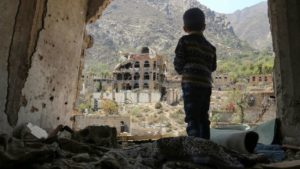
Yemen is a young country struggling through many internal problems. A civil war began in 2015 between the Yemeni government, with backing from Saudi Arabia, and the Houthi rebels. Now, it has become a conflict involving international leaders and is one of the worst humanitarian crises in the last 100 years. This is partly due to the mass exploitation of Yemeni child soldiers. It is very difficult to discover the exact number of recruited children due to the fluid roles of children, associated with family shame and fear. However, numbers ranged from about 3,000 to 50,000 children as of 2019.
Growing Up
Many Yemeni child soldiers have faced unfathomable hardships even before fighting. They have been constantly fleeing their homes to avoid airstrikes and war zones. Because of this, 3.4 million children are out of school and many are trying to earn the little money they can like Salah, who is about 11, and whose family cannot afford meals every day. Starvation and disease-ridden camps have been the way of life for thousands of families since the war began five years ago.
Conversely, schools recruit children in regions with access to education through “indoctrination” from lectures. The Houthi movement’s founder gives these lectures and transcribes them into booklets known as “Malazem.” During this, children as young as 10 view graphic images of the war and others who have died for the cause. This encourages them to do the same. A mother told the Group of Experts, a partition of the U.N. Human Rights Council, that she fears for her son’s future. She also said that such practices are prevalent across the region.
Recruitment also occurs in surrounding countries like Sudan, a country also struggling from domestic conflicts. Approached at 14, Hager Shomo Ahmed had received an offer of $10,000 in exchange for his service in the war. Like many children, this was dire for his family, as they became penniless after others stole their cattle.
Persuaded and desperate for food, purpose and money, thousands of children like these entered the war.
During the War
From both the Saudi-led coalition and Houthi rebels, many Yemeni child soldiers went to the front lines. More than 1,000 have been coerced to fight.
Some dragged bodies from the field (sometimes even their own family), others would do kitchen services and others trained to use rifles. Naji, Younis and Saleh, Yemeni child soldiers who were around 11 and 13 at the time, recounted stories like these. A Saudi rehabilitation center that has helped about 400 boys has created a safe space for these stories.
A psychiatrist at a Marib rehabilitation center, Mayoub al-Makhlafi, says children have suffered as fighters and servants. Staffers recount children’s descriptions of experiencing beatings and sexual abuse from their own commanders.
Many, promised with money and non-combatant roles, find themselves in traffickers’ hands and training camps. Some are sent to patrol checkpoints 12 hours a day. Others are the first to be dispatched as human bodyguards. The young foot soldiers have no other option since they are lured with knowledge of a steady income sent home or depicted as martyrs.
The war has killed over 2,000 Yemeni child soldiers, as UNICEF reported in 2018. However, due to poor access to Yemen and limited data collection, these numbers are could be much higher.
Surviving After
Younis and his mother, Samira, shared the nightmares he used to have about the Houthis taking him again and how his mother would comfort him back to sleep.
In Dhamar, Yemen, a teacher places a photograph on desks of 14 former students during the Week of the Martyr, a celebration that the Houthi government enforces to continue its propaganda about the honor of fighting. The children, mostly fifth and sixth graders, mourn their friends. Those who do not die find themselves in displacement camps, like 14-year-old Morsal. Like many of his comrades, Morsal suffers from panic attacks, aggressive behavior and hearing loss from airstrikes and explosions.
Fifteen-year-old Mohammad’s father, Ali Hameed, details a time before the war and how his son had started working after graduating high school. He sadly continued to when his son left to join the Saudi coalition and then went missing. Some of the boys from Mohammad’s unit were able to flee and return home and the Houthis captured others. Mohammad was not part of either group.
Others like Hager, who had lost 180 men in his unit, were able to return home. By earning some money for his service, he was able to buy his family 10 cattle to restore their livelihood.
Relief Efforts
Coping with such traumatic events is extremely difficult for adults. However, the horrors are greater for children. Fortunately, The Wethaq Foundation for Civil Orientation developed eight rehabilitation centers across Yemen. As of 2019, it has helped 2,000 Yemeni child soldiers in psychological support and children’s rights education.
Internationally, the Child Protection and Children Friendly Spaces programs, initiatives of UNICEF, have given over 600,000 children psychosocial support through individual counseling, reading, cooperative games and family reunification, as of 2018 in Yemen.
Victim assistance is another crucial sector for children who have lost limbs. Such assistance is possible through Prosthesis and Rehabilitation centers in Yemen for children with disabilities as a result of the war. These centers receive support from the International Committee of the Red Cross. In just 2019, they have been able to provide over 1.1 million Yemenis emergency care in 18 hospitals that the IRC supports, and given food, essential home supplies, cash grants and access to clean water to 5.7 million Yemenis.
Broadly focused groups like War Child, working in North and South Yemen, have offered assistance to more than 30,000 children and families. War Child provides psychosocial support through coping mechanisms for trauma, recreational activities and legal support to enable school enrollment. Through school restoration and cash assistance to families, it is able to provide better futures for children.
Supporting these groups and others, vital for long-term recovery, is essential to nurturing the Yemeni child soldiers who have fallen victim to this waging war and the millions of civilians in the entire region suffering from starvation, displacement and great loss.
– Mizla Shrestha
Photo: Flickr

Top 5 Commercials Taking on Poverty
Advertising, a multibillion-dollar industry, is one of the most prominent ways to spread information. The average American watches 16 minutes of commercials in every hour of television watched. When commercials shine a light on global poverty, more viewers will aspire to help the cause. Here are 5 commercials taking on poverty:
Unsung Hero by Thai Life Insurance
Thailand requires all children within the country to enroll in school. However, 14% of secondary school-aged children are not enrolled in school. The story begins with a benevolent man who lives a humble life giving back. He donates money daily to a family begging for money to send their daughter to school and does random kind deeds for several members of his community. As the community’s happiness grows, the man realizes that the daughter of the family has gone. He soon comes to realize that, with his donations, she now can attend school. Thai Life Insurance is a Christian insurance company dedicated to making people happier.
Giving by TrueMove
The commercial follows the life of an owner of a street food stand. In the beginning, a poor boy gets caught stealing medicine from a neighboring stall. The street stand owner pays for his stolen goods and gives him a bag of soup for his sick mother. Decades later, the man passes out and is extremely ill. The hospital fee comes back and the family isn’t able to afford it. A few days later, the family finds out that the little boy from the beginning is now a neurosurgeon and paid all the hospital bills. Although Thailand provides its citizens with universal healthcare, low-income families still cannot afford some hospital treatment fees. TrueMove is one of the leading mobile providers in Thailand, spreading the message, “Giving is the best communication.”
If London Were Syria by Save the Children
Among the 70.8 million displaced people, 31 million are children. Conflicts force children out of their homes and into international waters in search of safety. With war, terrorists, human trafficking and the additional threat of racism, Syrians and other displaced people face many humanitarian issues everywhere. The award-winning advertisement by Save The Children has almost 65 million views on YouTube, spreading empathy into millions of hearts. The film follows a young girl throughout the span of a year, from comfortable living to displaced. She undergoes near-death experiences and the loss of members of her family, spotlighting the hardships of a refugee.
Make a Change by Hyundai Philippines
This commercial by Hyundai Philippines overviewed the life of a blind beggar. At first, the beggar did not receive many donations, and every passerby ignored him. A man came along and reworded the sign, raising the number of donations. After a while, the beggar asked the man what he changed to the board. The new quote said, “It’s a beautiful day, but I can’t see it.” The touching story raises awareness about 19.8% of people living under the poverty line in the Philippines.
You Can Save Her by Magic Bus
This commercial begins with one high-class girl seeing a girl in poverty. The poor girl was in worn-out clothes and barefoot, working intensive labor for her abusive father. She strolls around her village, introducing facts about Indian children in poverty. Although child marriage has been illegal since 1929, a quarter of girls in India are married off before the age of 18. India houses 30% of the world’s children living in extreme poverty. Magic Bus is an Indian organization sponsoring Indian children throughout their lives. They send children to school and help them integrate into society, preventing immoral marriages and abuse.
Through these commercials taking on poverty, viewers realize the impact of global poverty on the world, encouraging them to act on their emotions. With donations from millions of viewers, organizations can reduce the number of people in poverty.
– Zoe Chao
Photo: Flickr
Water Disparities in Nigeria
The Problem of Water Contamination
Adriel Garrick, who grew up in Nigeria, knows about water inequality. Garrick told The Borgen Project that “When [she] was young [she] had a friend diagnosed with Typhoid,” an infection that drinking contaminated drinking water or food causes. She also said that “[Her] friend did not know he was drinking polluted water, and he was in the hospital for about three weeks, then later passed away.”
Death from water contamination is not unusual. According to the CIA’s World Factbook, as of 2015, 42.7% of Nigeria’s rural population and 19.2% of its urban population lacked clean, reliable drinking water. Diarrheal diseases, usually from contaminated drinking water, are the fifth leading cause of death in Nigeria.
Nigeria’s rural population is in a worse situation than the urban population for one reason: wealth. Wealth is a massive determinant of who gets clean drinking water there.
Water Supply System in Nigeria
According to Chidozie Nnaji, a researcher at the University of Nigeria, Nigeria does not treat drinking water as a social right. “The government provides water for the highly placed and charges them peanuts, but the same gesture is hardly extended to the generality of the masses who have to provide (purchase) their own water,” Nnaji told The Borgen Project. “Water is perceived as a social right for the highly placed, but as an economic good for the rest of the people. What an irony!”
Nigeria has a privatized water supply, contributing to disparities between the access of the wealthy and the poor. “Privatized water supply in developing countries is known for little infrastructure investments, neglecting low-income areas, and prioritizing profit over service quality,” Ismaila Rimi Abubakar, an associate professor at the University of Dammam, told The Borgen Project.
Not only can privatized water add to economic disparities, but it is also often unhealthy. Water vending is not a sustainable solution, according to Abubakar.
“Water vending is supposed to be a stop-gap solution to water outages or for households not yet connected to piped water supply,” said Abubakar. “Water vendors have now become the primary source of water for numerous households, . . . they should not be allowed as a long-term solution. . . . Water vendors and packaged water are expensive and not free from contamination.”
UNICEF’s Solution to Clean Water
The United Nations Children’s Fund has been working with the Nigerian government since 2005 to implement the Water, Sanitation and Hygiene (WASH) program. The program aims to provide clean water to all of Nigeria and implement hygiene education and sanitation facilities. WaterAid is a global federation of nonprofits. It has an initiative working with the Nigerian government to provide clean water and sanitation to families who need it most.
Safe, clean water is a necessity for all people, not a privilege. Given the disparities in access to clean water in different economic sectors, it is clear that Nigeria is experiencing a crisis that will not be resolved until the country as a whole is able to claim clean water and the physical health that depends upon this resource as an essential human right.
– Sophia Gardner
Photo: Flickr
3 Aspects of Inequality in Colombia
In Colombia, the issue of income inequality is undeniable. Income inequality is present largely due to income distribution and poverty. The Colombian government proposed reforms for economic and social aspects. However, the reforms only benefitted businesses, leaving behind the working class, indigenous groups, young people, women and ethnic groups. In recent years, the divide between the rich and poor has become more noticeable.
3 Aspects of Inequality in Colombia
Looking to the Future
One nonprofit organization and NGO that is working to eliminate inequality in Colombia is the Pintando Caminos Asociación Para Recrear el Futuro. This NGO has worked for 12 years to improve the lives of children by providing opportunities to children in oppressed and impoverished areas, such as Bogota, Colombia. Bogota is known for its slums, the conditions of which the government overlooks, allowing cartels to easily control the area. This creates a cycle of poverty. This organization is trying to break that cycle by providing aid and necessary tools to allow children to succeed without inequality holding them back. So far, they have raised over $43,781 and have helped 140 children.
Due to the inequality in Colombia, only 10% of the population succeeds, whereas the rest are struggling from the unlivable wages and working conditions. This inequality differently affects the working class or low-income workers, as well as those who are most vulnerable in society: children.
Photo: Flickr
UPS Transports COVID-19 Relief Across the Globe
As the COVID-19 pandemic surges around the globe, world leaders are trying their best to help their people by providing masks, personal protection equipment (PPE), testing kits and treatment for the disease. However, who transports and delivers these items? That responsibility goes to logistics firms. These firms are responsible for shipping and handling items, including healthcare necessities such as PPE, testing kits and medicine. The United Parcel Service (UPS) is one such company that has been doing an outstanding job providing such logistics globally. Its main focus, however, is providing logistics to the least developed countries in their fight against COVID-19. UPS is at the frontlines using its resources to help the poor in receiving COVID-19 relief and essential healthcare supplies to fight this pandemic.
COVID-19 Relief Efforts
UPS has been at the frontlines at the fight against COVID-19 since February 2020 during the early stages of the pandemic. The company transported medical supplies—2 million masks, 11,000 protective suits and 280,000 pairs of medical gloves—to China free of cost in February. This action provided Chinese health clinics and hospitals the resources they needed at a faster rate.
The logistics company has also partnered with the drone delivery service Zipline to provide blood bags, medicine, vaccines and healthcare equipment to remote regions in Rwanda and Ghana. It has completed about 44,900 flights throughout the pandemic. This has helped Ghana and Rwanda receive life-saving medication, assistance and other equipment in short amounts of time. Such supply chain innovation systems have put UPS at the center of the logistics scene in providing essential supplies to developing countries.
Making Sure Vaccines Are Available for All
UPS is also partnering with Gavi, The Vaccine Alliance. The partnership is working to ensure that unvaccinated individuals receive the COVID-19 vaccine upon development. UPS subsidiary company Marken specializes in supply chain logistics for healthcare, science and clinical supplies. Marken is preparing for providing transportation and logistics for the COVID-19 vaccines when they are available. The company believes that if it keeps transportation and resources ready, delivering vaccines will be faster and easier, especially to developing regions.
UPS has also committed to donating $3 million to provide free medical supplies and automated stock management systems to Uganda. UPS will soon help the country receive vaccines at a faster and efficient rate.
A Humanitarian Foundation
UPS has a separate nonprofit organization called the UPS Foundation. It focuses on providing humanitarian relief, environmental sustainability and inclusiveness within communities. UPS is at the frontlines in disaster response and humanitarian aid throughout the globe. The UPS Foundation assists many countries during disasters. The COVID-19 pandemic has mobilized the foundation to continue its work in struggling countries. The UPS Foundation invested about $20 million in disaster relief just last year in 2019 and has given U.N. agencies at least $6 million in grants to fight against COVID-19.
UPS and its humanitarian foundation has been essential in the fight against COVID-19. The private business works to improve the lives of those in need and continues to do so in the face of this pandemic.
– Sadat Tashin
Photo: Flickr
The Lives of Yemeni Child Soldiers
Yemen is a young country struggling through many internal problems. A civil war began in 2015 between the Yemeni government, with backing from Saudi Arabia, and the Houthi rebels. Now, it has become a conflict involving international leaders and is one of the worst humanitarian crises in the last 100 years. This is partly due to the mass exploitation of Yemeni child soldiers. It is very difficult to discover the exact number of recruited children due to the fluid roles of children, associated with family shame and fear. However, numbers ranged from about 3,000 to 50,000 children as of 2019.
Growing Up
Many Yemeni child soldiers have faced unfathomable hardships even before fighting. They have been constantly fleeing their homes to avoid airstrikes and war zones. Because of this, 3.4 million children are out of school and many are trying to earn the little money they can like Salah, who is about 11, and whose family cannot afford meals every day. Starvation and disease-ridden camps have been the way of life for thousands of families since the war began five years ago.
Conversely, schools recruit children in regions with access to education through “indoctrination” from lectures. The Houthi movement’s founder gives these lectures and transcribes them into booklets known as “Malazem.” During this, children as young as 10 view graphic images of the war and others who have died for the cause. This encourages them to do the same. A mother told the Group of Experts, a partition of the U.N. Human Rights Council, that she fears for her son’s future. She also said that such practices are prevalent across the region.
Recruitment also occurs in surrounding countries like Sudan, a country also struggling from domestic conflicts. Approached at 14, Hager Shomo Ahmed had received an offer of $10,000 in exchange for his service in the war. Like many children, this was dire for his family, as they became penniless after others stole their cattle.
Persuaded and desperate for food, purpose and money, thousands of children like these entered the war.
During the War
From both the Saudi-led coalition and Houthi rebels, many Yemeni child soldiers went to the front lines. More than 1,000 have been coerced to fight.
Some dragged bodies from the field (sometimes even their own family), others would do kitchen services and others trained to use rifles. Naji, Younis and Saleh, Yemeni child soldiers who were around 11 and 13 at the time, recounted stories like these. A Saudi rehabilitation center that has helped about 400 boys has created a safe space for these stories.
A psychiatrist at a Marib rehabilitation center, Mayoub al-Makhlafi, says children have suffered as fighters and servants. Staffers recount children’s descriptions of experiencing beatings and sexual abuse from their own commanders.
Many, promised with money and non-combatant roles, find themselves in traffickers’ hands and training camps. Some are sent to patrol checkpoints 12 hours a day. Others are the first to be dispatched as human bodyguards. The young foot soldiers have no other option since they are lured with knowledge of a steady income sent home or depicted as martyrs.
The war has killed over 2,000 Yemeni child soldiers, as UNICEF reported in 2018. However, due to poor access to Yemen and limited data collection, these numbers are could be much higher.
Surviving After
Younis and his mother, Samira, shared the nightmares he used to have about the Houthis taking him again and how his mother would comfort him back to sleep.
In Dhamar, Yemen, a teacher places a photograph on desks of 14 former students during the Week of the Martyr, a celebration that the Houthi government enforces to continue its propaganda about the honor of fighting. The children, mostly fifth and sixth graders, mourn their friends. Those who do not die find themselves in displacement camps, like 14-year-old Morsal. Like many of his comrades, Morsal suffers from panic attacks, aggressive behavior and hearing loss from airstrikes and explosions.
Fifteen-year-old Mohammad’s father, Ali Hameed, details a time before the war and how his son had started working after graduating high school. He sadly continued to when his son left to join the Saudi coalition and then went missing. Some of the boys from Mohammad’s unit were able to flee and return home and the Houthis captured others. Mohammad was not part of either group.
Others like Hager, who had lost 180 men in his unit, were able to return home. By earning some money for his service, he was able to buy his family 10 cattle to restore their livelihood.
Relief Efforts
Coping with such traumatic events is extremely difficult for adults. However, the horrors are greater for children. Fortunately, The Wethaq Foundation for Civil Orientation developed eight rehabilitation centers across Yemen. As of 2019, it has helped 2,000 Yemeni child soldiers in psychological support and children’s rights education.
Internationally, the Child Protection and Children Friendly Spaces programs, initiatives of UNICEF, have given over 600,000 children psychosocial support through individual counseling, reading, cooperative games and family reunification, as of 2018 in Yemen.
Victim assistance is another crucial sector for children who have lost limbs. Such assistance is possible through Prosthesis and Rehabilitation centers in Yemen for children with disabilities as a result of the war. These centers receive support from the International Committee of the Red Cross. In just 2019, they have been able to provide over 1.1 million Yemenis emergency care in 18 hospitals that the IRC supports, and given food, essential home supplies, cash grants and access to clean water to 5.7 million Yemenis.
Broadly focused groups like War Child, working in North and South Yemen, have offered assistance to more than 30,000 children and families. War Child provides psychosocial support through coping mechanisms for trauma, recreational activities and legal support to enable school enrollment. Through school restoration and cash assistance to families, it is able to provide better futures for children.
Supporting these groups and others, vital for long-term recovery, is essential to nurturing the Yemeni child soldiers who have fallen victim to this waging war and the millions of civilians in the entire region suffering from starvation, displacement and great loss.
– Mizla Shrestha
Photo: Flickr
Addressing 3 Civil Rights Issues in Cuba
For years, Cubans have experienced severe restrictions in their ability to exercise freedom of speech. While they do not have the same First Amendment liberties as in the United States, Cubans are fiercely fighting for their rights to expression, speech and access to online opinion articles. Change is steadily emerging for Cubans, but the process has been slow. Here are three civil rights issues in Cuba.
3 Civil Rights Issues in Cuba
Involving NGOs
Acknowledging Cuban citizens’ need for support in securing their civil liberties, United States organizations have begun to intervene. For example, The Global Rules of Law & Liberty Legal Defense Fund (GLA) in Alexandria, Virginia is a legal defense fund assisting citizens who cannot afford legal guidance. The GLA had total revenue of $92,400 in 2018, enabling this NGO to provide legal resources like local councils and political information to communities within multiple Latin American countries including Cuba. By enhancing resources for Cuba’s legal system and due process, actions from groups like the GLA could become significant in helping Cubans secure freedom of expression.
The GLA has helped Cuban journalists like Roberto de Jesus Quiñones Haces, who is serving a one-year sentence for charges of “resistance” and “disobedience,” according to the global liberty alliance. He was arrested for reporting the prosecution of Pastors Rigal and Exposito, who were homeschooling their children in Guantanamo. The GLA recognized this arrest as persecution of the press and agreed to support Quiñones, increasing national awareness of his unjust prosecution by filing a Request for Precautionary Measures with the Inter-American Commission on Human Rights and publishing a video documenting his story. Since the beginning of his jail time in September 2019, Quiñones and the immorality of persecuting the press have gained widespread attention in both the United States and Cuban legal systems.
Another United States NGO advocating for civil rights in Cuba is Plantados until Freedom and Democracy in Cuba in Miami, Florida. By providing aid to Cubans imprisoned for expressing support for democracy, this organization aims to support freedom and democracy in an environment where these fundamental liberties are largely ignored.
The Future of Civil Rights in Cuba
Thoroughly addressing these three civil rights issues in Cuba could help Cubans finally gain freedoms that democratic nations around the world enjoy. As several United States NGOs have demonstrated, actions like simply sharing news and advocating for change have the potential to encourage progress. In doing so, Cuba has the power to become a model for other developing countries in the fight for civil liberties.
– Grant Ritchey
Photo: Flickr
3 Bahamian Charities Combating COVID-19
3 Bahamian Charities Combating COVID-19
Between natural disasters, a pandemic and pre-existing struggles with poverty, the Bahamas undoubtedly have several unique challenges left to work through. However, with continued support from passionate Bahamian charities, there is promise for the nation to repair itself in the near future.
– Katrina Robinson
Photo: Flickr
Maternal Healthcare in Algeria: 4 Facts Everyone Should Know
Algeria, a large country in North Africa, bordering the Mediterranean Sea. The country is known for its rich history and culture, as well as its scorching temperatures. Like many nations in Africa, Algeria struggles to combat maternal mortality – a long-standing, persistent issue for many women in the country. However, in the last several years, Algeria has taken numerous steps to expand maternal healthcare and reduce pregnancy and labor complications. Here are four facts about maternal healthcare in Algeria.
4 Facts About Maternal Healthcare in Algeria
A Leader in Maternal Healthcare
Much work remains in order for Algeria to be able to effectively put an end to preventable, maternal deaths. However, the measures put into practice within the last several years have already proven to be a success. Thanks to these policies, Algeria has become known as a leader in maternal healthcare in North Africa and the country continues to build a strong momentum and infrastructure to fight this problem.
– Shreeya Sharma
Photo: Flickr
Intra African Trade and the AfCFTA
Uniting 54 countries in the African Union, The African Continental Free Trade Agreement (AfCFTA) will create the largest free trade area in the world since the World Trade Organization formed in 1994. The implementation of the treaty was originally supposed to occur on July 1, 2020, but was postponed due to COVID-19 restrictions. Over 1.3 billion people with a cumulative GDP of $3.4 trillion will come together to further economic expansion. This effort will push Africa into a competitive spot in the global economy. The treaty outlines a reduction of tariff restrictions and of non-tariff barriers (NTBs) as well as a trade facilitation agreement (TFA). The AfCFTA will make vast improvements in catching intra-African trade up with the numbers of the rest of the world.
Currently, continental exports across Africa clock in at about 19% of total exports, comparatively lower to intra-Asian and intra-Europe exports which make up around 60% of their total exports. AfCFTA looks to encourage a higher level of intra-African trade by cutting all tariffs between countries in the zone by 2035, expected to increase intracontinental exports by more than 81%, as stated by the World Trade Organization in its 2020 report. According to CNBC, this could mean a $2.8 billion per year rise in net income in the area.
Overall, the UN Economic Commission for Africa expects African trade to increase from 15% to 25% by 2040, translating to a GDP growth of over $2 trillion. Expectations also determine that intra-African trade will encourage globalization and technology advances. Africa’s adoption of e-commerce and other electronic advantages into its economy will further those goals.
Poverty Reduction Effects
AfCFTA projects that an additional 30 million people will emerge out of extreme poverty, reducing the headcount ratio without the deal from 10.9% to 9.3% with it. The World Trade Organization also expects that 67.9 million will rise out of moderate poverty by 2035. The largest change in income will be for unskilled workers and women. Still, most social groups will see a 10% increase in income.
A key factor in poverty reduction is the growth of industries, which creates new jobs. Energy-intensive manufacturing will grow as African trade and other markets develop. Total exports related to the manufacturing industry should rise by 110% in intra-African trade and by 46% worldwide. The production of the manufacturing industry will see a $56 billion increase. As a result, a number of countries are looking to provide larger foreign direct investments to the continent.
Growth in the agricultural sector will work alongside manufacturing to pull people out of poverty. The AfCFTA will cause the industry to see a loss of $8 billion. However, agricultural employment will see a rise in 60% of the countries involved in the deal. Expectations determine that agricultural exports (only second to manufacturing) will grow 49% in intracontinental trade and 10% in worldwide trade.
Overall income will also grow as a result of the AfCFTA. A higher quality of life will close the gender gap and the gap between skilled and unskilled workers. The full implementation of AfCFTA could cause a 7% growth in real income ($450 billion) by 2035. Still, it is important to note that this growth will not occur equally over all the countries involved.
Mitigation of COVID-19 Economic Effects
Due to COVID-19, the implementation of the AfCFTA terms is on hold indefinitely. Officials expect to start again Jan 1, 2021 but are unable to continue negotiations at this time. Poor internet connections and language barriers amongst different officials also pose challenges. Nevertheless, the AfCFTA will act as a stimulus plan for countries in the region that lack economic or fiscal means to distribute a large relief package.
While economic growth has been steadily increasing at about 2.4% in 2019, the World Bank expects it to drop from anywhere between -2.1% to -5.1% in 2020. This means a loss of between $37 billion to $79 billion during 2020. The economic drops could cause less food security as food prices rise in many areas.
The losses come from a combination of sources. Shutdowns reduced exports and imports, and many African countries are reluctant to open borders. The shutdowns caused welfare losses of up to 14%. In addition, reduced tourism and commodity prices have taken their toll.
Connecting Countries
The AfCFTA will look to open up borders between African countries in order to encourage free trade once again. As a larger market, African countries can obtain necessary medical instruments and food resources at a cheaper price. The agreement will double or triple exports in Cameroon, the Arab Republic of Egypt, Ghana, Morocco and Tunisia. The countries will see the largest benefits, although almost all of the other countries will see growth.
The introduction of AfCFTA will shift the global marketplace significantly. China has been the center of manufacturing in recent years, but there may be a shift to Africa, as China’s investment in the signing of the AfCFTA has shown. Major powers, such as the U.S., European Union and India, have shown an increased interest in African foreign development as they see the rise in this cohesive market. Although COVID has taken its hit on the world, the AfCFTA might encourage a quick bounce back, lifting millions out of poverty and increasing jobs for many.
– Nitya Marimuthu
Photo: Flickr
5 Things to Know About COVID-19 in Taiwan
5 Things About COVID-19 in Taiwan
Although Taiwan is close to China and has a population of nearly 23 million, it has done remarkably well in its response to COVID-19. As of July 30, 2020, there have been 467 positive cases and just seven deaths reported. This translates to 20 cases of COVID-19 per one million people living in Taiwan.
In an effort to help citizens locate where they can purchase masks, more than 1,000 Taiwanese software developers created applications to help citizens understand where masks were available. In early March there were “59 map systems, 21 line applications, three chatbots, 23 mask sales location search systems, 22 apps, five audio systems, two information-sharing systems and one online mask reservation system.”
Wearing a mask in public to prevent the spread of COVID-19 was an early practice in countries like Taiwan. Prior to the rise of the pandemic, Taiwanese manufacturers were producing 1.88 million to 2.44 million face masks per day. In an effort to ensure masks were available to those who needed them, the Government of Taiwan banned the export of masks on January 24, 2020.
During the 2003 SARS outbreak, Taiwan had a robust contact tracing and quarantine system, border and travel regulations, a SARS advisory committee and training on infection control. Although these efforts were initially effective, Taiwan ultimately reported 668 probable cases of SARS. As a result of the severity of the SARS outbreak in the country, Taiwan stepped in quickly with stricter policies to slow the spread of COVID-19 by hosting virtual lectures about COVID-19, implementing travel restrictions, prohibiting large events and quarantine and isolation measures.
Because Taiwan has been able to successfully control the spread of the COVID-19 pandemic, many aspects of daily life have resumed. After approximately three consecutive weeks of no community spread, the Taiwanese Baseball League became the first in the world to allow spectators and fans back into games. On May 8, 2020, the professional baseball league allowed 1,000 fans into their scheduled games to spectate.
As a result of its swift and effective response to COVID-19, Taiwan has been able to return to a semblance of normalcy. Taiwan’s success stems from the government’s quick action, technological assistance as well as hard lessons learned from the SARS pandemic. In light of all the above, it comes as no surprise that Taiwan’s response to COVID-19 ranks as one of the world’s best.
– Maddi Miller
Photo: Flickr